Patron: Her Majesty The Queen
Rothamsted Research
Harpenden, Herts, AL5 2JQ
Telephone: +44 (0)1582 763133
Web: http://www.rothamsted.ac.uk/
Rothamsted Research is a Company Limited by Guarantee Registered Office: as above. Registered in England No. 2393175. Registered Charity No. 802038. VAT No. 197 4201 51. Founded in 1843 by John Bennet Lawes.
Rothamsted Repository Download
A - Papers appearing in refereed journals
Srivastava, A., Mohan, S., Mauchline, T. H. and Davies, K. G. 2019.
Evidence for diversifying selection of genetic regions of encoding putative
collagen-like host-adhesive fibers in Pasteuria penetrans . FEMS
Microbiology Ecology. 95 (1), p. fiy217.
The publisher's version can be accessed at:
•
https://dx.doi.org/10.1093/femsec/fiy217
The output can be accessed at:
https://repository.rothamsted.ac.uk/item/95y02/evidence-for-diversifying-selection-of-
genetic-regions-of-encoding-putative-collagen-like-host-adhesive-fibers-in-pasteuria-penetrans
.
© 30 October 2018, CC-BY terms apply
doi: 10.1093/femsec/fiy217
Advance Access Publication Date: 30 October 2018 Research Article
R E S E A R C H A R T I C L E
Evidence for diversifying selection of genetic regions
of encoding putative collagen-like host-adhesive fibers
in
Pasteuria penetrans
Arohi Srivastava
1
, Sharad Mohan
2
, Tim H. Mauchline
3
and Keith
G. Davies
1
,
4
,
*
1
Department of Biological and Environmental Sciences, University of Hertfordshire, Hatfield, AL10 9AB, UK,
2
Division of Nematology, Indian Agricultural Research Institute, Pusa Campus, New Delhi 110012, India,
3
Department of AgroEcology, Rothamsted Research, Harpenden, AL5 2JQ, UK and
4Division of Biotechnology
and Plant Health, Norwegian Institute of Bioeconomy Research, Postboks 115, ˚As-1431, Norway
∗Corresponding author:Keith G Davies, Department of Biological and Environmental Sciences, University of Hertfordshire, Hatfield, AL10 9AB, UK. E-mail:[email protected]
One sentence summary:Collagen-like genes that are expressed on the surface of spores are hypothesised to have been obtained by horizontal gene transfer and are involved in the spores’ adhesion to nematode cuticle.
Editor:Rolf K ¨ummerli
ABSTRACT
Pasteuriaspp. belong to a group of genetically diverse endospore-forming bacteria (phylum: Firmicutes) that are known to parasitize plant-parasitic nematodes and water fleas (Daphniaspp.). Collagen-like fibres form the nap on the surface of endospores and the genes encoding these sequences have been hypothesised to be involved in the adhesion of the endospores ofPasteuriaspp. to their hosts. We report a group of 17 unique collagen-like genes putatively encoded by
Pasteuria penetrans(strain: Res148) that formed five different phylogenetic clusters and suggest that collagen-like proteins are an important source of genetic diversity in animal pathogenic Firmicutes includingPasteuria.Additionally, and unexpectedly, we identified a putative collagen-like sequence which had a very different sequence structure to the other collagen-like proteins but was similar to the protein sequences in Megaviruses that are involved in host-parasite interactions. We, therefore, suggest that these diverse endospore surface proteins inPasteuriaare involved in biological functions, such as cellular adhesion; however, they are not of monophyletic origin and were possibly obtainedde novoby mutation or possibly through selection acting upon several historic horizontal gene transfer events.
Keywords:BclA; hair-like nap; endospore; adhesion; bacterial collagens; pathogenicity
INTRODUCTION
Pasteuria penetrans is a parasite of root-knot nematodes (Meloidogyne spp). It is one of a number of species of Gram-positive bacteria that form endospores and has the potential to
be used as an environmentally benign biological control agent of plant-parasitic nematodes (Davies 2009; Davieset al.2018; Stirling2014). A major constraint in its use as a bio-pesticide is its restricted host range; one population ofP. penetranswill attach to and infect one population of root-knot nematode but
Received:31 May 2018;Accepted:29 October 2018
C
FEMS 2018. This is an Open Access article distributed under the terms of the Creative Commons Attribution License
(http://creativecommons.org/licenses/by/4.0/), which permits unrestricted reuse, distribution, and reproduction in any medium, provided the original work is properly cited.
1
2 FEMS Microbiology Ecology, 2019, Vol. 95, No. 1
not another (Stirling1985; Davies, Kerry and Fylnn1988; Espanol
et al.1997). The taxonomy of thePasteuriagroup of bacteria is confused; this is because of its obligate nature and early char-acterisation had to rely on an isolate’s biology; essentially, its life-cycle, morphology and in particular, its host range. However, molecular techniques, including genomics and proteomics, are today playing an increasingly important and crucial role in char-acterising its diversity.
Currently, three species ofPasteuriahave been characterised that parasitize plant-parasitic nematodes: namelyP. penetrans
(Sayre and Starr1985) on hosts ofMeloidogyne spp.;Pasteuria nishizawae(Sayreet al.1991) on hosts of cyst nematodes Het-erodera and Globodera spp.; Pasteuria thornei (Starr and Sayre 1988) on hosts ofPratylenchus,and onePasteuria ramosa (Metch-nikoff 1888) that is a parasite of Cladocerans such as Daph-nia, the water flea. Two other hyperparasites of plant-parasitic nematode species have been characterised and given Candida-tusstatus:Pasteuria usgaeisolated fromBelonolaimus longicauda-tus(Giblin-Daviset al.2003) andP. aldrichii(Giblin-Daviset al.
2011) onBursillaspp. (Stackebrandt2014). Two other populations ofPasteuriahave been characterised, P. hartismerei,a parasite ofMeloidogyne ardenensisandPasteuria goettingianae, a parasite ofHeterodera goettingianabut these names, according to Stacke-brandt (2014) are invalid.
Early molecular methods ofPasteuriacharacterisation tended to focus on using 16S rRNA genes to differentiate species and populations (Sturhan 1988; Andersonet al. 1999; Duanet al.
2003). Interestingly, a closely related population ofPasteuria iso-lated from an Indian plant-parasitic cyst nematodeHeterodera cajanipopulation (Sharma and Davies1996) has recently been shown to be more promiscuous; endospores of this particu-larPasteuriapopulation attach to and infect not only the orig-inal cyst nematode host,H. cajani, but also nematodes from the genusGlobodera(Mohanet al.2012); more recent results using 16S rRNA showed that it was closely related toP. nishizawaewith 98.6% base-pair similarity whilst endospores of P. nishizawae
fromHeterodera glycines(soya bean cyst nematode) also adhered to a range of cyst nematodes, includingHeterodera espedezaei
(Lespedezae cyst nematode),Heterodera schachtii(sugar beet cyst nematode),H. trifolii(clover cyst nematode) andGlobodera ros-tochiensis(potato cyst nematode), but unlike theH. cajani popu-lation ofPasteuriafrom India,they neither infected nor complete their life cycle in any nematode other thanH. glycines(Sayreet al.
1991; Atibalentja, Jakstys and Noel2004; Noel, Atibalentja and Domier2005). It would, therefore, appear that the relatedness of thesePasteuriafromH. cajaniandH glycines,as constructed with 16S rRNA, does not reflect host range. This is consistent with endospore attachment studies of root-knot nematodes where adhesion was not linked to nematode phylogeny (Davieset al.
2001).
Ribosomal RNA (16S rRNA) was used for the reconstruction of the ‘tree of life’ (Woese 1987) and it has been universally accepted as a tool for phylogenetic reconstruction and classifi-cation of prokaryotes. Apart from the known conservation of 16S rRNA at the level of nucleotide sequences and secondary struc-tures, the classical concept presumed that these genes do not undergo horizontal gene transfer (HGT) events. However, sev-eral studies report the horizontal transfer of segments of this gene and advocate the need for alternative methods to avoid misidentification and interpretation of discordant phylogenies (Eardly, Wang and Van Berkum1996; Yap, Zhang and Wang1999; Schouls, Schot and Jacobs2003; Rajendhran and Gunasekaran 2011). Protein-coding housekeeping genes may have advantages over ribosomal RNA genes and a multilocus protein sequence
approach, using 25 or more housekeeping genes translated from a genome survey sequence of strain RES147, produced a robust bacterial phylogeny that suggested thePasteuriagenus was ancestral toBacillus(Charleset al.2005); additionally, sin-gle nucleotide polymorphisms in protein-encoding genes pro-vided increased phylogenetic discrimination than using 16S rRNA sequences (Mauchlineet al.2011).
Although these protein-coding genes may be more useful in determining the phylogenetic relatedness ofPasteuriabetween closely related Firmicutes than 16S RNA, they are unlikely to relate in any meaningful manner to host-range and pathogenic-ity.
Another protein-encoding gene with potentially the ability to characterise endospore-forming Firmicutes that have been found in animal parasitic bacteria isbclA. This gene, originally characterised inBacillus anthracis,is expressed during the final stages of endospore formation and produces a collagen-like pro-tein (CLP) on the surface of the endospore’s exosporium which forms a hair-like nap (Sylvestre, Mock and Couture-Tosi2002; Steichen et al. 2003; Sylvestre, Couture-Tosi and Mock 2003; Toddet al.2003). Genome survey sequences ofP. penetranshave revealed that they too contain collagen-like genes (Davies and Opperman2006) and it has been hypothesised that the expres-sion of these collagen-like genes produces a similar hair-like nap on the surface of thePasteuriaendospore that is involved in aVelcro-like attachment process (Davies2009). More recently, a large family of polymorphic collagen-like genes have been described inP. ramosa, the endospore-forming parasite of Daph-niaspp. (Moutonet al.2009; McElroyet al.2011) and they are pos-sibly involved in the interaction betweenP. ramosaand its Daph-niahost (Luijckxet al.2011; Luijckxet al.2013).
As attachment ofP. penetransendospores to nematodes has been shown to be unrelated to nematode phylogeny (Davies
et al.2001) we would hypothesise that the phylogenetic relat-edness using protein-encoding house-keeping genes ofP. pene-transwould be very different from the phylogenetic relatedness described by a protein involved in a key aspect of pathogenicity like endospore adhesion to its potential host. The present inves-tigation usesin-silicocomparative bioinformatics to look at the phylogenetic relatedness betweenP. penetransand other selected closely related Firmicutes based on their 16S rRNA phylogeny and to compare this to the phylogenetic trees using the low-complexity collagen-like repeat regions.
MATERIALS AND METHODS
Search for protein sequences coding for putative collagens inPasteuria
Collagen-like genes were predicted in unpublished contigs forPasteuria Res148 isolate, a related but host-selected sub-population, of Res147 (Mauchlineet.2011).
Gene predictions were done using the RAST annotation web server (Azizet al.2008) and the annotations were searched for any predicted collagen-like sequences based on the comparison of contig annotations with the sequenced genome of a closely related Firmicute,Bacillus thuringiensisAl Hakam. To look for any collagen-like sequences not predicted by RAST, the contigs were uploaded on to Artemis genome browser and annotation tool (Carveret al.2012) and were manually searched for open reading frames containing ‘G-X-Y’ triplet amino acid repeats using the ‘navigator’ feature of Artemis (Rutherfordet al.2000) (Rutherford
et al.2000). The sequences were further tested for the presence
of collagen-like motifs using MOTIF search tool of GenomeNet web server Kanehisaet al.(2002).
Comparison of CL sequences inPasteuriaand other collagens
To search for similar sequences in other organisms, the putative
Pasteuriacollagens were used as query sequences for BLASTp searches targeting non-redundant (nr) protein database. The low complexity filter was turned on for these searches to avoid any random hits to low complex G-X-Y repeats of collagens. BLASTp hits with significantly low E-values ranging from 0 to 2e−128 were pooled together. The G-X-Y repeat regions of selected puta-tive CLPs (File I,Supporting Information) were analysed for the diversity in their percentage amino acid composition. The G-X-Y repeat regions were extracted from the sequences and a cus-tomised script was written inR(R Development Core Team2010) to do the following analyses. The Manhattan distance (Kauf-man and Rousseeuw1990) between the percentage amino acid compositions for all possible pairs of sequences was computed. The resulting distance matrix was subjected to an agglomerative hierarchical clustering method using hclust function (Murtagh and Legendre2011). The heatmap.2 function of gplots package in R (http://cran.r-project.org/web/packages/gplots/index.html) was used to generate a heatmap representation of the Manhat-tan disManhat-tances between the percentage amino acid composition of the G-X-Y repeat regions of different collagen-like sequences. The custom R-script used for generating the heatmap can be found in the supplementary material (File II,Supporting Infor-mation for the script).
Conventional molecular phylogenetic tree based on 16S rRNA
The publicly available 16S rRNA sequences of the cladoceran parasiticP. ramosaand nematode parasiticPasteuriaspp. were compared with selected 16S rRNA sequences of Clostridium
spp.,Paenibacillusspp. andPelosinusspp. and three major ani-mal pathogenicBacillus spp. (B. anthracis, B. thuringiensisand
B. cereus) and the non-pathogenic Bacillus subtilis. Cyanobac-terial species includingMicrocystis elabens,Arthrospira platensis,
Cyanobium gracileand/orGloeothecespp. were used as outgroups. The list of accession numbers of sequences used in the analy-ses can be found in the File III, Table I (Supporting Information) linked to this article (see).
As a standard comparator a phylogenetic tree was con-structed using the classic 16S rRNA gene sequences in MEGA7 (Kumar, Stecher and Tamura2016) using the Maximum Like-lihood method based on Tamura-Nei model and JTT matrix-based model for nucleic acid and protein sequences respec-tively (Jones, Taylor and Thornton1992; Tamura and Nei1993). The initial tree was made using BioNJ algorithm (Gascuel1997). The bootstrap consensus tree was inferred from 500 replicates (Felsenstein1985).
RESULTS
Molecular phylogeny based on the 16S rRNA gene
The phylogenetic tree with the highest log likelihood (-11 556.6217) is shown in Fig. 1a. The analysis involved 33 nucleotide sequences. There was a total of 1821 positions in the final dataset. The 16S rRNA gene sequences from all the five-analysed species of the genus Pasteuria, including the
cladoceran parasite P. ramosa, clustered together with high bootstrap support (100%). Pasteuria spp. were observed to be more closely related to Clostridiumspp. thanBacillus species. However, their close-relatedness withClostridiumspp. was sup-ported with a low bootstrap value of only 58%. All theBacillus
spp. and Paenibacillus spp. were grouped together supported by a high bootstrap value. The pathogenic Bacillusspp. i.e.B. cereus,B. thuringiensisandB. anthraciswere separated from the non-pathogenB. subtiliswith 100% support. In 95% of the tree replicates,Pelosinusspp. was separately grouped as an outgroup with the cyanobacteria.
Putative collagen-like proteins inPasteuria
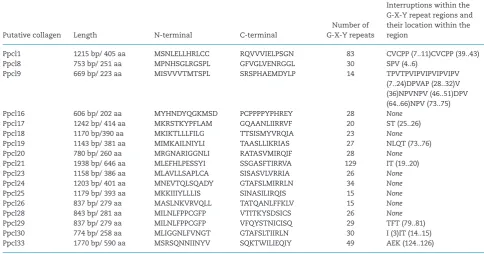
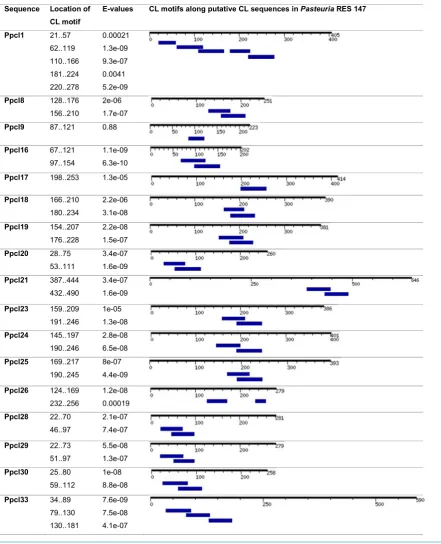
Using the sequence-based comparison tool of RAST, 17 puta-tive collagen coding genes were identified in different con-tigs obtained from the sequencing of PasteuriaRes148. Using a manual search, further 16 open reading frames contain-ing G-X-Y repeat regions were found. These sequences (33 in total) were named as Ppcl for ‘Pasteuria penetrans collagen-like sequences’ and were numbered as Ppcl1 to Ppcl33. Out of these, 23 sequences were unique and intact (i.e. started with a start codon and ended with a stop codon). To confirm that these sequences are related to the collagen superfamily, these sequences were searched for collagen motifs in MOTIF search. Only 17 of these sequences hit the Pfam: collagen family and were considered as the putative CLPs in P. penetrans Res148 (Tables1and2). These 17 Ppcl sequences were selected for fur-ther analyses. The G-X-Y repeat regions in some of these puta-tive sequences were interrupted with one or more amino acids, while G-X-Y repeats in eight of the sequences were uninter-rupted. See File I (Supporting Information) for the nucleic acid sequences of the 17-selected putative CLPs inP. penetransRes148.
CL sequences similar toPasteuriaPpcl sequences
In the BLASTp searches using putative CL sequences fromP. pen-etrans, significant matches were found to Ppcl23, Ppcl25, Ppcl26 and Ppcl33. Ppcl23 hit CL sequences fromBacillusspp. (98 hits)
Clostridium arbusti (1 hit) and Sediminibacillus albus(1 hit); all hits were in the E-value range of 0.008 to 3e−08. Ppcl25 had 108 BLASTp hits (E-value≤1e−07) fromBacillusspp. (96 hits),
Paeni-bacillusspp. (7 hits),Clostridiumspp. (4 hits),Pithovirus sibericum
(1 hit). All the hits to Ppcl23 and Ppcl25 were in the CTDs of the sequences (query cover:≤43% for Ppcl23;≤49% for Ppcl25). Ppcl26 hit CL proteins from a range of bacterial genera includ-ing Clostridiumspp.,Ruminococcus torques,Fusicatenibacterspp.,
Eisenbergiella spp.,Desulfotomaculum spp.,Lachnospiraceaespp.,
Eubacterium dolichum,Blautia producta,Bifidobacteriumspp., Lac-tonifactor longoviformis,Epulopisciumspp.,Bacteroides gallinarum,
Parabacteroides spp.,Methanobrevibacter spp., Lactobacillusspp.,
Flavonifractor plautii,Leuconostocspp.,Veillonella dispar,Prevotella
spp. tc2–28. The topmost hits were for proteins from Clostrid-ium spp. that had ≥90% query cover and very low E-values ≤1e−62. Ppcl33 showed sequence similarity withMegavirusesand
Ruminococcusspp. (E-value: 0 to 2e−128; as high as 99% identity for 77% query cover).
Characterisation of the low-complex G-X-Y repeat region
Of all the significant BLASTp hits to the Ppcl sequences, 52 CL sequences, which showed better query coverage and also had significantly low E-values (in the range of 0 to 2e−128), were
4 FEMS Microbiology Ecology, 2019, Vol. 95, No. 1
Figure 1.Molecular phylogeny ofPasteuria(A) The bootstrap consensus tree based on 16S rRNA gene sequences reconstructed using the Maximum Likelihood method. Numbers shown next to the branches are the percentage of replicate trees in which the associated taxa clustered together in the bootstrap test (500 replicates). Only bootstrap values 70% are shown. (B) Heatmap reconstructed using the cluster analysis of G-X-Y repeat regions of Ppcl sequences ofP. penetrans, Pcl sequences ofP. ramosaand other selected CLPs based on the percentage amino acid composition of the low complex G-X-Y repeat regions.
Table 1.List of 17 putative CLPs in P. penetrans Res148 (File I, Supporting Information for the complete sequences).
Putative collagen Length N-terminal C-terminal
Number of G-X-Y repeats
Interruptions within the G-X-Y repeat regions and their location within the region
Ppcl1 1215 bp/ 405 aa MSNLELLHRLCC RQVVVIELPSGN 83 CVCPP (7..11)CVCPP (39..43) Ppcl8 753 bp/ 251 aa MPNHSGLRGSPL GFVGLVENRGGL 30 SPV (4..6)
Ppcl9 669 bp/ 223 aa MISVVVTMTSPL SRSPHAEMDYLP 14 TPVTPVIPVIPVIPVIPV (7..24)DPVAP (28..32)V (36)NPVNPV (46..51)DPV (64..66)NPV (73..75) Ppcl16 606 bp/ 202 aa MYHNDYQGKMSD PCPPPPYPHREY 28 None
Ppcl17 1242 bp/ 414 aa MKRSTKYPFLAM GQAANLIIRRVF 20 ST (25..26) Ppcl18 1170 bp/390 aa MKIKTLLLFILG TTSISMYVRQIA 23 None
Ppcl19 1143 bp/ 381 aa MIMKAILNIYLI TAASLLIKRIAS 27 NLQT (73..76) Ppcl20 780 bp/ 260 aa MRGNARIGGNLI RATASVMIRQIF 28 None
Ppcl21 1938 bp/ 646 aa MLEFHLPESSYI SSGASFTIRRVA 129 IT (19..20) Ppcl23 1158 bp/ 386 aa MLAVLLSAPLCA SISASVLVRRIA 26 None
Ppcl24 1203 bp/ 401 aa MNEVTQLSQADY GTAFSLMIRRLN 34 None
Ppcl25 1179 bp/ 393 aa MKKIIIYLLLIS SINASILIRQIS 15 None
Ppcl26 837 bp/ 279 aa MASLNKVRVQLL TATQANLFFKLV 15 None
Ppcl28 843 bp/ 281 aa MILNLFPPCGFP VTITKYSDSICS 26 None
Ppcl29 837 bp/ 279 aa MILNLFPPCGFP VFQYSTNICISQ 29 TFT (79..81) Ppcl30 774 bp/ 258 aa MLIGGNLFVNGT GTAFSLTIIRLN 30 I (3)IT (14..15) Ppcl33 1770 bp/ 590 aa MSRSQNNIINYV SQKTWILIEQIY 49 AEK (124..126)
Table 2.CL motifs in putative collagen-like sequences inP. penetransRes148. CL motifs were predicted by GenomeNet MOTIF using the Pfam database. The location of each CL motif within the sequence is shown along with the E-value for each motif.
selected for further analysis, along with 37 previously charac-terised CL sequences fromP. ramosa, the BclA and ExsJ protein sequences fromB. anthracisandB. cereus.See File III, Table II (Supporting Information) for the list of accession numbers of the CLP sequences selected for the comparative studies with
PasteuriaPpcl sequences. A total of 108 sequences including 17 Ppcl sequences were analysed for the percentage amino acid composition of the G-X-Y repeat regions. It was evident that
after Glycine (G), Threonine (T) is the most commonly occurring amino acid, followed by Proline (P). However, other amino acids like Alanine (A) and Valine (V) also occur. The heatmap gener-ated by the hierarchical clustering of the G-X-Y repeat regions is shown in Fig.1b. The tree splits the sequences categorically into nine clusters.
The Ppcl sequences fromP. penetranswere spread across five clusters (Cluster 3, 4, 5, 6, 7, 9). Ppcl28 and Ppcl29 clustered
6 FEMS Microbiology Ecology, 2019, Vol. 95, No. 1
together (Cluster 3) with other collagen-like sequences fromP. ramosa (Pcl28, Pcl17, Pcl8, Pcl18, Pcl32, Pcl30),Clostridiumspp. (Clos12),B. thuringiensis(Bt4) and the BclA protein ofB. anthracis.
Ppcl26 was placed in Cluster 4 along with six collagen-like sequences fromClostridium(Clos10, Clos8, Clos7, Clos6, Clos4) and one sequence each fromFusicateniacter(Fusica), Ruminococ-cus(Rumino1),Eisenbergiella(Eisen),Eubacterium(Eubac), Lach-nospiraceae (Lachno) and Desulfotomaculum (Desulfo). Ppcl23, Ppcl20, Ppcl18, Ppcl17, Ppcl24, Ppcl30, Ppcl21, Ppcl19 and Ppcl25 along with a sequence fromProtochlamydia(Proto) formed Clus-ter 5 which was the clusClus-ter with the largest number ofP. pene-transsequences. Ppcl1 clustered (Cluster 6) with fourP. ramosa
sequences Pcl4, Pcl3, Pcl35, Pcl5), two Clostridium sequences (Clos1, Clos5) and one sequence each fromBacillusspp. (B.LL01),
Paenibacillus(Paeni3) andPithovirus(Pitho).Ppcl33 most uniquely clustered, in Cluster 7, with all the seven Megavirus sequences that were used in the study along with two sequences fromP. ramosa(Pcl1, Pcl2), one sequence fromClostridiumspp. (Clos11) and oneRuminococcussequence (Rumino2). Members of Cluster 7 were unique because they all had Lysine (K) and Aspartic acid (D) as the most occurring amino acid after Glycine. Ppcl8, Ppcl9 and Ppcl16 were separately clustered as Cluster 9. Most of the
P. ramosasequences (25 out of 37) clustered together in Clus-ter 1 with oneClostridiumsequence (Clos3). Cluster 2 consisted of elevenBacillussequences (Bc2, B.JH7, Bt3, B.wied, Bt2, Bc6, Bc3, Bc5, B.weihen1, B.weihen2, Bc1) with one sequence each of
Clostridiumspp. (Clos2) andP. ramosa(Pcl29). Cluster 8 consisted of eight, three and one sequences of Bacillusspp., Paenibacil-lusspp. andSediminibacillusspp. (B.amylo1, B.velez, B.safensis1, B.amylo2, B.pumilus1, B.pumilus2, Bc.ExsJ, B.acidicola, Paeni4, Paeni2, Paeni1, Sedimini). See File III, Table I (Supporting Infor-mation) for the codes used for the CLP sequences for different organisms.
DISCUSSION
The diversity of CLPs inP. penetransRes148
The adhesive role of CLPs in thePasteuria-nematode interac-tion has been hypothesised for a long time (Davies and Danks 1993; Mohan, Fould and Davies2001; Davies and Opperman2006; Davies2009). This hypothesis was built on the knowledge that the endospores of many Gram-positive bacteria are covered with a hair-like nap, the fibers of which are constructed of glyco-proteins containing X-Y repeat sequences, the number of G-X-Y repeats contributing to the length of the fibers (Sylvestre
et al.2003; Davies and Opperman2006). While a diverse set of CLPs in the cladoceran parasiteP. ramosahave been identified and characterised, the CLPs ofP. penetransand other nematode parasitic Pasteuriaspecies remain unexplored. Here, we iden-tify putative genes coding for CLPs in the genome of a highly host-selected isolate ofP. penetrans(designated Res148). From a set of unpublished contigs, we predict 17 unique collagen-like sequences of which four putative CLPs (Ppcl23, Ppcl25, Ppcl26 and Ppcl33) were shown to have statistically significant similar-ities with 52 CLPs sequences from 22 different bacterial species and two groups of viruses. A cluster analysis of these sequences along with selected previously characterised CL sequences from
P. ramosa and the BclA and ExsJ protein sequences from B. anthracisandB. cereussuggested that the CLPs in P. penetrans
are extensively diverse. Since low complexity regions in proteins are more prone to non-erroneous replication slippage (DePristo, Zilversmit and Hartl2006; Rad ´o-Trilla and Alb `a2012; Zilversmit
et al.2010) and are thereby susceptible to rapid evolution, these
results suggest that the Ppcl sequences and their predicted homologs are evolutionary linked and they possibly evolved to serve similar biological functions. When compared with the phylogenetic diversity analyses using universal 16S rRNA gene, the cluster analysis of the G-X-Y repeat regions of CLPs suggest the latter to be an important source of variation and diversity on which evolution can act amongstPasteuriaspp. and other closely related pathogenic Firmicutes.
Incongruencies in the phylogenetic resolutionPasteuria
spp.
Preliminary studies had shown slight incongruences in the phy-logenies estimated from different genesgyrB,groEL,spo0Aand there was an observed phylogenetic biasedness between the trees based on the nucleic acid and amino acid sequences. This is likely because proteins are under different selective constraints due to their functional roles and are likely to be conserved over geological timescales (Huynen and Bork1998; Romero and Arnold2009). Biasedness in the phylogenetic res-olution ofPasteuriaspp.using CLPs suggests a real biological phenomenon more than just an artefact. One such known phe-nomenon could be due to incomplete lineage sorting, where a specific gene phylogeny is not congruent with the species phy-logeny due to the evolutionary time-based selection pressures on different parts of a given genome (Degnan and Rosenberg 2006; Maddison and Knowles2006). It is quite possible that this selection pressure did not allow the convergence of ancestries of individual genes ofPasteuriaspp. to their overall observed phy-logeny. Another phenomenon known to contributed to phyloge-netic tree discordance is HGT which is known to facilitate bacte-rial diversity and plays a major role in bactebacte-rial evolution (Dutta and Pan2002; Philippe and Douady2003; Maddison and Knowles 2006). HGT events are also known to be an important source of ecological variances between closely related taxa (Cohan and Koeppel2008; Wiedenbeck and Cohan2011).
Since the nematode parasitic bacteria form a shared habitat with other soil-inhabiting bacteria, and HGT events between dif-ferent species of soil bacteria is well-documented (Andrewset al.
2018), we suggest that these soil bacteria share a common gene pool, and therefore, they may have obtained these collagen-like sequences through HGT.
Interestingly, our results show an unanticipated sequence similarity of Ppcl33 with CLPs from Megaviridae. The mem-bers of the Megaviridae family are giant viruses (0.7μm) that are known to infect protozoans in aquatic ecosystems. They have relatively large genomes (≥1.2 Mbp) which are predicted to encode more than a thousand protein coding genes includ-ing metabolic genes not found in any other viruses (Arslanet al.
2011; Colsonet al. 2012; Legendreet al. 2012); they also pos-sess hair-like structures on their capsids that are thought to be involved in adhesion and infection of their hosts. It has been postulated that Megaviruses acquired a large set of genes from bacteria during the course of their evolution through HGT (Fil ´ee, Siguier and Chandler2007). The fact that P. ramosais a bac-terial endosymbiont of water fleas implies that bothP. ramosa
and Megaviruses possibly share the same ecological niche i.e. aquatic ecosystem and might support the view that HGT had occurred. However, our analysis did not identify any putative Megavirus CLPs in P. ramosa as might be expected. The CLP Ppcl33 was dissimilar to any other of the bacterial CLPs which
suggests a totally different phylogenetic origin. In total, our anal-ysis revealed five clusters of CLPs which would, therefore, sug-gest that the CLPs inPasteuriaare certainly not of a monophyletic origin; they therefore could have arisende novothrough muta-tion and subsequent selecmuta-tion, or more speculatively through selection acting upon G-X-Y repeats that had been acquired through several historic HGT events.
SUPPLEMENTARY DATA
Supplementary data are available atFEMSEConline.
FUNDING
The authors would like to thank Indian Council for Agricultural Research for their support to AS as an ICAR International Fellow-ship and British Council for partial support of this work through their UKIERI grant DST-2013–14/059.
Conflicts of interest. None declared.
ACKNOWLEDGEMENTS
This research forms a part of the PhD thesis of AS carried out at the University of Hertfordshire.
REFERENCES
Anderson J, Preston J, Dickson Det al.Phylogenetic analysis of
Pasteuria penetransby 16S rRNA gene cloning and sequencing.
J Nematol1999;31:319.
Andrews M, De Meyer S, James Eet al.Horizontal transfer of symbiosis genes within and between rhizobial genera: occur-rence and importance.Genes2018;9:321.
Arslan D, Legendre M, Seltzer Vet al.Distant Mimivirus relative with a larger genome highlights the fundamental features of Megaviridae.Proc Natl Acad Sci2011;108:17486–91.
Atibalentja N, Jakstys B, Noel G. Life cycle, ultrastructure, and host specificity of the North American isolate of Pas-teuriathat parasitizes the soybean cyst nematode,Heterodera glycines.J Nematol2004;36:171.
Aziz RK., Bartels D, Best AAet al.The RAST Server: rapid annota-tions using subsystems technology.BMC Genomics2008;9:75. Carver T, Harris SR, Berriman M et al. Artemis: an inte-grated platform for visualization and analysis of high-throughput sequence-based experimental data. Bioinformat-ics2012;28:464–9.
Charles L, Carbone I, Davies KGet al.Phylogenetic analysis of
Pasteuria penetransby use of multiple genetic loci.J Bacteriol
2005;187:5700–8.
Cohan FM, Koeppel AF. The origins of ecological diversity in prokaryotes.Curr Biol2008;18:R1024–34.
Colson P, De Lamballerie X, Fournous Get al.Reclassification of giant viruses composing a fourth domain of life in the new order Megavirales.Intervirology2012;55:321–32.
Davies KG. Understanding the interaction between an obligate hyperparasitic bacterium,Pasteuria penetransand its obligate plant-parasitic nematode host, Meloidogyne spp.Adv Para-sitol2009;68:211–45.
Davies KG, Danks C. Carbohydrate/protein interactions between the cuticle of infective juveniles of Meloidogyne incognita and spores of the obligate hyperparasitePasteuria penetrans.
Nematologica1993;39:54–64.
Davies KG, Fargette M, Balla G et al. Cuticle heterogeneity as exhibited by Pasteuria spore attachment is not linked to the phylogeny of parthenogenetic root-knot nematodes (Meloidogyne spp.).Parasitology2001;122:111–20.
Davies KG, Hallmann J, Mohan S. Biological Control. In: Perry RN, Moens M, Jones JT . (ed.).Cyst Nematodes. Wallingford: CABI; 2018, 237–70.
Davies KG, Kerry BR, Flynn CA. Observations on the pathogenic-ity ofPasteuria penetrans, a parasite of root-knot nematodes.
Ann Appl Biol1988;112:491–501.
Davies KG, Opperman CH. A potential role for collagen in the attachment ofPasteuria penetransto nematode cuticle. Multi-trophic Interactions in Soil: IOBC/wprs Bulletin2006;29:11–15. Degnan JH, Rosenberg NA. Discordance of species trees with
their most likely gene trees.PLoS Genet2006;2:e68.
DePristo MA, Zilversmit MM, Hartl DL. On the abundance, amino acid composition, and evolutionary dynamics of low-complexity regions in proteins.Gene2006;378:19–30. Duan Y, Castro H, Hewlett Tet al.Detection and characterization
of Pasteuria 16S rRNA gene sequences from nematodes and soils.Int J Syst Evol Microbiol2003;53:105–12.
Dutta C, Pan A. Horizontal gene transfer and bacterial diversity.
J Biosci2002;27:27–33.
Eardly B, Wang FS, Van-Berkum P. Corresponding 16S rRNA gene segments in Rhizobiaceae and Aeromonas yield discordant phylogenies.Current Issues in Symbiotic Nitrogen Fixation, In. Elkan, RG. (eds). Springer, Dordrecht. 1996;69–74.
Espanol M, Verdejo-Lucas S, Davies K et al. Compatibility betweenPasteuria penetransisolates and Meloidogyne popu-lations from Spain.Biocon Sci Technol1997;7:219–30.
Felsenstein J. Confidence limits on phylogenies: an approach using the bootstrap.Evolution1985;39:783–91.
Fil ´ee J, Siguier P, Chandler M. I am what I eat and I eat what I am: acquisition of bacterial genes by giant viruses.Trends Genet2007;23:10–15.
Gascuel O. BIONJ: an improved version of the NJ algorithm based on a simple model of sequence data.Mol Biol Evol
1997;14:685–95.
Giblin-Davis RM, Nong G, Preston JF et al. ‘Candidatus Pas-teuria aldrichii’, an obligate endoparasite of the bacterivorous nematode Bursilla.Int J Syst Evol Microbiol2011;61:2073–80. Giblin-Davis RM, Williams DS, Bekal Set al.‘CandidatusPasteuria
usgae’sp. nov., an obligate endoparasite of the phytoparasitic nematodeBelonolaimus longicaudatus.Int J Syst Evol Microbiol
2003;53:197–200.
Huynen MA, Bork P. Measuring genome evolution.Proc Natl Acad Sci1998;95:5849–56.
Jones DT, Taylor WR, Thornton JM. The rapid generation of mutation data matrices from protein sequences.Comp Appl Biosci CABIOS1992;8:275–82.
Kanehisa M, Goto S, Kawashima Set al.The KEGG databases at GenomeNet.Nucleic Acids Res2002;30:42–46.
Kaufman L, Rousseeuw PJ. Partitioning around medoids (pro-gram pam). In:Finding Groups in Data: An Introduction to Cluster Analysis, John Wiley, New York. 1990, 68–125.
Kumar S, Stecher G, Tamura K. MEGA7: molecular Evolutionary Genetics Analysis version 7.0 for bigger datasets.Mol Biol Evol
2016;33:1870–4.
Legendre M, Arslan D, Abergel Cet al.Genomics of Megavirus and the elusive fourth domain of Life.Commun Integr Biol
2012;5:102–6.
Luijckx P, Ben-Ami F, Mouton L et al. Cloning of the uncul-turable parasite Pasteuria ramosa and its Daphnia host
8 FEMS Microbiology Ecology, 2019, Vol. 95, No. 1
reveals extreme genotype–genotype interactions.Ecol Letters
2011;14:125–31.
Luijckx P, Fienberg H, Duneau Det al.A matching-allele model explains host resistance to parasites.Curr Biol2013;23:1085– 8.
Maddison WP, Knowles LL. Inferring phylogeny despite incom-plete lineage sorting.Syst Biol2006;55:21–30.
Mauchline TH, Knox R, Mohan S et al. Identification of new single nucleotide polymorphism-based markers for inter-and intraspecies discrimination of obligate bacterial para-sites (Pasteuriaspp.) of invertebrates.Appl Environ Microbiol
2011;77:6388–94.
McElroy K, Mouton L, Du Pasquier Let al.Characterisation of a large family of polymorphic collagen-like proteins in the endospore-forming bacteriumPasteuria ramosa.Res Microbiol
2011;162:701–14.
Metchnikoff E.Pasteuria ramosaun repr ´esentant des bact ´eries `a division longitudinale. Annales de l’Institut Pasteur (Paris)
1888;2:165–70.
Mohan S, Fould S, Davies KG. The interaction between the gelatin-binding domain of fibronectin and the attachment of
Pasteuria penetransendospores to nematode cuticle. Parasitol-ogy2001;123:271–6.
Mohan S, Mauchline TH, Rowe Jet al. Pasteuriaendospores from
Heterodera cajani(Nematoda: Heteroderidae) exhibit inverted attachment and altered germination in cross-infection stud-ies withGlobodera pallida(Nematoda: Heteroderidae).FEMS Microbiol Ecol2012;79:675–84.
Mouton L, Traunecker E, McElroy Ket al.Identification of a poly-morphic collagen-like protein in the crustacean bacteria Pas-teuria ramosa.Res Microbiol2009;160:792–9.
Murtagh F, Legendre P. Ward’s hierarchical clustering method: clustering criterion and agglomerative algorithm, J Class. 2014;31:274–295.
Noel GR, Atibalentja N, Domier LL. Emended description of Pas-teuria nishizawae.Int J Syst Evol Microbiol2005;55:1681–5. Philippe H, Douady CJ. Horizontal gene transfer and
phylogenet-ics.Curr Opi Microbiol2003;6:498–505.
R Developement Core Team.R: A Language and Environment for Statistical Computing. Vienna: R Foundation for Statistical Computing, 2010, Retrieved fromhttp://www.R-project.org Rad ´o-Trilla N, Alb `a M. Dissecting the role of low-complexity
regions in the evolution of vertebrate proteins.BMC Evol Biol
2012;12:155.
Rajendhran J, Gunasekaran P. Microbial phylogeny and diversity: small subunit ribosomal RNA sequence analysis and beyond.
Microbiol Res2011;166:99–110.
Romero PA, Arnold FH. Exploring protein fitness landscapes by directed evolution.Nature Rev Mol Cell Biol2009;10:866–76. Rutherford K, Parkhill J, Crook Jet al.Artemis: sequence
visual-ization and annotation.Bioinformatics2000;16:944–5. Sayre R, Starr M. Pasteuria penetrans (ex Thome, 1940) nom.
rev., comb, n., sp. n., a mycelial and endospore-forming
bacterium parasitic in plant-parasitic nematodes. Proc Helminthol soc Washington1985;52:149–65.
Sayre R, Wergin W, Schmidt Jet al. Pasteuria nishizawaesp. nov., a mycelial and endospore-forming bacterium parasitic on cyst nematodes of genera Heterodera and Globodera.Res Microbiol
1991;142:551–64.
Schouls LM, Schot CS, Jacobs JA. Horizontal transfer of segments of the 16S rRNA genes between species of theS treptococcus anginosusgroup.J Bacteriol2003;185:7241–6.
Sharma S, Davies K. Characterisation ofPasteuriaisolated from
Heterodera cajaniusing morphology, pathology and serology of endospores.Syst Appl Microbiol1996;19:106–12.
Stackebrandt E. The Family Pasteuriaceae. The Prokaryotes. Springer. 2014, 281–4.
Starr M, Sayre R.Pasteuria thorneisp. nov. and Pasteuria pene-trans sensu stricto emend., mycelial and endospore-forming bacteria parasitic, respectively, on plant-parasitic nematodes of the genera Pratylenchus and Meloidogyne.Paper presented at the Annales de l’Institut Pasteur/Microbiologie1988;139:11–31. Steichen C, Chen P, Kearney JFet al.Identification of the immun-odominant protein and other proteins of theBacillus anthracis
exosporium.J Bacteriol2003;185:1903–10.
Stirling G. Host specificity ofPasteuria penetranswithin the genus Meloidogyne.Nematol1985;31:203–9.
Stirling G.Biological Control of Plant-parasitic Nematodes: Soil Ecosys-tem Management in Sustainable Agriculture. 2nd Edn. Walling-ford: CAB International, 2014, 304–41.
Sturhan D. New host and geographical records of nematode-parasitic bacteria of thePasteuria penetrans group.Nematol
1988;34:350–6.
Sylvestre P, Couture-Tosi E, Mock M. Polymorphism in the Collagen-Like Region of the Bacillus anthracis BclA Protein Leads to Variation in Exosporium Filament Length.J Bacteriol
2003;185:1555–63.
Sylvestre P, Mock M, Couture-Tosi E. A collagen-like surface gly-coprotein is a structural component of theBacillus anthracis
exosporium.Mol Microbiol2002;45:169–78.
Tamura K, Nei M. Estimation of the number of nucleotide sub-stitutions in the control region of mitochondrial DNA in humans and chimpanzees.Mol Biol Evol1993;10:512–26. Todd SJ, Moir AJG, Johnson MJet al.Genes ofBacillus cereusand
Bacillus anthracisEncoding Proteins of the Exosporium.J Bac-teriol2003;185:3373–8.
Wiedenbeck J, Cohan FM. Origins of bacterial diversity through horizontal genetic transfer and adaptation to new ecological niches.FEMS Microbiol Rev2011;35:957–76.
Woese CR. Bacterial evolution.Microbiol Rev1987;51:221. Yap WH, Zhang Z, Wang Y. Distinct types of rRNA operons exist
in the genome of the actinomyceteThermomonospora chro-mogena and evidence for horizontal transfer of an entire rRNA operon.J Bacteriol1999;181:5201–9.
Zilversmit MM, Volkman SK, DePristo MAet al.Low-complexity regions inPlasmodium falciparum: missing links in the evolu-tion of an extreme genome.Mol Biol Evol2010;27:2198–209.