EXPLORING DIFFERENT INFORMATION NEEDS IN
BUILDING INFORMATION MODELLING (BIM) USING
SOFT SYSTEMS METHODOLOGY (SSM)
Mohammad Mayouf1, Sharon Cox2 and David Boyd1
1 School of Birmingham School of Built Environment, CEBE Faculty, Birmingham City University, B4 7XG 2 School of Computing, Telecommunications and Network, CEBE Faculty, Birmingham City University, B4 7XG
Abstract
Managing information for construction projects has been a crucial task where information technology (IT) was employed to tackle this issue. Building information modelling (BIM) is considered to be the first truly global digital construction technology; it is a process that aims to inform and communicate project decisions through creating and using an intelligent 3D model. BIM is claimed to be an effective tool for information exchange, which involves digital representation of physical and functional characteristics of the building. However, the involvement of interdisciplinary stakeholders within a construction project implies different data requirement, thus various information needs. The complexity of information and data required to deliver this information in construction projects is an on-going issue, thus understanding the nature of this complexity is needed. This paper aims to investigate different information needs from multiple perspectives, and raise awareness towards data requirement that BIM can incorporate. CATWOE as one of the analytical tools of soft systems methodology (SSM) will be used to demonstrate different data requirement. The data is obtained using interviews conducted on facility management team and end-users from newly operated building. The paper concludes with a proposed road map suggesting different required data from design to operation. Further work is needed to check BIM capabilities in terms of integrating this data, and whether interoperability issues would require additional tools to support BIM process. This paper provides essential awareness towards information needed from BIM, thus resulting in a more productive building.
1.
Introduction
Conceptually, the term ‘information’ is considered to be ambiguous due to the variety of ways it can be interpreted or used (Buckland, 1991). In fact, humanity has been living and
experiencing various kinds of information since the era of 4th millennium BC (also called
is the purpose of this paper. Data are collected through interviews with the building design team, facility manager and end-users. An analytical tool ‘CATWOE’ based on soft systems methodology (SSM) will be used to analyse this data. The conclusion drawn from this analysis provides a more holistic view towards intangibles complexities using BIM, and open
allows more thorough view over the usefulness of BIM for buildings future.
2.
Literature Review
Building Information Modelling (BIM): A general overview
In construction world, there is a large amounts of information, which are generated during the building design process, and often time is wasted searching for, sharing and sometimes recreating information (Persson et al., 2009). Therefore, there was a need to establish a common data environment, which includes processes and procedures that enable reliable information exchange between project team members and other stakeholders (CIC and BIM Task Group, 2013). The advent of computer technology has supported a rapid, efficient development and management of building deliveries in the built environment; making it possible to organise complicated processes in the construction industry. BIM is known as the first truly global digital construction technology, which steadily becoming deployed in every country (HM Government, 2012). BIM is considered as a procedural and technological shift within Architecture, Engineering, Construction and Operations (Succar, 2009).
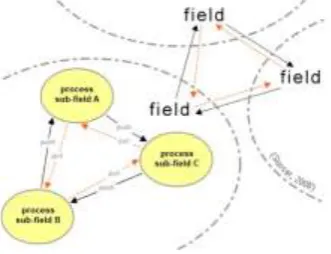
According to (Penttilä, 2006), BIM is defined as a set of interacting policies, processes and technologies generating a methodology, which aims to manage the essential building design and project data in digital format throughout the building’s life cycle. BIM can be seen as an evolution of Computer Aided Design (CAD) systems, but providing more interoperable and intelligent information (Aranda-Mena et al., 2009). In addition, (Aranda-Mena et al., 2009) pointed out that BIM is an ambiguous term, which can either be computed as a software application, process for designing and documenting building information, and finally a whole new approach that requires implementing new policies, contracts and relationships between stakeholders. However, with these variety of views, there is one central background for BIM, which is a product data models concerning the information of buildings (Björk, 1995). BIM facilitates a knowledge transfer platform between various interdisciplinary fields and sub-fields, and these knowledge transactions are called BIM interactions (Holsapple and Joshi, 2006). BIM interactions are expressed as push-pull mechanisms. Push mechanisms transfer knowledge to another field or sub-field while pull mechanisms transfer knowledge to satisfy request (see figure 1).
Construction Information: why BIM?
According to (Buckland, 1991), there are two traditional meaning for ‘information’: telling of something and that which is being told. Although these two meanings are overly simplistic, they represent an abstract picture of what (Floridi, 2010) has pointed out in his book
‘Information: A Very Short Introduction’ about the life cycle of information. He stated that
information go through several phases, which are: occurrence (designing), transmission (retrieving), processing and management (organising), and usage (analysing). Historically, information is communicated verbally between architects and different construction parties (Khatib et al., 2007). Today, the situation is radically different as architects apart from their primary design skills, they need to create and communicate information in a way that previous generations never had to (Race, 2012). From one side, architects have to be increasingly cautious in obtaining and filtering the information they require. Another side is the continual disposal of information caused by Internet (Race, 2012). Perhaps, construction is considered to be one of the heaviest information producing industry sectors; it involves so many parties contributing information.
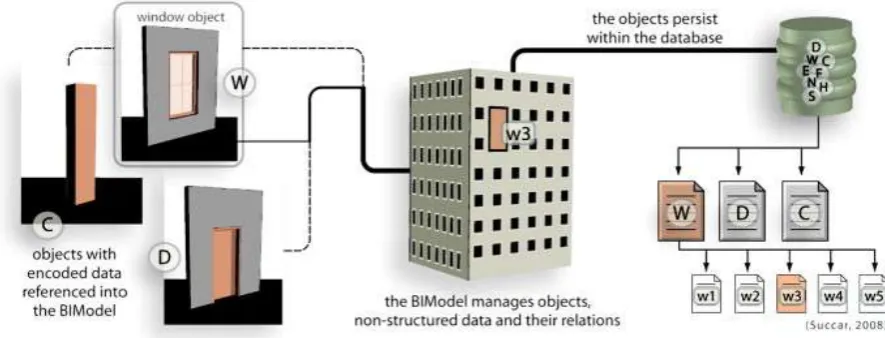
BIM represents an approach to create and manage information over the whole life cycle of a building (Liu et al., 2012). BIM is described as an information-centric software, providing information modelling, unlike CAD, which is building graphic modelling (Ibrahim and Krawczyk, 2003). BIM does not discriminate between the types of information that can be considered (Race, 2012). It supports the coordination of the following information: construction documentation, visualisation (design and construction), material and equipment quantities, cost estimates, 4-D construction sequencing and reporting, scheduling and fabricating data and tool paths (Garber, 2014). The operation of BIM is based on digital databases of building information, and by managing and storing these databases, BIM can capture and present data in ways that are appropriate for designers, contractors, client or vendors (Ibrahim and Krawczyk, 2003). (Succar, 2009) has described the data flows in BIM, which is considered as critical for BIM stakeholders. The data flows include the transfer of structured/computable (e.g. databases), semi-structured (e.g. spreadsheets) or non-structured/non-computable data (e.g. image). It is important to mention that data flows do not only include sending/receiving ‘semantically rich’ objects (the main components of BIM Models ‘smart objects’ see figure 2), but also sending and receiving of document-based information (Froese, 2003).
BIM: Information and stakeholders’ needs
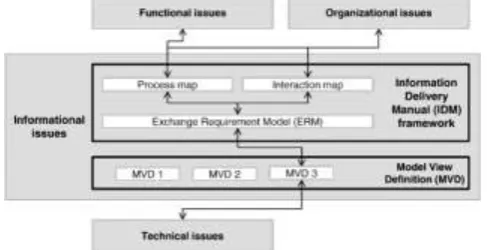
According to (Volk et al., 2014), BIM can be seen from two perspectives: narrow sense and broader sense (see figure 3). The narrow sense comprises of the digital building model itself as a central information management repository (Eastman et al., 2011). The broader sense covers a more holistic image looking at functional, informational, technical and organisational sides (see figure 3). Feasibly, depending on the stakeholders’ needs and project requirements, a BIM model is used to support and perform expert services for buildings (AIA, 2008). Potential applications (expert software) and required functionalities of BIM are needed to suit stakeholders’ and project’ needs (Volk et al., 2014).
There are two types of expert software, which might interact with BIM. The first type is data input applications providing services of import, data processing or captured data transformation. The second type is data output applications providing technical analysis and reports (Volk et al., 2014). On the other hand, functionalities are based on process maps, which define the logical view of information and activities, also defining stakeholders’ roles with a particular functionality (ISO Standard, 2010). These functionalities (e.g. quantity takeoff, cost calculation) are either inherent in BIM or attached to it as independent expert applications.
Figure 3: broader and narrow sense of BIM (Eastman et al., 2011)
Simultaneously, although BIM is spreading worldwide, stakeholders such as Facility managers and building owners are scarcely using BIM, and are not fully integrated in BIM development and implementation yet (Becerik-Gerber and Rice, 2010). This also includes building occupants (social aspect) and the way they interact with the building (technical aspecta), which forms a socio-technical system (Rüppel and Schatz, 2011). Focusing on integrating these parties in BIM development process, implies the need to consider information from multiple perspectives (Mayouf et al., 2014), but current applications do not support the integration of wide variety of information (Ding et al., 2014). Therefore, a multiple perspective insight into the different information needs BIM is necessary, and this do not only future of buildings, but also promotes collaboration at an early design stage to achieve more efficient buildings (Choi et al., 2011).
Figure 4: Information Delivery Manual (IDM) framework (ISO Standard, 2010).
3.
Methodology
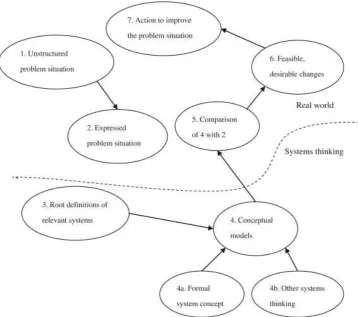
This research aims to investigate different information requirements in BIM from multiple perspectives. Soft systems approach has been used as a process of inquiry into a problematic situation, which acknowledges systemic complexity (Mehregan et al., 2012). SSM as a systems-based methodology is used to tackle real world problems; it enables the analyst to understand different perspectives on the situation. Moreover, it proposes a way to solve problems through learning rather the than replacement of the current situation (Checkland, 2000), and consists of seven stages (see figure 5)(Checkland, 1984). CATWOE as one of SSM’s analytical tools will be used to demonstrate different information requirements for multiple perspectives. Furthermore, CATWOE has helped to simplify complex situations and understand different actors’ perspectives and perceptions, and hence leading to a better description of the problem meant to be addressed (Vacik et al., 2014). To analyse the different information needs in BIM from multiple perspectives, a conceptual model will be developed using SSM. The analysis will be based on the results of the interviews with the building design team, facility management team and building occupants.
Figure 5: The seven stages of soft systems methodology (Checkland, 1984)
The first iteration process, which is developing the rich picture, was through conducting interviews with the parties mentioned before. It is important to mention that the involved parties are within the context of a newly constructed university building. The building design team involved four members: Project architect, Energy assessor, Project manager and BIM coordinator. The facility management team involved the facility manager and building services supervisor. Finally, there were three building occupants who are staff members. The scope of the interview questions has aimed to review their experience with buildings, what information they acquire in BIM and the role of this information to deliver an effective and productive building environment.
The second iteration process is developing the conceptual model using the rich model developed from the interviews conducted. The model is developed using both notes collected from interviews and existing literature. The conceptual model is meant to address a clearer image of the problematic nature of information needs in BIM. In addition, it will also show different interactions and processes among stakeholders.
4.
Results
Root definition CATWOE Analysis BIM Information:
Any information generated from BIM
Models, which can be in the form of graphics (2D plans, 3D models), reports (clash
detection, bill of quantities) or spreadsheets (cost analysis). These information are generated by project delivery team, which normally involve a team of designers and contractors (project engineers) where
information are coordinated and managed by the project’s BIM Manager (project
designer). The BIM model is normally generated during at the pre-tendering stage, but information required is generated at the pre-design and design stages and used throughout the process of project execution stage. The information are stored and
updated within the BIM central model, which consists of all building systems and also managed by the project’s BIM Manager. After building handover, information can be extracted from the BIM model to manage building assets and act as a key reference for both client and building’s operation manager and facility manager.
C: Customers:
Facility manager – Client – Building occupants.
A: Actors:
Building delivery team – Facility management team.
T: Transformation:
Building delivery team communicate information to client and facility
management team through project manager or director.
W: Weltanschauung:
Increasing building performance, support better operation and management for FMs and increase building occupants’ satisfaction.
O: Owner:
Building delivery team.
E: Environmental:
Financial support from client, capability of building delivery team to use different methods to incorporate multiple perspectives (FM’s and building occupants’
requirements).
Table 1: Root definition and CATWOE analysis.