Article
Phosphorus removal and carbon dioxide capture in a
pilot conventional septic system upgraded with a
sidestream steel slag filter
Dominique Claveau-Mallet 1,2,*, Hatim Seltani 1,3 and Yves Comeau 1
1 Department of Civil, Geological and Mining Engineering, Polytechnique Montréal, Montréal, Québec, Canada, H3C 3A7; [email protected]; [email protected]
2 Department of Chemical Engineering, McGill University, 3610 University Street, Montréal, Québec, Canada H3A 0C5
3 Bionest, 55, 12th Street, P.O. box 10070, Shawinigan, Québec, Canada G9T 5K7; [email protected] * Correspondence: [email protected]
Abstract: The objective of this work was to evaluate the removal of phosphorus and carbon dioxide capture of a conventional septic system upgraded with a sidestream steel slag filter used in recirculation mode. A pilot scale sidestream experiment was conducted with two septic tank and drainfield systems, one with and one without a sidestream slag filter. The experimental system was fed with real domestic wastewater. Recirculation ratios of 25%, 50% and 75% were tested. Limestone soils and silica soils were used as drainfield media. The phosphorus removal efficiency observed in the second compartment of the septic tank was 30% in the slag filter upgraded system, compared to -3% in the control system. The drainfield of silica soils achieved very high phosphorus removal in both control and upgraded systems. In the drainfield of limestone soil, the slag filtration reduced the groundwater phosphorus contamination load by up to 75%. Phosphorus removal in the septic tank with a slag filter was attributed to either sorption on newly precipitated calcium carbonate or precipitation of vivianite, or both. Recirculation ratio design criteria were proposed based on simulations. Simulations showed that the steel slag filter partly inhibited biological production of carbon dioxide in the septic tank. The influent alkalinity strongly influenced the recirculation ratio needed to raise the pH in the septic tank. The control septic tank produced carbon dioxide, whereas the slag filter upgraded septic tank was a carbon dioxide sink.
Keywords: Hydroxyapatite; calcite; vivianite; onsite wastewater treatment; PHREEQC; precipitation; groundwater contamination; septic tank; drainfield; reactive filter
1. Introduction
Conventional septic systems (e.g. a septic tank followed by a drainfield) are commonly employed in onsite and decentralized domestic wastewater treatment. The primary treatment by settling takes place in the septic tank, whereas the drainfield acts as a secondary treatment for biological carbon removal (Figure S1, Supplementary Materials). Drainfields are built using in situ soil when conditions are favorable regarding a minimum distance above the water table and a minimum hydraulic conductivity [1,2]. The seepage from the drainfield infiltrates to the underlying soil. A drainfield is a nonpoint source of contamination and is not subject to regular water quality monitoring. While drainfields are assumed to be efficient for carbon removal, they are not intended or designed for efficient nutrient removal and plumes of dissolved phosphorus have been observed in groundwater below several monitored drainfields [3]. In ecosystems where phosphorus is the limiting nutrient [4] such as in Quebec, Canada [5], drainfields contribute to eutrophication.
The general objective of this study is to propose a passive and simple upgrade of the phosphorus retention capacity of existing conventional septic systems. The proposed upgrade is based on the use of steel slag filters, which are made of by-products from the steel industry [6]. Slag filters are
economical, passive and efficient for phosphorus removal, which makes them appealing for decentralized treatment. Steel slag filters have been used for phosphorus removal in several pilot applications: secondary treatment of domestic wastewater [7] or dairy farm effluent [8], tertiary treatment of domestic wastewater [9], stormwater management [10] and lake remediation [11]. The main operational challenges for steel slag filters are exhaustion and clogging which require the occasional replacement of media [9] and the need for an additional treatment step for effluent neutralization. Steel slag filters achieve high phosphorus removal efficiency with reported total phosphorus (TP) at the effluent of wastewater treatment systems below 1 mg P/L [6,9,11].
The proposed upgrade consists in a barrel-shape steel slag filter in recirculation mode fed by the effluent of the second compartment of the septic tank. This was previously tested at bench scale with a reconstituted effluent [12] where a sidestream slag filter improved the TP retention capacity of a septic tank, with an effluent pH below 9.5. This configuration is promising for existing septic tanks compared to tertiary treatment slag filters, because the need for high-pH effluent handling is avoided and the size of the filter is reduced. This promising recirculation configuration still involves scientific knowledge gaps, such as the need for the validation of the performance of the barrel-shape filter fed with real wastewater with high alkalinity, the assessment of the drainfield integrity when it is fed with a high pH influent and the evaluation of the CO2 capture of the septic tank.
Alkaline filters such as steel slag filters are a potential CO2 trap due to high pH and high Ca concentration [13]. In alkaline filters, CO2 sequestration depend on the filter configuration. In horizontal subsurface flows with direct contact with the atmosphere, passive sequestration of biological or atmospheric CO2 was observed [14,15]. Active CO2 sequestration is possible in configurations with filter sealed with minimum contact with the atmosphere. In such case, CO2 -enriched air from an upstream biological reactor can be used for the neutralization of a slag filter effluent [16]. Few researchers measured greenhouse gas emissions or quantified CO2 capture of alkaline filters. Kasak et al. [15] measured CO2, CH4 and N2O emissions in horizontal subsurface flow mesocosms filled with layers of alkaline hydrated oil shale ash and well-mineralized peat. They found that adding oil shale ash to the mesocosms significantly reduced CO2 emissions compared to peat alone. Bove et al. [16] calculated that up to 75% of the CO2 produced in a secondary treatment was sequestrated by neutralization of a steel slag filter effluent with CO2-enriched air from the secondary treatment.
The specific objectives of this paper are:
1. to evaluate the TP removal and CO2 capture of a pilot-scale conventional septic system upgraded with a sidestream steel slag filter fed by the effluent of the second compartment of the septic tank, compared to a control conventional septic system without slag filter;
2. to evaluate the effect of media (e.g. silica or limestone sand) on TP removal in drainfields; 3. to evaluate the effect of the septic tank effluent pH on the drainfield regarding removal of
chemical oxygen demand (COD);
4. to determine precipitation mechanisms and clogging risks in septic tanks and drainfields with or without a slag filter; and
5. to develop design criteria for slag filters in recirculation based on a pH control strategy using modelling.
The TP concentration in the seepage from the drainfields was compared with the 1 mg P/L standard recommended by Quebec regulations for tertiary treatment [17]. The target pH for the effluent of the septic tank was 9.0 to avoid affecting the biological treatment taking place in the drainfield, and to meet typical pH discharge guidelines [17].
2. Materials and Methods
flowrate of 1000 m3/d, COD of 350 mg/L, carbonaceous 5-day biochemical oxygen demand (CBOD5) of 100 mg/L, total suspended solids (TSS) of 135 mg/L and TP of 3.3 mg P/L.
2.1. Septic system pilot tests
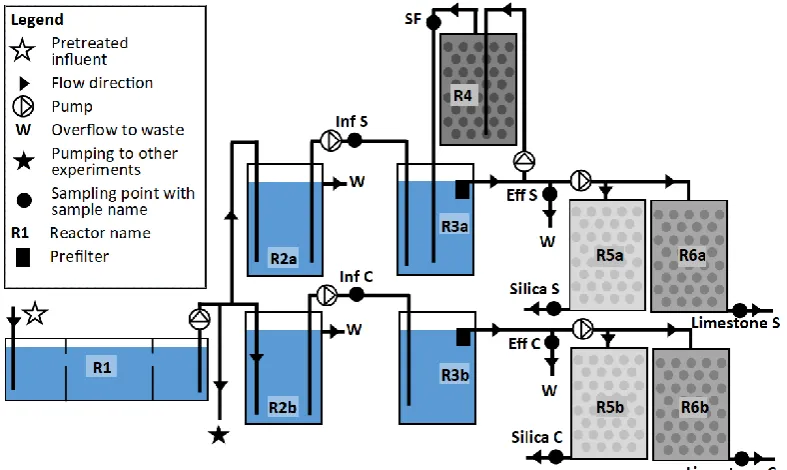
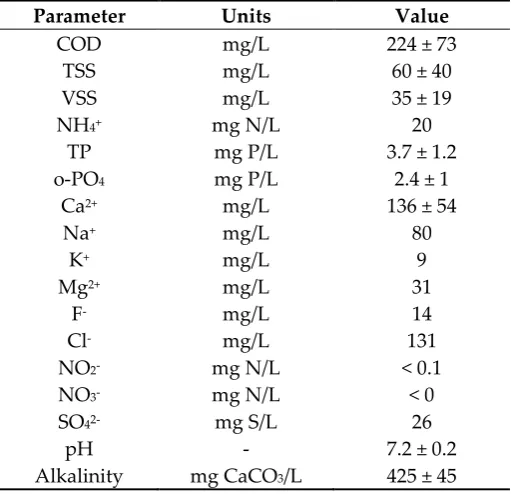
Pilot tests consisted in two pilot-scale septic tanks followed by drainfields with and without a sidestream slag filter (Figure 1 and Table 1, pictures of the setup shown in Figures S2 and S3). Screened raw wastewater from the SRDLA WRRF taken upstream of the chemical dosage point was pumped to a 10 m3 septic tank (reactor R1). This settled effluent was used as the influent and was representative of the effluent of the first compartment of a domestic septic tank. The mean influent composition is presented in Table 2.
Figure 1. Schematic of septic system pilot tests. Pretreatment refers to trash and grit removal. Inf C: influent control. Inf S: influent slag. SF: slag filter. Eff C: effluent control. Eff S: effluent slag. Limestone C: limestone control. Limestone S: limestone slag. Silica C: silica control. Silica S: silica slag.
Reactors R2 to R6 were 200 L plastic barrels. The sludge at the bottom of the pumping reservoirs (R2a and R2b) was regularly removed to prevent sludge accumulation. Wastewater was continuously pumped into reactors R3a and R3b, which had a prefilter at the outlet (aperture of the prefilter of 1.6 mm). Part of the R3 effluent was pumped intermittently (1 min at 40 mL per minute followed by a 7.45-minute rest period) by a peristaltic pump into either a silica or a limestone drainfield. The drainfields R5 and R6 were composed of 75 cm of sand over a 12.5-cm gravel layer. The influent of R5 and R6 was pumped at a depth of 12 cm in one of four inlet tubes. Each inlet tube was used for one week sequentially to ensure uniform division of the flow. The R5 and R6 effluents were collected in the gravel layer through four 25-mm diameter pipes with 3-mm perforations. Pilot tests were paused between days 92 and 152. During the pause, reactors R2 to R4 were kept saturated and reactor R1 remained in operation.
Table 1. Description of reactors in the septic system pilot tests.
Reactor Volume Influent flow rate
Empty bed contact time
L L/d d
R1 Three-compartment septic tank 10 200 5000 to 10 000 1.0 to 2.0
R2a Pumping reservoir1 200 280 0.7
R2b Pumping reservoir1 200 280 0.7
R3a Septic tank2 200 180 1.1
R3b Septic tank2 200 180 1.1
R4 Steel slag filter 180 45 to 135 1.3 to 4.0
R5a Silica drainfield 220 6.8 32.4
R5b Silica drainfield 220 6.8 32.4
R6a Limestone drainfield 220 6.8 32.4
R6b Limestone drainfield 220 6.8 32.4
1 The R2a and R2b effluent represents the effluent of the first compartment of a conventional domestic septic tank
2 R3a and R3b reactors represents the second compartment of a conventional domestic septic tank
Table 2. Characteristics of the primary effluent for the pilot tests (mean ± standard deviation at sampling points Inf S and Inf C). Inf S: influent slag. Inf C: influent control.
Parameter Units Value
COD mg/L 224 ± 73
TSS mg/L 60 ± 40
VSS mg/L 35 ± 19
NH4+ mg N/L 20
TP mg P/L 3.7 ± 1.2
o-PO4 mg P/L 2.4 ± 1
Ca2+ mg/L 136 ± 54
Na+ mg/L 80
K+ mg/L 9
Mg2+ mg/L 31
F- mg/L 14
Cl- mg/L 131
NO2- mg N/L < 0.1
NO3- mg N/L < 0
SO42- mg S/L 26
pH - 7.2 ± 0.2
Alkalinity mg CaCO3/L 425 ± 45
The systems were sampled periodically at the sampling points indicated on Figure 1 and analyzed for pH, ortho-phosphates (o-PO4), TP, Ca, dissolved inorganic carbon (DIC), alkalinity, COD, TSS and volatile suspended solids (VSS) according to standard procedures [18]. Turbidity was measured instead of TSS in the drainfield effluents. Mg, K, Na and SO4 were measured in the primary effluent (Table 2) by atomic absorption spectroscopy (AAnalist 200, Perkin Elmer). Cl was measured with chloride test strips (Quantab CAT 27449-40, Hach). NH4+, F-, NO2- and NO3- were measured by ionic chromatography. NO2-, NO3- and NH4+ were not analyzed in the test.
2.2 Slag and sand media
Two drainfields with different chemical composition (silica and limestone sands) were selected to represent two soils in Quebec, Canada [19]. The properties of the drainfield sands are shown in Supplementary Materials, Table S1. Both sands were consistent with Quebec regulations for drainfields [1]. The silica and limestone sands were obtained from the Mascouche and the Saint-Dominique quarries (Quebec, Canada), respectively. The gravel size at the bottom of drainfields was 14 to 40 mm.
2.3 Modelling of septic tank with sidestream slag filters
The modelling was conducted using MATLAB and IPHREEQCom modules [20]. First, equilibrium curves of P mineral phases and the calcium carbonate saturation index were calculated to define precipitation in the septic tank. Second, the septic tank with a sidestream slag filter was simulated by mixing the septic tank influent and the steel slag filter effluent. Ca, pH and DIC in the effluent of the septic tank were simulated. Third, CO2 fluxes in the septic tank were calculated based on a CO2 gradient between the septic tank water and air headspace.
2.3.1 Production of theoretical equilibrium curves of phosphorus mineral phases
A solution was specified in the REACTION datablock using various concentrations of CaCl2, NaOH, KH2PO4, K2HPO4 and FeCl2. Then, hydroxyapatite or vivianite was allowed to precipitate (but not to dissolve) using the EQUILIBRIUM_PHASES datablock. The pH, Ca/Fe and o-PO4 concentration after equilibration was recorded. The saturation index was computed to ensure that equilibrium was reached. The saturation index was always very low between -10-15 and 10-15 indicating that an equilibrium was attained (a positive saturation index indicates supersaturation while a negative saturation index indicates undersaturation, and zero indicates equilibrium [21]). Dissociation equations and solubility constants of hydroxyapatite and vivianite are provided in Table 3.
Table 3. Dissociation equations of phosphate mineral phases.
Phase Dissociation equation Solubility constant
Hydroxyapatite 𝐶𝑎5(𝑃𝑂4)3𝑂𝐻 = 5𝐶𝑎2++ 3𝑃𝑂43−+ 𝑂𝐻− 10-46 [22]
Vivianite 𝐹𝑒3(𝑃𝑂4)2: 8𝐻2𝑂 = 3𝐹𝑒2++ 2𝑃𝑂43−+ 8𝐻2𝑂 10-36 [21]
The solubility constant of hydroxyapatite was set at 10-46 according to the fine-particle theory [4]. This value is in agreement with the equilibrium state observed at effluent of steel slag filters [22]. The fine-particle hydroxyapatite solubility constant is eleven orders of magnitude more soluble than the tabulated bulk solubility of 10-57 [4].
2.3.2 Calculation of calcium carbonate saturation index
The saturation index of calcium carbonate in the influent and effluent of the septic tanks was calculated for each water sample with simultaneous pH, Ca and DIC measurements. The sample characteristics were reproduced with the REACTION datablock using various concentration of CaCl2, NaOH, HCl and NaHCO3. The saturation index of calcium carbonate was calculated using PHREEQC using either crystalline calcite (CaCO3, log(Ksp) = -8.48, PHREEQC database) or calcium carbonate
monohydrate (CaCO3H2O, log(Ksp) = -7.144, MINTEQ database [23]).
2.3.3 Simulation of septic tank with a sidestream steel slag filter
influent and specified pH of the effluent of the steel slag filter. MATLAB-PHREEQC functions are provided as Supplementary Materials.
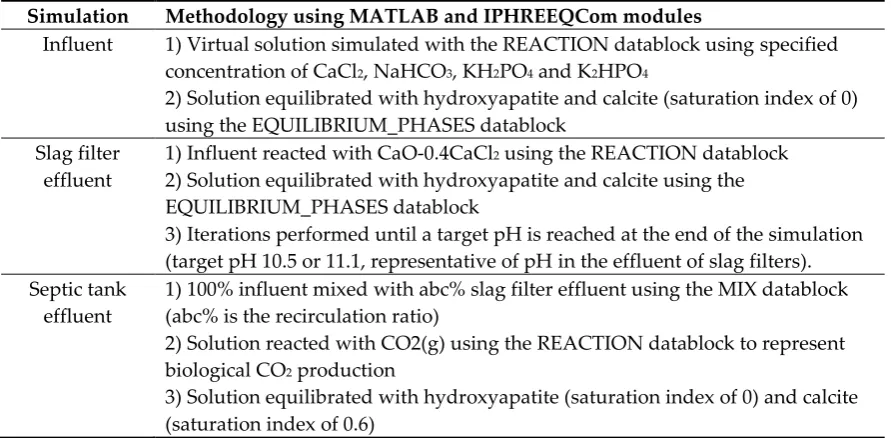
Table 4. Septic tank and sidestream steel slag filter simulations methodology.
Simulation Methodology using MATLAB and IPHREEQCom modules
Influent 1) Virtual solution simulated with the REACTION datablock using specified concentration of CaCl2, NaHCO3, KH2PO4 and K2HPO4
2) Solution equilibrated with hydroxyapatite and calcite (saturation index of 0) using the EQUILIBRIUM_PHASES datablock
Slag filter effluent
1) Influent reacted with CaO-0.4CaCl2 using the REACTION datablock 2) Solution equilibrated with hydroxyapatite and calcite using the EQUILIBRIUM_PHASES datablock
3) Iterations performed until a target pH is reached at the end of the simulation (target pH 10.5 or 11.1, representative of pH in the effluent of slag filters). Septic tank
effluent
1) 100% influent mixed with abc% slag filter effluent using the MIX datablock (abc% is the recirculation ratio)
2) Solution reacted with CO2(g) using the REACTION datablock to represent biological CO2 production
3) Solution equilibrated with hydroxyapatite (saturation index of 0) and calcite (saturation index of 0.6)
2.3.4 Calculation of carbon dioxide flux to septic tanks
The CO2 flux to the septic tank was calculated for each water sample with simultaneous pH, o-PO4, Ca and DIC measurements. pH, Ca, o-PO4 and DIC of the sample were reproduced in the REACTION datablock of PHREEQC using various concentration of KH2PO4, K2HPO4, CaCl2, NaOH, HCl and NaHCO3. The CO2 flux, FCO2 (mol L-1 d-1), was calculated by PHREEQC according to equation 1 [24]:
𝐹𝐶𝑂2= 𝑘𝐿𝑎(𝐾𝐶𝑂2𝑃𝐶𝑂2− {𝐶𝑂2}) (1)
where kLa is the off-gas CO2 transfer coefficient in an anaerobic reactor, 7.2 d-1 [24], KCO2 is the
Henry law constant for CO2, 0.034 mol atm-1 L-1 (PHREEQC database), PCO2 is the partial pressure of
CO2 in the septic tank air space (atm) and {𝐶𝑂2} is the CO2 activity in water (mol/L). CO2 flux was calculated assuming steady state conditions in the septic tank exposed to confined air (enriched in CO2). The CO2 partial pressure was fixed at various values within a range of 2000 to 10 000 ppm, representing small or large concentrations [16] in the confined air of the reactor.
3. Results and discussion
Raw experimental data of the septic system pilot tests is provided in Supplementary Materials.
3.1 Phosphorus removal performance of the upgraded septic tank and drainfield
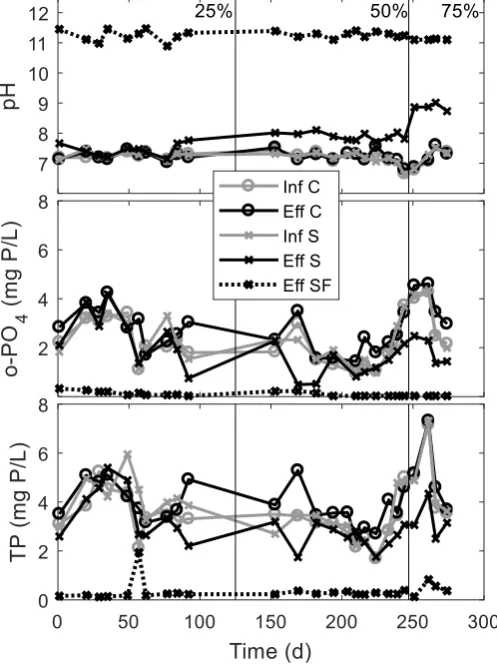
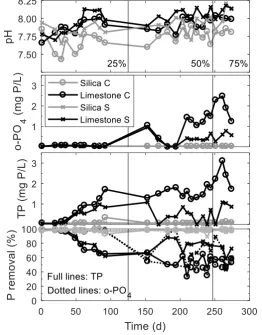
The P removal performance of the sidestream system is shown in Figure 2 for the septic tanks and Figure 3 for the drainfields. The control septic tank without a slag filter had an influent pH of 7.2 ± 0.2 which remained stable in the R3b compartment. The R3b compartment released o-PO4 (Figure 2), probably due to sludge hydrolysis. The slag filter resulted in a favorable pH above 11, and an effluent o-PO4 and TP below 0.1 and 0.3 mg P/L, respectively, during the 275 days of the tests. The water quality of the slag filter effluent was consistent with previous observations from slag filters of the same media [16].
improved, reaching 40% at a recirculation percentage of 75% (Table 5, all data different from control at t < 0.02 except when indicated). TP and o-PO4 removal at 25% recirculation ratio was not significantly different from the control test. A larger pH resulted in lower TP and o-PO4 concentrations in the R3a compartment of the experimental septic tank, in which pH increased to 8.9 at 75% recirculation ratios. The pH increase was due to the slow dissolution of the slag filter, which added hydroxide and calcium in the septic tank supernatant.
Figure 2. Phosphorus removal and pH at the influent and effluent of septic tanks without (C) or with (S) a slag filter. Inf: influent, Eff: effluent; SF: slag filter. Recirculation ratios are indicated at the top of the Figure and delineated by vertical lines.
Table 5. Mean total phosphorus removal, mean ortho-phosphate removal and pH in the second compartment of the septic tank without (control) and with a steel slag filter.
Period Recirculati on rate
Mean TP removal (%)
Mean o-PO4 removal (%)
pH in septic tank effluent
(d) (%) Control With slag
filter Control
With slag
filter Control
With slag filter 1 to 125 25 -2 ± 10 17 ± 12* -15 ± 26 6 ± 23* 7.2 ± 0.1 7.4 ± 0.2 125 to 250 50 -8 ± 8 11 ± 15 -30 ±30 33 ± 26 7.2 ± 0.2 7.9 ± 0.1 250 to 275 75 -7 ± 10 32 ± 13 -24 ±16 40 ± 9 7.2 ± 0.3 8.9 ± 0.1 *Not statistically different from the control (t-test > 0.02, two-tailed distribution)
Note: TP removal of the control system: points at t = 92 d, 224 d, 233 d and 266 d were not considered in the calculation of mean removal as the TP concentration in the effluent was significantly greater than in the influent.
stream mode (e.g. all influent passing through the filter). Indeed, TP concentration of 0.55 mg P/L at the effluent of a vertical flow oil shale ash filter was reported [25].
Figure 3. Effluent pH and phosphorus of drainfields following septic tanks without (C for control) or with a slag filter (S for slag). Recirculation ratios are indicated at the top of the Figure and delineated by vertical lines.
The type of sand had an impact on the phosphorus removal in the drainfield (Figure 3). The phosphorus removal by the silica drainfield was very large in both control and steel slag filter systems, reaching a mean TP (and o-PO4) concentration below 0.1 mg P/L for the 275 days of the experiment. In the limestone drainfield, however, such a high o-PO4 removal was observed only for the first 100 d (o-PO4 below 0.1 mg P/L at the drainfield effluent). After 100 d, the o-PO4 concentration at the effluent from the limestone drainfield increased in both control and slag filter systems, possibly because of sorption saturation. Interestingly, the TP concentration in limestone drainfield effluents increased after only 25 d even if the o-PO4 concentration was still low and stable.
After reaching breakthrough, the TP removal efficiency of the limestone drainfield was improved by the sidestream slag filter. In the limestone control system, the mean TP removal efficiency between day 100 and day 275 was 54%, resulting in a TP concentration between 1 mg P/L and 3 mg P/L in the drainfield effluent. In the system with a slag filter, this efficiency increased to 76% TP removal in the drainfield between day 100 and day 275, which resulted in a mean TP concentration of 0.7 mg P/L in the drainfield effluent.
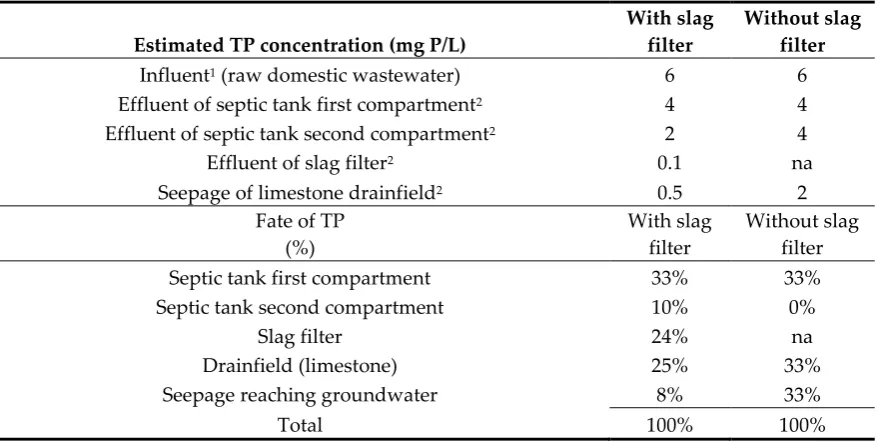
application. According to the results of this study, a septic tank improved with a sidestream steel slag filter at a 75% recirculation ratio reaches the target of 1 mg P/L at the seepage of the drainfield, which is comparable to common nutrient removal targets in advanced secondary or tertiary treatment processes [17]. This target was not reached in the control system with limestone drainfield, which is in agreement with previous groundwater monitoring below drainfields [19]. In drainfields located in natural silica sand, however, efficient long-term removal of phosphorus is possible [26] and steel slag filters might not be needed in those applications.
The phosphorus recovery potential of the system was improved by the presence of the slag filter, assuming that the TP in the septic tank can be recovered in a subsequent centralized sludge treatment process [17]. In the control system, 33% of TP was accumulated in the first and second compartments of the septic tank, compared to 43% in the presence of a steel slag filter. An additional 24% of TP accumulated in the steel slag filter, but extracting and recovering phosphorus from steel slag filters is challenging.
Table 6. Comparison of total phosphorus mass balances in conventional septic systems with or without a sidestream slag filter (75% recirculation ratio; limestone drainfield).
Estimated TP concentration (mg P/L)
With slag filter
Without slag filter
Influent1 (raw domestic wastewater) 6 6
Effluent of septic tank first compartment2 4 4
Effluent of septic tank second compartment2 2 4
Effluent of slag filter2 0.1 na
Seepage of limestone drainfield2 0.5 2
Fate of TP (%)
With slag filter
Without slag filter
Septic tank first compartment 33% 33%
Septic tank second compartment 10% 0%
Slag filter 24% na
Drainfield (limestone) 25% 33%
Seepage reaching groundwater 8% 33%
Total 100% 100%
1Considering a removal of 2 mg/L by settling in the first compartment. 2Considering results obtained in this study. Note: na: not applicable
The COD and TSS removal efficiency of the drainfields with or without a slag filter was similar (Figure S7, Supplementary Materials), which indicates that the biological activity in the drainfield was not affected by the slag filter effluent. In the steel slag filter system, the R3a effluent pH did not exceed 9.0. Such pH rise is not expected to strongly inhibit BOD5 removal by heterotrophic bacteria, which tolerate a pH range of 6.0 to 9.0 [17]. As the pH in the drainfield was buffered to about 8.0 by contact with atmospheric CO2 and biological activity (Figure 3), biological polishing in the drainfield is not expected to be inhibited despite a septic tank effluent pH higher than 9.0. Having a slag filter had a minor impact on the effluent (seepage) pH of the drainfield (0.1 to 0.2 pH increase).
3.2 Inorganic carbon fluxes in the septic tank
3.2.1 Modelling calcium carbonate precipitation in the septic tank
crystalline calcite (CaCO3, log(Ksp)= -8.48), especially those from the effluent of the septic tank with a
sidestream steel slag filter (Table 7). This observation indicates that the supernatant of the septic tank with a sidestream slag filter might be in equilibrium with calcium carbonate monohydrate (CaCO3H2O, log(Ksp) = -7.144). This compound is more soluble than CaCO3 and is expected to be formed when the saturation index is close to equilibrium, as was observed in the septic tank with slag filter (Table 7).
Table 7. Mean supersaturation index of crystalline calcite and amorphous calcium carbonate in the conventional septic systems.
Sampling location Period Recirculation
ratio Mean saturation index
(d) (%) Crystalline
calcite
Amorphous calcium carbonate
Influent control 1 to 275 na 0.42 -0.92
Influent with slag filter 1 to 275 na 0.37 -0.96
Effluent control 1 to 275 na 0.52 -0.81
Effluent with slag filter 125 to 250 50 0.95 -0.38
Effluent with slag filter 250 to 275 75 1.94 0.60
Note: na: is not applicable.
Amorphous calcium carbonate precipitation was considered to take place in steel slag filters according to a model calibration which resulted in an intermediary solubility product of 10-7.5 [22]. In this former study, the presence of crystalline calcite was confirmed by X-ray diffraction, but no mineralogical investigations were performed to detect amorphous calcium carbonate. In future mechanistic studies, it would be useful to use mineralogical analysis techniques for both crystalline and amorphous phases such as X-ray diffraction (XRD), Fourier transform infrared spectroscopy (FTIR) or X-ray absorption near edge structure (XANES) [10]. The presence of precursor amorphous calcium carbonate, even in small quantity, might control the solubility product and affect pH estimates. This mechanism is critical in decentralized wastewater treatment, where the calcium carbonate precipitation potential is important due to highly mineralized influents (e.g. often from groundwater source).
In the control septic tank, the DIC concentration increased (Figure S4, Supplementary Materials). This increase can be explained by biological production of CO2 by anaerobic acidogenesis, which agrees with a stable COD observed in the septic tank (Figure S5, Supplementary Materials, e.g. the effect of hydrolysis and acidogenesis on COD mass balance is very low [17]). In a septic system with steel slag filter, however, biological production of CO2 may be inhibited by a too high pH.
The proposed mechanism governing DIC concentration in slag filter upgraded septic tanks is the precipitation of calcium carbonate monohydrate at a saturation index of 0.6 with inhibited biological production of CO2. The proposed mechanism was supported by a successful model calibration using experimental data at 50% and 75% recirculation rates (Figure 4). The pH, DIC and calcium concentrations in the septic tank effluent were reproduced well by simulations. The calibrated biological CO2 input was 21 and 0 mg/L at 50% and 75% recirculation ratios, respectively. Note that the septic tank influent and the slag filter effluent characteristics were properly calibrated as shown in Supplementary Materials, Table S2.
3.2.2 Carbon dioxide flux into the septic tank
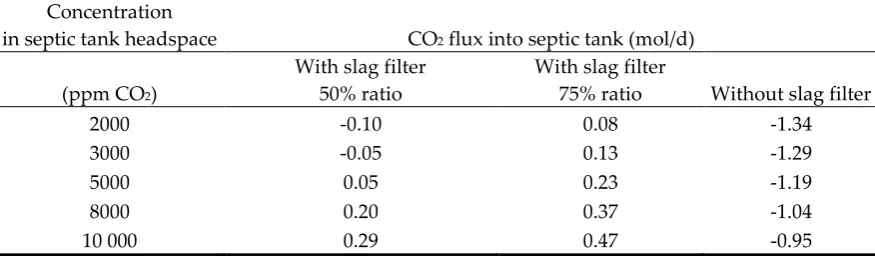
5000 to 10 000 ppm CO2 in the headspace. At 75% recirculation, the septic tank became a CO2 trap at any assumed CO2 concentration in the headspace. The change from CO2 source to CO2 sink is related to the increase of pH in the septic tank, which was 7.9 and 8.9 at 50% and 75% recirculation ratio, respectively.
Figure 4. Calibration of Ca, DIC and pH at the effluent of the septic tank upgraded with a slag filter. Measurements are represented by points and simulated data by lines. Recirculation ratios are indicated at the top.
Table 8. Mean carbon dioxide fluxes in septic tanks with (50% and 75% recirculation ratios) or without slag filter (positive sign = entrapment of carbon dioxide, negative sign = release of carbon dioxide)
Concentration
in septic tank headspace CO2 flux into septic tank (mol/d)
(ppm CO2)
With slag filter 50% ratio
With slag filter
75% ratio Without slag filter
2000 -0.10 0.08 -1.34
3000 -0.05 0.13 -1.29
5000 0.05 0.23 -1.19
8000 0.20 0.37 -1.04
10 000 0.29 0.47 -0.95
Results of this study illustrated the critical role of pH in CO2 capture. In future studies on slag filter upgraded septic tanks, the analysis could be extended to methane release, an important greenhouse gas [27], as methanogenesis could be affected by the pH rise induced by the slag filter, considering an optimum anaerobic digestion pH range of 6.5 to 7.5 [28]. As methane produced from small septic tanks is released to the atmosphere, the use of slag filters could reduce greenhouse gas emission by reducing methanogenesis in the septic tank. Partial methanogenesis inhibition in the septic tank would result in sending more organic matter to the drainfield, where aerobic conditions for organic matter mineralization are present.
3.3 Phosphorus removal mechanisms in the septic tank
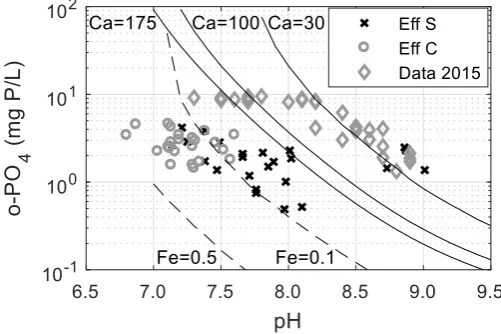
Vivianite equilibrium curves were drawn at iron concentrations of 0.1 mg/L and 0.5 mg/L, which is the approximate range observed in ten different real septic tanks [19].
Figure 5. o-PO4 - pH relationship in septic tank effluents with sidestream slag filter fed by the effluent of the second compartment. Calculated hydroxyapatite equilibrium curves are represented by full black lines (calcium concentration in mg/L next to each curve) and calculated vivianite equilibrium curves are represented by dashed lines (iron concentration in mg/L indicated next to each curve). Data 2015: from [12] with 5-50% recirculation ratio, fed with reconstituted domestic wastewater.
The septic tank effluent o-PO4 and Ca concentrations from this 2015 project were equilibrated with finely-grained hydroxyapatite for pH between 8.3 and 9.0. Results suggest that in a septic tank improved with a sidestream slag filter, phosphorus is removed by hydroxyapatite precipitation as observed in steel slag filters [16]. Note that equilibrium with finely-grained hydroxyapatite with solubility product of 10-46 resulted in a realistic o-PO4 concentrations between 0.1 mg/L and 10 mg P/L for pH between 7.5 and 9.0. Bulk hydroxyapatite solubility product (e.g. 10-57 according to [4]) is commonly considered as in a recent wastewater modelling study [29], but results in equilibrated o-PO4 concentrations that are much lower while supersaturation with bulk hydroxyapatite is observed in slag filters [22] or biological reactors [30]. Further mineralogical observations would be needed to confirm the presence and size of hydroxyapatite in biological reactors and to determine an appropriate hydroxyapatite solubility product.
In this study, results were below the 100 mg Ca/L and 170 mg Ca/L finely-grained hydroxyapatite equilibrium curves, which suggests that other removal mechanisms took place. One possible mechanism is the sorption or coprecipitation of o-PO4 on freshly precipitated calcium carbonate. Phosphate sorption on calcium carbonate can have a significant effect in high-alkalinity wastewater in which significant DIC reduction is observed, which was not the case in [12] where the influent alkalinity was less than 250 mg CaCO3/L, compared to 400 to 500 mg CaCO3/L in this study. Calcium-carbonate-based media are known to have a phosphorus sorption capacity, such as 0.3 to 0.6 mg P/g for limestone, 3.5 mg P/g for shell sand and up to 800 mg P/g for oyster shells [31]. Assuming a recirculation ratio of 75% in the septic tank, a reduction of 20 mg/L of DIC is expected, which corresponds to 166 mg/L of calcium carbonate precipitates. Assuming a sorption capacity of 3 mg P/g, 0.5 mg P/L of phosphate is expected to sorb on calcium carbonate precipitates, which explains a part of the phosphorus removal efficiency.
3.4 Effect of influent alkalinity on steel-slag-filter upgraded septic tank operation
The recirculation ratio needed to reach a pH of 9 at the effluent of the septic tank is shown in Figure 6, based on simulations of slag filter upgraded septic tank (influent calcium concentration fixed at 175 mg/L). Two slag filter hypotheses were tested: fresh slag which is assumed at the beginning of the filter lifetime, and long-term behavior of slag according to a slow slag exhaustion. Note that simulations agree with experimental data in this study (influent of 400 to 500 mg CaCO3/L alkalinity, slag filter effluent of 11.1, recirculation ratio of 75% and pH at the effluent of septic tank of 8.7 to 9.0, experimental points shown in Figure 6).
Figure 6. Slag filter recirculation ratio needed to reach a septic tank effluent pH of 9, with fresh slag (slag filter effluent pH of 11.1) or partly exhausted slag (pH slag filter effluent pH of 10.5). Experimental points refer to the 75% recirculation ratio phase.
The simulated needed recirculation ratio depended strongly on the influent alkalinity and the slag freshness. With fresh slag, the needed recirculation ratio was below 70% for alkalinity up to 425 mg CaCO3/L, but it increased following the slag exhaustion (needed ratio over 100% if alkalinity is above 225 mg CaCO3/L). In the present study, the slag filter effluent pH decreased from approximately 11.4 to 11.1 in 215 days of operation and is expected to decrease progressively until slag exhaustion at a pH of approximately 10.5. Therefore, the septic tank effluent pH will decrease as well, and the phosphorus removal capacity of the septic tank will be affected. The slag filter longevity was not reached in this study, but it can be estimated using slag filter modelling.
Claveau-Mallet et al. [9] estimated the longevity of a steel slag filter operated under similar conditions (a series of two barrels of 5-10 mm slag followed by three barrels of 3-5 mm slag with a total empty bed contact time of 30 h) and fed with an influent alkalinity of 210 mg CaCO3/L. The longevity was estimated at two years using simulations with the P-Hydroslag model [9]. With a higher influent alkalinity of 400 to 500 mg CaCO3/L, the longevity is expected to be less than two years because of increased precipitation and clogging by calcium carbonate. The use of a sidestream slag filter instead of a flow-through slag filter, however, increases the expected longevity to approximately 18 months as a significant part of calcium carbonate precipitation takes place in the septic tank instead of the slag filter. In this study at 75% recirculation ratio, 30% of influent DIC was removed in the septic tank, which means that the septic tank influent alkalinity was reduced by 30% compared to the septic tank influent. Such calcium carbonate control has an important impact on steel slag filter applications in onsite and decentralized treatment, where high-alkalinity influents is expected from some drinking water from groundwater supplies.
4 Conclusions and recommendations
4.1 Recommendations for process design
Implementing a sidestream steel slag filters in conventional septic systems is recommended for applications where limestone sand is present. In such cases, the amount of phosphorus released to the groundwater could be reduced by as much 75%. In the presence of silica sand, slag filters may not be needed because the sand has phosphorus retention capacity and a negligible concentration of soluble phosphorus is expected to be detected in groundwater [32]. In practice, properly characterizing the aquifer and groundwater movement below the drainfield may not be possible or economical and relying on a steel slag filter remains a safe option even in silica sand soils.
Reaching a pH value of 9.0 in the effluent of the septic tank is recommended as a compromise between efficient phosphorus removal (e.g. less than 0.1 mg P/L) and leaving enough phosphorus to allow efficient biological treatment in the drainfield. The recirculation ratio needed to reach this pH should be selected by the supplier according to the influent alkalinity (Figure 6) using modelling of the septic tank. In high-alkalinity influents (e.g. 200 to 400 mg CaCO3/L), a recirculation ratio of up to 100% is needed to ensure the system efficiency during the lifetime of the filter. For a slag filter empty bed contact time of 30 h, the longevity of the slag filter is expected to be approximately 18 months. One possible operation strategy would be for the maintenance staff (e.g. visiting every 6 months) to reduce the recirculation rate in the first year of the filter lifetime to benefit from the higher reactivity of the fresh slag.
Other benefits than reduced groundwater contamination arise from the implementation of a sidestream steel slag filter. First, the phosphorus recovery potential of the system is improved by the means of phosphorus enrichment of the septic tank sludge. Second, the septic tank becomes a CO2 sink instead of being a CO2 source. Third, clogging risks in the drainfield are reduced because part of the DIC is removed in the septic tank instead of being sent to the drainfield.
4.2 Recommendations for further understanding and improved control
Implementing a slag filter results in increased calcium carbonate sludge accumulation in the septic tank second compartment. The consequences on septic tank maintenance should be assessed, especially in high influent alkalinity applications. Clogging risks in the drainfield feeding pipes due to high pH should also be assessed. The experimental septic tank could be operated and monitored at an effluent pH ranging from 8.5 to 9.5 to improve the understanding of phosphorus removal mechanisms. Reducing the septic tank effluent pH would result in reduced recirculation ratio and increased filter longevity. The effect of a high pH (e.g. 9 to 10) in the septic tank effluent on the drainfield biological activity could be studied to evaluate the extent to which the higher pH is neutralized by atmospheric CO2. Finally, the long-term stability of slag and potential leaching of metals must be assessed consistently with practical uses of septic tanks.
The CO2 greenhouse gas study should be extended to CH4 release in the septic tank as its carbon dioxide equivalent for greenhouse gas effect is about 25 times higher than CO2, and the CH4 release could be determined experimentally. The study should also be extended to the drainfield to understand the effect of the slag filter on the fate of inorganic carbon (e.g. precipitation as calcium carbonate or CO2 stripping). Finally, the impact of organic matter and biological fouling on filter longevity should be assessed. Estimates of slag filter longevity using the P-Hydroslag model could be extended to consider the presence of organic matter as this model was designed for tertiary treatment for which organic matter was not considered [9].
(S) slag filter, Table S1: Drainfield sand properties, Table S2: Calibration of the septic tank effluent and the slag filter effluent (mean values in the 50 and 75% recirculation ratio period).
Author Contributions: Dominique Claveau-Mallet : Conceptualization, Methodology, Software, Validation, Formal Analysis, Data Curation, Writing – Original Draft. Hatim Seltani: Methodology, Validation, Investigation, Data Curation, Visualization. Yves Comeau: Conceptualization, Methodology, Validation, Resources, Writing – Review & Editing, Supervision, Project Administration, Funding Acquisition.
Funding: This research was funded by the Natural Sciences and Engineering Research Council of Canada (grant number RDCPJ476673-14), Bionest, GHD, Arcelor Mittal Produits Longs Canada, Les Produits et Minéraux Harsco and Agro Énergie.
Acknowledgments: The authors thank Guy Chateauneuf from GHD for initiating this project. We also thank Cristian Neagoe, Hassan Hemouzal, Simon Amiot and Pascale Mazerolle from Polytechnique Montreal and David Marien from the Municipality of Saint-Roch-de-l’Achigan for technical assistance at the Saint -Roch-de-l’Achigan WRRF. We thank Manon Leduc, Jérôme Leroy and Denis Bouchard from Polytechnique Montreal for calcium, metal and phosphorus analyses, and Étienne Boutet from Bionest for providing the slag barrels.
Conflicts of Interest: The authors declare no conflict of interest. The funders had no role in the design of the study; in the collection, analyses, or interpretation of data; in the writing of the manuscript, or in the decision to publish the results.
References
1. Bernier, B. 2017. Guide of conventional technologies for domestic wastewater treatment (In French). Direction des politiques du secteur municipal – Service de l’expertise technique en eau. Ministère du développement durable, de l’environnement et des parcs, Quebec Government.
2. EPA (United States Environmental Protection Agency), 2019. How Your Septic System Works. [WWW Document]. United States Government. URL https://www.epa.gov/septic/how-your-septic-system-works (accessed 6.6.19).
3. Lusk, M.G.; Toor, G.S.; Yang, Y.-Y.; Mechtensimer, S.; De, M.; Obreza, T.A. A review of the fate and transport of nitrogen, phosphorus, pathogens, and trace organic chemicals in septic systems. Crit. Rev. Environ. Sci. Technol. 2017, 47, 455–541.
4. Stumm, W.; Morgan, J.J. Aquatic Chemistry: Chemical Equilibria and Rates in Natural Waters, 3rd ed.; John Wiley & Sons: New York, United States, 1996.
5. Galvez-Cloutier, R.; Saminathan, S.K.M.; Boillot, C.; Triffaut-Bouchet, G.; Bourget, A.; Soumis-Dugas, G. An evaluation of several in-lake restoration techniques to improve the water quality problem (eutrophication) of Saint-Augustin lake, Quebec, Canada. Environ. Manage. 2012, 49, 1037–1053.
6. Penn, C.; Chagas, I.; Klimeski, A.; Lyngsie, G. A review of phosphorus removal structures: how to assess and compare their performance. Water 2017, 9, 583.
7. Nilsson, C.; Renman, G.; Johansson Westholm, L.; Renman, A.; Drizo, A. Effect of organic load on phosphorus and bacteria removal from wastewater using alkaline filter materials. Water Res. 2013, 47, 6289– 6297.
8. Bird, S.C.; Drizo, A. EAF steel slag filters for phosphorus removal from milk parlor effluent: The effects of solids loading, alternate feeding regimes and in-series design. Water 2010, 2, 484–499.
9. Claveau-Mallet, D.; Boutet, É.; Comeau, Y. Steel slag filter design criteria for phosphorus removal from wastewater in decentralized applications. Water Res. 2018, 143, 28–37.
10. Qin, Z.; Shober, A.L.; Scheckel, K.G.; Penn, C.J.; Turner, K.C. Mechanisms of phosphorus removal by phosphorus sorbing materials. J. Environ. Qual. 2018, 47, 1232–1241.
11. Hussain, S.I.; Blowes, D.W.; Ptacek, C.J.; Olding, D. Phosphorus removal from lake water using basic oxygen furnace slag: system performance and characterization of reaction products. Environ. Eng. Sci. 2014, 31, 631–642.
12. Claveau-Mallet, D.; Lida, F.; Comeau, Y. Improving phosphorus removal of conventional septic tanks by a recirculating steel slag filter. Water Qual. Res. J. Canada 2015, 50 (3), 211-218.
13. Uibu, M.; Velts, O.; Kuusik, R. Developments in CO2 mineral carbonation of oil shale ash. J. Hazard. Mater. 2010, 174, 209–214.
15. Kasak, K.; Mander, Ü.; Truu, J.; Truu, M.; Järveoja, J.; Maddison, M.; Teemusk, A. Alternative filter material removes phosphorus and mitigates greenhouse gas emission in horizontal subsurface flow filters for wastewater treatment. Ecol. Eng. 2015, 77, 242–249.
16. Bove, P.; Claveau-Mallet, D.; Boutet, É.; Lida, F.; Comeau, Y. Development and modelling of a steel slag filter effluent neutralization process with CO2-enriched air from an upstream bioprocess. Water Res. 2018, 129, 11-19.
17. Metcalf & Eddy-AECOM. Wastewater engineering: treatment and resource recovery, 3rd ed.; McGraw-Hill: New York, United States, 2014.
18. APHA; AWWA; WEF. Standard Methods for the Examination of Water and Wastewater, 22nd ed.; American Public Health Association, American Water Works Association and Water Environment Federation: Washington, D.C., United States, 2012.
19. Robertson, W.D.; Schiff, S.L.; Ptacek, C.J. Review of phosphate mobility and persistence in 10 septic system plumes. Groundwater 1998, 36, 1000–1010.
20. Charlton, S.R.; Parkhurst, D.L. Modules based on the geochemical model PHREEQC for use in scripting and programming languages. Comput. Geosci. 2011, 37, 1653–1663.
21. Parkhurst, D.L.; Appelo, C.A.J. Description of input and examples for PHREEQC Version 3 - -A computer program for speciation, batch-reaction, one-dimensional transport, and inverse geochemical calculations. Chapter 43 of Section A, Groundwater, Book 6, Modeling Techniques, United States Geological Survey, Denver, Colorado, 2013.
22. Claveau-Mallet, D.; Courcelles, B.; Pasquier, P.; Comeau, Y. Numerical simulations with the P-Hydroslag model to predict phosphorus removal by steel slag filters. Water Res. 2017, 126, 421-432.
23. Allison, J. D., Brown, D. S., Novo-Gradac, K. J. MINTEQA2/PRODEFA2, a geochemical assessment model for environmental systems: version 3.0 User’s manual. Envirionmental research laboratory, USEPA, Athens, Georgia, 1991.
24. Lizarralde, I.; Fernández-Arévalo, T.; Brouckaert, C.; Vanrolleghem, P.; Ikumi, D.S.; Ekama, G.A.; Ayesa, E.; Grau, P. A new general methodology for incorporating physico-chemical transformations into multi-phase wastewater treatment process models. Water Res. 2015, 74, 239–256.
25. Karabelnik, K.; Kõiv, M.; Kasak, K.; Jenssen, P.D.; Mander, Ü. High-strength greywater treatment in compact hybrid filter systems with alternative substrates. Ecol. Eng. 2012, 49, 84–92.
26. Robertson, W.D. Enhanced attenuation of septic system phosphate in noncalcareous sediments. Groundwter 2003, 41, 48–56.
27. Kim, I.T.; Lee, Y.E.; Yoo, Y.S.; Jeong, W.; Yoon, Y.H.; Shin, D.C.; Jeong, Y. Development of a combined aerobic-anoxic and methane oxidation bioreactor system using mixed methanotrophs and biogas for wastewater denitrification. Water 2019, 11(7), 1377.
28. McCarty, P.L. Anaerobic treatment fundamentals. Part two, environmental requirement and control. Public Work. 1964, 10, 123–126.
29. Vaneeckhaute, C.; Claeys, F.H.A.; Tack, F.M.G.; Meers, E.; Belia, E.; Vanrolleghem, P.A. Development, implementation, and validation of a generic nutrient recovery model (NRM) library. Environ. Model. Softw. 2018, 99, 170–209.
30. Valsami-Jones, E. Mineralogical controls on phosphorus recovery from wastewaters. Mineral. Mag. 2001, 65, 611–620.
31. Vohla, C.; Kõiv, M.; Bavor, H.J.; Chazarenc, F.; Mander, Ü. Filter materials for phosphorus removal from wastewater in treatment wetlands—A review. Ecol. Eng. 2011, 37, 70–89.
32. Robertson, W.D. Irreversible phosphorus sorption in septic system plumes? Groundwater 2007, 46, 51–60.