INTRODUCTION
Biomedical importance of iodine and supplementation in table salt
Iodine is an essential nutritional factor with important biochemical functions such as mental
www.orientjchem.org
Est. 1984
An International Open Free Access, Peer Reviewed Research Journal CODEN: OJCHEG
2012, Vol. 28, No. (4): Pg. 1547-1555
All-Solid-State Iodide Selective Electrode for
Iodimetry of Iodized Salts and Vitamin C
TIRUWORK MEQUANINT
1, GHIRMA MOGES
2*,
MERID TESSMA
3and SOLOMON MEHRETU
31ChemTest Consulting, P. O. Box 275 Code 1250, Addis Ababa. 2Department of Chemistry, Jimma University, Jimma.
3Department of Chemistry, Addis Ababa University, P. O Box 1176, Addis Ababa, Ethiopia.
*Corresponding author
(Received: August 20, 2012; Accepted: November 01, 2012) ABSTRACT
A laboratory-made all-solid state iodide selective electrode, with Ag2S-AgI coated on a graphite rod recovered from dry cell battery, was prepared according to previous procedures. The electrode’s linear response to iodide was in the concentration range of 10-6 M to 10-1 M with a slope of 56.85 mV/decade and a detection limit of 6×10⁻⁷ M. Iodate recovery test for laboratory formulated iodate-iodized salt was found to be 98.6 % with a standard deviation of 1.14%. The titratability of the iodized salt solution was at least 10-200 ppm potassium iodate (6-120 ppm iodine), exhibiting distinct endpoints in the range wider than the ones set in regulatory standards and reflecting that QC monitoring in production and stability decline of iodine content upon storage can be performed with the electrode method. On the basis this potentiometric titration, the application of the laboratory-made iodide electrode (vs. a saturated calomel reference electrode) was extended to the determination of iodine in commercial iodized salts. In all the iodine assays, the iodate-iodized salt was initially treated with acid and an excess of iodide before titration against Na2S2O3 solution. The iodine content in table salts iodized with iodide was determined by direct potentiometry. The electrode was further used for vitamin C (ascorbic acid) determinations in pharmaceutical tablets and orange juice by back titrating excess I3- against standard Na
2S2O3 in acidic media. The overall outcome is that the iodide ISE can be used as sharp endpoint indicator for these titrimetric reactions in place of the well known official, but visually monitored, starch- triodide end-point reaction detection.
Key words: Solid state iodide selective, Electrode, Graphite, Vitamin C.
development, and basic metabolisms1. In areas
ascribed to the chief action of iodine in the human body which plays an important role in the efficient conversion of beta-carotene to vitamin A. The most familiar iodine deficiency disorder (IDD) arising from low iodine diets is goiter. The other consequences of IDD are elaborated in other reports2.
Goiter is one of the nutritional problems with public health significance in Ethiopia. One out of every 1,000 people is a cretin, and about 50,000 prenatal deaths are occurring annually due to iodine deficiency disorders. A baseline survey of goiter prevalence conducted among five endemic regions and four non-endemic regions from 1988 to 1991 revealed that both the endemic and non-endemic regions were found to have a higher goiter prevalence rate than previously reported3,4. As per
WHO recommendation, the safe and adequate dietary intake of iodine for infants to adults ranges from 50 to 200 microgram per day the intake requirements increasing from infants/children to pregnant/lactating women5.
Salt iodization
This is known to be the most effective long-term public health intervention for achieving optimal iodine nutrition. Effective salt iodization is vital for the sustainable elimination of IDD. Many countries have adopted mandatory iodization programmes for table salt, signifying the importance of this element to public health.
Stability iodide and iodate in iodized salts Most countries including Ethiopia used potassium iodate to iodize table salts. Potassium iodide is less stable than potassium iodate, as it can be oxidized to elemental iodine by oxygen or other oxidizing agents, especially in the presence of impurities, such as metal ions and moisture, which catalyze the reaction. To avoid this problem, 3 a reducing agent, typically dextrose (C6H12O6) is added to reduce back any iodine formed to the colorless iodide ion. Even so, the actual availability of iodine from iodized salt at the consumer level can vary over a wide range as a result of variability in the amount of iodine in the iodization process as well as the uneven distribution of iodine in the iodized salt within batches, stability loss due to salt impurities, environmental, storage, packaging distribution conditions, as well as due to food
processing, and cooking6. According to the WHO/
UNICEF/ICCIDD, the loss of iodine from production to household has been estimated to be upto 20% 7.
Monitoring iodine levels in table salt
The AOAC iodometric titration procedure [8] is used to monitor the amount of iodine, be it in the form iodide or iodate added table to salt. The method involves the well known starch indication of end point (Eq. 3)
I- + 3Br2 + 3 H2O → IO3- +6Br - + 6H+ ...(1)
IO3- + 6H+ + 8I- → 3I
2 + 3H2O ...(2)
I2 + 2S2O32-→3 I- + S 4O6
2- ...(3)
In the AOAC official method, a sample of iodide-iodized salt using all the steps in equations 1-3. Evidently, iodine in salts iodized with iodate is determined only using the last 2 steps, (Eqn. 2 and 3).
Monitoring iodine levels is therefore important for stability reasons and for quality control during the production of iodized salts. The determination of iodine and its related compounds is also important for monitoring its levels in a variety of matrices pharmaceuticals foods, fodder, water, clinical and biological materials, pharmaceutical preparations and environmental samples3.
L-Ascorbic acid
L-Ascorbic acid (vitamin C) is widely distributed in plant and animal tissues and is involved in the metabolism of various substances in vivo. The reversible oxidation of L-ascorbic acid to dehydro-L ascorbic acid is the basis for its physiological activities, stabilities, and technical applications9. It is found in citrus fruits, green
peppers, red peppers, strawberries, tomatoes, broccoli, brussels sprouts, turnip and other leafy vegetables. The beneficial effects of vitamin C 4 against the common cold may be caused by its antioxidant properties10. The deficiency of vitamin C
Vitamin C assay methods
A large number of methods have been reported for the determination of acid ascorbic: titrimetr y, voltammetr y, potentiometr y, spectrophotometry, flow injection analysis and chromatography12.
A titrimetric method with 2, 6-Dichlorophenolindophenol (DCIP) has been used as the titrant for the determination of ascorbic acid. The method is based on the reduction of DCIP with ascorbic acid in acidic solution. It is an official method, for many pharmaceutical preparations, which do not contain Fe (II), Sn(II), Cu(I), SO2, SO3
2-and S2O32- ions. Moreover, DCIP has been found to
oxidize thiols13. Iodide Ion Selective Electrodes
Halide (X-) ion- selective electrodes are generally prepared by co-precipitation of a silver halide and Ag2S. To an equal molar solution of potassium halide and sodium sulfide excess silver nitrate solution is added till complete precipitation to be used as a halide ion selective electrode is 14.
KX (aq) + Na2S (aq) + 3AgNO3(aq) → AgX(s) + Ag2S(s) + KNO3(aq) + NaNO3(aq) ...(7)
Commercial iodide ion-selective electrode consists of a compressed pellet of silver sulfide and silver iodide.
The main objective of this work was to construct and assess the analytical application of laboratory constructed solid state iodide ion selective electrode coated on graphite rod recovered from a dry cell battery to determine iodine in iodide salts and the amount of ascorbic acid pharmaceutical products and in raw orange juices by a back titration iodometry5.
EXPERIMENTAL Reagents and Samples
Reagents
Potassium iodate 99.5 % (BDH, England), Potassium chloride (Riedel-de Haen, AG), Potassium nitrate (Research Chemicals Ltd), Potassium iodide (BDH, England), Sodium thiosulfate (Riedel-de Haen, AG), Sodium Chloride (Oxford Laboratory Reagent, Extra pure (99.5%) India, Sodium carbonate (BA, A.A.U), Sodium
sulfide (BDH, England), Silver nitrate ( Scharlau Chemie S.A, EU), Paraformaldehyde film (American can company, America), and distilled water were used throughout the experiments. Samples
Iodized salts purchased from supermarkets were manufactured by (a) Saudi Salt Refinery, Saudi Arabia (label claim 70-100 mg/Kg as iodine), (b) Klinge Foods Ltd, Scotland, 47.5 mg/ Kg as iodine) (C) American Garden product, USA (0.006% as potassium iodide). The Vitamin C tablets purchased from local pharmacies were produced from the Ethiopian Pharmaceuticals Manufacturing Industry S.C. and Chemical Industrial Development (Egypt). The latter is sold as Effervesce Vitamin C tablet. Egyptian Orange fruit juice, and whole Ethiopian orange (yellow and Green orange) were also randomly purchased from supermarkets. Apparatus and Instruments
Potentiometric measurements were made at room temperature using Jenway Model 3345 Ion Meter with the graphite coated electrode recovered from a dry cell, against Ag/AgCl external reference electrode (Hanna Model HI5412). Stable potentials were recorded within 1-5 minutes of stirring using a teflon- coated magnetic stirring bar.
Electrode preparation
electrode and the copper wire. The electrode was allowed to dry current air in a hood for 2 hours and finally conditioned for at least an hour before use15-16.
Solution preparations
Preparation of calibration standards. 0.1 M stock solution of iodide was prepared by dissolving 4.15 g of KI in 250 ml volumetric flask. Serial tenfold dilutions of the stock solution were used to prepare solutions down to 1x10⁻⁸ M iodide.
The diluent was 0.1 M KNO3 to keep the ionic strength of all the solutions constant at 0.1. Standardization of sodium thiosulfate
8.7 g of Na2S2O3 was prepared by dissolving in 500 ml (about 0.07 M) freshly boiled distilled water containing 0.05 g of Na2CO3. This solution was kept in a tightly capped amber bottle. 0.01 M KIO3 was prepared by weighing 1.07 g of the salt and dissolving in a 500 ml volumetric flask. 50.00 ml of 0.01 M KIO3 solution was transferred into titration flask and 2 g of solid KI and 10 ml of 0.5 M H2SO4 was added to it.
Preparation of Iodized salt solution for recovery study
25 gram of 99.5% NaCl was dissolved in 100 ml of 7.5x10⁻⁶ M KIO3 to make the content of latter about 47.5 ppm, the middle value for iodine content according to the Ethiopian standard. This solution was acidified with 1.0 ml of about 0.3 M H2SO4 and 2 gram of KI was added in excess to solubilize the iodine generated as triiodide. Titratability study of iodate-iodized salt. 1000 ppm of stock KIO3 was prepared in 250 ml volumetric flask. From this, solutions of KIO3 10 ppm, 50 ppm, 100 ppm, 150 ppm, and 200 ppm were prepared in 200 ml flasks by serial dilutions of the stock solution. Excess KI (190 mg/l final) and 0.3 ml of 0.3 M H2SO4 were added to each before the titration of each serially diluted KIO3 solution. 7
Vitamin C and iodine level determinations in Samples
Determinations of vitamin C
Ten tablets of vitamin C, or the vitamin emptied from 10 capsules, were weighed and crushed to powder for homogenization. 200 mg of this powder was dissolved in 60 ml of 0.3 M H2SO4.
2 g of KI and 50 ml of 0.01 M KIO3 was added to produce triiodide ion. A known volume of orange juice was similarly treated with excess of the triiodide-generating solution. The reactions were allowed to proceed for 2 minutes each and the excess I
-3 back titrated potentiometrically with
standard thiosulfate solution.
Determination of iodine in iodized salts
Analysis of iodine contents in iodate-iodized commercial salts and known mixtures were made by dissolving 25 g of the sample with 100 ml distilled water and acidifying the solution with H2SO4 to generate free iodine from the iodate in the salt sample. Excess KI was added to solubilize the free iodine as I3- The solubilized iodine so formed was
potentiometrically titrated with standard thiosulfate solution with iodide electrode as end point indicator. For samples iodized with iodide salts, the iodine contents were directly found from the calibration curve.
RESULTS AND DISCUSSION Calibration of the electrode
The potential response of the cell in mV for the Ag2S-AgI membrane electrode, coupled with the saturated calomel reference electrode, plotted against - log [I-] behaved according to E = -85.97 +
56.85log [I-] (R = 0.99984). The electrode showed
linearity over the concentration range of 10-6 - 10-1
M with a slope of 56.85 mV per decade change in concentration of iodide ion at 25°C. The slope reflects a Nernstian relationship and is a well-behaved solid state membrane electrode. The detection limit of the electrode was found to be 6,0×10⁻⁷ M with standard deviation of 1.35 (n=10) at
5×10⁻⁴ M iodide. Four sensors had shown response
times within 1-5 minutes and could be used for at least 4 months without any considerable divergence in potential responses8.
Standardization of sodium thiosulfate
Table 2: Vitamin C content of commercial orange juices
Orange sample mg of vitamin C per 100 ml* of
orange juice Orange (Egyptian, yellow) 51.92 ± 1.10 Orange (Ethiopian, partially yellow) 41.4 ± 1.50 Orange (Ethiopian, green) 32.4 ± 1.30 *
Mean ± SD, n = 3 for each sample
Table 3: Comparison of performances and the cost of the coated graphite electrode with commercial electrodes
Parameters ELIT Solid-state Crystal Jenway Iodide This work –Coated membrane* [19] Selective Electrode** [20] graphite electrode Electrode slope at 25°C 54±5 mV/decade -59.16mV/decade ±3mV 56.85 mV/decade
±0.5mv Linear range 5×10⁻⁷ to 1 M 5x10⁻⁷ to 1 M 5×10⁻⁷ to 1 M
Time for stable reading < 1 to > 5 min 1-5 min
Detection Limit 0.06 ppm 0.06 ppm
Recalibration Once per day Once per day Once per day
Interferences Ag+, CN- and S2- Ag+, CN- and S2- Ag+, CN- and S
2-Potential Drift 2mV per day 2mV per day 3 mV per day
Price of ISE 250 USD Incomparably cheap
Table 1: Iodine and iodate contents of commercial iodized salts produced in different countries and formulated iodized salt.
Product Added or Label value (mg/Kg) Found (mg KIO3/Kg) ±SD, n=3
(Production date) I2 KIO3 KI I2 KIO3 KI
Lab-formulated 05/2009 47.5 65.45 - 46.90 64.63±0.739
-Saudi Arabia 9/2008 70-100 96.46 -137.80 - 78.44 108.08±0.815 -Saudi Arabia 2/2007 70-100 96.46 -137.80 - 72.72 100.20±0.914 -Scotland, 11/2007 47.5 65.45 - 42.45 58.5±1.20
-America, 09/2008 43.5 - 60 34.8 - 48.0±0.99
Recovery Study for laboratory prepared iodized salts. The fitness for purpose in the use of the iodide electrode for the determination of iodine content in iodate-iodized salts was made by recovery studies by measuring iodine content through titration of laboratory-formulated iodate iodized salt solution with 3x10⁻³ M Na
2S2O3 using
iodide selective electrode vs SCE. Triplicate measurements were made to observe the
Titratabilty Study of potassium iodate with Na2S2O3
Titratability of different concentration of KIO3 (in presence of the same excess of iodide and the acidity) with Na2S2O3 was studied. Fig.3 shows the titration curves with inflection points to locate the potentiometric end points for solutions ranging from 10 ppm to 200 ppm KIO3 (6-120 ppm iodine)9.
Analysis of Laboratory-formulated and commercial iodized salts
In this work, the iodine contents of different commercial iodized salts were estimated. The results of replicate analyses (n = 3) showed that determined values for samples 2 and 3 were within the range of the label claims by the manufacturers. However, the iodine contents of all other iodized salt samples were found lower than the label value.
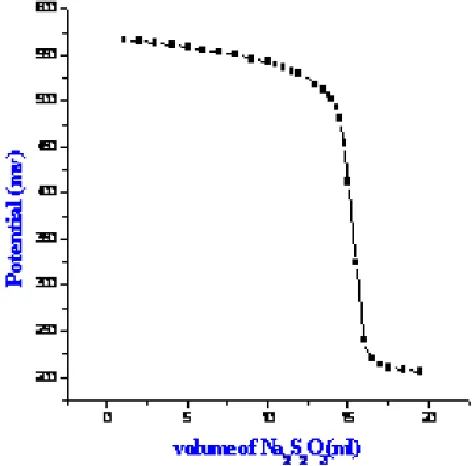
Fig. 1: Titration of Na2S2O3 (about 0.07 M) by potentiometric titration of 50 ml of 0.01 M with KIO3
Fig. 2: A typical potentiometric titration of laboratory-formulated iodized salt (47.5 mg iodine /Kg NaCl, or 65.4 mg iodate/kg NaCl) with 3×10⁻³ M Na
This can be attributed to stability factors and in-homogeneity of the products. It is established that the actual availability of iodine from iodized salts at the consumer level can vary over a wide range because of uneven distribution of iodine in the product17 loss of iodine due to salt impurities,
packing and environmental conditions during storage and distribution. Moreover, even though sample 2 & 3 were purchased from the same manufacturer the amount of iodine calculated in these samples is different this may be to varied due to their production dates. Sample three, which had been produced earlier than sample 2 has lost more
iodine relative to sample 2. Iodine losses from point of production to consumption can even be well below 50% 17.
The tests with formulated iodized salts solutions cover iodine contents not only in the standard range (40-60 ppm iodine for the Ethiopian Standard) but also iodine contents well below the unstable storage conditions. The result also shows that under-dose and overdose quantities of iodine in salts can be monitored in the quality control of iodization programmes.
Fig. 3 Titration of 25 ml of A) 200 ppm, B) 150 ppm, C) 100 ppm, D) 50 ppm, E) 10 ppm KIO3 each in the presence of 190 mg/l potassium iodide with 2x10⁻⁴ M Na
2S2O3
Analysis of pharmaceutical products
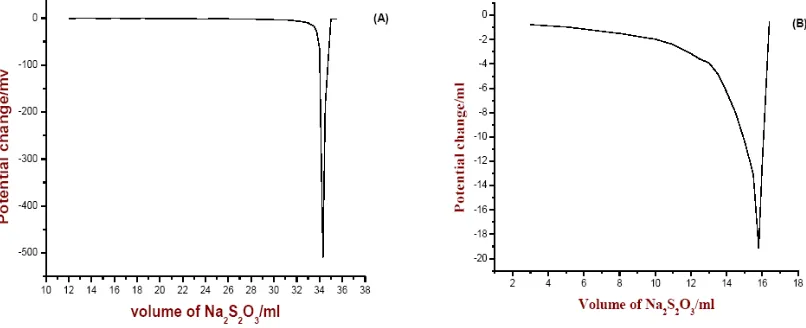
Differential potentiometric titration curves which are sharp, smooth, and symmetric; hence, one can more easily used to locate end-points, indicating the normal behavior of solid-state iodide selective electrodes. These electrodes were found to be suitable for this type of oxidation reduction titration and they were employed in this work.
For tablet B the amount of vitamin C from the local manufacturer (Ethiopian Pharmaceutical Manufacturing Industry) was found to be 431.5 ± 1.05 mg (labeled value 500 mg, production year 2008). In the case of tablet A (Effervescent tablets, Egypt; expiry date 15/07/2009) the measured vitamin content was 451.66 ± 0.89 mg against the label value of 1000 mg. When the experiment was conducted, it was just two months away from the expiry date of the Egyptian product (July 2009). It is evident that both tablets had measured vitamin C lower than the labeled quantities The vitamin C contents recorded in the triplicate measurements of both pharmaceutical products were evidently less than the label values. Ascorbic acid is a well known reducing agent and storage over a long time could be a cause for the reduced amounts in the products kept for long periods. Although a systematic study is required, this experiment clearly shows that the quality control of such pharmaceutical products containing ascorbic acid can be monitored with such analytical systems.
Analysis of vitamin C in commercial and in the fruit of locally grown orange
The amounts of vitamin C determined in orange juice from packed commercial products and from randomly selected orange fruit grown in Ethiopia are shown in Table 5. In this method a sample of 2.5 ml clear Orange juice (Greece) obtained by fruit pressing was diluted with distilled water to a final volume of 10 ml. The USDA food composition database shows that the total ascorbic acid in raw orange juice is 50 mg per 100 g juice18.
One report shows that the concentration level of vitamin C in orange juice is 30.48 mg/100 ml. Other results indicate a vitamin C content of 33 –50 mg/ 100 ml for orange juice (Valencia) obtained by squeezing the fruits19. The results from our work vary
within about 32 mg/ml and 41 g/100 ml for the green orange and for the nearly yellow orange, respectively. These experiments were done without
systematic sampling and did not even identify the type of the oranges, but still in good agreement with data from the cited international reports. Still, validation of our potentiometric titration method for the content of ascorbic acid in oranges cultivated in Ethiopia is proposed from further work through comparison with an official method.
Comparison with other Iodide Electrodes Table 3 also shows that most of the performances of these electrodes are comparably useful as the commercial ones20-21. The simplicity of
preparation invites laboratories to design and apply to real sample analysis. Like the commercial electrodes, the inferences from the reported electrode Ag+, CN- and S2- is expected since the
sensor material is Ag2S-AgI coating on the
conducting graphite electrode. Table 3 here CONCLUSION
The application of laboratory-made very low cost all-solid-state coated graphite iodide ion selective electrodes provide a rapid and inexpensive method for the determination of iodide in the range of 10-6- 1.0×10⁻¹ M iodide. The performance of these
1. Kishore, K. Mater. Med., 1: 38 (1983). 2. Lacerda, F.S.; Lameiras, F.S. Brazilian
Archive of Biological and Technology, 50: 707 (2007).
3. Getahun, K.; Urga, T. Ethio. J. Health Dev., 15: 55 (2001).
4. Langdon, M. Iodine Deficiency Disorders, National Survey in Ethiopia (2007). http:// www.reliefweb.int/rw/RWFiles2007.nsf/ F i l e s B y R W D o c U n i d F i l e n a m e / E G U A -762KWE-full_report.pdf/$File/full_report.pdf accessed Jan 2009.
5. Bhagat, P.R.; Acharya, R. Food. Chem., 115: 706-710 (2009).
6. Beheshti, S.S.; Amini, M.K. Int. Electrochem. Sci., 2: 778-787 (2007). Saeed S. Beheshti Mohammad K. Amini
7. Thomson, B.M. Stability of added iodine in processed cereal foods, Food Additives and Contaminants, 26: 25 (2009).
8. AOAC Method 925.56, Iodine in Iodized Salts, in AOAC Official method of Analysis, 18th Ed., 11.2.02. (2007)
9. Salkic, M.; Kubicek, R. Eur. J. Sci. Res., 23: 351 (2008).
10. Hemila, H. Scand. J. Infect.Dis., 26: 1 (1994).
11. Ringsdorff, W.M. Orthomolecular Psychiatry, 11: 128 (1982).
12. Walingo, A. J. Food Agric. Nutr. Dev., 5: 20 (2005).
13. Takele, T.; Belachew, T.; Bekele, E. A.; Med. J., 50: 532 (2005).
14. Pungor, E. Anal. Sci., 14: 249 (1998). 15. Department of Chemistry, AAU, Instrumental
Analysis Procedure (1993).
16. S.N.B. Jabar and M.Z. Ibrahim., Orient J. Chem. 28(3): 1117-1121 (2012).
17. Cepuliene, R.; Bobiniene, R. Veterinarija IR Zootechnika. T., 64: 38 (2008).
18. (USDA, http://www.nal.usda.gov/fnic/ foodcomp/cgi-bin/list_nut_edit.pl, accessed 28 Dec 2009).
19. Pisaschi, A.F.; Journal of Automated Methods and Management in Chemistry, 937 (2008). 20. ELIT Brand Electrochemical Sensors, http:// www.nico2000.net/analytical/iodide.htm, accessed 28 Dec 2009
21. Jenway Operating Instructions and Technical Specifications http://www. techneusa.com /Electrochemaccess ories/ 924-510% 20Iodide%20 Mono.pdf, accessed 28 Dec 2009.