Enhancement of Student Learning in
the Lecture Theatre by means of
a Radio Frequency Feedback System
by
Martin Kenward Gilbert
A thesis submitted in partial
fulfilment for the degree of
Doctor of Philosophy
University of London
1999
ProQuest Number: 10797850
All rights reserved
INFORMATION TO ALL USERS
The qu ality of this repro d u ctio n is d e p e n d e n t upon the q u ality of the copy subm itted.
In the unlikely e v e n t that the a u th o r did not send a c o m p le te m anuscript and there are missing pages, these will be note d . Also, if m aterial had to be rem oved,
a n o te will in d ica te the deletion.
uest
ProQuest 10797850
Published by ProQuest LLC(2018). C op yrig ht of the Dissertation is held by the Author.
All rights reserved.
This work is protected against unauthorized copying under Title 17, United States C o d e M icroform Edition © ProQuest LLC.
ProQuest LLC.
789 East Eisenhower Parkway P.O. Box 1346
Abstract
The principal formal teaching mechanism of universities is the lecture - a cost
efficient format where hundreds of students may be taught by a single lecturer.
Lectures’ learning outcome is less certain; the lecturer has little ability to appraise the
nature of the audience’s understanding. The introduction of an electronic
communication path horn students to the lecturer mitigates this disjuncture. This
communication path has been introduced and was found to be extensively used
during a series of lectures, with each student provided with a handset that is reliable,
inexpensive and portable. Upon these handsets are buttons; the data is transmitted at
radio frequencies to the lecturer, aggregated and displayed graphically for quick
assimilation.
It has been recognised that this communication path permits the direct measurement
of student’s educational behaviour without disturbing the lecture itself. Preliminary
results indicating the value of this research methodology have been obtained. A
significant correlation was identified between the percentage of questions during the
lecture students answered correctly and their previous year’s overall academic mark.
A correlation was identified between the number of times students initiate
communication with the lecturer and the number of questions during the lecture they
answered correctly. Mixed evidence was found regarding a possible correlation
between the evidence of satisfaction with their learning students provided using the
system and the number of questions during the lecture they answered correctly.
The introduction of an electronic communication path into lectures has proved to be
an innovation deserving of further research and wider introduction into teaching
Contents
Chapter 1 Introduction 1
Chapter 2 Education overview 6
2.1 Behaviourism 6
2.1.1 Classical behaviourism 6
2.1.2 Operant behaviourism 7
2.2 Gestalt 8
2.3 Constructivism 9
2.3.1 Classical constructivism 9
2.3.2 Radical constructivism 10
2.4 Implementation 10
2.5 False trichotomy 11
Chapter 3 Educational technology 13
3.1 Historical outcome of educational technology 14
3.1.1 Case study of a successful technology 15
3.1.2 Case study of two less successful technologies 17
3.1.3 Summary 18
3.2 Improving lecturing 20
3.2.1 Prior attempts to deploy lecture feedback 21
3.3 Conclusions 24
Chapter 4 Overview of the feedback system 26
4.1 Educational overview 27
4.2 Economic overview 28
4.3 Technical overview 29
4.3.1 Handset power consumption 29
4.3.2 Handset power source 31
5.1 Clock capture 34
5.1.1 Synchronous capture 34
5.1.2 Asynchronous capture 3 5
5.1.3 System choice 36
5.2 Random networks 36
5.3 Organised networks 36
5.3.1 Time division multiple access 3 7
5.3.2 Token passing 38
5.3.3 Collision sense 39
5.3.4 Frequency division multiple access 40
5.3.5 System choice 40
5.4 Spread spectrum 41
5.4.1 Pseudonoise 41
5.4.2 Frequency hopping 43
5.4.3 Time hopping 44
5.4.4 Direct sequence 44
5.4.5 CDMA system development 47
5.5 Conclusions 47
Chapter 6 Noise 49
6.1 Wideband noise 49
6.1.1 Binary symmetric channel 50
6.1.2 Error performance 53
6.1.3 M-ary modulation 55
6.2 Narrowband noise: spread spectrum 58
6.3 Coding 61
6.3.1 Repetition codes 63
6.3.2 Combinatorial codes 63
6.3.3 Error detection 64
6.3.3.1 Code performance 64
6.3.4 Error correction 66
6.4 Conclusions 68
Chapter 7 Prototype system 70
7.1 Handset 71
7.1.1 Handset schematic 72
7.1.2 Handset circuit details 76
7.1.2.1 Manual switch 76
7.1.2.2 Data latching 76
7.1.2.3 Three Volt supply 76
7.1.2.4 Voltage controlled switch A 78
7.1.2.5 Isolating interface 78
7.1.2.6 Control circuitry 78
7.1.2.7 Five Volt supply 78
7.1.2.8 Modulation 79
7.1.2.9 Transmission 80
7.1.2.10 Voltage controlled switch B 80
7.2 Data reception and storage 80
7.3 Data display and long term storage 81
7.3.1 Computer-FIFO interface 82
7.3.2 Lecturer interface 83
7.4 System limitations 84
7.4.1 Handset provision 84
7.4.2 Power drain 85
7.4.2.1 Protection diode: negative effect 86
7.4.2.2 Protection diode: white knight 86
7.5 Conclusions 89
Chapter 8 Large class feedback: system 2 90
8.1 Start up, data capture and handset power control: board 1 91
8.2 Data modulation and transmitter control: board 2 95
8.3 Radio frequency transmitter and receiver 100
8.3.2 Radio receiver 102
8.4 Baseband data recovery 103
8.4.1 Post-reception processing 109
8.5 False positives 110
8.6 Cost per handset 111
8.7 Handset complement 111
8.8 Probability of transmission failure and misreception 112
8.9 Energy consumption per transmission 113
8.10 Conclusion 114
Chapter 9 Experience with prototype system 115
9.1 Research methodology 115
9.2 First trial 118
9.2.1 Experimental details 118
9.2.2 Results and discussion 119
9.2.3 Conclusions 120
9.3 Covariance trials 121
9.3.1 Experimental details 121
9.3.1.1 Lecturer-prompted feedback 123
9.3.1.2 Student-prompted feedback 124
9.3.2 Results and discussion 124
9.3.2.1 Informal questioning 125
9.3.2.2 Engagement 126
9.3.2.3 Aptitude 128
9.3.2.4 Self-satisfaction 131
9.4 Conclusions 133
Chapter 10 Conclusions and future research directions 135
10.1 Technological research directions 136
10.1.1 Cost 136
10.1.2 Transmission failure improvement 136
10.1.4 Spread spectrum 138
10.1.5 Power 139
10.2 Educational research directions 140
10.2.1 Confirmation of preliminary results 140
10.2.2 Lecture theatre geography 140
10.2.3 Lectures: a single teaching experience? 141
10.2.4 Exploring the nature of in-lecture learning 141
10.2.5 Changing the communication possibilities 142
10.2.6 Lectures as tutorials 142
Appendix 1 Probability of collision in a random access system 143
A 1.1 Input stream 143
A 1.2 Derivation 144
A1.3 Application to the feedback system 147
Appendix 2 Analysis of a simple collision detection system: Aloha 148
A2.1 System overview 148
A2.2 Capacity utilisation 148
A2.3 Utilisation calculation 149
Appendix 3 Software to permit data display and storage by PC 151
Appendix 4 System 2 radio transmitter and receiver 161
A4.1 Radio transmitter 161
A4.1.1 Pin description 161
A4.1.2 Functional description 162
A4.2 Radio receiver 163
A4.2.1 Pin description 164
A4.2.2 Functional description 164
Appendix 6 Handset registration 168
A6.1 Definitions 168
A6.2 Probability of all handsets being registered 169
A6.3 Probability of no ghost registrations 170
A6.4 Probability of a single ghost registration 171
A6.5 Results 171
Appendix 7 System 2 handset cost 173
Appendix 8 Energy dissipated by 1 system 2 handset transmission 175
A8.1 Devices operating at 3V
A8.1.1 ICM7555 timer 175
A8.1.2 HC4040 176
A8.1.3 PVD1354 176
A8.1.4 NMP0103 smoothing capacitance 176
A8.1.5 Other capacitance 176
A8.1.6 Other devices 177
A8.1.7 Total energy requirement, 3V board 177
A8.2 Devices powered by the 5V supply 177
A8.2.1 HA7210 177
A8.2.2 PVD1354 178
A8.2.3 RF9901 (whilst not transmitting) 178
A8.2.4 RF9901 (transmitting) 178
A8.2.5 MAX756 smoothing capacitance 179
A8.2.6 RF9901 smoothing capacitance 179
A8.2.7 Other devices 179
A8.2.8 Total energy requirement, 5V board 179
A8.3 Energy requirement for one operation of a system 2 handset 180
Appendix 9 OHPs presented during talks at UCL and Imperial 181
A9.1 Slides from talks at University College 181
Appendix 10 Product-moment correlation of experimental data 191
A10.1 Engagement 191
A 10.2 Aptitude 194
A 10.3 Self-satisfaction 195
Appendix 11 Parts list, system 2, board 1 198
Appendix 12 Papers published 199
List of figures
1.1 The number of full-time students attending UK higher education
1960 to 1995
1.2 Public funding per student for the financial years 1976-77
to 1995-96
3.1 The “Feedback Classroom”; each student is provided with a
response unit for multiple choice questioning. If a student’s
answer is correct (determined by pre-selection on the teacher’s
console) a lamp is illuminated [...]
5.1 Simple and differential Manchester coding
5.2 A general block diagram of a spread spectrum communication
system
5.3 Pseudo-noise generation using a bank of Q shift registers
5.4 The generation of Gold codes
5.5 The generation of a frequency hopping spread spectrum signal
5.6 The generation of a direct sequence spread spectrum signal
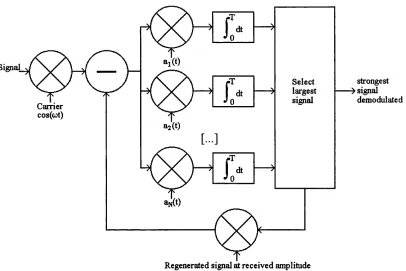
5.7 Block diagram of a successive interference cancellation multiuser
detector
6.1 The probability density function of two received signals, with some
modulation § (phase, frequency or amplitude) with magnitude ±a
about some level p. The noise in the channel is Gaussian [...]
6.2 Comparative error performance of On-Off, Frequency Shift and
Phase Shift Keyed modulations (OOK, FSK and PSK respectively)
over a range of transmitted bit energies [...]
6.3 The conversion of a binary data stream to a quaternary data stream
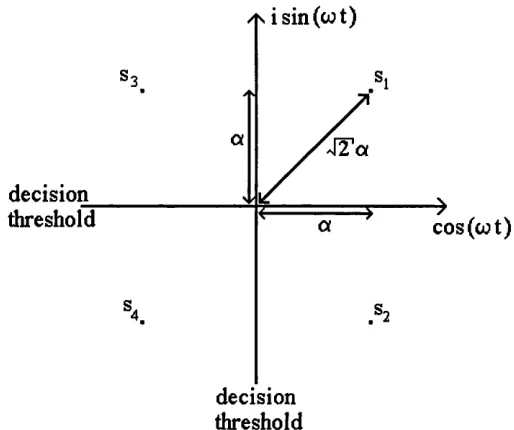
6.4 The signal space representation of a 4-ary phase shift keyed signal
constellation with the axes as decision thresholds [...]
6.5 (a) 8-ary phase shift and (b) quadrature amplitude signal
3
3
22
35
41
42
43
44
45
47
51
54
55
constellations, of equal constellation energy with increased signal
separation (shown by the single-headed arrows) of the quadrature
modulated case visible 57
6.6 The probability density functions received when two signals are
transmitted with a modulation magnitude of ± a in the presence of
wideband Gaussian noise, with the addition of narrowband noise
of amplitude P [...] 58
6.7 The generation and reception of a bi-phase shift keyed, direct
sequence spread spectrum signal 59
7.1 A schematic of the data flow from a handset to the central receiver,
where it is processed by software and stored and displayed by a
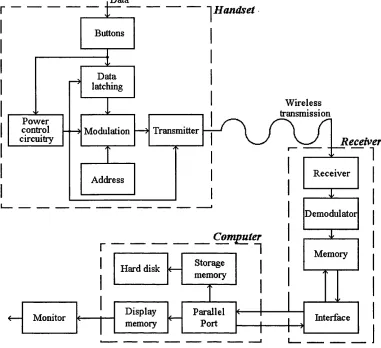
computer 72
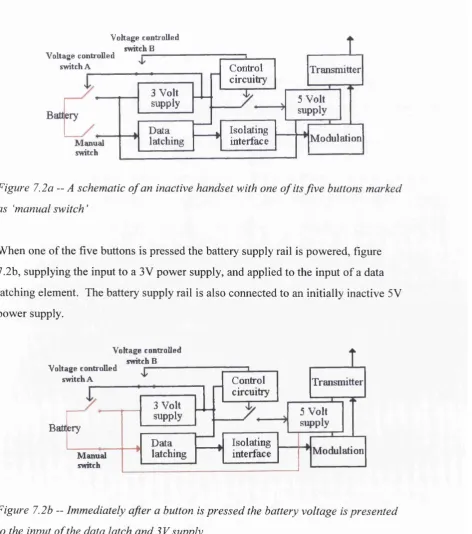
7.2a A schematic of an inactive handset [...] 72
7.2b Immediately after a button is pressed [...] 72
7.2c The handset 3V supply rapidly stabilises [...] 73
7.2d Voltage controlled switch A closes [...] 73
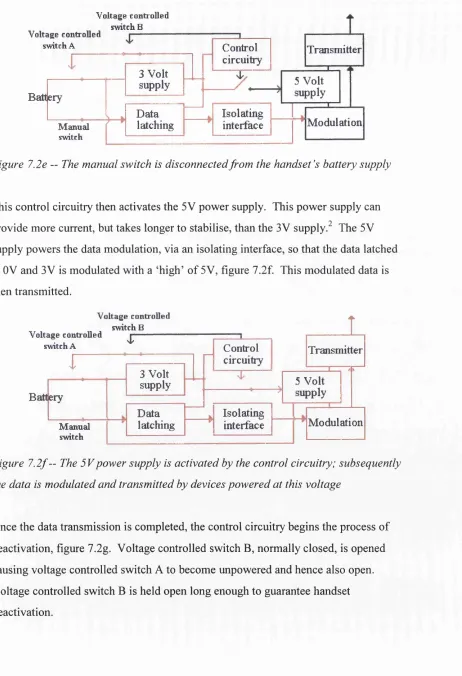
7.2e The manual switch is disconnected [...] 74
7.2f The 5V supply is activated [...] 74
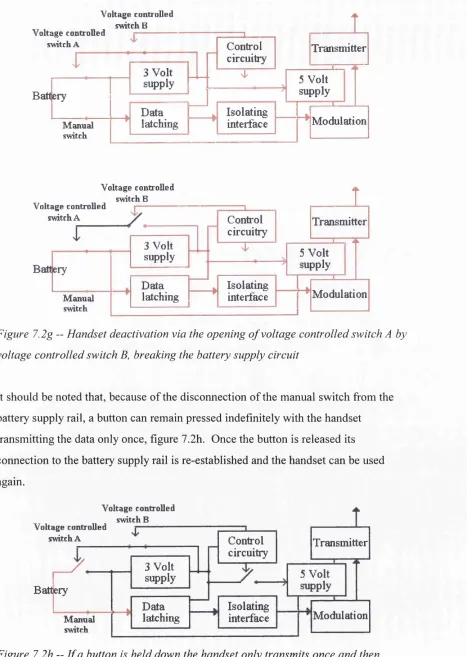
7.2g Handset deactivation [...] 75
7.2h If a button is held down the handset only transmits once [...] 75
7.3 The handset circuit diagram for the prototype feedback system 77
7.4 Modulation uses 3 bits of a master clock per data and address bit 79
7.5 The modulator’s paragogic word with a bit duration of 3 master
clock bits [...] 79
7.6 The data reception and storage circuit 81
7.7 The circuit diagram of the PC and FIFO interface 82
7.8 The 3 and 5 button displays to the lecturer with the total number
of handsets present set as 100% [...] 84
7.9 The time sequence of a handset to receiver transmission indicating
the causes of the transmission duration 85
power discharge path for a continuous topmost button press
shown [...] 87
8.1a A block diagram of the handset in its inactive state 91
8.1b Power and signal flow resulting from a button press 92
8.1c Voltage controlled switch A closes, establishing a connection
from the battery to the 3V supply [...] 92
8. Id The capacitative link charges to a level such that the input of the
data latch becomes low; the manual switch opens [...] 93
8.2 The circuit diagram for board 1 94
8.3a Power-on state of the modulation circuit during initial oscillator
stabilisation 95
8.3b After 5.6ms input 1 goes “high”, providing power to the
transmitter and power amplifier [...] 96
8.3c 9.5ms after the 5V supply is activated the modulation board
oscillator and transmitter have stabilised [...] 97
8.3d Input 2 goes ‘high’, activating the counter’s clock input and
loading the parallel data into the shift registers [...] 97
8.3e Transmission begins after the counter reaches 64 98
8.3f After transmission an “off’ signal is generated by the counter [...] 99
8.4 The circuit diagram for board 2 99
8.5 A block schematic of the radio transmitter 101
8.6 A block schematic of the radio receiver 103
8.7 The baseband output of the downconverted transmission [...] 103
8.8a The baseband output of the radio receiver is subject to an initial
check [...] 104
8.8b A tight check is then applied to the data [...] 105
8.8c The receiver now waits for the sequence of 4 ‘highs’ that precede
the clock synchronising ‘low’ 106
8.8d The falling edge detector activates a counter which has a 32 MHz
input 107
transmission [...] 108
8.8f A second counter provides “write” pulses to a FIFO memory
device in which the transmission is stored 109
9.1 Self-prompted feedback from 8 handsets during a day consisting
of a series of talks [...] 120
9.2 Evidence of understanding versus student initiated handset
use [...] 127
9.3 Previous year’s overall result versus percentage of questions
asked during lecture that were answered correctly [...] 129
9.4 Percentage of self-prompted feedback indicating student
dissatisfaction versus percentage of questions asked during the
lecture that were answered correctly [...] 132
A4.1 The circuit diagram of the system 2 radio transmitter [...] 161
A5.1 Initial check, tight check and clock synchronisation 166
List of tables
5.1 The autocorrelation properties of a three stage shift register
maximal length code with respect to a reference sequence
‘1110010’ 42
6.1 Modulo-2 addition 63
6.2 The generation of a (7,3) code word which can correct single bit
errors 66
6.3 The possible (7,3) code words from table 6.2 with a Hamming
distance of 3 demonstrating that single error correcting capability 66
8.1 The transmitter precludes using certain addresses [...] 112
A4.1 The pin descriptions of the RF9901 161
A4.2 The pin descriptions of the RF9902 164
A6.1 The possible outcomes of a handset transmission 169
A7.1 The component costs of a single handset 174
A 10.1 Engagement, UCL students 192
A 10.2 Engagement, Imperial students 193
A 10.3 Aptitude, UCL students 194
A 10.4 Aptitude, Imperial students 195
A 10.5 Self-satisfaction, UCL students 196
Acknowledgements
I am grateful to the Leverhulme Trust and Hewlett-Packard Limited for providing the
funds with which to pursue this research.
Thanks to everyone associated with the Molecular Physics laboratory - in particular
Jon Gingell and Nyk Jones - for both help in this research and much enjoyable
socialising. Thanks also to Michael Worton, Brigitte Picot and everyone else
involved in finding me the space and time in which to work when it was critical, and
Nigel Mason for finding me more when things got really hairy. My thanks to Brian
Fantini for his invaluable technical assistance during this project.
To all my Guildford friends - Jason Hemingway, Simon Handby, Alan Harding,
Howard Thain and everyone else - thanks for providing me with a well-spring of
good company and relaxation over numerous years.
Thanks to Stuart Sullivan for being a great housemate and friend - a rock about
which I could swirl.
Mum and Dad I owe thanks on more levels that can be expressed - but I am
profoundly grateful to have had so much love, conversation and fun with two of the
most special people it has been my pleasure to know. My thanks also to Lucy and
Paul; Isabel and Len; Fay, Badger, Samantha, Eleanor and Zoe - 1 am lucky to have a
family that is so loving and interesting. I am grateful to Fudge and Biscuit for many
a greeting “meow” and purring nudge.
My love and unbounded thanks to Katherine Brown - friend, girlfriend, soul mate.
Finally, my thanks to Eric Ash for being, simultaneously: benign and perceptive,
forthright and tactful, supportive and critical. I have been superbly supervised - but
more than that, I have had the pleasure of the company of a man to whose qualities I
“It seems to me to be a superlative thing to know
the explanation o f everything, why it comes to be,
Chapter 1 Introduction
“The wide world is all about you; you can fence yourself in, but you cannot for ever
fence it out” J. R. R. Tolkien, ‘The Lord o f the Rings ’
An academic, somehow transported in time from the turn of the century to the current
day, could walk into a lecture theatre filled with eager students and fully understand
the teaching role he was about to play. Some details of the mechanics of the lecture,
such as the use of overhead projectors, would require explanation but the basic
configuration has remained the same: a single lecturer delivering what is
fundamentally a monologue to an audience. Once he (as it was then) opened his
mouth, however, the students would immediately recognise that the research findings
being presented were not so such much outdated as antique. Those hundred years
have revolutionised knowledge - and even introduced new, radical courses such as
electrical engineering. Yet the predominant formal teaching format in all but the
most affluent of universities, the lecture, has barely changed. This thesis will
demonstrate the means to effect a substantive improvement to the lecture.
It is not hard to understand why lecturing remains the primary form of teaching at
almost all universities, as it is a cost-effective means to ensure that all students have
been introduced to the material upon which they will be examined, requiring as little
as hundredths of a lecturer hour per student. One can be less certain of its learning
outcome. “When measures of knowledge are used, the lecture tends to be as efficient
as other methods. Alternatively, in those experiments involving measures of
retention of information after the end of a course, measures of transfer of knowledge
to new situations, or measures of problem solving, thinking, or attitude change, or
motivation for further learning, the results tend to show differences favouring
discussion methods over lecture” [McKE].1 Lectures can amount to little more than a
curriculum setting exercise, with understanding occurring elsewhere (such as during
private study).
A lecturer teaching a small number of students can engage in dialogue with them and
actively explore and expand their understanding - as happens during tutorials.
However, this interaction becomes difficult, or even impossible, when teaching larger
classes. The lecturer has to resort to delivering the material largely as a monologue,
without the ability to check on the progress of understanding of the students; the
students are constrained to a largely passive role, which can easily lead to their
disengagement from the lecture. Although “definitions of ‘a large class’ are
somewhat arbitrary” [WARD] a useful operating definition is where these individual
student-lecturer interactions are rare - which is very often the case with an audience
of thirty or more.
The number of students attending UK higher education has substantially risen over
the last two decades, figure 1.1, whilst the financial resources provided for each of
these student’s education has declined progressively over the same time period,
figure 1.2. This financial pressure has to led to a broadly similar teaching function
being delivered to a sharply increased number of students, leading to an inevitable
upward pressure in the class sizes attending lectures [GIBB]. Lectures where the
audience is small enough for the lecturer to enter into meaningful dialogue with
individual students have become rare, particularly so in foundation (first year)
courses - where material with the widest applicability is taught. Enhancing the
learning outcome from large class lectures, whilst retaining their cost efficiency,
would realise significant benefits. Students would receive an improved education
from each lecture, raising the possibility of both reducing the number of lecture-hours
that each student needs to attend and decreasing the need for ancillary teaching
resources (such as well-stocked libraries), with the resources released deployed
usefully elsewhere.
1200
1 0 0 0
-Year
Figure 1.1 — The number o f full-time students attending UK higher education 1960
to 1995, after [DEAR, chart 3.1]
o 100
© 60 '
-Financial year beginning
Figure 1.2 — Public funding per student fo r the financial years 1976-77 to 1995-6,
normalised such that 1976 = 100, after [DEAR, chart 3.16]
An electronic feedback path from the students to the lecturer seems an attractive
means to introduce student-lecturer communication into large class lectures,
permitting students to convey opinions to the lecturer without the difficulties of other
techniques (such as the attendant disturbance and lack of confidentiality of a show of
hands). The information provided to the lecturer by this communication path
necessarily describes the students’ reactions statistically and will allow these
opinions to be understood en masse by the lecturer. The lecture can then be directed
with more accuracy toward those areas which students have yet to understand. It
will also provide students with an active role during lecturing, engaging them in the
process through their ability to influence its development. This thesis describes the
development and initial validification of one such electronic communication path.
To enable the feedback system to be set in a correct context the principal theories of
setting are examined, and prior attempts at providing student-lecturer communication
paths outlined, to ensure that this research incorporates best practice. These analyses
indicate that this electronic communication path should be portable, cheap to
introduce, require minimal maintenance and not predicate a particular teaching style.
It was determined that the format that best meets these criteria is providing each
student with a handset, upon which there are several buttons to be pressed when the
student wishes to indicate an opinion. When a button is pressed the data is
transmitted via radio to a central receiver, where the data are aggregated and
displayed graphically on a computer. These buttons are initially intended to be used
in two ways: they can be pressed to respond to multiple choice questions posed by
the lecturer; during periods of lecturer discourse they can be pressed to indicate that
its speed to “too fast”, “all right” or “too slow”.
The technical issues surrounding the operation of the feedback system within these
guidelines are then examined. The energy required to transmit each button press
should be minimised to remove the need for maintenance (such as regular battery
replacement). If this energy dissipation were low enough the handsets could then use
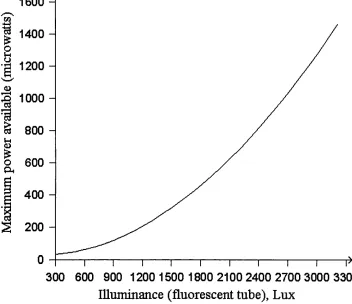
a photovoltaic power supply; however, in the first instance the system resorts to the
use of batteries. The handsets, using CMOS components (the technology of choice
for low power electronics), operate on a duty cycle: activating when a button is
pressed, transmitting the data and then deactivating. The power supply offered by the
use of photovoltaics was provisionally determined to provide an indication of the
target energy dissipation per handset operation.
The feedback system is a star shaped network, with many transmitters and a single
receiver. Without control over when each handset transmits there is a possibility that
two or more handsets’ transmissions will occur simultaneously, causing data loss.
This probability is evaluated. It is possible to organise the handsets’ transmissions,
ensuring no overlap between transmissions. However, these methods have the
undesirable effect of increasing the energy dissipation per transmission. As the
handsets are to be used to gain information regarding the entire audiences’ opinions
that handset transmissions would not be organised and a probability of data loss from
transmission overlap would be tolerated.
A transmission which does not overlap with another is subject to a separate
probability of data loss from the effects of random noise. Techniques to reduce this
probability are examined, and their impact on the feedback system quantified. The
feedback system will use frequency modulation to transmit the data on the radio
frequency carrier, and will not deploy error detecting or correcting codes at this stage.
A prototype handset system was constructed and successfully used to conduct initial
exploration of the use of the electronic feedback in teaching situations. However,
this system had an unacceptably high probability of transmission overlap if more than
eight handsets were used at one time, and hence could not be used in large class
situations. Additionally, a design flaw caused the handsets’ energy dissipation to
greatly exceed the design target.
In light of the experience gained in producing the prototype system a large class
feedback system was developed. This system was close to the design targets, as it is
affordable, can be expanded to 249 handsets and each handset has an energy
dissipation per transmission such that its batteries will last for tens of thousands of
hours of lecturing.
The results of the exploration of the use of the prototype handset system in teaching
situations are presented. It was verified that the system would have utility for an
audience over prolonged periods of teaching (the handsets were used by eight
students over six consecutive hours of lecturing). In a separate study, a total of 54
second year students were given lectures and a detailed analysis of their use of the
system conducted. This analysis shows that, although not intended at the outset, the
feedback system opens new vistas for educational research. Finally, future research
directions, both technical and educational, for this electronic lecture communication
Chapter 2 Education overview
“Be very, very careful. This ride is not for the weak. I t ’s a psycho. A bit like real
life. Well, maybe not quite that bad” Jeff Noon, ‘Vurt’
The aim of this work is innovation in education. One should not embark on such a
venture without seeking guidance from the vast body of educational theory that has
evolved. This chapter presents a brief summary of the main ideas that have been
advanced, and attempts to gauge how they might guide this project.
Review of the three principal schools of thought concerning individual learning
processes - behaviourism, gestalt and constructivism - discovered they illuminate
different aspects of the educational process. The system was therefore designed
without an attempt to be specifically welded to any single educational direction: it
will have equal applicability for lecturers using any, or none, of these ideas.
2.1 Behaviourism
Behaviourism has at its heart the precept that humans can be fully analysed by means
of the objective observation of their actions. When a person is presented with a
stimulus there will be a response. Desirable responses are encouraged through the
process of teaching, by reward and punishment. Abstract terms such as
‘consciousness’ are not inherent to the explanation of humans’ behaviour; this
behaviour is a direct product of the external events to which they are exposed.
2.1.1 Classical behaviourism
Classical behaviourism arose from the work of I. Pavlov [PAVL]. In his famous
experiment, after a period of a bell being rung when food is presented a dog will
salivate simply at the sound of the bell, without feeding. This is an example of
‘conditioning’. The unconditioned response to a bell being rung, no response on the
salivates in response to the noise itself. This work was extended to humans, with
classical behaviourists proposing that behaviour is simply the reaction of humans to
stimuli in their environment. Learning is the teacher adapting the students’ response
by rewarding correct ones, and punishing the incorrect - stimulus-response (S-R)
links are the essence of education. The actions of humans can be broken into a series
of S-R relationships, where a human leams by the formation of a new reaction to
events. There are two basic ‘laws’:
(i) law o f effect is that when a persons’ actions cause them to experience satisfaction
in a given situation, where that situation recurs the action is also likely to recur (a S-
R link is formed). Further, the greater the pleasure (or, by reflection, the lesser the
discomfort) the stronger the link between the situation and action. A later
modification to this law was that a learner who is punished for an action will seek
alternative S-R links to gain pleasure, whereas reward directly reinforces the link
(first proposed in [THOR p.96]).
(ii) law o f exercise is that, all other things being equal, more frequent repetition of a
S-R link results in a more secure connection - that is, practice makes perfect. A later
caveat to this law is that the learner must be aware of the successful outcome of his
actions (proposed in [THOR, p.95]).
W. B. Watson, an influential researcher in this school, felt humans could be
completely explained as biologically determined phenomena. He felt that humans
did not have “memory”, but skills retained over a period of no practice. He rejected
the concept of consciousness as an improvable assumption. There are no intervening
mechanisms such as thought or intention in a S-R link [WATS pp.2-6, 235-248].
2.1.2 Operant behaviourism
B. F. Skinner evolved classical behaviourism into operant behaviourism - explaining
learning behaviour in terms of ‘operant conditioning’ [SIGN]. An operant is a series
of voluntary acts on behalf of a learner in response to the environment (for example,
reinforced to improve the efficiency of the learner by reward when a correct operant
is used in a situation, or punishment when it is incorrect. Skinner also identifies
‘respondent’ behaviour, which are responses elicited involuntarily (for example,
blinking of the eye when an object approaches unexpectedly close). From these
concepts Skinner explored an experimental analysis of learning behaviour in
presence of reinforcement. He believed if one can successfully analyse the various
stimuli producing behaviour one can, by influencing those stimuli appropriately,
control behaviour.
2.2 Gestalt
Gestalt psychology is named after the German word ‘gestalt’ meaning a structure,
pattern or configuration. The gestaltists state that the mind can only productively be
viewed as a whole [BURT]. The simplicity of the S-R relationship is over
simplified, and would be better viewed as S-O-R, where the stimulus occurs, is
perceptually organised by the learner and then followed by a response. This can be
seen by the fact that a melody is recognisable whichever key the piece is played in - it
is the overall organisation of the piece that we respond to, not the precise individual
notes. The fundamental activity of perception cannot be divorced from the idea of
organisation.
The concept of ‘insight’ is central to the gestalt school. Insight is a complex reaction
to a situation in its entirety suddenly producing a new understanding - a ‘flash of
inspiration’. The learner suddenly perceives the structural essence of a problem
through a full comprehension of the situation posed by it.
There are six laws of gestalt psychology, by which one can understand the
organisation of the mind:
(i) Law o f figure-ground relations. Perceptions are organised into coherent
‘figures’ which stand out from the background as identifiable wholes
(ii) Law o f contiguity. Perceptions are grouped into figures with reference to
(iii) Law o f similarity. Similar items are grouped together in patterns.
(iv) Law o f Pragnanz. The brain tends to group perceptions into figures of
maximum simplicity and balance to give most possible illumination.
(v) Law o f closure. Incomplete perceptions are viewed as complete - the learner
‘fills in the gaps’.
(vi) Law o f transposition. Patterns are recognisable even if their exact nature has
changed. A tune can be sung in many keys whilst retaining its identity.
2.3 Constructivism
Constructivism developed in part from the gestalt school, and holds views in radical
opposition to behaviourism [LESG][MATT][MART]. Constructivism holds the view
that individuals create mental constructs from the information that is given to them.
The learner selects important information from the stimuli provided, and rejects that
which is felt to be trivial or fallacious. The learner then applies this construct to
novel stimuli. If it fails to perform adequately - providing incorrect answers, for
example - it is rejected and a new construct is developed in light of the new
information. Learning is the process of adjusting conceptions of the world to
produce the best possible result. This adjustment occurs within the learner, and
cannot necessarily be observed. The learner is an active participant in the learning
process, and not a passive recipient.
2.3.1 Classical constructivism
Classical constructivism believes that whilst the learner might have a wide variety of
experiences and resultant mental operations, all learners approach a common set of
constructs. Leading exponents of this view include J. Piaget, who stated that humans
pass through several stages of development from childhood - there is a progression of
the mind towards a shared construct [GINS]. This progression, it should be
emphasised, is not necessarily a linear one - as J. Bruner termed it, one can have a
reformulating constructs through tuition, and then circles back to the previous
understanding to permit further progress from further tuition.
2.3.2 Radical constructivism
Radical constructivism takes issue with the idea that learners progress to broadly
shared constructs. It views the learner as being unfettered as to what models to draw
from his experiences; learners create many different constructs even with the same
experiences. Learners should be encouraged to explore their constructs through the
active reinterpretation of ideas. According to this school, teaching should centre on
students’ reappraisal of their constructs with teachers acting as facilitators of many
different cognitive changes.
2.4 Implementation
The execution of these ideas in lectures with student-lecturer communication would
lead to differing teaching styles. A behaviourist lecturer would be seeking to present
the information, and then test the students upon it. Those answering correctly would
get a reward - perhaps tokens towards a free coffee (and those responding incorrectly
could receive a punishment, such as the requirement to return the tokens). If the
lecturer felt too many students answered incorrectly the material would be outlined
again, with further tests, until it was felt that the students had developed the correct
response. A gestaltist lecturer would present material with reference to its relation to
other concepts - its location in the overall picture. The feedback would then be used
to examine the nature of the figures the students had developed. Incorrect figures, or
a lack of insight into the new figure, would lead to further teaching until correct ones
were in place. A constructivist lecturer would first seek to explore what the students’
pre-existing constructs were. In light of that information, the lecture would attempt
to highlight the failures of these constructs, by presenting contradictory evidence.
Following this, the nature of the constructs the students had developed during the
strongly from that intended, further contrary facts and greater elucidation of the
material would follow.
2.5 False trichotomy?
The three schools of thought outlined are not necessarily mutually exclusive. Indeed,
to a certain extent they overlap. The underlying philosophy of the post-teaching
testing differs, but feedback is used to test students’ understanding of the material
presented in every case.
A further difficulty arises from the fact that these educational ideas were developed
with reference to school students (and animals). These learners are significantly less
complex than university students under all of the paradigms (fewer S-R links, less
operant conditioning, fewer figure-ground relationships or less detailed constructs).
This adds another layer of opacity to their application in university teaching.
A typical university provides many different types of learning, from the practical
manipulation of experimental apparatus in the sciences, to the use of syntax and
grammar in the arts (and occasionally sciences), to highly abstract concepts. Within
lectures I do not feel that any one theory of learning is applicable, but rather that there
is a spectrum of utility, where different types of learning play varying roles.
Finally, it should be noted that many lecturers do not teach with any of the three main
paradigms uppermost in their mind. Indeed, some are not aware of them at all. If the
feedback system was designed for only one theory, this would necessitate an
accompanying explanation of the theory and the manner in which the feedback
should be used. This adds complexity to the system’s introduction, which would
have to be balanced by improved results from the application of that theory. There is
no unequivocal evidence to indicate the universal superiority of any one of these
In light of these difficulties, it was considered desirable to design the feedback
system purely as a means to improve student-lecturer communication. This
communication is not entirely educationally a-theoretical. Behaviourist
communication views the student as a passive recipient of knowledge. Feedback
from the student is viewed as permitting the examination of their knowledge for
possible reinforcement. Constructivism and gestaltism, however, view the learner as
active participant: communication is to elicit the learners’ internal response to aid the
teacher in understanding the nature of their mental models. Nevertheless, leamer-
teacher communication fundamentally underlies all teaching methods. Without
adequate communication of ideas and concepts it is not possible for the student to
learn, and the provision of the means to effect feedback is theoretically neutral. It is
the lecturer’s choice how utilise the system - negating any possible ‘Not Invented
Here’ syndrome (lecturers feeling constrained to teach to a particular pedagogy that
Chapter 3 Educational technology
“now it’s all reversed. The media image is the reality, and by comparison day to day
life seems to lack excitement. So now day to day life is false, and the media image is
true. Sometimes I look around my living room, and the most real thing is the
television. I t ’s bright and vivid, and the rest o f my life looks drab. So I turn the
damn thing off. That does it every time. Get my life back. ” Michael Crichton,
‘Airframe ’
New technology has been declaimed as being on the point of revolutionising
university education since the late eighteenth century - as Samuel Johnson remarked:
“Lectures were once useful; but now, when all can read, and books are so numerous,
lectures are unnecessary” [BOSW]. These claims have persisted, with Bill Gates
writing “PCs [Personal Computers] can do a better job of supporting varied thinking
and learning modes than lecturers and textbooks can” and “the daily habits of
students and faculty will change to take advantage of the opportunities interactive
networks offer. The many small changes will add up [...] to change significantly the
formal processes of education.” [GATE] To date, the outcomes of these claims have
been somewhat less dramatic.
This chapter will argue that the introduction of some technologies has improved the
delivery of university teaching, and will continue to do so. These technologies have
supplemented existing teaching formats, for example the use of text in tandem with
lecturing; or replaced elements within a teaching format as with the use of overhead
projections (OHPs) largely replacing chalk and blackboard within lecture theatres.
Other technologies have made less impact, such as the predicted widespread use of
television as a medium for the delivery of university teaching [IVES]. A technology
is most likely to be successfully introduced if it satisfies a number of criteria. The
changes it provides should address specific weaknesses in a teaching situation. The
development of educational material using the technology and, critically, its delivery
in the educational situation should be as low-cost as possible.1 The technology
should also offer discernible benefits, either by improving the quality of teaching
outcome, or by providing savings in the time and/or cost required for the overall
teaching function.
The need to improve the quantity, quality and immediacy of student-lecturer
communication in large class lecturing has long been recognised (for example [BLIG
pp.99-121]). There have been various previous attempts to introduce technology to
encourage this communication without widespread success - although where there
has been long-term use significant learning improvement is apparent [POULa].
Possible reasons for this lack of take-up are identified to guide the development of
radio frequency lecture feedback. It will be reliable, flexible, portable, inexpensive
and requiring minimal maintenance. Further, the physical process of student data
transmission will be as confidential as possible, and it will be presented to the
lecturer without identification of the originator. The feedback may be initiated by
students, so that they can indicate when they are having difficulty in understanding
the lecture, or by the lecturer posing multiple choice questions.
3.1 Historical outcomes of educational technology
There have been many attempts to introduce promising technologies into university
education, but few successes. Diana Laurillard quotes “a folk wisdom in academic
circles that educational technologies come and go, and all the expensive machines
end up gathering dust in cupboards.” [LAUR p.210] This is somewhat unfair, not
least as it implicitly defines educational technologies as “expensive machines”, and
the subsequent discussion also focuses on newer educational technologies such as
audio-visual media and the use of computers in education. It is important to
recognise older technologies such as OHPs as providing very useful case studies of
success; with a case study of an unsuccessful technology being provided by one form
3.1.1 Case study of a successful technology
One comparatively recent and highly widespread use of an educational technology is
that of overhead projection during lecturing - Lewis Elton claims the “two most
successful aids in education over the past twenty years have not been television and
the computer, although they have had the most publicity, but the overhead projector
and the Xerox machine” [ELTO]. However, there is a dearth of study of the teaching
effectiveness, and ancillary impact, of lecturing using OHPs as compared to the
traditional chalk-on-blackboard delivery. I am forced, therefore, to surmise the
attractions that lead to its ubiquity.
Some attractions can perhaps best be understood by observing where OHPs have not
found widespread use - mathematics teaching, where the use of blackboards
remained common. In broad terms, mathematics relies on the comprehension of a
series of logical procedures that lead toward a conclusion - each step is as important
as the next. Therefore, there are fewer opportunities to present key conceptual
crystallisations of material. It is important to note that OHPs can be used in exactly
the same way as blackboards, with the lecturer writing on overheads during the
discourse (and devices such as the continuous feed, roller to roller, transparency even
obviates the difficulty of changing single transparency pages). The lack of OHP use
in this manner could be due to the difficulty of quickly writing large quantities of
clear notation in a font that is small to the lecturer.
Overhead projections in lectures are not often used in this direct blackboard
replacement format - more common are individual transparency pages upon which
the lecturer has prepared written information. Subjects taught in OHP assisted
lectures often do have conceptual crystallisations. For example, in physics laws and
concepts can be introduced in a written format, and their effects and manifestations
subsequently discussed - the key material can be condensed and presented in bullet
point format. The OHP can be used to reproduce, identify and emphasise important
material; the lecturer is then freed from the ‘mundane’ task of writing and can talk
but there are further additional logistical advantages with the use of prepared
transparencies: ensuring the presentation of all the material intended with an ordered
delivery, little chance of missing important topics, the writing itself is likely to as
legible as possible and, above all, the lecturer is released from the chore and
distraction of writing during the lecture. It also reasonably simple to use colour to
consistently highlight or identify categories of material.2 OHPs can additionally be
used to present diagrams and pictures without the need to create them during the
lecture itself (such pictures commonly also represent a condensation of information).
Many OHP lectures also include textbook references and handouts of more detailed
material - the latter often photocopied - so much so that Laurillard comments that this
“combination of lecture and print has almost become the canonical form of the
‘lecture’” [LAUR p.l 10]. In this case, printed text is used to pass a detailed
permanent copy of factually deductive and logical information to the students,
removing the need to take copious amounts of notes.
Therefore one can discern that the use of OHPs frees the lecturer, and to a degree
students, from the task of writing during the lecture. This allows the lecturer a more
wide ranging teaching role - not least by facing the class - and ensures important
points are highlighted and can be readily understood by students who are able to
concentrate on understanding the material presented. Additionally, once OHPs have
been written, they stay written: there are time savings to the lecturer over a multi-year
timescale.
There are also some disadvantages that are avoided in the use of overhead projection.
It is a robust technology with little chance of an unexpected breakdown; once
installed the projector and screen cost very little to maintain, and the marginal cost of
the creation of each overhead projection is extremely low.
3.1.2 Case study of two less successful technologies
There are few examples of technologies that have been introduced into university
education that have entirely failed to have an impact. However, many have yet to
progress beyond use in specific situations, such as the delivery of teaching via
television which is largely confined to distance learning (for example, by the Open
University). This is despite initial claims that videotaped lectures would “reduce
costs per student-hour, while holding outputs constant” whilst “replacing bad
instructors by good ones” [LAYA]. A clue to this medium’s lack of penetration is,
surprisingly, to be found within the same paper where it recognised that “videotape
can never justify its fixed presentation costs unless the equipment is used for at least
15 hours [per year][...] Similarly, whatever the number of hours’ usage, it can never
justify its master costs unless each course-hour is used by at least two institutions”.
The authors felt this a surmountable obstacle - but it does require a considerable
initial commitment by those two institutions, and the figures also rely on a series of
estimations of the costs of producing videotape that were acknowledged to be at the
cheaper end of the spectrum of possibilities. Evidently, the commitment felt
necessary was not forthcoming.
There is a good example of a thoroughly unsuccessful technology intended for use in
schools, Viewdata, principally because of a remarkably candid paper from one of the
technology’s advocates, Oleg Liber [LIBEa]. Viewdata was the provision of
computer mediated teaching materials. A large database of pages, each “containing
text and simple mosaic graphics in up to 7 colours, similar to teletext pages” could be
accessed via a “basic microcomputer” with a modem connection to ordinary
telephone lines; material could be “created and stored locally, but accessed globally”
[ibid.]. These pages were to be used principally as a factual information retrieval
facility by schools, to which students could refer. The development of this
information delivery mechanism was hailed as having the potential to be as important
as the development of the printing press [LIBEb].
However, fifteen years after its introduction in the early 1980s Viewdata was defunct.
It could perhaps be described as a technological solution in search of an educational
problem. It had no clearly defined role within its education milieu and solved few
pre-existing difficulties in the access to information (the vast majority of
schoolchildren can visit libraries); neither was a new, supplementary education
modality developed. Indeed, Liber notes that the longest lasting element of the
Viewdata network was one that had not been initially envisaged as being important:
the later development of pages that permitted interpersonal interaction, as “people
preferred to use systems that allowed discussion. Communication is preferable to
information” [LIBEa].
Viewdata not only had a lack of clarity in its educational objectives, it also had a high
marginal cost per use. Even after the purchase of the necessary technical equipment,
schools had to pay the costs of the telephone link to access the pages, and “cuts in
education funding led to many [local education] authorities to limit school’s
telephone budgets, and schools turned their focus on to other aspects of IT
[information technology]” [ibid.].
3.1.3 Summary
The reasons for a technology’s success, or lack of it, can often be determined after
the attempt at introduction. It is more important to seek guidelines in light of past
experiences against which a technology can be judged before expenditure is incurred.
Laurillard suggests that the technology must have a “learning context” including:
“student preparation” making them aware of the objectives of the learning and its
place within the wider course, “integration with the rest of the course” to ensure that
the technology is not treated as a bolt-on, “inculcating an appropriate conception of
learning” and providing “supporting materials”; academic “assessment” should cover
the materials introduced by the technology, and the “logistics” must not be neglected
to an existing teaching situation, where many of these elements will already be in
place. This point is made more forcibly, with reference to a number of educational
technology innovations, by Steve Draper, who states that successful outcomes are
“where a teacher analysed what was particularly weak in an existing situation and
thought of how technology could be used to address that bottleneck” and offers the
following prescription: “take a specific teaching and learning situation; identify the
main limitation in the current delivery method; design a solution. Leave other things
alone” [DRAP].
There is a further practical requirement that should be added to these educational
themes: the technology must be robust as its failure could easily forestall learning.
There are also economic considerations. The technology should not be prohibitively
expensive to acquire, including such externalities as the space and facilities required
for its use. It should not need frequent replacement (the acceptable frequency is, of
course, dependent on the required capital). However, the recurrent costs of delivery
are probably more important. The cost and time needed to develop teaching material
for use with the technology should be minimised. The time required to switch
between items of teaching whilst the technology is in use should also be as short as
possible. Further, the students’ use of the technology should not incur significant
expense (for example, the technology should require minimal maintenance).
A recent report, Information Technology Assisted Teaching and Learning (ITATL) in
UK Higher Education, prepared for the National Committee of Inquiry into Higher
Education (the “Dearing Report” [DEAR]) found that these practical and economic
considerations were most likely to be met by techniques that are not state of the art.4
“There appears to be a relatively strong case for ITATL investments which involve
less complex technologies and applications. Typically these are robust, require low
maintenance [and] support and the processes of adoption are simplified. We
recommend that funding agencies support the adoption of less complex technologies
where demonstrable economies of scale or quantifiable improvements in learning can
be anticipated” [DAVI].
3.2 Improving lecturing
Lecturing is commonly recognised as being a teaching modality that deserves
improvement. There is a need for training for lecturers, so that best practice can be
adopted - such as preparing lectures in advance, communicating information
efficiently, etc. [BLIGpp.59-152, 180-191]. However, a more fundamental difficulty
for lecturers (however well trained) is that a lecture “provides little opportunity for
judging audience understanding and reaction accurately” [GREG]. The didactic flow
is unidirectional - there is no “conversational framework” within which the teacher
and students can interact [LAUR pp. 102-105]. Additionally, students have little
formal role with the lecture providing “limited opportunity for active student
participation” [GREG]. This passivity can all too often degenerate into a total
disengagement from the lecture, replaced by thoughts on possibly more agreeable
matters.
Recent research into the improvement of lectures has concentrated on replacement of
all or parts of the lecture to encourage students to engage in the teaching process.
This can be ascribed in part to a tendency for lecturing to be dismissed as “a grossly
inefficient way of engaging with academic knowledge” which should provide a
“baseline” from which to escape [LAUR pp. 107-109]. Many papers propose
changing the lecture format by introducing student-student interaction, or ‘buzz
groups’ (for example, [JACK]). The idea is to break the lecturer’s discourse into
smaller sections, interspersed with periods where students actively discuss amongst
themselves problems or issues raised by the lecturer, after which their conclusions
are made known (by a show of hands, etc.). The intention is to “break the
unavoidable monotony of the passive lecture” [MAZU]. However, whilst providing
students with a role (periodically), this idea does not address the central difficulty of
the lecturing itself being a monologue, and any difficulties in student conceptions not
However, there is the possibility of engaging students during the discourse itself - to
use feedback from the audience to the lecturer to pass information on the progress of
their understanding, which also provides students with a more active role. Lecture
theatre feedback is not a new idea, inter alia being identified as a promising concept
by Bligh, but has not found widespread use [BLIG pp.99-121].
At a most basic level, student feedback in response to questioning is possible within
lecture theatres without technology, by a show of hands. However, this has
disadvantages: it requires students to publicly associate themselves with an answer,
potentially leading to students feeling exposed to ridicule; it is time consuming to
ask questions with more than two possible answers,5 and it can be difficult to
ascertain with accuracy the proportion of students with their hands up.
3.2.1 Prior attempts to deploy lecture feedback
There have been prior attempts to improve upon ‘show of hands’ feedback. One
such technique was the “Feedback Classroom”: each seat in a classroom is provided
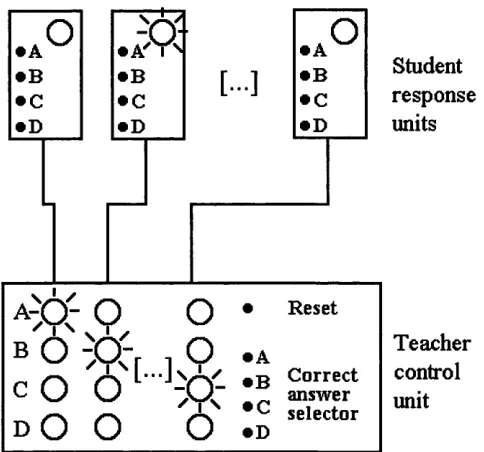
with a “response unit” upon which there are several buttons, figure 3.1, connected via
wire to a “teacher control unit” [WEBB][HOLL]. The lecturer pre-selects the correct
answer on the teacher’s control unit, and then poses a multiple choice question. The
students press the button corresponding to their answer. If a student’s answer is
correct, a small partially screened lamp on the response unit is illuminated; the
lecturer has a set of lamps to indicate every student’s answer whether correct or not.
This solution has the distinct advantage that students’ answers are confidential.
However, the system is relatively cumbersome, with many wired connections,
requires installation before use and cannot readily be expanded to very large classes
as the number of lamps on the teachers console would become unwieldy.
Additionally, the lecturer pre-selection of the correct answer is time-consuming.
Perhaps for these reasons the Feedback Classroom concept fell into disuse, with no
published analysis of its effects on students learning.
• A • B • C
• D
• A • B • C
• D
• B • C
• D
/ 1 N v 1 ✓
B ° W [ . . . ]x9
c O O l
IQ
d
O O
O
• A • B • C
• D
R eset
C orrect answer selecto r
Student response units
Teacher control unit
Figure 3.1 — The “Feedback Classroom each student is provided with a response
unit for multiple choice questioning. I f a student’s answer is correct (determined by
pre-selection on the teacher’s console - ‘B' above) a lamp is illuminated. The
teacher can see all the answers offered by students, also by lamp illumination. After
each question has been answered the teacher resets the system by pressing the
appropriate button
Another form of hardwired feedback was introduced successfully and used over
many years, “Audience Paced Feedback” (APF), which is essentially similar to the
Feedback Classroom, but with simplifications [POULb]. There is no
‘correct/incorrect answer’ lamp on these units; the system has only a single button on
each response unit and questions are phrased so that they can be answered by a
simple “yes” or “no”. The lecturer can then intersperse periods of feedback between
discourse of material. This feedback is used in various ways:
“(a) exploration, to gauge the opinion of the students of their own
understanding (for example, “Have you understood my arguments regarding
this equation?”)
(b) verification, to allow the lecturer to assess the state of the students
(c) interrogation, to test the ability of the students to apply the work to specific
situations (for example a multiple choice question [...])
(d) organization (“Are you ready for me to continue?”)” [POULa]
The lecturer can then pose questions, with the students’ responses displayed by a dial
which indicates the proportion of students pressing their button (permitting its use in
large class lectures). The lecturer does not need to physically pre-select a correct
answer; after each use the system is reset by a button press. The technology is robust
and the marginal cost and time needed for its operation by the lecturer is low.
Analysis indicates a highly positive educational outcome. The results of
approximately 2,500 student-years of APF lecturing was compared to a similar
number of student-years of lecturing without feedback (with the traditional lectures
in the preceding or succeeding years of APF lectures). The chosen evaluation tool
was the examination pass rate of the attending students, as it will provide an
indication of the students’ learning. APF was found both to significantly increase the
pass rate and reduce its year on year variation: students both understand the material
better and the level of attainment is more consistent over several years [POULa].
This is an encouraging endorsement that feedback can have a role to positive role to
play in lecturing.
However, this feedback form still requires the installation of the wired system, which
seems to have deterred more widespread use of this technique. Additionally,
problems in understanding can only be diagnosed when a question is answered
incorrectly as there is also no facility for students to initiate feedback - any problems
in student understanding early in a period of lecturing will not be disclosed until the
next period of questioning.
A different form of technology was introduced in reaction to the Feedback Classroom
scheme. It sought to be more simple, inexpensive and robust and was introduced at
RAF Cosford [TAPL]. Each student was provided with a wooden cube, the faces of
which were painted different colours. The lecturer could then ask questions with up
elbows on his desk with the cube cupped in both hands below his chin”; students
could also initiate feedback as the “black face of the cube may be shown at any time
the student feels the need during the lesson to indicate ‘I do not understand’ and the
white may be used to indicate ‘All clear now”’ [ibid.]. This technique for obtaining
answers to questions accords with the practical and economic considerations
previously identified; however, the feedback is not completely confidential. This
could lead to difficulties similar to those of ‘show of hands’ feedback. Additionally,
students’ indication of understanding difficulties whilst the discourse is in progress is
not apposite. Students are required to disengage from any note taking, locate the
black face and then go through the display procedure, thereby identifying themselves
as having difficulties in comprehension (as the ‘All clear now’ function is necessarily
preceded by a ‘I do not understand’). It is also difficult to achieve much accuracy in
the determination of the proportions of students indicating a particular answer.
There are no published analyses of the outcome of lectures using Cosford Cubes, and
the technique has fallen into disuse despite its advantages of cheapness and
robustness. It is likely that this is principally due to it having few advantages over a
show of hands as a means of question response: it still requires students to identify
themselves with opinions. This difficulty is more acute when students wish to
inform the lecturer of comprehension difficulties during a lecture discourse.
3.3 Conclusions
Previous successful and unsuccessful educational technology innovations have been
critically analysed. From these, and from wider studies, it is clear that an educational
technology innovation should provide a solution on a specific weakness in a teaching
situation, and be capable of introduction and use with the minimum of outlay of time
or cost.
The most common formal teaching format of university education is the lecture. The
clearest weakness of the lecturing modality is that it provides little opportunity for
the process. These weaknesses can be addressed by the introduction of a lecture
technology to permit student feedback. This feedback should be available when the
student feels it necessary to indicate difficulties, and permit the lecturer to pose
questions to explore student conceptions.
The exploration of previous attempts to introduce lecture feedback serve to reinforce
the conclusions drawn from the wider scale study of educational technology. The
most successful of these, Audience Paced Feedback, is robust, simple, confidential,
requires little effort to use from either the lecturer or students and has been shown to
have a encouragingly positive effect on learning outcomes. However, this technology
does require the installation of fixed infrastructure, which could have discouraged its
more widespread introduction. Other feedback techniques have met with less
success, primarily because they require greater input from students or lecturers.
The feedback introduced should, therefore, be as robust and inexpensive as possible.
To obviate the need for fixed installations the feedback technology should be
portable. The display of the students’ opinions should be designed so that it can
easily cope with large classes. A particular student’s transmission of an opinion to
the lecturer should be confidential to all lecture theatre participants; and all those
present in a lecture should be able to initiate contact. The feedback technology
should require little or no maintenance, to minimise the costs of delivery; the time
and cost of the preparation of teaching materials to be used with the feedback must