HYPOGLYCEMIC ACTIVITY OF EXTRACTS OF OROXYLUM IDICUM (L.) VE#T ROOTS I# A#IMAL MODELS
Ashpak M. Tamboli*, Sujit T. Karpe, Sohrab A. Shaikh, Anil M. Manikrao,
Dattatraya V. Kature
Sahyadri college of Pharmacy, Methwade, Tal: Sangola, Dist: Solapur.
*Correspondance: E-mail: [email protected]
Summary
India leads the world with largest number of diabetic subjects earning the dubious distinction of being termed as “diabetes capital of the world” unless urgent preventive steps are taken. The so called “Asian Indian Phenotype” refers to certain unique clinical and biochemical abnormalities in Indians which include increased insulin resistance, greater abdominal adiposity i.e., higher waist circumference despite lower body mass index, lower adiponectin and high sensitive C-reactive protein levels. In present study, the hypoglycemic effect of the aqueous and ethanolic extracts of Oroxylum indicum roots were examined in alloxan and dexamethasone induced diabetic rats. The extracts at 500 and 300 mg/kg produced a significant decrease in plasma glucose levels when compared with diabetic control group in alloxan induced diabetes and dexamethasone induced insulin resistance in rats. Phytochemical investigations were also accomplished and presence of alkaloids, tannins, flavonoids and glycosides were recognized in extracts.
Keywords: Alloxan, Dexamethasone, Hypoglycemic, Oroxylum indicum
Introduction
Diabetes mellitus is one of the main threats to human health in the 21st century. The World Health Organization (WHO) estimated that there were 135 million diabetics in 1995 and this number would increase to 300 million by the year 2025. India leads the world today with the largest number of diabetics [2].
Oroxylum indicum (L) Vent belonging to the family Bignoniaceae has chosen for hypoglycemic activity. The plant has been suggested in the Indian system of medicine for a number of disorders such as rheumatism, diarrhea, cough, diabetes and cystitis [3]. This study was therefore undertaken to find out whether in the case of Oroxylum indicum roots aqueous and ethanolic extracts are effective in the management of diabetes in alloxan induced diabetes and dexamethasone induced insulin resistance in rats.
Materials and methods
Plant materials
The plant Oroxylum indicum belongs to the family Bignoniaceae is largely found in the Maharashtra. The roots of the plant were acquired from Bavadekar ayurvedic shop, Kolhapur. The collected plant roots were carefully separated and washed with tap water and left to dry for 15 days in the shade at room temperature. The dried roots were stored in well sealed cellophane bags, so as to prevent from the environmental effects. The shade dried powdered roots were used for the successive solvent extraction with Petroleum ether, Chloroform, Ethanol and Distilled water. In each case, the powder weighing approximately 225-250 gm was extracted by adding 1000 ml of the solvents. The duration of extraction varies with the solvent and was found to be between 08-12 h with all the solvents. The extract was filtered and the filtrate evaporated to dryness under reduced pressure using a rotary evaporator [4].
Preparation of extract
The required dose of aqueous extract was prepared in distilled water and the ethanolic extract was suspended in 0.5% CMC with distilled water.
Experimental Animals:
Albino male Wistar rats weighing between 150 to 200g were procured form registered breeders. The animals were housed under standard conditions of temperature (25 ± 2O C) and relative humidity (55- 65%) with a 12:12 light-dark cycle. The animals were fed with standard pellet diet and water ad libitum. Approval of CPCSEA for the Institutional Animal Ethics Committee (IAEC) of Appasaheb Birnale College of Pharmacy, Sangli was taken for conducting hypoglycemic activity activity.
Acute oral toxicity study
Selection of standard drug and dose:
The hypoglycemic effect of extract was compared with the standard antidiabetic drug glimepiride 4mg/kg b.w. single dose in alloxan induced diabetes rats. Pioglitazone was suspended in 0.5 % CMC and administered orally at a dose of 30 mg/kg b.w. using oral feeding needle and used as standard drug in dexamethsone induced diabetes rats. The quantity of drug administered to each animal was calculated daily from its body weight.
Alloxan induced diabetic rats
The study was carried out for 21 days to access the effect of various treatments on biochemical parameters and glycogen content of different tissues in alloxan induced diabetes in rats. Rats were made diabetic by a single intraperitoneal injection of alloxan hydrate at a dose of 120 mg/kg [6]. Alloxan was first weighed individually for each animal according to the body weight and solubilized with 0.5 ml of normal saline. Then 7 days later blood samples were collected by retroorbital puncture method and glucose levels were determined by using glucose estimation kit (GOD-POD Method) to confirm the development of diabetes. Rats with serum glucose levels of >200 mg/dl were included in the study [7].
Dexamethasone induced diabetic rats
The study was carried out for 11 days to access the effect of various treatments on biochemical parameters and glycogen content of different tissues in dexamethasone induced insulin resistance in rats. The rats were divided into 7 groups, consisting five animals each. Rats in the first group received vehicle (2 ml/kg) and served as normal control group while the second group of rats received vehicle plus dexamethasone (10 mg/kg s.c.) [8] served as diabetic control group (positive control group). Rats in the third group were treated with pioglitazone (30 mg/kg, p.o.) plus dexamethasone (10 mg/kg). Rats in experimental group 4 and 5 were treated with aqueous extract (300 and 500 mg/kg p.o. resp.) and dexamethasone (10 mg/kg, s.c.). Rats in the group 6 and 7 received ethanolic extract (300 and 500 mg/kg p.o. resp) along with dexamethasone (10 mg/kg, s.c). At the end of experimental period, i.e. on day 11, the overnight fasted animals were anaesthetized with diethyl ether and blood was collected by retroorbital puncture method. Serum was separated by using centrifuge machine at 5000 rpm for 5 min and stored at 4-80 C until use.
Biochemical Analysis:
BSL, serum triglyceride, total cholesterol and glycogen content were estimated.
Phytochemical analysis
Phytochemical group tests were also accomplished as per standard text [9, 10] and presence of alkaloids, tannins, flavonoids and glycosides were recognized in extracts.
Statistical analysis
Results
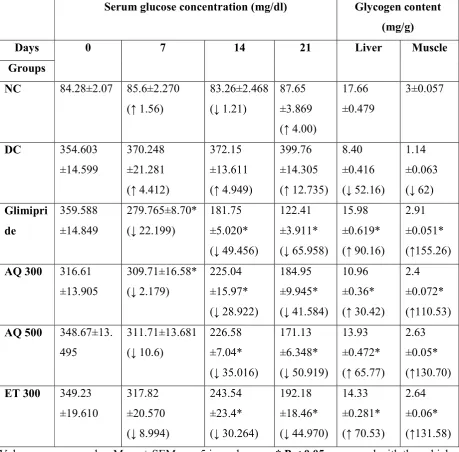
Table #o: 1 Effect of Aqueous and Ethanolic extracts of roots of Oroxylum indicum (L.) Vent on serum glucose level and glycogen content of Alloxan induced diabetic animals during chronic study
Serum glucose concentration (mg/dl) Glycogen content
(mg/g)
Days
Groups
0 7 14 21 Liver Muscle
#C 84.28±2.07 85.6±2.270
(↑ 1.56) 83.26±2.468 (↓ 1.21) 87.65 ±3.869 (↑ 4.00) 17.66 ±0.479 3±0.057
DC 354.603
±14.599 370.248 ±21.281 (↑ 4.412) 372.15 ±13.611 (↑ 4.949) 399.76 ±14.305 (↑ 12.735) 8.40 ±0.416 (↓ 52.16) 1.14 ±0.063 (↓ 62) Glimipri de 359.588 ±14.849 279.765±8.70* (↓ 22.199) 181.75 ±5.020* (↓ 49.456) 122.41 ±3.911* (↓ 65.958) 15.98 ±0.619* (↑ 90.16) 2.91 ±0.051* (↑155.26)
AQ 300 316.61
±13.905 309.71±16.58* (↓ 2.179) 225.04 ±15.97* (↓ 28.922) 184.95 ±9.945* (↓ 41.584) 10.96 ±0.36* (↑ 30.42) 2.4 ±0.072* (↑110.53)
AQ 500 348.67±13.
495 311.71±13.681 (↓ 10.6) 226.58 ±7.04* (↓ 35.016) 171.13 ±6.348* (↓ 50.919) 13.93 ±0.472* (↑ 65.77) 2.63 ±0.05* (↑130.70)
ET 300 349.23
±19.610 317.82 ±20.570 (↓ 8.994) 243.54 ±23.4* (↓ 30.264) 192.18 ±18.46* (↓ 44.970) 14.33 ±0.281* (↑ 70.53) 2.64 ±0.06* (↑131.58)
Table #o: 2 Effect of Aqueous and Ethanolic extracts of roots of Oroxylum indicum (L.) Vent on serum Triglyceride and serum total cholesterol level of Alloxan induced diabetic animals during chronic study.
Serum Triglyceride concentration
(mg/dl)
Serum Total cholesterol concentration
(mg/dl)
Days
Gr.
0 7 14 21 0 7 14 21
#C 113.69
±3.383 118.46 ±3.34 (↑ 4.01) 116.74 ±2.676 (↑ 3.00) 116.75 ±3.00 (↑ 2.51) 99.71 ±2.4 107.37 ±2.63 (↑ 7.68) 96.36 ±9.96 (↓ 3.36) 104.5 ±15.11 (↑ 4.80)
DC 115.86
±3.7 219.42 ±16.1 (↑ 140.3) 278.41 ±10.16 (↑ 140.3) 299.5 ±10.41 (↑ 158.5) 99.92 ±12.98 178.5 ±14.74 (↑ 78.5) 169.89 ±10.11 (↑69.89) 206.01 ±13.709 (↑ 106.01) Glimi pride 117.81 ±5.9 138.43 ±9.2* (↑ 17.5) 136.88 ±24.93* (↑ 16.18) 129.45 ±6.59* (↑ 9.88) 112.74 ±14.65 142.04 ±17.74 (↑ 25.99) 118.86 ±11.42* (↑ 5.43) 129.12 ±7.8* (↑ 5.43) AQ 300 116±5. 998 165.71 ±11.064* (↑ 42.86) 176.65 ±13.12* (↑ 52.29) 168.63 ±11.18* (↑ 45.38) 139.63 ±16.8 141.62 ±10.78 (↑ 1.43) 144.68 ±11.08 (↑ 3.62) 188.69 ±17.55 (↑ 35.14) AQ 500 117.84 ±7.1 155.46 ±11.38* (↑ 31.92) 164.38 ±12.37* (↑ 39.49) 155.95 ±10.47* (↑ 32.34) 104.93 ±23.45 134.97 ±14.2 (↑28.63) 132.21 ±15.29 (↑25.99) 143.72 ±13.33* (↑ 36.96) ET 300 118.52 ±5.05 166.89 ±5.94 (↑ 40.81) 168.93 ±7.56* (↑ 42.53) 183.96 ±7.24* (↑ 55.21) 87.48 ±17.62 131.55 ±16.95 (↑ 50.38) 142.17 ±156.43 (↑62.51) 174.3 ±12.19 (↑ 99.29) ET 500 116.06 ±5.19 149.04 ±9.3* (↑ 28.41) 153.82 ±8.72* (↑ 32.53) 168.37 ±6.042* (↑ 45.07) 102.5 ±24.12 129.05 ±22.25 (↑ 25.9) 147.84 ±15.24 (↑44.23) 165.35 ±10.43 (↑ 61.32)
Table #o: 3
Table #o: 3 Effect of Aqueous and Ethanolic extracts of roots of Oroxylum indicum (L.) Vent on Serum glucose, Serum Triglyceried, Total Cholesterol level and glycogen content of Dexamethasone induced insulin resistance in rats.
Glycogen content (mg/g) Groups Serum glucose
concentration
(mg/dl)
Serum
Triglyceride
concentration
(mg/dl)
Serum Total
Cholesterol
concentration
(mg/dl)
Liver Muscle
#C 88.492±2.702 123.72±7.131 121.56±4.289 20.12±0.230 2.82±0.046
DC 182.922±3.716
(↑ 106.710)
180.64±9.196
(↑ 46.01)
162.983±6.004
(↑ 34.07)
8.3±0.353
(↓ 55.82)
1.31±0.031
(↓ 53.55)
Glimipride 115.338±2.738*
(↓ 36.947)
152.44±10.286*
(↓ 15.611)
130.092±7.576
(↓ 20.181)
18.49±0.366*
(↑ 107.99)
2.72±0.038*
(↑ 107.63)
AQ 300 158.718±3.241*
(↓ 13.232)
155.46±4.357
(↓ 13.939)
159.915±14.289
(↓ 1.882)
13.66±0.331*
(↑ 53.66)
2.13±0.039
(↑ 62.60)
AQ 500 150.682±3.399*
(↓ 17.625)
175.347±7.887
(↓ 2.930)
161.652±13.029
(↓ 0.817)
14.58±0.491*
(↑ 64.00)
2.33±0.042*
(↑ 77.86)
ET 300 158.16±3.034*
(↓ 13.537)
167.297±6.994
(↓ 7.387)
153.357±11.941
(↓ 5.906)
16.16±0.448*
(↑ 81.78)
2.27±0.065*
(↑ 73.28)
ET 500 153.62±2.869*
(↓ 16.019)
155.463±4.357
(↓ 13.938)
167.45±15.665
(↓ 2.741)
15.36±0.253*
(↑ 72.78)
2.61±0.046*
(↑ 99.24)
Values are expressed as Mean ± SEM, n = 5 in each group, * P < 0.05 compared with the vehicle treated normal control group at respective hour. Values in brackets indicate percent increase or decrease vs. respective initial fasting value (0 day).
Effect on serum glucose level of Alloxan induced diabetic animals during sub acute and chronic study
Effect of aqueous and ethanolic extracts on glucose levels of Alloxan induced diabetic animals during Sub-acute and chronic study are presented in table no: 1.
and ethanolic extracts at 300 mg/kg & 500 mg / kg produce significant reduction in serum glucose levels after 21 days when compared with diabetic control group.
Effect on serum Triglyceride level of Alloxan induced diabetic rats
Effect of aqueous and ethanolic extracts on serum Triglyceride levelof Alloxan induced diabetic rats are presented in table no: 2. On 21 day Diabetic control group shown 158.5 % increase in serum Triglyceride and glimipride treated diabetic rats shown only 9.88 % increase while aqueous extract at 300 & 500 mg/kg reveled 45.38 & 32.34 % increase and that of ethanolic extract at 300 & 500 mg/kg 55.21 & 45.07 % increase respectively. Groups treated with glimipride, aqueous and ethanolic extracts shown significant reduction in serum Triglyceride after 14 days.
Effect on serum Total cholesterol level of Alloxan induced diabetic rats
Effect of aqueous and ethanolic extracts on serum Total cholesterol level of Alloxan induced diabetic rats are presented in table no: 2. Groups treated with aqueous extracts (at 300 & 500 mg / kg) and ethanolic extract at the dose of 300 mg/kg were found out to be less effective in reducing total cholesterol and only glimipride and ethanol extract at dose of 500 mg / kg with only 5.43% & 61.32 % increase shown significant reduction on 21 day when compared with diabetic control group.
Result of Glycogen content of Liver, Muscle in Alloxan induced diabetic animals
Effect of aqueous and ethanolic extracts on Glycogen content of Liver, Muscle of Alloxan induced diabetic rats are presented in table no: 1. Diabetic control group showed reduction in glycogen content of liver and skeletal muscle by 52.16 and 62 %. Ethanolic extract at the dose of 500 mg/kg shown 74.57 and 147.37 % increase in glycogen content while least increase was shown by aqueous treated hyperglycemic group with only 30.42 and 110.53 % increase in liver and muscle glycogen. Glimipride and both the extracts (at 300 & 500 mg / kg) had shown significant reduction in glycogen content when compared to diabetic control group.
Effect on Serum glucose level of Dexamethasone induced insulin resistance in rats
Results of Serum Triglyceried and Total Cholesterol level of Dexamethasone induced insulin resistance in rats
Result of Serum Triglyceried and Total Cholesterol level of Dexamethasone induced insulin resistance in rats are presented in table no: 3. Continuous treatment with aqueous and ethanolic extract at dose of 300 and 500 mg/kg along with dexamethasone at 10 mg /kg produced no significant effect on serum triglyceride and total cholesterol when compared to dexamethasone treated group.
Effect on Glycogen content of Liver, Muscle of Dexamethasone induced insulin resistance in rats
Effect on aqueous and ethanolic extracts on Glycogen content of Liver, Muscle of Dexamethasone induced insulin resistance in rats are presented in table no: 3. Group of animals treated with aqueous extract at 300 mg/kg along with dexamethasone at 10 mg /kg produced no significant increase in glycogen content with only 62.60 % increase in glycogen content when compared with dexamethasone treated group. Glimipride and aqueous extract at 500 mg/kg and ethanolic extract at 300 & 500 mg/kg treated group along with dexamethasone at 10 mg/kg produced significant increase in glycogen content of liver and muscle when compared to dexamethasone treated group.
Discussion
Alloxan causes reduction in insulin secretion by selective destruction of β cells of pancreas which ultimately results in diabetes. The cytotoxic action of this diabetogenic agent is mediated by reactive oxygen species along with disturbances in intracellular calcium homeostasis in β cells of pancreas [8]. Purpose of present study is to evaluating hypoglycemic activity extracts of Oroxylum indicum (L.) Vent roots in diabetic rats.
Chronic study in alloxan induced diabetic rat revealed effectiveness of extracts in reducing serum glucose level. Greatest reduction in serum glucose concentration was shown by aqueous and ethanolic extracts at 500 mg/kg after 21 days by 50.92 & 49.59 % respectively when compared with initial fasted serum glucose level, both the aqueous and ethanolic extracts shown significant improvement in glucose tolerance, when compared with diabetic control group.
The levels of serum triglycerides and total cholesterol were elevated in diabetic animals by 158.5 & 106.1 % after 21 days. Extract treatment do not revealed improvement in total cholesterol level while significant control on serum triglycerides was achieved by aqueous and ethanolic extract after 7 days when compared with diabetic control group. Aqueous treated group at 500 mg/kg shown only increase of 32.34% in serum triglyceride level which was greatest as compared to other groups. Glycogen level is considered as a marker for insulinomimetic activity. Glycogen content of all the animals was significantly increased as compared to diabetic control group. Diabetic control group shown reduction of glycogen in liver and muscles up to 52.16% & 60 % respectively. Group of animals treated with ethanolic extract at 500 mg/kg shown greatest increase with 147.33 % which is comparable with standard when compared with diabetic control group.
blunting insulin’s action to suppress hepatic glucose production along with reduction in peripheral glucose utilization [11].
Administration of dexamethasone alone at 10 mg/kg for continuous 10 days results in increase in serum glucose, triglyceride and total cholesterol. Aqueous and ethanolic extract revealed no significant reduction in triglyceride and total cholesterol when compared with diabetic control group. Serum glucose was significantly reduced in glimipride, aqueous and ethanolic extract treated rats when compared with diabetic control group. Diabetic control group shown increase in serum glucose up to 106.71 % while that of ethanolic extract treated group results in decrease in glucose up to 17.63 % compared to diabetic control group.
Muscle and liver glycogen content of increased significantly by 99.24 % and 72.78 % respectively for 500 mg/kg of ethanolic extract as compared to dexamethasone alone treated group.
Conclusion
Result of present study revealed that the aqueous and ethanolic extract of roots of Oroxylum indicum (L.) Vent has no hypoglycemic activity but it seems to be effective in reducing elevated blood glucose level in alloxan induced diabetes and dexamethasone induced insulin resistance in rats. Improvement in body weight, serum triglyceride levels as well as glycogen content of insulin dependent tissues was shown by aqueous and ethanolic extract. Aqueous and ethanolic extract showed similar antidiabetic activity.
The results of this preclinical study will provide the necessary data for phase II clinical trials in type 1 and 2 diabetes. Finally further studies are required to disclose the lead chemical constituents and mechanism of the antidiabetic action.
References
1. Hardman, J.G. Limbird L. E.2001. Goodman and Gilman’s. The Pharmacological basis of Therapeutics, 10th ed. McGraw Hill, page no: 1686-1687.
2. Pradeepa R, Mohan V. 2002 Oct The changing scenario of the diabetes epidemic: implications for India. Indian J Med Res.; 116:121-32.
3. Sudhir Sharma et. al.,2010, Conservation of biodiversity of highly important medicinal plants of India through tissue culture technology- a review, Agriculture and Biology Journal of North America; 1. 5: 827.833.
4. Kokate CK, Practical Pharmacognosy, 4th Ed (Reprint) Vallabh prakashan, 107-111, 1996. Delhi.
5. OECD/OCED. OECD Guidelines for testing of chemicals. Acute oral toxicity-fixed dose procedure. 420, modified, Adopted 23rd Mar. 2006.
7. Kalia A.N., Yadav J.P., Saini S., Dangi A.S., 2008. Hypoglycemic and hypolipidemic activity of ethanolic extract of Salvadora oleoides in normal and alloxan-induced diabetic rats. Indian Journal of Pharmacology 40:1:23-27.
8. Szkudelski T.2001. The Mechanism of Alloxan and Streptozotocin Action in B Cells of the Rat Pancreas. Physiol. Res. 50: 536-546
9. Kokate CK, Purohit AP, Gokhale SB.s. Pharmacognosy. 24th ed, Nirali Prakakashan; Pune, 149-153: 2003.
10.Khandelwal KR. Practical pharmacognosy techniques and experiments. Pune, Nirali prakashan. 2nd Ed. 2000; 149-156.
11.Weinstein SP, Wilson CM, Pritsker A, Cushman SW: Dexamethasone inhibits insulin-stimulated recruitment of GLUT4 to the cell surface in rat skeletal muscle. Metabolism 47:3–6, 1998