5345
The Linkage Between Population Growth, Gdp
And Food Security In Oman: Vector Error
Correction Model Analysis
Sonal Devesh, Abdullah, M. Asrul Affendi
Abstract: The paper examines the determinants of food security in Oman during the period 1980-2017. It investigates the influence of population growth rate and GDP per capita on food import bill. Cointegration and vector error correction model (VECM) approach have been used to identify the long term and short-term relationship of food security determinants. The finding indicates that food security in Oman is positively influenced by the population growth rate and GDP/capita. The error correction term suggests that 98 percent of the total disequilibrium in food security was being adjusted every year which a fast adjustment is justifiable for an oil producing country.
Index Terms: Cointegration and Vector Error Correction Model, Food Security, Oman, Population growth
—————————— ——————————
1
INTRODUCTION
Food security is of a major concern worldwide. The 2018 Global Report on Food Crises estimated 124 million people in 51 countries are currently facing crisis of food insecurity. The demand for food is expected to grow substantially by 2050 due to the increase in world population which will reach 9.1 billion, 34 percent higher than today [17]. The United Nations Food and Agriculture Organisation (FAO) reported that world food production will have to increase by more than 75 per cent over the next 33 years to ensure food supplies for 9.6 billion people by the year 2050, compared to 7.5 billion today [21]. Food security is achieved by the large amount of food imports from various countries across the globe and increasing domestic food production. The Middle East currently imports about $35 billion of food annually expecting a rise to $70 billion in two decades due to unfavorable weather conditions in these countries as indicated by the International Center for Agricultural Research in the Dry Areas [29]. Similarly, Gulf countries will be spending $53.1 billion in 2020 on food imports due to an increase of the population [8]. The needs of the GCC countries to suffice on food, prompted some of these countries to purchase lands as an investment in countries like Africa, Australia and Latin America. Maadid [5] reported that despite the differences amongst the GCC, their primary aim is to come together in unity for the pursuit of common security objectives including oil and food. Many countries with the highest number of people facing food insecurity have high fertility rates and rapid population growth [31].
According to officials from the Ministry of Environment and Water at the World Food Security Summit in UAE the country’s reliance on importing most of its food will continue to increase due to an increasing population, growing income and a change in consumption patterns [33].(This information is optional; change it according to your need.) In the recent past, Oman has developed strategic planning and stringent policies to maintain its place as one of the most food secure nations in the Gulf Corporation Council (GCC). According to Global Food Security Index [23], Oman is ranked second among the six GCC nations, and 28th globally, among the 113 countries listed in the report. While Kuwait ranked first in the region, Qatar third followed by Saudi Arabia, UAE and Bahrain. However, in 2018, Oman rank declined to third in the GCC and 29th at the global level [36]. This may be attributed towards the oil price decline which further resulted in the decline of the Gross Domestic Product (GDP) of Oman. The import bill for Oman in 2010 was 19.9 billion, reached 23.26 billion in 2016 and increased to 27.15 billion in 2017 indicating an increase in the values of the food import bill. Regarding the percentage of the food import bill on total import bill, it showed an increase of 14% in 2017 compared to 9.25% in 2013[28]. As Oman is highly dependent on oil, the decline in the oil prices will affect its ability to import food and hence a threat to food security. Due to its low level of food production, Oman has strived hard to achieve self-sufficiency in food security. By the end of 2040, Oman is set to achieve a target of food sufficiency of 100 per cent, with an expected rise of 70-80 per cent by 2020 and the investments of $4,941 million in agriculture and fisheries-related infrastructure projects made as per the Eighth Five-Year Economic Development Plan (2011-15), which has helped Oman to achieve 75.7 per cent self-sufficiency in vegetable production as reported by Oman’s investment and export development agency (Ithraa) [40]. The increasing population in Oman, from 3.04 million in 2010 to 4.63 million in 2017 with a Compounded Annual Growth Rate (CAGR) of 6.20% to the dampening government revenues due to the decline in the oil prices has caused a lot of concern on food security. The impact of the population growth on food security in Oman, and its effect on the GDP need to be explored. The country’s reliance on importing most of its food will continue to surge due to the rise in population. Understanding the dynamics of food import bill and GDP growth is important for
_______________________________________
• Sonal Devesh is currently pursuing PhD. degree program in Econometrics in Universiti Tun Hussein Onn(UTHM), Malaysia, PH-096892805615. E-mail: [email protected]
5346
policy makers in Oman. The main objective of this paper is to explore the linkage of Food import bill with population and GDP growth. The remaining part of the paper is structured as follows. Section 2 will present the literature review.
2.
LITERATURE
REVIEW
Food security includes the access by all people at all times to enough food for an active, healthy life [56]. The concept of Food security is introduced in mid-1970s at the world food summit in 1974. According to The Committee on World Food Security in 1975 set up by UN World Food Conference reflected that food security has three dimensions: availability, access and utilization, although this source which was also endorsed by OECD [17]. Later, the Food and Agriculture Organization (FAO) of the United Nations, identified four dimensions for food security as food availability, food access, food use and food stability [52]. The increasing world population reaching 9.1 billion in 2050 expects a 34 percent rise in the demand for food [17]. Economic growth and diversification that initiates jobs for a majority of people, breaking the strong dependence to the international oil and food price shocks, managing depletion of water resources and effectively adapting to the climatic changes, transforming policies to target the poor, and empowering women to play a more active role in the economy and society of the country is very important to achieve food security [7]. This high reliance on the food depends on demand and supply factors. The demand factor is related to the growing population and food consumption which keeps on changing and the supply factor depends on the deficient natural resources such as land and water. In order to achieve food security, crops can be grown in a sustainable way without compromising the country’s scarcity of water and land resource [34]. The study also recommended Oman to invest in buying or leasing land in land abundant countries and provide the people with family planning services and encourage nutrition education. Economic growth is sustainable if all countries have food security [10]. The combination of high food prices and volatile petroleum prices have the potential of inflating the pressure in the competition for expenditures intended for reducing poverty. Considering the region’s high and increasing dependency on food imports, policy makers are concentrating on adopting more effective and sustainable measures to address the anticipated long-term increase in international food prices as well as increasing the food price volatility [4] Further, the World Food Summit in 1996 demonstrated that food security exists when all people, at all times, have physical and economic access to sufficient, safe and nutritious food that meets their dietary needs and food preferences for an active and healthy life [52]. The Global report [23] on food crises reported that conflict and insecurity continued to be the most important drivers of food insecurity in 18 countries, where almost 74 million food-insecure people remain in need of urgent assistance. Therefore, food security remains a primary concern worldwide. Food insecurity in 2017 was driven by continuing conflict and insecurity throughout Africa, the Middle East and in parts of South Asia [38]. With a projected world population of 9 million people by 2050 [58] achieving food self-sufficiency is very challenging. To meet the demand of the world’s growing population, the food production will need to increase by 70 percent [27]. This food
5347
oil, Nigeria is facing the threat of hunger with 70 per cent of the population living on less than $ 0.7 per day suffering from youth unemployment and high food imports [16]. O On the demand side, there are lot of countries facing food insecurity considering their high fertility rate resulting in the rise in the population. Hence, we can say that population growth rate has a negative impact on economic growth [11]. Worldwide there are two approaches to address the relationship between food imports and food security. One is that the countries should be self-sufficient so that they meet their food needs fully from domestic production. The other is that their food needs are met through the food imports which
is acquired by the revenues earned by exporting the goods. According to a study conducted in Nigeria [16] on yearly time
series data from 1988 to 2017 applying a cointegration and error correction model determining the short and long-run dynamics of food inflation indicated that real GDP and food import were the key determinants of food price inflation. The researchers in Aalto university (2017) estimated that 1.4 billion people are dependent on food imports for food security. Further, 460 million people live in areas where even increased imports are not sufficient to balance the deficiency of local production. Hence resulting in a strong connection between scarcity in food production, population pressure and import of food [41]. Not all countries are expected to be self-reliant on food. Some countries may not be able to suffice in domestic food production. This may be due to the climatic conditions of the countries. Some others may not due to the limited export earnings and the high food demands relative to domestic food production. To mitigate the need for food security, the government should begin investing on the agriculture sector to meets the food needs. Oil and minerals exporting countries were able to build revenues to cover their food import bills to cope with the impact of the increasing food prices on their macroeconomic performance in the 2000’s [50]. The MENA region is the most food import– dependent region in the world, with expected increase in net food imports. Economic growth raising the people’s incomes is considered to be the most favourable driver of food security [7]. The report of Arab Forum for Environment and Development (AFED) indicated that Food imports in Arab countries is projected to reach US$ 150 million by 2050 and the reason for importing such huge quantities is lack of regulations and cooperation in the field of food security [46]. With a low risk of disruption, these countries will likely be able to afford food imports, if they can continue to export oil and gas. However, strategies to facilitate and maintain a supply of imported food remains critical to GCC countries [15] due to the fluctuating oil prices. Oil being a limited source of income and most of the population in the MENA region is younger than 30, it is very challenging to accelerate job growth and improve the living standards and food security of the rural and urban people of this region [7].The increasing dependency of the near east and north African countries on imports of basic food commodities makes these countries vulnerable to the international food prices, thus raising concerns on the rising ratio of the food import bills to total merchandise export earnings [20]. Therefore, the governments in these regions are addressing these concerns by implementing short term remedies are highly reliable on food imports, they have the means to buy food and hence less vulnerable to rise in the food prices. National production, the exchange reserves available for importing foodstuffs and
the population growth are the main factors influencing food security [47]. It is well known that the capacity of any nation to finance food imports is solely depending on the level of the national income and the performance of the export sector including volume of foreign currency generated to finance food imports [45]. The revenues earned from, the exports and food prices on the international market have an effect on the food import capacity [47]. The per capita income being a function of GDP reflects on the country’s capacity to import food products, ensuring food security.
3 OMAN
SCENARIO
According to the forecast of United Nation’s Food and Agriculture Organization (FAO), the food imports of Oman is expected to touch $4.8 billion by 2020, when compared to $2.1 billion in 2010.Given, that 60 percent of its food needs are met by international markets,[54] currently Oman is capable to finance the imports to meet the food security of its population. However, with the growing population, climatic conditions, urbanization and influx of tourists, the sufficiency of food is at a jeopardy. The number of foreign tourists visiting Oman is expected to increase at a Compounded Annual Growth Rate of 5.7 per cent between 2012 and 2017 [35] due to the government initiatives on tourism investments in the country, is likely to increase food consumption. The dependence of food on fuel export earnings have adverse effects on the macroeconomic growth of the countries through inflation, foreign exchange reserves and fluctuation in trade [55].Any country is food secure if its total exports exceeds the total imports. The export earnings should be enough to meet the food imports of the country. It is identified that ratio of total exports to food imports is an indicator used to measure food security at the macro level [9,59]Though the Oman government has taken initiatives and able to achieve a foreign direct investment (FDI) exceeding OMR 9.34 billion (USD 24 billion in the Sultanate at the end of 2017 [37] , the decrease in the global oil prices from 2014 -2017 has had an impact on the Oman’s budget due to the relatively expensive subsidies, expenditures, and job creation initiatives. Projecting a three billion Omani rial (10 percent of GDP) fiscal deficit in 2018, the government is concentrating on diversifying its economy towards industrial, food processing, logistics, information technology, tourism, healthcare, fisheries, and higher education sectors setting a goal of 81 percent of GDP by 2020 for the non-oil sector.44Due to the oil price shocks and the dependence of the oil price revenues on the food import of the country, the food security of Oman is a challenge. Hence it is very important to mitigate the challenge by designing strategies to accelerate food security. Since Oman is mostly rely on food imports for food sufficiency, food import bill is considered as a proxy for food security.From the literature discussed above, we observe that the key determinants of food import bill are population growth and GDP.Hence the study will validate the following hypothesis
H1: Population growth induces more demand for the food leading to increase food import bill.
5348
4 RESEARCH
METHODOLOGY
Cointegration and Vector Error Correction Model
In case of Cointegration and VECM in time series analysis, a spurious relationship arises when a vector autoregressive (VAR) model is applied to the series that are integrated. The solutions recommended are either using a VAR model on first difference or using a vector error correction model (VECM). The second solution is preferred as it provides the long relationship and produces efficient coefficient estimates. The VECM equation is given as follows:
Where is (n×1) vector of the n variables, with (n×1) vector of constants. represents (n×(k-1)) matrix of short-run coefficients, denotes a (n×1) vector white noise residuals and is a (n×n) coefficient matrix.If the matrix has reduced rank (0≺r≺n), it can be split into (n×r) matrix of loading coefficients α and a (n×r) matrix of cointegrating vectors β. The former indicates the importance of the cointegration relationships in the individual equations of the system and of the speed of adjustment to disequilibrium, while the latter represents the long term equilibrium relationship, such that α βI, where k is the number of lags, t denotes the time and is a difference operator.
4.1 The Econometric Model
The main objective of this paper is to explore the determinants of Food security in Oman which can be achieved using an econometric approach.
The estimated model will be as follows:
Food Import Bill = f(Population, GDP/capita(current) ; Food Import Bill (Valdes and Konandreas,1980) covers total amount spend on the Oman’s imports, where Pop indicates the population growth rate of Oman2, and GDP/capita(current) 47 indicates the Gross Domestic Product current per capita of Oman. The choice of these variables in the model was based on the literature support of these variables. All, the variables were converted to natural logarithms(ln) in order to reduce the variability in the variables provided by the author.
5 EMPIRICAL
RESULTS
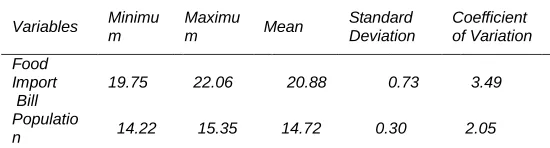
If you Table 1 provides the summary statistics for the Food import bill, which is used as a proxy for food security and its determinants and other variables population and GDP/Capita(current). Over the period 1980–2017, the average of the GDP/ Capita (current) is 9.18 with the highest coefficient of variation of 5.77.Population growth accounted to an average of 14.72 and coefficient of variation of 2.05 followed by Food import bill of 20.8 per cent with a coefficient of variation of 3.49 .
Table 1. Summary Statistics for the Model Variables
Variables Minimu
m
Maximu
m Mean
Standard Deviation Coefficient of Variation Food Import Bill
19.75 22.06 20.88 0.73 3.49
Populatio
n 14.22 15.35 14.72 0.30 2.05
GDP/ Capita(cur rent)
8.45 10.00 9.18 0.52 5.77
Table 2(a). Unit Root Unit Test (ADF) for the Model Variables
Variable s
Level Critical Values First Difference Critical Values
1 % 5 % 10 % t-val ue p-val ue 1 % 5 % 10 % t-val ue p-val ue Food Import Bill -3. 62 -2. 94 -2. 61 -0.5 6 0.8 6 -3. 63 -2. 95 -2. 61 -9.5 9 0.0 0 Populati on -3. 67 -2. 96 -2. 62 1.1 1 0.7
0 -3.
67 -2. 96 -2. 62 -3.2 2 0.0 2 GDP/ capita(cu rrent) -3. 62 -2. 94 -2. 61 -0.7 8 0.8
1 -3.
62 -2. 94 -2. 61 -6.3 3 0.0 0
Table 2(b). Unit Root Unit Test (ADF) for the Model Variables
Variables
Level Critical Values First
Difference Critical Values
1% 5% 10% t-value
p-value
Food Import Bill -3.63 -2.95 -2.61 -9.59 0.00
Population -3.67 -2.96 -2.62 -3.22 0.02
GDP/ capita(current)
-3.62 -2.94 -2.61 -6.33 0.00
The results of the test of the stationarity of the series of the model are presented in table 2.The Augmented Dickey Fuller (ADF) test for Food import bill, population, GDP/ capita (current) The Table 2 presents the results of the stationarity of the series of the model. The Augmented Dickey Fuller (ADF) unit root test showed that at level, all the series are non-stationary with p≻0.05. The t statistics for ADF test for FIB, Pop and GDP/capita(current) are not greater than the 1 per cent, 5 percent and 10 percent level of significance which implies that the variables are non-stationary in their level forms. In case of first difference, the ADF test showed that all the variables are stationary with p≺ 0.05, indicating all the variables are integrated of order 1. After formulating a Vector Autoregression (VAR) system containing Food Import Bill, Population and GDP/capita(current)The VAR lag order selection criterion is presented in Table 3
Table 3. VAR Lag Order Selection Criteria
Lag Log L LR FPE AIC SC HQ
0 -6.2514 NA 0.0003 0.561 0.697 0.606
1 116.567 215.863 3.56e-07 -6.337 -5.793 -6.154
2 164.238 75.177* 3.47e-08* -8.681* -7.729* -8.361*
Note: *5% level
5349
Table 4: Johansen Cointegration Test
Hypothesize d
Eigen value
Trace Statisti cs
5% Critical Value
p-value
Max-Eigen 5% Critical Value
None* 0.449 31.798
0
29.797
0.029 20.86 0.054
At most 1* 0.253 10.936
15.494 0.215
10.23
8 0.196
At most 2* 0.019 0.698 3.841 0.403 0.698 0.403
Note: * denotes rejection of the hypothesis at 5% level of significance
Since all the variables are integrated of the same order, Johansen Cointegration Test was applied and the results are shown in Table 4.The results of trace statistics exceeds the 5% critical value, there are 2 cointegrating equations at 5% level of significance, whereas max eigen value indicates one cointegrating equations. Table 5 shows the Error Correction Term l(ECT) in all the equations show positive as well as negative sign. However, in the ECT, the food import bill equation showed a coefficient of 0.98 which indicates that the adjustment towards the equilibrium takes place at 98 percent per annum. The cointegrating equation is negative and significant with the value of 0.986
Table 5: Error Correction Model
Error Correction:
D(LNFOOD
IMPBILL) D(LNPOP)
D(LNGDPPER CAPITACURRENT)
CointEq1 -0.986557
(0.35983) [-2.74171]
-0.000657 (0.00331) [-0.19855]
0.437333 (0.17448) [-2.50647
The estimated model is as follows:
Ln(foodimportbill) = -7.53 + 1.68Lnpopulation + 0.39 LnGDP/capita(current) Standard Error = (2.77) + (0.26) + 0.151 R2 = 0.90
The model indicates that if the population is increased by 1% food import bill is 1.68. If the GDP/capita(current) increases by 10 %, then food import bill will increase by 3.9%.The value of R2, indicates 90% variation in food import bill is influenced by the population and GDP/capita(current).
6 DISCUSSION
From the above analysis, food import bill which is considered as a proxy of food security is positively related to population and GDP/capita(current). The results are in consistent with the literature.39,42 It is observed that out of the two determinants, population growth has the maximum influence on food security. As the challenge of today is to provide the world’s growing population with a sustainable, secure supply of safe, nutritious, and affordable high quality food, Oman has been committed to integrated package of various projects in line with the government’s plans that aim at achieving food security in the Sultanate of Oman [40]. The 98% adjustment in the Error Correction term of the food import bill of cointegration equation indicates that if any disequilibrium occurs the system adjusts in one year which is justifiable for an oil producing country like Oman [43].
7 CONCLUSIONS
AND
POLICY
IMPLICATIONS
The paper examined the determinants of the food import bill in
Oman during the period of 1980 to 2017 and revealed that the main determinants of the food security are population growth rate and current GDP/capita. Based on the data analysis, Food security is positively influenced by population and current GDP/capita. Out of which, food security is largely influenced by the population growth rate. It is very important for any country to develop its own food security strategy, which may otherwise result in a negative effect on human capital that results in negative consequences on government expenditures. Further leading to stagnated economic growth in the long term. Thus, a proper food security strategy is an essential for all countries. Hence it is highly recommended to the policy makers to consider the growth rate of the population while framing food security policies for long term food sustainability in Oman.
8
REFERENCES
[1] J.S. Bridle, ―Probabilistic Interpretation of Feedforward Classification Network Outputs, with Relationships to Statistical Pattern Recognition,‖ Neurocomputing— Algorithms, Architectures and Applications, F. Fogelman-Soulie and J. Herault, eds., NATO ASI Series F68, Berlin: Springer-Verlag, pp. 227-236, 1989. (Book style with paper title and editor)
[2] K. Ahmad and A. Ali, ―Rising Population and Food Insecurity Linkages in Pakistan: Testing Malthusian Population Growth Theory‖, Munich Personal RePEc Archive (MPRA),2016, available at https://mpra.ub.uni-muenchen.de/71131/1/MPRA_paper_71131.pdf
[3] J.C.Aker and A. Lemtouni, ―A Framework for Assessing Food Security in the Face of Globalization: The Case of Morocco‖, Agroalimentaria, vol. 8, no.1, pp.13-26, 1999 [4] S. D. Applanaidu, A. H. Baharudin, ―An Econometric
Analysis of Food Security and Related Macroeconomic Variables in Malaysia: A Vector Autoregressive Approach (VAR)‖, UMK Procedia, vol. 1, no. 1, pp. 93- 102, 2014 [5] Y. Al-Hamad, S. Akhtar, H. Ghanem, N. Khouri, M.
Losacco, M. Battat, El Solh, F.Taha, A. Droubi, M. Cackler, A. Kubursi, I. Limam and M. Rouis, ―Food and Water Security in the Arab World, Proceedings of the First Arab Development Symposium‖, The International Bank for Reconstruction and Development/World Bank and the Arab Fund for Economic and Social Development, Washington, 2012.
[6] A.A.S Al-Maadid, ―Effects of Oil Prices, Food Prices and Macroeconomic News on GCC Stock Markets‖, PhD dissertation, Department of Economics and Finance, Brunel University London, 2016.
[7] Z. Al-Nasseri, ―Food imports likely to touch $4.8bn by 2020‖, Oman Observer, Oman,2018, available at http://www.omanobserver.om/food-imports-likely-to-touch-4-8bn-by-2020/
[8] C. Breisinger, T. V. Rheenen, C. Ringler, N. A. Pratt, N. Minot, C. Aragon, B. Yu, O. Ecker and T. Zhu, ‖Food security and economic development in the Middle East and North Africa: current state and future perspectives‖, IFPRI Discussion Paper 00985,2010
[9] P. Deulgaonkar, ―GCC food import bill to hit $53.1bn in 2020‖, Arabian Business, 2017
5350
Institute, 2002
[11]L. Deason, D.D. Laborde, N. Minot, S. Rashid, and M. Torero, ―Food price volatility: Effects and response mechanisms in Africa‖, In Promoting Agricultural Trade to Enhance Resilience in Africa, 2014
[12]A. Desta, ―Linkages between economic growth and food security: An eclectic perspective‖, 2016, available at www.aigaforum.com-food-security-economicgrowth.pdf [13]O. Ecker and M. Qaim, ―Analyzing nutritional impacts of
policies: an empirical study for Malawi‖, World Dev. vol. 39, no.3, pp. 412–428, 2011
[14]O. Ecker and C. Breisinger, ―The food security system: A new conceptual framework‖, IFPRI discussion papers 1166, International Food Policy Research Institute (IFPRI), 2012
[15]Economic Commission for Africa, Economic Report on Africa, ―Governing development in Africa - the role of the state in economic transformation‖, United Nations Economic Commission for Africa, Ethiopia,2011, available at
https://www.uneca.org/sites/default/files/PublicationFiles/er a2011_eng-fin.pdf
[16]S. Efron, C. Fromm, B. Gelfeld, S. Nataraj, C. Sova, ―Food Security in the Gulf Cooporation Council‖, Emege 85 and RAND Corporation, 2018
[17]H. Egwuma, O. A. Ojeleye, S.S. Adeola, ―What Determines Food Price Inflation? Evidence from Nigeria‖, FUOYE Journal of Agriculture and Human Ecology, vol1, no.2, pp. 48-61, 2017
[18]FAO, ―The State of Food and Agriculture‖, Food and Agricultural Organisation, Rome, 2009, available at http://www.fao.org/docrep/012/i1318e/i1318e00.pdf. [19]Food and Agriculture Organization, ―The State of Food
Insecurity in the World 2014 – Strengthening the enabling environment for food security and nutrition‖, International Fund for Agricultural and World Food Programme, Rome, 2014
[20]Food and Agriculture Organization, ―The State of Food Insecurity in the World - Meeting the 2015 international hunger targets: taking stock of uneven progress‖, International Fund for Agricultural, & World Food Programme, pp. 1–62, Rome,2015
[21]FAO, ―Regional Overview of Food Insecurity - Near East and North Africa: Strengthening Regional Collaboration to Build Resilience for Food Security and Nutrition‖, Food and Agricultural Organisation Cairo, Egypt,2015.
[22]FAO, ―The future of food and agriculture – Trends and challenges‖, Food and Agricultural Organisation, Rome, 2017, available at http://www.fao.org/3/a-i6583e.pdf [23]FAO, IFAD, UNICEF, WFP and WHO, ―The State of Food
Security and Nutrition in the World 2019 Safeguarding against economic slowdowns and downturns‖, Food and Agricultural Organisation, Rome,2019
[24]Global Food Security Index , ―Building resilience in the face of rising food-security risks‖, The Economist Intelligence Unit, Dubai,2018
[25]H.C.J .Godfray, J.R. Beddington, I.R.Crute, L. Haddad,D. Lawrence, J.F. Muir, J. Pretty, S. Robinson, S.M.Thomas, C. Toulmin, ―Food security: the challenge of feeding 9 billion people‖ Science, vol. 3, no. 27, pp. 812–818, 2010 [26]C. Hall, T.P. Dawson, J.I. Macdiarmid, R.B Matthews, P.
Smith, ―The impact of population growth and climate change on food security in Africa: looking ahead to
2050‖, International Journal of Agricultural Sustainability, vol. 15, no.2, pp.124-135, 2017, doi: 10.1080/14735903.2017.1293929
[27]D. D. Headey, ―The impact of the global food crisis on self-assessed food security‖, The World Bank Economic Review, vol.27, no. 1, pp. 1–27, 2013. doi: 10.1093/wber/lhs033.
[28]D. Hofstrand, ―Can we Meet the World’s Growing Demand for Food?‖, Agriculture Marketing Resource Center, 2014 [29]O.A. Ibrahim, S. Devesh and H,M. Hassan, ―Sensitivity of
Fiscal Balances to Oil Price Shocks: Short- and Long-Term Effects in the Context of Oman‖, International Journal of Energy Economics and Policy, vol. 9, no.2, pp. 146-155, 2019
[30]ICARDA, ―ICARDA Annual Report 2014‖, International Center for Agricultural Research in the Dry Areas, Beirut, Lebanon,2015
[31]P. Konandreas and A. Valdes, ―Assessing Food Insecurity Based on National Aggregates in Developing countries‖, In A Valdes (ed.). Food Security for Developing Countries. Journal of Agriculture and Social Research (JASR), vol.10, no. 1, 2010
[32]Population Action International, ―Healthy families, Healthy Planet, Why Population Matters to Food Security‖,2011 , available at https://pai.org/wp-
content/uploads/2012/02/PAI-1293-FOOD_compressed.pdf
[33]ReSAKSS Annual Trends and Outlook Report, O. Badiane, T. Makombe, G. Bahiigwa, Eds. Chapter 3. Pp. 18-37. Washington, D.C, International Food Policy Research Institute (IFPRI), 2013,available at http://ebrary.ifpri.org/cdm/ref/collection/p15738coll2/id/128 850
[34]C. Malek, ―UAE’s growing population makes food security a vital issue‖, The national newspaper, UAE, 2014, available at https://www.thenational.ae/uae/uae-s-growing- population-makes-food-security-a-vital-issue-say-experts-1.264558
[35]M.D. Mbaga, ―Alternative mechanisms for achieving food security in Oman‖, Agriculture & Food Security, vol.2, no.3, 2013
[36]Muscat Daily, ―Research Projects Growth In Oman’s Food Consumption‖, Muscat Daily, Muscat, 2014, available at https://muscatdaily.com/Archive/Oman/Research-projects-growth-in-oman-s-food-consumption-2xhp
[37]Muscat Daily, ‖Sultanate ranked 29th in 2018 global food security index‖, Muscat Daily, Muscat, 2018, available at https://muscatdaily.com/Archive/Oman/Sultanate-ranked-29th-in-2018-Global-Food-Security-Index-5buv
[38]National center of Statistics and Information, 2019, available at https://www.ncsi.gov.om/Pages/NCSI.aspx [39]T. Nkunzimana, E. Custodio , A.C.Thomas , N. Tefera,
H.A. Perez and F. Kayitakire, ―Global analysis of food and nutrition security situation in food crisis hotspots‖ EUR 27879, 2016 doi:10.2788/669159
[40]O.P. Olofin, V.A. Adejumo, K.A. Sanusi , ― Determinants of Poverty Level in Nigeria‖, Journal of Sustainable Development, vol.8, no.1, 2015, available at DOI: 10.5539/jsd.v8n1p235
5351
[42]M. Porkka, J. H. A . Guillaume, S. Siebert, S. Schaphoff and M. Kummu,‖The use of food imports to overcome local limits to growth‖, Earth’s Future, vol.5, no. 1, pp. 393– 407, 2017, available at doi:10.1002/2016EF000477. [43]Pourreza , S. Geravandi, M. Pakdaman, ―Food Security
and Economic growth‖, Journal of Nutrition and Food Security (JNFS), vol. 3, no. 3, pp. 113-115, 2018
[44]W. Qing and F.F. Ugo , 2002. "Testing the Relationship Between Government Spending and Revenue; Evidence From GCC Countries," IMF Working Papers 02/201, International Monetary Fund, 2002
[45]Oman Market review,2018, available at https://www.export.gov/article?id=Oman-Market-Overview [46]S. Rosen, ―The Link between Imports and Food Security‖,
Economic Research Service/ USDA, 1998
[47]N. Saab, A.K. Sadik (eds.),‖ Arab Environment: Sustainable Development In A Changing Arab Climate‖, Annual Report of Arab Forum for Environment and Development, Beirut, Technical Publications,
2016,available at
http://www.afedonline.org/en/inner.aspx?contentID=1238 [48]N,L. Safoulanitou, A.M.M. Ndinga, ―An Empirical Analysis
of the Determinants of Food Imports in Congo‖, AERC Research Paper 195 ,African Economic Research Consortium, Nairobi, April 2010
[49]K. Schwab, ―Global Competitiveness Report‖, World Economic Forum, Geneva, 2018
[50]S. Shahla and S. Rosen, ―Food security assessment: Why countries are at risk‖, Agriculture Information Bulletin No. 754, Market and Trade Economics Division, Economic Research Service, U.S. Department of Agriculture, 1999
[51]S. Shapouri and S. Rosen, ― Energy Price Implications for Food Security in Developing Countries‖, Economic Research Service/USDA, USA,2007, available at http://www.ers.usda. gov/publications/gfa18/gfa18b.pdf. [52]E. Skoufias, V. D. Maro, T.C González and S.R.
Rodríguez ,‖Nutrient consumption and household income in rural Mexico‖, Agricultural Economics, vol. 40,no. 6, pp.657– 675,2009
[53]M.B. Slimane, H. M. Bourd and H. Zitouna, ―The role of sectoral FDI in promoting agricultural production and improving food security‖, International Economics, vol. 145, pp.50-65, 2016.
[54]S. Takagi, ― Establishing monetary union in the Gulf Cooperation Council: What lessons for regional cooperation?‖ ADBI Working Paper No. 390, 2012 [55]Times of Oman, ―Oman makes good progress in food
security‖, 2016, available at https://timesofoman.com/article/90461
[56]UNCTAD, ―Digitalization, Trade and Development‖, Information Economy Report, 2017, Geneva, available at http://unctad.org/en/PublicationsLibrary/ier2017_en.pdf [57]World Bank, ―Poverty and Hunger: Issues and Options for
Food Security in Developing Countries‖, Washington DC,1986
[58]World Bank, ―The World Bank Annual Report 2009‖, Year in Review, Vol. 1, Washington, DC, 2009, available at https://openknowledge.worldbank.org/handle/10986/4354 License: CC BY 3.0 IGO.
[59]World Bank, The World Bank Annual Report 2014. Washington, DC, 2014, available at https://openknowledge.worldbank.org/handle/10986/2009
3 License: CC BY-NC-ND 3.0 IGO.