The Influence of Perceived Benefits on The Satisfaction with the Loyalty Program
Asta Kyguoliene, Kristina Zikiene, Viktorija Grigaliunaite
Vytautas Magnus University
K. Donelaicio st. 58, LT-44248, Kaunas, Lithuania
E-mail. [email protected], [email protected], [email protected]
http://dx.doi.org/10.5755/j01.ee.28.1.14635
Nowadays every loyalty program must have some value proposition, it becomes the main factor attracting customer to join the loyalty program. Value proposition, considered as a set of benefits customer receives being a member of the loyalty program relates to perceived benefits. Identifying the influence of perceived benefits becomes important to satisfy customers and can lead to greater loyalty to the program what can result greater loyalty to the store.
The aim of the study was to measure the influence of perceived benefits on the satisfaction with the loyalty program in Lithuanian grocery retailing. 312 respondents took part in the research. A structural equation modelling using partial least squares path modelling methodology was applied in order to determine the impact of perceived benefits on the satisfaction with the loyalty program. The research findings indicate that the most important loyalty program benefits for the customer satisfaction with the loyalty program are monetary savings (as a part of utilitarian benefits), exploration (as a part of hedonic benefits), entertainment (as a part of hedonic benefits) and social (as a part of symbolic benefits). On the other hand, convenience (as a part of utilitarian benefits) and recognition benefit (as a part of symbolic benefits) are not important in the case of the satisfaction with the loyalty program in Lithuanian grocery retailing. The study findings imply that it is advantageous for Lithuanian grocery retailers to provide partly utilitarian, hedonic and partly symbolic benefits in their programs for gaining customer satisfaction through loyalty programs.
Keywords: Perceived Benefits, Satisfaction, Hedonic Benefits, Utilitarian Benefits, Symbolic Benefits, Loyalty Program, Grocery, Retailing.
Introduction
Loyalty programs have emerged in many organisations and nowadays they often play an important role in overall marketing strategy. Different organizations have chosen different ways of keeping customers loyal: using different reward programs, giving loyalty cards for customers, offering various loyalty program structures. The essential question, no matter loyalty program type or structure, is value proposition. Any loyalty program must have some value proposition (Liu, 2007; Jorgensen, 2010; Bolton et al., 2000), though it gets challenging to the companies to design loyalty programs and rewards which would help differentiate from competitors (Daryanto et al., 2010). If there isn’t any value, customers will hardly join the loyalty program, the satisfaction of members of the loyalty program will be low, and the loyalty program will not give desired results. Value proposition considered as a set of benefits customer receives being a member of the loyalty program relates to perceived benefits. The benefits of the loyalty program must have perceived value, because only the benefits which customers desire might empower the loyalty program to work (Jorgensen, 2010). Inability to find out what motivates customers can have negative impact on customers’ opinion about loyalty program. Though identifying the influence of perceived benefits becomes important to satisfy customers, having in mind that only satisfied customers can get more loyal to the program and as a result more loyal to a store (Omar et al., 2015).
The influence of perceived benefits on the satisfaction with the loyalty program has been chosen as an object of this paper. A number of authors have considered perceived values in different studies, examining how customers perceive benefits of loyalty programs (Bose & Rao, 2011; Radder et al., 2015), impact of perceived benefits on the satisfaction with the loyalty program (Mimouni-Chaabane & Volle, 2010; Hanzaee & Rezaeyeh, 2013; Omar et al., 2015), impact on program loyalty (Kim et al., 2013; Omar
et al., 2015), customer loyalty (Kim et al., 2013), and store loyalty (Omar et al., 2015). Little research has been done about perceived benefits in grocery retailing sector, though research shows that the biggest interest in loyalty programs in retailing sector is in the area of groceries (Ott, 2011). Authors of this article have chosen to analyse Lithuanian grocery retailing sector, because grocery retailers act in the fast moving consumer goods (FMCG) sector, where everything is changing very fast, competition is very high, many customers use grocery retailers loyalty cards and they do it often, differentiation in loyalty programs is quite complicated because of low margins, i.e. retailers face the challenge of loyalty program structure, which would have perceived value.
Research problem is structured as a question: what perceived benefits of loyalty programs have influence on customer satisfaction with the loyalty program in Lithuanian grocery retailing?
Research method used in this article is questionnaire research. On the basis of evaluations reported by respondents, structural equation modelling using partial least squares path modelling methodology is applied.
The paper consists of both theoretical and empirical analysis. In the first section issues of loyalty programs in grocery retailing sector are reviewed. Perceived benefits of loyalty programs and their influence on the satisfaction with the loyalty program are analysed from a theoretical point of view as a background for research. In the next part of the paper research methodology is outlined, followed by research findings. At last, conclusions are stated.
Loyalty Programs in Grocery Retailing
Card loyalty programs are the most frequently used loyalty strategy by the major retailers (Sharp & Sharp, 1997) leading to the same tendency in grocery retailing. Loyalty cards in grocery retailing are being widely investigated from different points of view (Cedrola & Memmo, 2010; Leenheer et al., 2007; Demoulin & Zidda, 2009; Meyer-Waarden & Benavent, 2008). Loyalty cards most often work accumulating points through purchases and recording them on a card, provide tangible rewards, such as discount on future purchases, gifts and intangible rewards referring to preferential treatment as rewards adapted to the needs of client, preferential access to products, special communication or newsletters (Garzia-Gomez et al., 2012). Nevertheless, if all programs offer the same rewards, the result is competitive parity (Uncles
et al., 2003), what encourages retailers to look for the other options in order to differentiate.
The task to differentiate gets more essential because of grocery retailing peculiarities. In grocery retailing customers are rarely fully loyal, they buy from several stores depending on promotions, situation, loyalty programs (Meyer-Waarden & Benavent, 2008), though most often customers have a focal store, in which they shop the most often (East et al., 2000). Loyalty programs may lead to greater loyalty if customer experiences satisfaction with purchases associated with the loyalty program in this way formatting habits for repeated buying (Meyer-Waarden & Benavent, 2008).
According to Kumar & Shah (2004), retailer loyalty programs in Europe are based mainly on promotional features, programs employ single-tier, linear devices that treat all customers equally, reward them in proportion to their total expenses, offering few other services. Most often loyalty programs of grocery retailing can be described exactly this way, what impedes differentiation. It is logically explained by grocery industry’s low margins, hence grocery retailers face the challenge to meet industries opportunities with customers’ expectations so that benefits of grocery retailers’ loyalty programs could be perceived as a high value by customers.
Perceived Benefits of Loyalty Programs
Perceived benefits of loyalty programs are the benefits customers receive from participating in the loyalty program (De Wulf et al., 2002). Lennheer et al. (2007) points out, that customers are more likely to join a loyalty
program if they see that they receive both financial and non-financial benefits. This implies that there exist some categories of customer received benefits. According to Mimouni-Chaabane & Volle (2010), customer’s perceived benefits can be divided into 3 categories: utilitarian, hedonic and symbolic benefits.
Utilitarian benefits are functional, instrumental and cognitive in nature. These benefits provide the customer with a solution to basic needs (Mimouni-Chaabane & Volle, 2010). Dimension of utilitarian benefits is related with efficient, task specific and economical aspects of product and services (Overby & Lee, 2006). According to Omar et al. (2015), there is a consensus among researchers emphasizing greater value of utilitarian benefits to customers, because of its intangibility, ease of understanding and evaluating (Verhoef, 2003; Gable et al.,
2008; Bridson et al., 2008; Steyn et al., 2010).
Utilitarian benefits are based on monetary saving and
convenience benefits. In loyalty programs, utilitarian values derive from financial advantages (Bolton et al.,
2004; Johnson, 1999). Monetary savings is the most common benefit attracting customers to join loyalty program (Peterson, 1995; Allaway et al., 2006; Jorgensen, 2010; Che Wel et al., 2011). Lennheer et al. (2007) state that enrolment in the loyalty program depends on the amount of financial rewards customers perceive they receive from loyalty program. Monetary benefits can be understood as different kinds of discounts, bonuses, cash-back offers, coupons, rebates. Convenience benefits are another part of utilitarian benefits. This kind of benefits make shopping easier and more convenient. Convenience benefits reduce consumer search and decision costs through value-added services, involve consumers’ getting to know the organisation, its products, services (Mimouni-Chaabane & Volle, 2010), save time, enhance shopping convenience (Radder et al., 2015). Examples of convenience benefits in retailing could be quick payment counters, opportunity to save time through faster service or customer learning.
Hedonic benefits are more subjective and abstract (Rintamaki et al., 2006). Hedonic values derive from non-instrumental, experiential, emotional, personally gratifying benefits (Hirshman & Holbrook, 1982), they are often related to non-tangible retailer / product attributes (Hanzaee & Rezaeyeh, 2013).
According to Mimouni-Chaabane & Volle (2010), hedonic benefits appear through exploration and
entertainment dimensions appealing to pleasure and satisfaction. Exploration benefits covers offering opportunities to try new products, promotional offers (Mimouni-Chaabane & Volle, 2010), encourage changing behaviour and habits (Arnold & Reynolds, 2003). Examples of entertainment dimension could be collecting and redeeming points (Mimouni-Chaabane & Volle, 2010; Johnson, 1999), participating in events, competitions open to loyalty program members (Radder et al., 2015).
Asta Kyguoliene, Kristina Zikiene, Viktorija Grigaliunaite. The Influence of Perceived Benefits on The Satisfaction with…
Symbolic benefits refer to personal expression, self-esteem, social approval (Keller, 1993). Mostly they are intangible, associated to non-product related attributes (Mimouni-Chaabane & Volle, 2010). Omar et al. (2015) state that this category of benefits can be understood as the ability of loyalty program to offer a source of identification and conform to customer’s needs to associate with something successful or desirable (Kaynak et al., 2007). As a result of that, symbolic benefits are expressed through
recognition and social benefits.
Recognition benefits appear when members of loyalty program are treated better than non-members, have special status, rather prestige (Mimouni-Chaabane & Volle, 2010). Remembering customers at individual level (Arantola, 2003) as well as opportunity to differentiate and discriminate among customers who likely perceive customized offers as a sign of respect or distinctiveness (Gordon et al., 1998) play a special role in recognition. Examples of recognition benefits in loyalty programs could be personal offers, extra attention, personalized services, first-early access to sales.
Social benefits can be experienced through a being a part of a special group, sense of belonging, sharing common values, customers feeling privileged (Mimouni-Chaabane & Volle, 2010), feeling sense of mattering. If members of loyalty program feel themselves as a members of special group, get special attention, perceptions of social benefits enhance (Omar et al., 2015), emotional engagement with the organization increases (Szczepanska & Gawron, 2011).
Program Satisfaction
Generally program satisfaction is defined as a member’s affective state resulting from the cumulative evaluation of experience gained from loyalty program (Omar et al., 2015). According to Omar et al., (2015)
,
loyalty programs have affirmative association between program satisfaction and loyalty, customers become more loyal and less price sensitive, if they are satisfied with the rewards obtained from loyalty program in grocery retailing(
Demoulin & Zidda, 2008). The satisfaction with the loyalty program leads both to program loyalty and store loyalty. Omar et al., (2015) summarize various studies with a conclusion that satisfaction with the loyalty program impacts loyalty to the store positively (Sivadas & Baker-Prewitt, 2000; Bloemer & De Ruyter 1998).Research Methodology
As it is typical in determining the impact of perceived benefits on the satisfaction with the loyalty program, the questionnaire research is provided.
The questionnaire is composed of two parts: (1) the part related to the benefits and the satisfaction associated with the loyalty program, i.e. the measurement model; (2) the demographic part.
Measurement model. A quantitative study among Lithuanian grocery retailing cardholders provides further insights identifying the influence of perceived benefits on the satisfaction with the loyalty program.
To determine the impact of perceived benefits on the satisfaction with the loyalty program in Lithuanian grocery
retailing, 22 questions were prepared. First, the respondents are informed with the attitude that the possession of a loyalty card is treated as a loyalty for particular grocery retailer.
In order to analyse the impact of perceived benefits on the satisfaction with the loyalty program, each of the latent variables (according to Mimouni-Chaabane & Volle (2010), they are these: satisfaction, monetary savings, convenience, exploration, entertainment, recognition, social benefits) are measured by their corresponding manifest variables, composing the research questionnaire (available from the authors upon request). Each exogenous latent variable contains three manifest variables, while the one endogenous latent variable – four manifest variables. Considering the fact that all of the manifest variables of the specific construct covariate with each other, reflective measurement model is preferred
.
7-point Likert scale is applied for the questionnaire. On the basis of evaluations reported by respondents, structural equation modelling using partial least squares path modelling methodology is applied in order to analyse the impact of perceived benefits on the satisfaction with the loyalty program in Lithuanian grocery retailing. SmartPLS V.3 (Ringle et al., 2015) and XLSTAT 2014 software packages are used for the statistical analysis.Based on the analysis and synthesis of scientific literature, six research hypotheses are made:
H1: Benefits of monetary savings have a direct positive
influence on customer satisfaction with the loyalty program in Lithuanian grocery retailing.
H2: Benefits of convenience have a direct positive
influence on customer satisfaction with the loyalty program in Lithuanian grocery retailing.
H3: Benefits of exploration have a direct positive
influence on customer satisfaction with the loyalty program in Lithuanian grocery retailing.
H4: Benefits of entertainment have a direct positive
influence on customer satisfaction with the loyalty program in Lithuanian grocery retailing.
H5: Benefits of recognition have a direct positive
influence on customer satisfaction with the loyalty program in Lithuanian grocery retailing.
H6: Social benefits have a direct positive influence on
customer satisfaction with the loyalty program in Lithuanian grocery retailing.
Table 1
The Respondents’ Demographic Characteristics, %
Gender Age Education Income in euro (monthly/ for one
family number)
Men 24.4 Under 24 25.9 Unfinished secondary 1.6 Less than 150 9.2
Women 75.6 24-35 16.9 Secondary 19.2 151-300 35.5
35-44 20.1 Professional education 8 301-450 31.3
45-54 21.4 College education 18.8 451-600 12.5
55-64 11.2 Higher education 52.4 601 and more 11.5
65-74 2.9
74 and more 1.6
Research Results
The analysis of the research results comprises the assessment of the reflective measurement model and structural model as well as testing of research hypotheses.
The assessment of the reflective measurement model contains the evaluation of internal consistency, indicator reliability, convergent validity, and discriminant validity. The measure of Cronbach’s Alpha is usually applied for assessing internal consistency of the measurement model, though Hair et al. (2014) argue that Cronbach’s Alpha assumes that all indicators are equally reliable; moreover, Cronbach’s Alpha is sensitive to the number of items in the scale and generally tends to underestimate the internal consistency reliability, hence the measure of composite reliability should be preferred for assessing internal consistency of the measurement model. Latter measure
takes into account the different outer loadings of the indicator variables. Thus, composite reliability as a measure of internal consistency is applied in this research. As Table 2 shows, composite reliability values of latent variables are above 0.7 and below 0.95, therefore it could be stated that there is no lack of internal consistency reliability in the measurement model.
The mean values of the squared loadings of the indicators associated with the specific constructs, i.e., the values of average variance extracted (AVE) measure, are above the threshold value of 0.5 (see Table 2), revealing that each construct explains more than half of the variance of its indicators. Thus, it is substantiated that the degree of convergent validity is sufficient regarding reflective measurement model.
Table 2
Values of Average Variance Extracted and Composite Reliability
Variables Average Variance Extracted (AVE) Composite Reliability
Convenience 0.692 0.871
Entertainment 0.551 0.783
Exploration 0.725 0.888
Monetary savings 0.777 0.913
Recognition 0.624 0.828
Satisfaction 0.720 0.911
Social Benefits 0.763 0.906
When assessing individual indicator reliability, it is revealed that all of the indicators’ outer loadings are above the value of 0.7 and statistically significant (p < 0.05), except two indicators (one indicator – “using the partners’ of loyalty program propositions” – is associated with entertainment; the other one – “ feeling of getting better services than the ones who are not participating in the loyalty program” – is associated with the recognition) with the values of outer loadings being around 0.6 and statistically significant (p < 0.05). Considering the fact that the outer loadings of latter two indicators are statistically significant, the decision is not to eliminate these indicators. Consequently, all of the individual indicators are assessed as reliable.
For assessing whether there is no lack of discriminant validity in the reflective measurement model, two standard criteria are applied: Fornell-Larcker criterion and cross-loadings. Based on the cross-loadings criteria, all of the indicators’ outer loadings with their corresponding latent constructs are greater than their outer loadings with all the remaining constructs. Based on the Fornell-Larcker criterion, each construct’s squared root value of average variance extracted is higher than its correlations with other latent constructs (see Table 3). Hence, each construct shares more variance with its associated indicators than with any other construct. Consequently, based on latter two criteria, it could be stated that there is no lack of discriminant validity in the reflective measurement model.
Table 3
Fornell-Larcker Criterion
Variables Convenience Entertainment Exploration Monetary savings Recognition Satisfaction Social benefits
Convenience 0.832 - - - -
Entertainment 0.403 0.742 - - - - -
Exploration 0.320 0.499 0.851 - - - -
Monetary
savings 0.498 0.296 0.243 0.881 - - -
Recognition 0.413 0.404 0.275 0.193 0.790 - -
Satisfaction 0.446 0.514 0.454 0.400 0.431 0.849 -
Asta Kyguoliene, Kristina Zikiene, Viktorija Grigaliunaite. The Influence of Perceived Benefits on The Satisfaction with…
Nevertheless, the alternative approach based on the heterotrait-monotrait ratio of correlations (HTMT) criterion (see Henseler et al., 2015) is applied for the final assessment of discriminant validity. The values of HTMT criterion are lower than the predefined threshold value of 0.85 (see Table 4), substantiating previous criteria revealing that there is no lack of discriminant validity in
the reflective measurement model. Hence, it could be stated that each construct of reflective measurement model captures the specific part of the loyalty programs’ benefits not represented by other constructs of the model. Consequently, reflective measurement model is assessed as reliable and valid.
Table 4
Heterotrait-Monotrait Ratio (HTMT0.85)
Variables Convenience Entertainment Exploration Monetary savings Recognition Satisfaction Social benefits
Convenience - - - -
Entertainment 0.574 - - - -
Exploration 0.404 0.713 - - - - -
Monetary savings 0.606 0.407 0.296 - - - -
Recognition 0.525 0.586 0.370 0.263 - - -
Satisfaction 0.542 0.695 0.537 0.460 0.524 - -
Social Benefits 0.337 0.604 0.418 0.073 0.847 0.516 -
For the assessment of the structural model the evaluation of variance inflation factor (VIF), Cohen f2 effect size, Stone-Geisser Q2, and coefficient of determination (R2) values are applied.
As it can be seen from Table 5 below, the values of predictor constructs VIF are below the threshold value of 5, indicating that the model does not exhibit multicollinearity problems. The coefficient of determination (R2) value is 0.443, indicating that the amount of explained variance of variable satisfaction is moderate (above 44 percent). Cohen f2 effect sizes are used
to evaluate whether if the specific exogenous construct is omitted then a substantive impact on the endogenous construct is made. From the data in Table 5 it can be seen that two exogenous variables – convenience and recognition, have very small effect sizes on the endogenous variable satisfaction. On the other hand, remaining exogenous variables have small – medium effect sizes on the variable satisfaction. Finally, Stone-Geisser Q2 value of variable satisfaction is above zero, revealing that model exhibits predictive relevance.
Table 5
Values of Variance Inflation Factor, f Square, Q Square, and coefficient of determination (R Square)
Variables Variance Inflation Factor (VIF) f2 Q2 R2
Convenience 1.619 0.014 - -
Entertainment 1.671 0.036 - -
Exploration 1.402 0.040 - -
Monetary savings 1.386 0.058 - -
Recognition 1.748 0.011 - -
Satisfaction - - 0.301 0.443 (R2adj = 0.432)
Social Benefits 1.796 0.037 - -
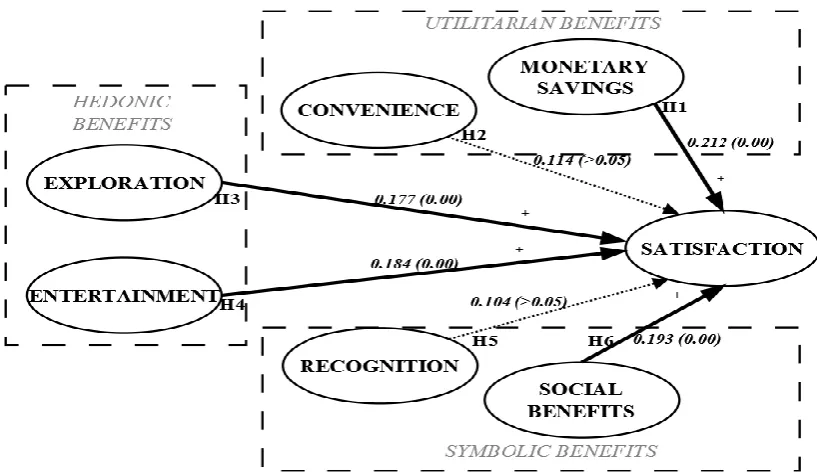
In this case, all of the direct effects are equal to the total effects, because none of the indirect effects are observed. Thus, only path coefficients represent the hypothesized relationships among the constructs. All of the path coefficients are provided in Table 6 below. As it can be seen, the benefit of convenience (0.114, p = 0.112) as well as the benefit of recognition (0.104, p = 0.114) does not have statistically significant influences on the satisfaction with the loyalty program. Contrarily, the remaining benefits – entertainment (0.184, p = 0.002),
exploration (0.177, p = 0.003), monetary savings (0.212, p = 0.000), and social benefits (0.193, p = 0.001) have statistically significant positive direct influences on customer satisfaction with the loyalty program in Lithuania grocery retailing, all together explaining above 44 percent of variance of satisfaction. Moreover, the benefit of monetary savings has the highest influence on customer satisfaction with the loyalty program compared to all of the other benefits.
Table 5
Path Coefficients and their statistical significances
Variables Path Coefficient Standard
Deviation
Lower bound (95%)
Upper bound
(95%) T Statistics p Value
Convenience -> Satisfaction 0.114 0.072 -0.031 0.274 1.591 0.112
Entertainment -> Satisfaction 0.184* 0.061 0.070 0.277 3.037 0.002
Exploration -> Satisfaction 0.177* 0.060 0.053 0.296 2.928 0.003
Monetary savings ->
Satisfaction 0.212* 0.059 0.100 0.374 3.603 0.000
Recognition -> Satisfaction 0.104 0.066 -0.034 0.234 1.581 0.114
Social Benefits -> Satisfaction 0.193* 0.057 0.090 0.306 3.402 0.001
The impact and contribution of the variables to the satisfaction are visualized in Figure 1. As it can be seen, it is apparent from this Figure that the benefit of recognition has the least (and statistically non-significant) influence on customer satisfaction with the loyalty program as well as the contribution to R2, as revealed by f2 effect size. Even though the benefit of convenience has a little higher influence on customer satisfaction, it is still statistically non-significant and the contribution to R2 is minimal.
Alternatively, there is a clear trend of social benefits and benefits of entertainment and exploration having similar moderate and statistically significant impacts on customer satisfaction with the loyalty program as well as similar moderate contributions to R2, while the benefit of monetary savings having the highest impact on customer satisfaction with the loyalty program as well as the highest contribution to R2.
Figure 1. Impact and Contribution of the Variables to the Satisfaction with the Loyalty Program
Returning to the hypotheses posed at this study, it is now possible to state that H1, stating that benefits of
monetary savings have a direct positive influence on customer satisfaction with the loyalty program in Lithuanian grocery retailing, is supported. H2, stating that
benefits of convenience have a direct positive influence on customer satisfaction with the loyalty program in Lithuanian grocery retailing, is rejected. H3, stating that
benefits of exploration have a direct positive influence on customer satisfaction with the loyalty program in Lithuanian grocery retailing, is supported. H4, stating that
benefits of entertainment have a direct positive influence
on customer satisfaction with the loyalty program in Lithuanian grocery retailing, is supported. H5, stating that
benefits of recognition have a direct positive influence on customer satisfaction with the loyalty program in Lithuanian grocery retailing, is rejected. Finally, H6,
stating that social benefits have a direct positive influence on customer satisfaction with the loyalty program in Lithuanian grocery retailing, is supported. These results of hypotheses testing lead to the elaboration of the empirical model of the satisfaction with the loyalty program in Lithuanian grocery retailing, presented in Figure 2 below.
Asta Kyguoliene, Kristina Zikiene, Viktorija Grigaliunaite. The Influence of Perceived Benefits on The Satisfaction with…
As the elaborated model reveals, all three categories of benefits have the impact on the satisfaction with the loyalty program in Lithuanian grocery retailing. Nevertheless, this research is in alignment with the authors (Peterson, 1995; Allaway et al., 2006; Jorgensen, 2010; Che Wel et al, 2011) stating that monetary savings is the most common benefit, because in the case of the satisfaction with the loyalty program in Lithuanian grocery retailing, only monetary savings as utilitarian benefit influences satisfaction. The assumption can be made that convenience benefits, which implies to making shopping easier and more convenient, are not relevant for Lithuanian grocery retailing customers.
Hedonic benefits, related to non-tangible retailer / product attributes, which appear through exploration and entertainment dimensions, are both similarly important in the case of the satisfaction with the loyalty program in Lithuanian grocery retailing. Thus, it could be stated that offering opportunities to try new products, promotional offers and collecting and redeeming points make a positive influence on the satisfaction with the loyalty program. On the other hand, in the case of the satisfaction with the loyalty program in Lithuanian grocery retailing, hedonic benefits comparing to utilitarian are not more effective and preferred, as other studies (Kivetz & Simonson, 2002) argue.
Finally, only part of symbolic benefits, expressed through recognition and social benefits, influence the satisfaction with the loyalty program in Lithuanian grocery retailing. For Lithuanian grocery retailing customers, social benefits, experienced through sharing common values and feeling sense of mattering influence the satisfaction with the loyalty program. Thus, this research provide support for the studies (Szczepanska & Gawron, 2011; Omar et al., 2015) arguing that if members of loyalty program feel themselves as a members of special group, get special attention, the perception of social benefits enhances and emotional engagement with the organization increases. Then again, this research reveals that recognition benefits are not relevant for Lithuanian grocery retailing customers, which is not surprising bearing in mind that enormous amount of customers is participating in loyalty programs. Therefore, participation in the loyalty program lost the value of having a special status.
Conclusions
Findings of the theoretical part of the research lead to the conclusion that customers expect different benefits of loyalty programs. Scientific literature suggests that the benefits customers obtain from joining loyalty programs consist of utilitarian benefits (monetary savings and
convenience), hedonic benefits (exploration and entertainment) and symbolic benefits (recognition and social benefits) (Mimouni-Chaabane & Volle, 2010). The theoretical analysis revealed that perceived benefits have a positive impact on the satisfaction with the loyalty program, which can influence customer loyalty to the store (Omar et al., 2015).
The analysis of research results leads to the conclusion, that monetary savings as utilitarian benefit have the highest influence on the satisfaction with the loyalty program in Lithuanian grocery retailing. Conversely, benefit of convenience as utilitarian benefit, which implies to making shopping easier and more convenient, does not influence Lithuanian grocery retailing customer satisfaction with the loyalty program. Consequently, the main benefits which should be managed by Lithuanian grocery retailing companies in order to enhance customer satisfaction with the loyalty program are monetary savings.
Nevertheless, managing monetary savings benefits should be complemented by the management of hedonic benefits, which appear through exploration and entertainment dimensions and are both similarly important in the case of the satisfaction with the loyalty program. This is manageable through offering opportunities to try new products, making promotional offers, and organizing competitions where customers are able to collect and redeem points. Moreover, social benefits, as a part of symbolic benefits, which refer to sharing common values and feeling sense of mattering, should be promoted by Lithuanian grocery retailing companies. On the other hand, recognition benefits, as a part of symbolic benefits, are not important in the case of the satisfaction with the loyalty program in Lithuanian grocery retailing, thus there should be done deeper research to find out why it is this way.
The elaborated empirical model of customer satisfaction with the loyalty program in Lithuanian grocery retailing indicates that the most important loyalty program benefits for the customers are monetary savings, exploration, entertainment, and social. Hence, these are the benefits for the moment which are worth investments by the companies in order to gain Lithuanian grocery retailing customer satisfaction.
In this research a comparison of the segment-specific influences of perceived benefits on customer satisfaction with the loyalty program in Lithuanian grocery retailing is not analyzed, which becomes the limitation of the research. Consequently, segment-specific influences of perceived benefits on customer satisfaction with the loyalty program in Lithuanian grocery retailing are the direction for future research.
References
Allaway, A. W., Gooner, R. M., Berkowitz, D., & Davis, L. (2006). Deriving and exploring behaviour segments within a retail loyalty card program. European Journal of Marketing, 40, 1317–1339. https://doi.org/10. 1108/030905 60610702830
Arnold, M., & Reynolds, K. (2003). Hedonic shopping motivations. Journal of Retailing, 79(2), 77-95. https://doi.org/10.1016/S0022-4359(03)00007-1
Bloemer, J., & De Ruyter, K. (1998). On the relationship between store image, store satisfaction and store loyalty.
European Journal of Marketing, 32(5/6), 499-513. https://doi.org/10.1108/03090569810216118
Bolton, R. N., Kannan, R. K., & Bramlett, M. D. (2000). Implications of loyalty program membership and service experiences for customer retention and value. Journal of the Academy of Marketing Science, 28, 95–108. https://doi.org/10.1177/0092070300281009
Bolton, R., Lemon, K.N., & Verhoef, P.C. (2004). The Theoretical Underpinnings of Customer Asset Management: a Framework and Propositions for Future Research. J Acad Mark Sci, 32(3), 271–292. https://doi.org/10.1177/0092 070304263341
Bose, S., & Rao, V. G. (2011). Perceived benefits of customer loyalty programs: validating the scale in the Indian content.
Management and Marketing. 6(4), 543-560.
Bridson, K., Evans, J., & Hickman, M. (2008). Assessing the relationship between loyalty program attributes, store satisfaction and store loyalty. Journal of Retailing and Customer Services, 15(5), 364-374. https://doi.org/10.1016/ j.jretcon ser.2007.08.004
Cedrola, E., & Memmo, S. (2010). Loyalty marketing and loyalty cards: a study of the Italian market. International Journal of Retail & Distribution Management, 38 (3), 205–225. https://doi.org/10.1108/09590551011027131
Che Wel, C.A., Alam, S.S. & Mohd Nor, S. (2011). Factors affecting brand loyalty: An empirical study in Malaysia.
Australian Journal of Basic and Applied Sciences, 5(12), 777-783.
Daryanto, A., de Ruyter, K., Wetzels, M., & Patterson, P. G. (2010). Service firms and customer loyalty programs: a regulatory fit perspective of reward preferences in a health club setting. Journal of Academy of Marketing Science, 38(5), 604-616. https://doi.org/10.1108/09590551011027131
De Wulf, K., Odekerken-Schroder, G., de Canniere, M.H. & van Oppen, C. (2002). What drives consumer participation to loyalty programs? A conjoint analytical approach. Unpublished paper. Maastricht: Maastricht University.
Demoulin, N.T.M., & Zidda, P. (2009). Drivers of customers’ adoption and adoption timing of a new loyalty card in the grocery retail market. Journal of Retailing, 85 (3), 391–405. https://doi.org/10.1016/j.jretai.2009.05.007
Demoulin, N.T.M., & Zidda, P. (2008). On the impact of loyalty cards on store loyalty: Does the customers’ satisfaction with the reward scheme matter? Journal of Retailing and Consumer Services, 15(5), 386-398. https://doi.org/10. 1016/ j.jretconser.2007.10.001
East, R., Hammond, K., Harris, P., & Lomax, W. (2000). First-store loyalty and retention. Journal of Marketing Management, 16(4), 307–325. https://doi.org/10.1362/026725700784772907
Gable, M., Fiorito, S. S., & Topol, M. T. (2008). An empirical analysis of the components of retailer customer loyalty programs. International Journal of Retail & Distribution Management, 36(1), 32-49. https://doi.org/10.1108/09 590550810846983
Garzia-Gomez, B., Gutierrez-Arranz, A. M., & Gutierrez-Cillan, J. (2012). Exploring the influence of three types of grocery retailer loyalty programs on customer affective loyalty. The international review of Retail, Distribution and Customer Research, 22(5), 547-561. https://doi.org/10.1080/09593969.2012.711254
Gordon ME, McKeage K., & Fox M.A. (1998). Relationship marketing effectiveness: the role of involvement. Psychol Mark, 55(5), 443–459. https://doi.org/10.1002/(SICI)1520-6793(199808)15:5<443::AID-MAR3>3.0.CO;2-7
Hair, J. F., Hult, G. T. M., Ringle, C. M., & Sarstedt, M. (2014). A Primer on Partial Least Squares Structural Equation Modelling. Thousand Oaks: Sage.
Hanzaee, K. H., & Rezaeyeh, S. P. (2013). Investigation of the effects of hedonic value and utilitarian value on customer satisfaction and behavioural intentions. African Journal of Business Management, 7(11), 818-825.
Henseler, J., Ringle C. M., & Sarstedt, M. (2015). A new criterion for assessing discriminant validity in variance-based structural equation modelling. J. of the Acad. Mark. Sci., 43, 115-135. https://doi.org/10.1007/s11747-014-0403-8 Hirshman, E, & Holbrook, M. (1982). Hedonic consumption: emerging concepts methods and propositions. J Mark, 46(3),
92-102. https://doi.org/10.2307/1251707
Johnson, K. (1999). Making loyalty program more rewarding. Direct Marketing, 61(11), 24–27.
Jorgensen, K. S. (2010). 10 Steps for setting up a loyalty programme. Available from internet
:
http://www.yupingliu.com/files/papers/loyalty_programs_10_steps.pdfKaynak, E., Salman, G. G., & Tatoglu, E. (2007). An integrative framework linking brand associations and brand loyalty in professional sports. Journal of Brand Management, 15(5), 336-357. https://doi.org/10.1057/palgrave.bm.2550117 Keller, L. K. (1993). Conceptualizing, measuring and managing customer-based brand equity. J Mark, 57(1), 1-22.
Asta Kyguoliene, Kristina Zikiene, Viktorija Grigaliunaite. The Influence of Perceived Benefits on The Satisfaction with… Kim, H. Y., Lee, J. Y., Choi, D., Wu, J., & Johnson, K. K. P (2013). Perceived benefits of retail loyalty programs: their effects on program loyalty and customer loyalty. Journal of Relationship Marketing, 12(2), 95-113. https://doi.org/10.1080/15332667.2013.794100
Kivetz, R., & Simonson, I. (2002). Earning the right to indulge: Effort as a determinant of customer preferences toward frequency program rewards. Journal of Marketing Research, 39(2), 155-170. https://doi.org/10.1509 /jmkr.39.2.155.19084
Kumar, V., & Shah, D. (2004). Building and sustaining profitable customer loyalty for the 21st century. Journal of Retailing, 80(4), 317–330. https://doi.org/10.1016/j.jretai.2004.10.007
Leenheer, J., van Heerde, H., Bijmolt, T., & Smidts, A. (2007). Do loyalty programs really enhance behavioral loyalty? An empirical analysis accounting for self-selecting members. International Journal of Research in Marketing, 24(1), 31-47. https://doi.org/10.1016/j.ijresmar.2006.10.005
Liu, Y. (2007). The long-term impact of loyalty programs on consumer purchase behaviour and loyalty. Journal of Marketing, 71(4), 19–35. https://doi.org/10.1509/jmkg.71.4.19
Meyer-Waarden, L., & Benavent, L.C. (2008). Grocery retail loyalty program effects: Self-selection or purchase behaviour change? Journal of the Academy of Marketing Science, 37(3), 345–358. https://doi.org/10.1007/s11747-008-0123-z Mimouni-Chaabane, A., & Volle, P. (2010). Perceived Benefits of Loyalty Programs: Scale Development and Implications
for Relational Strategies. Journal of Business Research, 63, 32-37. https://doi.org/10.1016/j.jbusres.2009.01.008 Omar, N. A., Ramly, S. M., Alam, S. S., & Nazri, M. A. (2015). Assessing the effect of Loyalty Program Benefits in
Satisfaction-Loyalty Relationship: Evidence from Malaysia. Jurnal Pengurusan, 43, 145-159. https://doi.org/10.17576/pengurusan-2015-43-13
Ott, B. (2011). Making loyalty programs work. Business journal, October 10. Available from internet: http://www.gallup.com/businessjournal/149570/Making-Loyalty-Programs-Work.aspx?version=print.
Overby, J. W., & Lee, E. J. (2006). The effects of utilitarian and hedonic online shopping value on consumer preference and intentions
.
Journal of Business Research, 59, 1160-1166. https://doi.org/10.1016/j.jbusres.2006.03.008Peterson, R. (1995). Relationship Marketing and the Consumer. Journal of the Academy of Marketing Science, 23(4), 278-281. https://doi.org/10.1177/009207039502300407
Radder, L., Eyk, van M., & Swiegelarr, C. (2015). Levels of customer loyalty and perceptions of loyalty programme benefits: a South Africa retail example. The retail and Marketing Review, 11(1), 92-105.
Ringle, C. M., Wende, S., & Becker, J-M. (2015). SmartPLS 3. Bonningstedt: SmartPLS. Retrieved from http://www.smartpls.com.
Rintamaki, T., Kanto, A., Kuusela, H., & Spence, M.T. (2006). Decomposing the value of department store shopping into utilitarian, hedonic and social dimensions: Evidence from Finland. International Journal of Retail & Distribution Management, 34(1), 6-24. https://doi.org/10.1177/009207039502300407
Sharp, B., & Sharp, A. (1997). Loyalty programs and their impact on repeat-purchase loyalty patterns. International Journal or Research in Marketing, 14(4), 473–86. https://doi.org/10.1016/S0167-8116(97)00022-0
Sivadas, E., & Baker-Prewitt, J.L. (2000). An examination of the relationship between service quality, customer satisfaction, and store loyalty. International Journal of Retail Distribution Management, 28(2), 73-82. https://doi.org/10.1108/09590550010315223
Steyn, P., Pitt, L., Strasheim, A., Boshoff, C., & Abratt, R. (2010). A cross cultural study of the perceived benefits of a retailer loyalty scheme in Asia. Journal of Retailing and Consumer Services, 17(5), 355-373. https://doi.org/10. 1016/j.jretconser.2010.03.017
Szczepanska, K., & Gawron, P.P. (2011). Changes in approach to customer loyalty. Journal of Contemporary Economics,
5(1), 60-69. https://doi.org/10.5709/ce.1897-9254.5
Uncles, M., Dowling, G., & Hammond, K. (2003). Customer loyalty and customer loyalty programs. Journal of Consumer Marketing, 20(4), 294–316. https://doi.org/10.1108/07363760310483676
Verhoef, P. (2003). Understanding the effect of customer relationship management efforts on customer retention and customer share development. Journal of Marketing, 67(4), 30-45. https://doi.org/10.1509/jmkg.67.4.30.18685