to PBL
Faculty Development Program in Dokuz Eylül School of Medicine:
In the process of curriculum change from traditional to PBL
Berna Musal*
Hakan Abacioglu
§Oguz Dicle
¶Elif Akalin** Sülen Sarioglu
§§Adil Esen
¶¶*
Professor, Chair of Medical Education Deptartment, Dokuz Eylül School of Medicine, Izmir, Turkey
§
Professor, Department of Microbiology, Dokuz Eylül School of Medicine, Izmir, Turkey ¶
Professor, Department of Radiology, Vice Dean of Dokuz Eylül School of Medicine, Izmir, Turkey
**
Associate Professor, Department of Physical Therapy & Rehabilitation, Dokuz Eylül School of Medicine, Izmir, Turkey
§§
Professor, Department of Pathology, Dokuz Eylül School of Medicine, Izmir, Turkey ¶¶
Professor, Department of Urology, Dokuz Eylül School of Medicine, Izmir, Turkey
Abstract: Introduction: In Dokuz Eylül School of Medicine (DESM) a faculty development program is being carried out by the “Trainers’ Training Committee”. DESM made a fundamen-tal change in its curriculum from traditional to Problem-based Learning (PBL) in 1997. This was the first implementation of a PBL curriculum in Turkey. Faculty development activities were initiated in the same year. This paper describes the faculty development activities with a special emphasis on PBL courses.
Program description: Between 1997-2000 27 four-day long PBL courses were held for 343 participants. The curriculum consisted of PBL philosophy, PBL steps, role of the tutor and stu-dents in PBL process, effective case design, assessment principles and group dynamics. PBL simulations enabled the participants to play the roles of both tutors and students.
Process evaluation: At the end of the program most of the participants stated that length of the program, content, training methods and the course organization was appropriate. The majority of the participants (89.5%) found the program very useful. PBL steps, PBL practices and PBL philosophy were found as the most useful sessions.
Discussion: These courses gave medical staff the opportunity to develop their u nderstanding of PBL methodology and theory. PBL courses and continuous educational activities such as weekly tutor meetings are being held and new courses on advanced tutoring skills are being planned for the near future in DESM.
Key words: Faculty development program, PBL, medical education
In medical education there is a potential conflict between the desire to provide a broad educational experience and the necessity of ensuring a sound technical training for doctors. There is a growing consensus that it is necessary for medical teachers to be trained in educational methods as well as have sound technical training.1 An effective faculty devel-opment program may well be the most essential component leading to the success of any educational innovation.2,3 To address this challenge, medical schools such as McMaster, New Mexico, Maastricht, Southern Illinois, Harvard, Liverpool and Dalhouise which made curriculum revisions from traditional to student-centered PBL curricu lum, have implemented
staff development activities.2,4,5,6,7 Following these enterprising models, Dokuz Eylül School of Medi-cine (DESM) made a fundamental change in its curriculum from traditional to PBL in 1997-1998 academic year. DESM is the first medical school in Turkey to implement a PBL curriculum.
to PBL
The educational development of medical faculty members is an integral part of the curriculum re-form.3 The process of a curriculum reform intensifies the necessity for medical teachers to have a formal training in teaching methods and educational theory. Therefore, at the beginning of the curriculum reform experts from different countries were invited to DESM to provide seminars and workshops on cur-riculum development and analysis, PBL philosophy, the role of the teachers in PBL, educational methods and theories .
Dr. Steward P. Mennin from New Mexico con-tributed with lectures and PBL demonstrations to faculty members. Some faculty members visited Liverpool, Dundee and New Mexico to observe the imple mentation of the PBL program. One of the authors of the present paper (B.M) began and com-pleted Master of Health Profession Education Pro-gram in Maastricht University. In April 1997, a fac-ulty development program was organized as two courses; “Basic Training Skills Course”, and “PBL Course”. This paper aims to describe the organization and the results of DESM’s faculty development pro-gram with a special emphasis on the PBL course.
Teachers first attended Basic Training Skills Course then participated in PBL course before they can fulfill a tutoring role. The Basic Training Skills Course covers active learning principles, creating positive learning climate, using interactive methods, facilitating small group activities, using audio-visual aids, demonstration and coaching, assessment princi-ples and methods, group dynamics, and interactive lecture practices. Between 1997 and 2000, 406 teach-ers, 37% of who were from other medical faculties attended Basic Training Skills Course. Nearly 90% of the teachers at DESM attended this course. During the same period the total number of PBL course par-ticipants was 343, 84% of whom were from DESM. Each course lasted four days. There were 26 Basic Training Skills Course and 27 PBL Course cycles during this period. The implementation of these courses was carried out by the “Trainers’ Training Committee”.
The authors of the present paper who are from different departments having experience and knowl-edge about educational methods and theory are also members of this committee. The Trainers’ Training Committee members have also provided continuous educational activities such as small group practices and discussion sessions during weekly tutor meetings and counseling services.
Description of PBL Courses
Each four-day course addressed a group of 14-16 faculty members. At the beginning of the course program participants were asked to express their expectations and trainers reached a consensus be-tween expectations and course objectives. The par-ticipants were asked about what they foresaw as benefits of each session. A pre -course questionnaire was given to participants to provide information on the course content and to determine the participants’ knowledge level.
At the end of each day, participants and trainers evaluated the course content and process. PBL courses topics consisted of PBL philosophy, PBL steps, role of the tutor and stud ent in PBL process, case design, assessment principles, PBL methods, and group dynamics. The trainers’ experiences and observations as well as relevant literature on tutor training programs at universities were used to deter-mine course content, educational methods and course schedule.2,4,5,6,7,10
The first two days of the program were intended to familiarize participants with PBL philosophy, group dynamics, principles of effective case design using interactive methods such as discussions, small group activities and video demonstrations. During the re maining two days, participants were divided into two groups for simulated tutorials. During the morn-ing session, members of one group took turns tutor-ing while the other group had student role. In the afternoon, the groups switched roles. Two different cases were used for PBL simulations. Participants received their tutor copies regarding the case for tutoring role, the day before the practice. Trainers determined tutoring practice time of each trainee. Each session was divided to 7-8 shifts among the trainees for the tutoring role. Trainers observing the tutorial session from outside the PBL group gave counseling and feedback to each trainee before and after his/her tutoring role.
to PBL
using three categories: useless, useful and very use-ful. To improve their confidence and respect confi-dentially participants were told to omit their names from the questionnaire. The main constraint of the present paper is its study design which does not allow statistical comparisons of the initial and final opin-ions of participants.
Participants used a 5 point scale (min: 1 point, max:5 point) to describe their contentment levels regarding training materials, communication with trainers, attainment of the course objectives, fulfill-ment of individual expectations and course organiza-tion.
Process Evaluation
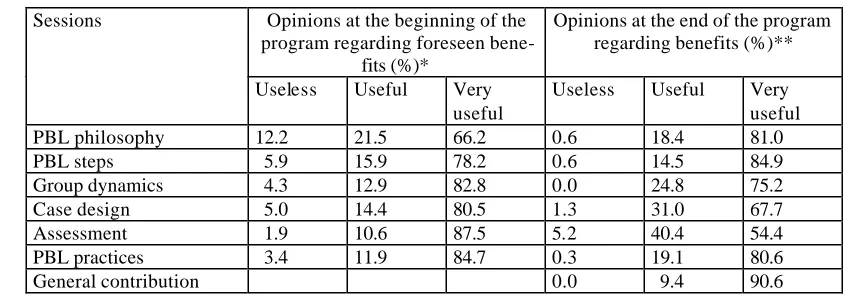
Table 1 displays the participants’ opinions regard-ing foreseen benefits of each session of the course program as stated at the beginning of the course. Assessment principles and PBL practices were
con-sidered as the most useful sessions of the program while PBL philosophy was viewed as the least useful session. Table 1 also presents feedback from the participants regarding benefits of each session of the course program. Most of the participants (90.6%) found the program very useful. PBL steps, PBL prac-tices and PBL philosophy were found to be the most useful sessions. Assessment principles were found as the least useful session.
Table 2 presents the participants ’ ratings of train-ing materials, communication with trainers, attain-ment of the objectives, fulfillattain-ment of individual ex-pectations and course organization. The ratings
given by participants averaged between 4.42 and 4.84 of a five point scale. Participants gave the highest ratings to communication with trainers and course organization. Eighty-four percent of the participants stated that length of the course program was appro-priate. Twelve percent of the participants felt it was too short and 4% felt it was too long.
Table 1
Opinions of the participants about program
Opinions at the beginning of the program regarding foreseen
bene-fits (%)*
Opinions at the end of the program regarding benefits (%)** Sessions
Useless Useful Very
useful
Useless Useful Very
useful
PBL philosophy 12.2 21.5 66.2 0.6 18.4 81.0
PBL steps 5.9 15.9 78.2 0.6 14.5 84.9
Group dynamics 4.3 12.9 82.8 0.0 24.8 75.2
Case design 5.0 14.4 80.5 1.3 31.0 67.7
Assessment 1.9 10.6 87.5 5.2 40.4 54.4
PBL practices 3.4 11.9 84.7 0.3 19.1 80.6
General contribution 0.0 9.4 90.6
*n : 320 **n: 310
Table 2
Means of the scores given by the participants to some course matter
Means Attainment of the objectives 4.61±0.53 Fulfillment of individual
expecta-tions
4.42±0.62
Training materials 4.56±0.59
Communication with trainers 4.84±0.47
to PBL
Discussion
The development of the staff is one of the most important challenges in the process of curriculum reform. Structured courses as described in this paper can give the medical staff the opportunity to develop in educational methods and theory. In DESM, many participants’ view on medical education had become student-centered with Basic Training Skills Courses.11 PBL courses led the participants to gain knowledge on PBL philosophy, PBL principles and steps, case design, some clues on group dynamics and assessment principles in PBL.
In the introductory course of the University of Liverpool, the majority of participants reported that they had come to learn more about PBL, the role of tutor in PBL or progress on the new curriculum.6 Although at the beginning of the PBL Course pro-gram of DESM the topic of PBL philosophy was rated by the participants as the least useful session, at the end of the program PBL steps, philosophy and practices were found as the most useful sessions. It is likely that at the beginning of the course, participants assumed they already gained sufficient knowledge through different workshops and seminars during the curriculum development process, but discussing and working PBL made them realize their lack of knowl-edge.
The topic of assessment principles and methods in PBL was rated as the least useful part of the course. Assessment principles, student and tutor rating scales were introduced in this session. Most of the partici-pants expressed their needs for a longer discussion of this topic due to difficulties in understanding and interpretation of some items of rating scales. Taking participants’ feedback into consideration Evaluation Committee arranged additional seminars on assess-ment principles and methods.
In PBL practice sessions , participants role-played both as students and tutors during the last two days of the course. This was similar to the role -playing e x-periences using in McMaster University’s orientation workshop.5 It is difficult to develop standard ap-proaches to resolve problems arising in the function-ing of a group. There are however some basic princi-ples that can be derived from the actions of a tutor encountering with problems in a tutorial.5 These principles were discussed and shared with partici-pants after each PBL practice session.
This program also assisted faculty members in pre-paring themselves for a variety of educational roles such as tutoring and case writing.
Evaluation of faculty development program is difficult, because there are many extraneous vari-ables. This makes it difficult to attribute changes to the program.10 In DESM, tutors are being evaluated during their tutoring period by observations and stu-dents’ ratings. Since PBL course is a prerequisite for all tutors, no data is available on faculty’s perform-ance prior to PBL course.
At the end of the course most of the participants stated that they had a sound understan ding of PBL rationale and tutor’s and student’s role in PBL. The felt however they needed more practice to master some of the required tutoring skills.
A comprehensive faculty development program includes professional development, organizational development, educational scholarship and leader-ship.12 In DESM, PBL courses and continuous educa-tion activities such as weekly tutor meetings, obser-vations and counseling service are being carried out and new courses on leadership develo pment and advanced tutoring skills are being planned for the near future.
References
1. Lowry S. Teaching the Teachers, British Medical Journal 1993; 306: 127-130.
2. Wetzel SM. Developing the Role of the Tutor/facilitator, Techniques in Medical Education. Problem-Based Learning, Ed: Bligh JG., Harvard Medical School, Office of Educational Development, 1995; 3: 474-477.
3. Rubeck RF, Witzke DB. Faculty Develop-ment: A Field of Dreams, Academic Medi-cine 1998; 73(9) Supplement September: 32-37.
4. Mann KV, Kaufman DM. A Response to the ACME-TRI Report: The Dalhouise Prob-lem-Based Curriculum, Medical Education 1995; 29: 13-21.
to PBL
6. Evans PA, Taylor DCM. Staff Develop ment of Tutor Skills for Problem-Based Learning, Medical Education 1996; 30: 365-366.
7. Irby DM. Models of Faculty Development for Problem-based Learning, Advances in Health Sciences Education 1996;1: 69-81.
8. Schreurs ML, Roebertsen H, Bouhuijs PAJ. Teacher Training for All Teachers in A Fac-ulty of Health Sciences, ICED Conference in Austin, Texas,1998.
9. Benor DA. Faculty development, teacher training and teacher accreditation, Medical Teacher 2000; 22: 503-513.
10. Nayer M. Faculty Development for Prob-lem-Based Learning Programs, Teaching and Learning in Medicine1995;7: 138-148.
11. Musal B, Sarioglu S, Yemiscigil A, Alici E. A Trainers’ Training Program for Clin ical Training Skills, Journal of Dokuz Eylül Medical Faculty1999; 13: 101-108.
12. Wilkerson LA, Irby DM. Strategies for Improving Teaching Practices: A Compre-hensive Approach to Faculty Development, Academic Medicine1998; 73: 387-396.
Correspondence
Berna Musal