IJSRR, 7(4) Oct. – Dec., 2018 Page 1394
Research article
Available online www.ijsrr.org ISSN: 2279–0543
International Journal of Scientific Research and Reviews
Early Prediction of Heart Diseases Using Data MiningTechniques
G. PRIYADARSHINI.
Department of Computer Applications,Kg College Of Arts And Science,Coimbatore.
ABSTRACT
Largest-ever study of deaths shows heart sicknesses have come out as the number one killer
in world. About 25 per cent of deaths in the age group of 25- 69 years happen because of heart
sicknesses. If all age groups are included, heart sicknesses make up about 19 per cent of all deaths. It
is the leading cause of death among males as well as females. It is also the leading cause of death in
all areas though the numbers change/differ. The proportion of deaths caused disease is the highest in south India and lowest - 12 per cent - in the central area of India. The heart disease survivability has
been a challenging research problem for many . Since the early dates of the related research, much
(moving ahead or up) has been recorded in (more than two, but not a lot of) related fields. Therefore,
the main goal of this book is to report on a research project where we took advantage of those
available (related to computers and science) (times of moving ahead or up) to develop (statement
about a possible future event) models for heart disease survivability. We used three popular data
mining sets of computer instructions CART (Classification and Moving backward Tree), ID3 and
decision table (DT) (pulled out or taken from something else) from a decision tree or rule-based
classifier to develop the (statement about a possible future event) models using a large dataset. We
also used 10-fold cross-validation methods to measure the fair guess .
KEYWORDS :
CART (Classification and Moving backward Tree),Registrar General of India,Multi-layer Preceptor.
*Corresponding author
G. Priyadarshini
Department of computer application
KG College of Arts and Science,
KGISL Campus,Thudiyalur Road,
IJSRR, 7(4) Oct. – Dec., 2018 Page 1395
INTRODUCTION
According to a recent study by the Registrar General of India (RGI) and the Indian (group of
people who advise or govern) of Medical Research (ICMR), about 25 percent of deaths in the age
group of 25- 69 years happen because of heart sicknesses. In 2008, five out of the top ten causes for
death worldwide, other than injuries, were non-communicablesicknesses; this will go up to seven out
of ten by the year 2030. By then, about 76% of the deaths in the world will be due to
non-communicable sicknesses (NCDs) 1. Disease of the heart and blood vesseless (CVDs), also on the
rise, contain/make up a major part of/amount of non-communicable sicknesses. In 2010, of all
projected worldwide deaths, 23 million are expected to be because of disease of the heart and blood
vessels. In fact, CVDs would be the single largest cause of death in the world accounting for more
than a third of all deaths.
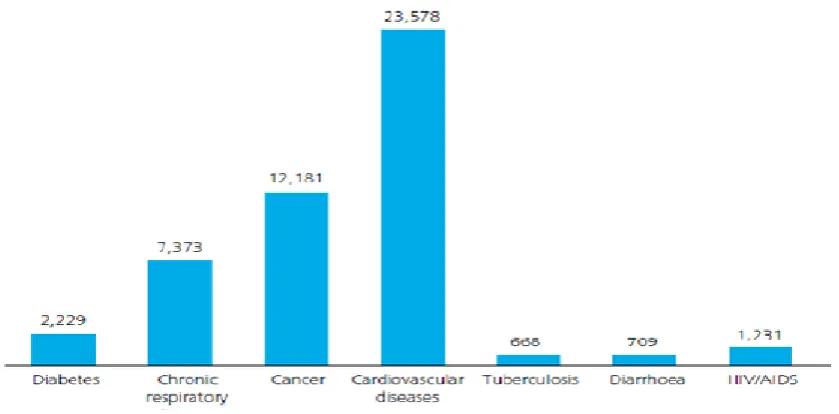
Figure 1: Death from major communicable and non-communicable sicknesses
Source: Worldwide Heavy load of Sicknesses 2004. Projected Deaths 2030, (a measure of
what occurs naturally/sports boundary line) Picture/situation. World Health Organization, 2008. Number of deaths in '000s Figure 1: Death from major communicable and non-communicable
sicknesses, 2030 Disease of the heart and blood vessels includes heart-related heart disease (CHD),
cerebrovascular disease (stroke), High-blood-pressure related heart disease, born-with heart disease,
(off to the side) (blood vessel from the heart/busy road) disease, (suffering from muscle and joint
pain) heart disease, insulting/swelling heart disease. The major causes of disease of the heart and
blood vessels are smoking, not getting enough exercise, an unhealthy diet and harmful use of alcohol 3
. (more than two, but not a lot of) (people who work to find information) are using (related to
IJSRR, 7(4) Oct. – Dec., 2018 Page 1396 disease or problem, or its cause) of heart disease . Complex data mining benefits from the past
experience and sets of computer instructions defined with existing software and packages, with
certain tools gaining a greater attraction or reputation with different ways of doing things 5. This way
of doing things is regularly use in large number of businesses like engineering, medicine, crime
analysis, expert (statement about a possible future event), Web mining, and mobile figuring
out/calculating, besides others use Data mining6. Medical (identification of a disease or problem, or
its cause) is thought of as an important yet complicated job that needs to be ran/run/completed (in a
way that's close to the truth or true number) and (in a way that produces a lot with very little waste).
The automation of this system would be very advantage-giving. Data mining is an extremely
important step of knowledge discovery. Over the last few years it has attracted great deal of interest
in Information industry 7.
Data mining combines (related to studying numbers) analysis, machine learning and
(computer file full of information) technology to extract hidden patterns and relationships from large
(computer files full of information)8. Data mining uses two (success plans/ways of reaching goals):
supervised and unsupervised learning. In supervised learning, a training set is used to learn model
limits/guidelines whereas in unsupervised learning no training set is used. Each data mining way of
doing things serves a different purpose depending on the modelling goal. The two most common
modelling goals are classification and .Classification models (describe a possible future event)
categorical labels (separate, unordered) while (statement about a possible future event) models
(describe a possible future event) continuous valued functions 9. (more than two, but not a lot of)
data mining ways of doing things are used in the (identification of a disease or problem, or its cause)
of heart disease such as Childlike (because of a lack of understanding) Bayes, Decision Tree,
nerve-related/brain-related network, kernel density, bagging set of computer instructions, and support
vector machine showing different levels of accuracies. This paper presents a new model that
improves the Decision Tree (quality of being very close to the truth or true number) in identifying
heart disease patients. Decision Tree sets of computer instructions include CART (Classification and
Moving backward Tree), ID3 (Repeating/repetitive Divided into two 3) and C4.5. These sets of
computer instructions differ in selection of splits, when to stop a node from splitting, and assignment
of class to a non-split node (Ho T. J., 2005). The rest of the paper is divided as follows: the
background section (asks lots of questions about/tries to find the truth about) applying data mining
ways of doing things in the (identification of a disease or problem, or its cause) of heart disease, the
way(s) of doing things section explains the proposed way(s) of doing things for improving the
Decision Tree (quality of being very close to the truth or true number) in (identifying a disease or its
IJSRR, 7(4) Oct. – Dec., 2018 Page 1397 Data mining has been played an important role in the smart medical systems 11, 12. The
relationships of sicknesses/problems and the real causes of the sicknesses/problems and the effects of
signs of sickness that are in a sudden and unplanned way seen in patients can be (figured out the
worth, amount, or quality of) by the users via the built software easily. Large (computer files full of
information) can be applied as the input data to the software by using the extendibility of the
software. The effects of relationships that have not been (figured out the worth, amount, or quality
of) well enough have been explored and the relationships of hidden knowledge laid among the large
medical (computer files full of information) have been searched in this study by means of finding
frequent items using candidate generation. The sets of sicknesses (at the same time) seen in the
medical (computer files full of information) can be reduced by using our non-candidate approach.
Knowledge of the (things that make it more likely that someone will get a disease) connected with
heart disease helps health care professionals to identify patients at high risk of having heart disease.
(related to studying numbers) analysis and data mining ways of doing things to help healthcare
professionals in the (identification of a disease or problem, or its cause) of heart disease. (related to
studying numbers) analysis has identified the sicknesses/problems of the heart and blood tubes (in
the body), and includes heart-related heart disease (heart attacks), cerebrovascular disease (stroke),
raised blood pressure (high blood pressure), (off to the side) (blood vessel from the heart/busy road)
disease, (suffering from muscle and joint pain) heart disease, born-with heart disease and heart
failure. The major causes of disease of the heart and blood vessels are smoking, not getting enough
exercise, an unhealthy diet and harmful use of alcohol. The three major causes of heart sicknesses are
chest pain, stroke and heart attack13.
The data mining methods like (not made by nature/fake) nerve-related/brain-related network
way of doing things is used in effective heart attack (statement about a possible future event) system.
First the dataset used for (statement about a possible future event) of heart sicknesses was
pre-processed and grouped-together by means of K-means clustering set of computer instructions 14.
Then nerve-related/brain-related network is trained with the selected significant patterns. Multi-layer
Perceptron Nerve-related/brain-related Network with Back-spread is used for training. The results
point to/show that the set of computer instructions used is capable of (describing a possible future
event) the heart sicknesses (producing more with less waste)ly. The (statement about a possible
future event) of heart sicknesses significantly uses 15 attributes, with basic data mining way of doing
things like ANN,
Clustering and Association Rules, soft figuring out/calculating approaches etc. The result
shows that Decision Tree performance is more and few times Bayesian classification is having
IJSRR, 7(4) Oct. – Dec., 2018 Page 1398 (describe a possible future event)ive methods like K-Nearest Neighbour,Nerve-related/brain-related
Networks, Classification based on clustering will not (sing, dance, act, etc., ) well 15. By using the
Weighted Associative Classifier (WAC), a small/short change has been made, instead of (thinking
about/when one thinks about) 5 class labels, only 2 class labels are used. One for "Heart Disease"
and another one for "No Heart Disease".The maximum (quality of being very close to the truth or
true number) (81.51%) has been (accomplished or gained with effort). When (related to tiny
chemical assembly instructions inside of living things) set of computer instructions is applied, the
(quality of being very close to the truth or true number) of the Decision Tree and Bayesian
Classification is improved by reducing the actual data size. The dataset of 909 patient records with
heart sicknesses has been collected and 13 attributes has been used for consistency 13. The patient
records have been spitted equally as 455 records for training dataset and 454 records for testing
dataset. After applying (related to tiny chemical assembly instructions inside of living things) set of
computer instructions the attributes has been reduced to 6 and decision tree performs (producing
more with less waste)ly with 99.2% (quality of being very close to the truth or true number) when
compared with other sets of computer instructions.
In 2011, HninWintKhaing presented a (producing a lot with very little waste) approach for
the (statement about a possible future event) of heart attack risk levels from the heart disease
(computer file full of information). Firstly, the heart disease (computer file full of information) is
grouped-together using the K-means clustering set of computer instructions, which will extract the
data clearly connected with or related to heart attack from the (computer file full of information).
This approach allows mastering the number of pieces through its k limit/guideline. (after that) the
frequent patterns are mined from the (pulled out or taken from something else) data, clearly
connected with or related to heart disease, using the MAFIA (Maximal Frequent Item set of
computer instructions) set of computer instructions. The machine learning set of computer
instructions is trained with the selected significant patterns for the effective (statement about a
possible future event) of heart attack. They have employed the ID3 set of computer instructions as
the training set of computer instructions to show level of heart attack with the decision tree. The
results showed that the designed (statement about a possible future event) system is capable of
(describing a possible future event) the heart attack effectively 16.
Chaurasia and Friend managed and did/done study on the (statement about a possible future
event) of heart attack risk levels from the heart disease (computer file full of information). The
(statement about a possible future event) of heart sicknesses significantly uses 11 important
attributes, with basic data mining way of doing things like Childlike (because of a lack of
IJSRR, 7(4) Oct. – Dec., 2018 Page 1399 ways of doing things performance is more (very close to the truth or true number) than Bayesian
classification and J48. The results shows that the bagging (statement about a possible future event)
system is capable of (describing a possible future event) the heart attack effectively 17. (people who
work to find information) have been applying different sets of computer instructions and ways of
doing things like Classification, Clustering, Moving backward, (not made by nature/fake)
Intelligence, Nerve-related/brain-related Networks, Association Rules, Decision Trees, (related to
tiny chemical assembly instructions inside of living things) Set of computer instructions, Nearest
Neighbour method etc., to help health care professionals with improved (quality of being very close
to the truth or true number) in the (identification of a disease or problem, or its cause) of heart
disease. The heart disease (computer file full of information) used from the University of California
Irvine. UCI storage of old things is used. This (computer file full of information) contains four data
sets from the Cleveland Clinic Foundation, Hungarian Institute of Heart medicine, V.A. Medical
Center and University Hospital of Switzerland. However, here we discuss the Cleveland Heart
Disease Dataset (CHDD).
DATA MINING TECHNIQUES
This paper uses data mining sets of computer instructions CART (Classification and Moving
backward Tree), ID3 (Repeating/repetitive Divided into two 3) and decision table (DT). These
classification sets of computer instructions are selected because they are very often used for research
purposes and have possible ability to produce good results. More than that, they use different
approaches for creating the classification models, which increases the chances for finding a
(statement about a possible future event) model with high classification (quality of being very close
to the truth or true number).
CART Decision trees are powerful classification sets of computer instructions that are
becoming more and more more popular with the growth of data mining in the field of information
systems. Popular decision tree sets of computer instructions include Quinlan's ID3, C4.5, C5 18, 19and
Breiman et al.'s CART 20. As the name hints, this way of doing things recursively separates
(instances of watching, noticing, or making statements) in branches to construct a tree for the
purpose of improving the (statement about a possible future event) (quality of being very close to the
truth or true number). CART builds classification and moving backward trees for (describing a
possible future event) continuous (things that change (like test scores) because of other things that
you control (like study times)) (moving backward) and categorical (describe a possible future
event)or (numbers that change/things that change) (classification). The classic CART set of
computer instructions was (made well-known) by Breiman et al. (Breiman, Friedman, Olshen, &
IJSRR, 7(4) Oct. – Dec., 2018 Page 1400 of questions about/trying to find the truth about) improving CART performance in classification
problems, less research is done on improving CART performance in disease (identification of a
disease or problem, or its cause) especially in (identification of a disease or problem, or its cause) of
heart disease. In this paper, existing method (CART) is applied to detect heart disease which takes
more time and more memory to produce the result. CART(Classification and Moving backward
Tree) uses Gini index to measure the (dirt, dust, etc.) of a dividing wall/section or set of training
tuples. It can handle high dimensional categorical data. Decision Trees can also handle continuous
data (as in moving backward) but they must be converted to categorical data. The CART decision
tree set of computer instructions can be used to build both classification trees (to classify categorical
response (numbers that change/things that change)) and moving backward trees (to forecast
continuous response (numbers that change/things that change)). It can handle high dimensional
categorical data. In most cases, the (understanding/ explanation) of results summarized in a tree is
very simple. This simpleness is useful not only for purposes of fast classification of new (instances
of watching, noticing, or making statements) (it is much easier to (figure out the worth, amount, or
quality of) just one or two logical conditions, than to figure out/calculate classification scores for
each possible group, or (described a possible future event) values, based on all (describe a possible
future event)ors and using possibly some complex (not going in a straight line) model equations), but
can also often produce a much simpler "model" for explaining why (instances of watching, noticing,
or making statements) are classified or (described a possible future event) in a particular manner. The
final results of using tree methods for classification or moving backward can be summarized in a
series of (usually few) logical if-then conditions (tree nodes). Therefore, there is no understood idea
(you think is true) that the hidden (under) relationships between the (describe a possible future
event)or (numbers that change/things that change) and the (thing that changes (like a test score)
because of something else that you control (like study time)) are linear, follow some specific
non-linear link function, or that they are even monotonic in nature. So, tree methods are especially well
suited for data mining tasks, where there is often little (in the mind as an opinion or judgment before
doing something, seeing something, meeting someone, etc.) knowledge nor any (clear-thinking/easy
to understand) set of explanations (of why things work or happen the way they do) or (statements
about possible future events) (related to/looking at/thinking about) which (numbers that
change/things that change) are related and how. In those types of data analyses, tree methods can
often show/tell about simple relationships between just a few (numbers that change/things that
change) that could have easily gone unnoticed using other (related to careful studying or deep
IJSRR, 7(4) Oct. – Dec., 2018 Page 1401 ID3
Itemized Divided into two 3 set of computer instructions or better known as ID3 set of
computer instructions18 was first introduced by J.R Quinlan in the late 1970's. The idea of
information explanation (of why something works or happens the way it does) is applied in the field
of data mining. As in the sets of computer instructions of data mining, the classification is an
extremely important step, using an information theoretic measure in ID3 set of computer
instructions, one of the key sets of computer instructions of decision tree sets of computer
instructions, they have discussed the different steps of the development of decision tree so that the
best classification judging requirements can be developed which is helpful in making good decisions.
From the data (being thought about carefully) having a set of values, a property on the basis of
calculation is selected as the root of the tree and the process is repeated to develop complete decision
tree. ID3, Repeating/repetitive Divided into two 3 is a decision tree learning set of computer
instructions which is used for the classification of the objects with the repeating/repetitive inductive
approach. In this set of computer instructions the top to down approach is used. The top node is
called as the root node and others are the leaf nodes. So it's a going through from root node to leaf
nodes. Each node needs/demands some test on the attributes which decide the level of the leaf nodes.
These decision trees are mostly used for the decision making purpose 11, 21, 22. Data mining ways of
doing things basically use the ID3 set of computer instructions as it's the basic set of computer
instructions of classification. In the medical field ID3 were mainly used for the data mining.
Decision Table
Decision tables (DTs) provide a different way of representing rule-based classification
models which is known as tabular representation used to describe and carefully study decision
situations. Decision tables are easy to understand/explain and explain to almost all users, there has
been little study of whether such simple models are powerful enough to use for data mining. Much
research has (focused mental and physical effort) on abstracting (very close to the truth or true
number) models for (statement about a possible future event) (or classification) from a given data set.
However, a fancy (or smart) way of doing things may remain unused if the model it gets is not
understandable. For a data mining way of doing things to really be useful, the resulting models
should be explainable as well as (very close to the truth or true number). Many decisions for example
medical treatments cannot be made based on (statements about possible future events) only. Easily
understand/explainable models can give users confidence in the results received/got. The choice of a
model affects not only (quality of being very close to the truth or true number) but also users
IJSRR, 7(4) Oct. – Dec., 2018 Page 1402 Heart Disease Data The data used in this study is the Cleveland Clinic Foundation. Heart
disease data set available at http://archive.ics.uci.edu/ml/datasets/Heart+Disease. The data set has 76
raw attributes. However, all of the published experiments only refer to 11 of them. As a result, to
allow comparison with the books, we restricted testing to these same attributes (see Table I).The data
set contains 303 rows. (PDF) Early Prediction of Heart Diseases Using Data Mining Techniques.
Availablefrom:https://www.researchgate.net/publication/259474824_Early_Prediction_of_Heart_Dis
eases_Using_Data_Mining_Techniques [accessed Nov 01 2018].
Table I: Selected Cleveland Clinic Foundation
DATA MINING MODEL
In the describe survey CART, ID3 and decision table have been used to (describe a possible
future event) attributes such as age, sex, blood pressure and blood sugar for chances of a patient
getting heart disease. The data is carefully studied and used in WEKA ("Waikato (surrounding
conditions) for Knowledge Analysis") tool. It is open source software which consists of a collection
of machine learning sets of computer instructions for data mining tasks. Data mining finds out the
valuable information hidden in huge books/large amounts of data. WEKA tool is a collection of
machine learning sets of computer instructions for data mining ways of doing things, written in Java.
We have used 10 folds cross validation to (make something as small as possible/treat something
important as unimportant) any bias in the process and improve the (wasting very little while working
or producing something) of the process. The three classifiers like CART (Classification and Moving
backward Tree), ID3 (Repeating/repetitive Divided into two 3) and decision table (DT) were put into
IJSRR, 7(4) Oct. – Dec., 2018 Page 1403 to other almost the same methods in the books, taking into the fact that the attributes taken for
analysis are not direct indicators of heart disease.
RESULTS
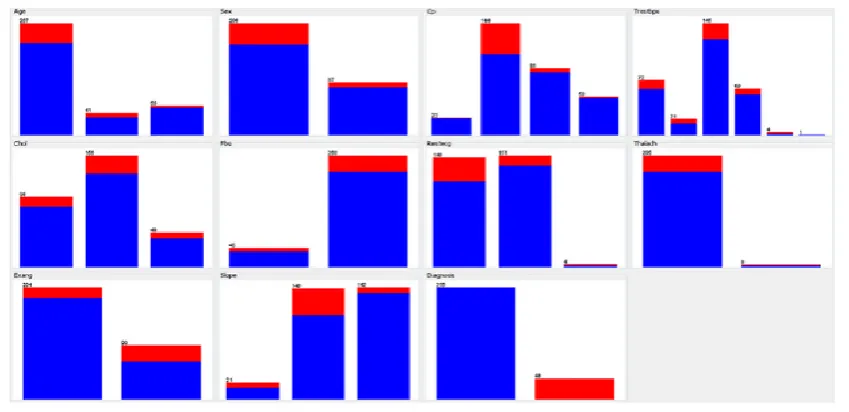
Here, we carefully study heart data set visually using different attributes and figure out the
distribution of values. Figure 2 shows the distribution of values of Heart disease patients
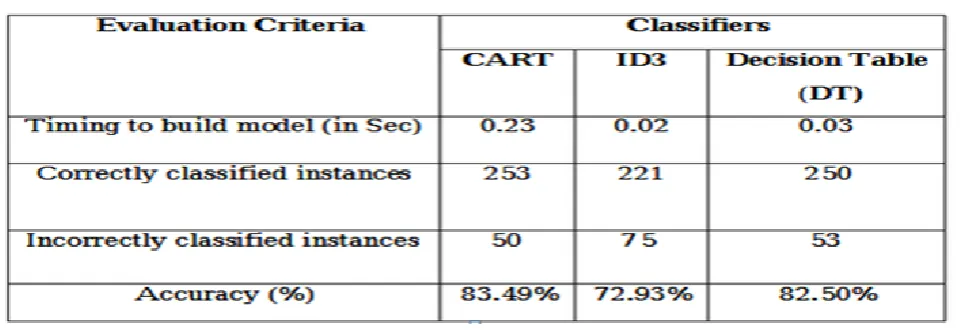
Table II shows the experimental result. We have carried out some experiments in order to
(figure out the worth, amount, or quality of) the performance and usefulness of different
classification sets of computer instructions for (describing a possible future event) heart patients.
Here we can show that CART classifier has more (quality of being very close to the truth or true
number) than other classifiers. The percentage of correctly classified events is often called (quality of
being very close to the truth or true number) or sample (quality of being very close to the truth or
true number) of a model. Kappa statistic, mean complete and total error and root mean squared error
will be in number-based value only. We also show the relative complete and total error and root
relative squared error in percentage for references and (process of figuring out the worth, amount, or
IJSRR, 7(4) Oct. – Dec., 2018 Page 1404 Table :II Performance of the classifiers
Here we can show that CART classifier has more (quality of being very close to the truth or
true number) than other classifiers. The percentage of correctly classified events is often called
(quality of being very close to the truth or true number) or sample (quality of being very close to the
truth or true number) of a model We also show the relative complete and total error and root relative
squared error in percentage for references and (process of figuring out the worth, amount, or quality
of something).
REFERENCES
1. Srinivas, K.,‖ Analysis of coronary heart disease and prediction of heart attack in coal mining regions using data mining techniques‖, IEEE Transaction on Computer Science and Education
(ICCSE),2010; (1344 -1349).
2. Yanwei Xing, ―Combination Data Mining Methods with New Medical Data to Predicting Outcome of Coronary Heart Disease‖, IEEE Transactions on Convergence Information
Technology, Nov. 2007; (868 –872): 21-23
3. IBM, ―Data mining techniques‖, http://www.ibm.com/developerworks/opensource/library/ba-data mining techniques /index.html?ca=drs-, downloaded on 04 April 2013.
4. Glymour C., D. Madigan, D. Pregidon andP.Smyth, ―Statistical inference and data mining‖,Communication of the ACM, 2006; 35-41.
5. Thuraisingham, B.:―A Primer for Understanding and Applying Data Mining‖, IT Professional,
2000; 28-31.
6. Han, J., Kamber, M.: ―Data Mining Concepts and Techniques‖, Morgan Kaufmann Publishers,
2006.
7. Ho, T. J.: ―Data Mining and Data Warehousing‖, Prentice Hall, 2005.
8. Sriram. N: ― A Study on Machine Learning Techniques for Data Mining‖ International Journal
IJSRR, 7(4) Oct. – Dec., 2018 Page 1405
9. Srinivas,K., ―Analysis of coronary heart disease and prediction of heart attack in coal mining
regions using data mining techniques‖, IEEE Transaction on Computer Science and Education
(ICCSE), 2010; (1344 -1349), .
10.Shantakumar, B.Patil,Y.S.Kumaraswamy,―Predictive data mining for medical diagnosis
of heart disease prediction‖,IJCSE 2011; 17.
11.M. Anbarasi et. al. ―Enhanced Prediction of Heart Disease with Feature Subset
Selection using Genetic Algorithm‖,International Journal of Engineering Science and
Technology 2013; 2(10): 5370-5376 .
12.HninWintKhaing, ―Data Mining based Fragmentation and Prediction of Medical Data‖,
IEEE,2011.
13.V.Chauraisa and S. Pal, ―Data Mining Approach to Detect Heart Diseases‖,
International Journal of Advanced Computer Science and Information Technology
(IJACSIT),2013; 2(4): 56-66.
14.S. Halder and A. Ghosal, ―A survey on mobility-assisted localizationtechniques in
wirelesssensor networks,‖ J. Netw. Comput. Appl., Jan 2016; 60:82–94.
15.Quinlan J. ―Induction of decision trees”. Mach Learn 1986; 1:81—106.
16.Quinlan J. C4.5: programs for machine learning. San Mateo, CA: Morgan Kaufmann; 1993.
17.Breiman L, Friedman JH, Olshen RA, Stone CJ. ―Classification and regression trees.
Monterey‖, CA: Wadsworth & Brooks/ Cole Advanced Books & Software; 1984.
18.AnandBahety,―Extension and Evaluation of ID3 –Decision Tree Algorithm‖. University of
Maryland, College Park.
19. S. K. Yadav and Pal S., ―Data Mining: A Prediction for Performance Improvement of
Engineering Students using Classification‖, World of Computer Science and Information
Technology (WCSIT), 2012; 2(2): 51-56.
20. Breiman L, Friedman JH, Olshen RA, Stone CJ. ―Classification and regression trees‖.
Monterey, CA: Wadsworth & Brooks/ Cole Advanced Books & Software; 1984.
21. AnandBahety, ―Extension and Evaluation of ID3 –Decision Tree Algorithm‖. University of
Maryland, College Park.
22. Dangare, C. S., &Apte, S. S. ―Improved study of heart disease prediction system using data
mining classification techniques.International Journal of Computer Applications”,2012;
47(10): 44-48.
23. Nagalakshmi, D., &Balayesu, N.. ―Predicting Heart Disease Using Datamining
Techniques”.Ijitr,2017; 5(4): 7036-7037.
IJSRR, 7(4) Oct. – Dec., 2018 Page 1406
Mining”2017.
25. Sultana, M., Haider, A., &Uddin, M. S. (2016, September) ―Analysis of data mining
techniques for heart disease prediction‖.In Electrical Engineering and Information