R E S E A R C H A R T I C L E
Open Access
Injury narrative text classification using
factorization model
Lin Chen
1, Kirsten Vallmuur
2*, Richi Nayak
1From
ACM Eighth International Workshop on Data and Text Mining in Biomedical Informatics
Shanghai, China. 7 November 2014
Abstract
Narrative text is a useful way of identifying injury circumstances from the routine emergency department data collections. Automatically classifying narratives based on machine learning techniques is a promising technique, which can consequently reduce the tedious manual classification process. Existing works focus on using Naive Bayes which does not always offer the best performance. This paper proposes the Matrix Factorization approaches along with a learning enhancement process for this task. The results are compared with the performance of various other classification approaches. The impact on the classification results from the parameters setting during the classification of a medical text dataset is discussed. With the selection of right dimension k, Non Negative Matrix Factorization-model method achieves 10 CV accuracy of 0.93.
Introduction
Administrative health databases, such as those collected in primary care practices, emergency departments, hos-pitals, mortality registration data and workers compen-sation databases collect various coded data and narrative text fields for the routine monitoring and analysis of injury causation and incidence. Several authors have promoted and described the value of narrative text for providing extra detail to supplement routine coded data [1,2] or for providing the required information to clas-sify an injury post data collection if a dataset has not been coded at the point of care [3]. To develop methods for accurately classifying narrative text into injury cause categories automatically, machine learning approaches using ‘gold standard’injury surveillance data can prove useful.
Methods of obtaining the information from the narra-tive text vary from study to study and depend on the field of research. Approaches range from basic keyword searches of text strings [4,5] through to complex statisti-cal approaches using Bayesian methods and Natural
Language Processing techniques [3,6,7]. In general, the simple approaches such as keyword search are inferior than the complicated machine learning methods in terms of achieving the specificity and sensitivity [3]. Pre-dominantly, Bayesian model as a machine learning method is selected as the case study of using narrative text for classification of coded data [8-11,3]. Many superior classifiers such as Support Vector Machine (SVM), Matrix Factorization have never utilized in the medical-oriented dataset experiments. Considering the unique characteristics of medical narrative datasets, it is a question as to whether the conclusions drawn from the existing classification methods comparisons would still hold for a medical dataset.
Many existing works have discussed the application of matrix factorization for (1) the better visualization of dataset in 2D and 3D space, (2) clustering of documents, and (3) collaborative recommendations [12]. Only a handful of works have applied matrix factorization tech-niques to classification [13-15]. Predominately, the near-est neighbor approach is applied for the various tasks including classification.
Narrative text usually contains information relevant to several coded data. In this study, the aim is to map the narrative text to major injury code and external code. From the observations of dataset, it is noticed that
* Correspondence: [email protected]
2Centre for Accident Research and Road Safety - Queensland, School of
Psychology and Counselling, Faculty of Health, Queensland University of Technology, Victoria Park Road, Kelvin Grove, Brisbane, Queensland, Australia Full list of author information is available at the end of the article
major injury code is closely related to external code. For example, burns are associated with hot objects; lacera-tions are associated with sharp objects. Because of such associations existing in the dataset, the inclusion of injury code will help improve the classification accuracy of external code and vice versa.
In this paper, classification approaches on matrix fac-torization will be exclusively presented. The purpose of this study is as follows. (1) This study applies a series of classifiers from different classification families, including matrix factorization approaches, to a medical text narra-tive dataset. (2) Learning enhancement process which incorporates the injury code/external code in the feature space is studied to observe any improvement on the classification accuracy of external code/injury code. (3) Empirical comparisons of the classification family are conducted based on several evaluation metrics such as Sensitivity, Specificity, Precision, Kappa statistics and Area Under Curve (AUC/ROC), in order to evaluate the methods accurately. The best classification method is observed. (4) Results from the experiments are reported. The indications from the results and medical domain aspect are illustrated for future study.
Literature review
Narrative text information usage includes (1) selection of cases for analysis (2) extraction of relevant informa-tion. For this work, the focus is the extraction of rele-vant information.
This scenario happens when the coded data is unable to identify medical cases. The basic strategy applied in some papers [4,16-18,5] to enable the selection of cases is keyword search on narrative text. Once cases were selected, the patterns and trends in injuries could then be examined by variables of interest, though no further cod-ing of narratives was undertaken for these studies [19].
Wellman [3] focused on using injury narratives and corresponding E-codes assigned by Experts from National Health Interview Survey. A Fuzzy Bayesian model was developed for automatically assigning E-code categories to each injury narrative. It was shown that a Fuzzy Bayesian approach boosted the per-formance because the assumption of the algorithm is that words are conditional dependent and therefore, the combination of words increased the probability of categories.
A follow-on study of Wellman’s previous Fuzzy Baye-sian work combined Fuzzy and Naive BayeBaye-sian methods [10] for training and prediction of 14,000 narratives
from claims from a worker’s compensation insurance
provider. The process of assigning code to narrative text was not fully automated when Naive Bayesian and Fuzzy Bayesian assignments disagreed, and when prediction strength is lower than a threshold.
Machine learnt algorithms for extractions of relevant information generally achieve reasonable specificity and sensitivity. Bayesian methods, even though explanatory of the results, are not necessarily the methods with the best results.
In this paper, various machine learning methods are applied to a medical dataset. Evaluations are conducted and the impacts of various factors are determined.
Data pre-processing
Pre-processing is carried out to ensure the quality of data. Those records with a null entry in injury description are removed during the Data Removal step. Inconsisten-cies in External Cause Code and Major Injury Factor Code due to different coding systems being adopted at different periods of time are also corrected.
Misspelling: Misspelling can happen frequently in busy medical settings [20]. Failure to detect misspelling results in poor classification. Due to its severe conse-quences, research in spelling auto-correction is well-stu-died. The early researchers utilise the single edit operation such as insertion, deletion, and substitution, for the words that do not appear in a dictionary [21]. More recently, statistical models such as error models and n-gram language models are employed, especially in online query spelling correction settings [22]. In the medical environment, most misspellings are caused by mistyped keys and misunderstanding of the correct spel-ling of words [20]. We have corrected the misspelspel-lings by finding and replacing the misspelt word with a soun-dalike word, which is the smallest edit distance from the original word. We utilised Aspell for the soundalike type of spelling correction as the performance of Aspell has been reported better than Ispell or Google (Atkinson, 2006).
Removal of punctuation:Punctuation contains no actual meaning of information and can consume extra storage space in the lengthy document-term entry, if they are not removed. The removal of punctuations should be performed before stop-word removal and stemming pro-cedures, otherwise, they may not be performed accu-rately. The words before and after the punctuation are identified as a single word. For example,‘fall (from the high chair)’. If punctuation is not removed before the stop word removal,‘from’is identified as a word, thus, the stop-word‘from’is not removed.
in the text narratives are identified and only one form of abbreviations is used.
Feature reduction:Stop-word removal and Stemming are common steps to reduce the number of terms in the document-term entry before text mining is carried out. In this work, the Porter stemming algorithm is utilized. Additionally, terms that appear too infrequently or too frequently should be removed. Infrequent terms only appear in a few text narratives and are not applicable to the majority of records. Frequently appeared terms should be removed as they are like stop words. If the frequent terms appear in all the classes, they are not good text indicators for classifications and thus serve no purpose of keeping the term. The results for frequent terms are discussed later in the section entitled‘Impact of removal of topn terms’. We found that frequent term should be removed with the guidance of medical experts as the removal of Top-N terms without guidance leads to the worse accuracy. Medical experts know which terms are the unique to some classes and which terms are quite general and appear in lots of classes.
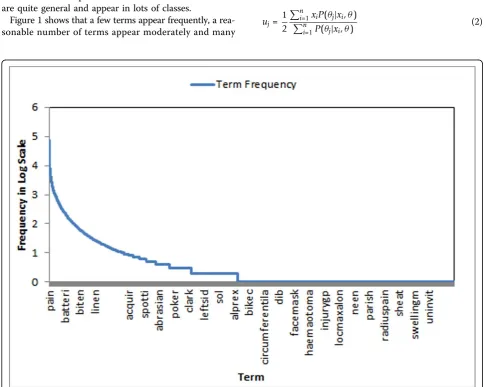
Figure 1 shows that a few terms appear frequently, a rea-sonable number of terms appear moderately and many
terms appear rarely. In order to decide the cut-off criteria for differentiating infrequently and frequently appearing terms, an EM clustering approach is employed [23].
Let xirepresent the frequency of termi in the dataset. LetX = (x1, x2,..., xn)represent all the terms frequency in the dataset. Let the dataset be divided into two sub-sets-frequent term subset and infrequent term subset. Given the dataset X, the objective is to mine a set of parameters θ= {θ1,θ2} such that the probability P(X|θ} is maximized whereθj= (uj, sj) are the mean and stan-dard deviation. By iteratively applying E-step and M-step, the parameters are calculated and therefore the clusters can be decided.
In E-step, the probability of xi belonging to each dis-tribution can be calculated by using
P(θj|xi,θ) =
P(xi|θj)
2
m=1P(xi|θm)
(1)
In M-step, the parameters are adjusted by using
uj=
1 2
n
i=1xiP(θj|xi,θ)
n
i=1P(θj|xi,θ)
(2)
σj=
n
i=1P(θj|xi,θ)(xi−uj)2
n
i=1P(θj|xi,θ)
(3)
After each iteration, the convergence test is per-formed. WhenθN −θN −1 < ∈is satisfied, the iteration process stops.∈is set to 1.0e-6.
The total number of terms was 27,734 initially and this is cut down to 4,924 after feature reduction.
Matrix factorization based classifier
The medical narrative text injury dataset is composed of many short documents. Each document describes the injury events such as how it happened, where it happened and what caused it. The data can be characterized as high-dimensional sparse, in which few features are irrele-vant, but features tend to be correlated with one another and generally organized into linearly separable categories. Because of this characteristic, it is more appropriate to use matrix factorization techniques mapping all the fea-tures to lower dimensional space rather than reduce the number of features. Feature reduction methods such as Mutual Information, Chi-Squared criteria and odds ratio aim to reduce the number of features. However, no single feature selection method can work well with all text cate-gorization methods, as different classifiers evaluate the important features differently. Simply removal of features may cause of the removal of important features for some classifiers. On the other hand, feature extraction such as matrix factorization should work well as all the features are kept and transformed into lower dimensional space. By doing so, noise is reduced and the latent semantic structure of the vocabulary used in the dataset becomes more obvious, thus, the lower-dimension feature space improves the classification performance. We propose to use two matrix factorization techniques, Singular Value Decomposition (SVD) and Non Negative Matrix Factori-zation (NNMF).
Singular value decomposition (SVD)
Let Dbe identified as the narrative text injury dataset. Singular Value Decomposition transforms an original
matrix D∈ Rm×n into left singular matrix U ∈ Rm×m,
right singular matrixV∈Rn×nand diagonal matrix∑∈
Rm×n. Formally, D = U ΣVT. Let the approximation
denoted asD˜kwhich is formed by considering only the topksingular value inΣhas the smallest distance toD measured in any unitarily invariant norm [12]. More specifically,D˜kcan be decomposed to D˜k=UkkVkT.
Where kis thek largest singular values, Uk ∈ Rm×k,
Vk∈Rn×k, and∑k∈Rk×k.
Model-based Classification: Let Dbe identified as the narrative text injury dataset containingmnumber of documents. Let SVD approximation of narrative text
documents identified as D˜k, D˜k= (d˜1,d˜2,. . .,d˜m). For each documentd˜j, it can be represented byklargest sin-gular values asd˜j= (w1j,w2j,. . .,wkj).
The classification problem is to approximate a target function f :D˜k→C where C= (c1, c2...cx) is a set of pre-defined categories. In this paper, various families of classifiers are tested in the experiment section, with only the best classifier being applied on the approximated document matrixD˜k.
Memory-based Classification: Inspired by the CMF method [13], the approximation matrix can be repre-sented as
˜
Dk=UkkVkT=UkkVkTVkVkT=DVkVTk (4) Because Vk is singular matrix, VkTVk=I where I is identity matrix.
Let the training dataset be denoted as D˜Train
k and let
the testing dataset be denoted asD˜Test
k . The singular vec-tors VkTrainextracted from training phase are also the representative of the test data as training data and test data should exhibit the similar characteristics [13].
˜
DTraink =DTrainVTrain
k (V
Train
k )T (5)
˜
DTest
k =DTestVkTrain(VkTrain)T (6)
By comparing the similarity of each document inD˜Test k and the document in D˜Traink , the most likely class is assigned to the document in D˜Test
k with the class label
from the most similar document in D˜Traink . Formally described as,
C= arg max ⎧ ⎨ ⎩
(D˜Train
k )
T˜
DTest k
D˜Traink D˜Testk ⎫ ⎬
⎭ (7)
Non-negative matrix factorization (NNMF)
It is more natural to use NNMF rather than SVD as each document is the addition of topics and therefore the coefficients should be all non-negative values. Further, topics under a document are not completely independent of each other and therefore, the semantic space capturing the topics are not necessarily orthogonal [24].
Given D∈Rm×n, it can be decomposed toA∈ Rm×r
andH∈Rr×nwhereris the new feature space [25]. For-mally,
D≈AH (8)
documents in the newly formed space and H is repre-sentation of terms in newly formed space.
Model-based classification:BecauseAis deemed to be the representation of documents in the newly formed feature space, A is used in classification. LetATrain be identified as the document representation fromDTrain. Let ATestbe identified as the document representation fromDTest. During the training phase, the best classifier is selected for training(ATrain, CTrain)which is the class label for each training case. During the testing phase
ATestis supplied to the trained classifier for the predic-tion of the class label for each testing case.
Memory-based classification: Let the training dataset be denoted as D˜Traink and let the testing dataset be denoted asD˜Traink
˜
DTraink ≈ATrainHTrain (9)
˜
DTestk ≈ATestHTest (10)
By comparing the similarity of each document in
ATrainand the document inATest, the most likely class is assigned to the document in ATest with the class label from the most similar document inATrain More specifi-cally,
C= arg max
(ATrain)TATest ATrainATest
(11)
Learning enhancement
From the observations of dataset, it is noticed that major injury code is closely related to external code. For example, burns are associated with hot objects; lacera-tions are associated with sharp objects. Suppose the classification assignment of major injury code/external code can be represented as supplementary features for the classification of external code/major injury code.
Let the k features denoted asF = (f1,f2...,fk) with each feature representing as a text. Suppose there is p num-ber of class of external code. Let the external code class represented as supplementary features and the features are changed to F = (f1, f2,... fk, fk+1, fk+2,... fk+p). If the instance belongs to classi, then only fk+i has value 1 and the rest of class represented as featuresfk+1, fk+2....fk
+phas value as 0. The objective is to classify the major injury code using the newly changed features F. The classification of external code can be done similarly using the major injury code as the supplementary feature.
Experimental setup
Our dataset contains 15,000 emergency department pre-sentation records from a sample of hospitals collecting
data for the Queensland Injury Surveillance Unit during 2009 to 2012. Each record contains narrative text field which is the description of various aspects of medical case including the cause and mechanism leading to the injury, activity involved, absence or presence of protec-tive equipment and treatment of the case. The External Cause is the primary event, circumstances or condition associated with the occurrence injury. Major Injury Fac-tors are the types of objects and substances involved in occurrence of injury. They have been coded by profes-sional medical staff using ICD-10 classification system.
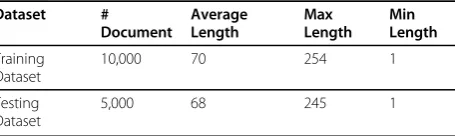
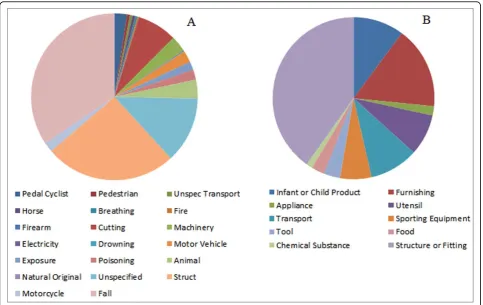
Dataset: The objective of experiments is to evaluate the performance of various classifiers on the injury narrative dataset. Table 1 shows the statistics of the injury narrative dataset. Documents with empty injury description text, or empty External Cause class, or empty Major Injury Factor Cause Class are not included in the dataset. Figure 2 shows that the dataset is imbalanced, with two major classes taking up about 70% of the whole population for External Code distribution, while two major classes in Injury Factor take up about 50% of the population.
Evaluation criteria: The criteria used are designed for the medical domain. To avoid bias because of the imbal-anced dataset, Kappa statistic is employed. Note TP in Table 2 corresponds to true positive which is the items correctly classified and belongs to the positive class. FP is false positive which refers to the items incorrectly classified and should belong to negative class. TN is true negative which refers to item correctly classified and belongs to the negative class. FN is false negative which means the item is misclassified and belongs to positive class.
Traditional classifiers
Decision tree:C4.5 algorithm is employed and a prun-ing approach is adopted for reducprun-ing the complexity of the classifier and improving the accuracy.
Probabilistic:Naive Bayes algorithm with multi-variate Bernoulli model is used. This is known for its perfor-mance when the dataset contains small vocabularies [26].
Linear:Support Vector Machine (SVM) is used with the radial basis function selected as the kernel type and regression is employed as SVM type.
Neural network: A two-layer neural network is trained with the expected output and actual output in
Table 1. Dataset statistics
Dataset # Document Average Length Max Length Min Length Training Dataset
10,000 70 254 1
Testing Dataset
order to get the weights for each term feature. A back-propogation algorithm is utilized in order to minimize the error.
K-NN:The nearest neighbour approach in which k = 1 is adopted.
Boosting: Adaboost with Decision Tree as the weak learner is applied in our experiments. Boosting-based methods are considered superior to Ensemble-based (Majority Voting) methods which can suffer from the overfitting problem [27].
Results
Impact of classifier
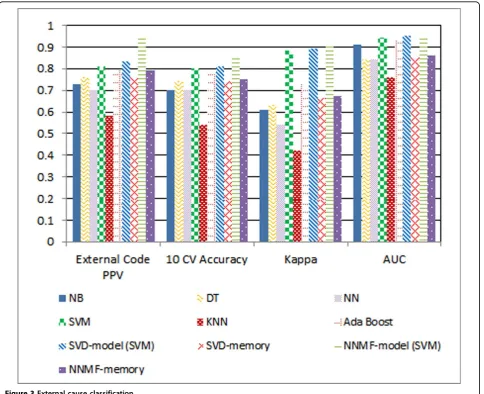
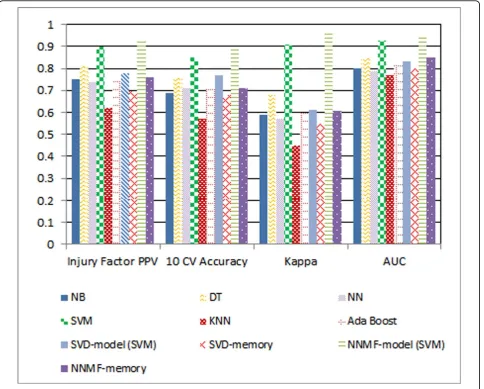
General performance:The NNMF-model (NNMF with SVM) achieved the best performances against all the evaluation criteria for both External Code and Injury Factor Code classifications. The experiments show that NNMF can achieve better performance than SVD for the text classification because NNMF captures the char-acteristics of text where the topics should be related in additive manner rather than being independent in an
Figure 2Distribution of dataset. A) shows the external code distribution and B) shows the injury factor code distribution.
Table 2. Evaluation measures
Measure Definition Equation
Positive Predictive Value (PPV) Ratio of truth positive to number of cases truly falls under the classes
TP/(TP+FP)
Sensitivity Proportion of actual positives which are correctly identified
TP/(TP+FN)
Specificity Proportion of negative which are correctly identified TN/(FP+TN)
10 Cross Validation Accuracy Split the dataset into 10 folds and runs classification 10 times
(TP+TN)/(TP+FP+TN+FN)
Kappa Robust measure taking into account the agreement
by chance
K = (Io-Ie)/(1-Ie)
Io= (TP+TN)/(TP+TN+FP+FN)
Ie= ((TN+FN)(TN+FP)+ (TP+FP)(TP+FN))/n2
n = TP+TN+FP+FN
Area Under Receiver Operating Characteristic Curve (AUC)
orthogonal manner. Without the boost of Matrix Factori-zation, SVM achieves lower results. But SVM can achieve better results than all of the tested classic methods because SVM is highly tolerant to sparse and high dimensional medical injury text dataset with correlated features. Comparing KNN to the rest of the classic approaches, SVD-model to SVD-memory, NNMF-model (NNMF with SVM) to NNMF-memory, model-based approaches are superior to memory-based approaches. This is because the memory-based approach treats each feature equally and cannot differentiate the importance of features for each class. Figures 3 and 4 summarise the classification performance of the various tested classifiers.
Kappa statistic:Kappa statistic measures the agree-ment between automated classification results and the gold-standard class assignment by medical expert(s). A value with ranges from 0.21-0.4 and 0.41-0.6 are asso-ciated with fair and moderate agreement respectively, while between 0.61 and 0.8 show substantial agreements
[28]. Even though the dataset shows biased distribution, most classification methods except KNN still can achieve substantial agreement with the gold-standard. This means the agreement that would occur by chance is generally low.
AUC:Despite the imbalanced dataset, AUC results are
consistent with 10 CV Accuracy. According to AUC results, NNMF-model (NNMF-SVM) achieves the best performance for both External Cause and Major Injury Factor classification.
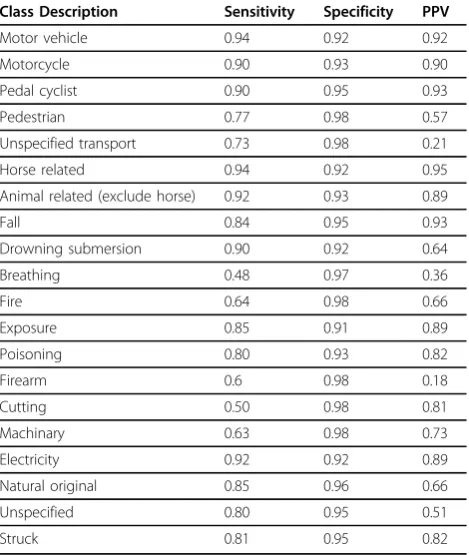
Prediction of external code and major injury factor For most classes, sensitivity, specificity, and PPV of External cause and Major Injury Factor achieved high results as Table 3 and 4 indicated. Some classes (i.e. Fire, Firearm, Cutting, Machinery, Chemical Substance) achieved poor results. The reason behind is the lack of suf-ficient training cases associated with these classes. Increas-ing the number of trainIncreas-ing cases for these classes may help improve the performances.
Impact of training size
Figure 5 shows the impact of training size in terms of predicting Major Injury Factor and External Cause in the testing dataset. The two lines show a similar trend
on the graph. With the increase in training size, PPV result improves. However, the improvements of PPV are clearly slowing down as the increase of the training size continues. Increasing the training size usually leads to higher computational cost. Figure 6 shows that increase of training size leads to much higher increase in computation time. The balance of increasing the training size for the purpose of better performance and the increase of computational resources should be decided with the consideration of the ratio of the increase of PPV/accuracy to the increase of computa-tion costs.
Impact of removal of TopN terms
TopN terms usually are associated with frequently appearing terms. These common terms appear regularly in all the classes and they are not deemed as distin-guishing identifiers. However, the empirical results shown in Figure 7 indicate removal of TopN terms
Figure 4Injury factor classification.
Table 3. Performances of major injury code
Class Description Sensitivity Specificity PPV
Infant 0.89 0.91 0.87
Furnishing 0.90 0.83 0.90
Appliance 0.86 0.98 0.81
Utensil container 0.90 0.91 0.93
Transport 0.94 0.90 0.95
Sporting equipment 0.92 0.95 0.92
Tool 0.92 0.90 0.86
Food 0.86 0.97 0.74
Chemical substance 0.70 0.98 0.65
decreases the precision rate on the testing dataset. It is possible that some frequently appearing terms do associ-ate with class identifiers and their removal can cause the performance to decrease. Guidance from medical experts for the removal of TopN terms is desirable in future.
Impact of term weights
Figure 8 illustrates that the best PPV is achieved when Binary weighting is applied followed by TF and then
TF-IDF. BM25 is not tested as it works the best with lengthy document and our dataset contains lots of short documents. Surprisingly, TF-IDF does not achieve the best result. This might be due to the length of the docu-ments in the dataset. When the document is long, TF-IDF usually works well as TF part identifying the important terms within a document and the IDF part identifying the unique terms which is different from other documents in the dataset. In injury text narrative dataset, the length of each document is short which explains the lower performance accounting from the term frequency for each document. In this experiment, how much influence the IDF part played is not known. In future, it might be worth trying to use the weighting score which accounts both the appearance of the term (term appears or not) and IDF.
Table 4. Performances of external code
Class Description Sensitivity Specificity PPV
Motor vehicle 0.94 0.92 0.92
Motorcycle 0.90 0.93 0.90
Pedal cyclist 0.90 0.95 0.93
Pedestrian 0.77 0.98 0.57
Unspecified transport 0.73 0.98 0.21
Horse related 0.94 0.92 0.95
Animal related (exclude horse) 0.92 0.93 0.89
Fall 0.84 0.95 0.93
Drowning submersion 0.90 0.92 0.64
Breathing 0.48 0.97 0.36
Fire 0.64 0.98 0.66
Exposure 0.85 0.91 0.89
Poisoning 0.80 0.93 0.82
Firearm 0.6 0.98 0.18
Cutting 0.50 0.98 0.81
Machinary 0.63 0.98 0.73
Electricity 0.92 0.92 0.89
Natural original 0.85 0.96 0.66
Unspecified 0.80 0.95 0.51
Struck 0.81 0.95 0.82
Figure 5Impact of training size.
Figure 6Impact of training size against computation time.
Impact of k selection in factorization
With the increase of k, the accuracy scores for both classes increase initially and then the performance drops after some threshold. The performance reaches its
cli-max at k = 500 for External Cause Code, while Major
Injury Factor achieves a climax at k = 1000. This is
shown in Figure 9.
Impact of enhancement learning
As Figure 10 shows that using one set of coded data for the classification of another set of coded data improve the precision. In general, there is about 1-2% increase, if the coded data is used as feature in SVM classification. And there is 2-3% precision increase when the NNMF classification is applied.
Conclusion
Many previous studies have done general document classification. Injury Text Narrative shows unique char-acteristics and is different from long document classifi-cation. An exclusive study is carried out in this paper with the classifiers particularly suitable for sparse high dimensional datasets.
In the pre-processing step, a soundalike word correc-tion approach is adopted to correct the common errors caused by misunderstanding of correct spelling of words. Some stop-words related to output class such as off/from are combined with the previous word as a phrase. Keeping all terms appearing in the dataset is expensive and unnecessary. An EM clustering approach is adopted to decide the terms cut-off criteria.
In the experiments, various classifiers are compared. NNMF with SVM classifier achieves the best perfor-mance. For the traditional classifiers, SVM always achieves higher performances under the tested dataset and the Model-based classifier is superior to memory-based classifier. As Kappa statistic and AUC are less sen-sitive than general evaluation metric under the imbal-anced dataset, they are employed in our experiments. The amount of increasing training size is not at the same pace as the performance increases, thus choosing the cor-rect size of the training set can reduce the resources needed. Top-N terms should not be arbitrarily removed as some frequent words may be the key feature for identi-fying classes. Guidance from experts is desirable. Binary weighting works better than TF-IDF and TF in short document classification. K should not be the universal number, even though the same input text is used. For dif-ferent classes, difdif-ferent size of K should be adopted. The
Figure 8Impact of weighting measure.
Figure 9Impact of k selection.
inclusion of one coded data helps in improving the classi-fication accuracy of another coded data.
This study used specialised injury surveillance data (which is only available for a small number of emer-gency departments) to evaluate the feasibility of machine learning and to identify the most accurate methods for classifying narrative text. The findings from this research can be applied to routine adminis-trative emergency department data (which is available for the majority of emergency departments) to classify causes of injuries from presenting problem text to enable broader capture and classification of injury data beyond specialised collections. Developing automated accurate methods for categorising unstructured emer-gency department text will provide a valuable resource for injury researchers seeking to understand the pat-tern of causes of injuries treated in emergency departments.
Competing interests
The authors declare that they have no competing interests.
Authors’contributions
LC was responsible for designing and undertaking the experiments, analysing the results from said experiments and drafting the manuscript. RN was responsible for reviewing, providing guidance and feedback with relation to the experiments and reviewing draft versions of this manuscript. KV was responsible for designing the overall research project, providing context knowledge, drafting this manuscript’s introduction, reviewing drafts of the manuscript, and sourcing the dataset used in the experiments. All authors read and approved the final manuscript.
Acknowledgements
This research was supported under Australian Research Council’s Future Fellowships funding scheme (fellowship FT120100202). The views expressed herein are those of the authors and are not necessarily those of the Australian Research Council. Authors acknowledge the Queensland Injury Surveillance Unit (QISU) for providing the data and their support of the research.
Declarations
Publication of this article has been funded by Queensland University of Technology.
This article has been published as part ofBMC Medical Informatics and
Decision MakingVolume 15 Supplement 1, 2015: Proceedings of the ACM
Eighth International Workshop on Data and Text Mining in Biomedical Informatics. The full contents of the supplement are available online at http://www.biomedcentral.com/bmcmedinformdecismak/supplements/15/S1.
Authors’details
1Faculty of Science & Technology, Queensland University of Technology, 2
George St, Brisbane, Queensland, Australia.2Centre for Accident Research
and Road Safety - Queensland, School of Psychology and Counselling, Faculty of Health, Queensland University of Technology, Victoria Park Road, Kelvin Grove, Brisbane, Queensland, Australia.
Published: 20 May 2015
References
1. Langley J:Loss of narrative data in new zealand health statistics public hospital discharge injury files.Australian Epidemiologist1998,
5(4):18-20.
2. Jones SJ, Lyons RA:Routine narrative analysis as a screening tool to improve data quality.Injury Prevention: Journal of the International Society
for Child and Adolescent Injury Prevention2003,9(2):184-186.
3. Wellman HM, Lehto MR:Computerized coding of injury narrative data from national health interview survey.Accident: Analysis and Prevention
2004,36(2):165-171.
4. Hume PA, Chalmers DJ,et al:Trampoline injury in new zealand: emergency care.British Journal of Sports Medicine1996,30(4):327-330. 5. Sikron F, Glasser S, Peleg K:Children injured following tv tipovers in
israel, 1997-2003. Child: Care.Health and Development2007,33(1):45-51. 6. Muscatello DJ, Churches T,et al:An automated, broad-based, near real
time public health surveillance system using presentations to hospital emergency departments in new south wales.BMC Public Health2005,
5:141-1141.
7. Brooks B:Shifting the focus of strategic occupational injury prevention: mining free-text, workers compensation claims data.Safety Science2008,
46(1):1-21.
8. Abdata F, Leclercqa S, Cunyb X, Tissotca C:Extracting recurrent scenarios from narrative texts using a bayesian network: Application to serious occupational accidents with movement disturbance.Accident Analysis
and Prevention2014,70:155-166.
9. Bertke SJ, Meyers AR, Wurzelbacher SJ, Bell J, Lampl ML, Robins D:
Development and evaluation of a naive bayesian model for coding causation of workers compensation claims.Journal of Safety Research
2012,43:327-332.
10. Wellman HM, Lehto MR, Corns H:A combined fuzzy and naive bayesian strategy can be used to assign event codes to injury narratives.Injury
Prevention2011,11:407-414.
11. Taylor JA, Lacovara AV, Smith GS, Pandian R, Lehto M:Near-miss narratives from the fire service: A bayesian analysis.Accident Analysis and Prevention
2014,62:119-129.
12. Menon AK, Elkan C:Fast algorithms for approximating the singular value decomposition.TKDD2011,5(2):16-37.
13. Garza P:Structured Data Classification by Means of Matrix Factorization.
20th ACM International Conference on Information and Knowledge
Management2011, 2165-2168.
14. Li Y, Ngom A:Non-negative Matrix and Tensor Factorization Based Classification of Clinical Microarray Gene Expression Data.IEEE
International Conference on Bioinformatics and Biomedicine2010, 438-443.
15. Zelikovitz S, Hirsh H:Using LSI for Text Classification in the Presence of Background Text.10th International Conference on Information and
Knowledge Management (CIKM 2001)2001, 113-118.
16. Collins JW:Injuries related to forklifts and other powered industrial vehicles in automobile manufacturing.American Journal of Industrial
Medicine1999,36(5):513-521.
17. Lombardi DA, Pannala R, Sorock GS, Wellman H, Courtney TK, Verma S, Smith GS:Welding related occupational eye injuries: a narrative analysis.
Injury Prevention: Journal of the International Society for Child and Adolescent
Injury Prevention2005,11(3):174-179.
18. Hammig BJ, Yang H, Bensema B:Epidemiology of basketball injuries among adults presenting to ambulatory care settings in the united states.Clinical Journal of Sport Medicine2007,17(6):446-451.
19. McKenzie K:The use of narrative text for injury surveillance research: A systematic review.Accident Analysis and Prevention2009.
20. Shapiro AR:Taming variability in free text: Application to health surveillance.Morbidity and Mortality Weekly Report, Supplement: Syndromic
Surveillance2004,53:95-100.
21. Damerau F:A technique for computer detection and correction of spelling errors.Communications of the ACM1964,7(3):171-176. 22. Li Y, Duan H, Zhai C:A Generalized Hidden Markov Model with
Discriminative Training for Query Spelling Correction.SIGIR 20122012, 611-620.
23. Chen L, Nayak R:A Recommendation Approach Dealing with Multiple Market Segments.WI 20132013, 89-94.
24. Xu W, Liu X, Gong Y:Document Clustering Based on Non-negative Matrix Factorization.SIGIR 20032003, 267-273.
25. Gillis N:Sparse and unique nonnegative matrix factorization through data preprocessing.JMLR2012,13(1):3349-3386.
27. Sebastiani F:Machine learning in automated text categorization.ACM
Computing Survey2002,34:1-47.
28. Armitage P, Berry G:Statistical Methods in Medical Research.Blackwell Sciences Pty. Ltd., Malden; 1994.
doi:10.1186/1472-6947-15-S1-S5
Cite this article as:Chenet al.:Injury narrative text classification using
factorization model.BMC Medical Informatics and Decision Making2015
15(Suppl 1):S5.
Submit your next manuscript to BioMed Central and take full advantage of:
• Convenient online submission
• Thorough peer review
• No space constraints or color figure charges
• Immediate publication on acceptance
• Inclusion in PubMed, CAS, Scopus and Google Scholar
• Research which is freely available for redistribution