Drying Modelling, Moisture Diffusivity and Sensory
Quality of Thin Layer Dried Beef
EunicE AkELLo MEwA
1*, MichAEL wAnDAyi okoTh
1,
cAThErinE nkiroTE kunyAngA
1and MuSA njuE rugiri
21Department of Food Science, Nutrition and Technology, University of Nairobi, Kenya.
2Department of Agricultural Engineering and Technology, Egerton University, Kenya.
Abstract
The objective of the present study was to determine the drying kinetics, moisture diffusivity and sensory quality of convective air dried beef. The effect of temperature of drying (30-60°C) and thickness of samples (2.5-10 mm) on the convective thin-layer drying kinetics of beef dried in a cabinet dryer was evaluated. Five semi-theoretical models were fit to the drying experimental data with the aim of predicting drying characteristics of beef and fitting quality of models determined using the standard error of estimate (SEE) and coefficient of determination (R2). Determination of
effective moisture diffusivity (Deff) from the experimental drying data was
done and sensory quality of the optimized dried cooked and uncooked beef samples evaluated. Drying time and rate of drying increased with an increasing temperature but decreased with increased slice thickness. However, there was overlapping of drying curves at 40-50°C. Among the selected models, Page model gave the best prediction of beef drying characteristics. Effective moisture diffusivity (Deff) ranged between 4.2337 x 10⁻¹¹ and 5.5899 x 10⁻¹⁰ m2/s, increasing with an increase in air temperature
and beef slice thickness. Of all the sensory parameters evaluated, texture was the only attribute that gave significantly different (P ≤ 0.05) scores between the cooked and uncooked dried beef samples.
current research in nutrition and Food Science
Journal Website:www.foodandnutritionjournal.org
Article history
Received: 02 February 2018
Accepted: 24 August 2018
keywords
Beef slice thickness, Drying temperature, Mathematical modelling, Moisture diffusivity, Sensory quality.
introduction
Drying is a unit operation whereby heat and mass transfer processes occur simultaneously. Heat penetrates into the product and causes transfer of moisture from within the food product to its surface with subsequent evaporation to the air stream as vapour1. The reasons for drying different types of
food products are extremely diverse: from reducing bulk during transportation to increasing the shelf-life of agricultural commodities. As one of the most extensively used methods of food preservation, drying prevents the deterioration of perishable products and ensures their availability during periods of scarcity.
conTAcT Rebecca C. Jordan [email protected] Rutgers University, The State University of New Jersey, Department of Human Ecology, Program in Science Learning, 59 Lipman Drive, Waller Hall 104, New Brunswick, USA.
© 2018 The Author(s). Published by Enviro Research Publishers.
Some important areas in drying technology include modelling of the dehydration process as well as the drying equipment2. Drying simulation for many food
products can be represented by a set of mass and heat transfer equations describing the moisture and heat exchange within the product and between the product and air3. In various studies, thin-layer
drying procedure is quite a reliable tool for evaluating the drying kinetics of a wide range of products4-6.
Mathematical modelling of the thin layer drying process is critical for managing operating conditions during drying and for predicting the performance of a drying process7.
Thin layer drying generally means that drying is done as a single layer of slices or sample particles2. The
categories of thin layer drying models currently being applied in evaluation of the drying characteristics of food products include; empirical, theoretical and semi-theoretical models. For the empirical and semi-theoretical models only external resistance to movement of moisture from the sample to the air is taken into account8, while the theoretical model
considers the resistance to moisture movement from within the product9. Theoretical models can
be used at all process conditions as they clearly explain the drying behaviors of products. However
many assumptions are made10 causing considerable
errors. In deriving most semi-theoretical models, the use of Fick’s second law of diffusion is very common in literature. However, the validity of these models is only within the experimental conditions applied11. Similar to the semi-theoretical models,
empirical models are strongly dependent on the drying conditions. However, information given on the drying behavior of the material is limited12.
The drying rate of a food product describes the rate of conversion of moisture to vapor by evaporation and depends on the pressure gradient existing between the product and air due to an established temperature gradient13. On the other hand, the rate
of transfer of moisture internally within a material during drying is described by an effective diffusivity (Deff). It depends on the product’s moisture content, temperature of the drying air, and the physical nature of the solid. The temperature and moisture content dependence of moisture diffusivity has been verified for various products14. Generally, the properties of
agricultural products, such and moisture diffusivity
are also required for the ideal dryer design and operation15.
Currently, there are many researches reporting on drying modelling and moisture diffusivity of different products as influenced by drying temperature and thickness of the product4,16-18. However, similar
reports on beef drying are limited. Trujillo et al.,6
used different drying methods to experimentally determine the moisture diffusivity of beef in the range of 6.6-40.4°C whereas Chabbouh et al.,19
examined dehydration of beef during salting and drying steps of Kaddid meat’s production. In the present study, drying curves were generated from experimental data of beef drying processes at different temperatures and sample thicknesses. Some selected semi-theoretical models were used to simulate the moisture removal behaviour of beef and the suitability of the models for characterizing the drying process was investigated. Influence of drying temperature and slice thickness on the effective moisture diffusivity of beef was assessed and the sensory quality of the optimized dried beef samples evaluated.
Methodology
Preparation of Beef Samples
Beef meat was taken from the hind quarter round of a Zebu (Bos indicus) carcass. Its collection and preparation was done as described by Mewa
et al.,20 giving 100 mm long and 30 mm wide beef
strips with thicknesses of 2.5, 5.0, 7.5 and 10 mm. For determination of the sample’s initial moisture content, the oven method was used at 105 °C for 3 h21.
Drying Apparatus
layout of the trays ensured the desired uniform air distribution inside the drying chamber. The dryer was started and the set temperature attained before each drying run.
Experimental
The drying of beef samples was conducted at temperatures of 30, 40, 50, and 60°C and airflow fixed at a 24 V voltage. About 220 g of the slices of beef with different thicknesses were put on the perforated trays as a single layer for each drying run. The trays and sample weights were noted before being inserted into the drier. To ensure uniform drying conditions, all trays were inserted into the dryer. As drying progressed, the trays were taken out after every 15 min and weighed using an electronic balance (ESA 600, Salter Brecknell, UK) before being returned to the dryer, ensuring the weighing process was done within 1 min. The experiments were repeated 3 times until the dried products had between 10–20% moisture content (dry weight basis) which corresponds to the moisture content range for meat products dried traditionally in tropical countries22. The dried beef was allowed to
cool and then packaged in low-density polyethylene (LDPE) bags.
Mathematical Modelling
During the drying process, the moisture content of beef samples was determined as shown in the following equation:
Mt = (W0-W)-W1) / W1 ...(1)
where Mt is the product’s moisture content (g water/100 g dry matter or % dry weight basis(dwb))
at time t, W0 is weight of sample before drying (g), W is the amount of evaporated moisture (g), and W1 is the sample’s dry matter content (g).
Drying curves were represented as moisture content as a function of time and drying rate (DR) as a function of moisture content graphs. The drying rate (DR) of beef slices was determined as given below:
DR=(Mt - Mt+∆t) / ∆t ...(2)
where Mt + ∆t is the moisture content at time ‘t+∆t’ (% dwb) and t is time (min).
To the beef experimental data, Fick’s diffusion equation was used as shown below.
MR = Mt - Me / M0– Me ...(3)
where MR represents the dimensionless moisture ratio; Me is equilibrium moisture content (% dwb); Mt is moisture content at time t (% dwb) and M0 is the initial moisture content (% dwb).
Compared to values of Mt and M0, the value of Me is relatively smaller23, so the equation can be
reduced to
MR = Mt / M0 ...(4)
The experimental data were presented as moisture ratio vs drying time graphs and fitted into five different models shown in Table 1.
Table 1: Mathematical models used for fitting to the experimental drying data
Model Equation references
Newton MR=exp (-kt) 7
Logarithmic MR=a exp (-kt)+c 24
Page MR=exp (-ktn) 25,26
Handerson and Pabis MR=a exp (-kt) 27
Two-term exponential MR=aexp (-kt)+(1-a)exp(-kat) 28
Statistical Analysis
Drying data analysis was done by using Minitab (Version 17.0, Minitab Inc., USA) software package and Excel 2008 (Microsoft Corporation, USA). Nonlinear regression was done based on the Gauss-Newton algorithm in order to estimate the model parameters. The model’s fitting quality to the drying data was assessed using the coefficient of determination (R2) Eq. (5) calculated numerically by
Excel and the standard error of estimate (SEE) Eq. (6) generated by Minitab. The ideal value of SEE is “zero”, and a small value means that the data points fall closer to the curved fitted line29. For goodness of
fit of the curve to the equation, a high R2 value and
a low SEE value were taken30.
...(5)
...(6)
where N is the number of observations, MRpre,i is the predicted dimensionless moisture ratio, MRexp,i is the ith experimental moisture ratio and MRexp,avg is the average experimental moisture ratio
E f f e c t i v e M o i s t u r e D i f f u s i v i t y ( De f f) determination
The drying process of most food materials has been described using Fick’s second law of diffusion31 in
which the drying process occurs in the falling rate period32 as given below:
∂M / ∂t = ∇[Deff (∇M)] ...(7)
where effective moisture diffusivity (m2/s) is given by
Deff (the term used to represent all moisture transport mechanisms within a sample), t is time (s) and M is the local moisture content (% dwb).
Crank,33 gives the solution of Fick’s second law as
shown in Eq. (8), considering constant moisture diffusivity, uniform initial moisture distribution and infinite slab geometry13.
...(8)
where n represents a positive integer and L the slab’s half thickness (m).
Only the first term of Eq. (8) is normally applied, giving:
...(9)
The slope of a normalized plot of experimental moisture ratio, ln (MR) vs time (s) can be used to obtain the Deff of a sample, for corresponding temperature data using the following equation34
Deff = -slope 4L2 / p2 ...(10)
Sensory Quality Evaluation
For sensory quality evaluation, beef samples with 5.0 mm thickness dried at 60°C were used. These optimized samples were selected based on the physical and microbiological quality studies of dried
beef by Mewa et al.,20. The samples were cooked
at 100°C for 20 minutes and cut into cubes of sizes 2 cm x 2 cm x thickness. The cooked and uncooked samples were labelled with random 3-digit codes and presented randomly to panellists consisting of 15 volunteers who had been selected and trained. Uncooked samples of dried beef were observed for their colour, odour, appearance and overall acceptability whereas the cooked samples were evaluated and compared with uncooked control samples for their colour, odour, flavour, texture, appearance and overall acceptability. The beef samples were placed into white saucers and sensory attributes tested on a nine point hedonic scale, where 1= dislike extremely, 2 = dislike very much, 3 = dislike moderately, 4 = dislike slightly, 5 = neither like nor dislike, 6 = like slightly, 7 = like moderately, 8 = like very much and 9 = like extremely.
Statistical Analysis
results and Discussion
influence of Air Temperature on Drying curves of Beef
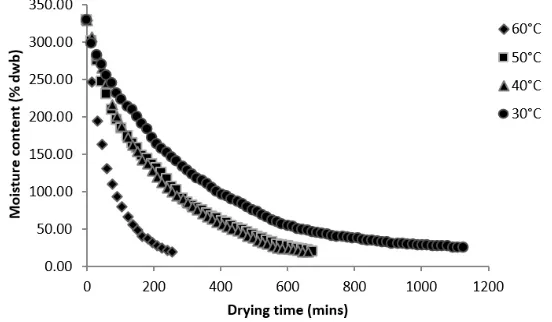
The average moisture content of fresh beef was 328.69% (dwb) and drying time for all the beef samples ranged between 2.5 and 30 h. Moisture
content vs time graph for 2.5 and 5.0 mm thick beef samples are shown in Figures 1 and 2 respectively. To reach the desired moisture contents, drying time was 535, 345, 275 and 150 min at 30, 40, 50 and 60°C, respectively (Figure 1).
Fig. 1: Drying curve of beef (2.5 mm thick slices) at different temperatures
The drying process was enhanced by increasing the drying temperature within this temperature range, thus shortening the time of drying. The reduction in time with increasing temperature is attributed to increased thermal energy which speeds up the transfer of water molecules within the meat35. The
higher temperatures also create large water to vapor
pressure deficit; one of the driving forces for moisture transfer externally: from the surface of the meat to the air36. Similar results have been reported for drying
curves of other food materials37,38. The relationship
between temperature and drying time still followed the same trend when the thickness of the meat was increased to 5.0 mm (Figure 2).
The lowest effect of temperature on reduction of drying time was between 40 and 50°C which resulted in overlapping of drying curves at this temperature range. When drying beef samples, Chabbouh
et al.,19 observed that after 30 minutes of dehydration,
samples dried at 50°C lost moisture slower than those dried at 40°C. This was explained by the fact that during high temperature drying, rapid evaporation of water from the surface of the meat allowed crust formation due to case hardening, presenting a high resistance to moisture movement from within the meat thus lowering the drying rate39.
This effect could have been overcome at 60°C due to change in internal meat structure as a result of
changes in physico-chemical properties of beef. Different meat proteins denature during heating at different temperatures, causing changes to the structure of the meat. Denaturation of connective tissue proteins occurs at 60-70°C, which causes the shrinkage of connective tissue fibres and muscle fibres longitudinally, giving large extracellular voids40. Together with a higher heat transfer, these
could have promoted a faster moisture movement at 60°C.
The drying rate vs moisture content curve for 10 mm thick beef slices at various temperatures is given in Figure 3.
Fig. 3: Drying characteristic curve of beef (10 mm thick slices) at different temperatures
There was a continuous decrease of drying rate with decrease in moisture content and drying rate was highest at the highest temperature (60°C). The beef drying process occurred predominantly in the falling rate period and there was no constant drying rate period. The lack of constant rate period may be due to the fact that at the beginning of drying, the surface of meat dries out very quickly, generating a partial barrier which resists free moisture movement29.
This means that the dominant physical mechanism controlling moisture movement within the beef was diffusion, as obtained for most agricultural products41.
influence of Sample Thickness on Beef Drying curves
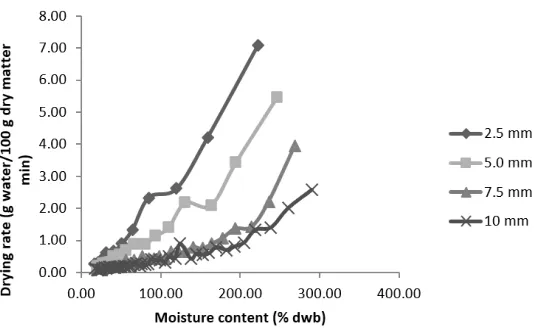
Influence of beef sample thickness on the drying curves is shown in Figures 4 and 5. Drying time increased with an increased beef sample thickness
(Figure 4). For thicker beef samples, the amount of water that needs to be moved from the center of the meat to its surface is more42 thus increasing the
time needed for drying the slice to the same level of moisture content31.
The curve of drying rate vs moisture content at 60°C (Figure 5) shows that beef with the smallest thickness value (2.5 mm) had the highest drying rate as compared to thicker samples.
Fig. 4: Drying curve for beef of different thicknesses at 60°c
Fig. 5: Drying characteristic curve of beef of different thicknesses at 60°c
Mathematical Modelling
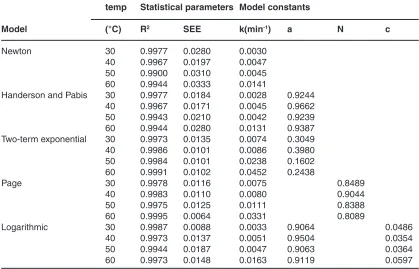
The influence of temperature on the regression coefficients for five drying models was represented by the experimental results of 5.0 mm thick beef slices (Table 2). To evaluate the effect of slice thickness, experimental results for beef samples dried at 40°C were randomly selected (Table 3). Specific model constants and statistical parameters (R2 and SEE), for assessing the goodness of fit of
each of the selected drying models are given in Tables 2 and 3. Increasing temperature enhanced the rate of drying (Table 2) as indicated by the k values for the two-term exponential and the page models. Increasing beef slice thickness reduced the drying rate (Table 3) and the k values decreased for each of the drying models.
All the five drying models indicated a good fit as they gave coefficient of determination (R2) values higher
than 0.99 at all drying conditions (Tables 2 and 3). The models that gave the lowest SEE and the highest
R2 values were the Page and two-term exponential
Table 2: regression coefficients of the drying models for 5.0 mm thick beef slices
temp Statistical parameters Model constants
Model (°c) r2 SEE k(min-1) a n c
Newton 30 0.9977 0.0280 0.0030
40 0.9967 0.0197 0.0047
50 0.9900 0.0310 0.0045
60 0.9944 0.0333 0.0141
Handerson and Pabis 30 0.9977 0.0184 0.0028 0.9244
40 0.9967 0.0171 0.0045 0.9662
50 0.9943 0.0210 0.0042 0.9239
60 0.9944 0.0280 0.0131 0.9387
Two-term exponential 30 0.9973 0.0135 0.0074 0.3049
40 0.9986 0.0101 0.0086 0.3980
50 0.9984 0.0101 0.0238 0.1602
60 0.9991 0.0102 0.0452 0.2438
Page 30 0.9978 0.0116 0.0075 0.8489
40 0.9983 0.0110 0.0080 0.9044
50 0.9975 0.0125 0.0111 0.8388
60 0.9995 0.0064 0.0331 0.8089
Logarithmic 30 0.9987 0.0088 0.0033 0.9064 0.0486
40 0.9973 0.0137 0.0051 0.9504 0.0354
50 0.9944 0.0187 0.0047 0.9063 0.0364
60 0.9973 0.0148 0.0163 0.9119 0.0597
Table 3: regression coefficients of the drying models for beef dried at 40°c air temperature
Meat Statistical parameters Model constants thickness
Model (mm) r2 SEE k(min-1) a n c
Newton 2.5 0.9974 0.0213 0.0102
5.0 0.9967 0.0197 0.0047
7.5 0.9898 0.0516 0.0034
10 0.9918 0.0426 0.0022
Handerson and Pabis 2.5 0.9961 0.0191 0.0098 0.9652
5.0 0.9967 0.0171 0.0045 0.9662
7.5 0.9769 0.0367 0.0028 0.8510
10 0.9860 0.0284 0.0019 0.8853
Two-term exponential 2.5 0.9968 0.0165 0.1255 0.0748
5.0 0.9986 0.0101 0.0086 0.3980
7.5 0.9933 0.0311 0.0065 0.2346
10 0.9961 0.0197 0.0046 0.2060
Page 2.5 0.9976 0.0137 0.0169 0.8943
5.0 0.9983 0.0110 0.0110 0.9044
7.5 0.9944 0.0164 0.0088 0.7140
10 0.9967 0.0131 0.0063 0.7723
Logarithmic 2.5 0.9990 0.0088 0.0112 0.9505 0.0384
5.0 0.9973 0.0137 0.0051 0.9504 0.0354
7.5 0.9932 0.0179 0.0039 0.8468 0.0719
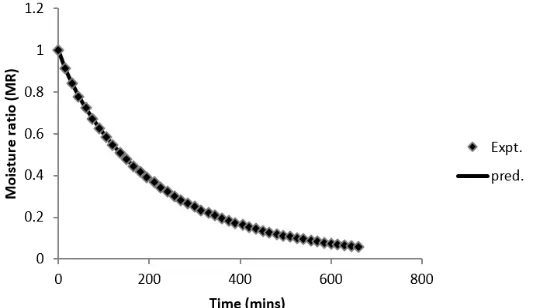
Fig. 7: Fitted line plot using newton model for experimental data at 40°c drying temperature and 5.0 mm slice thickness, where Expt. and pred. are the
experimental and predicted moisture ratios respectively
Figures 6 and 7 give a fitted line plot for moisture ratio against time for experimental and predicted data by the Page and two-term exponential models respectively, with the Page model showing a visually good fit.
The efficiency of the Page model for evaluating the drying kinetics of beef was further indicated by plotting a curve of predicted moisture ratios vs observed moisture ratios for 5.0 mm thick slices (Figure 8). A good fit for the experimental drying data was given by the predicted model, as indicated
by the linear nature of the curve at 45° slope from the origin1.
Effective Moisture Diffusivity (Deff)
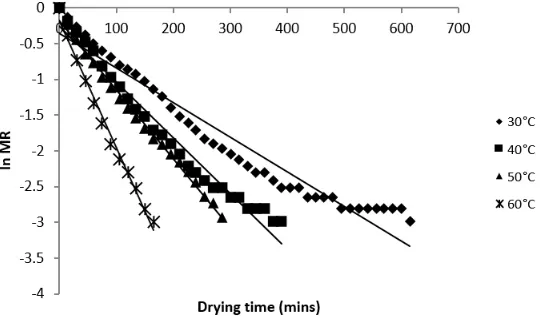
Figure 9 shows the influence of temperature on the linear relationship between logarithmic moisture ratio vs time for 2.5 mm thick beef slices.
The slopes of the linear graphs were 0.000081, 0.000130, 0.000161 and 0.000297 at 30, 40, 50 and 60°C respectively (Figure 9).
Fig. 6: Fitted line plot using page model for experimental data at 40°c drying temperature and 5.0 mm slice thickness, where Expt. and pred. are the experimental and
Fig. 8: comparison of predicted Mr with experimental Mr by page model for beef of 5.0 mm slice thickness dried at different temperatures.
Fig. 9: Logarithmic moisture ratio vs drying time graph at various drying temperatures for meat of 2.5 mm thickness
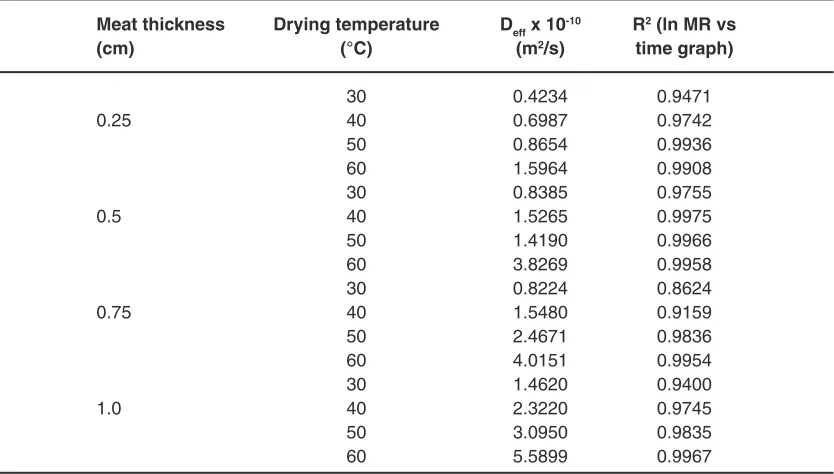
The Deff obtained from slope of graphs according to Eq. (9) at all the experimental drying conditions ranged between 4.2337 x 10⁻¹¹ and 5.5899 x 10⁻¹⁰
m2/s (Table 4).
The values of Deff for this study were within the normal range (between 10−11 to 10−9 m2/s) obtained
for most agricultural products14 and can be compared
to 1.20 x 10⁻¹¹ to 1.15 x 10⁻¹⁰ m2/s for meat products
during drying under different conditions45,46. From
the results, increasing temperature as well as slice thickness increased the Deff values. Comparable results have been described for a number of food products4,47,48. A higher drying temperature increased
thermal energy and subsequently increased the activity of water molecules resulting in high moisture
diffusivity49. Nguyen and Price,50 attributed the
increase in diffusivity with thickness of a material to the edge effect (side way diffusion) of thicker slices. The diffusion model used in this study, assumed that diffusion took place from inside to the surface of the slab from one direction. This assumption was more applicable for thinner slabs for which the edge effect was negligible thus giving lower moisture diffusivity values.
The diffusion model fit the drying experimental data better at higher temperatures, as shown by the high values of R2 (Table 4) and the goodness of fit
temperatures. At lower temperatures, the surface dries off slowly at a rate controlled partly by surface resistance. At higher temperatures, the surface dries off quickly and water movement is largely
controlled by diffusion within the meat6. Therefore,
the assumption of negligible external resistance for the diffusion model was more applicable at higher temperatures.
Table 4: influence of sample thickness and drying temperature on the effective moisture diffusivity (Deff) of beef
Meat thickness Drying temperature Deff x 10-10 r2 (ln Mr vs
(cm) (°c) (m2/s) time graph)
30 0.4234 0.9471
0.25 40 0.6987 0.9742
50 0.8654 0.9936
60 1.5964 0.9908
30 0.8385 0.9755
0.5 40 1.5265 0.9975
50 1.4190 0.9966
60 3.8269 0.9958
30 0.8224 0.8624
0.75 40 1.5480 0.9159
50 2.4671 0.9836
60 4.0151 0.9954
30 1.4620 0.9400
1.0 40 2.3220 0.9745
50 3.0950 0.9835
60 5.5899 0.9967
Sensory quality
Results of sensory analysis of beef samples dried at
60°C drying temperature and 5.0 mm slice thickness. are shown in Table 5.
Table 5: Mean sensory analysis scores for cooked and uncooked dried beef samples at 60°c drying temperature and
5.0 mm slice thickness
Sensory parameter uncooked beef cooked beef
samples samples
Colour 6.73±1.03a 7.20±1.52a
Odour 6.87±1.68a 7.20±1.57a
Flavour 7.04±1.36a 6.93±1.49a
Texture 5.01±1.43a 6.87±1.55b
Appearance 7.00±0.93a 6.60±1.24a
Overall acceptability 7.06±1.10a 7.20±1.15a
Generally, both the cooked and uncooked dried beef samples scored well (above average) for all the sensory parameters evaluated. Other than the texture scores, there was no significant difference (P > 0.05) in the scores of the other sensory quality parameters for the cooked and uncooked beef samples. This meant that the cooked and uncooked dried beef samples were equally acceptable to the consumers in terms of colour, odour, flavour, appearance and overall acceptability. The high texture scores of the samples which were cooked after drying could be attributed to the increased moisture content as a result of the high rehydration capacity of the samples20, which gave more tender meat. According
to Youssef et al.,51, moisture content is the primary
cause of meat texture and an increase in moisture
content increases the tenderness of meat. The effect of moisture content on the compressive behaviour of dried materials was also assessed by Krokida et al.,52.
Acknowledgements
The financial support from the German Federal Ministry of Education and Research (BMBF), in the framework of the project ‘Reducing Losses Adding Value-RELOAD’ is greatly acknowledged by the authors of this paper.
conflict of interest
There is no conflict of interest to be declared by the authors of this paper.
references
1. Tulek Y. Drying Kinetics of Oyster Mushroom
(Pleurotus ostreatus) in a Convective Hot-air Dryer. Journal of Agriculture, Science and
Technology.2011;13:655-64.
2. Akpinar E. K, Bicer Y, Cetinkaya F. Modelling
of Thin Layer Drying of Parsley Leaves in a Convective Dryer and Under Open Sun.
Journal of Food Engineering.2006;75:
308–315.
3. Efremov G. Describing of Generalized Drying
Kinetics with Application of Experimental
Design Method. Technical Sciences.2013;
16: 309-22.
4. Akgun N. A, Doymaz I. Modelling of Olive Cake Thin-layer Drying Process. Journal of
Food Engineering.2005;68:455–461.
5. Akpinar E. K, Bicer Y, Midilli A. Modelling and Experimental Study on Drying of Apple Slices in a Convective Cyclone Dryer. Journal
of Food Process Engineering.2003;26:
515-541.
6. Trujillo F. J, Wiangkaew C, Pham Q. T. Drying
Modelling and Water Diffusivity in Beef Meat. Journal of Food Engineering.2007;78: 74-85.
7. Fudholi A, Othman M.Y, Ruslan M. H, Yahya
M, Zaharim A, Sopian K. The Effects of Drying Air Temperature and Humidity on Drying Kinetics of Seaweed. Recent Researches in
Geography, Geology, Energy, Environment
and Biomedicine.2011;19:129-33.
8. Fortes M, Okos M. R, Barrett J. R. Heat and
Mass Transfer Analysis of Intra-kernel Wheat Drying and Rewetting. Journal of Agricultural
Engineering Research.1981;26:109-125.
9. Suarez C, Viollaz P, Chirife J. Diffusional Analysis of Air-drying of Grain Sorghum. International Journal of Food Science &
Technology.1980;15:523-531.
10. McMinn W. M. Thin-layer Modelling of
Convective, Microwave Convective and microwave Vacuum Drying of Lactose Powder. Journal of Food Engineering.2006;
72:113–123.
11. Fortes M, Okos M. R. Non-equilibrium
Thermodynamics Approach to Heat and Mass Transfer in Corn Kernels. Transactions
of ASAE.1980;22:761–769.
12. Keey R. B. Drying: Principles and Practice. International Series of Monographs in
Chemical Engineering.1972;13.
13. Ahmad-Qasem M. H, Nijsse J, García-Pérez
J. V, Khalloufi S. (2017). The Role of Drying Methods on Enzymatic Activity and Phenolics Content of Impregnated Dried Apple. Drying Technology.1-10.
14. Zogzas N. P, Maroulis Z. B, Marinos-Kouris
in Foodstuffs. Drying technology.1996;14: 2225-53.
15. Aghbashlo M, Kianmehr M. H,
Samimi-Akhijahani H. Influence of Drying Conditions on the Effective Moisture Diffusivity, Energy of Activation and Energy Consumption During the Thin-layer Drying of Beriberi Fruit
(Berberidaceae). Energy Conversion and
Management.2008;49:2865-71.
16. Shiby V. K, Mishra H. N. Thin-layer Modelling
of Recirculatory Convective Air Drying of Curd (Indian yoghurt). Food and Bioproducts
Processing.2007;85:193-201.
17. Jena S, Das H. Modelling of Vacuum Drying
Characteristics of Coconut Presscake. Journal
of Food Engineering.2007;79: 92–99.
18. Doymaz I. The Kinetics of Forced Convective
Air-drying of Pumpkin Slices. Journal of Food
Engineering.2007;79:243-248.
19. Chabbouh M, Hajji W, Ahmed S. B. H, Farhat
A, Bellagha S, Sahlia A. Combined Effects of Osmotic Dehydration and Convective Air Drying on Kaddid Meats: Kinetics and Quality.
Drying Technology.2011;29:1571-1579.
20. Mewa E. A, Okoth M. W, Kunyanga C. N,
Rugiri M. N. Effect of Drying Air Temperature and Slice Thickness on the Physical and
Microbiological Quality of Dried Beef.
LWT-Food Science and Technology.2018;92:
484-489.
21. A.O.A.C. Official methods of analysis.
Association of Official Analytical Chemists International; Maryland, USA:2000.
22. Kalilou S, Collignan A, Zakhia N. Optimizing
the Traditional Processing of Beef into Kilishi.
Meat Science.1998;50:21-32.
23. Menges H. O, Ertekin C. Mathematical
Modelling of Thin-layer Drying of Golden Apples. Journal of Food Engineering.2006;
77:119-25.
24. Chandra P. K, Singh R. P. Applied Numerical
Methods for Food and Agr icultural Engineers, CRC Press, Boca Raton; pp. 163-167FL:1995.
25. Page G. E. Factors Influencing the Maximum
Rates of Air-drying Shelled Corn in Thin Layers. M.S. thesis, Department of Mechanical Engineering, Purdue University, Purdue, USA:1949.
26. Doymaz I. Drying Kinetics of White Mulberry.
Journal of Food Engineering.2004;61:
341-46.
27. Henderson S. M, Pabis S. Grain Drying
Theory II. Temperature Effects on Drying
Coefficients. Jour nal of Agricultural
Engineering Research.1961;6:169–74.
28. Sharaf-Eldeen Y. I, Blaisdell J. L, Hamdy M. Y. A Model for Ear Corn Drying. Transactions of
the ASAE.1980;23:1261-71.
29. Borah A, Hazarika K, Khayer S. M. Drying Kinetics of Whole and Sliced Turmeric Rhizomes (Curcuma longa L.) in a Solar Conduction Dryer. Information Processing in
Agriculture.2015;2:85-92.
30. Basunia M. A, Abe T. Moisture Adsorption
Isotherms of Rough Rice. Journal of Food
Engineering.1999;42:235-42.
31. Saravacos G. D, Charm S. E. A Study of the Mechanism of Fruit and Vegetable
Dehydration. Food Technology.1962;1:
78-81.
32. Wang N, Brennan J. G. Thermal Conductivity
of Potato as a Function of Moisture content.
Journal of Food Engineering.1992;17:
153-60.
33. Crank J. The Mathematics of Diffusion. 2nd
Ed., Clarendon press: Oxford, UK;1975.
34. Akpinar E.K. Determination of Suitable
Thin-layer Drying Curve Model for Some
Vegetables and Fruits. Journal of Food
Engineering.2006;73:75-84.
35. Maskan A, Kaya S, Maskan M. Hot Air and
Sun Drying of Grape Leather (pestil). Journal
of Food Engineering.2002;54:81-88.
36. Prabhanjan D. G, Ramaswamy H. S,
Raghavan G. S. V. Microwave-assisted Convective Air Drying of Thin-layer Carrots.
Journal of Food Engineering.1995;25:
283-293.
37. Mwithiga G, Olwal J. O. The Drying Kinetics of Kale (Brassica oleracea) in a Convective Hot Air Dryer. Journal of Food Engineering.2005;
71:373-37.
38. Speckhahn A, Srzednicki G, Desai D. K.
Drying Beef in Superheated Steam. Drying
Technology.2010;28:1072-1082.
39. Mujaffar S, Sankat C. The Air Drying Behavior
of Shark Fillets. Canadian Biosystems
Engineering.2005;47:11-21.
Meat science.2004;70:493-508.
41. Aregbesola O. A, Ogunsina B. S, Sofolahan
A. E, Chime N. N. Mathematical Modelling of the Thin-layer Drying Characteristics of Dika (Irvingia gabonensis) Nuts and Kernels.
Nigerian Food Journal.2015;33: 83-9.
42. Sa-Adchom P, Swasdisevi T, Nathakaranakule
A, Soponronnarit S. Drying Kinetics Using Superheated Steam and Quality Attributes of Dried Pork Slices for Different Thickness, Seasoning and Fibers Distribution. Journal of
Food Engineering.2011;104:105-13.
43. Shivhare U. S, Arora S, Ahmed J, Raghavan
G. S. V. Moisture Adsorption Isotherms
for Mushroom. LWT-Food Science and
Technology.2004;7:133-137.
44. Ikonic P, Petrovic L, Tasic T, Jokanovic M, Savatic S, Ikonic B. The Effect of Processing Method on Drying Kinetics of Petrovská klobása, an Artisan Fermented Sausage. Chemical Industry and Chemical Engineering
Quarterly.2012;18:163-169.
45. Gou P, Comaposada J, Arnau J. Nacl
Content and Temperature Effects on Moisture Diffusivity in the Gluteus medius Muscle of
Pork Ham. Meat Science.2003;63:29-34.
46. Gou P, Comaposada J, Arnau J. Moisture
Diffusivity in the Lean Tissue of Dry-cured
Ham at Different Process Times. Meat
Science.2004;67:203-9.
47. Jaya S, Das H. A Vacuum Drying Model for
Mango Pulp. Drying Technology.2003;21:
1215–1234.
48. Ramaswamy H. S, Van Nieuwenhuijzen N.
H. Evaluation and Modelling of Two-stage
Osmo-convective Drying of Apple Slices.
Drying Technology.2002;20:650–667.
49. Shi J, Pan Z, Mc Hugh T. H, Wood D, Hirschberg E, Olson D. Drying and Quality Characteristics of Fresh and Sugar-infused Blueberries Dried with Infrared Radiation Heating. LWT-Food
Science and Technology.2008;41:1962-72.
50. Nguyen M. H, Price W. E. Air Drying of Banana: Influence of Experimental Parameters, Slab Thickness, Banana Maturity and Harvesting Season. Journal of Food Engineering.2007;
79:200-207.
51. Youssef E. Y, Garcia C. E. R, Yamashita F, Shimokomaki M. Chemical Basis for Beef Charqui Meat Texture. Brazilian Archives of
Biology and Technology.2007;50:719-724:
(2007).
52. Krokida M. K, Maroulis Z. B. Effect of