Theses Digitization Project John M. Pfau Library
2007
Conics in the hyperbolic plane
Conics in the hyperbolic plane
Trent Phillip Naeve
Follow this and additional works at: https://scholarworks.lib.csusb.edu/etd-project
Part of the Geometry and Topology Commons
Recommended Citation Recommended Citation
Naeve, Trent Phillip, "Conics in the hyperbolic plane" (2007). Theses Digitization Project. 3075.
https://scholarworks.lib.csusb.edu/etd-project/3075
A Thesis
Presented to the
Faculty of
California State University,
San Bernardino
In Partial Fulfillment
of the Requirements for the Degree
Master of Arts
in
Mathematics
by
Trent Phillip Naeve
A Thesis
Presented to the
Faculty of
California State University,
San Bernardino
by
Trent Phillip Naeve
June 2007
Chetan Prakash, Committee Member
r/o T
-Date
Peter Williams, Chair, Department of Mathematics
Chavez
Abstract
Let us consider the locus of intersection L D T (L), as L runs through the entire
pencil of lines through a point P where T is an affine transformation such that T (P) = Q.
This locus is an affine conic and any affine conic can be produced from this incidence
construction. The affine type of the conic (ellipse, parabola, hyperbola) is determined by
the invariants of T, the determinant and trace of its linear part. The purpose of this thesis
is to obtain a corresponding classification in the hyperbolic plane of conics defined by this
construction. We will use the Poincare disk as our model of the hyperbolic plane, whereby
T is a linear fractional transformation that preserves the disk. So th at our classification
is not model-dependent we will show that the conic produced by T is mapped to an affine
conic when dilation about the center of the disk by a hyperbolic factor of 2 is imposed.
The resulting intersections of this affine conic with the boundary of the disk coincide with
those of the hyperbolic locus, and this hyperbolic conic can be recovered in explicit form
by contracting the affine conic. We will find th at the type of conic is determined not only
Acknowledgements
I would like to dedicate this project to my brother, Christopher Todd Naeve
(1968-2006). This loss was drastic and devastating, but I was able to perservere with
extreme focus and concentration. He was always proud of all of my accomplishments and
I know he will be proud of this one. Chris was more than ju st my brother, he was a
father, a great companion and a good friend. I love and miss him very much.
I would like to thank Dr. John Sarli, without him, none of this could be possible.
I appreciate the time and effort th at Dr. Sarli devoted to me, as well as, his vast knowledge
and expertise. My only regret is th at I had only one opportunity for him to be my
instructor during my course of study. The experience of working on my project with Dr.
Sarli was the highlight of my M aster’s program.
I would also like to thank all my friends and family th at have supported and
Table of Contents
A bstract iii
A cknow ledgem ents iv
List o f Figures vi
1 Introdu ction 1
2 T he Affine P lan e 3
3 H yperbolic P lan e 21
4 Spinor C orrespondence 29
5 C lassification o f H yperbolic Conics 36
6 C onclusion 54
List of Figures
2.1 The intersections of L and T (L) that create an ellipse... 2.2 The ellipse... 2.3 The intersections of L and T (L) that create the parabola... 2.4 The parabola... 2.5 The intersections of L and T (L) that create the hyperbola... 2.6 The hyperbola...
4.1 A hyperbola created by the opposite case. ... 4.2 The contracted conic...
5.1 The ellipse with no intersections... 5.2 The ellipse with a unigue intersection, a single tangent... 5.3 The ellipse with two intersections, both tangents... 5.4 The ellipse with two intersections, a secant... 5.5 The ellipse with two intersections, a tangent and a secant... 5.6 The ellipse with two intersections, two secants... 5.7 The ellipse with no intersections... 5.8 The ellipse with one unique intersection... 5.9 The ellipse with two intersections as tangents... 5.10 The ellipse with two intersections as a secant... 5.11 The ellipse with three intersections... 5.12 The ellipse with four intersections...
Chapter 1
Introduction
W hat is a conic? The name comes from the work of the Greek mathematicians
Apollonius and Menaechmus who studied the intersection of planes with cones and prop
erties of the resulting ellipses, parabolas, and hyperbolas [BEG99]. We associate these
curves with second-degree polynomial equations, th at is every second degree equation
represents a conic. Most texts define conics in terms of a focus and a directrix. These
are im portant metric properties but do not give any indication of how conics arise syn
thetically in geometry. The study of conics is well over 2,000 years old and has given rise
to some of the most beautiful and striking results in geometry.
Conics arise in a planar geometry as a linear correspondence between a pair of
pencils [Ped88]. We can classify and produce affine conics by using the following theorem
which we will prove
T heorem 1.1. I f P and Q are points of the affine plane a n d T is an affine transformation
such that T (P) = Q, then the locus of intersections L d T (P), as L runs through the
entire pencil of lines through P, is a conic.
We will show th at the equation of this conic is
ex2 + (d — a )x y — by2 — (a + d )r y — cr2 = 0
where T is represented by the matrix:
_ ( ax by r
(1 +
a)and P = (—r, 0) and Q = (r, 0).
In the affine plane, the invariants of T, the determinant 5 and the trace t of the matrix, will allow us to classify the conic. The goal is to find invariants of T in the
hyperbolic plane th at function as the trace and determinant in the affine plane.
Poincare’s conformal disk model will be used, where points are those of the open
unit disk and lines are circular arcs orthogonal to the unit circle.
Choosing two points P and Q in the hyperbolic plane, a transformation T such
that T (P) = Q is now a conformal hyperbolic transformation T takes the pencils of lines
(arcs) through P to the pencil through Q. As in the affine plane, the locus of intersections
will define a conic. In order to classify the conic determined by T we will use a property
of the Poincare model th at relates to the Lobachevsky chord model, specifically, dilation
about the center of the disk by a hyperbolic factor of two takes the arc th at represents the
line to the chord of the disk with the same boundary points. This dilation gives rise to a
map from the group of hyperbolic transformations into the Euclidean affine group. This
so-called “spinor” map then allows us to place the hyperbolic conic in the same category
as its affine counterpart.
The result of this work will show that, while in the affine plane a conic can be
classified by three types of cases: an ellipse, a parabola, and a hyperbola, in the hyper
bolic plane, conics are classified as one of six types: no intersection, unique intersection,
two intersections with either both tangents or a secant, three intersections, and four in
tersections. Each case is determined by the number of intersections the conic has with
Chapter 2
The Affine Plane
In geometry, affine transformations of the plane map lines to lines, parallel lines
to parallel lines, and preserve ratios of lengths along lines [BEG99]. The affine linear
transformation T will be defined by linear equations such that:,
X = ax + by + p
Y = ex + dy + q
for some constants a, b, c, d,p, q. The transformation T must also be invertible (det ad —
be 7^ 0) and will be written as a matrix equation,
a b p f x \ ax + by + p
T (z, y) = c d q y = ex + dy + q
V 0 l ) V J
1 /
a b
c d
x
+ P
Q y
be—ad
be—ad
- l
- l
d —b
—c a
dp — bq
—cp + aq
so,
and
X
y =
\ i !
d —b dp—bq \
be—ad —cp+aq
be—ad
1 /
ad—be —c ad—be a ad—be 0 ad—be 0
d „ —b 1, dp—bq ad—be'1' ad—be " be—ad ~C T a ii —cp+aq a d - b c J' ad—b ed be—ad
The above is the general theory where
- l
is the linear part and is the
T 1(x,y)
a bc d
a b
c d
l
l
V
a b
c d x
y
P
Q a b
c d
P
Q
P
Q
translation part.
For a specific case we will select two points P and Q th at will make the distance
between them arbitrary. Let P = (—r, 0) and Q = (r, 0). So our transformation T is
T
' a b p ' ' X ’ ' X '
c d q y = y
O
o I i / I i /
f —r \
0
\ 1 /
/ r \
0
\ 1 /
a b
c d
\ 0 0
P
Q
V
then solve for p and q
—ar + 6(0) + p = r
—cr + d (0) + q = 0
. p = r + ar and
q = cr p = r (1 + a)
since T (P) = Q. The line L through P (—r, 0) with slope m is represented by the following
equation:
y - y i = m ( x - x i )
y — 0 = m ( x + r)
y = m (x + r)
and the transformation T is represented by
a b r (1 + a)
T = c d
\ 0 0
cr
1 so
and
/ -4
- 6T-i =
ad—be—cad—be \ 0
d+ ad—bc ad—be be—ad
a — c
ad—be
0
be—ad
1
\
’ X a d -b c '^ ad—bcP be—ad ■ r '
y _ ~ c -r a ti —c
ad—bcJ' a d -b c y be—ad
must satisfy line L through point P (—r, 0) with slope m:
y — m ( x + r ) .
This yields,
^ x +
+ ( a ■r)
ad-ad,^Tcx + ^ b - cy - bc—ad
m {^bix - ^=rcy +
•r + r)
m {-^b-cx - ^ y +
■r +r)
___ C_ ,___a________ cr
ad—be'1' ad—b e y be ad
n
xm - ^b-cym +
d+ ad—bcbe—ad rm + rmad
=b~cy + ^b-cym
ad—bexm +
ad—be+
— d+ ad—bcbe—ad rm + be—ad r + rm( P+bmA I a d -b c 1 y
f a s h
I dm + c \ i d m + a d m —bem + bem —a dm , „ , c
y a d —bcJ ’ be—ad ' ' be—ad
( d m + c \ , d m + c ,„
y ad— be J x ~r (,c_ o(/ '
_ I dm + c . a d -b c \ _ i f d m + c _ ad—be A „ \ ad—be a+ bm J x 1 be—ad a+ bm J '
( d r r + c ] _ f d m + c \ y a + b m J J' y a + b mJ
y =
which is the equation of T (£).
Finally, we must determine the intersection of L with T (L) as L runs through
the pencil of P and describe this locus of points of intersection.
If we solve for m in the equation for L,
L : y = m ( x
+ r)
T ( L ) :
(®—r)
c+d™ (T _ a+bm ' >
c+d(^+ )
“+6(4 ? )
x —r
-JL~ x —r
c ( s + r ) + d y
x + r a ( x + r ) + b y
x + r
J L -x —r
c (x + r)+ d y a (x+ r)+ b y
x —r
cx+ cr+ d y a x+ ar+ by
1 ' g+r
a 1 b y '
1 ' ®+r
y (ax + ar + by)
axy + ary + by2
= (x — r) (ex + cr + dy)
ex2 + arx + dxy — crx — cr2 — dry9
--- S W * 1
2 _
ex2 — axy + dxy — by2 — ary — dry — cr 0
ex2 + (d — a) x y — by2 — (a + d )r y — cr2 = 0.
This is the equation of the affine conic (ellipse, parabola, or hyperbola) created by the
locus of points of intersection [Sar03].
The affine conic is determined by the invariants of T , the determinant and trace
of its linear parts. The type of conic in the Cartesian plane is determined by the co
efficients of quadratic terms, so the type of conic depends only on the coefficients of x ( a b \
and y in the definition of T. Recall that in the m atrix T = the determinant
A = c ^ ( d - a )
j (d - a) —b
= —cb — 5 (d — a)2
-- —cb — | (d2 — 2ad + a2)
= (ad — cb) — | (d2 + 2ad + a2)
= (ad — cb) — | (a + d)2
will be an ellipse if A > 0, a parabola if A = 0, or a hyperbola if A < 0. Now we can
distinguish the type of conic strictly in terms of the determinant 8 and trace t and are able to summarize the results into the following theorem:
T heorem 2.1. The conic determined by P ,Q and transformation T is an ellipse if
r 2 < 48, a parabola if t2 = 4d , or a hyperbola if t2 > 48.
Let’s consider the following three cases: 1) ellipse, 2) parabola, and 3) hyper
bola, where point P (—1,0) —> Q (1,0) and a, b, c, d are chosen at random and create the
equation of each conic:
Case 1: The Ellipse
Let a = —3, b = —2, c = 3, d = —2 and r = 1,
p = r (1 + a) q — rc
so = l (l + (-3 )) and = (1) (3)
= —2 = 3
( - 3 - 3 —2 \
and the matrix T = 3 —2 3
V 0 0 1 )
We will use the determinant d and trace t of the m atrix to verify th at the conic is an
ellipse,
= ad — be
= (-3 ) (-2 ) - (3) (-2 )
= 6 + 6
= 12
& d T2 < 48
(-3 ) + (-2 ) ( - 5 ) 2 < 4(12)
- 5 25 < 48
so the conic is an ellipse.
The m atrix of is
so T- l
and T - 1
( x \
y
\ 1 y
=2. 2.
12 12
= 3
12 12
= 5 \ 6 1 6 ^ 1 4
v o o i y v i y
z
XZ
= ± x6 x | y- 1 -X 1
y T X - p y 4
V
lJ
I
i7
must satisfy L through P (—1,0) with y = m (x + 1) so T (Z):
y = m(a: + l)
+ ? = r n ( - ± x + l y -
j + l)
= - ^ m x + ^m y + ^m
■ \ y - l m y
] m x + A® + j m - i l/ 1 \
0
z - i \
0
-|m+ £4I _ I ° - V - r _L_ __ 6- ■
I I ™ * + Z l_ I
— 2 m + 3
a t — ____1?__ /p _1_ 12 .
y — —3 ~ 2 m 'b ' - 3 - 2i
- 2 m + 3 ™ i 2 m —3
.a - - r
—3 —2 m " —3—2m
T ( £ ) : y = —2 m + 3 ( —2 m —3 _ -I \L > •
Solve line L for m, (m = and substitute in T (L) to find the equation of the conic:
T ^ - - y =
_2Z_ 2—1
x —1
2y2 - 3xy - 3y
~ 2 y2 - 3xy - 3y
3x2 + x y + 2y2 + 5y - 3
^^■—3x+l °
_ - 2 y + 3 a:+ 3
—2y—3a;—3
= (x - 1) (—2y + 3x + 3)
= —2xy + 3a:2 + 3a: + 2y — 3a: — 3
= 0
is the equation of the ellipse.
Graphing the conic gives a visual of the locus of intersection. First, choose
Ln : y = ra (a; + 1) - > T ( L n) : y = —2 m + 3 / —2 m —3
i x : y = x + 1 - > T ( L i) : y = ^ + 1
L 2 : y = 2x + 2 - > T { L 2y. y = 4X _ l7
L 3 : y — 3x + 3 - > T { L 3y . y = 3 X _ 13
l4 - y = —x — 1 - > T { L 4)-. y = —5x + 5
L 5 : y = —2x — 2 -4- T ( L 5): y = - 7 s - 7
L 6 -. y = —3a; — 3 - > T ( L 6)-. y = 3s — 3
L f . y ~ 2X + 2 —> T { L 7)-. y = ~2~x + 2
L 8 : y - _ i T _ 1 - > T { L 3)-. y = —QiX + 2
Lg: y = —6a: — 6 - > T {L g y. y = 5 r _ 53 ^ 3
Lio : y = —8a; — 8 - > T ( L W) : y =
19 ' _ 19
13 13
L n : y - - i s - ± 6 ^ 6 —> T ( L U ) ; y = _ 1 9 ~ , 19 X7x -t- 17
L12 : y = - * x - *3^ 3 - > T (£ i2 ) : y =
13
5 ' 5
Next graph each of the equations L and T (L} respectively and identify their intersections,
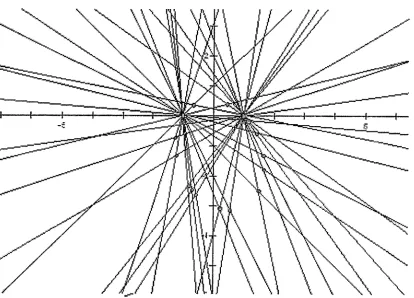
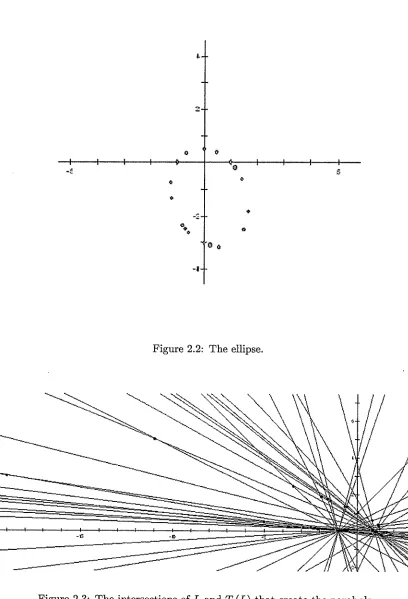
and the locus of intersections will create an ellipse. See Figure 2.1 and 2.2.
Case 2: The Parabola
Let a = 4, b = —10, c = 1, d = 12 and r = 1,
P
so r (1 + a) and q 5
rc
1
and the m atrix T =
/ 4 -1 6 5 \
1 12 1 o i y
The m atrix of T 1 is
12 16
64 64
z T A
64 64
so T~
- l
y \ l )
16 1 4
z i i A
64 16
0
V o
o
i y
\y
^ 1 9 \16
X 64
/ 1 \ i - i \
0 = 0
V i ) I 1 )
64 X 16 J* 64
T
i x \
y
V 1 /
satisfies L through P (—1,0). So T (L}\
y = m(a; + l)
+ + + H + 1)
^y - i my
^ m x + ± x -
±
-i-X i£i
1 2 m + l — 1 2 m —1
n I — 64 np _| _ 64____
tZ 1—4m •** * 1 —4m
16 16
, , _ 1 2 m ± l _ 1 2 m ± l
" 4 —1 6 m '7' 4 —16m
1 2 m + l
4 —16m (a; - 1).
Substitute for m from line L into T (L) to find the equation of the conic,
T { L ) \ y 12( 4 r ) + ! ( ® - l )
y x
16 "
X +
W y
_2Z_
2—1 4_16JL> + 4x+1
y _ 1 2 y + a + l
x —1 4 a;+ 4 —16?/
y (4x + 4 - 16y)
—2y2 — 3xy — 3y
4xy + 4y — 16y2
x 2 + 8xy + 16a/2 — 16a/ — 1
is the equation of the parabola.
(a; — 1) (12y + x + 1)
—2xy + 3a;2 + 3x + 2y — 3x — 3
12xy + x 2 + x — 12y — x — 1
0
Ln : y = m (x + 1 ) - > T ( L n) : y = 1 2 m + l ( 4 —16m
Lx : y = x + 1 - > T ( L i ) : y = _ 1 3 1 2 ^ , 1312
L 2 : y = 2a; + 2 - > T ( L 2): y = _ 2 5 28 x , 2528
L s : y = 3a; + 3 - > L ( L 3): y = _ 3 7 „ , 37 44 x 44
Z 4 : y =4a; + 4 - > T ( L 4): y = _ 4 9 „ , 49 60 x 60
L 5 : y = —x — 1 - > T ( L 5): y = - I l 2 0 J ' + 11 20
L 6 : y = —2a; — 2 - > T ( L 6): y = _ 2 3 36x + 2336
l
7 -.
y = —3a; — 3 - > T ( L 7): y = _ 3 5 52 , 3552L s : y = ~ ^ x ~ i - > T ( L 8): y = _ 1 2 ^ l s + _L 12
L
q:
y = 2 X + 2 - > T ( L 9): y = - Z a ; + 74"^ ' 4L w ■ y = - k x - I
6 'l 6 T ( L 10) : y = ____i— 5L
Lxi : y = _ i T _ i &x 8 -> T ( L U ) : y = _ i a ; + J _ 12"" 12
L l 2 '• y = - i a ; - - i- 1 2 x 12 -> T ( L 12) : y = 0.
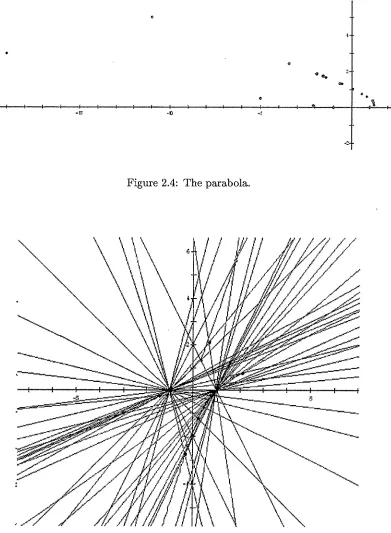
The locus of intersections will create a parabola. See Figure 2.3 and 2.4.
Case 3: The Hyperbola
Let a = 3, b = —2, c = 3, d = — 5 and r = 1 so p = 4 and q — 3
( 3
3 the matrix T =
\ 0
—2 4 \
- 5 3
0
The determinant 5 = — 9 and trace r = - 2 so r 2 > 4J and the conic is a hyperbola.
/ -1 \
0
V 1 / / 1 \
0
V 1 /
{ x \
y
\ i y
so T~-l
T - i
y =
\ 1 J
5X =2 _ 1 4 \
9 'L 9 y 9
iy
satisfies L through P (—1,0). So T (Z):
y = m (a; + 1)
x — jy — j = f a x —f a y
~ l y + j w :
( - | + |m ) y =
f a x — f a —
jm + j
3—5m \ 0 0 1 7
¥
7
x
1 i 2 " f " 1 2
-+ £ m - j + jm
3 ' 9
5 m —3 3 —5 m
__2__ m _L ___9__
2 m —3 ~ 2 m —3
5 m —3 - _ 5 m —3
2 m —3 2 m —3
T ( Z ) : _ 5 m —32 m —35 4 ( z - l )
T ( L ) : 5 ( 4 i ) ~ 3
2(
t+
t)—
3
( z - l )
_ a _ £ —1
$2___3 s + i ° -22!— 3
aj+l °
4 _ X —1
5 y —3 x —3
2 y - 3 x —3
y (2y - 3x - 3)
2y2 - Zxy - 3y
= (a; — 1) (5y — 3x — 3)
= 5a;y — 3a;2 — 3a; — 5y + 3a; + 3
3a;2 — 8a;y + 2y2 + 2y — 3 = 0
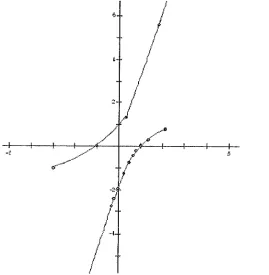
is the equation of the hyperbola. Graphing the conic in this case yields the following
equations,
Ln : y = m (x + 1 ) -4- T ( i n ) : y = 5 m —3 ( 2m-3
Z i : y = x + 1 4 i ( i l ) : y = 2a; — 2
i 2 : y = 2# + 2 4 T ( i 2 ) : y = 7x - 7
L 3 : y = 3a; + 3 i ( i 3 ) : y = 4a; — 4
i 4 : y = 4a; + 4 4 i ( i 4 ) : y = 17™ 5 ® 175
l
5 -.,
y = —x — 1 - 4 i ( i 5 ) : y = 8™ _ 85 ® 5
L 6 : y = -2a; — 2 4 T ( i e ) : y = 13™ 13
7 ® 7
L 7 : y = —3a; — 3 4 T ( i 7 ) : y = 2a; - 2
i s : y = —4a; — 4 - 4 i ( i s ) : y = 23™ 23
n ® l i
i 9 : y = ~ \ x - i 4 i ( i 9 ) : y = 11™ _ l i8 x 8
i i o : y = 4 i ( i i o ) : y = l x _ I
4® 4
i n : y = 1 - + i4 ® + 4 4 r ( L , i ) : y = 10® 7 710
i l 2 : y = _ 1 T _ 1
4® 4 4 i ( i l 2 ) : y = 17 14® _ 1714
i l 3 : y = - 2 - a ; 4 - - i
16 ® 16 4 i ( i i 3 ) : y = _L™ 10® 101
i l 4 : y = 15™ , 15
32® 32 4 i ( i l 4 ) : y = 22® 7 722
i
j.
G 0
+•
,■£
•>
4-$ ©
$
♦
©
-1
Figure 2.2: The ellipse.
-15
Figure 2.4: The parabola.
t
e
4--- &
Chapter 3
Hyperbolic Plane
Non-Euclidean geometry was one of the most momentous mathematical discov
eries of the 19th century. Hyperbolic geometry is a non-Euclidean geometry which obeys
all the Euclidean postulates except the parallel postulate [Ped88]. In Hyperbolic geome
try, the Poincare disk model, also called the conformal disk model, is a model in which
points of the geometry are in the open unit disk 5?. The lines of the geometry are seg
ments of circles (arcs) contained in the disk orthogonal to the boundary circle C and this
also includes diameters th at are orthogonal to the disk.
Choosing two points P and Q in the hyperbolic plane, a transformation T such
that T (P) = Q is now a conformal hyperbolic transformation T which takes the pencil
of circles through P to the pencil through Q. Every direct non-Euclidean transformation
can be described as a Mobius transformation of the form:
where M < 1. |a|
The matrix associated with the transformation is
G T
This transformation leaves orientations unchanged and is called a direct non-Euclidean
transformation [BEG99]. A direct transformation is called: a rotation if T has a fixed
point in 2D, a translation if T has no fixed point in 2? but two distinct points on C, and
The direct transformation above results in the following theorem:
T heorem 3.1. A direct non-Euclidean transformation T can be written in the form
T (z) = K where K and m are complex numbers with — 1 and |m| < 1.
This is the canonical form of a direct non-Euclidean transformation [BEG99]. Note that
the transformation T with m = —R will map the point —R of £) to the origin. By two
applications of the theorem, we can obtain the general form of a direct non-Euclidean
transformation th at maps —R to R in 2). Let Ti (jz) be the transformation th at takes —R
to the origin and T2 (z} be the transformation th at takes R to the origin, so
and T2 (a) = K 2f = ^
the matrices th at are associated with the above transformations are
K 2 - R K 2 \
R 1
J
The inverse of A 2,
Kr R K X
- R 1
A, =
and A 2 =A2- 1 1 R
- R K 2 k
2
so
1 R \ I K r RK±
- R K 2 K 2 I { - R 1
and let K \ = K — 2 K - R 2 R ( K + 1)
- R ( K + l ) - R 2K + \
Hence any direct transformation th at maps — R to R may be written in the form
T ( ; z ) (K - R 2) z + (R K + 1)
—J ? + 1 ) £ + (~ R ? K + 1 )
Thus, in correspondence with |A”| = 1, there are an infinite number of transfor
mations th at take —R to R. First, we will dispense of the trivial case. Let T \ =
( c d \
and T2 = I I where T2 (0) = R.
= R and T , = f =
—aR + 6 = 0 d = Rc
b = aR
2x a aR
aR a
T2
c Rc
Rc c
t
2
t,
c RcRc c
a Ra
Ra a
ac + R?ac R (ac + oc)
R {ac + ac) R 2ac + ac
ac + R 2ac 0
0 R 2ac + ac
i (1 - R 2) 0
0 i (R 2 —1)
1 0
0 - 1
which takes — R to R. This is nothing more than multiplication by —1 which takes the
real number line and maps it to itself. This case will result in a degenerate conic, which
Next, we will find a single parameter t where every value of t will generate a
different conic. Let R = tan h p and p = 5 where is the distance from the origin. If we
assume th at ac 7^ ai, then
T2T l =
ac+ R 2ac R{ac+ac)
1
1
a c+ R 2ac R(ac+ ac)
and since R — tanh ,
a c + R 2ac _ o c + ta n h 2 f Sc
2 # 2 ta n h
1 + ta n h 2 4 • ( l —t a n h 2 4 L a c
__ ____ J:__________ & f
2 ta n h j 2 ta n h ~ a c
But ■
1j',tan\ 2
- = coth d, and if we let our parameter t = ■ tan^-g-2 °c
, then aftersubstitut-2 ta n h | 2 ta n h j - a c ’
coth d + it 1
2 ta n h j - a c
ing we get c o th d + ii. This is the desired transformation T =
that takes —R to R.
coth d — it
coth d + it
1
1 \
, the conic coth d — it /
that is produced by the correspondence between P (~ R ) and Q (R) is determined by t,
so the conic is determined by coth d + it where p and t will determine whether T is a ro
tation, translation, or a limit rotation. In each case we must solve for the fixed points of T: Given the above transformation T =
(co th d + i t ) z + l
z 4-(co th d —it)
z 2 + (coth d —it) z = (coth d + it) z + 1
then z 4 i2+ 4
= it ± V l - t 2
so z\ = it + a/1 — t 2 and z? = it — \ / l — t 2. When |t| > 1 we get a rotation, if |t| < 1 a
translation, and when t = ±1 we will get a limit rotation [Sch79].
Lines in the hyperbolic plane are circular arcs orthogonal to the unit circle. If we
let H = | _ @ ] then the determinant of H = ad —
p d
| and if the determinant H < 0,
1 coth d + is
coth d — is 1
= 0
= 0
= 0
= 0. 1 coth d + is
coth d — is 1
then H will represent a circle. For example, let H =
then
G l )
( z + coth d — is z (coth d + is) + 1
z z + (coth d — is) z + (coth d + is) z + 1
|^|2 + 2 [z (coth d + is)] + 0
Let z = x + iy, then from the above equation:
a:2 + y2 + 2 (a: coth d — ys) + 1 = 0
x 2 + (2 coth d) x + y2 — 2sy = —1
(x + coth d)2 + (y — s)2. = — 1 + coth2 d + s2.
The center of the circle is (coth d, s) and the radius of the circle is v c o th 2 d + s2 — 1. So
any line in the Poincare plane is in the form of ( _ @ | , where 1/31 > 1 and I
V 1 / v 0
A line T, th at runs through —R can be represented by the following Hermitian
matrix,
coth d + is
for some s.
H =
coth d — is 1
If we let s = 1? ^- cot 8, then
H — 2R sin 0 (l + R 2) sin 8 + i (l — A2) cos 8
(l + A2) sin 8 — i (l — A2) cos 8 2R sin 8 , 0 < 0 < 7T
and
( - « 1 ) * ( - * )
= 0
R 2 (27?sin 0) — 2R (l + A2) sin0 + 2 Rsin# = 0
2 R sin 0 (R 2 — 2R + l) = 0
R 2 - 2R + 1 = 0 .
But R = tanh , so by substitution in the above equation, is equal to the following:
tanh2 5 — 2 tanh ^ + 1 = 0. The lines through R are represented by
y — cothd above, then
IS
— coth d + is
1 , for some s. If we use the same s = l —R 2
2R cot 6 as
H = 1
H =
2R sin 8 (l + A2) sin 8 — i (l — A2) cos 8( l + A2) sin0 — i (l — A2) cos6> 2R sin 8
and then by using the previous calculation from above 0 will
result in the same equation, tanh2 5 — 2 tanh ^ + 1 = 0.
Recall th at inversive geometry considers lines and circles in the plane to be the
same objects by adjoining the point 00. The inversive transformations form a group T
complex conjugation [Sch79]. We can now compute the image of a circle C under the
action of inverse transformations. If H is the Hermitian m atrix of the circle C we have
ZH Z* = 0, where Z — z 1 ) • We want a m atrix H such th at T (z) is on the line
represented by H , so ( T (F) 1 ) H = 0. If T + represents the transpose
of T , then this implies th at Z T +H T Z + = 0 and so (T+ )_1 H (T1) -1 is the Hermitian
matrix H of the circle T(C'). Note that (T+ )_1 = Tco, the cofactor m atrix of T , and
(T) 1 = T*o (the cofactor conjugate). This proves the following:
T heorem 3.2. I f H is the Hermitian matrix of the circle C and T is the matrix of a
LFT, then TC0H T f0 is the Hermitian matrix o f T (C).
The m atrix TroH T fo is called the spin conjugate of H by T . This spin action is the
principal method of transforming circles in C.
If H is in the pencil through P, then the image T (77) is as follows:
Let
T =
H =
Tco —
r p * ^CO
coth d + it 1
1 coth d — it
1 coth d + is
coth d — is 1
coth d — it —1
—1 coth d + it and
coth d + it —1
—1 coth d —it
s o T ( f f ) = T coH T tco*
coth d —it —1 / 1 coth d + is \ coth d + it —1
We want to change the parameter t similarly to the change of s. These simple parameter
changes create all the hyperbolic rotations about —R to R. So let s = cot Q and
t = R2 ^ cot then
T = coth d + it 1
1 coth d —it
becomes
T = (l + R 2) sin — i (l — 7?2) cos 2R sin £
27? sin (l + 7?2) sin + i (l — 7?2) cos |
where 0 < (f) < and T (77) = TC0HT*0, where
Tco —
(7?2 + l) (sin + i (l — 7?2) (cos -27?sin^
—27? sin (7?2 + l) (sin — i (l — 7?2) (cos
77 = 27? sin 0
(l + 7?2) sin 6 — i (l — 7?2) cos 6
(l + 7?2) sin# + i (l — 7?2) cos 0
2R sin 0
rp * ± C0
(7?2 + l) (sin — i (l — 7?2) (cos
—27? sin ^
—27? sin
(7?2 + l) (sin — i (l — 7?2) (cos
a b
c d
so, T (77) = , where
a = 27? sin (0 + ,
b = — (R 2 + l) sin (0 + + i (7?2 — l) cos (0 + </>),
c = — (7?2 + l) sin (0 + (ft) - i (7?2 — l) cos (0 + </>), and
Chapter 4
Spinor Correspondence
We now have representation of every line through — R = — tanh and a descrip
tion of every direct isometry that takes —R to R. We can now find the conic determined
by the locus L n T (L).
However this locus will be complicated to find so we will simplify our work by
finding instead the locus of intersections of chords obtained by dilating these lines by a
hyperbolic factor of 2. Thus we reduce our work to a corresponding affine conic obtained
as in the previous chapter.
The radial dilation of the arcs through —R transforms the arcs into chords
th at share the endpoints on the boundary circle C. Previoiusly we let R = tanh and
d ( - R , R) = d. When we dilate by the hyperbolic factor of 2 we get ~
tanh d. This will dilate the entire pencil of lines through —R to chords th at go through
the point and can be written as the following theorem.
T heorem 4.1. I f the Hermitian matrix @ J represents a Poincare line for some /3,
with |/?| > 1, then the corresponding dilated chord with the same endpoints is represented
0
Proof:
Let R e10 be any point on f _ @ | . We want to show th at , e10 is on f @
P 1
+
\ P 2m i i f
7 # | =o
( R ei0 + P, PReie
+ 1 )
I
= 0(Rei0 + P) Re~i8 + p R ei0 + 1 = 0
R 2 + pR e~ie + p R eie + 1 = 0
~P^e~i0 + P ^ e *
l+fl5'+ <±I =
’r « 2+io.
Then multiply by 2,
We need to check,
^ P e ~ i6 + ^ P e id
+ 2 = 0.o £ 1 I
P
2( 1 )
, x I
M *
lJ& I(S e « + 2 ) 1+* = 0
I > ^ + I > ^ + 2 = 0,
so indeed 1^ 2 e10 is on 0
P
P
2Recall th at if the straight line L through (—R, 0) is given by y = m (x + R) and
A is an affine transformation (—R, 0) to (R, 0), with linear part
A (L) is given by
a b
c d
, then the line
If the hyperbolic line through — R = — tanh 5 is represented by a Hermitan matrix
2R sin 6
H =
(l + R 2) sin 0 + i (l — R 2) cos 6 then H ( l + R 2) sin0 — i ( l — R 2} cos0 2R sin0dilates to the chord through —1^ 2 with slope m = tan 0 represented by
(1+.R2) , , ( l - / J 2)
2 R + ? 2 R C° t ® 0
(a±g!) c o tg 2 R 1 2 R CUb(7
Then T (H) = I where, V “ /
a = 2R sin(0 + ^>),
b — — (R2 + l) sin (0 + </>) + i (R 2 — l) cos (6 + (/>'), and
b — — (R2 + l) sin ($ + </>)— i (R2 — l) cos (0 + <^>)
dilates to a chord through x^ - 2' with slope M = tan (# + <•/)).
. We can now find an affine transformation A th at takes chords through —R to
chords through R in correspondence with the action of T on the hyperbolic lines, by
determining constants a, b, c, d. Since M = then
tan (0 + <j>)
c + d ( C T ) ta n g
A = 1
jrjjy tan <?!>
|z + |t a n 0
1
When we take the determinant 8 = tan 2 (p + 1 — sec2 (p, and trace t — 2, then
t2 — 45 = 4 — 4 sec2 <p < 0
= 4 (l — sec2 <^>) < 0, if cp 7^ 0.
Thus, the resulting dilated conic determined by the locus of intersection is always an
ellipse.
Note th at if transformation T is an opposite isometry then the image of a line
through —R is obtained by complex conjugation followed by a direct transformation.
Since the Hermitian m atrix of the complex conjugate of a line is represented by the
transpose of the Hermitian m atrix of the line we only need to replace 9 with —9 to obtain
the Hermitian m atrix of the image line, whereby the slope of the chord after dilation is
M = 1^5- tan {cp — 9). Thus we find the affine matrix A from the equation
1 ^ - tan (<p - 0) 1 + f l 2 ta n 0 —ta n 9 1—K 2 1 + ta n <j> ta n 9
c 4 ~ t / t a n 9
a+^i1+o21 — tan 0 ’
this yields
1
| ^ ^ t a n ^
A —
- 1
The determinant 6 = — tan 2 (p — 1 = — sec2 <?!>, and the trace r = 0, so t2 — 4<5 — 4 sec2 (p >
0. Thus the opposite case of the dilated conic determined by the locus of intersection
always results in a hyperbola. So with r =
y2^
and a, b. c, and d from above,y - = 0
becomes
J?2 + l 1 - J?2
which simplifies to
x 2 — 2xy cot </> — 1 — R 2 -R2 + 1
4I22
(R 2 + 1) (1 - R 2)
x 2 cosh d — 2xy cot (f> — y 2 (tanh d) (sinh d } . coshd
Since this hyperbola is symmetric about the center of the disk it can always be rotated
about the origin into standard position and there are four distinct intersections with the
boundary circle C. This yields the following opposite case.
Opposite Case
If we let R = r; and (f> = | , then
tf 2 + l
1 — R 2 x 2 — 2xy cot <^> —
1
- R 2 R 2 + \4R,2
(R 2 + 1) (1 - R 2) 0
simplifies to
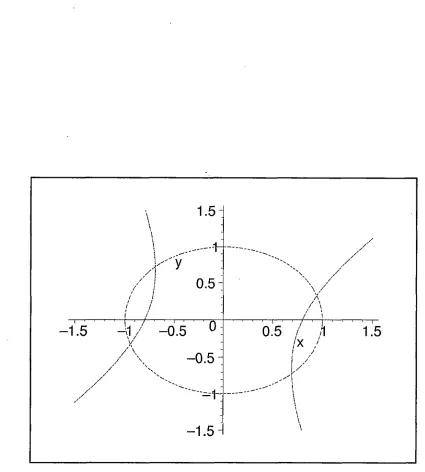
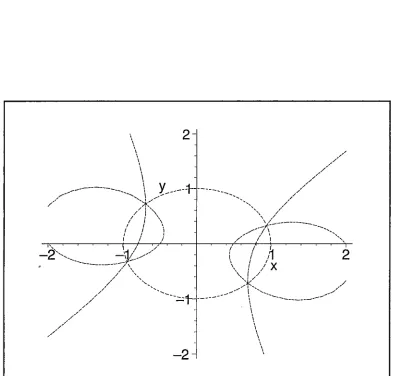
25a;2 — 10\/3a;y — 9y2 — 16 = 0. See Figure 4.1.
We can contract the equation of the hyperbolic conic by substituting u = x ~T~y 2:E2 , . , v =
-h i'
a;2+2^ +1
; and d — into the equationx 2 cosh d — 2xy cot </> — y 2 — —- = (tanh d) (sinh d) coshd
which results in the following equation
4 co sh (/n 3 ) \ 2 _ f 8-^/3 \ _ f ___________4__________ A 2
(a:2+ i/2+ l ) / X \ 3 ( a : 2+2/2+ l ) J X ^ \ (co sh (/n 3 ))(a:2+7/2+ X )2 J — tan (Zn3) sin (Zn3) 0.
Figure 4.2 is the graph of the equation above combined with the graph of the hyper
Chapter 5
Classification of Hyperbolic
Conics
The previous work shows that there are potentially six types of hyperbolic conics
(as opposed to the three types of affine Euclidean conic). Recall in the Euclidean affine
plane we consider three cases:
1) Ellipse, if the line at infinity is an exterior line,
2) Parabola, if the line at infinity is a tangent,
3) Hyperbola, if the line at infinity is a secant.
In the hyperbolic plane the line at infinity is replaced by the unit circle £. So the type of
conic is determined by the way this circle intersects the locus. Since these intersections are
the same for the dilated conic we only need to consider the number of ways an ordinary
Euclidean conic can intersect the unit circle.
Let’s consider our dilated ellipse in standard form
(1+fi2)2 x2 , ^~R2Y (v
4K 2 csc2 </>x 4 K 2 esc2 $
2Rcot<j>\2
1 - f t 2 ) ~
For 0 < <j> < 7r we have csc^ > 0, so the vertices of the ellipse on the major axis
(imaginary axis) are located at cot ± esc (f>. In particular, the upper vertex
following six cases:
Case 1: No Intersection
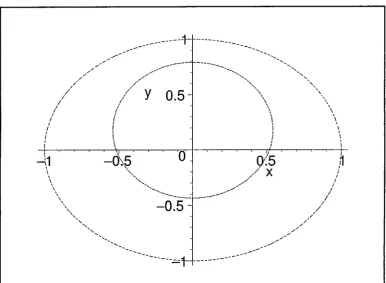
If cot 2 < 1 and tan | < 1 and we let R = j and <j) = then
G + f l 2) 2 2 , ( 2 1 - f l 2) 2 ( _ 2 f l c o t 0 \ 2 _ b p r O T n p s 867 2 , 675 ( _ _8 / o \ 2 - 1
47Z2 csc2 </>® + 4-R2 esc2 </> \ V 1 - f l 2 J ~ 1 D e c o m e s 2 56® + 256 \ V 45 v 6 ) ~
See Figure 5.1.
Case 2: Unique Intersection; A Single Tangent
If cot < 1 and tan | = 1, or cot | = 1 and tan < 1 and we
let R = 2 — y/3 and <p = , then^
3a:2 + j (y — | ) 2 = 1. See Figure 5.2.
+ 4fl2*X (? ~
= 1 becomesCase 3: Two Intersections; Both Tangents
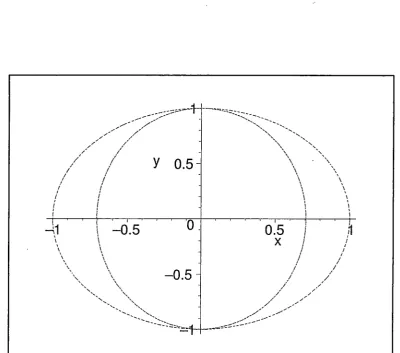
If we cot 2 ~ 1 and 1 ^ 2 tan = 1. For example, let R = y/2 — 1 and cj> = then
+ (y - = 1 becomes 2a:2 + y2 = 1. See Figure 5.3.
Case 4: Two Intersections, A Secant
If y ^ ? cot < 1 and y ^ - tan | > 1, or y ^ - cot | > 1 and y ^ - tan | < 1 and we
let E = b and «/> = | , then (y - = 1 becomes
Case 5: Three intersections, A Tangent and A Secant
If
j2^2
cot > 1 and 1^ 2 tan = 1, or cot — 1 and 1^ 2 tan > 1 and weiet R - and 0 = j , then ^ ^ x ? + 4^ c* 2\ (y - = 1 becomes
x 2 + j (y — l ) 2 = 1. See Figure 5.5.
Case 6: Four Intersections, Two Secants
If cot > 1 and tan > 1 and we let R = and <^> = J , then
■ , . . ( j - g 2 ) 2. _ 2 f l c o t # V _ x b e c o m e s 169 2 , _25_ ( _ 4 /q\ 2 _ i
4R?cs<?lj> 4 K 2 esc2 <j> \ y X-R2 J ~ 1 D e c o m e s 1 9 2 x + 192 \R ~ ■*"
See Figure 5.6.
Note: The equation of the ellipse can be written in terms of distance between the two
original points in the hyperbolic plane, d; and the angle of rotation </> th at determines T.
The equation of our dilated ellipse becomes
1
((tanh d)(csc0)) - X ((sinh d)(csc0))' (y — (sinhd) (cot d>))2 = 1,
where R = tanh i and
. 2g2
— 2tanh j
= sinhd.2 1—ta n h |
To find the actual hyperbolic conic suppose th at the m atrix a b
c d produces the
Cartesian conic f e ^ z 2 + =
1-Since this conic is the result of dilating the hyperbolic conic, we can obtain the equation
of the hyperbolic conic by the usual inverse transformation procedure, th at is, if (x, y) is a
point on the hyperbolic conic then the dilation of (a;, y) must satisfy the above quadratic.
The dilation of (a:,y) is
1+X y 2)' S°’ if W® let U = A * and v = 1+Xy2
then the above equation results in the following
(i+a2) \ 2 , ( l - f l 2 ) 2
4 f l2 csc2 e U + 4 K 2 CSC2 </>G - 2 Rl-R 2 cot 4> - 1 = 0
and becomes,
^ x 2 (sin2 </>)
(J2* ^ 1)2
+ 4 ^ (sin2 <f>) (l - R 2) 2 ( 2 ^ - 1 = 0which simplifies to the biquadratic or quartic form
+ (r2 + l) y -| (cot <j>) (l - B 2) — r2 (i?4 + l) + 4y2 + 1 = 0
where r 2 = x 2 + y 2 and R = tan 5.
If we use polar coordinates, x = r cos 9 and y = r sin (9, the above equation simplifies into
r 4 + A r3 + B r 2 + A r + 1 = 0.
This is the polar equation of the contraction to the hyperbolic conic, where
A = 2 ( i z ^ W sine = i « g sin(,
= 4 (cot (cschd) sin 0
B — — (7?4 — AR2 sin2 9 + l) = — (tanh2 p — 4 sin2 9 + coth2 p)
= 4sin2f l - 2 1+cn°s^ = —2 (cos29 + 2csch2d)
The symmetry in polar coefficients results from the fact tht the curve must be invariant
under the interchange of r with meaning that the curve is invariant under inversion
in the unit circle. The portion of the curve outside the unit circle results from the locus
of second intersections of the circular arcs through —R and R. We will now use the
Case 1: No Intersection
Let A = 2 ^ ~ R^ cot</> sin0, B = - ^ (fl* _ 4J?2 sin2 0 + i ) , j? = | , and
then r 4 + A r 3 + B r 2 + A r + 1 = 0 becomes
r 4 + |\ / 3 (sine) r3 + (4 sin2 0 — ^ ) r 2 + |\ / 3 (sine) r + 1 = 0. See Figure 5.7.
Case 2: A Unique Intersection; A Single Tangent
Let A = 2 gine, B = - ^ (R 4 - 4R2 sin2 0 + l ) , R = 2 - and </> = f ,
then r 4 + A r 3 + B r 2 + A r + 1 = 0 becomes
r 4 + 4 (sine) r 3 + (4 sin2 0 — 14) r 2 + 4 (sine) r + 1 = 0. See Figure 5.8.
Case 3: Two Intersections; Both Tangents
Let A = sin0, b = (B4 - 4A2 sin2 0 + l) , R = ^ 2 - 1, and <f> = f , then r 4 + A r 3 + B r 2 + A r + 1 = 0 becomes r 4 + (4 sin2 0 — 6) r 2 + 1 — 0.
See Figure 5.9. Notice th at if we change to Cartesian coordinates this graph is a picture
of two circles intersecting on the boundary and has Cartesian factors of
(a;2 — 2x + y 2 — l) (x2 + 2x + y 2 — l) = 0 .
Case 4: Two Intersection; A Secant
Let A = sin#, B = (R4 - 4A2 sin2 0 + l) , R = i , and </> = f ,
then r 4 + A r 3 + B r 2 + A r + 1 = 0 becomes
Case 5: Three Intersections; A Secant and A Tangent
Let A = sinO, B = - (A4 - 4A2 sin20 + l ) , R = and <f> = f ,
then r 4 + A r 3 + B r 2 + A r + 1 = 0 becomes
r4 + | (sin 0 )r3 + (4 sin2 0 — r 2 + j (sin#) r + 1 = 0. See Figure 5.11.
Case 6: Four Intersections; Two Secants
Let A = 2^X R^ cot^ sin0, B = — (R 4 — 4A2 sin26 + l) , R = j , and (/> —
then r4 + A r 3 + B r 2 + A r + 1 = 0 becomes
Chapter 6
Conclusion
In this body of work, we have studied and shown how conics arise in planar
geometry as a linear correspondence between two concurrent pencils. The locus of inter
sections L Pl T (L), as L runs through the entire pencil of lines through a point P, and
where T is an affine transformation such that T (P) = Q, creates an affine conic: an
ellipse, a parabola, or a hyperbola.
When we determined the intersection of L with T (L) we found the following
equation of the affine conic,
ex2 + (d — a) x y — by2 — (a + d )ry — cr2 = 0.
The type of conic was determined by the invariants of T , the determinant and trace of
the linear parts of the matrix T. This led to three cases of the affine conics.
We used this affine result to explore conics in the hyperbolic plane using Poincare’s
conformal disk model, where the lines of the geometry are segments of circles contained
in the disk orthogonal to the boundary circle £. We then chose two points P and Q and
a transformation T which takes the pencil of circles through P to the pencil through Q.
The transformation T is a linear fractional transformation th at preserves the disk.
We finally showed th at the conic produced by T is mapped to an affine conic
when dilation about the center of the disk by a hyperbolic factor of two is imposed. This
dilation takes the arc to chords of the disk th at share the same boundary points and
gives rise to a map, called the spinor map, th at allows us to classify the hyperbolic conic
by examining it’s affine counterpart. Since the affine conic is always an ellipse, we were
boundary of the disk. This resulted in six cases and the actual hyperbolic conic can be
Bibliography
[BEG99] David A. Brannan, Matthew F. Esplen, and Jeremy J. Gray. Geometry. Cam- 0
bridge University Press, Cambridge, 1999.
[Ped88] Dan Pedoe. Geometry. Dover Books on Advanced Mathematics. Dover Publi
cations Inc., New York, second edition, 1988. A comprehensive course.
[Sar03] John Sarli. Polar inversion and conics, pages 1-17, 2003. Unpublished Exposi
tory Work.
[Sch79] Hans Schwerdtfeger. Geometry of complex numbers. Dover Publications Inc.,
New York, 1979. Circle geometry, Moebius transformation, non-Euclidean
geometry, A corrected reprinting of the 1962 edition, Dover Books on Advanced