Article
E
ff
ects of Nitrogen Foliar Fertilization on the
Vegetative and Productive Performance of the Olive
Tree and on Oil Quality
Luca Regni *,†and Primo Proietti *,†
Dipartimento di Scienze Agrarie, Alimentari e Ambientali, Universitàdegli Studi di Perugia, Borgo XX Giugno, 74-06121 Perugia, Italy
* Correspondence: [email protected] (L.R.); [email protected] (P.P.)
† These authors contributed equally to the work.
Received: 29 October 2019; Accepted: 25 November 2019; Published: 29 November 2019
Abstract:The correct management (dose, time of distribution) of N fertilization in olive growing is still not completely clarified but is nowadays essential in order to guarantee sustainable production. In this regard, in central Italy over a 4-year-period a study was carried out to investigate the effect of high nitrogen availability during oil accumulation in the fruit (second phase of fruit growth) on vegetative and productive activities of olive trees and oil quality. In May of each year, secondary branches were selected and girdled in their proximal part. Afterwards, half of the girdled branches were sprayed three times with a solution containing urea (2% w/w), whereas the other half was sprayed only with water. The nitrogen treatments did not cause any damage to the foliage and fruits nor did it cause appreciable changes in leaf photosynthesis and specific weight, fruit-drop, ripening pattern and weight, water and oil contents, pulp/pit ratio of the fruits, fatty acid composition, polyphenols content, and sensorial characteristics of the oil. The N provided via foliar fertilization during the oil accumulation phase in trees in conditions of good supply of N does not induce significant effects on the vegetative-productive activity of the tree.
Keywords: Olea europaeaL.; foliar nitrogen fertilization; N management; oil quality
1. Introduction
Nitrogen is the mineral nutrient most commonly applied in olive (Olea europaeaL.) orchards since it is a major nutritional factor affecting plant growth [1–3]. N shortage results in a marked decrease in plant photosynthesis since a great part of the total leaf N is allocated to the photosynthetic apparatus [4].
N deficiency, therefore, affects, to various extents, sugar metabolism and/or carbohydrate partitioning between source and sink tissues [5–7]. Low N availability causes reduction in leaf N, reduced number of flowers per inflorescence, low fruit set and yield [8–11]. N fertilization was also reported to increase fruit set in olive [8]. Among the possible methods for fertilization, there is foliar fertilization, which is one of the most commonly used in olive groves. In particular, combining soil and foliar urea application was seen to be more effective in increasing leaf N than only soil application [12]. Multiple application of urea (2%) via foliar spray to olive trees with inadequate nitrogen status increased leaf N significantly but did not affect the percentage of flowering nodes or flower size at anthesis in May [13].
Since the relative low cost of N fertilization, olive growers have increased the amount of N fertilizers used based on the perception that this can increase yields and so N is usually supplied in excess [3]. Some studies, however, have demonstrated no increase in crop growth or olive yield by
N-sufficient trees following N fertilization [3,11,14,15]. At present, many olive orchards are being over-fertilized with nitrogen, causing numerous problems in both the tree and the soil [12]. Moreover, excess fertilizer application is expensive and leads to N losses by leaching with negative impacts on the environment [4]. A correct management (dose, time of distribution) of N fertilization has not been completely clarified yet, but it is nowadays essential in order to guarantee sustainable production as it allows the design of management strategies to reduce the environmental impact of nitrogen losses and the negative effect of excess nitrogen on the tree, and to guarantee optimal tree growth and productivity. At the same time, there is still a lack of knowledge regarding the correct management of N and time guidelines for N fertilization of olive orchards are few [16–18].
Erel et al. [8] reported that the oil phenolic content decreased by increasing leaf N, indicating protein-phenol competition in leaves. On the other hand, polyunsaturated fatty acids (PUFAs) C18:3 increased in response to higher doses of N [9].
The aim of the present study was to investigate the effects of N foliar fertilization on the vegetative and productive activity of the olive tree and on the quality of the oil. In particular, the effects of the N foliar fertilization on the quality of the oil are of great interest because there is still little knowledge in this regard.
2. Material and Methods
2.1. Olive Grove and Environmental Characteristics
The trial was carried out for four years in Central Italy in a 12-year-old rainfed olive grove near Assisi (12◦56’ E longitude, 43◦11’ N latitude, about 400 m a.s.l.). The trees belong to the Frantoio cultivar, were trained to the vase system, and spaced 6×6 m. The soil was managed by green cover mowing.
The climatic data were monitored by a meteorological station near the olive grove and are reported in Table S1. The mean annual precipitation in the area during the years of experimentation was about 900 mm, the minimum temperature (−0.3◦C) was recorded in February, while the highest temperature
(32.4◦C) was recorded in July (Table S1). The soil, derived from calcareous marl and classified as Typic Haploxerept (Soil Survey Staff, 2010), is characterised by an alkaline pH in water (1:2.5 soil:water ratio) (8.1±0.3), and a loam texture (sand 41%, silt 34%, clay 25%). The total organic carbon (TOC) was
9.3±0.3 g kg−1, total N was 0.7±0.1 g kg−1, available P was 8.0±1.1 mg kg−1and exchangeable
K was 114±11.0 mg kg−1
. The olive trees were subjected to the usual cultivation cures and to the ordinary spring fertilization to the soil. In particular, at the beginning of each March, 150 kg ha−1of N as urea and 100 kg ha−1of K as potassium sulphate were distributed on the soil over the green cover without burying.
2.2. Foliar Fertilization
2.3. Leaf N Content
One-year-old fully expanded leaves (three per branch) and current season fully expanded leaves (three per branch) were randomly harvested, a week after the last treatment, from thirty branches in each treatment and combined into a composite sample, weighed and analyzed. Leaf tissue nitrogen (N) was determined in triplicate by the Kjeldahl method.
2.4. Vegetative Activity
On both the treated and control branches the following activities were determined: the growth and the number of nodes of the shoots (measuring the length of the shoots, at the end of the autumn growth on 5 secondary branches per branch). The phytotoxic effect of the treatments was monitored by visual controls.
2.5. Leaf Net Photosynthesis (Pn) and Area Dry Mass (ADM)
Leaf net photosynthesis (Pn) was determined in the morning (from 9:00 to 11:00) on cloudless days on 15 expanded current-season and one-year-old leaves per treatment, randomly sampled from well-lit branches’ portions 10 days after each treatment, when the incoming photosynthetic photon flux density (PPFD) was 2056, 2036 and 1990 mmol m-2 s-1 respectively—which is over the light saturation point in olive [19–21]. Pn was determined using a portable ADC LCA-3 gas exchange analyser (Analytical Development Company Ltd., Hoddesdon, UK) and a Parkinson-type assimilation chamber as described by [20]. After the gas exchange measurements, the leaves were immediately transferred to the laboratory in a portable refrigerator for determination of area dry mass (ADM) as described in [22].
2.6. Fruits Production, Maturation Indexes and Oil Characteristics
The number of fruits per inflorescence after the first N treatment and at the harvest was evaluated on six secondary branches per tree. The fruit drop was calculated as a difference between the number of fruit after the first treatment and at harvest on 200 inflorescence per branch. At harvest time, olive production per branch was determined. On 50 olives per tree the following aspects were determined: detachment force, flesh firmness, pigmentation, fresh weight (FW) and dry weight (DW) of the olives (the latter determined by drying the olives at 90◦
C), pulp/pit ratio.
The detachment force was measured by a “Carpano et Pons” dynamometer. Flesh firmness was
assessed using a “Carpo” hand dynamometer (“Effe.gi” dynamometer DT 05, Alfonsine, Ravenna,
Italy) with a 1.0 mm diameter tip. The “Jean pigmentation index”, ranging from 0 to 5 with the 0 value for green olives and the 5 value for olives with deep purple pigmentation of the pulp respectively, was visually assessed. The oil and water content of the olives was determined, after fruits crashing, using the “SpectraAlyzer ZEUTEC”—NIR: Near Infra-Red”. Each year, one day after harvesting (beginning of November), oil was extracted from two samples of about 2.5 kg per treatment using an artisanal mini olive-mill [23,24]. The determination of the oil chemical characteristics (acidity, peroxide number, total phenol content and fatty acid composition) and the sensory evaluation (panel test) were carried out on 3 subsamples for each oil sample following the Official Methods of Analysis [25].
2.7. Statistical Analysis
3. Results
3.1. N Content
The N content of the one-year-old fully expanded leaves one week after the last treatment was rather high both in the treated leaves and in the control ones, settling on values around 1.7%±0.34%
of dry matter for the treated leaves and 1.3%±0.45% for the control. On the other hand, the N content
of the current season leaves was higher in the treated leaves (2.1%±0.25%) than in control leaves
(1.4%±0.32%).
3.2. Vegetative Activity
The shoots growth, measured at the end of the autumn, was quite limited both in the control and in the treated branches. However, in the treated branches an elongation greater than in the control branches was observed (1.26±0.31 cm and 0.76±0.20 cm, respectively). The foliar fertilization with
urea did not cause visible damage to the leaves.
3.3. Leaf Net Photosynthesis (Pn) and Area Dry Mass (ADM)
The photosynthetic activity of young and one-year-old leaves was not affected by the foliar N treatment. In general, the photosynthetic activity of young leaves was not different from that of one-year-old leaves (Table1). The specific weight of the leaves in treated branches was not influenced by the treatment nor by the age of the leaves (Table1).
Table 1.Area dry mass (ADM) and photosynthesis (Pn) in current season and one year old leaves at 10 days after each treatment (DAT).
Leaf Age Treatment
ADM Pn ADM Pn ADM Pn
(mg cm−2
) (µmmoli CO−2 2
s−1
) (mg cm
−2
) (µmmoli CO−2 2
s−1
) (mg cm
−2
) (µmmoli CO−2 2
s−1
)
10 DAT1 10 DAT2 10 DAT3
Year 1
Current season Control 23.45 b 8.23 a 20.83 a 3.20 a 19.46 a 7.19 a
Treated 25.04 b 9.26 a 19.85 a 2.84 a 19.90 a 6.85 a
One year old Control 27.76 a 7.76 a 20.72 a 2.47 a 20.03 a 8.71 a
Treated 27.16 a 9.15 b 21.45 a 3.05 a 20.01 a 8.41 a
Year 2
Current season Control 24.76 a 11.03 a 19.87 a 3.45 a 22.46 a 11.46 a
Treated 25.10 a 10.87 a 19.90 a 3.56 a 22.90 a 11.35 a
One year old Control 27.77 a 7.94 a 19.93 a 2.87 a 25.83 a 8.84 a
Treated 28.43 a 8.38 a 20.05 a 2.95 a 24.03 a 8.17 a
Year 3
Current season ControlTreated 18.94 a18.55 a 10.31 b8.65 a 19.84 a20.55 a 2.80 a3.75 a 21.36 a21.80 a 12.85 a11.75 a
One year old Control 20.91 a 9.30 b 21.91 a 2.59 a 24.73 a 11.70 b
Treated 20.34 a 5.65 a 21.35 a 3.15 a 23.93 a 10.09 a
Year 4
Current season ControlTreated 19.46 a19.90 a 13.67 a13.07 a 20.14 a19.75 a 3.82 a4.45 a 20.36 a21.09 a 7.19 a6.85 a
One year old Control 20.03 a 10.76 a 20.63 a 3.78 a 22.73 a 8.71 a
Treated 20.01 a 11.41 a 21.75 a 3.49 a 22.93 a 8.41 a
For each year mean values followed by different letters are significantly different (P<0.05) (n=15).
3.4. Fruits Production, Maturation Indexes and Oil Characteristics
Therefore, it can be deduced that the fruit-drop too, which occurred from the time of the first treatment to the harvest, was not modified by foliar fertilization.
The fresh and dry weight of the fruits and the pulp/pit ratio were not significantly different among the fruits from treated and control branches. The water content of the fruit at harvesting time was around 55% in the first year, 47% in the second year, 45% in the third year and 61% in the last year, while the and oil content was around 20% of the fresh weight: they did not change as a consequence of the treatment (Table2). The lack of effect on the oil content of the fruit suggests that, under normal nutritional conditions, the accumulation of oil in the fruit is not influenced by the high availability of N.
Table 2.Fruits characteristics.
Treatment
Water Content
Dry Weight (DW)
Oil
Content Pulp/Pit
Detachment
Force Colour
Pulp Firmness
(%) (g) (% FW) (FW/FW) (N) (0–5) (kg)
Year 1
Control 55.0 a 0.85 a 21.57 a 2.71 a 2.63 a 2.22 a 0.32 a Treated 55.7 a 0.89 a 20.72 a 2.75 a 2.77 a 1.94 a 0.34 a
Year 2
Control 46.6 a 1.03 a 22.85 a 3.71 a 3.16 a 2.11 a 0.36 a Treated 47.2 a 1.05 a 22.59 a 3.68 a 3.00 a 2.19 a 0.34 a
Year 3
Control 45.4 a 0.94 a 22.92 a 2.79 a 2.56 a 4.05 a 0.32 a Treated 46.7 a 0.98 a 21.83 a 2.86 a 2.28 a 3.75 a 0.34 a
Year 4
Control 60.8 a 0.64 a 19.91 a 1.79 a 3.45 a 2.61 a 0.52 a Treated 61.2 a 0.68 a 18.81 a 1.98 a 3.39 a 2.79 a 0.48 a
For each year mean values followed by different letters are significantly different (P<0.05) (n=500).
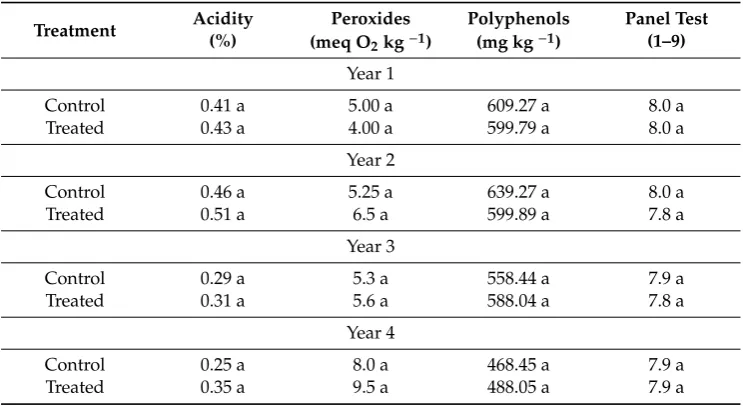
The course of the maturation of the olives, determined on the basis of their resistance to detachment, the drop, the pigmentation and the hardness of the pulp, was not influenced by foliar fertilization. The quality of the oil was not affected by the treatment either and was excellent in terms of acidity, number of peroxides, total polyphenol content and panel test evaluation (Table3).
Table 3.Chemical-sensory oil characteristics.
Treatment Acidity(%) Peroxides Polyphenols Panel Test (meq O2kg−1) (mg kg−1) (1–9)
Year 1
Control 0.41 a 5.00 a 609.27 a 8.0 a
Treated 0.43 a 4.00 a 599.79 a 8.0 a
Year 2
Control 0.46 a 5.25 a 639.27 a 8.0 a
Treated 0.51 a 6.5 a 599.89 a 7.8 a
Year 3
Control 0.29 a 5.3 a 558.44 a 7.9 a
Treated 0.31 a 5.6 a 588.04 a 7.8 a
Year 4
Control 0.25 a 8.0 a 468.45 a 7.9 a
Treated 0.35 a 9.5 a 488.05 a 7.9 a
For each year mean values followed by different letters are significantly different (P<0.05) (n=6).
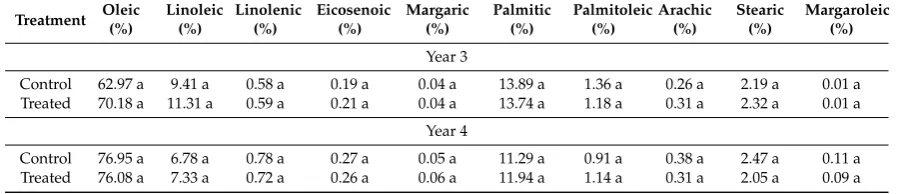
Table 4.Oil acidic composition.
Treatment Oleic Linoleic Linolenic Eicosenoic Margaric Palmitic Palmitoleic Arachic Stearic Margaroleic
(%) (%) (%) (%) (%) (%) (%) (%) (%) (%)
Year 3
Control 62.97 a 9.41 a 0.58 a 0.19 a 0.04 a 13.89 a 1.36 a 0.26 a 2.19 a 0.01 a Treated 70.18 a 11.31 a 0.59 a 0.21 a 0.04 a 13.74 a 1.18 a 0.31 a 2.32 a 0.01 a
Year 4
Control 76.95 a 6.78 a 0.78 a 0.27 a 0.05 a 11.29 a 0.91 a 0.38 a 2.47 a 0.11 a Treated 76.08 a 7.33 a 0.72 a 0.26 a 0.06 a 11.94 a 1.14 a 0.31 a 2.05 a 0.09 a
For each year mean values followed by different letters are significantly different (P<0.05) (n=6).
4. Discussion
The leaves’ N content was high both in control and treated leaves [12,26]. The absence of substantial differences between the N content in one-year-old treated and control leaves after one week from the last treatment can be attributed both to the modality of urea absorption that occurs mainly due to the young leaves (in which the thick layer of the cuticle is not yet present), and to the rapid translocation of N from the leaves to the sinks present (fruits) [15,27]. Indeed, the N content in the current season leaves was higher than in control leaves.
The autumn growth of the shoots was very limited both in the control and treated branches, presumably as a consequence of the late fertilization of the leaves with respect to the period of maximum vegetative activity and, above all, of the girdling that has a notoriously depressive effect on the growth of the shoots [28,29].
The absence of differences in leaves’ photosynthetic rate can be attributed to the high leaves’ N content also in the control. As a matter of fact, the response of leaf photosynthesis to N fertilization is largely dependent on the leaf N content [4].
The number of fruits per inflorescence was not influenced by foliar fertilization in the four years of experimentation. Consequently, it can be deduced that even the fruit drop, which occurred from the time of the first treatment to the harvest, was not modified by foliar fertilization. In other experiments, however, early foliar nitrogenous fertilization has substantially reduced the fruit drop, with a consequent increase in production. This seems to indicate that only in the early stages of fruit development, competition for N can significantly affect the retention of fruits formed by reducing the size of the natural drop [30].
The fresh and dry weight of the fruits and the pulp/pit ratio, in accordance with what reported by [15,30], were not significantly different between control and treated branches. Since the number of fruits per inflorescence and their unit weight did not change with N foliar fertilization, in agreement
with what was found by [15], we deduce that the treatment did not change the production by
branch either.
5. Conclusion
It can be stated, therefore, that the high availability of N during the forwarding phase does not affect the quality of the oil adversely and that, in trees in conditions of good supply of N, it does not induce significant effects on the vegetative-productive activity of the tree. To better define the effect of nitrogenous foliar fertilization on the process of transmission and on the quality of the oil, it would be interesting to carry out treatments on trees in a condition of N deficiency and to investigate the effects obtainable with treatments carried out during the entire vegetative season.
Supplementary Materials: The following are available online athttp://www.mdpi.com/2077-0472/9/12/252/s1: Table S1: Experimental site meteorological data.
Author Contributions:Methodology, L.R.; data curation, L.R.; writing—original draft preparation, L.R. and P.P.; supervision: P.P., funding acquisition, P.P.
Funding:This research was partially funded by EU project LIFE OLIVE4CLIMATE (LIFE15 CCM/IT/000141).
Acknowledgments:The authors are grateful to Massimo Pilli and Mirco Boco for their technical support.
Conflicts of Interest:The authors declare that the research was conducted in the absence of any commercial or financial relationships that could be construed as a potential conflict of interest.
References
1. Albornoz, F. Crop responses to nitrogen overfertilization: A review.Sci. Hortic.2016,205, 79–83. [CrossRef] 2. Kirkby, E. Introduction, Definition and Classification of Nutrients. InMarschner’s Mineral Nutrition of Higher
Plants, 3rd ed.; Elsevier Ltd.: Amsterdam, The Netherland, 2012; pp. 3–5.
3. Fernández-Escobar, R.; García-Novelo, J.M.; Restrepo-Díaz, H. Mobilization of nitrogen in the olive bearing shoots after foliar application of urea.Sci. Hortic. 2011,127, 452–454. [CrossRef]
4. Boussadia, O.; Steppe, K.; Zgallai, H.; Ben El Hadj, S.; Braham, M.; Lemeur, R.; Van Labeke, M.C. Effects of nitrogen deficiency on leaf photosynthesis, carbohydrate status and biomass production in two olive cultivars ‘Meski’ and ‘Koroneiki’.Sci. Hortic.2010,123, 336–342. [CrossRef]
5. Paul, M.J.; Driscoll, S.P. Sugar repression of photosynthesis: The role of carbohydrates in signalling nitrogen deficiency through source: Sink imbalance.Plant Cell Environ.1997,20, 110–116. [CrossRef]
6. de Groot, C.C.; Marcelis, L.F.M.; van den Boogaard, R.; Kaiser, W.M.; Lambers, H. Interaction of nitrogen and phosphorus nutrition in determining growth.Plant Soil2003,248, 257–268. [CrossRef]
7. Scheible, W.R.; Morcuende, R.; Czechowski, T.; Fritz, C.; Osuna, D.; Palacios-Rojas, N.; Schindelasch, D.; Thimm, O.; Udvardi, M.K.; Stitt, M. Genome-wide reprogramming of primary and secondary metabolism, protein synthesis, cellular growth processes, and the regulatory infrastructure of Arabidopsis in response to nitrogen.Plant Physiol.2004,136, 2483–2499. [CrossRef]
8. Erel, R.; Kerem, Z.; Ben-Gal, A.; Dag, A.; Schwartz, A.; Zipori, I.; Basheer, L.; Yermiyahu, U. Olive (Olea europaeaL.) tree nitrogen status is a key factor for olive oil quality.J. Agric. Food Chem.2019,61, 11261–11272. [CrossRef]
9. Dag, A.; Ben-David, E.; Kerem, Z.; Ben Gal, A.; Erel, R.; Basheer, L.; Yermiyahu, U. Olive oil composition as a function of nitrogen, phosphorus and potassium plant nutrition.J. Sci. Food Agric. 2009,89, 1871–1878. [CrossRef]
10. Chatzissavvidis, C.A.; Therios, I.N.; Antonopoulou, C. Seasonal variation of nutrient concentration in two olive (Olea europaeaL.) cultivars irrigated with high boron water. J. Hortic. Sci. Biotechnol.2004,79, 683–688. [CrossRef]
11. Erel, R.; Yermiyahu, U.; Van Opstal, J.; Ben-Gal, A.; Schwartz, A.; Dag, A. The importance of olive (Olea europaea
L.) tree nutritional status on its productivity.Sci. Hortic.2013,159, 8–18. [CrossRef]
12. Fernández-Escobar, R.; Marin, L.; Sánchez-Zamora, M.A.; García-Novelo, J.M.; Molina Soria, C.; Parra, M.A. Long-term effects of N fertilization on cropping and growth of olive trees and on N accumulation in soil profile.Eur. J. Agron.2009,31, 223–232. [CrossRef]
14. Fernández-Escobar, R.; Benlloch, M.; Herrera, E.; García-Novelo, J.M. Effect of traditional and slow-release N fertilizers on growth of olive nursery plants and N losses by leaching.Sci Hortic.2004,101, 39–49. [CrossRef] 15. Connel, J.H.; Ferguson, L.; Krueger, W.H.; Sibbett, G.S. Effects of foliar application of olive on olive leaf
nitrogen, growth, and yield.Acta Hortic.2002,586, 251–254. [CrossRef]
16. Fernández-Escobar, R.; García-Novelo, J.M.; Molina-Soria, C.; Parra, M.A. An approach to nitrogen balance in olive orchards.Sci. Hortic.2012,135, 219–226. [CrossRef]
17. Fernández-Escobar, R. Olive Nutritional Status and Tolerance to Biotic and Abiotic Stresses.Front. Plant Sci.
2019,10, 1151. [CrossRef]
18. Haberman, A.; Dag, A.; Shtern, N.; Zipori, I.; Erel, R.; Ben-Gal, A.; Yermiyahu, U. Significance of proper nitrogen fertilization for olive productivity in intensive cultivation.Sci. Hortic.2019,246, 710–717. [CrossRef] 19. Reale, L.; Nasini, L.; Cerri, M.; Regni, L.; Ferranti, F.; Proietti, P. The influence of light on olive (Olea europaea
L.) fruit development is cultivar dependent.Front. Plant Sci.2019,10. [CrossRef]
20. Proietti, P.; Famiani, F. Diurnal and seasonal changes in photosynthetic characteristics in different olive (Olea europaeaL.) cultivars.Photosynthetica2002,40, 171–176. [CrossRef]
21. Proietti, P.; Nasini, L.; Ilarioni, L. Photosynthetic behavior of Spanish Arbequina and Italian Maurino olive (Olea europaeaL.) cultivars under super-intensive grove conditions.Photosynthetica2012,50, 239–246. [CrossRef]
22. Proietti, P.; Nasini, L.; Reale, L.; Caruso, T.; Ferranti, F. Productive and vegetative behavior of olive cultivars in super high-density olive grove.Sci. Agric.2015,72, 20–27. [CrossRef]
23. D’Amato, R.; De Feudis, M.; Hasuoka, P.E.; Regni, L.; Pacheco, P.H.; Onofri, A.; Businelli, D.; Proietti, P. The selenium supplementation influences olive tree production and oil stability against oxidation and can alleviate the water deficiency effects.Front. Plant Sci.2018,9. [CrossRef] [PubMed]
24. D’Amato, R.; Proietti, P.; Nasini, L.; Del Buono, D.; Tedeschini, E.; Businelli, D. Increase in the selenium content of extra virgin olive oil: Quantitative and qualitative implications.Grasas Aceites2014,65. [CrossRef] 25. Balestrieri, F.; Bottari, E.; Festa, M.R.; Marini, D.Metodi di analisi di prodotti alimentari; Oli e grassi. SO.GRA.ME:
Napoli, Italy, 1988.
26. Therios, I.Olives: Crop Production Science in Horticulture; CABI Publishing: Wallingford, UK, 2009; pp. 182–409. 27. Wiesman, Z.; Ronen, A.; Ankarion, Y.; Novikov, V.; Maranz, S.; Chpagain, B.; Abramovich, Z. Effect of
olive-nuti-van on yield and quality of olives and oil.Acta Hortic.2002,594, 557–562. [CrossRef]
28. Lavee, S.; Haskal, A.; Tal, Y.B. Girdling olive trees, a partial solution to biennial bearing. Methods, timing and direct tree response.J. Hortic. Sci.1983,58, 209–218. [CrossRef]
29. Levin, A.G.; Lavee, S. The influence of girdling on flower type, number, inflorescence density, fruit set, and yields in three different olive cultivars (Barnea, Picual, and Souri). Aust. J. Agric Res. 2005,56, 827–831. [CrossRef]
30. Frega, N.; Garzi, R.; Mancuso, S.; Rinaldelli, E. The effect of foliar nutrition on olive fruit-set and on the quality and yield of oil: Further testing.Adv. Hortic. Sci.1995,9, 148–152.
31. Proietti, P.; Tombesi, A.; Boco, M. Influence of leaf shading and defoliation on oil syntesis and growth of olive fruits.Acta Hortic.1994,356, 272–277. [CrossRef]
32. Proietti, P.; Paliotti, A.; Nottiani, G. Availability of assimilates and development of olive fruit.Acta Hortic.
1999,474, 297–300. [CrossRef]
33. Gullo, G.; Pace, L.S. Fruit growth and olive oil quality in relation to foliar nutrition and time of application.
Acta Hortic.2002,586, 507–509.
34. Inglese, P.; Gullo, G.; Pace, L.S. Fruit Growth and Olive oil Quality in Relation to Foliar Nutrition and Time of Application. In4th International Symposium on Olive Growing; Vitigliano, C., Martelli, G.P., Eds.; ISHS: Leuven, Belgium, 2002; p. 586.
35. Marcelo, M.E.; Jordão, P.V.; Matias, H.; Rogado, B. Influence of nitrogen and magnesium fertilization of olive tree Picual on yield and olive oil quality.Acta Hortic.2010,868, 445–450. [CrossRef]
36. Rosati, A.; Caporali, S.; Paoletti, A. Fertilization with N and K increases oil and water content in olive (Olea europaeaL.) fruit via increased proportion of pulp.Sci. Hortic. 2015,192, 381–386. [CrossRef]