www.soil-journal.net/2/511/2016/ doi:10.5194/soil-2-511-2016
© Author(s) 2016. CC Attribution 3.0 License.
SOIL
Knowledge needs, available practices, and future
challenges in agricultural soils
Georgina Key1, Mike G. Whitfield2, Julia Cooper3, Franciska T. De Vries1, Martin Collison4, Thanasis Dedousis5, Richard Heathcote6, Brendan Roth7, Shamal Mohammed8, Andrew Molyneux9,
Wim H. Van der Putten10, Lynn V. Dicks11, William J. Sutherland11, and Richard D. Bardgett1
1School of Earth and Environmental Sciences from Faculty of Life Sciences, Michael Smith Building,
The University of Manchester, Oxford Road, Manchester, M13 9PL, UK 2Lancaster Environment Centre, Lancaster University, Lancaster, LA1 4YQ, UK 3School of Agriculture, Food and Rural Development, Newcastle University, Kings Road,
Newcastle upon Tyne, NE1 7RU, UK
4Collison and Associates Limited, Honeysuckle Cottage, Shepherdsgate Road, Tilney All Saints, King’s Lynn,
Norfolk, PE34 4RW, UK
5European Agro Development Team, PepsiCo Europe, Rue du Rhône 50, 1204 Geneva, Switzerland 6Richard Heathcote, R & J Sustainability Consulting Ltd, working with: National Association of Cider Makers,
Cool Farm Alliance, and Innovate UK, 21 Lattimore Road, Stratford-upon-Avon, CV37 0RZ, UK 7Department for Environment, Food & Rural Affairs, Nobel House, 17 Smith Square, London, SW1P 3JR, UK
8GeoInfo Fusion Ltd, Cranfield, Bedford, MK43 0DG, UK
9Huntapac Produce Ltd, 293 Blackgate Lane, Holmes, Tarleton, Preston, Lancashire, PR4 6JJ, UK 10Netherlands Institute of Ecology, Department of Terrestrial Ecology and Laboratory of Nematology,
Wageningen University and Research Centre, Droevendaalsesteeg 10, 6708 PB Wageningen, the Netherlands 11Department of Zoology, University of Cambridge, Cambridge, CB2 3QZ, UK
Correspondence to:Georgina Key ([email protected]) Received: 15 March 2016 – Published in SOIL Discuss.: 11 May 2016
Revised: 4 September 2016 – Accepted: 10 September 2016 – Published: 10 October 2016
1 Introduction
Soil health in agroecosystems describes the continued ability of a soil to sustain crop (or animal) growth over the long-term through efficient recycling and provision of nutrients and wa-ter and is controlled by a variety of factors and their inwa-terac- interac-tions, including soil physical and chemical properties, soil or-ganic matter, and the activities of diverse soil biological com-munities (Maeder et al., 2002; Bardgett, 2002; Barrios, 2007; Kibblewhite et al., 2008; Lamarque et al., 2011). Enhancing soil health is central to delivering food security and ecosys-tem services (Lal, 2009; De Vries et al., 2012; Lipper et al., 2014). As agriculture has become increasingly intensified, and agroecosystems less biologically diverse, the ecosystem processes underpinning soil health are deteriorating (Glover et al., 2010; Amundson et al., 2015; FAO and ITPS, 2015; Bardgett, 2016). In addition to food production, healthy soils also underpin a wide range of ecosystem services, including carbon sequestration, flood control, and biological control of pests and diseases (Lavelle et al., 2006; Wall et al., 2012; FAO and ITPS, 2015; Bardgett, 2016), which are crucial to underpinning sustainable development goals (Keesstra et al., 2016).
Soil degradation is caused by many factors, including de-forestation, infrastructure development, and construction, but inappropriate management of agricultural land is also a ma-jor cause (Terranova et al., 2009; Nunes et al., 2011). For example, increased mechanization and size of farm machin-ery has caused extensive soil compaction (a major factor in soil degradation) (Beylich et al., 2010; Allman et al., 2015); continuous tillage, which disrupts soil structure and increases soil organic matter loss, has accelerated rates of soil ero-sion in parts of the world (Martinez-Casasnovas and Ramos, 2009; Don et al., 2010; Crittenden et al., 2015); heavy graz-ing by livestock leaves land sparsely vegetated, compacted, and vulnerable to soil erosion (Lal, 1990; Nunes et al., 2011); and leaving cropland without a protective vegetative cover causes declines in soil organic matter content and leaves soil exposed to the erosive forces of wind and rain (Lal, 1990; Pi-mentel et al., 1995). Evidence is accumulating that intensive farming practices reduce the diversity and complexity of soil food webs (Tsiafouli et al., 2016), which has consequences for the functioning of soil and its ability to buffer against ex-treme weather events (De Vries et al., 2012).
While many practitioners are well versed in how to main-tain soil health, they are often not aware of the trade-offs that exist between enhancing certain soil properties and maintain-ing the functions that underpin them. For example, relatively little is known about how farming practices influence the di-versity and functioning of complex soil microbial communi-ties that are responsible for transforming nutrients into plant-available forms or what can be done to harness the benefits of soil organism activities for soil health and crop production
(Philippot et al., 2013; Bardgett and van der Putten, 2014). Also, management practices that have been shown to main-tain many ecosystem services in tandem with soil fertility, such as mulching, composting, and specific crop rotations, might not markedly benefit soil biodiversity (Turbé et al., 2010). There is also much discussion about how to best man-age for soil health, resulting in the need for evidence-based environmental policies for sustainable soil management, as well as the identification of knowledge needs for researchers and practitioners.
The overall goal of this paper was to identify effective practices for enhancing soil health and clarify future research needs. This was done by a synopsis of soil literature that specifically tests practices designed to maintain or enhance elements of soil health. Using an expert panel of soil scien-tists and practitioners, we then assessed the evidence in the soil synopsis to highlight practices beneficial and detrimen-tal to soil health and practices that need further investiga-tion. We used the Delphi technique (Mukherjee et al., 2015) to produce a ranked list of current evidence-based practices for enhancing soil health (Sutherland et al., 2004, 2011). The Delphi technique is a data synthesis method that seeks to find a consensus between experts on a particular subject (Hsu and Sandford, 2007). It is widely used in medicine to clarify par-ticular issues, assess gaps in knowledge, enhance decision-making, and inform policy (Jones and Hunter, 1995; Has-son et al., 2000; Hsu and Sandford, 2007). However, it also presents opportunities to improve decision-making in conser-vation and agricultural policy (Sutherland, 2006). For exam-ple, the Delphi technique was used to determine a package of best management practices to reduce nitrogen emissions from poultry units (Angus et al., 2003) and to quantify the ef-fectiveness and certainty of evidence to determine beneficial practices for conservation (Walsh et al., 2013). We used the Delphi technique to identify and assess practices that benefit soil health.
2 Methods
the literature search we used the Web of Science database (Thomson Reuters 2014), and search terms were chosen us-ing an iterative process of searchus-ing and refinus-ing. The terms used in this search focused on practices to maintain or re-store natural (or semi-natural) soil processes related to soil health. The initial searches returned 37 748 hits. The first 100 titles for each search term were examined and the search re-fined. Duplicate studies were removed. All article titles and abstracts were examined and irrelevant references excluded. A panel of experts were selected to help refine the number of studies. They were chosen based on their expertise in their respective fields, to give a range of perspectives on the liter-ature and to highlight potential issues either with the science or implementation of a practice. Study abstracts for the re-maining 543 references were then scanned to identify studies meeting two criteria: (1) there was a practice that farmers or land managers could perform to enhance soil health on their land; and (2) effects of the practice were monitored quantita-tively. These criteria excluded studies examining the effects of specific practices without testing them explicitly. For ex-ample, predictive modelling studies and correlative studies were excluded (Dicks et al., 2013b).
For the journal trawl, seven journals were selected based on the wide scope of their soil-related research and on the recommendation of experts in soil science. These included the European Journal of Soil Science, Geoderma, Global Change Biology, Land Use Policy, Soil Biology and Bio-chemistry,Soil Use and Management, and theJournal of Ap-plied Ecology. Study titles and abstracts were scanned from volume 1 of each journal to mid-2012. The trawl identified 175 studies relevant to all soil health practices. These litera-ture review methods together returned a total of 718 studies monitoring the effects of practices in the list. As this was part of a project looking at how to increase food security, we included European studies and regions with similar temper-ate climtemper-ates where similar agricultural practices were used. The majority of our papers relate to farming in temperate regions of the world, especially Europe and the US; our ref-erences are therefore only a sample of the global literature but nonetheless represent a substantial body of evidence and include a broad spectrum of journals that publish soil-related research.
The literature was distilled into a synopsis of practices for enhancing soil health, available online (http://www. nercsustainablefood.com, http://www.conservationevidence. com) and in Key et al. (2015). The list of 27 practices to en-hance soil health was developed from a list suggested by sev-eral academics who work in relevant fields and who were not part of the Expert Panel (see below). These practices were refined and added to as we reviewed the literature. Practices were included if they could realistically be adopted by farm-ers and land managfarm-ers, regardless of whether they had al-ready been adopted or whether or not evidence for their ef-fectiveness already existed. We consulted farmers and land managers, as to whether it was feasible or likely that a
prac-tice would be implemented. All captured studies relevant to soil health were included. The review was carried out over a short time frame in 2012. The Expert Panel then took part in the Delphi Assessment of the review in 2013.
The Expert Panel consisted of three experts from academia, three from private-sector research, one from a gov-ernmental body, one from an agricultural consultancy, and one from agribusiness. All have expertise in soil research and land management, and each of them provided an inde-pendent assessment of the evidence for each practice. They were asked to participate because they were either primary stakeholders or decision makers and because they all have specialized knowledge in soil management (Hsu and Sand-ford, 2007). Expert panels range widely in number. In an as-sessment of the effectiveness of various conservation mea-sures, expert panel numbers ranged from 4 to 47 members (Sutherland et al., 2015), whereas in a systematic review of healthcare quality indicators, the average number of panel members was 17 (Boulkedid et al., 2011). Here, we had nine panel members who were asked to allocate a score to each practice using the online survey software Qualtrics (http://www.qualtrics.com). Their assessment was based on four factors: the effectiveness of each practice in enhancing soil health; certainty in the evidence for each practice; the strength of potential negative side effects associated with im-plementing the practice; and finally soil types and locations covered. The panel were asked to ignore prior knowledge of effectiveness and base their scoring only on the evidence pre-sented in the synopsis.
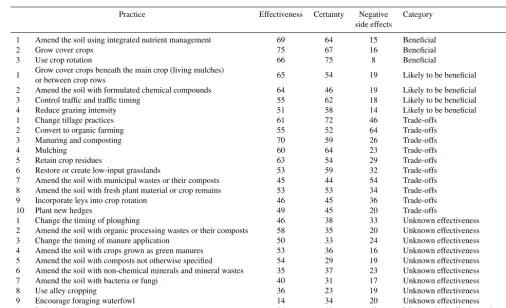
Table 1.The 27 practices for enhancing soil health ranked according to the median of final scores (1–100) by scientists, practitioners and policy-makers, from most beneficial through to harmful. The scores have been used to put the practices into six indicative categories, based on categories of effectiveness by Sutherland et al. (2015): (1) beneficial; (2) likely to be beneficial; (3) trade-offs between benefits and adverse side effects; (4) unknown effectiveness; (5) unlikely to be beneficial; (6) likely to be ineffective or to have adverse side effects.
Practice Effectiveness Certainty Negative Category side effects
1 Amend the soil using integrated nutrient management 69 64 15 Beneficial
2 Grow cover crops 75 67 16 Beneficial
3 Use crop rotation 66 75 8 Beneficial
1 Grow cover crops beneath the main crop (living mulches) 65 54 19 Likely to be beneficial or between crop rows
2 Amend the soil with formulated chemical compounds 64 46 19 Likely to be beneficial 3 Control traffic and traffic timing 55 62 18 Likely to be beneficial
4 Reduce grazing intensity 51 58 14 Likely to be beneficial
1 Change tillage practices 61 72 46 Trade-offs
2 Convert to organic farming 55 52 64 Trade-offs
3 Manuring and composting 70 59 26 Trade-offs
4 Mulching 60 64 23 Trade-offs
5 Retain crop residues 63 54 29 Trade-offs
6 Restore or create low-input grasslands 53 59 32 Trade-offs 7 Amend the soil with municipal wastes or their composts 45 44 54 Trade-offs 8 Amend the soil with fresh plant material or crop remains 53 53 34 Trade-offs
9 Incorporate leys into crop rotation 46 45 36 Trade-offs
10 Plant new hedges 49 45 20 Trade-offs
1 Change the timing of ploughing 46 38 33 Unknown effectiveness
2 Amend the soil with organic processing wastes or their composts 58 35 20 Unknown effectiveness 3 Change the timing of manure application 50 33 24 Unknown effectiveness 4 Amend the soil with crops grown as green manures 53 36 16 Unknown effectiveness 5 Amend the soil with composts not otherwise specified 54 29 19 Unknown effectiveness 6 Amend the soil with non-chemical minerals and mineral wastes 35 37 23 Unknown effectiveness 7 Amend the soil with bacteria or fungi 40 31 17 Unknown effectiveness
8 Use alley cropping 36 23 19 Unknown effectiveness
9 Encourage foraging waterfowl 14 34 20 Unknown effectiveness
1 Reduce fertilizer, pesticide use 26 40 48 Likely to be ineffective or harmful
which practices were presented was varied to prevent panel bias in scoring from order of presentation. All scoring took place remotely via the Qualtrics website.
The 27 practices for enhancing soil health were then ranked according to the median of the final scores, as as-sessed by the expert panel. The scores were used to put the practices into six categories, following the method described by Sutherland et al. (2015): (1) beneficial (in enhancing soil health); (2) likely to be beneficial; (3) trade-offs between benefits and adverse side effects; (4) unknown effectiveness; (5) unlikely to be beneficial; and (6) likely to be ineffective or to have adverse side effects. The categories are based on threshold values of certainty, effectiveness, and negative side effects, i.e. on a combination of the benefit and harm and the strength of the evidence (Supplement, Table 1).
Due to the relatively low number of practices, we used a partial Spearman’s correlation to analyse the Expert Panel’s assessment to identify any relationship between the certainty of the evidence and the perceived effectiveness of each prac-tice. We used the ppcor package (Kim, 2012) in R, ver-sion 3.1.1 (R Core Team, 2014). The median scores for the effectiveness of each practice and certainty of evidence were the main variables, with the strength of potential negative
side effects from implementing the practices as the controlled variable.
3 Results
The 27 practices assessed by the Expert Panel were ranked by how beneficial each practice is to soil health (Table 1 and Supplement).
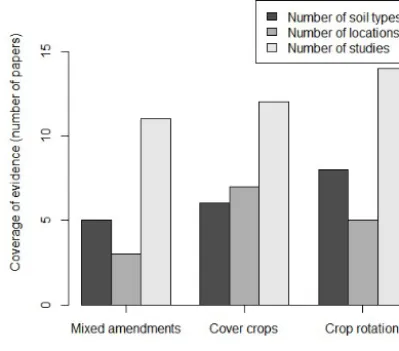
cat-Figure 1.Coverage of soil type, geographical location, and number of studies for the three practices identified as beneficial to soil fertil-ity. Mixed amendments: integrated nutrient management (a mix of organic and inorganic amendments); cover crops: grow cover crops; crop rotation: use crop rotation.
egory was reducing fertilizer and pesticide use, largely due to consequent reductions in crop yields.
Nine of the practices were scored as having “unknown ef-fectiveness”. This was largely because few of the studies cap-tured for those practices were replicated or randomized, and therefore many panel members felt unable to comment on the effects of the practices with certainty. Other factors that contributed to “unknown effectiveness” include fewer geo-graphical locations or soil types coverage.
For some practices, several of the practitioners on the Ex-pert Panel were surprised that no negative effects had been reported and questioned why practices such as “change the timing of ploughing” were not common practice if there were no negative side effects. For other practices, panel members identified known negative side effects from their own knowl-edge and also suggested additional studies, but these were not included in the assessment. The majority of these practices fell into the “trade-offs” category, where evidence suggested that the practices were either beneficial in specific circum-stances or considered likely to be beneficial but with strong negative side effects.
We accounted for the negative side effects of practices us-ing a partial Spearman’s Rank correlation analysis (Fig. 2). We detected a significant positive relationship between the effectiveness of the practice and certainty of the evidence (rpartial =0.72,n=27,P=<0.001). There was no signif-icant relationship between effectiveness and negative side effects (rpartial= −0.34, n=27,P=0.09) or certainty and negative side effects (rpartial=0.17,n=27,P=0.39).
Figure 2.Partial Spearman’s rank correlation, determined using the median scores for each of the 27 practices given by the expert panel. Points are plotted according to the first two variables, effec-tiveness and certainty, while controlling for the third, negative side effects. Effectiveness: effectiveness of the practice; certainty: cer-tainty of the evidence; negative side effects: negative side effects of implementing the practice. Spearman rank correlation coefficient
rs=0.72,P <0.001. The red line represents the slope of the least squares line for the residual series.
4 Discussion
num-ber of current soil management practises that are based on non-scientific knowledge.
For example in the “trade-offs” category, the conversion to organic farming has been shown to be beneficial for soil health in some situations but not others. Several papers re-viewed here had similar findings, showing that there are higher numbers, diversity, or activity of soil organisms under organic management (Liu et al., 2007; Canali et al., 2009, Overstreet et al., 2010; Chaudhry et al., 2012). However, re-sults do not always corroborate each other and can be pe-culiar to specific crop or soil types. In trials by Malhi et al. (2009), for example, organic management in cereal or pulse crops resulted in lower yields compared to conven-tional management, whereas two trials in fruit crops in the USA (Jacobsen and Jordan, 2009; Reganold et al., 2010) found that although the fruit was smaller, it was of a higher quality (important for fruit crop value) and more resistant to disease. Also, the addition of municipal wastes has been shown to reduce soil loss and increase water retention (Ros et al., 2001) but has also been shown, depending on the type of waste used, to reduce soil mineral nitrogen (Rahn et al., 2009).
In the “unknown effectiveness” category, only one paper (Beckwith et al., 1998) for the practice “change the timing of manure application” and two (Ramesh and Chandrasekaran, 2004; Ali et al., 2012) for amending the soil with green ma-nures were captured. The three papers only covered two soil types. While partly due to the nature of this review, the fact that so little literature was captured for these practices and the others in this category suggests that far more work needs to be done before a judgement on their effectiveness can be made.
The beneficial practices, such as “use crop rotation”, have considerable supporting evidence, and both scientists and practitioners are aware of the merits of these practices across several localities and soil types. The panel felt that there was clear evidence showing that crop rotation is beneficial to soil health, especially when legumes are included in the rotation (Blair and Crocker, 2000; Gregorich et al., 2001; Mäeder et al., 2002; Schjønning et al., 2007; Ryan et al., 2008). Includ-ing legumes in rotation can lead to other benefits, such as im-proved water filtration and reduced competition with weeds (Place et al., 2003). The panel also considered that the evi-dence for this practice covered a wide range of geographic locations and soil types but showed interest in seeing more studies demonstrating the effect of type and length of rota-tion on soil biodiversity. Panel members felt that the practice “amend the soil using integrated nutrient management” con-tributed to a wider range of nutrients and mineralization pro-cesses occurring in the soil, which was also found by Palm et al. (1997), as well as providing other benefits for crop pro-ductivity, such as weed reduction. This practice also scored highly due to the range of soil types covered by the evidence. The panel considered the evidence for “grow cover crops” to provide good coverage in Europe and scored highly for the
effectiveness of this practice. Research has shown that cover cropping over winter can reduce soil and nutrient loss (Ding et al., 2006; Gülser, 2006; Zhang et al., 2007; Zhou et al., 2012). The research was supported by the panel who con-sidered the practice to be most appropriate to the UK when used over winter as post-harvest cover cropping. These Ex-pert Panel responses, and the rich historical literature on the benefits of these practices for soil health, are evidence that they can be regarded as “hot topics” in this field, which are identified by Sutherland et al. (2013) as areas of research that are progressing and, in the case of crop rotation, has been widely implemented for many years (although less used now, or simplified in intensive systems) (Benton et al., 2003).
The “likely to be beneficial” practices were generally con-sidered to be effective with few negative side effects, but the Expert Panel suggested that more evidence was needed, par-ticularly in the form of commercial evidence or case studies, or with specific effects on yields presented. The Spearman’s rank correlation suggests that the relationship between nega-tive side effects and the perceived effecnega-tiveness of the prac-tice is not as closely correlated as the relationship between effectiveness and certainty of evidence, where more of the variance in the data is accounted for (Chatterjee and Hadi, 2012). The significant positive relationship found between the effectiveness of the practice and certainty of the evidence suggests that, for both scientists and practitioners, increased certainty in the scientific evidence presented for practices re-sulted in them being considered more effective.
fertil-izers should be reduced, and at what rate, rather than having a blanket reduction could reduce the trade-offs of such a prac-tice. Accessing knowledge from practitioners, which would not necessarily make it into scientific literature, such as the practical barriers to and the specific details of implement-ing practices, would add more context to the results in this paper. In addition, their knowledge could perhaps provide a wider range of practices for researchers to explore, widen-ing the tools available to enhance soil health. This highlights the importance of two-way knowledge exchange if we are to effectively enhance soil health.
We are aware that the review method we used has limi-tations, for example only one literature database was used in addition to journal trawling. The Expert Panel suggested studies that were not captured by our searches over the pe-riod of the project and were surprised at there being so few papers for some of the practices. The journals trawled repre-sent a spectrum of journals that publish soil-related research and are all well respected in the field. We recognize, how-ever, that there is scope to extend our analysis to consider an even wider range of literature including applied research by industry. The panel also highlighted practices not included in this synopsis that warrant further research, or suggested al-ternative practices, such as “mob” grazing, where a field is heavily grazed, before removing the animals for a rest period (Bittman and MacCartney, 1994), and grazing of livestock on crop stubble in mixed systems. Another important prac-tice not included in our analysis was integrated pest manage-ment (IPM), which is known to have indirect effects on soil health. These practices, which were not included in our anal-ysis, warrant further research.
Our database of references is only a sample of the global literature, but with 132 papers reviewed it nonetheless rep-resents a substantial amount of evidence and demonstrates what can be achieved within a short time frame. Previous research has queried the use of the Delphi technique as a stand-alone decision-making tool (Angus et al., 2003), so the next step would be to expand the review process and Delphi methods (i.e. a larger Expert Panel with additional rounds of scoring) to capture the full breadth of available evidence for soil health (Rowe and Wright, 2011). For some prac-tices the range of technology used, for example in formulated chemical amendments, highlights the difficulty in comparing studies; what might be suitable in one location on one soil type may not be appropriate for others. The condition of a site also needs to be taken into account when recommend-ing practices, given that the impact of various practices will vary depending on many factors, including soil type, the ex-tent that a soil is degraded, and local climate. Although not useful for forming broad applications, reviews such as this could lead to targeted “best-fit” approaches more beneficial to local soil health, an approach found by Giller et al. (2010) to be better for different types of farms. The review also pro-vides an informative starting point on appropriate practices for improved soil health.
5 Conclusions
This review provides a useful case study of a method to incorporate expert knowledge into the implementation of evidence-based practice to improve soil health in agroecosys-tems. Not only have we highlighted several ways of main-taining or improving soil health that are based on scientific evidence, but we also identify a high level of uncertainty sur-rounding many interventions that are widely used to maintain soil health. Further, our assessment has also identified major research gaps and areas of uncertainty in relation to the ef-fectiveness of certain interventions, which may prove to be a barrier to implementing practices. Expanding the scope of the review in future work may help to identify some of the uncertainty surrounding practices and refine what further re-search is needed. Agricultural intensification is required to improve food security; however, this needs to be done in a sustainable way if we are to have more resilient agricul-tural systems in the face of climate change. By implement-ing the beneficial practices as assessed above and addressimplement-ing some of the gaps in our knowledge, we could go some way to restoring functional biodiversity and associated ecosystem services for good soil health in agroecosystems.
The Supplement related to this article is available online at doi:10.5194/soil-2-511-2016-supplement.
Author contributions. The project was initiated by William J. Sutherland and Richard D. Bardgett. Georgina Key and Mike G. Whitfield carried out the systematic review, with input from Richard D. Bardgett, Lynn V. Dicks, and William J. Sutherland. Georgina Key carried out the Delphi process with contributions from Lynn V. Dicks. Ranking was carried out by Julia Cooper, Franciska T. De Vries, Martin Collison, Thana-sis DedouThana-sis, Richard Heathcote, Brendan Roth, S. A. M. Shamal, Andrew Molyneux, and Wim H. Van der Putten and collated by Georgina Key. Georgina Key carried out the statistical correlations with help from Mike G. Whitfield. Georgina Key prepared the paper with contributions from all co-authors.
Acknowledgements. This work was supported by the Natural Environment Research Council (grant number NE/K001191/1). William J. Sutherland is funded by Arcadia. Thanks to Josce-lyn Ashpole for her contributions to the process and to Phil Donker-sley for his statistical advice.
Edited by: S. Keesstra
References
Ali, R. I., Awan, T. H., Ahmad, M., Saleem, M. U., and Akhtar, M.: Diversification of rice-based cropping systems to improve soil fertility, sustainable productivity and economics, J. Animal Plant Sci., 22, 108–112, 2012.
Allman, M., Jankovský, M., Messingerová, V., Allmanová, Z., and Ferenˇcik, M.: Compaction of various Central European forest soils caused by traffic of machines with various chassis, Forest Systems, 24, 1–10, 2015.
Angus, A. J., Hodge, I. D., McNally, S., and Sutton, M. A.: The setting of standards for agricultural nitrogen emissions: a case study of the Delphi technique, J. Environ. Manage., 69, 323–337, 2003.
Anigma, S. D., Stott, D. E., O’Neill, M. K., Ong, C. K., and Weesies, G. A.: Use of calliandra-Napier grass contour hedges to control erosion in central Kenya, Agr. Ecosyst. Environ., 91, 15–23, 2002.
Amundson, R., Berhe, A. A., Hopmans, J. W., Olson, C., Sztein, A. E., and Sparks, D. L.: Soil and human security in the 21stcentury, Science, 348, 647–653, 2015.
Bardgett, R. D.: Causes and consequences of biological diversity in soil, Zoology, 105, 367–374, 2002.
Bardgett, R. D.: Earth Matters, Oxford University Press, Oxford, 2016.
Bardgett, R. D. and van der Putten, W. H.: Belowground biodiver-sity and ecosystem functioning, Nature, 515, 505–511, 2014. Barrios, E.: Soil biota, ecosystem services and land productivity,
Ecol. Econ., 1, 1–17, 2007.
Beckwith, C. P., Cooper, J., Smith, K. A., and Shepherd, M. A.: Nitrate leaching loss following application of organic manures to sandy soils in arable cropping. I. Effects of application time, manure type, overwinter crop cover and nitrification inhibition, Soil Use Manage., 14, 123–130, 1998.
Benayas, J. M. R., Newton, A. C., Diaz, A., and Bullock, J.: En-hancement of biodiversity and ecosystem services by ecological restoration: A meta-analysis, Science, 325, 1121–1124, 2009. Benton, T. G., Vickery, J. A., and Wilson, J. D.: Farmland
biodi-versity: is habitat heterogeneity the key?, Trends Ecol. Evol., 18, 182–188, 2003.
Beylich, A., Oberholzer, H. R., Schrader, S., Höper, H., and Wilke, B. M.: Evaluation of soil compaction effects on soil biota and soil biological processes in soils, Soil Till. Res., 109, 133–143, 2010.
Bhattacharyya, P., Roy, K. S., Neogi, S., Chakravorti, S. P., Be-hera, K. S., Das, K. M., Bardhan, S., and Rao, K. S.: Effect of long-term application of organic amendment in relation to global warming potential and biological activities in tropical flooded soil planted to rice, Nutr. Cycl. Agroecosyst., 94, 273–285, 2012. Birkhofer, K., Bezemer, M. T., Bloem, J., Bonkowski, M. Chris-tensen, S., Dubois, D., Ekelund, F., Fliessbach, A., Gunst, L., and Hedlund, K. L. U., Maeder, P., Mikola, J., Robin, C., Se-tala, H., Tatin-Froux, F., Van der Putten, W. H., and Scheu, S.: Long-term organic farming fosters below and aboveground biota: Implications for soil quality, biological control and productivity, Soil Biol. Biochem., 40, 2297–2308, 2008.
Bittman, S. and MacCartney D. H.: Evaluating alfalfa cultivars and germplasms for pastures using the mob-grazing technique, Can. J. Plant Sci., 74, 109–114, 1994.
Blair, N. and Crocker, G. J.: Crop rotation effects on soil carbon and physical fertility of two Australian soils, Aust. J. Soil Sci., 38, 71–84, 2000.
Boulkedid, R., Abdoul, H., Loustau, M., Sibony, O., and Alberti, C. Using and reporting the Delphi Method for selecting healthcare quality indicators: A systematic review, PLoS One, 6, 1–9, 2011. Burgman, M., Anna, C., Godden, L., Gregory, R., McBride, M., Flander, L., and Maguire, L.: Redefining expertise and improving ecological judgment, Conserv. Lett., 4, 81–87, doi:10.1111/j.1755-263X.2011.00165.x, 2011.
Canali, S., Bartolomeo, E. Di, Trinchera, A., Nisini, L., Tittarelli, F., Intrigliolo, F., Roccuzzo, G., and Calabretta, M. L.: Effect of different management strategies on soil quality of citrus orchards in Southern Italy, Soil Use Manage., 25, 34–42, 2009.
Celik, I., Gunal, H., Budak, M., and Akpinar, C.: Effects of long-term organic and mineral fertilizers on bulk density and penetra-tion resistance in semi-arid Mediterranean soil condipenetra-tions, Geo-derma, 16, 236–243, 2010.
Chatterjee, S. and Hadi, A. S. (Eds.): Regression Analysis by Ex-ample, 5th Edn., John Wiley & Sons, Inc., Hoboken, New Jersey, USA, and Canada, 8–9, 2012.
Chaudhry, V., Rehman, A., Mishra, A., Chauhan, P. S., and Nau-tiyal, C. S.: Changes in bacterial community structure of agricul-tural land due to long-term organic and chemical amendments, Microb. Ecol., 64, 450–460, 2012.
Crittenden, S. J., Poot, N., Heinen, M., van Balen, D. J. M., and Pulleman, M. M.: Soil physical quality in contrasting tillage sys-tems in organic and conventional farming, Soil Till. Res., 154, 136–144, 2015.
Defra: Safeguarding our soils: A strategy for England, De-partment for the Environment, Food and Rural Affairs, London, UK, 48 pp., available at: https://www.gov.uk/ government/uploads/system/uploads/attachment_data/file/ 69261/pb13297-soil-strategy-090910.pdf (last access: 7 Decem-ber 2015), 2009.
De Vries, F. T., Liiri, M. E., Bjørnlund, L., Bowker, M. A., Chris-tensen, S., Setälä, H. M., and Bardgett, R. D.: Land use alters the resistance and resilience of soil food webs to drought, Nat. Clim. Change, 2, 276–280, doi:10.1038/nclimate1368, 2012.
Dicks, L. V., Hodge, I., Randall, N. P., Scharlemann, J. P. W., Siri-wardena, G. M., Smith, H. G., Smith, R. K., and Sutherland, W. J.: A Transparent process for “evidence-informed” policy mak-ing, Conserv. Lett., 7, 119–125, 2013a.
Dicks, L. V., Abrahams, A., Atkinson, J., Biesmeijer, J., Bourn, N., Brown, C., Brown, M. J. F., Carvell, C., Connolly, C., Cresswell, J. E., Croft, P., Darvill, B., De Zylva, P., Effingham, P., Fountain, M., Goggin, A., Harding, D., Harding, T., Hartfield, C., Heard, M. S., Heathcote, R., Heaver, D., Holland, J., Howe, M., Hughes, B., Huxley, T., Kunin, W. E., Little, J., Mason, C., Memmott, J., Osborne, J., Pankhurst, T., Paxton, R. J., Pocock, M. J. O., Potts, S. G., Power E. F., Raine, N. E., Ranelagh, E., Roberts, S., Saunders, R., Smith, K., Smith, R. M., Sutton, P., Tilley, L. A. N., Tinsley, A., Tonhasca, A., Vanbergen, A. J., Webster, S., Wilson, A., and Sutherland, W. J.: Identifying key knowledge needs for evidence-based conservation of wild insect pollinators: a collaborative cross-sectoral exercise, Insect Conserv. Divers., 6, 435–446, 2013b.
ni-trate leaching and crop yield in a four-year experiment in Central Spain, Soil Use Manage., 20, 444–450, 2004.
Ding, G., Liu, X., Herbert, S., Novak, J., Amarasiriwardena, D., and Xing, B.: Effect of cover crop management on soil organic matter, Geoderma, 130, 229–239, 2006.
Don, A., Schumacher, J., and Freibauer, A.: Impact of tropical land use change on soil organic carbon stocks – a meta-analysis, Global Change Biol., 17, 1658–1686, 2010.
Donjadee, S. and Tingsanchali, T.: Reduction of runoff and soil loss over steep slopes by using vetiver hedgerow systems, Paddy Wa-ter Environ., 11, 573–581, 2013.
FAO and ITPS: Status of the World’s Soil Resources (SWSR) – Technical Summary, Food and Agriculture Organization of the United Nations and Intergovernmental Technical Panel on Soils, Rome, Italy, 2015.
Foley, J. A., Ramankutty, N., Brauman, K. A., Cassidy, E. S., Ger-ber, J. S., Johnston, M., Mueller, N. D., O’Connell, C., Ray, D. K., West, P.C., Balzer, C., Bennett, E. M., Carpenter, S. R., Hill, J., Monfreda, C., Polasky, S., Rockström, J., Sheehan, J., Siebert, S., Tilman, D., and Zaks, D. P. M.: Solutions for a cultivated planet, Nature, 478, 1–6, 2011.
Giller, K. E., Tittonell, P., Rufino, M. C., van Wijk, M. T., Zin-gore, S., Mapfumo, P., Adjei-Nsiah, S., Herrero, M., Chikowo, R., Corbeels, M., Rowe, E. C., Baijukya, F., Mwijage, A., Smith, J., Yeboah, E., van der Burg, W. J., Sanogo, O. M., Misikom, M., de Ridder, N., Karanja, S., Kaizzi, C., K’ungu, J., Mwale, M., Nwaga, D., Pacini, C., and Vanlauwe, B.: Communicating complexity: Integrated assessment of trade-offs concerning soil fertility management within African farming systems to support innovation and development, Agricult. Syst., 104, 1–13, 2010. Glover, J. D., Reganold, J. P., Bell, L.W., Borevitz, J., Brummer, E.
C., Buckler, E. S., Cox, C. M., Cox, T. S., Crews, T. E., Culman, S. W., DeHaan, L. R., Eriksson, D., Gill, B., Holland, J., Hu, F. Y., Hulke, B., Ibrahim, A., Jones, S., Murray, S., Ploschuk, E., Sacks, E. J., Snapp, S., Tao, D. Y., Van Tassel, D., Wade, L., Wyse, D., and Xu, Y.: Increased food and ecosystem security via perennial grains, Science, 328, 1638–1639, 2010.
Gregorich, E. G., Drury, C. F., and Baldock, J. A.: Changes in soil carbon under long-term maize in monoculture and legume-based rotation, Can. J. Soil Sci., 81, 21–31, 2001.
Gülser, C.: Effect of forage cropping treatments on soil structure and relationships with fractal dimensions, Geoderma, 131, 33– 44, 2006.
Hasson, F., Keeney, S., and McKenna, H.: Research guidelines for the Delphi survey technique, J. Adv. Nurs., 32, 1008–1015, 2000. Hsu, C. C. and Sandford, B. A.: The Delphi technique: making
sense of consensus, Pract. Assess. Res. Eval., 12, 1–8, 2007. Hutchings, A. and Raine, R.: A systematic review of factors
affect-ing the judgments produced by formal consensus development methods in health care, J. Health Serv. Res. Policy, 11, 172–179, 2006.
Jacobsen, K. L. and Jordan, C. F.: Effects of restorative agroecosys-tems on soil characteristics and plant production on a degraded soil in the Georgia Piedmont, USA, Renew. Agricult. Food Syst., 24, 186–196, 2009.
Jones, J. and Hunter, D.: Consensus methods for medical and health services research, Brit. Med. J., 311, 376–380, 1995.
Jones, S. K., Rees, R. M., Kosmas, D., Ball, B. C., and Skiba, U. M.: Carbon sequestration in a temperate grassland; management and climatic controls, Soil Use Manage., 22, 132–142, 2006. Keesstra, S. D., Bouma, J., Wallinga, J., Tittonell, P., Smith, P.,
Cerdà, A., Montanarella, L., Quinton, J. N., Pachepsky, Y., van der Putten, W. H., Bardgett, R. D., Moolenaar, S., Mol, G., Jansen, B., and Fresco, L. O.: The significance of soils and soil science towards realization of the United Nations Sustainable Development Goals, SOIL, 2, 111–128, doi:10.5194/soil-2-111-2016, 2016.
Key, G., Whitfield, M., Dicks, L. V., Sutherland, W. J. and Bardgett, R. D.: Enhancing soil fertility, in: What works in conservation, edited by: Sutherland, W. J., Dicks, L. V., Ockendon, N., and Smith, R. K., Open Book Publishers, Cambridge, UK, 317–318, 2015.
Kibblewhite, M. G., Ritz, K., and Swift, M. J.: Soil health in agri-cultural systems, Philos. T. Roy. Soc. B, 363, 685–701, 2008. Kim, S.: ppcor: Partial and Semi-partial (Part) correlation, R
pack-age, version 1.0, http://CRAN.R-project.org/package=ppcor (last access: 15 March 2016), 2012.
Lal, R.: Soil Degradation, in: Advances in soil science, in: Vol. 11, edited by: Lal, R. and Stewart, B. A., Springer-Verlag, New York, 129–172, 1990.
Lal, R.: Soil degradation as a reason for inadequate human nutrition, Food Security, 1, 45–57, doi:10.1007/s12571-009-0009-z, 2009. Lamarque, P., Tappeiner, U., Turner, C., Steinbacher, M., Bardgett, R. D., Szukis, U., Schermer, M., and Lavorel, S.: Stakeholder perceptions of grassland ecosystem services in relation to knowl-edge on soil fertility and biodiversity, Reg. Environ. Change, 11, 791–804, 2011.
Lavelle, P., Decaëns, T., Aubert, M., Barot, S., Blouin, M., Bureau, F., Margerie, P., Mora, P., and Rossi, J. P.: Soil invertebrates and ecosystem services, Eur. J. Soil Biol., 42, S3–S15, 2006. Lipper, L., Thornton, P., Campbell, B. M., Baedeker, T., Braimoh,
A., Bwalya, M., Caron, P., Cattaneo, A., Garrity, D., Henry, K., Hottle, R., Jackson, L., Jarvis, A., Kossam, F., Mann, W., Mc-Carthy, N., Meybeck, A., Neufeldt, H., Remington, T., Sen, P. T., Sessa, R., Shula, R., Tibu, A. and Torquebiau, E. F.: Climate-smart agriculture for food security, Nat. Clim. Change, 4, 1068– 1072, 2014.
Liu, B., Tu, C., Hu, S., Gumpertz, M., and Ristaino, J. B.: Effect of organic, sustainable, and conventional management strategies in grower fields on soil physical, chemical, and biological factors and the incidence of Southern blight, Appl. Soil Ecol., 37, 202– 214, 2007.
Maeder, P., Fließach, A., Dubois, D., Gunst, L., Fried, P., and Nig-gli, U.: Soil fertility and biodiversity in organic farming, Science, 296, 1694–1697, 2002.
Malhi, S. S., Brandt, S. A., Lemke, R., Moulin, A. P., and Zentner, R. P.: Effects of input level and crop diversity on soil nitrate-N, extractable P, aggregation, organic C and N, and nutrient bal-ance in the Canadian Prairie, Nutr. Cycl. Agroecosyst., 84, 1–22, 2009.
Martinez-Casasnovas, J. A. and Ramos, M. C.: Soil alteration due to erosion, ploughing and levelling of vineyards in north east Spain, Soil Use Manage., 25, 183–192, 2009.
Mukherjee, N., Sutherland, W. J., Dicks, L. V., Hugé, J., Koedam, N., and Dahdouh-Guebas, F.: Ecosystem service valuations of mangrove ecosystems to inform decision making and future val-uation exercises, PLOS ONE, 9, 1–9, 2014.
Mukherjee, N., Hugé, J., Sutherland, W. J., McNeill, J., Van Opstal, M., Dahdouh-Guebas, F., and Koedam, N.: The Delphi technique in ecology and biological conservation: applications and guide-lines, Meth. Ecol. Evol., 6, 1097–1109, 2015.
Mutegi, J. K., Mugendi, D. N., Verchot, L. V., and Kung’u, J. B.: Combining napier grass with leguminous shrubs in contour hedgerows controls soil erosion without competing with crops, Agroforest. Syst., 74, 1–13, 2008.
Nunes, A. D., de Almeida, A. C., and Coelho, C. O. A.: Impacts of land use and cover type on runoff and soil erosion in a marginal area of Portugal, Appl. Geogr., 31, 687–699, 2011.
Overstreet, L. F., Hoyt, G. D., and Imbriani, J.: Comparing nema-tode and earthworm communities under combinations of conven-tional and conservation vegetable production practices, Soil Till. Res., 110, 42–50, 2010.
Palm, C. A., Myers, R. J. K., and Nandwa, S. M. Combined use of organic and inorganic nutrient sources for soil fertility mainte-nance and replenishment, Replenishing Soil Fertility in Africa, Special publication 51, American Society of Agronomy and Soil Science Society of America, Madison, USA, 193–217, 1997. Philippot, L., Raaijmakers, J. M., Lemanceau, P., and van der
Put-ten, W.: Going back to the roots: the microbial ecology of the rhizosphere, Nat. Rev. Microbiol., 11, 789–799, 2013.
Pimentel, D., Harvey, C., Resosudarmo, P., Sinclair, K., Kurz, M., McNair, M., Crist, S., Shpritz, L., Fitton, L., Saffouri, R., and Blair, R.: Environmental and Economic Costs of Soil Erosion and Conservation Benefits, Science, 267, 1117–1123, 1995. Place, F., Barrett, C. B., Freeman, H. A., Ramisch, J. J., and
Van-lauwe, B.: Prospects for integrated soil fertility management using organic and inorganic inputs: evidence from smallholder African agricultural systems, Food Policy, 28, 365–378, 2003. Rahn, C. R., Bending, G. D., Lillywhite, R. D., and Turner, M. K.:
Co-incorporation of biodegradable wastes with crop residues to reduce nitrate pollution of groundwater and decrease waste dis-posal to landfill, Soil Use Manage., 25, 113–123, 2009. Ramesh, K. and Chandrasekaran, B.: Soil Organic Carbon Build-up
and Dynamics in Rice-Rice Cropping Systems, J. Agron. Crop Sci., 190, 21–27, 2004.
R Core Team: R: A language and environment for statistical com-puting, R Foundation for Statistical Comcom-puting, Vienna, Austria, http://www.R-project.org/ (last access: 15 March 2016), 2014. Reganold, J. P., Andrews, P. K., Reeve, J. R., Carpenter-Boggs, L.,
Schadt, C. W., Alldredge, J. R., Ross, C. F., Davies, N. M., and Zhou, J.: Fruit and soil quality of organic and conventional straw-berry agroecosystems, PloS ONE, 5, 1–14, 2010.
Ros, M., Garcia, C., and Hernandez, T.: The use of urban organic wastes in the control of erosion in a semiarid Mediterranean soil, Soil Use Manage., 17, 292–293, 2001.
Rowe, G. and Wright, G.: The Delphi technique as a forecasting tool: issues and analysis, Int. J. Forecast., 15, 353–375, 1999.
Rowe, G. and Wright, G.: The Delphi technique: Past, present and future prospects – Introduction to the special issue, Technol. Forecast. Social Change, 78, 1487–1490, 2011.
Ryan, J., Masri, S., ˙Ibriçi, H., Singh, M., Pala, M., and Harris, H. C.: Implications of cereal-based crop rotation, nitrogen fertilisation, and stubble grazing on soil organic matter in a Mediterranean-type environment, Turk. J. Agr. Forest., 32, 289–297, 2008. Schjønning, P., Munkholm, L. J., Elmholt, S., and Olesen, J. E.:
Or-ganic matter and soil tilth in arable farming: Management makes a difference within 5–6 years, Agr. Ecosyst. Environ., 122, 157– 172, 2007.
SEPA – Scottish Environment Protection Agency: Threats to soil quality, available at: http://www.sepa.org.uk/land/soil/threats_ to_soil_quality.aspx, last access: 1 December 2012.
Sutherland, W. J.: Predicting the ecological consequences of envi-ronmental change: a review of the methods, J. Appl. Ecol., 43, 599–616, 2006.
Sutherland, W. J., Pullin, A. S., Dolman, P. M., and Knight, T. M.: The need for evidence-based conservation, Trends Ecol. Evol., 19, 305–308, 2004.
Sutherland, W. J., Goulson, D., Potts, S. G., and Dicks, L. V.: Quan-tifying the impact and relevance of scientific research, PLoS ONE, 6, 1–10, 2011.
Sutherland, W. J., Freckleton, R. P., Godfray, H. C. J., Beissinger, S. R., Benton, T., Cameron, D. D., Carmel, Y., Coomes, D. A., Coulson, T., Emmerson, M. C., Hails, R. S., Hays, G. C., Hodg-son, D. J., Hutchings, M. J., JohnHodg-son, D., Jones, J. P. G., Keel-ing, M. J., Kokko, H., Kunin, W. E., Lambin, X., Lewis, O. T., Malhi, Y., Mieszkowska, N., Milner-Gulland, E. J., Norris, K., Phillimore, A. B., Purves, D. W., Reid, J. M., Reuman, D. C., Thompson, K., Travis, J. M. J., Turnbull, L. A., Wardle, D. A., and Wiegand, T.: Identification of 100 fundamental ecological questions, J. Ecol., 101, 58–67, 2013.
Sutherland, W. J., Dicks, L. V., Ockendon, N., and Smith, R. K. (Eds.): What Works in Conservation, Open Book Publishers, Cambridge, UK, 2015.
Terranova, O., Antronico, L., Coscarelli, R., and Iaquinta, P.: Soil erosion risk scenarios in the Mediterranean environment using RUSLE and GIS: An application model for Calabria (southern Italy), Geomorphology, 112, 228–245, 2009.
Tonitto, C., David, M. B., and Drinkwater, L. E.: Replacing bare fallows with cover crops in fertilizer-intensive cropping systems: A meta-analysis of crop yield and N dynamics, Agr. Ecosyst. Environ., 112, 58–72, 2006.
Tscharntke, T., Clough, Y., Wanger, T. C., Jackson, L., Motzke, I., Perfecto, I., Vandermeer, J. and Whitbread, A.: Global food se-curity, biodiversity conservation and the future of agricultural in-tensification, Biol. Conserv., 151, 53–59, 2012.
Tsiafouli, M. A., Thebault, E., Sgardelis, S. P., de Ruiter, P. C., van der Putten, W. H., Birkhofer, K., Hemerik, L., de Vries, F. T., Bardgett, R. D. and Brady, M. V.: Intensive agriculture reduces soil biodiversity across Europe, Global Change Biol., 21, 973– 985, 2016.
Wall, D. H., Bardgett, R. D., Behan-Pelletier, V., Herrick, J. E., Jones, H., Ritz, K., Six, J., Strong, D. R., and van der Putten, W. H. (Eds.): Soil Ecology and Ecosystem Services, Oxford Univer-sity Press, Oxford, 2012.
Walsh, J., Dicks, L. V. and Sutherland, W. J.: The effect of scientific evidence on conservation practitioners’ management decisions. Conservation Biology, 0 (0), 1-11, 2013.
Zhang, W., Ricketts, T. H., Kremen, C., Carney, K., and Swinton, S. M.: Ecosystem services and dis-services to agriculture, Ecol. Econ., 64, 253–260, 2007.