THE IMPACT OF PERCEIVED SOCIAL SUPPORT IN FIRST- YEAR SPANISH COLLEGE STUDENTS ADJUSTMENT
María F. Páramo1, Zeltia Martínez1, Carolina Tinajero1, María S. Rodríguez2 1
University of Santiago of Compostela, Spain, Department of Developmental Psychology 2
University of Santiago of Compostela, Spain, Department of Methodological Psychology
Abstract
A large body of research, not specifically developed in Spain, has revealed that adjustment to college can be experienced by emerging adults as stressful or supportive, depending on perceived social support. The aim of the present study was to analyze the extent to which different sources and cognitive/affective components of perceived social support predicted specific areas of adjustment in a sample of 300 first-year university students in Spain. The sample completed the Social Support Questionnaire (SSQ6), the Perceived Acceptance Scale (PAS) and the Student Adaptation to College Questionnaire (SACQ). Regression analysis revealed that perceived social support was a good predictor of adjustment to college. The association was stronger for peers support than family support once university entry grade point average and gender were controlled for. The relationship between the number of available others when needed and the satisfaction with available support with adjustment was mediated by perceived sense of acceptance.
Key words: Perceived Social Support, College Adjustment, First-year students
1. INTRODUCTION
Starting college has been viewed as a major transition in emerging adulthood (Arnett 2000), the period between the ages of 18 and 29, in which late adolescents simultaneously develop new patterns of behavioral, cognitive and affective responses to meet the demands of their new surroundings. This is a time of making friends and establishing romantic relationships, engaging in frequent social gatherings, exploring new places, growing intellectually and affirming personality (e.g. Buote et al 2007; Cutrona 1989; Hays & Oxley 1986; Ravert 2009; Swenson, Nordstrom & Hiester 2008). Such experiences should help students to move towards personal autonomy and emotional independence, and to achieve a sense of competence, manage emotions, interact with others with increasing tolerance, develop a sense of purpose, and to clarify a personal and consistent set of beliefs (Chickering & Reisser 1993). However, not all emerging adults are able to master the skills that will enable them to have a satisfactory experience in higher education. During the first year at university, students are often confronted with a variety of new demands and challenges (such as developing study habits for the new academic environment, coping with new evaluation systems, managing finances, and developing new patterns of more mature interpersonal relationships with family members, teachers and classmates), and developing a vocational identity in which processes of decision making, exploration and commitment are particularly important (Astin 1993; Chickering & Reisser 1993; Salami 2008; Soares, Guisande, Almeida & Páramo 2009; Tao, Dong, Pratt, Hunsberger & Pancer 2000; Tinto 1993). Considering the demanding conditions of this particular time of change, numerous studies across the world in the last decade have, unsurprisingly, focused on the first year at university as a critical period. University adjustment is characterized by complex social, emotional and academic mechanisms which, according to recent data, favour certain conflicts in the development and formation of emerging adults. The findings are not encouraging: more than half of the students who embark on higher education experience difficulties during this transitional period (Buote, Pancer & Pratt 2007; Briggs, Clark J & Hall 2012), with numerous incidences of academic difficulties (Wintre, Bowers, Gordner & Lange 2006), emotional difficulties such as isolation, loneliness, stress and depression (Cutrona 1989; Friedlander, Reid, Shupak & Cribbie 2007; Neto & Barros 2000), problems in their relationships
with parents and classmates (Hoffman & Weiss 1987), problems associated with the consumption of alcohol and other psychoactive substances (Caamaño-Isorna, Corral, Parada & Cadaveira 2008) and an increase in psychopathological behaviour (Council for the Advancement of Standards in Higher Education 2006).
2. PERCEIVED SOCIAL SUPPORT AND ADJUSTMENT TO UNIVERSITY
The documented difficulties that students experience during the transition to university, combined with the changing needs of students, have brought increased attention to the academic adjustment of first-year university students and interest in improving graduation rates. The poor academic yield, the excessive amount of time invested in degree studies and student attrition are common problems in all European Union countries (OECD 2011). It has been suggested that students often drop out of university for personal reasons, including failure to adjust to university life (Toews & Yazedjian 2007).
Adjustment to university is multifaceted and involves an array of demands, which vary in kind and degree and require a variety of coping strategies or adjustments (Baker & Siryk 1984, 1986, 1989). This phenomenon is of great concern to educationalists and health practitioners. Educationalists need to know how they can help their students adjust and how to retain the students attending their institutions. Health practitioners, on the other hand, are concerned about the well-being of students. The important dimensions of adjustment to university considered in this study include the academic, social and personal-emotional adjustment of students, as well as institutional attachment (Baker & Siryk 1989). Academic adjustment includes how well students deal with educational demands, such as motivation to complete academic requirements, academic effort and satisfaction with the academic environment. Social adjustment includes success in coping with the interpersonal-societal demands inherent in university life. Personal-emotional adjustment involves the psychological state of students and the extent to which they are experiencing general psychological distress. Institutional attachment describes students’ satisfaction with the university experience in general and the quality of the relationship between the student and the institution. Thus, adjustment can be seen as a condition or state in which the students feel that their needs have been fulfilled and that their behaviour conforms to the needs of the environment (Salami 2011).
Recent theoretical and empirical studies, mainly carried out in English-speaking countries, clearly indicate that student adjustment to university life largely depends on social support systems (e.g. Adams, Berzonsky & Keating 2006; Gottlieb & Bergin 2010; Dennis, Phinney & Chuateco 2005; Wintre & Yaffe 2000; Yazedjian, Purswell, Sevin & Toews 2007). Among the different dimensions involved, perceived social support, i.e. the perception that students have that they can communicate with others, and that they are valued, accepted and will be protected by these people if necessary (I.G. Sarason, Sarason & Pierce 1990; Pierce, Sarason & Sarason 1996), has been shown to be one of the most important protective factors in relation to adjustment in first year university students (Holahan, Valentiner & Moos 1995; Friedlander et al. 2007; Jamara, Belgrave & Zea 1996; Halamandaris & Power 1999; Solberg, Valdez & Villarreal 1994; Tao et al. 2000). Even if the transition period is not disruptive, successful adaption will largely depend on whether students perceive that they are accepted, supported and valued by their sources of social support (Chickering & Reissner 1993). Sarason and colleagues (1983) distinguished two essential elements in social support: perceived availability and perceived satisfaction. The protective effect of both factors is derived from the individual conviction that help or sympathy will be available when it is required (I.G. Sarason, Sarason, Shearin & Pierce 1987). Longitudinal studies have shown that students who have higher levels of perceived parental and peer social support adjust better to university life than those with lower levels of perceived social support (Halamandrias & Power 1999; Friedlander et al. 2007; Tao et al. 2000).
Specific research on the transition to university has shown the effects of different sources of perceived social support. Some studies have shown a positive significant relationship between higher levels of social support from family (specifically parents) and global, emotional and academic adjustment when
first starting university (Friedlander et al. 2007; Hinderlie & Kenny 2002). Other studies have found that students with higher levels of perceived social support from friends display better social adjustment (Schneider & Ward 2003). These studies also reported that higher levels of perceived social support from friends and peers is predictive of better adjustment to university after the first semester (Friedlander et al. 2007; Hays & Oxley 1986).
Brock and colleagues (1998) proposed that a key component of perceived social support, namely sense of acceptance, can be considered as an important mediatory element between adjustment and perceived social support from family or friends. Perceived acceptance is a working model that arises from the experience of attachment in infancy and is defined as a relatively stable cognitive evaluation of whether others are concerned about us and value us independently of our specific attitudes and actions. This cognitive component provides the student with a secure base with which to actively explore and adapt to the new environment, thus mitigating the stress involved in coping with an unknown socio-relational context represented by the university. The current study made use of this component for a comprehensive view of perceived social support that may be predictive of university adjustment.
3. CHANGES IN HIGHER EDUCATION AND DEMOGRAFICS IN SPAIN: EMERGING ADULTHOOD COLLEGE STUDENTS
Higher education in Spain has experienced a major shift in the past few decades. Spanish society has become more democratic and this, together with economic and technological growth, has led to higher education being a reality for most students finishing secondary education. After a period of segregation largely according to social class, Spanish Universities have moved away from providing elite education to providing mass education. Nowadays, university students in Spain come from a diversity of social, cultural and academic backgrounds and use various personal cognitive and motivational resources to cope with the particular challenges of university life. In addition, the Bologna Process, of which Spain is a signatory, launched the European Higher Education Area with the aim of widening student mobility across institutions and academic contexts. Most Spanish students who access higher education are aged between 18 and 25 years old, financially dependent on their parents or other family structures and are free of obligations such as a full-time job, a mortgage loan, marriage or children. In Spain, the transition to adulthood is characterized by prolonged stay in the parental home. After Portugal and Italy, Spain is one of the countries where young people live in the parental home for longest. The Mediterranean pattern of transition is defined by prolonged stay in the parental home, increasing rate of enrolment in higher education, delayed entrance into the workforce and older marriage age (Fierro & Moreno 2007; Instituto Juventud España 2012). These social changes have led to a delay in the attainment of adult status (Del Barrio, Moreno & Linaza 2006). Young university students experience a prolonged period of emerging adulthood that may significantly impact the quality of their adjustment to adulthood. Developmental outcomes of this stage of life will have significant effects on how young people adjust to adulthood. Originally considered as a time for the acquisition of adult responsibilities and roles, this developmental period now resembles adulthood in regard to social experiences, mainly through participation in university life, but does not entail the active exercise of adult duties. Thus, young people (between 18 and 25 years old) attending university face an important challenge: to combine the exploration and lack of definition that are proper of adolescents with characteristics demanded of independent adults (i.e. that they are active, independent, able to use strategies, reflective and self-regulated), in an unknown and highly competitive environment that requires new behavioral, cognitive and affective patterns of responses.
Analysis of the most recent edition of the “Education at a Glance” report (OECD 2011) shows that in Spain more than 50% of students fail to finish university courses, and that much of this attrition (approximately 26%) occurs in the first year. In this regard, Spain occupies one of the worst positions within the European Union. Surprisingly few studies carried out to date have investigated the difficulties of adjustment and widespread cultural differences that can contribute to how emerging adults experience the transition to university in Spain.
The aim of the present study was to advance our understanding of the impact of perceived social support on adjustment to university life among first-year students in Spain. Moreover, because traditional predictors may affect adjustment, we also considered gender and pre-university grades as second level independent variables that may affect adjustment.
4. METHOD 4.1. Participants
The sample used in the study consisted of 300 first-year students (198 females and 102 males) attending the University of Santiago de Compostela (Spain) and is representative of the distribution of the overall student population of the University. Participants were drawn at random from different faculties within five main areas of study: Sciences, Health Sciences, Social Sciences and Law, Humanities, and Engineering. The mean age of the students was 18.03 years (standard deviation, .52 years). All of the students were selected from a larger sample, by applying the following academic and family-related criteria: first-time, first-year attendance at university undertaking a full-time course (60 credits), age less than or equal to 20 years, passed university entrance exams in 2009, undertaking a course that was the first (86.7%) or second choice (13.3%), single, and not employed (i.e. economically dependent on their parents). Most students (91%) came from intact families, and 75.7% were relocated from their parents’ house.
4.2. Measures
The Spanish version of the Perceived Acceptance Scale (PAS, Brock et al. 1998) is a 44-item self-report measure designed to assess perceptions of acceptance within four specific categories of relationships: friends, family, mother and father. Responses are made on a 5-point Likert scale ranging from 1 "strongly disagree" to 5 "strongly agree". Rodríguez, Martínez, Tinajero, Guisande & Páramo (2012) have shown that the Spanish version of PAS has good internal consistency and reliability, with alpha values of .94 for the total score and between .86 and .90 for the four subscale scores.
The Spanish version of Social Support Questionnaire-Short Form (SSQ6, Sarason et al. 1987) is a six-item measure designed to assess two conceptually distinct aspects of perceived social support: Availability and Satisfaction. Availability is measured as the estimated number of people that can be relied on when assistance is required. Satisfaction is the perceived adequacy of the support available. For each of the 6 items, the respondent lists the people on whom he or she can rely on in the situation described (maximum of nine persons) and indicates his or her degree of satisfaction with the support provided (from 1 to 6). Two total scores are calculated: N (availability or number of people), as the average number of people listed for the items, and S (satisfaction), as the average satisfaction score. The SSQ6 reliability is high, as Cronbach's alpha values for the Spanish version were .90 for SSQ6N, .96 for SSQ6S (Martínez et al. 2010).
The Spanish validation of the Student Adaptation to College Questionnaire(SACQ, Baker & Siryk 1984) consists of 67 nine-point Likert items that assess the quality of students’ adjustment to college/university on the basis of a multifaceted concept of this process. Along with a global score for adaptation, the SACQ includes four subscales: academic adjustment, social adjustment, personal/emotional adjustment, and general institutional attachment. Rodríguez, Tinajero, Guisande & Páramo (2012) reported that the internal consistency of the Spanish version was .94 for the total score of SACQ, .90 for academic adjustment, .85 for social adjustment, .89 for personal-emotional adjustment and .84 for institutional adjustment.
Students’ pre-university grades (range 0 - 10) were supplied by the Academic Management Services of the University of Santiago de Compostela.
4.3. Procedure
The Perceived Acceptance Scale and Social Support Questionnaire-Short Form was administered in small group format during the first term of the academic year. The subjects also completed the demographic questionnaire at this time and provided information about pre-university grades. Those
students who agreed to participate in the study were invited in groups of 10 to complete the Student Adaptation to College Questionnaire in the middle of the second term of the academic year.
5. RESULTS
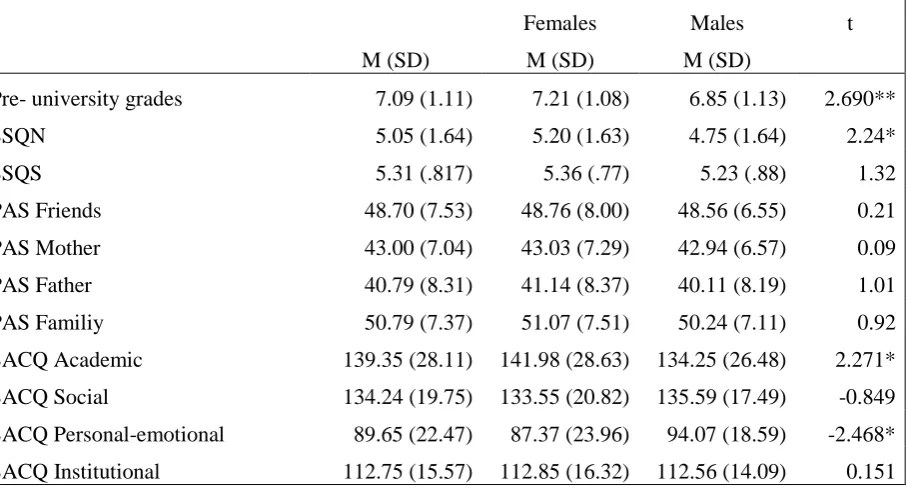
Mean values, standard deviations, and gender differences are shown in Table 1. The following significance levels were applied: *p < .05, **p < .01. ,***p< .001. Taking into account the number of items, the results indicate that Spanish students scored higher on Institutional attachment than other types of adjustment, as also found in other Mediterranean and Spanish speaking samples. They results also indicated high levels of perceived social support. T-tests used to examine differences between male and female students in all measures revealed significant differences in pre-university grades, availability of social support (SSQN), and academic and personal-emotional adjustment. Females scored significantly higher on pre-university grades, availability and academic adjustment, and males scored higher on personal-emotional adjustment.
Table 1. Means, standard deviations, and t values for gender
A correlation matrix for predictor variables and outcome variables in the analysis is shown in Table 2. The results show that all adjustment measures, except personal-emotional adjustment, are correlated with pre-college achievement. The adjustment measures were more closely correlated with the number of available others when needed (SSQN) than with satisfaction with available support (SSQS). All specific areas of adjustment were significantly and positively correlated with perceived sense of acceptance by friends and family (PAS friends and PAS family). Moreover, academic adjustment was more closely correlated than other adjustment measures with PAS family, PAS mother and PAS father.
M (SD)
Females M (SD)
Males M (SD)
t
Pre- university grades 7.09 (1.11) 7.21 (1.08) 6.85 (1.13) 2.690**
SSQN 5.05 (1.64) 5.20 (1.63) 4.75 (1.64) 2.24*
SSQS 5.31 (.817) 5.36 (.77) 5.23 (.88) 1.32
PAS Friends 48.70 (7.53) 48.76 (8.00) 48.56 (6.55) 0.21
PAS Mother 43.00 (7.04) 43.03 (7.29) 42.94 (6.57) 0.09
PAS Father 40.79 (8.31) 41.14 (8.37) 40.11 (8.19) 1.01
PAS Familiy 50.79 (7.37) 51.07 (7.51) 50.24 (7.11) 0.92
SACQ Academic 139.35 (28.11) 141.98 (28.63) 134.25 (26.48) 2.271* SACQ Social 134.24 (19.75) 133.55 (20.82) 135.59 (17.49) -0.849 SACQ Personal-emotional 89.65 (22.47) 87.37 (23.96) 94.07 (18.59) -2.468* SACQ Institutional 112.75 (15.57) 112.85 (16.32) 112.56 (14.09) 0.151
SACQ Academic
SACQ Social SACQ Personal SACQ Institutiona
Gender -.130* .049 .142* -.009
Pre- university grades .341*** .227*** .062 .221***
SSQN .139* .171** .169** .096
SSQS .123* .067 .059 .062
PAS Friends .288*** .382*** .389*** .281***
PAS Mother .207*** .059 .138* .130*
PAS Father .266*** .179** .134* .160**
PAS Familiy .325*** .202*** .172** .218***
Table 2. Correlations between adjustment measures and gender, pre-university grades and perceived social support
A hierarchical multiple regression analysis was performed with specific areas adjustment to university as the dependent variables and gender, pre-college achievement, number of available others, satisfaction with available support, and perceived sense of acceptance by family, friends, mother and father as the independent variables to investigate the role of dimensions of perceived social support in student adjustment. In the first step, gender was entered into the regression equation, followed in the second step by pre-university grades. The number of people available to provide support and the satisfaction with support was entered in the thirst step. In the final step, the four PAS scores were entered together, to test the significance of the increase in variance explained by the perceived sense of acceptance, after controlling the other variables. The results of the regression analyses are summarized in Table 3 (academic and social adjustment) and Table 4 (personal-emotional and institutional adjustment). The F statistic and change in R2 indicate the overall variance explained by each model. The standardized regression coefficients in each regression equation were examined to assess the individual contribution of each measure to adjustment.
The amount of variance explained by the predictors was 24% for academic adjustment, 22.1% for social adjustment, 18.5% for personal-emotional adjustment and 13.8% for institutional attachment. The results show the strong significant contribution of pre-university grades in academic (β=.329, p<.001), social (β=.240, p<.001) and institutional adjustment (β=.225, p<.001), after controlling for gender. By contrast, gender alone predicted personal-emotional adjustment (β=.142, p<.05) and academic adjustment (β=-.130, p<.05), although when pre-university achievement was entered in the model the contribution of gender was lower (β=-.080 p>.05), which appears to indicate that gender has an indirect effect on academic adjustment.
The analysis revealed that the influence of perceived social support measures (scores) on adjustment to university is very important and significantly predicted student adjustment over and above the influence of the gender and pre-university grades.
SSQ scores explained the variance in the prediction, as follows: 2.7% for academic adjustment, 3.4% for social adjustment, 3.8% for personal-emotional adjustment and 1.2% for institutional attachment. The variance explained by SSQ6 scores was primarily accounted for by availability of social support (SSQN) in SACQ social (β=.170, p<.01) and SACQ personal-emotional scores (β=.183, p<.01), while satisfaction with social support (SSQS) significantly predicted SACQ academic scores (β=.114, p<.05). When the PAS scores were added in the fourth step, they predicted an additional 9% to academic adjustment, 12.9% to social adjustment, 12% to personal-emotional adjustment and 7.6% to institutional adjustment. The standardized regression coefficients indicate that the contribution was stronger and significant (p<.001) for PAS friends in predicting all specific areas of adjustment.
However, PAS family only predicted academic adjustment (β=.182, p<.05).
SACQ Academic SACQ Social
Step and Variable F R2Change β F R2Change β
Step 1 5.15* .017* .72 .002
Gender -.130* .049
Step 2 20.76*** .106*** 9.25** .056
Gender -.080 .086
Pre-university grades achievement
.329*** .240***
Step 3 12.98*** .027** 7.56** .034
Gender -.057 .113*
Pre-university grades achievement
.333*** .241***
SSQN .105 .170**
SSQS .114* .057
Step 4 11.46*** .090*** 10.38** .129
Gender -.068 .100
Pre-university grades achievement
.295*** .226***
SSQN -.014 .035
SSQS .036 -.029
PAS Friends .206*** . .357***
PAS Mother -.040 -.169*
PAS Father .066 .060
PAS Family .182* .121
Table 3. Hierarchical regressions for academic and social adjustment
SACQ Personal SACQ Institutional
Step and Variable F R2Change β F R2Change β
Step 1 6.08* .020* .023 .000
Gender .142* -.009
Step 2 4.14* .007 7.75*** .050***
Gender .155** .026
Pre-university grades achievement
.085 .225***
Step 3 5.10*** .038** 4.83*** .012
Gender .182** .042
Pre-university grades achievement
.086 .227***
SSQN .183** .085
SSQS .048 .060
Step 4 8.32*** .120*** 5.79*** .076***
Gender .162** .029
Pre-university grades achievement
.071 .204***
SSQN .050 -.028
SSQS -.041 -.017
PAS Friends .372*** .254***
PAS Mother .034 -.049
PAS Father .027 .007
PAS Family -.011 .137
Table 4. Hierarchical regressions for personal-emotional and institutional adjustment
The results of regression for predicting academic, social and personal-emotional adjustment also indicated that when PAS scores were entered in the models, the significant effect of availability and satisfaction with available support decreased. This revealed that perceived sense of acceptance may mediate the relationship between perceived social support scores (SSQN, SSQS) and university adjustment. Subsequent regression analysis revealed that SSQN and SSQS scores failed to explain significant variance when gender, pre-university grades and PAS scores were first controlled for (p>.40), indicating that mediation occurs.
6. DISCUSSION AND CONCLUSIONS
The present study confirmed that perceived social support is a good predictor of adjustment to university (range from 8.8% for institutional attachment to 16.3% for social adjustment), as reported in previous studies (e.g. Friedlander et al. 2007; Halamandaris & Power 1999; Salami 2011; Tao et al. 2000). Thus, students who reported higher levels of perceived social support from family and friends also reported better academic adjustment. Therefore, these students should be able to adjust well to
university life. The association was stronger for peer support than family support once university entry grades and gender were controlled for. Thus, different sources of social support had different effects on adjustment, in that perceived family support only predicted academic adjustment (β=.182, p<.05), whereas perceived support from friends predicted academic adjustment (β=.206, p<.001), social adjustment (β=.357, p<.001), personal adjustment (β=.372, p<.001) and institutional adjustment (β=.254, p<.001). One explanation for this is that students rely more on friends and peers who are seen as a more effective source of support because they experience the same stressors and they can provide better support in areas such as social, personal and institutional aspects that parents are unable to provide (Tao et al. 2000). It is also possible that the source of social support changes once students have spent several months away from the family home. In the present study, we evaluated adjustment in the second semester, and by this time students may have developed supportive peer relationships with other students on campus.
The study also revealed another important finding, i.e. that the relationship between adjustment and both the number of people available to provide support when needed and satisfaction with available support was mediated by perceived sense of acceptance. Perceived social support should not only be considered as the perception of the availability or satisfaction with support from others, and analysis of the stability of these perceptions should also be carried out. This finding confirms a previous suggestion that perceived acceptance may be an important mediator between perceived social support from family and friends and university adjustment (Brock et al. 1998).
A better understanding of the interplay between perceived social support and adjustment will do more than simply expand the research for this population. These results strengthen previous research identifying communication as important for diminishing stress levels in university students. Such stress is largely produced as a result of the discontinuity between secondary and university education and the increased academic demands (Schneider & Ward 2003; Wintre & Yaffe 2000). In particular, reciprocal communication between university students and their parents may provide help alleviate difficulties in adjustment. Students’ perception of greater reciprocity of communication with their parents was associated with higher levels of self-worth and better adjustment to university. Moreover, university administrators should propose relevant directives that will facilitate development of new peer networks for students and make services available within the institution to help students with the transition to university.
ACKNOWLEDGEMENTS
This study is part of a wider project entitled “LA TRANSICION A LA UNIVERSIDAD EN EL CONTEXTO DEL ESPACIO EUROPEO DE EDUCACION SUPERIOR: INFLUENCIA DEL SOPORTE SOCIAL Y EL NIVEL DE INTEGRACION EN EL FRACASO/EXITO ACADEMICO” [Transition to College in European Higher Education: The Influence of Social Support and Integration on Academic Failure/Success], supported by the Spanish Ministry of Science and Innovation (PSI2011-24535).
REFERENCES
Adams, GR, Berzonsky, MD & Keating, L 2006, `Psychosocial resources in first-year university students: The role of identity processes and social relationships´, Journal of Youth and Adolescence, vol. 35, pp. 81-91.
Arnett, JJ 2000, `Emerging adulthood: A theory of development from the late teens through the twenties´, American Psychologist, vol. 55, pp. 469-480.
Astin, AW 1993, What matters in college? Four critical years revised, Jossey-Bass, San Francisco. Baker, RW & Siryk B 1984, `Measuring adjustment to college´, Journal of Counseling Psychology, vol. 31, pp. 179-189.
Baker, RW & Siryk, B 1986, `Exploratory intervention with a scale measuring adjustment to college´, Journal of Counseling Psychology, vol. 33, pp. 31-38.
Baker, RW & Siryk, B 1989, Student Adaptation to College Questionnaire SACQ: manual, Western Psychological Services, Los Angeles.
Briggs, ARJ, Clark J & Hall, I 2012, `Building bridges: understanding student transition to university´, Quality in Higher Education, iFirst article, pp. 1–19.
Brock, DM, Sarason, IG, Sanghvi, H & Gurung, RA 1998, `The Perceived Acceptance Scale: development and validation´, Journal of Social and Personal Relationships, vol. 15, pp. 5- 21.
Buote, VM, Pancer, MS, Pratt, MW, Adams, GR, Birnie-Lefcovitch, S, Polive, J & Wintre, GM 2007, `The importance of friends: Friendship and adjustment among 1st-year university students´, Journal of Adolescent Research, vol. 22, pp. 665-689.
Caamaño-Isorna, F, Corral, M, Parada, M & Cadaveira, F 2008, `Factors associated with risky consumption and heavy episodic drinking among Spanish university students´, Journal of Studies on Alcohol and Drugs, vol. 69, pp. 308-312.
Chickering, AW & Reisser, L 1993, Education and identity, 2nd edn, Jossey-Bass, San Francisco. Coble, HM, Gantt, DL & Mallinckrodt, B 1996, `Attachment, social competency, and the capacity to use social support´, in GR. Pierce & BR. Sarason (eds.), Handbook of social support and the family, Plenum Press, New York, pp. 141-172.
Council for the Advancement of Standards in Higher Education 2006, Self- assessment guide for counseling services, Author, Washington.
Cutrona, CE 1989, `Ratings of social support by adolescents and adult informants: Degree of correspondence and prediction of depressive symptoms´, Journal of Personality and Social Psychology, vol. 57, pp. 723- 730.
Del Barrio, C, Moreno, A & Linaza, JL 2006, `Spain´, in JJ Arnett (ed.), International Encyclopedia of Adolescence, Routledge, Nueva York/Londres, pp. 906-924.
Dennis, JM, Phinney, JS & Chuateco, LI 2005, `The role of motivation, parental support, and peer support in the academic success of ethnic minority first-generation college students´, Journal of College Student Development, vol. 46, pp. 223-236.
Fierro, D & Moreno, A 2007, `Emerging Adulthood in Mexican and Spanish Youth. Theories and Realities´, Journal of Adolescent Research, vol. 22, pp. 476-503.
Friedlander, LJ, Reid, GJ, Shupak, N & Cribbie, R 2007, `Social support, self-esteem and stress as predictors of adjustment to university among first- year undergraduates´, Journal of College Student Development, vol. 463, pp. 223-236.
Gottlieb, BH & Bergen, AE 2010, `Social support concepts and measures´, Journal of Psychosomatic Research, vol. 69, pp. 511-520.
Halamandaris, KF & Power, KG 1999, `Individual differences, social support and coping with the examination stress: A study of the psychosocial and academic adjustment of first year home students´, Personality and Individual Differences, vol. 26, pp. 665-685.
Hays, RB & Oxley, D 1986, `Social network development and functioning during life transition´, Journal of Personality and Social Psychology, vol. 50, pp. 305-313.
Hinderlie, HH & Kenny, ME 2002, `Attachment, social support, and college adjustment among black students at predominantly white universities`, Journal of College Student Development, vol. 43, pp. 327 – 335.
Hoffman, JA & Weiss, B 1987, `Family dynamics and presenting problems in college students´, Journal of Counseling Psychology, vol. 34, pp. 157-163.
Holahan, CJ, Valentiner, DP & Moos, RH 1995, `Parental support, coping strategies, and psychological adjustment: An integrative model with late adolescents´, Journal of Youth and Adolescence, vol. 246, pp. 633-648.
Instituto de Juventud España 2012, Informe juventud en España 2012, Instituto de Juventud, Madrid, Spain.
Jamara, ASL, Belgrave, FZ & Zea, MC 1996, `Stress, social support and college adjustment among Latino students´, Cultural Diversity and Mental Health, vol. 23, pp. 193-203.
Martínez, Z, Páramo, MF, Tinajero, C, Guisande, MA, Castelo, AM, Almeida, LS & Rodríguez, MS 2010, ´Adaptación española de Escalas de Evaluación del Soporte Social Percibido en estudiantes universitarios de primer año´, paper presented to Congresso Ibérico: Ensino Superior em Mudança: Tensoes e Possibilidades, Braga, Portugal, 25-26 february.
Neto, F & Barros, J 2000, `Psychosocial concomitants of loneliness among students of Cabo Verde and Portugal´, Journal of Psychology, vol. 134, pp. 503-514.
OECD 2011, Education at a glance: OECD indicators, Author, Paris.
Pancer, MS, Hunsberger, B, Pratt, MW & Alisat, S 2000, `Cognitive complexity of expectations and adjustment to university in the first year´, Journal of Adolescent Research, vol. 15, pp. 38-57.
Pierce, GR, Sarason, BR & Sarason, IG 1996, Handbook of social support and family, Plenum, New York.
Ravert, RD 2009, `You' re only young once: Things college students report doing now before it is too late´, Journal of Adolescent Research, vol. 243, pp. 376-396.
Rodríguez, MS, Martínez, Z, Tinajero, C, Guisande, MA & Páramo, MF 2012, `Adaptación española de la Escala de Aceptación percibuda PAS en estudiantes universitarios´, Psicothema, vol. 24, pp. 483-488.
Rodríguez, MS, Tinajero, C, Guisande, MA & Páramo, MF 2012, `The Student Adaptation to College Questionnaire SACQ for use with Spanish students´, Psychological Reports: Measures & Statistics, vol. 1112, pp. 624-640.
Salami, SO 2008, `Gender, identity status and career maturity of adolescents in south west Nigeria´, Journal of Social Sciences, vol. 161, pp. 35-49.
Salami, SO 2011, `Psychological Predictors of Adjustment Among First Year College of Education Students US-China´, Education Review, vol. 8, pp. 239-248.
Sarason, BR, Sarason, IG & Pierce, GR 1990, `Traditional views of social support and their impact on assessment´, in BR Sarason, IG Sarason & GR Pierce (eds.), Social support: An interactional view, John Wiley & Sons, New York, pp. 5-25.
Sarason, IG, Levine, H, Basham, R & Sarason, BR 1983, `Assessing social support: The Social Support Questionnaire´, Journal of Personality and Social Psychology, vol. 44, pp. 127-139.
Sarason, IG, Sarason, BR, Shearin, EN & Pierce, GR 1987, `A brief measure of social support: Practical and theoretical implications´, Journal of Social and Personal Relationships, vol. 4, pp. 497- 510.
Schneider, ME & Ward, DJ 2003, `The role of ethnic identification and perceived social support in latinos' adjustment to college´, Hispanic Journal of Behavioral Sciences, vol. 25, pp. 539 – 554. Smith, T & Renk, K 2007, `Predictors of academic-related stress in college students: An examination of coping, social support, parenting and anxiety´, NASPA Journal, vol. 44, pp. 405-431.
Soares, AP, Guisande, MA & Almeida, LS 2007, `Autonomía y ajuste académico: Un estudio con estudiantes portugueses de primer año´, International Journal of Clinical and Health Psychology, vol. 7, pp. 753-765.
Solberg, VS, Valdez, J & Villareal, P 1994, `Social support, stress and Hispanic college adjustment: Test of a diathesis- stress model´, Hispanic Journal of Behavioral Sciences, vol. 163, pp. 230-239. Swenson, LM, Nordstrom, A & Hiester, M 2008, `The Role of Peer Relationships in Adjustment to College´, Journal of College Student Development, vol. 496, pp. 551-567.
Tao, S, Dong, Q, Pratt, MW, Hunsberger, B & Pancer, SM 2000, `Social support: Relations to coping and adjustment during the transition to university in the people's Republic of China´, Journal of Adolescent Research, vol. 15, pp. 123-144.
Tao, S, Dong, Q, Pratt, MW, Hunsberger, B & Pancer, SM 2000, `Social support: relations to coping and adjustment during the transition to university in the People’s Republic of China´, Journal of Adolescent Research, vol. 15, pp. 123-144.
Tinto, V 1993, Leaving college: Rethinking the causes and cures of student attrition, 2nd edn, University of Chicago Press, Chicago.
Toews, ML & Yazedjian, A 2007, `College adjustment among freshmen: Predictors for white and hispanic males and females´, College Student Journal, vol. 41, pp. 891 – 900.
Wintre, MG & Yaffe, M 2000, `First-year students’ adjustment to university life as a function of relationships with parents´, Journal of Adolescent Research, vol. 15, pp. 9-91.
Wintre, MG, Bowers, C, Gordner, N & Lange, L 2006, `Re-evaluating the university attrition statistic: a longitudinal follow-up study´, Journal of Adolescence Research, vol. 21, pp. 111-132.
Yazedjian, A, Purswell, K, Sevin, T & Toews, ML 2007, `Adjusting to the first year of college: Students´ perceptions of the importance of parental, peer, and institutional support´, Journal of the First-Year Experience & Students in Transition, vol. 19, pp. 29-46.