ON THE CORRELATION BETWEEN GENERAL SELF-ESTEEM AND CULTURAL STEREOTYPES: THE CASE OF UNDERGRADUATE TEACHER TRAINING STUDENTS
IN THE STUDY PROGRAM ENGLISH LANGUAGE AND LITERATURE Marína Trnková
Department of English Language and Literature, Faculty of Education, Trnava University in Trnava
Abstract
The submitted paper explores the correlation between the variable of general self-esteem of undergraduate teacher training students whose major is English language and literature and the variable of cultural stereotypes. Rosenberg`s General Self-Esteem Scale and Cultural Stereotypes Scale (the latter created as a result of the author`s previous studies) were utilised in order to prove the hypothesis that students with a low self-esteem are prone to the choice of negative cultural stereotypes. Possible impacts of such preferences and possible minimisation of cultural bias are suggested. The examined mutual dependence also points to high interdisciplinarity of the field of intercultural communication and the demands that it places on future English language teachers.
Key words: general self-esteem, cultural stereotypes, Rosenberg`s General Self-Esteem Scale, Cultural Stereotypes Scale, undergraduate teacher training students
1 INTRODUCTION
The submitted paper deals with the relationship of self-esteem and the tendency to attribute either positive or negative generalised characteristic features to the members of a different culture. In the conditions of teaching and learning English language as a foreign language, the British and American culture are considered as primary target cultures in Slovakia. For the purpose of the paper stereotypes related to American culture, or more specifically, to Americans are worked with. Initial part of the paper introduces the concept of cultural stereotypes, their origination, awareness of the harm they can do to communication and the impact cultural stereotypes have on our behaviour. Similarly, theoretical background is provided for the concept of self-esteem, the focus is also on various possible correlations that were examined in other scientific works by many notable authors. These theoretical assumptions and practical findings lead further to specification of the hypothesis of my paper. Brief characterisation of methodology, including the research sample, selection of methods, statistical processing of the data and organisation of the research, can be found in the fourth part of the paper. Presentation of the findings and outcomes of the research is dealt with in an individual part. Discussion part is situated at the end of the paper, where recommendations for practice, in the field of intercultural communication, are suggested.
2 CULTURAL STEREOTYPES
Treatment of cultural stereotypes within the field of intercultural communication, or within the intercultural communicative competence in connection to foreign language learners and foreign language teachers has been regarded as essential to successful and effective participation in intercultural dialogues. Studies have been focusing on stereotypes, their origination and the process of stereotyping from various perspectives, including the psychological, social or moral perspective. Cultural stereotypes are recognised as “cultural entities, widely held by persons in the culture or society in question, and widely recognised by persons who may not themselves hold the stereotype” (Blum, 2004, p. 252). Greenwald and Banaji (1995, p. 14) define a stereotype as “a socially shared set of beliefs about traits that are characteristic of members of a social category”. Already in 1935 Katz and Braly proposed a clear cut definition that is still valid today. “A stereotype is a fixed impression, which conforms very little to the fact it pretends to represent, and results from our defining first and
observing second.” (Katz – Braly, 1935, p. 181). Stereotypes are generalisations, beliefs homogenising (cultural) groups, not allowing much variation. These judgements are simplified, often misleading and unfair, not taking into consideration individual differences within the stereotyped (cultural) group. Origination of stereotypes and their content can be looked at both as cultural entities and as individual psychic process. Blum (2004) offers a nice distinction through an example of Jim who has formed a stereotype of Finnish-Americans whom he perceives as dishonest. This stereotype might be based, let`s say, on his previous experience with Finnish-Americans. The stereotype was constructed by him and he applies it whenever he meets members of this cultural group. Even if he meets a Finnish-American, who is honest, Jim believes this to be either an exception or he doesn`t accept it at all and his construct of dishonest Finnish-Americans remains unchanged. Though there does not exist a cultural stereotype that would be widely known and recognised that Finnish-Americans are dishonest, Jim holds the stereotype that has resulted from an individual psychic process. To sum up, a stereotype may originate either in a society, community, family or any other social group and be passed to its members or, as in the case of Jim, a stereotype may be a result of an individual`s experience, individual psychic process. I agree with Blum (2004, p. 254) who believes that “most stereotypical images of groups originate in a social or cultural process. Normal, unpathological individuals absorb stereotypes from the world around them just because they live in that world […].” This guides me to an example. One of the negative stereotypes about the Americans that is spread (probably not only) in Slovak society is that Americans are violent. Presence of such a negative image in a mindset of a Slovak who encounters an American may result in the Slovak`s focus on this particular trait in the American, its fabrication and being blind to other traits. Lipmann (1997, In Blum, 2004, p. 255) argues that stereotypes in a culture considerably shape individual`s relationship toward the stereotyped group: “For the most part we do not first see, and then define, we define first and then see. In the great blooming, buzzing confusion of the outer world we pick out what our culture has already defined for us and we tend to perceive that which we have picked out in the form stereotyped for us by our culture”.
There is probably no doubt about the existence of stereotypes in each social group and each individual and it might be useful to look at their function in human`s life and the impact it has on intercultural relationships. It might be generally agreed that the tendency to categorise is a typical human feature, which actually makes the orientation within a particular system easier. That means that even categorising other cultures and nations on the basis of stereotypes may make the orientation in intercultural communication easier; of course, based on an assumption that stereotypes are treated reasonably. For example, being aware of the Scandinavians being rather reserved and cold, one would not expect or offer warm hugs and kisses while meeting someone new. On the other hand, this might be expected with the Spanish, whose meetings and greetings are accompanied by frequent hugs and kisses. At this point, the issue of the “kernel of truth” might be discussed. The above mentioned stereotypes are neither negative nor positive and as it was considered above, the information they involve may be even helpful in direct communication with members of these cultures. Thus, it might be suggested that these particular stereotypes have that “kernel of truth” in them. Apparently, careful treatment of stereotypes, which includes the awareness that they are mere generalisations, impacts success in an intercultural dialogue, not counting out the success of teaching and learning English as foreign language.
To conclude the part on stereotypes, Claude Steele`s “stereotype threat” hypothesis is worth mentioning, since in my opinion, it is related to superiority and inferiority of cultures and its impact on self-esteem of those who are stereotyped. Steele (2003, In Blum, 2004) claims that the group that is being stereotyped, becomes naturally aware of the stereotype and even internalises it or the fear of confirming the stereotype paralyses their behaviour. Harm is obviously done if negative stereotyping is considered. Steele presents the following example. African-American students, being aware of the fact that there exists a stereotype that they are less intelligent than white American students, performed poorly in a test when having been confronted both with the presence of a stereotype (in a mixed African-American and white American class they were told they would be tested on intellectual abilities) and with the presence of members of the “superior” cultural group (i.e. the white American
students). Those African-American students who took the same test, but were told that it is a study dealing with how different people solve problems, their performance was as good as the performance of white American students.
The above mentioned example draws a first parallel between negative stereotypes and lower self-esteem. The relationship there is as follows. The more we are aware of being stereotyped in a negative way and while the “stereotype threat” atmosphere is initiated, the lower our self-esteem. Nevertheless, the relationship that I am interested in this study, is the relationship between person`s general self-esteem and their preference in attributing negative or positive characteristics to other cultural groups. First, exploration of the self-esteem variable is needed.
3 GENERAL SELF-ESTEEM
A very straight-forward definition is provided by Ehrenberg (2008) who perceives self-esteem as evaluative attitudes towards oneself. Bagley et al. (1997, pp. 82-83) define self-esteem as “the manner an individual evaluates self-characteristics relative to the perceived characteristics of peers [...]. By adolescence the young person will have acquired a stable set of self-evaluations so that it becomes increasingly likely that even specific tasks (e.g. academic learning) will be enhanced or inhibited by pre-existing self-esteem.”
The concept of self-esteem has been linked and correlated with various other concepts, e.g. satisfaction with life, well-being, utilisation of leisure time, personality traits, etc. Agyar (2013, p. 2187) in his study on life satisfaction, perceived freedom in leisure and self-esteem relates self-esteem “to a positive or negative orientation toward the self” and believes that self-esteem “reflects one’s feelings of self-regard and self-worth. It is found to be important for a successful and satisfying life as being a central aspect of well-being.”
Other studies, e.g. Chickering and Reisser (1993, In King, 2011) explore the relationship between self-esteem and academic and social competence, but also attraction, persuasion and education. Another important study was carried out by Chen et al. (2004), who inspected the relationship between general self-efficacy and self-esteem. They tested whether general self-efficacy and self-esteem relate to different emotional and motivational constructs, both in academic environment and work setting. Their results proved that general self-efficacy is related to motivational variables and self-esteem to affective variables. Thus, proper distinction between them is definitely related to task performance.
Self-concept and self-efficacy were the concern of Gašić-Pavišić et al. (2006) who point out to the distinction between cognitive and evaluative component of self-concept. The cognitive component includes beliefs about one`s own attributes, one`s own beliefs about their capacity to accomplish a task. Among the cognitive components of self-concept is also the locus of control, as stated by Gašić-Pavišić et al. (2006). They distinguish between external locus of control and internal locus of control. The external locus of control is related to one`s responsibility over the events occurring in their life. The internal locus of control is connected to the extent one can control the effect of their actions. When it comes to the evaluative component or aspect of self-concept, the authors (ibid.) discuss esteem, which they perceive as a global value judgement of self. In their opinion, low self-esteem is often connected to many problems such as being less certain, less stable, having greater emotional reactivity and greater orientation toward self-protection. In other words, self-protection in the context of perception of different cultures and members of these cultures may result into selecting negative characterisations (simple negative heterostereotypes).
Apparently, the level of one`s self-esteem affects numerous competences and attitudes. At this point, let me move to formulation of the hypothesis of the paper and to the Methodology section of my paper.
4 METHODOLOGY
The fourth part of the paper presents the methodology of the research. Formulation of hypothesis, introduction of the sample, justification of research methods and statistical methods, as well as brief note on the organisation of the research are provided in the following part.
4.1 Hypothesis
On the basis of the theoretical background and previous empirical findings the following hypothesis was formulated:
I assume that students with a low self-esteem are prone to the choice of negative cultural stereotypes.
4.2 Sample
Research population: the undergraduate English language and literature students;
Subset of population: the undergraduate English language and literature students at the Department of English language and Literature, Faculty of Education, Trnava University in Trnava;
Sampling strategy: non-probability convenience sampling; Total sample size: 70 students.
4.3 Research methods
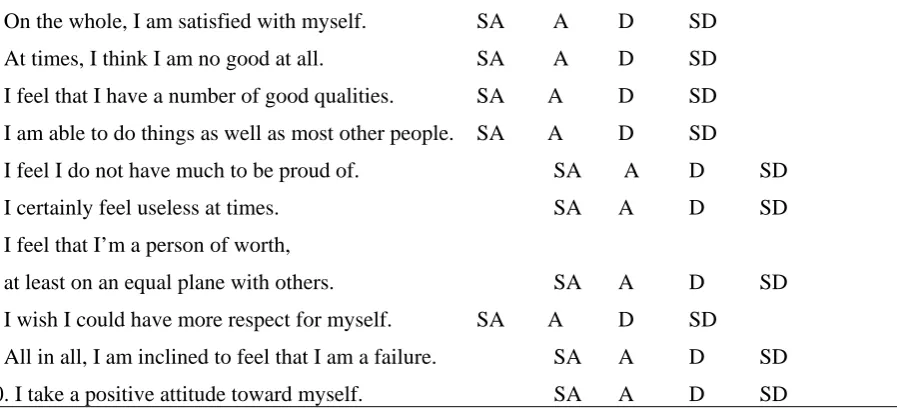
As for the methods, these two tools were utilized. In order to find out about the general self-esteem of the students Rosenberg`s General Self-Esteem Scale (see Figure 1) was used and in order to find out about simple heterostereotypes Cultural Stereotypes Scale (see Figure 2) was used. Rosenberg`s General Self-Esteem Scale is among the most frequently used scales, which is due to its good evidence of reliability and validity and also due to its brevity and easy-to-understand format as Blascovich and Tomaka (1991, In Bagley: 1997) observe. It has also been proved that Rosenberg`s General Self-Esteem Scale has strong cross-cultural validity, too.
Rosenberg’s General Self-Esteem Scale
Instructions: Below is a list of statements dealing with your general feelings about yourself. If you strongly agree, circle SA. If you agree with the statement, circle A. If you disagree, circle D. If you strongly disagree, circle SD.
1. On the whole, I am satisfied with myself. SA A D SD 2. At times, I think I am no good at all. SA A D SD 3. I feel that I have a number of good qualities. SA A D SD 4. I am able to do things as well as most other people. SA A D SD
5. I feel I do not have much to be proud of. SA A D SD 6. I certainly feel useless at times. SA A D SD 7. I feel that I’m a person of worth,
at least on an equal plane with others. SA A D SD 8. I wish I could have more respect for myself. SA A D SD
9. All in all, I am inclined to feel that I am a failure. SA A D SD 10. I take a positive attitude toward myself. SA A D SD
Figure 1 Rosenberg`s General Self-Esteem Scale
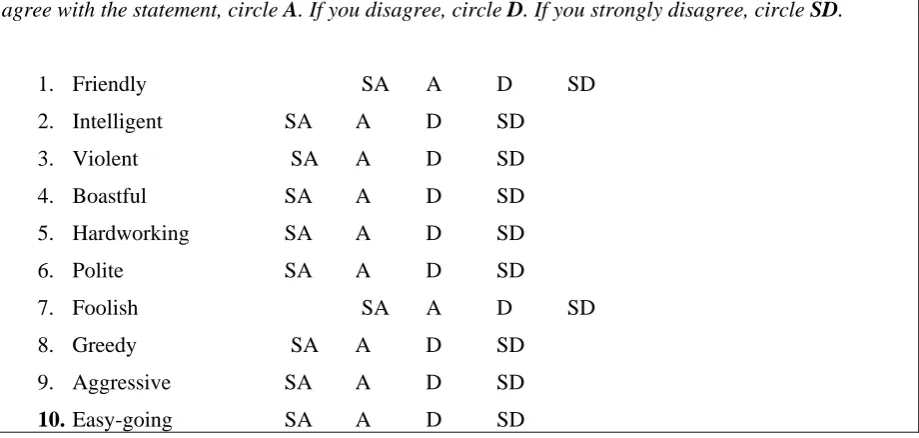
The Cultural Stereotypes Scale is a non-standardized tool. Due to a specific connection of Slovak undergraduate students of English language and literature and simple heterostereotypes that they attribute to the Americans (who are together with the British one of the target groups) a tool had to be invented. It reflects several years of my interest and research into national and cultural stereotypes and it also reflects the philosophy of Rosenberg`s General Self-Esteem Scale, i.e. I created a 10-item scale, consisting of 5 positive and 5 negative statements. The students express their attitude toward the statement in form of circling one of the options: SA (strongly agree), A (agree), D (disagree), SD (strongly disagree). The system of scoring is also identical with the Rosenberg`s General Self-Esteem Scale.
Cultural Stereotypes Scale Questionnaire
Instructions: Below is a list of adjectives describing Americans. If you strongly agree, circle SA. If you agree with the statement, circle A. If you disagree, circle D. If you strongly disagree, circle SD.
1. Friendly SA A D SD
2. Intelligent SA A D SD
3. Violent SA A D SD
4. Boastful SA A D SD
5. Hardworking SA A D SD
6. Polite SA A D SD
7. Foolish SA A D SD 8. Greedy SA A D SD
9. Aggressive SA A D SD
10. Easy-going SA A D SD
Figure 2 Cultural Stereotypes Scale
4.4 Statistical methods
In order to explore the relationship, the correlation between general self-esteem and simple heterostereotypes I used Pearson correlation coefficient. More on the Pearson correlation coefficient in connection to the variables inspected can be found in part 5 Verification of Hypothesis and Outcomes of the Research.
4.5 Organization of the research
The pre-research stage consisted mainly of collecting the most common stereotypical images that are assigned to the Americans by undergraduate students of English language and literature, which were later used in creation of the Cultural Stereotypes Scale. The pre-research stage was carried out by the means of a set of questionnaires, with open questions. The pre-research was carried out as a part of a larger study inspecting correlations between simple heterostereotypes, cultural identity and ethnocentric and ethnorelative perception of cultures. The research itself consisted of distribution of both scales, data collection, data interpretation and statistical processing of the data.
5 VERIFICATION OF HYPOTHESIS AND OUTCOMES OF THE RESEARCH
The data obtained by both scales were processed using the Pearson correlation coefficient “r”, which is the measure of the linear dependence of two variables, in our case the general self-esteem and simple
heterostereotype. As to the interpretation of “r”, it is not always unequivocal. Different interpretation of correlation has to be considered especially in educational and psychological researches, where the tool is influenced by the variables of human factor. Another important aspect of interpretation to be noted, concerns so called outliers, i.e. extreme values that may increase or decrease the correlation significantly. Thus, a careful examination of graphs is needed.
The Graph 1 presented below will serve the inspection of the correlation between our two variables. As it can be observed the x axis carries the values of the values of simple heterostereotype and the y axis carries the values of general self-esteem. The straight line intersecting the spectrum of points illustrates positive linear dependence between the two variables and at the same time it serves as an indicator of extreme values and outliers.
Graph 1 Correlation between simple heterostereotype and general self-esteem
Pearson`s correlation coefficient r = 0,494325. It is a medium dependence and taking into consideration the type of research, an educational research, the correlation between the variables of the Hypothesis can be considered statistically significant and thus, it can be stated that there exists a positive correlation between general self-esteem and representation of simple heterostereotype. In other words, the lower the general self-esteem of a student is, the more frequently negative simple heterostereotypes are attributed to the Americans and vice versa, i.e. higher general self-esteem of a student presupposes tendency toward selection of positive simple heterostereotypes related to the Americans. Hypothesis was verified.
6 DISCUSSION
The findings suggest that students whose general self-esteem is higher tend to select more positive characteristics for describing the Americans; on the other hand, students whose general self-esteem is lower are prone to select more negative characteristics. The examined dependence points to high interdisciplinarity of the field of intercultural communication. Teaching and learning culture is
necessarily bound to respecting and dealing with personality traits of learners and their general communicative competence. Naturally, there are other personality traits that are responsible for the overall performance of a learner in an intercultural encounter that would deserve specific attention and examination, among them, as Bérešová (2011) states empathy, flexibility, curiosity, openness, motivation, tolerance, etc. In the future, it might be interesting to focus the research on comparison of female and male respondents as well as comparison of bachelor`s degree students and master`s degree students.
One more practical issue that, I believe, needs to be opened here is minimization of cultural bias. Considering the teaching-learning process, minimisation of cultural bias is possible through various activities and techniques that may include cultural assimilators, cultural capsules, critical incidents, etc. However, I believe that development of intercultural communicative competence is a complex process, where individual components shall not be isolated and dealt with separately, but always in the context of the development of intercultural knowledge, skills and attitudes that may lead to successful participation in intercultural dialogues. As Bérešová (2011) writes there exist numerous sources and possibilities of enriching the teaching-learning process with the cultural aspect. All it requires is a flexible and innovative teacher.
7 CONCLUSION
The presented paper focused on the inspection of the relationship between the variable of general self-esteem of undergraduate teacher training students whose major is English language and literature and the variable of simple heterostereotype that concentrated on the stereotypes attributed to Americans. Both variables were dealt with from the theoretical perspective first, possible parallels were suggested. The well-known “defining first and observing second” was one of the ways how to approach the concept of stereotyping. Stereotypes were inspected both from the perspective of cultural entities as well as from the perspective of individual psychic process. Finally, the impact of “stereotype threat” was discussed, which raised the issue of self concept.
Consequently, attention was paid to the notion of self-esteem and related concepts such as self-worth, self-concept and self-efficacy. Correlations with various other concepts, e.g. satisfaction with life, well-being, utilisation of leisure time, personality traits, academic performance or orientation toward self-protection were also noted.
Further on, formulation of hypothesis and brief introduction to methodology followed. The research was introduced through the initial phase of pre-research, creation of the Cultural Stereotypes Scale and presentation of Rosenberg`s General Self-Esteem Scale. These two scales were utilized in order to verify the hypothesis. Statistical processing of the data was carried out through applying Person correlation coefficient.
The final parts of the paper are devoted to verification of the hypothesis, presentation of the outcomes and suggestions for discussion. Discussion draws the attention to the field of teaching and learning English language as a foreign language, since the research is related to undergraduate teacher training students.
In conclusion it can be stated that there exists a positive correlation between general self-esteem and simple heterostereotype, more specifically, a positive correlation between low general self-esteem and negative simple heterostereotype.
BIBLIOGRPHY
Agyar, E 2013, 'Life satisfaction, perceived freedom in leisure and self-esteem: The case of physical education and sport students' Procedia - Social and Behavioral Sciences, Vol. 93, pp. 2186 – 2193.
Bagley, C, Bolitho, F & Bertrand, L 1997, 'Norms and Construct Validity of the Rosenberg Self-Esteem Scale in Canadian High School Populations: Implications for Counselling' Canadian Journal of Counselling, Vol. 31:1, pp. 82 – 92.
Bérešová, J 2011, 'Interkultúrna komunikácia – jej nezastupiteľné miesto vo výučbe anglického jazyka a v príprave učiteľov v pregraduálnom a postgraduálnom vzdelávaní' in L Adamcová (ed.), Cudzie jazyky a medzikultúrna komunikácia – 1: Vzťahy, súvislosti a perspektívy. ZF LINGUA Bratislava, pp. 64-88.
Blum, L 2004, 'Stereotypes and Stereotyping: A Moral Analysis' Philosophical Papers, Vol. 33, No. 3, 251 – 289.
Brown, RA 2005, 'Evaluative Ratings of Selected Japanese Emic Trait Descriptors' Information & Communication Studies, Vol. 33, pp. 13 – 26.
Carter, JD et al. 2006, 'Individual Differences in the acceptance of stereotyping' Journal of Research in Personality, Vol. 40, pp. 1103 – 1118.
Chen, et al. 2004, 'General self-efficacy and self-esteem: toward theoretical and empirical distinction between correlated self-evaluations' Journal of Organizational Behavior, Vol. 25, Issue 3, pp. 375 – 395.
Cuddy, AJC 2009, 'Stereotype content model across cultures: Towards universal similarities and some differences' British Journal of Social Psychology, Vol. 48, pp. 1 – 33.
Ehrenberg, A et al. 2008, 'Personality and selfesteem as predictors of young people's technology use' CyberPsychology & Behavior, Vol. 11, pp. 739-741.
Gašić-Pavišić et al. 2006, 'General Self-Esteem and Locus of Control of Young Sportsmen' Zbornik Instituta za pedagoška istraživanja, 38(2), Beograd: Institut za pedagoška istraživanja, pp. 385-400.
Greenwald, AG & Banaji, MR 1995, 'Implicit Social Cognition: Attitudes, Self-Esteem, and Stereotypes' Psychological Review, Vol. 102, No. 1, pp. 4 – 27.
Hill, ME 1998, 'Stereotypes, Prejudices and Prejudice Reduction', A dissertation, Department of Psychology, University of Adelaide.
Hogan, CM 2010, 'The Self-protective Function of the Model Minority Myth for White Americans', A dissertation, Standford University, p. 33.
Katz, D & Braly, K W 1935, 'Racial prejudice and racial stereotypes' Journal of Abnormal Social Psychology, Vol. 30, p. 181.
King, MA 2011, 'Stereotype Threat and Self-Perceptions: The Impact on College Students' Journal of Student Affairs at New York University, Vol. 7.