CHALLENGES AND APPROACHES TO COMPETENCY DEVELOPMENT FOR FUTURE PRODUCTION
Siri Adolph, Michael Tisch, Joachim Metternich
Institute for Production Management, Technology and Machine Tools, Technische Universität Darmstadt
Otto-Berndt-Str. 2, 64287 Darmstadt, Germany
Abstract
Research shows that efficient processes through a mere optimization of machinery and equipment are not sufficient in order to be competitive to other companies. The analysis of so-called megatrends indicates flexibility, changeability and efficiency as differentiating factors in the competition of pro-duction sites. For this purpose in the future employees at all levels of the hierarchy must be capable to act even in case of complex challenges and in unfamiliar situations. This article identifies the chal-lenges of future production and derives necessary competencies for an exemplary field of action. Based on this, innovative learning approaches are identified in order to effectively develop needed capacities in an efficient manner.
Key words: Competency Development, Future Production, Learning Tools, Future Challenges,
Meg-atrend
1. INTRODUCTION
Despite the often predicted change from an industry to a service based economy in Europe, the num-bers paint a different picture. For example, approximately 7.7 million jobs can be found in the imme-diate vicinity of German production. An additional 1.7 million jobs exist in the production environ-ment, for example in logistics and IT (Abele and Reinhart, 2011). In view of the developments in the business environment, which is often propagated by the concept of megatrends, companies need the capacity to act quickly in order to meet the ever changing demands of the market. Since it is no longer sufficient to develop only manufacturing processes, machinery and equipment, companies must in-creasingly invest in the competence of their personnel. Methods and models are necessary which guar-antee a lifelong target based and effective further training in industrial companies. In view of rising labor costs in the European economy, it also seems useful to develop approaches that allow competen-cy development near or directly in the work process.
2. CHALLENGES FOR FUTURE PRODUCTION
Megatrends help to derive production challenges of the future, which affect manufacturing companies. Here, crucial and ongoing developments with high probability in the technological or social area are considered as megatrends (Naisbitt, 1986). These challenges must be met by production through inno-vative production processes, new products or services, and groundbreaking technologies (Grömling, 2009). Although megatrends can be temporarily superimposed by short-term developments, they de-termine the long-term direction of developments in key areas for production (e.g. organization, tech-nology, qualification, working conditions) (Abele and Reinhart, 2011). An overview of identified megatrends in literature, in many cases large-scale studies, is shown in Figure 1.
If companies do not respond to these challenges, a loss of 20-25% of the production dependent jobs is forecasted until 2020 in Germany. Megatrends lead to a rapidly rising uncertainty and complexity in production environments which will change the knowledge, skills, and competencies required. Devel-oped industrial nations have to face this under the constraint of an ageing workforce. To sustain their
competitive advantage the familiar innovation of product and process has to be backed up by innova-tive approaches to develop production related competencies on all staff levels (Abele and Reinhart, 2011). For companies the recruiting and especially the development of competent staff are the most important competitive factors which decide on the success or failure of companies.
Figure 1. Identified megatrends in literature (own representation based on (Abele and Reinhart, 2011; Arndt, 2008a; Graf, 2000; Grömling, 2009; Herrmann, 2010; Jovane et al., 2009; Warnecke, 1999;
Wartenberg and Haß, 2005; Schneiderman, 2006; Krys, 2011)
2.1.Globalization
Globalization is the worldwide integration of business, politics, culture, etc. (Abele and Reinhart, 2011). The main cause of this development is the liberalization of world trade and technological pro-gress, especially in information and communication as well as the transport technology (Arndt, 2008b; Naisbitt, 1986). Through a successful export orientation many European states could profit from the trend of global networks, and in this way secure and build manufacturing jobs (Grömling, 2009). The example of Germany makes it clear that there is a positive impact on national industrial employment when high quality goods are produced by an international production network led by local companies – as long as the core of production competency will be kept in the home country (Kinkel and Wengel, 1998). This can only be achieved with a well-trained and educated workforce. For manufacturing companies in high-wage countries, the following challenges arise (Abele and Reinhart, 2011):
• Productivity needs to be high in international comparison • Well trained and educated employees are needed
• Highest quality of goods produced is a prerequisite
• Flexibility and changeability need to be improved as advantages of the production sites
Id e n ti fi e d M e g a tr e n d s Globalization Shortening of Product Life Cycles New Technologies Scarce Resources Knowledge Society
Demografic Change
Security (var. Areas)
Climate Change / Environmental Degradation
Mobility
Quality of Life market Welfare Orientation Investment and Infrastructure
A bel e, R ei nhar t
(2011) Gröm
ling (2009) G raf ( 2000) A rndt ( 2008) K ry s ( 2011) J ov ane, W e s tk äm per ( 2009) H er rm ann (2010) Industrial Services W a rt enb er g, Ha ß (2005)
Digitalization / Networking / Info.techn.
W a rnec k e ( 1999) Production Product
Increasing Customer Demands
Explicit mention of the megatrends
Implicit mention or used on the edge of a development
2.2.Penetration of New Technologies
The increasing integration between different disciplines leads to increased creation of innovations. Interdisciplinary cooperation is necessary because innovations often arise at the interface of disci-plines. Using the integration of mechanics, electronics and computer science innovative products and production processes could be designed (Abele and Reinhart, 2011). Also the buzzword Industry 4.0 fits into this category. Thus, it is called the fourth industrial revolution, the linking of products and services with one another and with their respective environment through the internet enables functions to work autonomously – without human intervention (Sendler, 2013). Consequently, the role of hu-mans in production systems is predicted to be changed. The following challenges for production can be derived:
• Implementation of key technologies in the production environments
• Determination of necessary competencies and knowledge for an application of those key technol-ogies
2.3.More Dynamic Product Life Cycles
Product life cycles can be divided into the phases development and introduction, growth, maturity and degeneration. These different phases usually require different types of business strategies (Vernon, 1966). An increase in the demand for individual products in combination with technical innovations leads to a shortening of product life cycles, i.e. to a significant reduction of the time between two sub-sequent product generations, which in turn requires rapid adaptability and changeability of enterprises (Lübke, 2007; Abele and Reinhart, 2011). Companies intend to meet new customer needs in mature markets with a rising rate of innovation. Through shorter cycles companies can succeed in generating additional sales merely through the product replacement (Lübke, 2007). However the resulting shorter time in which a good is offered leads to declining sales of individual models (Claassen and Ellßel, 1997). Through this, the following production challenges arise (Abele and Reinhart, 2011):
• The importance of changeability of the production plants growing in importance • Increasing product complexity leads to increasing cognitive demands on staff • Ways must be found to reduce the high start-up costs of new products
• The individualization of products requires an increased flexibility of production plants and per-sonnel
2.4. Limited Resources
Due to the ever-growing world population, rising living standards and the partially careless use of available resources, it will come to a scarcity of resources within the next few years (Abele and Rein-hart, 2011). As early as 1972 with the publication of "Limits to Growth" a heated debate arouse about the way in which economies should grow and the way in which they can grow long term. The study, which was commissioned by the Club of Rome wanted to show that an unchanged economic devel-opment within a few decades would lead to insurmountable problems (Meadows, 1972). Meadow’s results must be viewed from today's perspective critically because until now the progress of mining technology has been able to more than absorb the statistical increase in resource consumption (Fron-del, 2011). However, relying solely on a technological advance of promotion, appears risky. In order not to burden the producing companies longer term with high commodity prices, not only innovations in mining technology, but in particular the manufacturing processes and the manufactured goods are required. Also, a cooperation between production research and materials science is needed here (Abele and Reinhart, 2011). In addition, care should be taken in this regard for economic and environmental reasons for the efficient use of energy and non-energy raw materials in production (Pfeiffer, 2010), which entails the following future challenges for production:
• Need for energy and resource-efficient production • Techniques for alternative materials
2.5.Knowledge Society
For social and economic progress education and knowledge provide key resources. In particular, in countries with a lack of resources knowledge and the resulting innovation factors are critical for pros-perity. Three drivers can be decisively identified for this development (Abele and Reinhart, 2011): • Technologies used in production are continuously improving, resulting in more complex
produc-tion environments
• Product life cycles shorten steadily (see section shortening of product life cycles). In 1980, the average product life cycle was seven years, in 2010, it was three years. This trend accelerates the process of knowledge aging
• Employees are always staying shorter and shorter in their respective departments. In the past 30 years, for example, the average time spent as a production planner has halved to just four years
To adapt to these new circumstances, competencies for production must be developed faster in a varie-ty of areas, also important production related knowledge has to be identified, internalized and trans-ferred. Due to the increasingly complex technologies the building of competency is becoming more difficult and must happen faster. For the future, this will require new ways of training and managing the rapid growth of knowledge (Abele and Reinhart, 2011). Thus following challenges should be ad-dressed:
• Development of learning organizations to maintain competitiveness • New training systems and methods
• Improved integration of science and practice in order to ensure the transfer of knowledge from academia to industry and vice versa
• Improved innovation activity and innovation ability of organizations
2.6.Risk of Instability
Instability refers to the increasing difficulty of companies to predict future relevant developments as a result of the increasing dynamics of economy and the markets. Market slumps, resource shortages, terrorist attacks, embargoes, etc. affect the global production by complicating a long-term and stable planning due to unpredictability. Therefore the capacitive flexibility of production facilities is neces-sary, which is not always compatible with highly automated processes. The following challenges are therefore to be encountered (Abele and Reinhart, 2011):
• Ability to anticipate changes in the business environment
• Robustness, in order to withstand changes in corporate environment without damage
• Ability to quickly adapt to possible, foreseeable changes in business environment (Flexibility) • Ability to quickly adapt as inexpensively as possible to unforeseen changes in the business
envi-ronment (changeability)
2.7.Demographic Change
In many European nations, the age structure of the population will fundamentally change in the com-ing years. This tendency has its roots in a decline in the birth rate combined with increascom-ing life expec-tancy. In Germany in 2030, a decrease of over 15% in the absolute number of potentially-employed workers is expected – by 2050, projections show a decline of up to 30% (Fuchs and Dörfler, 2005). As a result of demographic change, an increasing percentage of older employees will actively operate in production. Skills and competency development must be adapted to this change (Abele and Reinhart, 2011), which implies the following:
• New forms of learning that are adapted to the learning ability of older employees • Changing requirements for knowledge management in the company
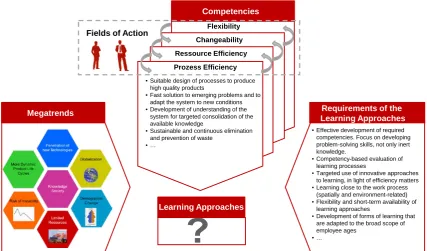
In order to consolidate these challenges derived from the megatrends and thus to make them more manageable, they are classified into areas of action for manufacturing companies.
3. FUTURE CHALLENGES FOR MANUFACTURING COMPANIES
The target values of production have evolved from the classic target of capacity utilization towards the targets of the so-called magic triangle of quality, cost and time (Wildemann, 2004). These targets must also be extended to the general condition of sustainability to respond (with an ecological, economic and social dimension) as well as the ability of the production system to respond to changes in the envi-ronment (flexibility and changeability) (Abele and Reinhart, 2011). It is possible to derive action areas (see figure 2) from the discussed challenges.
This leads to a versatile set of requirements for the employees. To ensure the versatility of the produc-tion system, a fast, low-cost producproduc-tion of error-free goods as well as sustainability and resource ori-entation, we need employees that can be deployed flexibly. This flexibility must, in addition to the temporal flexibility in terms of working hours, relate to the abilities of the staff (Abele et al., 2007). This variety of competencies must be developed among employees who are based on knowledge and qualifications from different areas of activity. Employees must also be empowered to shape work pro-cesses (Bergmann, 1999). In this way, the required efficient and competitive process can be realized (Lenske, 2009).
The competencies necessary depend on the field of actions that is taken into consideration. To increase process efficiency, for example, the socio-technical approach of lean production eliminates waste along the value chain within the company and between companies in order to increase the competi-tiveness (Holweg, 2007; Standridge and Marvel, 2006). The associated methods were developed by Taiichi Ohno at Toyota in the 1950s. The concept of lean production was presented by Womack and Jones in 1990 (Ohno, 1982; Womack et al., 1990). By eliminating waste and reducing cycle time, productivity in manufacturing can be significantly increased, thus leading to a higher flexibility and changeability (Fleischer et al., 2006; Oeltjenbruns, 2000).
4. COMPETENCIES FOR PROCESS EFFICIENCY
Competency can be understood as a complex ability for self-organization, which makes it possible to respond to constantly changing complex environments with new behavioral strategies (Heyse and Erpenbeck, 2009). In complex systems such as production, it is essential that workers can organize themselves in terms of infinitely many options for action, and be able to make decisions independently and creatively (Erpenbeck and Rosenstiel, 2005). Competencies can be built only through creative action when confronted with novel, open and real problem situations (Kuhlmann and Sauter, 2008). Competencies are constructs that are composed of different competency classes (technical and meth-odological, social and communicative, personal as well as activity- and implementation-oriented skills) and their interactions are getting effective during actions (e.g. problem solving). If possible solutions to achieve a goal are not known and the goal is only vaguely visible, it depends on the staff’s competency to find innovative ways individually (Heyse and Erpenbeck, 2009). Interiorized values, norms and rules in the form of emotion and motivation are prerequisites for self-organized problem-solving, as they organize the social self-organization and regulate social interaction (Fuchs, 2002; Heyse and Erpenbeck, 2009; Kuhlmann and Sauter, 2008).
Figure 2. Identified competencies for process efficiency
As a crucial prerequisite for a competitive production system that meets the challenges of the mega-trends, industrial companies must eliminate inefficient processes and adapt quickly to new industry-specific market conditions. The development of employee’s competencies enables quick problem solv-ing and continuous improvement of production processes. To meet the future production challenges, the following skills and competencies can be derived: There is a need for strengthened quality aware-ness. The employees of manufacturing companies therefore need to have the competence to reshape processes so that quality is ensured to produce stable high quality products, even under variable as-pects of processes. In addition, it is to react quickly to solve problems and adapt the system to new conditions, so as to ensure flexibility and changeability. The penetration of new technologies means that the employees of manufacturing companies need the expertise to expand their understanding of the system in order to be able to take advantage of the new opportunities that arise in the course of Industry 4.0. This also implies mastering the increasing availability of data through targeted consolida-tion of existing informaconsolida-tion. Last but not least is the competence for sustainable, continuous elimina-tion and prevenelimina-tion of waste, taking into account the entire value added chain. In order to convey these competencies, appropriate learning approaches are necessary, which must meet certain requirements.
5. INNOVATIVE COMPETENCY DEVELOPMENT METHODS
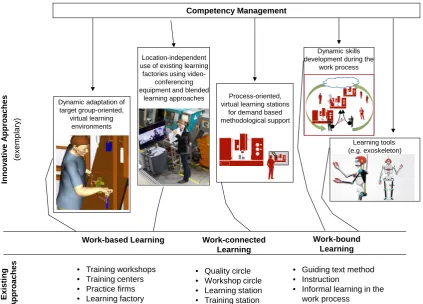
The field of related learning can, according to Dehnbostel, be subdivided into based, work-connected and work-bound learning (Dehnbostel, 2007). This classification describes the use of learn-ing approaches in the range from afar the actual work processes to learnlearn-ing durlearn-ing the work process. In addition to existing approaches, innovative approaches will be presented in the context of this arti-cle that will need to be expanded in the future.
Ideally, in a customer oriented, value-added supply chain, learning processes would informally be carried out during the work process without compromising its efficiency. Learning processes merely represent a preparation for value adding processes, when learning processes can be parallelized with the actual value adding process the value adding share could be increased. But because of the follow-ing two factors work-bound learnfollow-ing is not always the best way:
Prozess Efficiency Ressource Efficiency
Changeability
Megatrends
Competencies
Learning Approaches
Flexibility
Fields of Action
• Suitable design of processes to produce high quality products
• Fast solution to emerging problems and to adapt the system to new conditions • Development of understanding of the
system for targeted consolidation of the available knowledge
• Sustainable and continuous elimination and prevention of waste
• …
Requirements of the Learning Approaches
• Effective development of required competencies. Focus on developing problem-solving skills, not only inert knowledge.
• Competency-based evaluation of learning processes
• Targeted use of innovative approaches to learning, in light of efficiency matters • Learning close to the work process
(spatially and environment-related) • Flexibility and short-term availability of
learning approaches
• Development of forms of learning that are adapted to the broad scope of employee ages
• …
1. Learning during the work process affects the efficiency and the stability of the processes in many cases. It has to be deliberated in what manner the learning processes should be carried out: During the actual value adding process with possible speed and stability losses or in a preceding phase away from the actual value adding process. The additional learning phase could pay for itself with faster, better work in the value adding process.
2. Learning opportunities in the value chain are severely limited as a result of the changeability of the environment, as changes often can’t be implemented easily in running production. The risk of quality, safety and efficiency problems are not acceptable here.
Figure 3. Existing and new skills development approaches (illustration of virtual assembly environ-ment, the process learning factory CiP from (Haghighi, 2013), illustrated exoskeleton from
(Con-stantinescu, 2013))
At this point, so-called learning tools can provide a remedy. The use of learning tools, which accord-ing to Seliger (Seliger, 2013) are self-explanatory and easy to use tools through which people can ac-quire or improve technical skills, falls into the category of work-bound learning. These learning tools are used during the work process to enable employees on the one hand, to cope with hindering situa-tions, and on the other hand, to make the current process more efficient. The exoskeleton shown in Figure 3, for example, is used to support people so that they may lift heavier loads (Ciupek, 2011). In the work process, it can therefore be used to support the process where loads can be lifted with less force by the worker and therefore they will tire less quickly and thus can lift loads over a longer period of time. On the other hand, the employee learns through force-feedback of the exoskeleton, which position is the best ergonomically and learns to adjust his posture accordingly.
Work-connected Learning
Work-bound Learning Work-based Learning
• Guiding text method • Instruction
• Informal learning in the work process
• Quality circle • Workshop circle • Learning station • Training station • Training workshops
• Training centers • Practice firms • Learning factory
E
x
is
tin
g
A
ppr
oa
c
he
s
Innov
a
ti
v
e
A
ppr
oa
c
he
s
Dynamic skills development during the
work process
Learning tools (e.g. exoskeleton) Dynamic adaptation of
target group-oriented, virtual learning
environments
Process-oriented, virtual learning stations
for demand based methodological support Location-independent
use of existing learning factories using
video-conferencing equipment and blended
learning approaches
(ex
em
pl
ar
y
)
Competency Management
Another source of work-bound learning, which should be used in the future for competency develop-ment of production-related employees, is to solve emerging problems during the work process and to overcome obstacles on the way to the next process target state. If it is possible to put the right people on the right problems, there are good options for the dynamic improvement of employee’s competency portfolios. The bound learning needs to be more meshed with the connected and work-based learning. For example, learning stations close to the working place can help in the work-bound learning process with demand based, and target group oriented methodological support for emerging obstacles via virtual learning environments (work-connected learning).
The virtual environment is intended to be used for the targeted competency development, however, not necessarily the specific work process problem (triggering the work-connected learning process) but a similar problem developing situation suiting competencies has to be solved virtually.
In the field of work-based learning, external training providers or special training departments in large industrial companies can give new impulses and ideas through training courses. To address the lack of implementation and transfer of work-based learning, technology adequate learning environments have been created in recent years in the domain of production management, in which self-learning processes can be initiated and moderated. This approach has been realized structurally, technically, didactically and methodologically by several higher education institutions and major corporations of the industry in the form of learning factories (Tisch et al., 2013). Learning factories have become established as a promising approach for knowledge transfer and competency development in education for students and training for target groups in the industry.
A complete decoupling of dependencies on the location of the learning environment is possible through innovative approaches to work-based learning. For example, the use of videoconference sys-tems in learning factories enables the transfer of image and sound aspects of activities in authentic learning environments. This will allow location-independent access to the learning factory training center. Via the video conference system, the exercises can be carried out interactively, where employ-ees do not even have to leave their working environment, to gain experience in learning factories and test various problem solving approaches. Since the journey to the training center is saved, learning processes can be flexibly interlinked with the value-adding activities of employees.
The comprehensive element is the strategic competency management that identifies competency gaps that serve achieving strategic business objectives and addresses these gaps through appropriate staff development activities by deciding in what way each competency is developed (workbased, -connected, or -bound).
6. SUMMARY
Future developments in the market of manufacturing companies will expose them with to challenges. Since it is no longer sufficient to optimize only manufacturing processes and machinery or equipment, there is a need to empower employees to meet the challenges of the future. In this article megatrends were analyzed and challenges and areas of action were derived. These areas require different compe-tencies among employees of manufacturing companies in accordance with the hierarchy levels. For the example of the process efficiency, necessary competencies of professionals in the production were identified and appropriate learning approaches for adequate placement were discussed and classified. It has been shown that the competency development both during and outside the work process is pos-sible. Among the newer forms of work-based learning is the location independent use of existing learning factories equipped with videoconferencing equipment or the use of virtual learning environ-ments. Learning in close connection with the work process is permitted by work-oriented, virtual learning stations. The actual value adding process can be made more efficient through the proper use of learning tools, so that the employee no longer has to leave his working environment in order to ac-quire new skills and competencies. A strategic competency management finally flanks all approaches and makes recommendations which competencies should be developed by which employee, when, and how. In future research a comprehensive approach will be necessary to empower employees in manu-facturing companies to make the value chain more efficient, reconfigurable, and flexible. In order to
encounter the necessity for faster learning cycles, learning processes within or nearby the value adding process have to be developed and considered under socio-technical aspects. Further investigation and development of these innovative approaches to learning is necessary in order to tackle today’s and tomorrow’s challenges of producing companies appropriately.
References
Abele, E., Eichhorn, N. and Brungs, F. (2007), “Qualification in a real production environment”. Phil Transl., ZWF, Carl Hanser, Munich, Vol. 102 No. 2, pp. 741–745.
Abele, E. and Reinhart, G. (2011), Future of production. Phil Transl., HANSER, Munich.
Arndt, H. (2008a), Effects of Megatrends on Logistics. Phil. Transl., Gabler.
Arndt, H. (2008b), Supply Chain Management, Gabler, Wiesbaden.
Bergmann, B. (1999), Training for the work process. Phil. Transl. vdf, Zürich.
Ciupek, M. (2011), “Now cyborgs are everydayproof“. Phil. Transl., VDI-Nachrichten, 2011, p. 8.
Claassen, U. and Ellßel, R. (1997), “Product-business-plans as operative implementation of target costing and target investment“. Phil. Transl., Kostenmanagement, pp. 127–140.
Constantinescu, C. (2013), “Combining advantages of human and machine”. Phil. Transl., available at: http://m.iao.fraunhofer.de/lang-de/component/content/article.html?id=1064 (accessed 10 July 2014).
Dehnbostel, P. (2007), Learning in the work process. Phil. Transl., Studienreihe Bildung und Wissen-schaftsmanagement, Vol. 7, Waxmann, Münster.
Erpenbeck, J. and Rosenstiel, L. (2005), “Competency: Trendy buzz-word or innovative concept?” Phil. Transl., Wirtschaftspsychologie aktuell No. 3, pp. 39–42.
Fleischer, J., Ender, T. and Wienholdt, H. (2006), “A simulation-based optimization concept for pro-duction systems.“ Phil. Transl., ZWF, Carl Hanser, Munich, 2006, pp. 480–485.
Frondel, M. (2011), “Resource Competition.” Phil. Transl., pp. 61–75.
Fuchs, C. (2002), Crisis and criticism in the information society. Phil. Transl., Libri Books on De-mand, Norderstedt.
Fuchs, J. and Dörfler, K. (2005), “Projection of the Laborsupply until 2050. Phil. Transl., IAB-Kurzbericht No. 11, pp. 1–5.
Graf, H.G. (2000), Global Scenarios. Phil. Transl.: Transl. Globale Szenarien, NZZ-Verlag, Zürich.
Grömling, M. (2009), Global megatrends and prospects of German industry.” Phil. Transl., DIV, Co-logne.
Haghighi, A. (2013), “Application of digital environments for learning factories: digital learning facto-ries, review and discussion”, Master Thesis, School of Industrial Engineering and Management, De-partment of Production Engineering, KTH Stockholm, Stockholm, 12/2013.
Herrmann, C. (2010), Comprehensive Life Cycle Management. Phil. Transl., Springer, Berlin.
Heyse, V. and Erpenbeck, J. (2009), Competency Training. Phil. Transl.: Transl. Kompetenztraining, Schäffer-Poeschel, Stuttgart.
Holweg, M. (2007), “The genealogy of lean production”, Journal of Operations Management, 2007, pp. 420–437.
Jovane, F., Westkämper, E. and Williams, D. (2009), The ManuFuture Road: Towards Competitive and Sustainable High-Adding-Value Manufacturing, Springer-Verlag, Berlin, Heidelberg.
Kinkel, S. and Wengel, J. (1998), “Production between globalization and regional networks.” Phil. Transl., Von den Nachbarn lernen Wirtschafts- und Beschäftigungspolitik in Europa, pp. 63–75.
Krys, C. (2011), “Outlook: Megatrends and its Effects on Business Models.” Phil. Transl., in Bieger, T. (Ed.), Innovative Geschäftsmodelle, Springer, Berlin.
Kuhlmann, A.M. and Sauter, W. (2008), Innovative learning systems. Phil. Transl., Springer, Berlin.
Lenske, W. (2009), “Scope, costs, trends in vocational training.” Phil. Transl., Institut der Deutschen Wirtschaft, Köln: IW-Trends Vierteljahresschrift zur empirischen Wirtschaftsforschung aus dem Insti-tut der Deutschen Wirtschaft Köln, Vol. 36 No. 1, pp. 51–66.
Lübke, E. (2007), Life-cycle-oriented product structure management. Phil. Transl., TCW, Munich.
Meadows, D.H. (1972), The limits to growth: A report for the Club of Rome, Universe Books, New York.
Naisbitt, J. (1986), Megatrends, Bayreuth, Hestia.
Oeltjenbruns, H. (2000), Production organization with the toyota blueprint. Phil. Transl., Shaker Ver-lag.
Ohno, T. (1982), “How the Toyota production system was created”, Japanese Economic Studies, 1982, pp. 83–101.
Pfeiffer, J. (2010), Two-Way-Strategy for Europes Energysafety. Phil. Transl., Springer, Berlin, Hei-delberg, pp. 131-141
Schneiderman, R. (2006), “MEGATRENDS: The Global Factor. Wireless dominates, but what other technologies and issues will have the greatest impact on our industry over the next few years?”, ELECTRONIC DESIGN, 29 June, pp. 21–27, available at: WWW.ELECTRONICDESIGN.COM.
Seliger, G. (2013), Help youself for biker. Phil. Transl., International Workshop at the PTZ, 3/2013, Berlin.
Sendler, U. (Ed.) (2013), The 4th Industrial Revolution: Transl., Springer, Berlin, Heidelberg.
Standridge, C.R. and Marvel, J.H. (2006), “Why lean needs simulation”, Proceedings of the 2006 Winter Simulation, 2006, pp. 1907–1913.
Tisch, M., Hertle, C., Cachay, J., Abele, E., Metternich, J. and Tenberg, R. (2013), “A systematic ap-proach on developing action-oriented, competency-based Learning Factories”, Procedia CIRP Vol. 7, pp. 580–585.
Vernon, R. (1966), “International investment and international trade in the product cycle”, The quar-terly journal of economics / ed. Edward H. Chamberlin, Vol. 80 No. 2, pp. 190–207.
Warnecke, H.-J. (1999), Project Future. Megatrends in Research and Technology. Phil. Transl.: Transl. Projekt Zukunft. Die Megatrends in Wissenschaft und Technik, vgs, Cologne.
Wartenberg, L.-G.v. and Haß, H.-J.H. (2005), Investing in the Future. Phil. Transl., WILEY-VCH, Weinheim.
Wildemann, H. (2004), “Organization of Production.“ Phil. Transl., in Schreyögg, G. and Werder, A.v. (Eds.), Handwörterbuch Unternehmensführung und Organisation, 4. Auflage, Schäffer-Poschel.
Womack, J.P., Jones, D.T. and Roos, D. (1990), The Machine that Changed the World, Free Press, Simon & Schuster, New York.