Published online June 10, 2013 (http://www.sciencepublishinggroup.com/j/ajmp) doi: 10.11648/j.ajmp.20130204.12
The role of pion cloud in the structure function and the
EMC effect of
27
Al,
56
Fe,
63
Cu and,
107
Ag nuclei
Sara Hatampanah, Negin SattaryNikkhoo, Farhad Zolfagharpour
Department of Physics, University of MohagheghArdabili, Ardabil, IranEmail address:
[email protected](S. Hatampanah), [email protected](N. SattaryNikkhoo), [email protected](F. Zolfagharpour)
To cite this article:
Sara. Hatampanah, Negin. SattaryNikkhoo, Farhad. Zolfagharpour. The Role of Pion Cloud in the Structure Function and the EMC Effect of 27Al, 56Fe, 63Cu and, 107Ag nuclei. American Journal of Modern Physics. Vol. 2, No. 4, 2013, pp. 190-194.
doi: 10.11648/j.ajmp.20130204.12
Abstract:
In this paper we have studied role of pionic contribution in the structure function and the EMC effect for27Al,56
Fe, 63Cu and, 107Ag nuclei. For extracting nuclear structure function, first we calculated contribution of the Fermi motion, and the binding energy effects and, then, we added pionic contribution to them. Also, we used the free GRV nucleon structure functions in the conventional nuclear theory. Extracted results show that using the pionic contribution in these nuclei structure function and the EMC effect give good agreement with experimental data.
Keywords:
Pionic Contribution, Structure Function, the EMC Effect1. Introduction
Deep inelastic lepton-nucleus scattering has shown that bound nucleons structure functions are different from free nucleons structure functions [1-5]. This phenomenon has been known as the EMC (European Muon Collaboration) effect [5]. This effect declared that the distribution function of quarks in the bound nucleons inside nuclei is different from free nucleons. The binding energy and the Fermi mo-tion of nucleon inside nuclei have important role in the EMC effect in medium and large x ranges. Considering these effects could not explain bound nucleons structure functions and the EMC effect in all ranges. There are other effects such as pion cloud, shadowing, quark ex-change, ∆ particle, and so on, which should be considered to explain nucleons structure functions and the EMC effect. Because quark distribution functions inside nuclei are af-fected by nuclear environment, bound nucleons structure are different from free nucleons structure. As a result, con-sidering these nuclear effects could improve the extracted results. Nucleons inside nuclei are surrounded by pion cloud, so for achieving precise bound nucleons structure functions and the EMC effect, it seems that considering pionic contribution could improve theoretical results. Therefore, the probability of an incident virtual photon in-teracts with a nucleon is decreasing and this virtual photon is interacting with Pion cloud around nucleon inside nuclei.
This interaction mainly occurs in range 0.3 [6-7]. In this paper, we have attempted to study of the pionic contri-bution in nuclei structure functions that consist of nucleons and mesons.
2. Nucleon Structure Function
The structure functions for charged lepton scattering from a nucleon are related to cross section by:
Ω ′ 4
′
(1)
, !2 # ,
$ %&' ( ) *+ *4 ,sin , 1 * ,.
Where 342 ~6786 is the fine structure constant, four--momentum transfer squared is . Initial and scattered lepton energies are and ,, respectively. Energy of the virtual photon is 1 * ,, and 9:;is Bjorken scal-ing variable. $ is the nucleon rest mass. <is the detected lepton scattering angle. #and are the deep inelastic structure functions.
= ∑ ∑ ? @ A BCD E F BC
DGB,H ID @ BC D FJ , (2)
The first sum is over proton and neutron cases, and the second sum is over the quantum number of states. ABCDis the occupation number of energy level KBC for proton (L M) and neutron (L '), consideration of KBC for studied nuclei have been taken from [12]. Nucleon distribution function inside nucleus defines as:
ID @ BC ?E N N OD|QBC N | / 2S
|TUJV# VWXY| (3)
Where@ HTXYZ
U; is for free nucleon. Effects of momentum
and energy distribution of nucleon in the nucleus are in-cluded in equation 3 through QBC N and KBC, respectively. Magnitude nuclear binding energy (KBC) mainly affects structure functions in the intermediate region. Function
ID @ BC describes momentum and energy distribution of
nucleons inside nuclei, also satisfies the normalization rule:
∑DGB,H∑ ? @ ABC \E BCDID @ BC [. (4)
If all contributions such as gluons and sea quarks are considered then the nucleon structure function satisfies sum rule:
?# D 1
\ . (5)
Radius of each shell could be expressed by below for-mula:
^_ `BC a# 2' ! b ! 3/2 , (6)
Where α TXed, and in the natural unite we have:
ω
e ^f `.gh 2n ! l ! 3/2 . (7)
^_ `6andej express according to k_Ol and $km unit, respectively. The calculated data for ^_ `6 and ej for nuclei shell have been taken from [11, 12].
According to [8] nucleon distribution function inside nuclei is considered by below formula:
ID @ BC 1
2 OejD 6
'!
o ' ! b !p
(8)
q q *1% r6sr
#! % ! t
' ! b !# ' * %# u B
r G\ B
r6G\
t' ! b !
#
' * % u
o vb ! %#! % ! b,TedU @ * 1 *TWXYU w.
The free proton and neutron structure function, D xy , have been used from M. Gluck et al, [10] ,i. e. the free GRV nucleon structure function, and we ignored the contribution of strange quark. Therefore; the nuclear structure function is expressed by [8]:
?\= = ?E
\ = [^@`, (9)
^@` #=? @ \= @I= @ 1 !^Wz`
TU. (10)
The ^K{` is the mean one nucleon separation energy which have been taken from [12].
The nuclear binding energy causes a violation of sum rule. This violation is proportional to the factor ^@`. In our cal-culation, we have ^z`=C 0.9760 , ^z`ۥ 0.9747 ,
^z`‚ƒ 0.9685, and ^z`=† 0.9667. It seems most likely that sum rule can be restored by consideration of pions ap-pearing in nuclei as result of the nucleon-nucleon interac-tions. Although, their contributions may become noticeable only at small 0.3. They must play a role in sum rule for the nuclear structure functions. In this case, the nucleons carry only a fraction ^z` ‡ 1 of the nucleus momentum. Therefore, we can recover the momentum sum rule [7, 13] like as:
^@`D! ˆ‰ 1, (11) Where ^@`D could get from equation 10 and ˆ‰ is the momentum fraction which is being carried by pions:
ˆ‰ ?\:4⁄T @ @ I‰= @ . (12)
We ignored contribution of virtual particles like as ∆ particle and heavy mesons, so we suppose that nuclei consist of nucleons and pions. In the next section, we are going to investigate pions effects in nuclei structure function.
3. The PionicContribution and the
EMC Effect
The pionic contribution is assumed to be given by [6]:
δ D , [ ? @ I
‰ @ ‰
:Œ⁄T
F ⁄ ,@ (13)
I‰= @ 16S ∆•@ 3A
(14)
Ž#{exp Ž*2•%\O! O‰
‰ ’ !
# l *2•%\! O‰
O‰ ’
where
l *@ * ? % JE •“”r . (15)
whichA 13.5 is the coupling constant, ‰ is the pion structure function, and ‰ is the pion structure function. Pion mass is taken O‰ 139.570 $k•. We have taken λ 0.026for –[b, —˜ k, ˜p™š, #\–[A, and › nuclei. From equation 11,ˆ‰ 0.0239, ˆ‰ 0.0253,
ˆ‰ 0.0315, ˆ‰ 0.0332, and ˆ‰ 0.0130, [6], are considered for –[b, —˜ k, ˜p™š, #\–[A, and › nuclei, respectively. Also, ∆•=C 0.0057 , ∆•€• 0.00707,
∆•‚ƒ 0.752,∆•=† 0.0794, and∆•œ 0.0031 are
considered for –[b, —˜ k, ˜p™š, #\–[A, and ›, re-spectively.
parameteri-zation [7, 13]:
‰ •
ž m‰ !37 ‰ (16)
m‰ Ÿ a Ÿ s#Ÿ as s# a 1 * (17)
¡‰ 6¢[ N ! 1 1 * H (18)
0.36 * 0.074¡£ ¤ 0.99 ! 0.60¡£ (19)
¡£ b' CB 9 ¥CB 9 ⁄ ¦⁄¥ (20)
\ 25 §km V# , ¨ 0.2 §km V#, N 8.7 [ 0.51 * 2 ⁄ ! ¤ ! 1 . (21)
The structure function in these nuclei with respecting pion cloud effect is:
(
)
( )
(
)
( )
(
)
2 2 2 2 2 2 , , , , A x z x N x N z x F x Q f z F Q dz f z F Q dz z x π π ∞ ∞ = + ≥∫
∫
(22)First term indicates pionic contribution and the next term indicates nucleon contribution in the nucleus. The EMC effect in these nuclei with respect the pionic contribution effect is: ©ª:‚= €ŒF € «F = . (23)
Which = have been calculated from 22 for –[b,
k
—˜ ,˜p™š,#\–[A, and › nuclei.
4. Results and Discussion
Figure 1 shows pionic contribution for –[b, —˜ k,˜p™š,
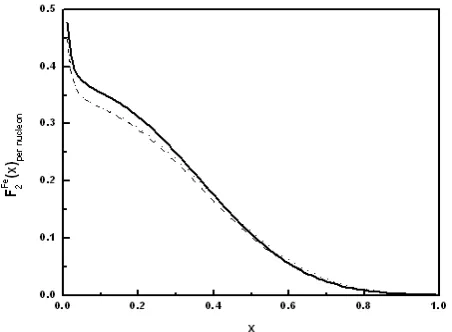
and #\–[A nuclei structure functions. Nuclei structure functions with considering the Fermi motion, binding energy, and pionic contribution have been plotted in figure 2, 3, 4, 5 for mentioned nuclei, respectively. One could release from extracted data in these figures that in 0.3 pionic con-tribution is changing results up to %8.5. For example, based on our calculation in 0.1 pionic contribution in nucleus structure function is %6.2, %7.7, %0.8, and %8.5 for –[b,
k
—˜ ,˜p™š, and #\–[A nuclei, respectively. Considering
pion cloud in nuclei structure functions improve the EMC ratios for –[b, —˜ k, ˜p™š, and #\–[A nuclei, which are plotted in figures 6, 7, 8, 9, not only in 0.3 region, but also in intermediate region. This improvement causes to have better agreement with experimental results. For re-maining difference, considering other nuclear effects such as quark exchange contribution [16], ∆ particle [17], sha-dowing [18], and so on, maybe could improve the extracted results.
Figure 1. The pionic contribution in the structure function for –[b, —˜ k,
™š
˜p , #\–[A, and › nuclei.
Figure 2. –[bstructure function. The full curve is plotted with
consider-ing, the Fermi motion, the binding energy, and the pionic contribution effect, the dash line is plotted with considering the Fermi motion, and the binding energy, the dotted curve with considering the Fermi motion.
Figure 3. —˜ kstructure function. The full curve is plotted with
Figure 4. ˜p™šstructure function. The full curve is plotted with consider-ing, the Fermi motion, the binding energy, and the pionic contribution effect, the dash line is plotted with considering the Fermi motion, and the binding energy, the dotted curve with considering the Fermi motion.
Figure 5. #\–[Astructure function. The full curve is plotted with
consi-dering, the Fermi motion, the binding energy, and the pionic contribution effect, the dash line is plotted with considering the Fermi motion, and the binding energy, the dotted curve with considering the Fermi motion.
Figure 6. The structure functions ratio for–[b nucleus. The full curve is plotted with considering, the Fermi motion, the binding energy, and the pionic contribution effect, the dash line is plotted with considering the Fermi motion, and the binding energy, the dotted curve with considering the Fermi motion. Experimental data are taken from [14].
Figure 7. The structure functions ratio 23 for —˜ k nucleus. The full
curve is plotted with considering, the Fermi motion, the binding energy, and the pionic contribution effect, the dash line is plotted with considering the Fermi motion, and the binding energy, the dotted curve with consider-ing the Fermi motion. Experimental data are taken from [14].
Figure 8. The structure functions ratio for ˜p™š nucleus. The full curve is
plotted with considering, the Fermi motion, the binding energy, and the pionic contribution effect, the dash line is plotted with considering the Fermi motion, and the binding energy, the dotted curve with considering the Fermi motion. Experimental data are taken from [15].
References
[1] J. J. Aubert, G. Bassompierr, K.H. Becks, C. Best, E. Böhm, X. de Bouard, F.W. Brasse, et al., “The ratio of the nucleon structure sunctionsF2N for Iron and Deuterium” Phys.Lett. B.,
Vol. 123, No. 3-4, pp. 275-277, 1983.
[2] J. Ashman, B. Badelek, G. Baum, J. Beaufays, C. P. Bee, C. Benchouk, et al., “Measurement of the ratios of deep inelastic muon-nucleus cross sections on various nucleicompared to Deuterium,” Phys. Lett. B., Vol. 202, 4, pp. 603-610, 1988.
[3] P. Amaudruz, M. Arneodo, A. Arvidson, B. Badelek and G. Baum, et al., “Precision measurement of the structure func-tion ratios F2He/F2D, F2C/F2D and F2Ca/F2D,”Z. Phys. C., Vol.
51, 3, pp. 387-393, 1991.
[4] The European Muon Collaboration, M. Arneodo, A. Arvid-son, J.J. Aubert, B. Badelek, J. Beaufays, C.P. Bee, C. Ben-chouk, et al., “Measurements of the nucleon structure func-tion in the range 0.002 < x < 0.17 and 00.2 < Q2< 8 GeV2 in deuterium, carbon and calcium”Nucl. Phys. B., Vol. 333, pp. 1-47, 1990.
[5] BCDMS Collaboration, A.C. Benvenuti, D. Bollini, G. Bruni, F.L. Navarria, A. Argento, J. Cvach, et al., “Nuclear effects in deep inelastic muon scattering on deuterium and iron targets” Phys. Lett. B., Vol.189,pp. 483-487, 1987.
[6] T.Uchiyama, K.Saito, “European Muon Collaboration effect in deuteron and in three-body nuclei”Physical Review .C. Vol. 38, No.5, pp. 2245-2250, 1988.
[7] E.L. Berger, F.Coester, “Nuclear effects in deep-inelastic lepton scattering” Phys, Rev, D.,Vol. 38, No. 5,pp.1071-1083,
1985.
[8] S. V. Akulinichev, S. Shlomo, S. A. Kulagin, and G. M. Vagradov, “Lepton-nucleus deep-inelastic scattering”Phys. Rev. Lett., Vol.55, No. 21, pp. 2239-2241,1985.
[9] F. Zolfagharpour, http://arxiv.org/abs/0802.1623v2.
[10] M. Gluck, E. Reya and A. Vogt, “Dynamical Parton Distri-butions of Parton and Small-x Physics” Z. Phys. C., Vol. 67, pp. 433-447, 1995.
[11] R. C. Barratt and D.F. Jackson, “Nuclear sizes and structure,” Oxford University Press,1977.
[12] N. SattaryNikkhoo, F.Zolfagharpour, “Study of the EMC effect for 27Al, 56Fe, 63Cu, and 107Ag nuclei” J. Mod. Phys., Vol. 3, pp. 1830-1834, 2012.
[13] K. Nakano, “Remarks on pionic constraints in the EMC effect”Phys. lett. G., Vol. 201, pp. L 201-L 207, 1991.
[14] http://durpdg.dur.ac.uk/
[15] B. L. Birbrair, M. G. Ryskin, and V. I. Ryazanov, “Contribu-tion of boundness and mo“Contribu-tion of nucleus to the EMC ef-fect”Eur. Phys. J. A.,Vol. 25, No. 9, pp.275-282, 2005.
[16] P. Hoodbhoy and R. L. Jaffe, “Quark Exchange in Nuclei and The European Muon Collaboration Effect” Phys. Rev. D., Vol. 35, No. 1, pp. 113-121, 1987.
[17] G. Cattapan and L. Ferreira “The role of the ∆ in nuclear physics” Phys Rep., Vol. 362, pp. 303-407, 2002.