ABSTRACT
This paper examines the factors that influence e-commerce adoption levels among SMEs in Malaysia. Based on Technological-Organisational-External (TOE) framework, it is found that external support is significant across all e-commerce adoption levels. This finding suggests that future policy to encourage e-commerce uptake in Malaysia should focus on providing support to facilitate e-commerce adoption effort. The findings also show that owners or CEOs of SMEs who are experienced, have completed tertiary education and used computer frequently, are more likely to adopt e-commerce. Hence, to further promote e-commerce adoption among SMEs, owners or CEOs of SMEs who are less experienced, high-school leavers, and who used computer less frequently, ought to be targeted in future e-commerce initiatives. Relatively, based on TOE framework, CEO attributes are more significant in terms of e-commerce adoption among SMEs in Malaysia.
Keywords:E-Commerce adoption; SME; multinomial logit model.
1. INTRODUCTION
For the past two decades, it has been argued that information revolution is having a significant impact upon all aspects of firms (Porter and Miller, 1985). Due to the rapid advancement of information and communication technology (ICT), technology adoption is regarded as one of the key determinants for firms’ survival irrespectively of their size. For instance, Ramayah et al. (2009) suggests that SMEs (Small and Medium Enterprises), although with limited resources, should not ignore the importance of ICT and to adopt new technologies in their business activities
ESTIMATING THE DETERMINANTS OF B2B
E-COMMERCE ADOPTION
AMONG SMALL & MEDIUM ENTERPRISES
Thi Lip-Sam
Universiti Utara Malaysia
Lim Hock-Eam♣
Universiti Utara Malaysia
There is a growing amount of studies focusing on technology adoption. One of the major criticisms of technology adoption research is that adoption is mainly viewed as a dichotomous outcome (either the innovation is adopted or not adopted). The adoption versus non-adoption approach does not fully address the issue of technology adoption (Hovav et al., 2004; Daniel et al., 2002)). Besides, only limited studies have explored the adoption or uptake of e-commerce among Small & Medium Sized Enterprises (SMEs). These studies mainly view adoption in terms of dichotomous outcome such as using or not using e-commerce applications (e.g. Teo and Ranganathan, 2004; Waarts et al., 2002). Others studies examined e-commerce adoption using stage approach that depicts e-commerce adoption from non-adoption to full implementation or integration of e-commerce with the rest of firm’s enterprise systems (e.g. McKay et al., 2000; Parish et al., 2002; Rao et al., 2003; Teo and Pian, 2004)
This paper examined the adoption of B2B e-commerce among SMEs in the Malaysian manufacturing sector. It empirically examined the determinants of adoption using the multinomial logit model with multiple outcomes on the adoption levels. The factors that influence the SMEs’ choice on the level of adoption are analysed using probability choice model, i.e., multinomial logit model. The findings from this study aimed to contribute knowledge on the uptake of B2B e-commerce specifically for SMEs from the manufacturing sector in Malaysia.
2. LITERATURE REVIEW
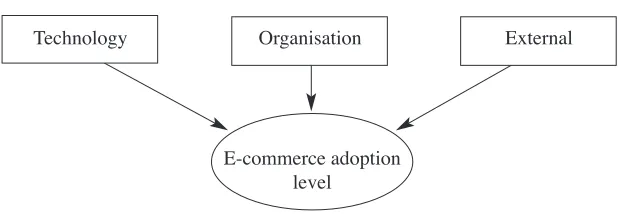
Studies have attempted to identify the contexts that impact innovation adoption and implementation. Tornatzky and Fleischer (1990) have conceptualised the contexts of innovation adoption decision as consisting of organisational, external and technological contexts. This framework suggests that at organization level, the e-commerce adoption are influenced by three key constructs namely technology, organisation and external as depicted in Figure 1 below.
Figure 1:A TOE framework for e-commerce adoption
E-commerce adoption level
Technologies are perceived to possess attributes that have effect on the decision to adopt and how they will be implemented. Rogers (1995) highlights five innovation attributes namely; relative advantage, compatibility, complexity, trialability and observability that have systematic effects on innovation adoption and diffusion. Another category of variables related to technological adoption is the concern for network security issues (Jones and Beatty, 1998; Doherty and Fulford, 2006), initial start-up costs (Wirtz and Wong, 2001), costs of purchasing
External Organisation
e-commerce related software, hardware and costs of system integration (Jones and Beatty, 1998). Apart from affordability and security concerns, the quality of IT infrastructure such as reliability of network and bandwidth, are also major issues influencing a firm’s initiatives to adopt e-commerce (Teo et al., 1997; Tan and Teo, 1998)
Previous literature on organisational factors mainly examined organisational readiness, top management support, firm size and strategy. The organisational readiness refers to the level of financial and technological readiness. In the case of SMEs which tend to lack these resources in the adoption of innovation. The importance of top management support for IS and e-commerce adoption is well documented (Chatterjee et al., 2002; Cragg. and King, 1993; Premkumar and Roberts, 1999; Teo et al., 1997; Thong, 2001; Waarts et al., 2002; Yap et al., 1992).
Similarly, firms do not exist in vacuum but operate in an environment that provides opportunities and imposes constrain (Fichman, 2000). The impact of external support conducive to IS adoption and success has been studied by Burgess and Cooper (1998), DeLone (1988), Thong et al., (1996), Thong (2001), and Thong et al., (1994). Generally, these researchers tried to uncover the impact of external expertise such as consultants and vendors on IS adoption and implementation. SMEs typically lack specialised knowledge and technical expertise (DeLone, 1988). Lack of technical knowledge is frequently cited as an inhibitor to innovation adoption and diffusion (Fichman and Kemerer, 1997; Stansfield and Grant, 2003). It is expected that the greater extend of external support; the more likely SMEs will adopt EC.
In the era of increase competition, firms are sometimes co-opted and influenced by actions or pressures initiated by competitors or trading partners such as customers and suppliers (Teo et al., 2003). This results in a greater intention by firms to adopt innovation that is being adopted by competitors (Teo et al., 1997; Premkumar and Roberts, 1999); Raymond, 2001; Chwelos et al., 2001; Waarts et al., 2002; Teo et al., 2003). Similarly, to avoid being labeled as less responsive, not innovative and also conforming to industry norm, firms may also adopt new innovations that are widely adopted by other firms in similar industry. Furthermore, coercive pressure may be applied by firms that dominate certain resources.
Previous studies have also found significant relationship between individual characteristics and technology adoption. For instance, Ndubisi (2008) found differences existed between gender in terms of usage frequency, usage determinants and other individual traits. Male respondents are found to be more flexible in terms of ICT adoption. Nevertheless, in terms of overall ICT usage, there is no gender difference between genders. The factors that drive technology adoption include system’s usefulness, ease of use (Ndubisi, 2008); ethnic group, education level, experience of computer usage, and personal traits of users (Ndubisi & Kahraman, 2005).
e-commerce implementation. Organisational factors namely SMEs readiness and IT strategy are also relevant to e-commerce adoption and implementation. Similarly competition and external support are perceived to have an impact on the uptake of e-commerce.
3. DATA AND METHODOLOGY 3.1 Data
The sample consists of 187 SMEs involved in manufacturing activities. This sample is obtained from Federation of Malaysian Manufacturers (FMM) directory. From the list, 1095 questionnaire are distributed and returned 187 (17.07% response rate). Tests for non-respondent bias were conducted using the time trend extrapolation method (Armstrong and Overton, 1982). It is found that the bias was at its minimum.
The variable of interest, e-commerce adoption levels are grouped into five levels, i.e., not using, low usage, moderate, intermediate and high usage. Whereas, for the variables of perceptions of e-commerce adoption factors are measurement by multiple items using 5-point Likert scale of strongly disagree to strongly agree. The CEO attributes include the daily usage of computer (hours per day), age and education level.
3.2 Methodology
The ordered logit model estimated take into account the ordinality of these five adoption levels. Nevertheless, the ordered logit model derives with parallel line assumption which means the effects of the independent variables are similar over the different adoption levels. This is inconsistent with our study that focuses on estimating the determinants of various level of e-commerce adoption. Thus, the multinomial logit model that relaxes the parallel line assumption will be used, instead of ordered logit model.
Given the SMEs utility function as below:
Uij= β′Zi+ εij ...(1)
where;
The SMEs are assumed to maximize utility while making their choice on j. Let the random variable y, represent the choice made, and assume that the error term is distributed logistically; we have multinomial logit model as shown in equation (2) and (3) as below:
U = Utility of making choice on the e-commerce adoption level of j z = vector of independent variables
ε = error term
i = 1,2,…,187 (sample size)
with j= 1,2,3,4
This multnomial logit model will be estimated with the following maximum likelihood function Pi(Y= j) = Pr ob(Y= j) = exp(β′jZi)
exp(β′jZi)
1 + 4
j=1
∑
...(2)
Pi(Y= 0) = Pr ob(Y= 0) =
1
exp(β′jZi)
1 + 4
j=1
∑
...(3)
where;
n= sample size
pi= probability of observing
the SMEs i making the choice of j
The maximum likelihood parameter estimates (MLE) are obtained by maximize the log of the above likelihood function (4) with respect to β.
4. RESULTS AND DISCUSSIONS 4.1 Analysis Descriptive Statistics
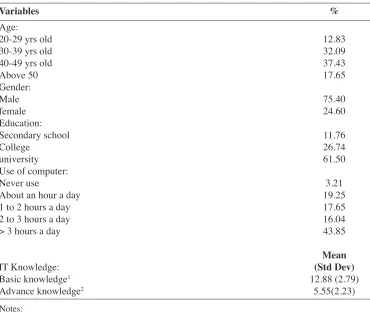
From Table 1, it is found that the majority CEO of the SMEs in Malaysia is in their 30-40s. Seventy five percent of the CEO is male which reflect the Malaysia situation where the top management of business sector is dominated by male. For the level of education, 11.76% are having secondary school. More than 80% have tertiary education either college or university. For the use of computer, only 3.21% of the CEO never use computer. This reflect the widely acceptance of computer in SMEs’ daily business.
Table 2 presents the e-commerce adoption level of the SMEs. It is found that among the SMEs, only 8.02% reported do not using e-commerce at all. Majority of them are in the adoption level of moderate (27.81%) and intermediate (32.62%).
L(β ⎟y,Z)= Pi)
n
i=1
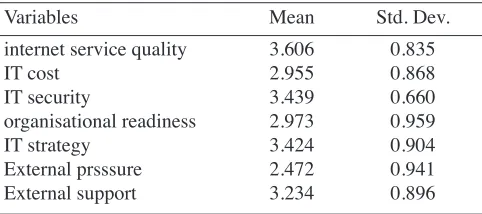
Table 3 presents the TOE factors. It is found that internet service quality is the most important perceived e-commerce adoption factor. On the measurement scale of 1 (being strongly disagree) to 5 (being strongly agree), on average, the Malaysian SMEs agreed that the internet service quality, IT cost, IT risk organizational readiness, IT strategy and external support are the factors that influenced e-commerce adoption. It is surprising to note that the SMEs owners or CEOs are neutral in terms of the external pressure as one of the factors in e-commerce adoption. Thus, the descriptive statistics suggest that except external pressure, all the TOE factors are associated with e-commerce adoption level, whereby the internet service quality is the most important factor.
Notes:
1. Basic knowledge: on scale of 4 (being not familiar) to 16 (familiar with extensive working knowledge)
2. Advance knowledge: on scale of 3 (being not familiar) to 12 (familiar with extensive working
knowledge)
Variables %
Age:
20-29 yrs old 12.83
30-39 yrs old 32.09
40-49 yrs old 37.43
Above 50 17.65
Gender:
Male 75.40
female 24.60
Education:
Secondary school 11.76
College 26.74
university 61.50
Use of computer:
Never use 3.21
About an hour a day 19.25
1 to 2 hours a day 17.65
2 to 3 hours a day 16.04
> 3 hours a day 43.85
Mean
IT Knowledge: (Std Dev)
Basic knowledge1 12.88 (2.79)
Advance knowledge2 5.55(2.23)
4.2 Multinomial Logit Model
4.2.1 Factors Influence E-Commerce Adoption Level
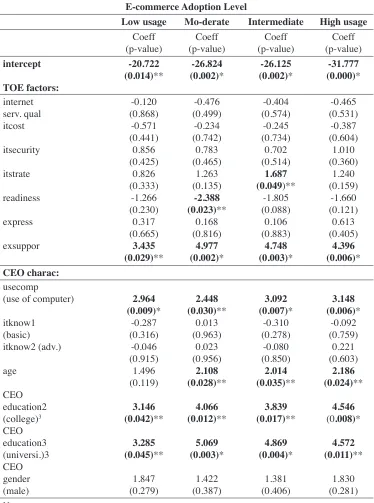
On overall, the estimated model is significant (p-value of 0.000) using LR test. The overall percentage correctly predicted is 55.4%. Given the five categories, this 55.4% correctly predicted shows the impressive result. We also found that the effects of the variables are varies across different level of e-commerce adoption. Thus, this shows that research that use the dichotomous adoption level are subjected to the aggregation bias.
Table 2: The e-commerce adoption level
Adoption level %
Not using 8.02
Low usage 11.76
Moderate 27.81
Intermediate 32.62
High 19.79
Table 3:Descriptive Statistics on TOE1
Variables Mean Std. Dev.
internet service quality 3.606 0.835
IT cost 2.955 0.868
IT security 3.439 0.660
organisational readiness 2.973 0.959
IT strategy 3.424 0.904
External prsssure 2.472 0.941
External support 3.234 0.896
Table 4: The Multinomial Logit Model (TOE + CEO) E-commerce Adoption Level
Low usage Mo-derate Intermediate High usage
Coeff Coeff Coeff Coeff
(p-value) (p-value) (p-value) (p-value)
intercept -20.722 -26.824 -26.125 -31.777
(0.014)** (0.002)* (0.002)* (0.000)*
TOE factors:
internet -0.120 -0.476 -0.404 -0.465
serv. qual (0.868) (0.499) (0.574) (0.531)
itcost -0.571 -0.234 -0.245 -0.387
(0.441) (0.742) (0.734) (0.604)
itsecurity 0.856 0.783 0.702 1.010
(0.425) (0.465) (0.514) (0.360)
itstrate 0.826 1.263 1.687 1.240
(0.333) (0.135) (0.049)** (0.159)
readiness -1.266 -2.388 -1.805 -1.660
(0.230) (0.023)** (0.088) (0.121)
express 0.317 0.168 0.106 0.613
(0.665) (0.816) (0.883) (0.405)
exsuppor 3.435 4.977 4.748 4.396
(0.029)** (0.002)* (0.003)* (0.006)*
CEO charac: usecomp
(use of computer) 2.964 2.448 3.092 3.148
(0.009)* (0.030)** (0.007)* (0.006)*
itknow1 -0.287 0.013 -0.310 -0.092
(basic) (0.316) (0.963) (0.278) (0.759)
itknow2 (adv.) -0.046 0.023 -0.080 0.221
(0.915) (0.956) (0.850) (0.603)
age 1.496 2.108 2.014 2.186
(0.119) (0.028)** (0.035)** (0.024)** CEO
education2 3.146 4.066 3.839 4.546
(college)3 (0.042)** (0.012)** (0.017)** (0.008)*
CEO
education3 3.285 5.069 4.869 4.572
(universi.)3 (0.045)** (0.003)* (0.004)* (0.011)**
CEO
gender 1.847 1.422 1.381 1.830
(male) (0.279) (0.387) (0.406) (0.281)
Notes:
1. * & ** represent significant at 1% and 5% respectively.
2. The reference group are “not using”
For the TOE factors, it is found that the external support (exsuppor) has a positive and significant effect across all adoption level. This implies that increase in external support leads to the choice of higher adoption level. Relatively, the impact of the external support is the lowest at the low adoption level (compare to not using). However, as adoption level increases, the significant level also increased. Thus, the sample shows evidence that external support is more important and influential at higher e-commerce adoption level of SMEs in Malaysia. This is consistent as higher adoption level requires higher level of technology know-how which is not available inside organization. Then, external supports from government and external expertise are crucial.
The firm’s IT strategy is found only significant at the intermediate level of adoption. Compared to not using, the increase of firm IT strategy will lead to increase probability that the firm will move to a higher adoption level (intermediate). At high usage, the impact is not significant. This means the IT strategy only has an impact at intermediate level only. For the organizational readiness, it is found to be insignificant except at moderate adoption level. Compared to not using, the increase of organizational readiness does not have significant impact or probability for SMEs move to higher adoption level; it decreases the probability of choosing the moderate adoption level. Other TOE factors are found not significant.
It is found that most of the variables that representing the characteristics of CEO are significant. The frequent uses of computer by the CEO have a positive impact on the probability for SMEs to adopt higher level of e-commerce. This positive impact is significant across all adoption levels. The CEO’s frequent use of computer implies his/her confident on the IT technology. CEO’s IT knowledge (either basic or advance) is found insignificant. CEO as the leader of the SMEs, his/her vision on e-commerce adoption is more likely to be implemented or advised by his/her assistants. CEO with low or high IT knowledge is most likely having similar information set on making e-commerce adoption level. Then, it is found that the IT knowledge is not significant, but the frequent use of computer (which represent the CEO’s confident on IT technology) is found highly significant.
CEOs with college and university qualifications are having higher probability of choosing high adoption level. Again, the effect is significant across all adoption level. Education level which represents the investment of human capital implies that those with tertiary education are more likely to adopt new technology.
Age of CEO is found significant with positive impact. This means that older CEOs are more likely to have high usage of e-commerce compared to the young CEO. The CEOs age is surrogate to CEOs experience– older implies more experience gained and more entrepreneurship inclined. This category of CEOs is likely to initiate higher level of e-commerce adoption. Thus, the positive relationship between age and e-commerce adoption level. However, gender is found not significant in influencing the e-commerce adoption level of SMEs in Malaysia.
4.2.2 Comparison of TOE Factors and CEO Characteristics
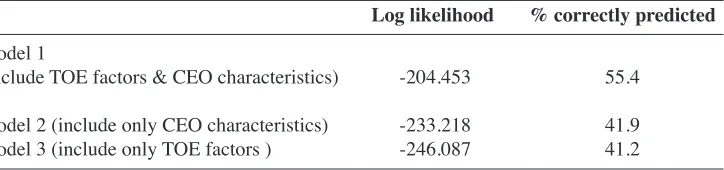
Table 5 presents the value of log likelihood for the model 1 (full model), model 2 (reduced model – exclude TOE factors) and model 3 (reduced model – exclude CEO characteristics). Using the LR test, it is found the TOE factors and CEO characteristics have significant influence on e-commerce adoption level with chi-square value of 57.53 and 83.268 (Restriction tests on Model 2 and 3) respectively.
Relatively, focusing on their contribution to log likelihood value, it is found when we exclude the TOE factors, the value drops from 204.453 to 233.218 (14.07%). The value drops from -204.453 to -246.098 (20.36%) when we exclude the CEO characteristics. This suggests that the CEO characteristics (7 variables – usecomp, itknow1, itknow2, age, CEO education2, CEO education3 & CEO gender) have contributed more to the overall fit of the model compared to TOE factors (7 variables – serqua, itcost, itsecurity, itstrate, readiness, expressur & exsuppor). In terms of overall percentage correctly predicted, it shows only minor difference. The exclusion of TOE factors result the percentage drops from 55.4% to 41.9% (a drop of 13.5%). The percentage drops from 55.4% to 41.2% (a drop of 14.2%) when we exclude the CEO characteristics. This means CEO characteristics are contributing more in the overall percentage correctly predicted. Thus, in the estimated multinomial logit model, relatively, we found that CEO characteristics and the TOE factors are significant variables. Relatively, the CEO characteristics have more impact when compared to TOE factors
Log likelihood % correctly predicted Model 1
(include TOE factors & CEO characteristics) -204.453 55.4
Model 2 (include only CEO characteristics) -233.218 41.9
Model 3 (include only TOE factors ) -246.087 41.2
Table 5: TOE factors versus CEO Characteristics
Notes:
1. Model 1 are the model includes all the TOE factors & CEO characteristics which is presented at
Table 4.
2. The model 2 and 3 are the reduced model which excluded the TOE factors (7 variables, i.e., serqua,
itcost, it security, itstrate, readiness, expressu & exsuppor) and COE characteristics (7 variables, i.e., usecomp, itknow1, itknow2, age, CEOeducation2, CEOeducation3 & CEOgender) respectively.
5. CONCLUSION
Based on the descriptive statistics or the choice modeling, the external pressure is not a major factor associated with all levels of SME’s e-commerce adoption. Hence, external pressure would not be a good strategy to drive SMEs to adopt higher level of e-commerce. Thus, this study suggests that, in the case of Malaysia, SMEs ought to be provided with external support instead of being pressured to promote high usage of e-commerce.
Other TOE factors such as internet service quality, cost, and IT security, organizational readiness and firm’s IT strategy are found to be insignificant in influencing high level of e-commerce adoption among SMes. This may due to the widely available and reliable Internet service providers (ISPs), IT vendors and IT consultants. Only SMEs IT readiness and IT strategy were found to be significant at moderate and intermediate usage level respectively. This could imply that SMEs have realised the importance of e-commerce and they are prepared to adopt e-commerce atleast at lower levels i.e. moderate and/or intermediate levels. Beyond these levels, external support is seemed to be the only factor that drives SMEs toward high usage of e-commerce.
In terms of the CEO characteristics, it is found that SME with experienced CEOs, CEOs who are graduates and use computer frequently, are more likely to adopt high usage of e-commerce. Hence, to increase the uptake of e-commerce among SMEs, SMEs which are managed by CEOs who is relatively inexperience, CEOs without non-tertiary education, and less frequent use of computer ought to be the targeted. The results show that CEO characteristics are important factors in influencing the SME’s choice of e-commerce adoption level. This fact should not be ignored in future government policies to encourage the uptake of e-commerce.
The findings from this study indicate some CEO characteristics and TOE factors are found to be significant compared to TOE factors. This study provides further support to previous literature (Thong et al., 1994; Thong and Yap, 1995; Yap et al., 1992) the key roles of the CEOs in determining innovations adoption among SMEs.
The above results are subjected to a few limitations. This study was limited to SMEs from the manufacturing sector. There is a need to examine e-commerce adoption for large manufacturing firms or firms of all sizes from other sectors. Technological factors namely Internet service quality, costs of IT and IT security were not significantly linked to any of the adoption groups. Future study might consider other technological attributes such as compatibility and complexity of the technology as potential variables to examine e-commerce adoption. Furthermore, future research could also determine if the general form of e-commerce adoption could be replicated in other emerging Internet technologies such as mobile commerce.
ACKNOWLEDGEMENT
REFERENCES
Armstrong, J. S. & Overton, T. A. (1982). Estimating nonresponse bias in mail surveys in marketing research: Applications and problems. In Arun, K. J., Christian, P. & Ratchford, B. T. (Eds.), Marketing research applications and problems.Chichester: John Wiley.
Burgess, L. & Cooper, J. (1998). The status of Internet commerce in the manufacturing industry in Australia: A survey of metal fabrication industries, 3rd Annual Conference on E-Commerce, New South Wales, Australia, September 1998.
Chatterjee, D., Grewal, R. & Sambamurthy, V. (2002). Shaping up for e-commerce : Institutional enablers of the organizational assimilation of web technologies. Management Information System Quarterly, 26(2), 65-89.
Chwelos, P., Benbasat, I. & Dexter, A. S. (2001). Research report: Empirical test of an EDI adoption model.Information Systems Research, 12(3), 304-321.
Cragg, P. B. & King, M. (1993). Small-firm computing: Motivators and inhibitors. Management Information System Quarterly, 17(1), 47-60.
Daniel, E., Wilson, H. & Myers, A. (2002). Adoption of e-commerce by SMEs in the UK: Towards a stage model. International Small Business Journal, 20(3) 253-270.
DeLone, W. H. (1988). Determinants of success for computer usage in small firms. Management Information System Quarterly, 12(1), 51-61.
Doherty, N. F. & Fulford, H. (2005). Do information security policies reduce the incidence of security breaches: An exploratory analysis.Information Resources Management Journal, 18(4), 21-39.
Doherty, N. F. & Fulford, H. (2006). Aligning the information security policy with strategic information systems plan. Computers and Security, 25(1), 55-63.
Fichman, R. G. & Kemerer, C. F. (1997). The assimilation of software process innovations: An organizational learning perspective. Management Science, 43(10), 1345-1363.
Fichman, R. G. (2000). The diffusion and assimilation of information technology innovations. In Zmud, R. W. (Eds.), Framing the domain of IT management.Cincinnati, OH: Pinnaflex Educational Resources, Inc.
Hovav, A., Patnayakuni, R. & Schuff, D. (2004). A model of Internet standards adoption: the case of IPv6,Information Systems Journal. 14(3), 265-294.
McKay, J., Marshall, P. & Prananto, A. (2000). Stages of maturity for e-business: The SOG-e model, Proceedings of the 4thAsia Pacific Conference on Information Systems, University of Science
amd Technology, Hong Kong, 1-3 June 2000.
Ndubisi, O.N. & Kahraman, C. (2005). Malaysian women entrepreneurs: understanding the ICT usage behaviour and drivers.Journal of Enterprise Information Management, 18(6), 721-739
Ndubisi, O.N. (2008). Gender differences in entrepreneurial traits, perceptions and usage of information and communication technologies. Academy of Entrepreneurship Journal, 14(2), 107-121.
Parish, P., Kibblewhite, G., Woodley, M. & Richardson, J. (2002). Study of E-commerce Adoption in the Electronic Sector.London: DTI
Porter, M. & Miller, V. E. (1985). How information gives you competitive advantage. Harvard Business Review, 63(4), 149-160.
Premkumar, G. & Roberts, M. (1999). Adoption of new information technologies in rural small businesses. Omega, 27(4), 467-484.
Rao, S. S., Metts, G. & Monge, C. A. M. (2003). Electronic commerce development in small and medium sized enterprises: A stage model and its implications. Business Process Management, 9(1), 11-32
Raymond, L. (2001). Determinants of web site implementation in small business. Internet Research, 11(5), 411-422.
Rogers, E. M. (1995). Diffusion of Innovation. New York: The Free Press.
Stansfield, M. & Grant, K. (2003). An investigation into issues influencing the use of the Internet and electronic commerce among small-medium sized enterprises., Journal of Electronic Commerce Research, 4(1), 15-33.
T. Ramayah, Osman Mohamad, Azizah Omar and Malliga Marimuthu. (2009). Technology adoption among Small and Medium Enterprises (SMEs): a research agenda. World Academy of Science, Engineerig and Technology Journal,53, 943-946.
Tan, M. & Teo, T. S. H. (1998). Factors influencing the adoption of the internet in Singapore. International Journal of Electronic Commerce, 2(3), 5-18.
Teo, H. H., Wei, K. K. & Benbasat, I. (2003). Predicting intention to adopt interorganizational linkages: an institutional perspective. Management Information System Quarterly, 27(1), 19-49.
Teo, T. S. H. & Ranganathan, C. (2004). Adopters and non-adopters of business-to-business electronic commerce in Singapore. Information and Management, 42(1), 89-102.
Teo, T. S. H., Tan, M. & Buk, W. K. (1997). A contingency model of Internet adoption in Singapore. International Journal of Electronic Commerce, 2(2), 57-69.
Thong, J. Y. L. & Yap, C. S. (1995). CEO's characteristics, organizational characteristics and information technology adoption in small business. Omega, 23(4), 429-442.
Thong, J. Y. L. (2001). Resource constraints and information systems implementation in Singapore small business. Omega, 29(2), 143-156.
Thong, J. Y. L., C. S. Yap & Raman K. S. (1996). Top management support, external expertise and information systems implementation in small businesses. Information Systems Research, 7(2), 248-267.
Thong, J. Y. L., Yap, C. S. & Raman, K. S. (1994). Engagement of external expertise in information systems implementation. Journal of Management Information Systems, 11(2), 209-231.
Tornatzky, L. G. & Fleischer, M. (1990). The Process of Technological Innovation. Massachusetts: Lexington.
Waarts, E., van Everdingen, Y. M. and van Hillegersberg, J. (2002). The dynamics of factors affecting the adoption of innovations. Journal of Product Innovation Management, 19(6), 412-423.
Wirtz, J. and Wong, P. K. (2001). An empirical study on Internet-based business-to-business e-commerce in Singapore. Singapore Management Review, 23(1), 87-112.
Coeff P-value TOE factors:
serqua -0.1551 0.4744
itcost -0.0815 0.6656
itsecurity 0.1555 0.5020
itstrate 0.5078 0.0157
readines -0.0334 0.8708
expressu 0.1586 0.3012
exsuppor 0.4601 0.0215
CEO charateristics:
UseComp 0.4483 0.0028
itknow1 -0.0828 0.2315
itknow2 0.2158 0.0079
AgeGroup 0.3630 0.0349
CEOeducation2 1.5562 0.0016
CEOeducation3 1.4745 0.0016
CEOgender 0.2364 0.5062
Threshold parameters
mu1 4.4512 0.0006
mu2 5.8352 0.0000
mu3 7.4910 0.0000
mu4 9.2740 0.0000
Null Hypothesis 489.06
General 434.29a 54.770b 42 0.89
The null hypothesis states that the location parameters (slope coefficients) are the same across response categories.
a. the log-likelihood value cannot be further increased after maximum number of step-halving.
b. The Chi-square statistic is computed based on the log-likelihood value of the last iteration of the general model. Validity of the test is uncertain.
c. Link function: logit
Appendix 2 Test of parallel linesc
Sig. df
Chi-Square -2 log likelihood