EFFECT OF SELECTED PROCUREMENT SYSTEMS ON
BUILDING PROJECT PERFORMANCE IN NIGERIA
Olugbenga Timo Oladinrin, Samuel Olusola Olatunji and Basir Tomiwa Hamza
Department of Quantity Surveying, Federal University of Technology, PMB 704, Akure, Ondo State Nigeria
*Corresponding E-mail:
Received 21 May 2012; Revised 11 February 2013; Accepted 28 March 2013
Abstract
Every client at the beginning of any project aims at having value for the money spent via a quality structure delivered on time and within budget by the contractor. However, researches have shown that in most cases this aim is not met. Therefore, this study examines the effect of procurement systems on building project performance in Nigeria, with a view to assess their effect on cost and quality. The data for this study were collected with the aid of structured questionnaires which were administered to actors in the construction industry in Lagos state being the major hub of construction activities in Nigeria. The questionnaires were related to the variants of procurement systems common to the Nigerian construction industry. Data analysis was done using descriptive statistics. The result revealed that the traditional system of procurement is the most adopted option in project execution in Nigeria. Meanwhile, design and build system performs better in cost, but lag construction management system in quality achievement. The study concluded that no procurement system is a do it all in that a procurement system may perform better than the other in an instant and fail in others as revealed in the findings. The study finally recommends that consultants and other stakeholders in the construction industry and particularly those in the building sector should be up to date as to be able to suitably advise clients when it comes to building procurement, and that before choosing a procurement system the main objective and even supporting objectives should be established.
Keywords: Building project, Construction management, Design and build, Nigeria, Procurement
1.0 Introduction
Project procurement has been described as an organized methods or process and procedure for clients to obtain or acquire construction products [1]. The procurement of construction project is vast in scope because it involves the gathering and organizing of myriads of separate individuals, firms and companies to design manage and build construction products such as houses, office buildings, shopping complex, roads, bridges etc. for specific clients or “customers”. Masterman [2], described project procurement as the organizational structure needed to design and build construction projects for a specific client. It is in a sense very true because the process of “obtaining” a building by a client involves a group of people who are brought together and organized systematically in term of their roles, duties, responsibilities and interrelationship between them.
There are many other factors that determine project success, but the focus of this research is on the two critical parameters of project performance i.e. cost and quality. The aim of this research is to assess the effect of the different procurement systems on project performance. Since there are many different project procurement systems, it is appropriate for the purpose of this research to limit it to the common ones practiced here in Nigeria i.e. traditional system, design and build, management contracting, and construction management.
2.0 Literature Review
The Nigeria construction industry is modeled after the British system being our colonial master, although, since independence in 1960, it has incorporated the styles of other European countries, such as Italy, Germany and France [5]. This industry is of paramount importance for employment and economic growth [6]. The Nigerian construction industry forms nearly 70% of the nation’s fixed capital formation [7], yet its performance within the economy has been, and continues to be, very poor. For example, the Nigerian construction industry’s contribution to employment has remained consistently at 1.0% over the last decade against the World Bank’s average observation of about 3.2% in developing countries [8]. The traditional design-bid-build system of procurement is still dominant in the Nigerian construction sector and this may likely continue to be the trend. In addition, the Nigerian construction sector comprises the clients, contractors, subcontractors, suppliers, and key professional actors responsible for design and supervision of projects. The professionals includes architects, engineers (structural and services), and Quantity Surveyors. There are professional bodies that regulate the activities of these professionals.
Delay in project execution is a major problem in the Nigerian construction industry. This occurs both in small and large projects. Virtually, all the projects executed over the years in Nigeria were faced with problem of delay in delivery. Odeyinka and Yusuf [9] observed that seven out of every ten projects suffer delay in Nigeria. Nigerian construction industry is faced with problem of cost overrun. Ogunsemi and Jagboro [6] noted that one of the most serious problems the Nigerian construction industry is faced with is the project cost overrun, with attendant consequence of completing projects at sums higher than the initial sum. Therefore, working with realistic project estimate is necessary at the outset of a project work, which would eliminate uncertainty and as well provide a platform for project success. Idrus and Sodangi [8] also observed that the last decade has however exposed the declining level of clients’ satisfaction from the built facilities as a result of poor quality performance in addition to the perennial problems of time and cost overruns in the Nigerian construction industry.
The Nigerian construction industry continues to occupy an important position in the nation’s economy even though it contributes less than the manufacturing or other service industries, [10]. This industry plays an important role in the economy, and the products of its activities are so vital to the achievement of national socio-economic development goals of creating job opportunities and social amenities and infrastructures [11].
2.1 Construction Project Performance
Performance has been described as “the degree of achievement of certain effort or undertaking” [3]. It relates to the prescribed goals or objectives which form the project parameters [4]. From project management perspective, it is all about meeting or exceeding stake holders’ needs and expectations from a project. It invariably involves placing consideration on three major project elements i.e. time, cost and quality [3]. Yates and Eskander [12] defined a successful project as a project that has been completed on schedule, within budget, within scope and satisfied the required quality.
utilized. Robinson, Anumba, Carillo & Al-Ghassani, [13] emphasized the need to develop and use tools for performance measurement and Ling & Chan [14], Thomas, Macken, Chung, & Kim, [15], Naoum, Fong, & Walker, [16] and Josephson & Lindstrom [17] developed numerous parameters for measuring project performance. Josephson and Lindstrom [17] identified 250 parameters while Ling [18] evaluated 70 potential factors for measuring project performance. These parameters can be classified into two broad categories namely: subjective and objective parameters. Ling [18] stated that the performance of a project is multifaceted and may include unit cost, construction and delivery speeds and the level of clients’ satisfaction. Pinto and Slevin (1998) classified project performance parameters into (1) internal factors which are project variables namely: schedule, cost and quality and (2) external factors which are concerned with stakeholders’ satisfaction with the performance of a project and the perceived impact on organisation’s effectiveness. Ling, Chan, Chong, & Ee, [19] identified two categories of indicators of project success namely: product success which consists of measures of achievement of quality standards and process success which is made up of variables that measure the achievement of time and cost.
On stakeholders’ satisfaction, clients remain the most important stakeholder when considering project performance. Neto, Mourao, Ferreira de Freitas & Aves, [20] stated that matching or exceeding the client’s expectations result in a satisfied client. They opined further that this can reflect on how loyal a client becomes to a provider or a brand and result in higher sales volumes, lower levels of sensitivity to price and generates positive comments about the provider and the brand. Clients’ satisfaction can be measured from several perspectives [21], however time, cost and quality have remained the most prominent in research studies. Josephson and Lindstrom [17] maintained that project goal which considers clients’ goals, is measured from several perspectives but the main aim is to stimulate clients to identify and clearly present their goals and to stimulate all managers involved to inform and remind all individuals of the goals. Hatush and Skitmore [22] maintained that success in a project is generally operationalized into time, cost and quality.
Michell, Bowen, Cattell, Edward & Pearl, [23] remarked that the primary concern of construction clients is that their projects are completed within budget, on time and at the required level of quality. On objective measurement of project outcome, two parameters namely: schedule and cost: are common with research studies. Michell, Bowen, Cattell, Edward & Pearl, [23] identified time and cost as the principal factors. The third parameter (quality) is not a common objective parameter in research studies because as Vincent and Joel [24] put it: stakeholders see the goal of quality management as customer satisfaction. From the perspective of previous studies, two parameters namely: time-overrun and cost-overrun remain the prominent indicators of objective measurement of project outcome. However, these two parameters have their limitation because their values rely on the initial contract period or cost of a project.
Construction project performance is influenced by many factors due to the interactions and interrelationships of the stakeholders. A construction project is commonly acknowledge as successful, when it is completed on time, within budget, profitability to contractors, absence of claims and court proceeding and “fitness for purpose” for occupiers have also been used as measures of project [25]. In developing countries, poor project performance has been attributed to inadequate mechanisms and systems for: Land allocation, funding, mortgage institutions, infrastructure, procurement systems etc. Project delivery is also affected by the poor performance of the construction industry as reported in literature [26-29, 5].
Hough [31] examined the records of more than 4000 construction projects and found that projects rarely finished within the allocated budget and to specification. Despite their proven importance, it is not uncommon to see a construction project failing to achieve its objective within the specified cost and quality. Cost overrun can be simply defined as when the final cost of the project exceeds the original estimates [32]. Most of the significant factors affecting project costs are qualitative such as client priority on construction time; contractor’s planning capability, procurement methods and market conditions including the level of construction activity [33].
2.2 Factors Influencing Choice of Procurement System
The following criteria were used to examine client requirements and experts preferences for the performance of each procurement method as cited in [34-37] suggest employing the following criteria to establish a profile of the clients requirements: speed (during both design and construction); certainty (price and the stipulated time and knowledge of how much the client has to pay at each period during the construction phase); flexibility in accommodating design changes; quality (contractors reputation, aesthetics and confidence in design); complexity (client may specify particular subcontractor, or buildability analysis); risk allocation/avoidance; responsibility (completion of program, price, product quality, design and construction); price competition (covering such issues as value for money, maintenance costs and competitive tendering); and disputes and arbitration.
Similarly, Arazi I., Mahmoud S. and Mohamad H.H. [38] analyzed project performance criteria using severity index method as follows; Construction cost; Construction time; Quality of finish project; Occupational health and safety; Level of technology; Environment friendliness; Contractor’s flexibility; Labour dependency; Quality of coordination by construction team; Contractor’s project management and Contractor’s capacity of manpower.
2.3 Project Procurement Systems
Procurement systems have become an important issue in the construction industry because of two reasons. Firstly, the procurement of construction projects involves a series of processes that are interrelated and sequential. The effectiveness and efficiency of the processes have considerable impact on the success or failure of projects. Secondly, there are several procurement methods that are available for a developer to adopt in procuring a project. For this reason, one major challenge that the project developer faces is the method to adopt among the available procurement options [1]. Ogunsanmi and Bamisele [39] and Ashworth and Hogg [1] defined procurement method as the management of the total process involved in construction project delivery. It is also ways in which a client or a sub-client may procure a building or other construction work varied and complex. According to [1], different variants of procurement are available for meeting different clients' needs and projects specifics. A number of factors have to be taken into account in determining the best method for a specific project. The variants of procurement methods available today metamorphosized from the need to improve construction project delivery, that is, project completion within budget and time.
activities also led to sequencing of activities in which design is completed before construction commences.
This became the traditional' sequence and it is now referred to as Design-Bid-Build [40]. Other variants of procurement method not following this format became the 'non-conventional' procurement method. Concepts of project delivery have been developed to compress the time required to realize a constructed facility which focuses on simplifying the project delivery process, with emphasis on optimizing the parameters (e.g. quality, cost, time of completion, meeting market needs, and safety among others). In non-conventional procurement methods, the grounds are gradually shifting from just meeting clients' needs into apportionment of risk, as the contractors are gradually taking their stance as business organizations with the aim of making optimum profits at the minimum risk, and this has led to the development of integrated methods of procurement which are hybrids of both traditional and non-conventional procurement methods [1, 42-44], classified construction procurement methods into two broad categories as: traditional procurement method, and non-conventional procurement method.
2.4 Traditional Procurement System
According to Seeley [43]; and Kadiri and Odusami [45] The main variants of traditional procurement method are: bills of firm quantities; bills of approximate quantities; drawings and specification; schedule of rates; cost reimbursement; and labour only. The traditional method as the name implies, is a project procurement method where the three sequential phases of design, bid and build are identified as separate tasks. It is traditionally referred to as the competitively bid contract. This method allows for all contractors that fill competent to bid for projects in a free and competitive atmosphere similar to competitive market environment. In a typical traditional approach, the client initiates the project and produces a written scope statement, identifying the project’s objectives and verifying the scope definition by the architect. The architect is responsible for defining the project scope in order to facilitate a clear assignment of responsibilities and to monitor the scope change control with the project team. The design team produces complete design documents before engaging the contractor, often affecting the quality by not taking into consideration build- ability, constructability and life-cycle costing.
Certain conditions warrant the use of Traditional procurement as opined by Turner, [46] these include when:
A programme allows sufficient time;
Consultant design is warranted;
A client wishes to appoint designers and contractors separately;
Price certainty is wanted before the start of construction;
Product quality is required; and
A balance of risk is to be placed between the client and constructor.
2.5 Design and Build
2.6 Management Contracting
According to Seeley [19], Management contracting is a system whereby a main contractor is appointed, either by negotiation or in competition, and works closely with the team of professionals. Also, Oyegoke [47] opined that “in a management contract, the permanent works are constructed under a series of construction contracts placed by the management contractor after approval by the client.” All physical construction is undertaken by sub-contractors selected in competitive bidding. This system usually has the main contractor called the management contractor who provides the management expertise in the construction of the project for a fee. This Manager is appointed at the inception or better still feasibility stage to join the client’s team of consultants, to help work out the design programme and site operations. He manages and co-ordinates the work packages to individual sub-contractors and equally provides on the site service, plant and equipment, amenities etc for the work. The fee paid to the management contractor depends on the nature and extent of the work done and not on the cost of the work.
However, management contracting system is most appropriate for large and complex projects which exhibit particular problems that militate against the employment of fixed price contract procedures. Typical examples of which are: Projects for which complicated machinery and / heavy equipment are to be installed concurrently with the building works; Projects for which the design process will of necessity continue throughout most of the construction periods; Projects on which construction problems are such that it is necessary or desirable that the design and management team includes a suitably experienced building contractor appointed on such a basis that his interests are largely synonymous with those of the employer’s professional consultants.
Though, there is a wide range of views as to the best procedures to be adapted in management contracting [43], but they usually incorporates the following activities and requirement: The management contractor is precluded from carrying out any of the physical works using directly employed labour; His role is primarily that of a planner, manager and organizer; The works are divided into packages agreed by the professional team and the management contractor as being most appropriate for the particular projects; The management contractor provides from his own resources the following: Site supervisor, technical and administrative staff to run the contract.
2.7 Construction Management
Construction management is that group of services over and above the normal Architectural and Engineering services related to the construction programme executed during the pre – design, design and construction phases, that contribute to the control time, cost and quality of new facility. Professional construction management treats the project planning, design, and construction phases as integrated tasks. This approach unites a three –party team consisting of owner, designer, and construction manager in a non-adversary relationship, and it provides the owner with an opportunity to participate fully in the construction process [41]. Construction Management is a fee-based arrangement in which the construction manager is responsible exclusively to the owner and acts in the owner’s interest at every stage of the project. He offers advice on: the optimum use of the available funds, control of the scope of work, project scheduling, avoidance of delays, changes and disputes, enhancing project design and construction qualities, and optimum flexibilities in contracting and procurement [48]. A prime construction contractor or funding agency may also be part of the team. The team works together from the beginning of design to project completion, with the common objective of best serving the owner’s interest.
member of the professional team helps ensure that every major design decision is balanced by proper analysis of its cost consequences, and impact on project schedule [48].
The role of the construction manager on a building project may vary substantially, and can be performed under a variety of contractual terms. The most traditional or purest form of construction management is that where the Construction Manager acts as the client’s agent as a professional consultant, providing estimating, cost control and scheduling services and undertaking administrative responsibilities during construction. Under this arrangement, all construction contracts are executed directly between the owner and contractors. The approach permits the construction work to be broken down into a number of trade contracts thereby eliminating the need for one or more "general" contractors. The elimination of the general contractor avoids a duplication of fees, cost mark-ups and general conditions costs otherwise incurred by the client.
2.8 Project Cost and the Effect of Certain Procurement System
Cost has been defined as the degree to which the general conditions promote the completion of a project within the estimated budget [49]. It covers overall costs incurred from project inception to completion. This highlights the importance that has to be attached to every project management activity carried out through every stage of the project development up to completion. [50] also argues that cost is not only confined to the tender sum and that it is the overall cost that a project incurs from inception to completion, which includes any cost arising from variations, modifications during construction period. These cost variables give indication of certain additional practices that when engaged in during the project management process would have both direct and indirect implications for the project cost performance.
The number and manner in which variation orders are issued by consultants during construction is an important practice to look at. Clients who often engage in the habit of agitating for numerous design changes before practical completion also play great role in the influences on project cost. The way contractors respond to variation orders may also have implications for the project performance. In predicting the performance of design-build and design-bid-build projects, [19] identified certain variables that affect cost performance. These include: the number of repetitive elements contained in a project, the extent of design completion when bids are invited, and the level of paid up capital of contractors engaged. These variables bring to bear certain related practices that may affect the performance of project cost. For instance the kind of procurement method usually adopted by clients; traditional procurement or design and build will determine the extent of completion of designs to be used for bidding. Moreover the kind of project consultants selected by clients for design of a particular kind of project will also have influence on the way the design will be made (i. e. whether repetitive elements will be brought into the design or not).
2.9 Project Quality and the Effect of Certain Procurement System
Construction quality is defined as “the totality of the features required to satisfy a given need; fitness for purpose. The extent to which projects are monitored, the experience of project consultants, quality and past performance record of contractors and the number of variation orders issued all have effect on quality. How all these factors can be competently coordinated would be relevant to achieving satisfactory quality performance. The project management team leader has the responsibility to ensure that these factors combine well to yield good quality performance.
Quality performance has been considered as a function of the procedures adopted during the construction process [51]. Those procedures comprise the concept of procurement form and the method of tendering. The fragmented nature of the construction industry and the fact that every building project is unique places great responsibility on the project management team in setting up the building process that will bring the project to a successful conclusion. The emphasis here is on process and procedures having influence on quality of a building project. The subsequent issue that arises is how often project managers, having a sense of the uniqueness of every project, tailor certain procurement practices to correspond with the uniqueness of a project in order to yield good quality performance. Some of the procedures to be given recognition may therefore include the selection procedure of organizations required to perform the design and supervision and those responsible for the construction of the particular project too. Usually, the construction team would be appointed under competition through competitive tendering process. Sometimes, a contractor may be appointed by negotiation on the basis of a fee. In cases where the design and construction is done as a complete package, both may be let by competition.
The selection procedures applied to contractors are therefore by no means always the same. Different methods have different levels of impact on project success. For instance it was noted from previous research that “competitive tendering can adversely affect the outcome of major projects and the number of separate contracts is related to the chances of success; different selection methods will pose different levels of risk to the project team members” [52]. The selection procedures adopted by clients for project consultants should also not be overlooked since less attention has been given to this aspect of project management by several research works.
Quality is considered as a very crucial issue in project development. [53] opined that the importance of quality performance and safety at times surpass cost and time of delivery in civil engineering projects although, these factors are interrelated and interdependent. [54] maintained that the issue of quality performance of construction projects in Nigeria has resulted in colossal waste of human and material resources and in most of the cases, the indigenous contractors are found culpable. The degree to which a project’s quality objective is attained which is subjectively measured on a ranking scale. In view of the numerous parties and factors whose requirements should be met, the several activities, actions, processes and techniques involved in meeting these requirements and the many individuals and bodies concerned with planning and implementing them, [55] maintained that quality management is far more difficult to achieve in construction than in other industries.
3.0 Methodology
The data used for this study were collected via well structured questionnaires which were self administered to construction professionals involved in the usage of various procurement systems in Lagos state, Nigeria. Lagos state was chosen for the study because of its characteristic as the major hub of construction activities in Nigeria. A total of 100 (one hundred) questionnaires were distributed and administered to the targeted professionals using decisive convenient sampling technique out of which 76 numbers were returned and suitable for analysis.
achievement. Eight major factors relating to assessment of procurement methods, fourteen and eleven factors relating to cost and quality performance respectively were identified from literatures and some were added having established them through pilot survey. The respondents were asked to rank these factors accordingly. The respondents were asked to rate on a 5-point Likert scale rating with 5 being the highest of the rating, for example 1= very low, 2= low, 3= neutral, 4= high 5= very high. The mean rank for a group of respondents is obtained as follows:
Ms = ∑ (F *S)
N Where, MS = Mean score
F = Frequency of responses
S = Score given to the criteria which ranges from 1-5 N = Total number of respondents.
4.0 Results and Discussions
The results obtained from the analysis of gathered data are presented in this section where table 1 shows the back ground of the respondents who participated in survey.
Table 1: Professional Background of Respondents
Respondents Distribution Responses % of Response
Quantity Surveyors 35 30 39.50
Architects 25 19 25.00
Builders 30 22 28.90
Civil Engineers 10 5 6.60
Total 100 76 100
From the table above, the majority of the respondents i.e. 39.5% have Quantity Surveying as their professional background, 25% of the respondents are of Architectural background, while Building technology is 28.9% and Civil engineering has the least with 6.6%. The result expressed the generation of adequate opinion of the construction industry in the study area as majority of construction professionals are represented
Table 2: Professional Qualification of Respondents
Respondent Professional Body Frequency Percentage %
MNIQS 21 27.60
MNIA 10 13.20
MNIOB 17 22.40
MNSE 3 3.90
Others 7 9.20
None 18 23.70
Total 76 100
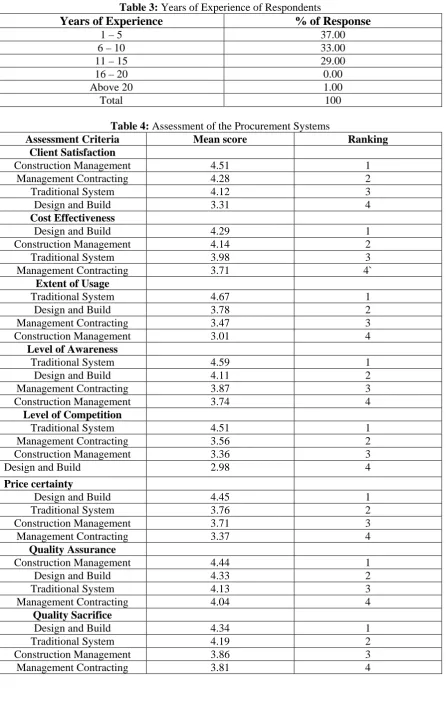
Table 3: Years of Experience of Respondents
Years of Experience
% of Response
1 – 5 37.00
6 – 10 33.00
11 – 15 29.00
16 – 20 0.00
Above 20 1.00
Total 100
Table 4: Assessment of the Procurement Systems
Assessment Criteria Mean score Ranking Client Satisfaction
Construction Management 4.51 1
Management Contracting 4.28 2
Traditional System 4.12 3
Design and Build 3.31 4
Cost Effectiveness
Design and Build 4.29 1
Construction Management 4.14 2
Traditional System 3.98 3
Management Contracting 3.71 4`
Extent of Usage
Traditional System 4.67 1
Design and Build 3.78 2
Management Contracting 3.47 3
Construction Management 3.01 4
Level of Awareness
Traditional System 4.59 1
Design and Build 4.11 2
Management Contracting 3.87 3
Construction Management 3.74 4
Level of Competition
Traditional System 4.51 1
Management Contracting 3.56 2
Construction Management 3.36 3
Design and Build 2.98 4
Price certainty
Design and Build 4.45 1
Traditional System 3.76 2
Construction Management 3.71 3
Management Contracting 3.37 4
Quality Assurance
Construction Management 4.44 1
Design and Build 4.33 2
Traditional System 4.13 3
Management Contracting 4.04 4
Quality Sacrifice
Design and Build 4.34 1
Traditional System 4.19 2
Construction Management 3.86 3
From the table above, assessing the selected procurement systems on the listed criteria, it was discovered that the traditional procurement system rank highest with mean score of 4.59 and 4.67 in their level of awareness and usage respectively. This means that Traditional system is the most patronized system of procurement in Nigeria due to to its highest level of awareness. Construction management system with mean score 3.74 and 3.01 rank least in the level of awareness and extent of usage respectively. Design and build top the ranking for price certainty with a mean score of 4.45, followed by the traditional system with a mean score of 3.78 while management contracting rank least. Also considering the quality assurance and client satisfaction, construction management rank highest with mean score of 4.44 and 4.51 respectively, while management contracting ranked least in quality assurance; design and build ranked least in the client satisfaction criteria.
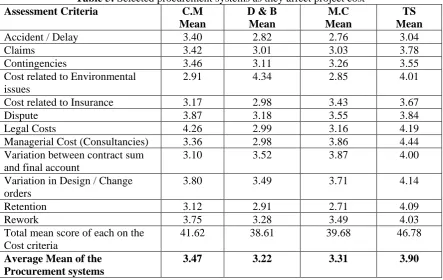
Table 5 presents means of the various procurement systems as they are individually investigated under various cost criteria. The analysis shows that design and build has the least mean of 3.218 while traditional system has the highest mean of 3.898 which implies that Traditional system is the most flexible procurement system in terms of cost.
Table 5: Selected procurement systems as they affect project cost Assessment Criteria C.M
Mean
D & B Mean
M.C Mean
TS Mean
Accident / Delay 3.40 2.82 2.76 3.04
Claims 3.42 3.01 3.03 3.78
Contingencies 3.46 3.11 3.26 3.55
Cost related to Environmental issues
2.91 4.34 2.85 4.01
Cost related to Insurance 3.17 2.98 3.43 3.67
Dispute 3.87 3.18 3.55 3.84
Legal Costs 4.26 2.99 3.16 4.19
Managerial Cost (Consultancies) 3.36 2.98 3.86 4.44
Variation between contract sum and final account
3.10 3.52 3.87 4.00
Variation in Design / Change orders
3.80 3.49 3.71 4.14
Retention 3.12 2.91 2.71 4.09
Rework 3.75 3.28 3.49 4.03
Total mean score of each on the Cost criteria
41.62 38.61 39.68 46.78
Average Mean of the Procurement systems
3.47 3.22 3.31 3.90
* C.M = Construction Management, D & B = Design and Build, M.C = Management Contracting and TS = Traditional System.
Table 6 presents mean of various procurement systems as they are individually investigated under various quality criteria. The analysis shows that construction management has the highest rank of (3.722), follow closely by management contracting with mean 3.697, while traditional system came third with a mean of (3.627) and lastly the design and build has the lowest mean score (3.482). Thus Construction Management is the most suitable procurement system whenever quality becomes the most priotized objective of the construction project in Nigeria.
Table 6: Effect of procurement systems on quality of work Assessment Criteria C.M
Mean
D & B Mean
M.C Mean
TS Mean
Adherence/Compliance to specification 3.97 3.66 4.10 3.64
Competence of contractor and his team 3.50 3.76 3.61 3.29
Insistence on specification 4.04 3.20 3.63 3.33 Major Variation between Original Design
and the actual completed work
3.75 3.80 3.87 4.08
Material test 3.64 3.43 3.84 3.45
Number of Rework 3.99 3.89 3.93 4.07
Number of Variation / Change Orders 3.27 3.35 3.19 3.41
Supervision of works 3.72 3.34 3.68 3.49
Total mean score of each on Quality criteria
33.50 31.34 33.27 32.64
Average Mean of each Procurement systems
3.72 3.48 3.70 3.63
* C.M = Construction Management, D & B = Design and Build, M.C = Management Contracting and TS = Traditional System.
4.1 Discussion on Findings
The aim of this research work was to investigate the effect of the selected procurement systems on the cost and quality performance of building projects in the Nigeria construction industry. The result of the data retrieved from the questionnaires indicates in table 1 that majority of the respondents are Quantity Surveyors, followed closely by the Builders, and then the Architects and the Civil Engineers were the least. Table 2 reveals that majority of the respondents are Qualified with NIQS, followed by those with none, also those with Qualified Certificate of NIOB. Table 3 indicates that among the selected procurement systems as used in Nigeria, the Traditional system is and still remain the most popular and frequently use system, despite its shortcomings, which is in agreement with Adedokun [56] and Babatunde, Opawole and Ujaddughe [57] that approximately half of construction projects are executed using traditional procurement system which is presumably due to long existence of the traditional procurement systems, less awareness of other procurement systems available, little or less information available on the systems and Nigerians and the construction industry adamant to changes.
It was discovered from this research that none of the selected procurement systems can provide all the cost and quality performance criteria always required by the clients, supported by the submissions of Adedokun [56] who posited that there is nothing like ‘the best’ procurement system and that the best we could say is that this procurement is better than this if this or that is the objective of the project. Also it was discovered from the general assessment of the procurement systems that the traditional system gives and provides the clients a good competition from contractors for the work which is also one of the rules in the new procurement acts as enacted by the federal government of Nigeria while the design and build system does not give room for that. Again the analysis shows that design and build system is highly cost effective as it ranked first while the cost effectiveness of the management contracting is low in the face of quality sacrifice. The design and build system top the ranking with the traditional system follow closely and the construction management ranked third and lastly is the management contracting in this regard.
the client and less quality sacrifice suffered by client as presented in table 4 under headings; client satisfaction, quality assurance and quality sacrifice it shows that Construction Management with the mean score of 4.51, 4.44 and 3.81 respectively and this also agree with [30] that the choice of variants of the non-conventional procurement system is made in order of consideration of quality assurance; and a consideration of project been completed at the estimated budget, Management Contracting is next in client satisfaction with 4.28 mean score, traditional system is next to the least is client satisfaction with mean score of 4.12, and Design and Build system satisfy client the least with its lowest mean score of 3.61. it is also discovered and thereby established that the construction management system of procurement has the highest mean of 3.722 to rank first and thereby pass to be said that it performs better in quality among the selected procurement systems.
5.0 Conclusions
Based on the findings of this study, the following conclusions are drawn:
a. That despite its problems and shortcomings which includes long and bureaucratic
processes, lots of variation and change orders and the resultant disputes, the traditional system of procurement still remain most popular, prevalent and frequently used system.
b. That none of the selected procurement systems could be called ‘the best’ but one can
be better than the other the other in term of specific performance.
c. Finally that among the selected procurement systems which are Construction
management, Design and Build, Management contracting and Traditional system, the Design and Build is most cost effective as it gives no room to claims, extra and external managerial cost in form of consultancies on the part of both the client and contractor, legal cost is minimal because the procurement is single source. Also from the findings on quality, if quality slippage must be curtail the Construction Management system is the most appropriate as it ranked highest from the field survey.
References
[1] A. Ashworth, and K. Hogg, “Willis's Practice and Procedure for Quantity Surveyor”, Blackwell Publishing Ltd, Oxford, UK. 2007.
[2] J. W. E. Masterman, “An Introduction to Building Procurement Systems, 2nd ed.”, Spon Press, London, 2002.
[3] Project Management Institute, “A Guide to the Project Management Body of Knowledge”, 3rd Ed, Global Standard, Four Campus Boulevard, Newtown Square, PA 19073-3299, USA, 2004.
[4] W. Chitkara, “On the Development of Project Management Research: Schools of Thought and Critique. International Project Management Journal, vol. 8, pp. 20-31, 2005.
[5] N. R. Mansfield, O. O Ugwu. and T. Doran, “Causes of Delay and Cost Overruns In Nigerian Construction Projects.” International Journal of Project Management, Vol. 12, pp. 254–260, 1994. [6] D. R. Ogunsemi, and G. O. Jagboro, “Time-Cost Model For Building Projects In Nigeria”. Journal of
Construction Management and Economics, vol. 2, pp. 253-258, 2006.
[7] Federal Office of Statistics (FOS) Quarterly Report, “Federal Ministry of Works and Housing, Abuja, Nigeria”, 2004.
[8] A. B. Idrus, and M. Sodangi, “Framework for Evaluating Quality Performance of Contractors in Nigeria”. International Journal of Civil & Environmental Engineering IJCEE-IJENS, vol. 10, pp. 34 – 39, 2008.
[9] H.A. Odeyinka, and A. Yusuf, “The causes and effects of construction Delays on cost of housing project in Nigeria,” Journal of Financial Management and Property and Construction. vol. 2, pp. 31-41, 1997.
[11] Anaman and Osei-AmponsahAn, “Evaluation of the Delivery Performance of Construction Projects Funded by the District Assemblies’ Common Fund” (A case Study of 4 Districts in Ashanti Region), Unpublished M Sc. Thesis submitted to the Department of Building Technology, KNUST, 2007. [12] J. Yates and A. Eskander, “Construction Total Project Management Planning Issues”. International
Journal of Project Management, vol. 33, pp. 37-48, 2002.
[13] Robinson, Anumba, Carillo and Al-Ghassani, “Measuring and classifying construction field rework: a pilot study”. Department of Civil and Environmental Engineering, University of Alberta. Presented to the Construction Field Rework Committee, Construction Owners Association of Alberta, 2005. [14] F. Y. Y. Ling and S.L. Chan, “Performance evaluation of alternative project procurement methods”.
Research Brief. Singapore: National University of Singapore. 55 p.
[15] H. Thomas, D.G. Macken, L.Y. Chung, and Y.C. Kim, “Factors influencing contractor performance”: an international investigation. Engineering, Construction and Architectural Management, vol. 10, pp. 322 – 332, 2002.
[16] S. Naoum, D. Fong and G. Walker, “Critical success factors in project management, in Proc. of the International Symposium on Globalization and Construction”. CIB 2004. W107, TG23, 17-19 September, 2004, School of Civil Engineering, Asian Institute of Technology, Thailand, 2004.
[17] P. E Josephson and J. Lindstrom J, “Measuring performance in construction projects, in Proc. of the CIB World Building Conference on Construction for Developmen”t, 14-18 May, 2007, Cape Town, South Africa, 383-394, 2007.
[18] F. Y. Y. Ling, “Key determinants of performance of DBB projects in Singapore”, Building Research & Information 32(2): 128-139. http://dx.doi.org/10.1061/(ASCE)0733-9364 (2004)130:1(75), 2004. [19] F. Y. Y. Ling, S. L. Chan, E. Chong and L.P. Ee, “Predicting performance of Design-Build and
Design-Bid-Build Projects”. Journal of Construction Engineering and Management, vol. 130, pp. 75-83, 2004.
[20] J. B. Neto, Y. R. Mourao, A. A. Ferreira de Freitas and T. L. Aves, “A method to evaluate and manage client requirements in housing projects, in Proc. of the CIB World Building Conference on Construction for Development”, 14-18 May, 2007, Cape Town, South Africa, 310-321, 2007.
[21] G. I. Idoro, “A comparative study of direct labour and design-tender-construct procurement systems in Nigeria”. PhD Thesis. Lagos: University of Lagos, Nigeria, 2007.
[22] Z. Hatush and M. Skitmore, “Evaluating contractor prequalification data: selection criteria and project success factors”, Construction Management and Economics vol. 15, pp. 129-147.
[23] K. Michell, P. Bowen, K. Cattell, P. Edward and R. Pearl, “Stakeholder perceptions of contractor time, cost and quality management on building project, in Proc. of the CIB World Building Conference on Construction for Development”, 14-18 May, 2007, Cape Town, South Africa. 231-240, 2007.
[24] K.O. Vincent and E.R. Joel, “Principles of Total Quality”. Kogan Page, London, 1995.
[25] P A Koushki, K. Al-Rashid, and N. Kartam, “Delays and cost increases in the construction of private residential projects in Kuwait”, Construction Management and Economics, vol. 2, pp. 285–94, 2005. [26] O. A. Adams, “Perceived Relative Importance of Training in Contractor Development in Nigeria, The
Organization and Management of Construction: Shaping Theory and Practice”, Volume Two, Managing the Construction Project and Managing Risk; London; E&FN Spon; pp 640 – 649, 1996. [27] A.N. Aniekwu, and D.C. Okpala, “The Effect of Systematic Factors on Contract Services in Nigeria”;
Construction Management and Economics6; London, E&FN Spon; 171-182, 1988.
[28] S. Ogunlana, K. Promkuntong and V. Jearkjirm, “Construction delays in a fast-growing economy: comparing Thailand with other economics”, International Journal of Project Management, vol. 14, pp. 37-45, 1996.
[29] J. Wells, “The Construction Industry in Developing Countries: Alternative Strategies for Development”, London; Croom Helm, 1986.
[30] F.L.Y. Yng, C.S. Lean, E.C.C. Wai, E.L. Ping and L. Min, “Performance evaluation of alternative project procurement methods”, Project Report, National University of Singapore, 2002.
[31] P.W.G. Morris and G.H. Hugh, “reconditions of success and failure in major projects. Templeton college”, The Qxford Centre for Management Studies, Kinnington Oxford, UK, 1983; Technical Paper No. 3, 1983.
[32] I. Avots, Cost-Relevance Analysis for Overrun Control. International Journal of Project Management, vol. 1, pp. 142-148, 1983.
[34] P. E.D. Love, M.R. Skitmore, and G. Earl “Selecting an appropriate procurement method for the construction process: an empirical study” Construction Management and Economics vol. 16, pp. 221-233, 1998.
[35] National Economic Development Office (NEDO), “Think About Building”, NEDC, London, 1985. [36] R.M. Skitmore and D.E. Marsden “Which procurement system? Towards a universal procurement
selection technique”, Construction Management and Economics, 6, 71Ð89, 1988.
[37] S. Singh, “Selection of appropriate project delivery system for building construction projects”, Proc. CIB W-90 International Symposium on Building Economics and Construction Management, Sydney, Australia, pp. 469Ð480, 1990.
[38] I. Arazi, S. Mahmoud and H.H. Mohamad, “Prioritizing Project Performance Criteria within Client Perspective”, Research Journal of Applied Sciences, Engineering and Technology vol. 3, pp. 1142-1151, 2011.
[39] O.E. Ogunsanmi and A. Bamisele, “Factors Affecting the Selection of Project Procurement Methods”, Builder Magazine, vol. 12, pp. 11-16, 1997.
[40] W.H. Daniel, “Construction Management” USA, John Wiley & Sons Inc, 2006.
[41] O. Adesanya, “Project Procurement Paths”, The Journal of the Federation of Construction Industry, vol. 2, pp. 6-21, 2008.
[42] J. Egan, “Rethinking construction, Construction Task Force report”, Department of the Environment, Transportand the Regions. HMSO, London, 1998.
[43] I.H. Seeley, “Quantity Surveying Practice”, Macmillan Publishers Ltd, London, 1997. [44] A. Turner, “Building Procurement” Palgrave Macmillan Ltd., UK, 1997.
[45] D.S. Kadiri and K.T. Odusami, “Comparative Study of Time and Cost Performance of Direct Labour and Labour Only Procurement System”, Journal of the Nigerian Institute of Quantity Surveyors,vol. 44, 2003.
[46] A. Turner, “Building Procurement”, Macmillan, UK, 1990.
[47] A.S. Oyegoke, “Construction Management Contracting Systems in the UK and US Practices: Consulting and Contracting Perspectives”, Journal of the Nigerian Institute of Quantity Surveyors, vol. 34, pp. 22-34, 2001.
[48] T. Alhazmi and R. McCaffer, “Project Procurement System Selection Model”, Journal of Construction, Engineering and Management. Vol. May/June, 2000.
[49] A. A. Bubashit and S. A. Almohawis, Evaluating the general conditions of a construction contract. International Journal of Project Management, vol. 12, pp. 133-35, 1994.
[50] A. P. C. Chan and A. P. L. Chan, “Key Performance Indicators for measuring construction success Benchmarking”,International Journal of Project Management, vol. 11, pp. 203-221, 2004.
[51] L.F. Alarcon and D. A. Sarpel, “Improving the design-construction interface”, In: Proceedings of the sixth Annual Conference of the International Group for Lean Construction,Guaruja- Brazil, 1998. [52] A.P.C. Chan, “Towards an expert system on project procurement”, Journal of Construction
Procurement, vol. 1, pp. 111-23, 1995.
[53] F. Harris, and R. McCaffer, “Modern Construction Management”, 5th edition, London, Blackwell Science Limited, 2002.
[54] Financial Standard, “Construction Industry Operators call for Review of Road Maintenance Act. Financial Standard”, Dec. 20, Lagos, Financial Standard Newspapers, pp 2, 2004.
[55] C.M. Tam, Z.M. Deng, S.X. Zeng and C.S. Ho, “Quest for Continuous Quality Improvement for Public Housing Construction in Hong Kong”, Construction Management and Economics,vol.18, pp. 437-446, 2000.
[56] G. A. Adedokun, “Assessment of Variation on different Contract Procurement systems”, An unpublished B. Tech. Thesis submitted to the department of Quantity Surveying, Federal University of Technology, Akure, 2009.