THE USAGE OF FACEBOOK FUNCTIONAL
BUILDING BLOCKS IN UNISEL
Latifah Abd Latib
1, Jusang Bolong
2, Akmar Hayati Ahmad Ghazali
31Faculty of Computer Science and Information Technology (FCSIT), Universiti Selangor,
Bestari Jaya Campus, Jalan Timur Tambahan,45600 Bestari Jaya, Selangor, Malaysia. [email protected]
2,3Department of Communication, Faculty of Modern Languages and Communication,
Universiti Putra Malaysia, 43400 Serdang, Selangor, Malaysia. [email protected]
ABSTRACT
The emergence of Internet-based social media has made it possible for a person to communicate with thousands of other people to increase the communication effectiveness, collaboration among internal organization and knowledge sharing. By engaging employees through social media such as Facebook as a two-way communications tool, employers can reach a larger audience and build credibility with techno-savvy workers. Although it is clear that Facebook is a very powerful tool for communication, many employers are unable to identify the functionality of Facebook in terms of developing strategies and to allocate the resources effectively. Taking this into account this study sought to identify the usage of Facebook Functionality building blocks. This survey involved 55 academic staffs from the Faculty of Computer Science and Information Technology, Unisel. The seven functional building blocks identified were Identity (M=3.39), Relationships (M=3.39), Groups (M=3.6), Presence (M=3.28), Sharing (M=3.06), and Conversations (M=2.90), Reputation (M=2.05). This study suggests that the ability to identify the functional building blocks itself is very important in an organization in terms of developing their communication strategies. It is hoped that the results of the study will be applicable to the instituition, current users, and potential users of Facebook.
Keywords: Social media, facebook, functional building blocks, Unisel
1. INTRODUCTION
Social media is a set of online tools for social interaction. It is one of the Internet-based Application groups that provides the base ideology and technology of web 2.0 to create and change of User Generated Content (Kaplan & Haenlein, 2010). Social media technologies are now frequently engaged by most internet users. In practice, social media serves as a catchall phrase for social networking services (SNS) (e.g Facebook), social sharing services (e.g YouTube, Flickr), a collection of web-based technologies and services (e.g Twitter) (Hansen, Shneiderman & Smith, 2011). As social media developed further it has become an important feature of people’s personal lives.
Social media has become ubiquitous and is frequently being used by people and business organizations for social networking and content sharing. It was preferred online platform where people create content, share, bookmark and connected to each others mostly at real time. Most of the mobile phones equipped with internet access get connected to the social media by installation of the application provided by the social media developers. Social media not only serves as communication tools for people but also shape the way they construct and present their social and professional identities (Hartman & McCambridge, 2011).
A survey by Watson Wyatt Worldwide (2004) found out that, "organizations that communicate effectively overall are significantly more likely to be effective in a number of aspects of communications. The purpose of employee communication, according to Jackson, is ‘to weld a cohesive and cooperative workforce that will achieve organisation purposes while satisfying the needs and expectations of employees’ (Smith, 2002). The employee commitments have a direct and indirect effects on the organization that often derived from way of communication (Watson & Papamarcos, 2002).
In 2013, Malaysia has a total of 9.3 million Facebook users, the number that evidently proved the popularity of Facebook as main social media among the people. For that reason, this study is conducted to identify the usage of Facebook Functionality building blocks. The findings of this study could be used to justify the effects of social media among the selected resppondents. The study will also provide the direction and guidance to the institution in managing the functionality of social media in the workplace and for the institutions to use social media as a powerful tool of communication with the public.
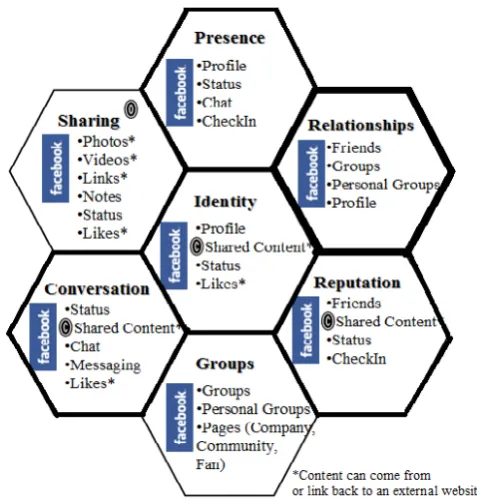
In order to have better understanding on Facebook services and their specific engagement needs, a honeycomb Facebook functional building blocks model was utilised (Kietzmann, Hermkens, McCarthy & Silvestre, 2011).
2. HONEYCOMB FACEBOOK FUNCTIONAL BUILDING BLOCKS
Figure 1: Facebook features’ fit on Smith’s (2007) Honeycomb Model (Rana Babac,2011)
Honeycomb model helps to explain the effects that each block is having and each building block of the model presents an important social media phenomenon. At the bottom line it could be used to explain how firms should engage with social media. The model is driven by primary, secondary and tertiary building blocks, which showed the rationale and importance of design decisions. The darker the color of each block line, the greater this social media functionality within the site (Kietzmann et al., 2011). The model also helps the employers to analyse and select appropriate blocks to be used for the community’s needs. In this section, we briefly present the seven functional building blocks of Facebook.
The seven honeycomb blocks are (1) Groups; represents the extent to which users can form their own societies or sub societies, (2) Reputation; represents the extent to which users can determine other users’ level or themselves in terms of their reputations through shared contents, status, friend list and CheckIn, (3) Relationships; represents the extent to which users attached to other users, they can create relationships through profile, adding new friends, joining other groups and creating their personal groups, (4) Sharing; represents the extent to which users exchange, distribute, receive and sharing their photos, audios, videos, notes, the likes and their status, (5) Conversations; represents the extent to which users communicate with other users in Facebook setting such as chatting, sharing, sending messages, shared contents and share the likes, (6) Identity; represents the extents to which users reveal their identities in Facebook setting such as their profile (name, gender, age and qualification), their status and interest, their shared contents and any information that represent users, (7) Presence; represents the extent to which users identify users from their user profile, status, chatting and CheckIn status on Facebook.
3. METHODOLOGY
This is a quantitative survey research utilizing a set of self administrative questionnaire as an instrument. The questionnaire set was distributed to the selected respondents using “drop and collect” method. The respondents were given one week to complete the questionnaire and it was then collected by the researcher from the faculty office. The sample was chosen based on simple random selection techniques according to Krecjie and Morgan table (1970). The design of the study required data to be collected from 55 academic staffs from the Faculty of Computer Science and Information Technology (FCSIT), UNISEL.
The instrument used in this study is a set of questionnaire comprising of 44 questions developed to investigate the usage of Facebook functional building blocks. A Honeycomb Facebook functional building blocks items was developed based on Smitch model (2007). The questionnaire is divided into three sections: Part A contains 6 questions designed to capture the demographic background. Part B contains 9 questions designed to understand the users’ usage pattern of Facebook and Part C contains 29 items structured to investigate the usage of seven Facebook functional building blocks among academic staffs.
Pretest was carried out to determine the reliability of the research instrument. Alpha Cronbach values recorded on Identity is 0.828, Relationships (0.902), Groups (0.986), Presence (0.753), Sharing (0.931), and Conversations (0.745), Reputation (0.763). Thus, the reliability of research instrument is acceptable. Descriptive statistics including frequency, percentage, mean and standard deviation used to determine demographic characteristics of the respondents, the pattern of Facebook usage and the trend of facebook usage through functional building blocks.
4. FINDINGS
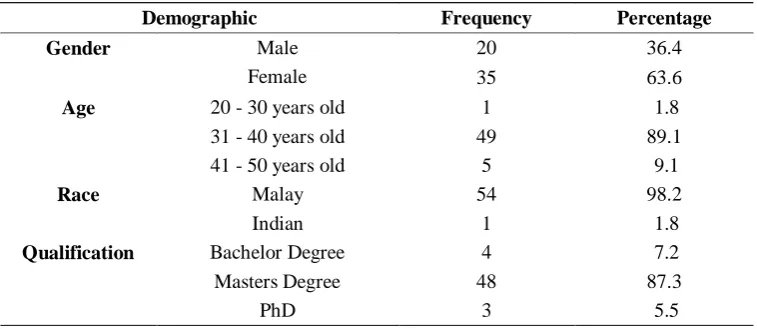
As recorded in Table 1, the respondents involved in this research include 20 (36.4%) males and 35 (63.6%) females. 49 of them (89.1%) are below 40 years old, 5 (9.1%) below 50 years old, and only 1 (1.8%) below 30 years old. The majority of the respondents are Malays (98.1%). As for academic qualification the data collected shows that 4 (7.2%) are Bachelor Degree holders, 48 (87.3%) Master Degree holders and 3 (5.5%) Ph.D holders.
Table 1: Distribution of Respondents by Demographic Background (n=55)
Demographic Frequency Percentage
Gender Male 20 36.4
Female 35 63.6
Age 20 - 30 years old 1 1.8
31 - 40 years old 49 89.1
41 - 50 years old 5 9.1
Race Malay 54 98.2
Indian 1 1.8
Qualification Bachelor Degree 4 7.2
Masters Degree 48 87.3
PhD 3 5.5
4.1
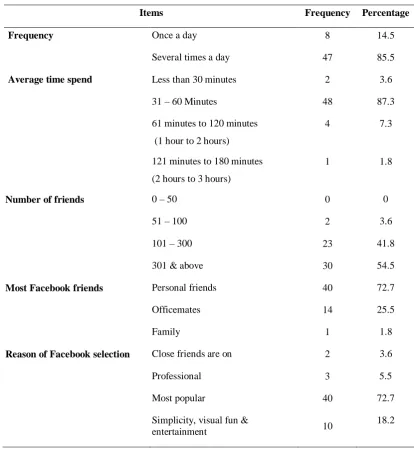
Pattern of Facebook Usage among Academic staffs in FCSIT, UNISELTable 2 recorded the data on the frequency of Facebook usage by the respondents. The highest pattern (84.5%) of the respondents logged in to their Facebook account several times a day while the least pattern (14.5%) logged in to their Facebook account once a day. A large percentage of respondents (87.3%) had spent their time browsing through their Facebook account with an average time of 31 minutes to 60 minutes and only a small percentage of them (3.6%) had spent between 1 to 2 hours daily. More than half of the respondents (54.5%) had a total number of more than 301 friends in their Facebook account. While 41.8% of them are having Facebook friends between 101 to 300 friends. Most of their Facebook friends (72.7%) are personal friends and another 27.3% from co-workers or officemates. The majority of the respondents (72.7%) choose Facebook over other social communication channels due to its popularity.
Table 2: Pattern usage on Facebook (n=55)
Items Frequency Percentage
Frequency Once a day 8 14.5
Several times a day 47 85.5
Average time spend Less than 30 minutes 2 3.6
31 – 60 Minutes 48 87.3
61 minutes to 120 minutes
(1 hour to 2 hours)
4 7.3
121 minutes to 180 minutes
(2 hours to 3 hours)
1 1.8
Number of friends 0 – 50 0 0
51 – 100 2 3.6
101 – 300 23 41.8
301 & above 30 54.5
Most Facebook friends Personal friends 40 72.7
Officemates 14 25.5
Family 1 1.8
Reason of Facebook selection Close friends are on 2 3.6
Professional 3 5.5
Most popular 40 72.7
Simplicity, visual fun &
entertainment 10
18.2
5. FACEBOOK FUNCTIONAL BUILDING BLOCKS
Tables 3 – 9 listed the data collected from the study and the findings;
5.1 Identity Function Building Block
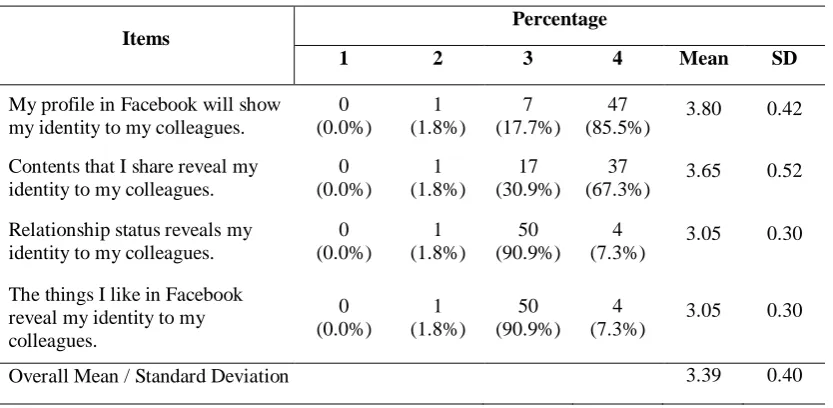
In terms of identity functional building blocks, data in Table 3 shows that almost all respondents agreed that the Identity Functional building block is important for them to reveal their identities and to have better engagement with their friends. (M=3.39, SD=0.40). The highest mean value of 3.80 is for item “My profile in Facebook will show my identity to my colleagues”, followed by mean 3.65 for item “Contents that I share reveal my identity to my colleagues” and “Relationship status reveals my identity to my colleagues” with mean 3.05. Facebook is a virtual community where users create their individual public profiles, interact with real-life friends, and meet other people based on shared interests. Users can reveal their name, gender, age, qualification, relationship status and any information that they represent and also disclose their subjective information through their feelings and thoughts (Kaplan and Haenlein, 2010).
Table 3: Frequency, Percentage, Mean score and Standard Deviation in Identity Functional building block towards Using Facebook (n=55)
Items Percentage
1 2 3 4 Mean SD
My profile in Facebook will show my identity to my colleagues.
0 (0.0%)
1 (1.8%)
7 (17.7%)
47
(85.5%) 3.80 0.42
Contents that I share reveal my identity to my colleagues.
0 (0.0%)
1 (1.8%)
17 (30.9%)
37
(67.3%) 3.65 0.52
Relationship status reveals my identity to my colleagues.
0 (0.0%)
1 (1.8%)
50 (90.9%)
4
(7.3%) 3.05 0.30
The things I like in Facebook reveal my identity to my colleagues.
0 (0.0%)
1 (1.8%)
50 (90.9%)
4
(7.3%) 3.05 0.30
Overall Mean / Standard Deviation 3.39 0.40
5.2
Relationship Functional Building BlockIn terms of relationship functional building block, data in Table 4 shows that generally the respondents agree that Relationship functional building block in Facebook is important to build relationship among them. (M =3.39, SD = 0.40). The highest mean value of 3.80 is for item “Joining any groups in Facebook will build relationship with my colleagues”, followed by mean 3.65 “I add my colleagues in my friend-list in Facebook is the way to build relationship with them” and “Groups in Facebook created by me build relationships with my colleagues” with mean 3.05. Facebook enables us to identify and build relationship and join self-organizing communities that share our interests. Relationship developed when users start to create their own group and through this way a productive conversation fostered especially when they start to communicate and exchange valuable information.
Table 4: Frequency, Percentage, Mean score and Standard Deviation in Relationship Functional building block towards Using Facebook (n=55)
5.3.1 Presence Functional Building Block
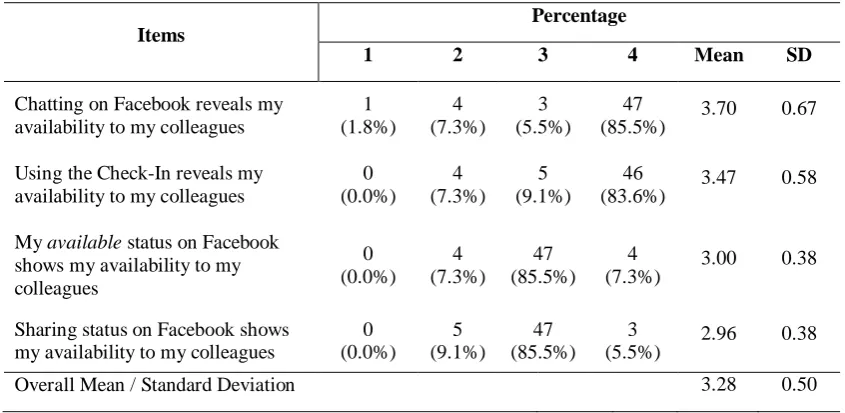
The data presented in Table 5 represented the responses of the respondents on the presence functional building blocks. Most of the respondents agree that knowing the whereabouts of others in the virtual world and/or in the real world, and whether they are available or not are important for them (M =3.28, SD = 0.50). The highest mean score (3.70) recorded for item “Chatting on Facebook reveals my availability to my colleagues”, followed by item “Using the Check-In reveals my availability to my colleagues” with mean score 3.47 and “My available status on Facebook shows my availability to my colleagues” with mean score 3.00. Facebook enables users to know the accessibility of other users in a specific time. It may include knowing where others are (in the virtual or real world), whether they are available, busy or taking a break.
Table 5: Frequency, Percentage, Mean score and Standard Deviation in Presence Functional building block towards Using Facebook (n=55)
Items
Percentage
1 2 3 4 Mean SD
Chatting on Facebook reveals my availability to my colleagues
1 (1.8%) 4 (7.3%) 3 (5.5%) 47
(85.5%) 3.70 0.67
Using the Check-In reveals my availability to my colleagues
0 (0.0%) 4 (7.3%) 5 (9.1%) 46
(83.6%) 3.47 0.58
My available status on Facebook shows my availability to my colleagues 0 (0.0%) 4 (7.3%) 47 (85.5%) 4
(7.3%) 3.00 0.38
Sharing status on Facebook shows my availability to my colleagues
0 (0.0%) 5 (9.1%) 47 (85.5%) 3
(5.5%) 2.96 0.38
Overall Mean / Standard Deviation 3.28 0.50
Items
Percentage
1 2 3 4 Mean SD
Joining any groups in Facebook will build relationship with my colleagues.
0 (0.0%) 1 (1.8%) 7 (17.7%) 47
(85.5%) 3.80 0.42
I add my colleagues in my friend-list in Facebook is the way to build
relationship with them.
0 (0.0%) 1 (1.8%) 17 (30.9%) 37
(67.3%) 3.65 0.52
Groups in Facebook created by me build relationships with my colleagues.
0 (0.0%) 1 (1.8%) 50 (90.9%) 4
(7.3%) 3.05 0.30
I share my profile in Facebook to build relationship with my colleagues.
0 (0.0%) 1 (1.8%) 50 (90.9%) 4
(7.3%) 3.05 0.30
Overall Mean / Standard Deviation 3.39 0.40
5.4 Group Functional Building Block
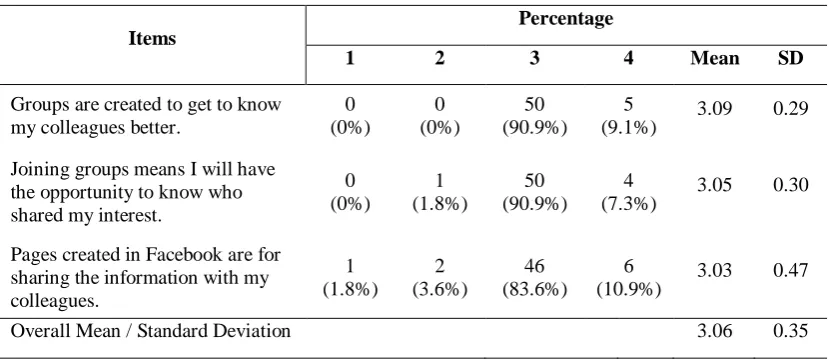
Does respondent getting more engaging with their Facebooks friends by forming or joining groups? Table 6 presented three items related to this question and overall mean score (3.06, SD 0.35) shows that most of the respondents agreed that they are getting more engaging with their Facebooks friends by forming or joining groups. The highest mean score (3.09) recorded for the item “Groups are created to get to know my colleagues better” and followed by the item “Joining groups means I will have the opportunity to know who shared my interest” (mean score 3.05) and “Pages created in Facebook are for sharing of the information with my colleagues” (mean score 3.03). Groups in Facebook represent the extent to which users can form their own societies or sub societies. The larger the group means that more people are socializing among themselves.
Table 6: Frequency, Percentage, Mean score and Standard Deviation in Group Functional building block towards Using Facebook (n=55)
Items
Percentage
1 2 3 4 Mean SD
Groups are created to get to know my colleagues better.
0 (0%)
0 (0%)
50 (90.9%)
5
(9.1%) 3.09 0.29
Joining groups means I will have the opportunity to know who shared my interest.
0 (0%)
1 (1.8%)
50 (90.9%)
4
(7.3%) 3.05 0.30
Pages created in Facebook are for sharing the information with my colleagues.
1 (1.8%)
2 (3.6%)
46 (83.6%)
6
(10.9%) 3.03 0.47
Overall Mean / Standard Deviation 3.06 0.35
5.5 Sharing Functional Building Blocks
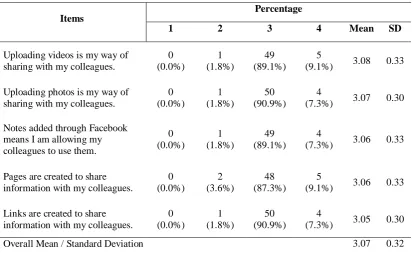
Data from items related to Sharing Functional Blocks in Table 7 shows that almost all respondents agree (mean score 3.07, SD 0.32) that sharing functional building block in Facebook is a way to communicate and to build relationship with their colleagues. The highest mean score (3.08) is recorded for item “Uploading videos is my way of sharing with my colleagues”, followed by item “Uploading photos is my way of sharing with my colleagues” (mean score 3.07) and “Notes added through Facebook means I am allowing my colleagues to use them” (mean score 3.06). Media sharing sites, such as MySpace, Flickr and Facebook are concentrating on shared videos and photos. In Facebook, users can share, exchange, distribute, and receive content as a way of communication with other users.
Table 7: Frequency, Percentage, Mean score and Standard Deviation in Sharing Functional building block towards Using Facebook (n=55)
Items
Percentage
1 2 3 4 Mean SD
Uploading videos is my way of sharing with my colleagues.
0 (0.0%)
1 (1.8%)
49 (89.1%)
5
(9.1%) 3.08 0.33
Uploading photos is my way of sharing with my colleagues.
0 (0.0%)
1 (1.8%)
50 (90.9%)
4
(7.3%) 3.07 0.30
Notes added through Facebook means I am allowing my colleagues to use them.
0 (0.0%)
1 (1.8%)
49 (89.1%)
4
(7.3%) 3.06 0.33
Pages are created to share information with my colleagues.
0 (0.0%)
2 (3.6%)
48 (87.3%)
5
(9.1%) 3.06 0.33
Links are created to share information with my colleagues.
0 (0.0%)
1 (1.8%)
50 (90.9%)
4
(7.3%) 3.05 0.30
Overall Mean / Standard Deviation 3.07 0.32
5.6 Conversations’ Functional Building Blocks
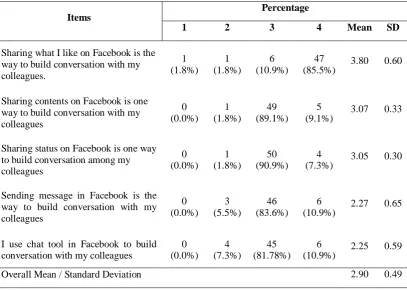
Data on the impact of conversations in Facebook’s Functional Blocks on the relationship among users as shown in Table 8 indicated that most respondents agreed that the conversations taking place had helped to build relationship among them. Higher overall mean score is recorded (2.90, SD 0.49). On item “Sharing what I like on Facebook is the way to build conversation with my colleagues” mean score recorded is 3.80 and followed by item “Sharing contents in Facebook is one way to build conversation with my colleagues” with mean score 3.70 and the third highest score with 3.05 is recorded by item “Sharing status on Facebook is one way to build conversation among my colleagues”. Users can communicate with others in a social media setting. Most of the media sites provide users a medium for conversations to meet new people or to share new ideas. Facebook and many other social media sites were also designed primarily to facilitate conversations among individuals and groups.
Table 8: Frequency, Percentage, Mean score and Standard Deviation in Conversation Functional building block towards Using Facebook (n=55)
Items
Percentage
1 2 3 4 Mean SD
Sharing what I like on Facebook is the way to build conversation with my colleagues.
1 (1.8%)
1 (1.8%)
6 (10.9%)
47
(85.5%) 3.80 0.60
Sharing contents on Facebook is one way to build conversation with my colleagues
0 (0.0%)
1 (1.8%)
49 (89.1%)
5
(9.1%) 3.07 0.33
Sharing status on Facebook is one way to build conversation among my colleagues
0 (0.0%)
1 (1.8%)
50 (90.9%)
4 (7.3%)
3.05 0.30
Sending message in Facebook is the way to build conversation with my colleagues
0 (0.0%)
3 (5.5%)
46 (83.6%)
6
(10.9%) 2.27 0.65
I use chat tool in Facebook to build conversation with my colleagues
0 (0.0%)
4 (7.3%)
45 (81.78%)
6 (10.9%)
2.25 0.59
Overall Mean / Standard Deviation 2.90 0.49
5.7 Reputation Functional Building Blocks
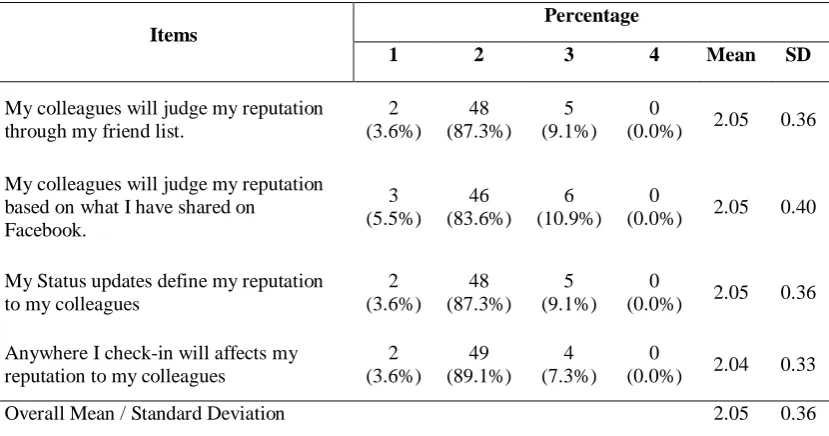
Overall mean score recorded lower (Mean score 2.05, SD 0.36) for the Reputation Functional Building Block in Facebook setting. This means that most of the respondents tend to disagree that Functional Building Block is important for them to get engaged with their colleague members. Three items recorded mean score 2.05, “My colleagues will judge my reputation through my friend list”, “My colleagues will judge my reputation based on what I have shared on Facebook” and “My Status updates define my reputation to my colleagues”. Reputation could have many connotations on social media platforms. In most cases, reputation is identified with the higher status of others or the degree of trust laid on others.
In social media, reputation refers not only to people but also their shared contents, friendlist and status updates which is often acknowledged using content voting systems. On YouTube, the reputation of videos might be based on ‘view counts’ or ‘ratings,’ and on Facebook this could be the total number of ‘likes’. The number of friendlist and likes on Facebook however has a limited value since it only indicates the popularity of a person and not the number of people who actually read the posts.
Table 9: Frequency, Percentage, Mean score and Standard Deviation in Functional building block Reputation towards Using Facebook
Items
Percentage
1 2 3 4 Mean SD
My colleagues will judge my reputation through my friend list.
2 (3.6%)
48 (87.3%)
5 (9.1%)
0
(0.0%) 2.05 0.36
My colleagues will judge my reputation based on what I have shared on
Facebook.
3 (5.5%)
46 (83.6%)
6 (10.9%)
0
(0.0%) 2.05 0.40
My Status updates define my reputation to my colleagues
2 (3.6%)
48 (87.3%)
5 (9.1%)
0
(0.0%) 2.05 0.36
Anywhere I check-in will affects my reputation to my colleagues
2 (3.6%)
49 (89.1%)
4 (7.3%)
0
(0.0%) 2.04 0.33
Overall Mean / Standard Deviation 2.05 0.36
6. CONCLUSION
Many years ago Facebook was almost unknown to many but today it has gained the highest popularity among other social network. In early days it has only attracted young and techno-savvy generation but today users had come from all walks of life including academicians, young and old as discovered in the group of respondents of this study. Ultimately, users among academicians at UNISEL had their own purposes of using Facebook but the findings of this study indicated that almost all of them are having common perception on the functional building blocks and how these functions could be utilized to maximise the usage of this social networking platform to expand and extend their relationship and develop further virtual friendship.
Facebook as a social networking was also discovered to be among the most powerful tools to improve the communication level in organisation and increase further collaboration among co-workers. The findings of this study is useful for organizations be it governmental or privates to look further on the best approach to improve their organizational communication level and effectiveness. Many issues and problems inside institutions could be solved faster if Facebook or other social networking fully utilized not only for informal communication but also for formal tasks and critical decision making. Future research on the impact of social media on many aspects of organizational management is highly demanding. For instance, a study could be conducted on how an organization could safe their budget by using free and open social networking such as Facebook, Twitter and etc.
REFERENCES
Hansen, D. L., Shneiderman, B., & Smith, M. A. (2011). Analyzing social media networks with NodeXL: Insights from a connected world. Burlington, MA: Morgan Kaufmann.
Hartman, Jackie L. & McCambridge, Jim. (2011). Optimizing Millennials’ Communication Styles,
Business Communication Quarterly, 74(1), 22-44.
Kaplan, A. M., & Haenlein, M. (2010). Users of the world, unite! The challenges and opportunities of Social Media. Business Horizons, 53(1), 59–68.
Kietzmann J. H., Hermkens K, McCarthy I. P. & Silvestre B. S. (2011) Social media? Get serious! Understanding the functional building blocks of social media. Business Horizons, 54(3), 241– 251.
Krejcie, R.V. & Morgan, D.W. 1970. Determining sample size for research activities. Educational and psychological measurement. 607-610.
Smith, S. (2002). The Best of Pat Jackson in PR Reporter. PR Publishing Co.
Watson, G. W. & Papamarcos, S. D. (2002). Social capital and organizational commitment, Business and Psychology, 16(4), 537–552.