Vol. 8, No.1| June 2016| ISSN 2229-8932 Journal of Technical Education and Training (JTET) |34
EFFECTS OF TEACHERS’ GENDER AND QUALIFICATION ON
STUDENTS’ PERFORMANCE IN VOCATIONAL TECHNICAL
EDUCATION
Igberadja, S.
Independent Researcher Delta State, Nigeria
ABSTRACT
The purpose of this study was to assess the effects of teachers’ gender and qualification on students’ performance in industrial safety. Two research questions guided the study and 2 hypotheses were tested at 0.05 level of significance. Ex-post facto research design was used and the population of the study was 334 students who registered Industrial Safety (TED 112) from 2004/2005 to 2013/2014 Academic Session. Due to the results TED112 available at the time of request for TED112 results, purposive sampling technique was used to select the TED112 result of students for 4 sessions. Two sessions each was selected based on the lecturers’ gender and qualification. However, 2007/2008, 2008/2009, 2009/2010, and 2013/2014 Session results were used as sample of the study. Therefore, the sample of the study was 91 undergraduate students. No instrument was developed in this study rather a letter was used to request for data. Data collected was analysed using mean for the research questions and anova (Analysis of variance) to test the hypotheses. The result revealed that the teachers’ gender and qualification do not have any significant effects on students’ performance in Industrial Safety. Hence, it was recommended among others that Delta State Ministry of Higher Education should employ qualified male and female lecturers to teach vocational technical education courses,since students’ performce is not related to the gender and qualification of the teacher, there should be no gender and qualification preference in recruiting VTE teachers in schools.
Vol. 8, No.1| June 2016| ISSN 2229-8932 Journal of Technical Education and Training (JTET) |35 1. INTRODUCTION
Education is considered the first step for every human activity as it plays a vital role in the development of human capital as well as an individual’s well-being and opportunities for better living. Vocational Technical Education (VTE) is a program of study designed to equip students with practical skills in different occupational fields which will help them become self-reliant in the face of the paucity of paid employment. Education for work had its beginning many years ago. In VTE, individuals are formally prepared for the world of work. Technical education differs in both concept and status in different nations of the world. In Nigeria,vocational technical education programmes are offered at the pre-vocational and vocational schools at post-primary level, the technical colleges, the polytechnics, and colleges of technical education and universities at the postsecondary level.
According to Udo (2004), technical vocational education is designed to develop skills, abilities, understanding, attitudes, work habits and appreciation that confers knowledge needed to enter and make progress in employment on a useful and productive basis. Vocational technical education (VTE) has been described as that form of education, which equips its recipients with the knowledge and skill necessary for transforming the findings of science into goods and services for the benefit of humanity (Raji, 2006). Shimare and Sallah (2005) described VTE as a vital instrument for changing and managing the environment recourses for technological, political, social and economic advancement of a nation. VTE is offered in technical colleges, Polytechnics, Monotechnics and Universities in Nigeria. The objectives of TVE are:
i. Provide trained workforce in the applied sciences, technology and business, particularly at craft and technical levels;
ii. Provide the technical knowledge and vocational skills necessary for agriculture, commercial and economic development;
iii. Give training and impart the necessary skills to individuals who shall be self-reliant economically (Federal Republic of Nigeria, 2004).
Academic achievement or performance is used in the school to refer to students’ success in learning specified curriculum content as revealed by continuous assessment and examination. According to Adediwura and Tayo (2007), academic achievement is designated by test and examination scores or marks assigned by the subject teachers. It could also be said to be any expression used to represent students’ scholastic standing. Levin, Wasanga and Somerset (2011) reported that the academic achievement of students at secondary school level is not only a pointer of the effectiveness of schools, but also a major determinant of the well-being of youths in particular and the nation in general. Yusuf and Adigun (2010); Lydiah and Nasongo (2009) noted that the performance of students in any academic task has always been of special interest to the government, educators, parents and society at large.
Vol. 8, No.1| June 2016| ISSN 2229-8932 Journal of Technical Education and Training (JTET) |36
effectiveness while poor academic achievement, on the other hand, is an indication that the teaching/learning process is everything but effective.
The differential scholastic achievement of students in Nigeria has been and is still a source of concern and research interest to educators, government and parents. This is so because of the great importance that education has on the national development of the country. All over the country, there is a consensus of opinion about the fallen standard of education in Nigeria (Adebule, 2004). Parents and government are in total agreement that their huge investment in education is not yielding the desired dividend. Teachers also complain of students’ low performance at both internal and external examinations.
Poor academic performance, according to Aremu (2003) is a performance that is adjudged by the examinee/testee and some other significant as falling below an expected standard. Poor academic performance has been observed in school subjects, especially mathematics, chemistry and English language among secondary school students (Adesemowo, 2005). Aremu (2000) stresses that academic failure is not only frustrating to the students and the parents, its effects are equally grave on the society in terms of the dearth of manpower in all spheres of the economy and politics.
Teachers cannot be dissociated from the schools they teach and academic results of schools. It would therefore be logical to use the standardized students’ assessments results as the basis for judging the performance of teachers. Teachers celebrate and are rewarded when their schools and teaching subjects are highly ranked. While appreciating the value of rewarding teachers who produce better results, teachers should also not escape a portion of blame when students perform poorly.It has been proved that teachers have an important influence on students’ academic achievement. They play a crucial role in educational attainment because the teacher is ultimately responsible for translating policy into action and principles based on practice during interaction with the students (Afe, 2001). In their study, Wright, Horn and Sanders (1997) concluded that the most important factor influencing student learning is the teacher. Teachers stand at the interface of the transmission of knowledge, values and skills in the learning process. If the teacher is ineffective, students under the teacher’s tutelage will achieve inadequate progress academically. This is regardless of how similar or different the students are in terms of individual potential in academic achievement.
Vol. 8, No.1| June 2016| ISSN 2229-8932 Journal of Technical Education and Training (JTET) |37
gender affect the academic performance of students in Science Technical Education and Mathematics (STEM) courses which Industrial Safety is a part of it.
Industrial Safety course is a general course in the field of Vocational Technical Education which is a core course Technical Education students must pass asa requirement for graduation. There is, therefore, need to assess the effects of teachers’ personal characteristics on students’ academic achievement in vocational technical education programme. Consequently, this study focuses on the effects of teacher’s gender and qualification on the academic achievement of students in the industrial safety course.
Teaching and learning of industrial safety depend to a large extent on the teachers’ knowledge of the course content and ability to adequately or effectively deliver the instruction to the students. Scholars have posited that a lot of teachers’ characteristics or variables may inhibit or hinder effective subject delivery. According to Abe (2014), these variables include teachers’ qualification, experience, and gender. It is against these backdrops that this present study seeks to find out whether teachers’ gender and qualification may affect the academic performance of students in industrial safety.Specifically, the study sought to find out the/compare the:
i. The effects of lecturers’ gender on students’ performance on Industrial Safety in VTE.. ii. The effect of lecturers’ qualification on students’ performance on Industry Safety in VTE iii. Compare the mean scores of students taught industrial safety by male and female lecturer iv. Compare the mean scores of students taught industrial safety by the lecturer with Ph.D
and M.Sc degree.
This study will be significant to technical education lecturers, students and stakeholders. This is so because the study will exposed the facts regards the effects of teachers’ gender and qualification on students’ performance. Hence, the findings of this study will be useful to judge the performance of students taught industrial safety. This will enable technical education lecturers, students, and stakeholders put in place measures that will improve students’ performance in industrial safety.
1.1 Research Questions
The following research questions guided the study:
i. What is the effect of lecturers’ gender on the students’ performance in the Vocational Technical Education?
ii. What is the effect of lecturers’ qualifications on the students’ performance in the Vocational Technical Education?
1.2 Hypotheses
The following hypotheses were tested at 0.05 level of significance:
i. There is no significant difference in the mean scores of students taught industrial safety by male and female lecturer.
Vol. 8, No.1| June 2016| ISSN 2229-8932 Journal of Technical Education and Training (JTET) |38 1.3 Empirical Studies
Owolabi and Adebayo (2012) study examined the effect of teacher’s qualification on the performance of Senior Secondary School students inPhysics. The results revealed that students taught by teachers with higher qualifications performed better than those taught by teachers with lower qualifications. The result also showed that teacher’s gender has no effect on their ability to impact knowledge on the students, much as he/she is a skilled teacher in that field of study. Similarly, Unanma, Abugu, Dike, and Umeobika (2013) study examined the relationship between Teacher’s academic qualifications and academic achievement of Senior Secondary school Students in Chemistry. The findings of the research revealed that there was a positive relationship between the teacher’s academic qualifications and student’s academic achievement.
In addition, Nwosu (2000) investigated the relationship between the qualification of science teachers and students academic performance in science subjects. The study discovered that there is a significant relationship between the qualification of teacher and students’ academic performance in science subjects. In same vein, Kifunya (2010) study on Teachers' Characteristics and Their Effects on Students’ Achievements in Chemistry: A Case Study of Bungoma North District.The purpose of the study was to investigate the effect of teacher qualification, experience and attitude on students’ performance in chemistry.The findings of the study showed that teacher characteristics were more influential in predicting student performance than school factors.
Consequently, Ugbe (2000) carried a research on the influence of teachers’ competence in students’ academic performance in senior secondary school chemistry in Cross River State. The study revealed that there is a significant difference between the performance of students taught by a qualified teacher and students taught by unqualified teacher in chemistry. Also, there is a significant difference between the performance of students taught by experienced teacher and students taught by inexperienced teacher. Furthermore, Bolarinwa (2014) study titled Teachers Characteristics and Students’ Performance Level in Senior Secondary School Financial Accounting.The purpose of this study was to investigate the relationship that exists between teachers’ characteristics (qualification, years of experience) and students’ performance level in Senior Secondary School Financial Accounting. Findings revealed that a positive relationship exists between teachers’ characteristics (Qualification and Experience) and performance level of the students in Financial Accounting. As well, Okoro, Ekanem, and Udoh (2012) study on Teacher Gender and the Academic Performance of Children in Primary Schools in Uyo Metropolis, Akwa Ibom State, Nigeria. The results showed that teacher-pupil gender interactions do significantly affect pupil’s academic performance.
2.0 METHODOLOGY
Vol. 8, No.1| June 2016| ISSN 2229-8932 Journal of Technical Education and Training (JTET) |39
2013/2014 Session results were used as sample of the study. Therefore, the sample of the study was 91 undergraduate students. No instrument was developed in this study.Rather, the researchers wrote a letter to the Head of Department of Technical and Business Education to request for data which was the TED112 results for the selected sessions. Data were collected by the researchers from the Department of Technical and Business Education Office and mean was used to analyse data for the research questions, while analysis of variance (ANOVA) was used to test the hypotheses. However, mean score of 50-69 is average performance, 70-100 is high performance, and 0-49 is poor performance. Furthermore, it was decided that where the f-calculated value was equal or greater than the table f-value, it indicates significant difference; the null hypothesis will be rejected but if otherwise, the null hypothesis will be accepted. All statistical analyses were performed with statistical package for social sciences (SPSS) software
3.0 DATA ANALYSIS AND RESULTS
The results of this study were presented according to the research questions and hypotheses.
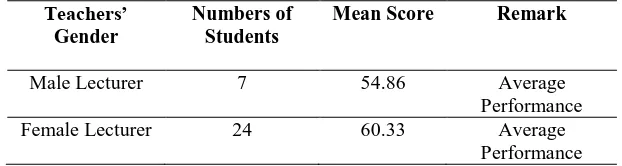
Research Question 1: What is the effect of lecturers’ gender on the students’ performance in the Vocational Technical Education?
Table 1 revealed that the performance of students taught by male and female lecturers were average, but the mean scores of students taught by female lecturer was higher than that of students taught by male lecturer.
Table 1: The mean scores of students taught Industrial Safety by male and female lecturer
Teachers’ Gender
Numbers of Students
Mean Score Remark
Male Lecturer 7 54.86 Average
Performance
Female Lecturer 24 60.33 Average
Performance
Research Question 2: What is the effect of lecturers’ qualifications on the students’ performance in the Vocational Technical Education?
Table 2 revealed that the performance of students taught by lecturer with Ph.D and M.Sc were average, but the mean scores of students taught by lecturer with Ph.D was higher than that of students taught by lecturer with M.Sc.
Table 2: The mean scores of students taught Industrial Safety by the lecturer with Ph.D and M.Sc degree
Teachers’ Qualification
Numbers of Students
Mean Score Remark
Lecturer with Ph.D 14 54.36 Average Performance Lecturer with M.Sc 46 53.83 Average
Vol. 8, No.1| June 2016| ISSN 2229-8932 Journal of Technical Education and Training (JTET) |40
Hypothesis 1: There is no significant difference in the mean scores of students taught industrial safety by male and female lecturer.
Table 3 revealed that the fcalculated (.007) is less than Ftabulated (4.67), therefore, the hypothesis was accepted. This implies that there was no significant difference in the mean scores of students taught industrial safety by male and female lecturer.
Table 3: The analysis of variance (ANOVA) of mean scores of students taught industrial safety by male and female lecturer
Sum of Squares Df Mean Square F Sig
Between People 974.714 6 162.452
Within People Between Items 1.143 1 1.143 .007 .935
Residual 955.857 6 159.310
Total 957.000 7 136.714
Total 1931.714 13 148.593
df=13, Ftab=4.67
Hypothesis 2: There is no significant difference in the mean scores of students taught industrial safety by the lecturer with Ph.D and M.Sc degree.
Table 3 revealed that the fcalculated (.022) is less than Ftabulated (4.21), therefore, the hypothesis was accepted. This implies that there was no significant difference in the mean scores of students taught industrial safety by the lecturer with Ph.D and M.Sc degree.
Table 4: The analysis of variance (ANOVA) of the mean scores of students taught industrial safety by the lecturer with Ph.D and M.Sc degree .
Sum of Squares df Mean Square F Sig
Between People 1872.464 13 144.036
Within People Between Items 2.893 1 2.893 .022 .885
Residual 1729.607 13 133.047
Total 1732.500 14 123.750
Total 3604.964 27 133.517
*Df=27, Ftab=4.21
4.0 DISCUSSION AND FINDINGS
Vol. 8, No.1| June 2016| ISSN 2229-8932 Journal of Technical Education and Training (JTET) |41
knowledge on the students, much as he/she is a skilled teacher in that field of study. However, the findings is in disagreement with the research of Akiri and Ugborugbo (2008) which revealed that there was a significant relationship between teachers’ gender and students’ academic achievement.As well, Okoro, Ekanem, and Udoh (2012) study showed that teacher-pupil gender interactions do significantly affect pupil’s academic performance.
Table 2 revealed that the performance of students taught industrial safety by the lecturer with Ph.D was average (54.36). As well, Table 2 revealed that the performance of students taught industrial safety by the lecturer with M.Sc was average (53.83).In addition, Table 4 revealed that hypothesis 2 which stated that there is no significant difference in the mean score of students taught industrial safety by the lecturer with Ph.D and M.Sc was accepted since the F-calculated (0.022) is less than the F-tabulated (4.21). This is in line with Ravkin et al (2005) study which revealed that teachers’ teaching experience and educational qualifications were not significantly related to students’ achievement. On a contrary, Owolabi and Adebayo (2012) study revealed that students taught by teachers with higher qualifications performed better than those taught by teachers with lower qualifications. Yala and Wanjohi (2011) and Adeyemi (2010) found that teachers’ experience and educational qualifications were the prime predictors of students’ academic achievement. Similarly, Unanma, Abugu, Dike, and Umeobika (2013) study revealed that there was a positive relationship between the teacher’s academic qualifications and student’s academic achievement. In addition, Nwosu (2000) study discovered that there is a significant relationship between the qualification of teacher and students’ academic performance in science subjects. Furthermore, Bolarinwa (2014) study revealed that a positive relationship exists between teachers’ characteristics (Qualification and Experience) and performance level of the students.
5.0 CONCLUSION
Based on the findings of this study, it was concluded that teachers’ gender and qualification do not have significant effects on the academic performance of students taught industrial safety. This implies that the rate of students’ performance are the same when taught by male or female lecturers, and when taught by the lecturers with Ph.D or M.Sc degree.
6.0 IMPLICATIONS OF THIS STUDY FOR PRACTICE AND/OR POLICY
The implication of the results from this study for practice and/or policy is that the study have been able to established that teachers’ gender and qualification does not have significant effects on students’ performance in vocational technical education. This implies that in practice and/or policy making, gender and qualification should not be a strong criteria for selecting vocational technical education lecturers. As well, in the distribution of courses to be taught by vocational technical education lecturers.
7.0 RECOMMENDATIONS
Based on the findings of this study, the following recommendations were made:
i. Since students’ performce is not related to the gender of the teacher, there should be no gender preference in recruiting VTE teachers in schools.
Vol. 8, No.1| June 2016| ISSN 2229-8932 Journal of Technical Education and Training (JTET) |42 References
Adebule, S. O. (2004). Gender differences on a locally standardized anxiety rating scale in mathematics for Nigerian secondary schools in Nigerian. Journal of Counselling and Applied Psychology. 1(1), 22-29. Adediwura, A. A. & Tayo, T. (2007). Perceptions of teacher knowledge, attitude and teaching skills as predictor of
academic performance in Nigerian secondary schools. Educational Research and Review, 2(7): 165-171. Adesemowo, P. O. (2005). Premium on affective education: Panacea for scholastic malfunctioning and aberration.
34th Inaugural Lecture, Olabisi Onabanjo University. Ago-Iwoye: Olabisi Onabanjo University Press. Adeyemi, B. (2010). Teacher related factors as correlates of pupils’ achievement in social studies in South West
Nigeria. Electronic journal of Research in Educational psychology, 8(1): 313-332.
Akiri, A. A. & Ugborugbo, N. M. (2008). An examination of genders influence on teachers productivity in secondary schools. Journal of Social Science, 17(3): 185-191.
Akiri, A.A. (2013). Effects of teachers’ effectiveness on students’ academic performance in public secondary schools, Delta State, Nigeria.Journal of Educational and Social Research, 3(3): 105-112.
Ali, S. (2013). Factors affecting academic achievement of students. American Journal of Educational Research 20131 (8), 283-289.
Aremu, O. A & Sokan, B. O. (2003). A multi-causal evaluation of academic performance of Nigerian learners: Issues and implications for national development. Department of Guidance and Counselling, University of Ibadan, Ibadan.
Arung, S.M. (2009). The effects of teachers qualification on students achievement in senior secondary school certificate examination in mathematics. M.Sc Classwork, Benue State University, Makurdi.
Etsy, K. (2005). Causes of low academic performance of primary school pupils in Theshamia Sub-Metro of Shama
Ahanta East Metropolitan Assembly of Ghana. Regional Conference of Education in West Africa, Dakar
Senegal, 1st -2nd Novemeber 2005
Federal Republic of Nigeria (2004). National policy on education (4th ed). Lagos: Nigerian Educational Research & Development Council.
Lewin, K. M., Wasanga, P., Wanderi, E. & Somerset, A. (2011). Participation and performance in education in Sub-Saharan Africa with special reference to Kenya.
Lydiah, L. M. & Nasongo, J. W. (2009). Role of the headteacher in academic achievement in secondary schools in Vihiga District, Kenya. Current Research Journal of Social Sciences,1(3): 84-92.
Owolabi, O.T. & Adebayo, J.O. (2012). Effect of teacher’s qualification on the performance of senior secondary school physics students: implication on technology in Nigeria. English Language Teaching, 5(6): 72-77. Raji, T.I. (2006). Population parameters in technology education for sustainable economic growth.Lead Paper
Presented at the 2nd Annual National Conference of the School of Technical Education, F. E. C. (T) Akoka, Lagos.
Rivkin, S. G., Hanushek, E. A, & Kain, J. F. (2005). Teachers, schools, and academic achievement. [Online] Available: http://www.utdallas.edu/research/tsp/pulications.htm. Retrieved on May 12, 2012.
Shimare, S. M. & Sallah, G.D. (2005). Issues on active women participation in technology education/or national empowerment.A paper presented at 18th Annual National Conference Held in Port-Harcourt.
Ugbe, A.I. (2000). Influence of teacher’s competence on student’s academic performance in senior secondary school chemistry. Educational Journal, 8: 61-69.
Wright, S. P., Horn, S. P. & Sanders, W. C. (1997). Teacher and classroom context effects on student achievement: implications for teacher evaluation. Journal of Personnel Evaluation in Education, 11(1), 57-67.
Yala, P. O. & Wanjohi, W. C. (2011). Performance determinants of KCSE in mathematics in secondary schools in Nyamira Division, Kenya. Asian Social Science, 7(20): 107-112.