ABSTRACT
The major component in nursing education is attachmnet at clinical practices to give the students experience, responsibility and understanding in care of the patient. Nurse educators and the clinical nurse instructors are responsible for coordinating the education of nursing students in clinical area. Currently practice using nursing processes is more familiar to compare than concept mapping care plan among the nurses and nursing students. Nursing care plan or nursing process has been utilized at the clinical setting to assess the actual and potential health problems of the patients. However, the format of nursing care plans makes challenging to the students, especially for new students in semester one to gather the information based on patients problems. In addition, this nursing process evaluation is one of examination tools for them in running assessments. Therefore, the development of concept mapping care plan at clinical practices was used to evalaute the students academic achievement in clinical pratices. Concept mapping care plan was found to enhance the knowledge and understanding of the nursing students and also improving the quality of clinical education. Nursing students who have good skills will perform certain procedures better than students having fewer skills. This affects the quality of work in the future as either a higher quality or of poor quality.
Keywords: Concept mapping care plan, Nursing care plan, Nursing students
1*, 2 3 4
Rusnani Ab Latif Akehsan Dahlan , Zamzaliza Ab Mulud , Mohd Zarawi Mat Nor
*Corresponding Author Email: [email protected]
1
Kubang Kerian Nursing College Malaysia
2
Universiti Teknologi MARA, Malaysia
3
Universiti Sains Malaysia, Malaysia
INTRODUCTION
The major component in nursing education is the attachmenet at clinical practices. Attachment to clinical practices, give the students experience, responsibility and understanding in care of the patient. The clinical learning environment has a great impact on students' learning and professional development, when students take care of patients that need extensive nursing interventions, they experience engagement in learning through nursing care (Manninen et al., 2013). It is supported by Morgan(1991) who stated that clinical education has been seen as the heart of professional nursing education.The clinical practices is an important learning environment of nursing students to get the learning experiences. The most influential context in acquiring knowledge and nursing skills for the nursing students is clinical settiong (Chan, 2003).
Nurse educators and the clinical nurse instructors are responsible for coordinating the education of nursing students in clinical area. Concept mapping as an active teaching is important in contributinge to the meaningful learning in classroom, so that the students can transform the knowledge learnt in didactic theory to clinical setting, it is important especially for nursing students those
interact with the patients. Therefore, the development of concept mapping care plan at clinical practices was used to evalaute the students academic achievement in clinical pratices. Concept mapping care plan was found to enhance the knowledge and understanding of the nursing students and also improved the quality of clinical education. By using concept mapping, the students not only gained content knowlege, but also enhanced the development of problem solving, crtical thinking, communication skills and active learning (Erasmus, 2013).
LITERATURE REVIEW
The characteristics of the differences between concept mapping care plan and nursing care plans i. Format
insight. To implement this concept mapping care plan in clinical setting early introduction to the nursing students is important before the students become familiar with traditional nursing care plans.
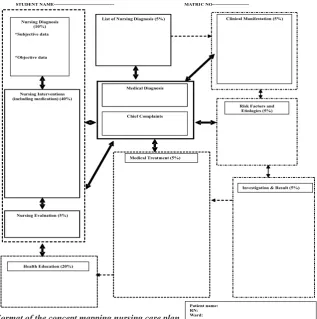
The framework of concept mapping care plan itself allows the students to foster connections between knowledge, theory and practical. It makes the learning at clinical practices more effectively with enhanced cognitive skills in learners; promoting critical thinking and makes the learning at clinical setting becomes meaningful one. It is because of the structured flow of the concept was arranged in the hierarchical manner. Concept mapping promotes the learning of new content by creating hierarchical arrangements of concepts and sub concepts and identifying the relationships between them (Wheeler & Collins, 2003). The Figure 1 below showed an example of a nursing care plan (nursing process) in the form of a column that has been practice in hospitals in Malaysia. Meanwhile figure 2 showed the concept mapping care plan that developed by the
researcher. Figure 1: Format of the nursing care plan (nursing process)
CONCEPT MAPPING CARE PLAN AND NURSING CARE PLAN
ii. Evaluation to score
In a study by Nirmala and Shakuntala (2012), it has been also reported that 18% of the respondents felt that it is very complicated to make concept maps as compared than using nursing care plan format as usual. 13% of the respondents felt tied while making the concept maps. In addition, 23% of the respondents felt that is difficult to read and understand the concept maps prepared by others. Meanwhile, 21% of the respondents stated that they felt that it is difficult to apply concept maps to the nursing process and it is difficult to evaluate the concept maps. Few of the respondents felt that it is difficult to change nursing process format to concept mapping in making nursing care plan, but they said that if the concept mapping was introduced first like the nursing process, it is easy to follow.
The author recommended that nurse educator can be trained to use and teach nursing students to used concept mapping in nursing care plan at the clinical areas, thus it can improve the quality of nursing care of the patients and enhance the patient safety. Concept maps to be a more accurate method of assessing knowledge attained during an internship than the traditional multiple-choice test method (Pilcher, 2009).
Therefore, the researcher believes that the development of concept mapping care plan to use in the clinical practices in this study was give benefit to the nursing student because it just need the nursing students to fill the columns that had already structured likes the nursing process format. In overcome the problems of difficult to evaluate the concept mapping, the researcher using rubric score based on the percentages adapted from Ainsley (2003). The score was divided to three categories: Low (<33.3%), Moderate (>33.3-66.6%) and High (>66.6%).
iii. Stimulate critical thinking
Nursing educators are faced with the dilemma of preparing critically thinking nursing students for professional practice in order to function within a complex health care system. Critical thinking is required to ensure quality care of the patients. Concept mapping has been identified as a stimulating learning method to facilitate critical thinking by encouraging students to connect new knowledge to their prior learning, and to give students an opportunity to gain further, wide and varied knowledge on a number of
concepts in a short period (Akinsanya & Williams, 2004).
Concept mapping care plan encourage students to develop the ability to organize and relate knowledge from didactive theory, especially learning using case base learning based on scenario to use at clinical practices. It also teaches the nursing students to use critical thinking to solve the problem solving. Hence, in nursing education concept mapping is adapted to develop nursing care plans from the assessment data collected from patients instead of the common care plans prepared in columns (Pehlar, 2003). Concept mapping is a teaching strategy that assists nursing educators in promoting critical thinking skills (Roop, 2002). More often than not, students cannot relate the clinical manifestations of diseases and the nursing process, especially when they were at clinical practices.
By using concept mapping, the students have a total view of patient care, where patient's medical conditions and nursing education can be made to be related. It promotes a holistic view of the patient care and prepare student to think critically when the student understand the concept, relationship to plan and can evaluate nursing care. Ausubel (1968) developed the assimilation theory also explains that concept mapping strategy might be more effective than traditional nursing care plans. It is because concept mapping helps student to learn, to think critically.
iv. Able to view the holistic perspective of the patients
Nurse educators have looked at the implementation of concept mapping as an instructional strategy to improve nursing care plan at the clinical areas. Nurse educators need to gain understanding about how their beliefs affect educational teaching in the clinical setting between the nursing educator and the nursing student (Heimlich & Norland, 2002). Nursing students perceive that the clinical setting is the most influential context for acquiring knowledge and nursing skills (Chan, 2003). Current research indicates a link between positive patient outcomes and nurses who use critical thinking in nursing practice (Forneris & Peden-McAlpine, 2007).
Concept mapping care plan allows the students to see relationships between elements of main concepts in nursing diagnosis and the relationships between others concepts such as nursing intervention in clear. It makes the student easier to understand and know the client heath concerns. By using concept mapping care plan, nursing students gained a more holistic view of patient problem and it helps the students to develop problem solving and decision-making skills. The students have a better understanding of how to view the client from a holistic nursing perspective if they are given guideline and example (Hicks-Moore & Pastirik, 2006). Concept mapping enhanced in and promote problem solving and critical thinking, students with helping students in organize complex patient data, process complex relationships and offer holistic care to patients (Novak & Gowin, 1984).
v. Reduced the paper work to the nurses and save the time
By using concept mapping care plan, would be easy to the students to become skillful at the clinical practices. The concept mapping structure enables the students to accomplish the tasks making nursing process easier and save the time. In the study done by Nirmala and Shakuntala (2012) showed that the respondents also felt that concept mapping can be adapted in clinical practices because it reduced the paper work to the nurses and save the time.
In addition, nursing students felt that writing nursing care plans is tiring and time consuming, they found that the best solutions to overcome this problem is to transform the nursing process format to concept mapping. This finding is similar with the finding by Schuster (2000) who reported that concept mapping can be completed and takes little time, so the nurses can complete it before
they give care to the patient. In addition, concept mapping is suitable in nursing education because it is oriented to patient centered care, and the students can integrate their knowledge in classroom and clinical practices.
vi. Increased understanding
In a study on Clinical concept mapping: Does it improve discipline based critical thinking of nursing by Moattari et al (2014), stated that before using concept mapping, nursing students must understand the steps of the nursing process first, to make some benefit leading to critical thinking. The feedback from the nursing students towards concept mapping shown that concept mapping makes the students more understandable to relate between patient diagnosis, symptoms, treatment and give nursing intervention based on patient problem.
Ausubel Assimilation Theory (1963) stated that the process of concept mapping has particular application to the nursing process; it contains clear reference to the d i s p o s i t i o n a l a t t r i b u t e s o f c r i t i c a l t h i n k i n g development. Concepts are arranged and presented in a hierarchical order, with the most general concepts at the top of the map and the less general and more specific concepts arranged below. The number of hierarchical levels addresses the degree of subsumption; the number of branching indicates progressive differentiation while the numbers of cross-links indicate the degree of integration of knowledge (Cannas, Coffery, Carnot, Hoffman, Feltonch & Novak, 2003). Ausubel (1963) believes learner do not learn by memorizing, rather they learn by organizing, relating, and subsuming concepts into their cognitive structures.
vii. Reduced stress among the students
The differences between the traditional nursing care plans, the student cannot associate between problems of the patient and nursing intervention very well. The students feel that to complete the nursing care plan become a task focused when they were at the clinical setting. This will make stressful to the students. Most of the students write down the nursing care or do nursing process based on what they learn in the theory without using critical thinking and evidence based practices about the patient's problem and patient's plan of care.
DISCUSSION
This format of nursing care plans makes it challenging to the students especially for new students in semester one to gather the information based on patients problems. In addition, this nursing process evaluation is one of examination tools for them in running assessments. However, the evaluating the quality and appropriateness of a care plan is a subjective process (Hinck et al.,2006). In another study performed by Moattari et al., (2014), concept mapping based on nursing process was more appropriated to nursing as a practical field and was used in the construction of clinical experience. One of the most common uses of concept mapping in nursing is the use of concept mapping to demonstrate the nursing process in care planning. Each component of the nursing process (assessment, diagnosis, planning, intervention, and evaluation) can be presented around a disease process; or patient problems can be identified and relationships established between the problems to develop a holistic perspective of patient care (Taylor & Wros, 2007).
Previous studies recommend that to replace traditional care plans or nursing care plans with concept mapped care plans to help students learn how patients' various problems are connected to one another (Chabeli, 2010; Kostovich et al.2007 Abel & Freeze, 2006). It can be seen that in oversees hospitals; the concept map care plans have been implemented. However, in Malaysia it not have been implement yet. Therefore, the concept mapping care plan can be a best method in replacing the current nursing care plans. This is a huge issue for nursing profession to change and perform this new approach in their daily practice. Concept mapping teaching strategy might be more effective than traditional nursing care plans (Wheeler & Collins, 2003).
CONCLUSION
The quality of nursing education and clinical experiences during undergraduate nursing programs influenced the ability of nurses to adapt to clinical roles upon graduation (Reid-Seari & Dwyer, 2005). Research on new nurse graduates suggests that critical thinking skills need to be developed as nurses enter practice (Toofany, 2008). It is important to prepare them in the current workforce. Nursing students who have good skills will perform certain procedures better than students having fewer skills. This affects the quality of work in the future as either a higher quality or of poor quality. Researcher believes that concept mapping care plan can replace the nursing process in the clinical practices because the process of concept mapping care plan is akin with the nursing process phases such as assessment, planning, implementation and make evaluation after nursing intervention was done. This process also was significant with the critical thinking process.
REFERENCES
Abel, W. M. & Freeze, M. (2006). Evaluation of concept mapping in an associate degree nursing program. Journal of Nursing Education, 45(9), pp 356-365.
Ab Latif, R. & Mat Nor, M. Z. ( 2016). Stressor and coping strategies during clinical Practices among diploma nursing students. Education in Medicine Journal, 8(3), pp 21-33.
Ainsley, J. (2003). CEO Analysis: Ten Years of analysis of the course experience questionnaire surveys symposium 2003: Canberra.
Akinsanya, C. & Williams, C. (2004). Concept-mapping for meaningful learning. Nurse Education Today, 24(1), pp 41−46.
Ausubel, D. P. (1968). Educational psychology: A Cognitive View. Holt, Rinehart & Winston, New York.
Ausubel, D. P. (1963). The Psychology of Meaningful Verbal Learning. Grune & Stratton, New York. Cañas, A., Coffey, J., Carnot, M., Feltovich, P.,
Hoffman, R., Feltovich, J., & Novak, J. (2003). A summary of literature pertaining to the use of concept mapping techniques and technologies for
education and performance support. Pensacola, FL: The Institute for Human and Machine Cognition. Chabeli, M. M. (2010). Concept-mapping as a teaching
method to facilitate critical thinking in nursing education: A review of the literature. Health SA Gesondheid, 15(1), Art. #432, 7 pages.
Chan, D. K. (2003). Validation of the clinical learning environment inventory. Western Journal of Nursing Research, 25(5), pp 519-532.
Ellermann, C. R., Kataoka_Yahiro, M. R. & Wong, L.C. (2006). Logic models used to enhance critical thinking. Journal of nurse educator, 45(6), pp 220-7. Erasmus, C. J. (2013). Concept mapping as a strategy to
enhance learning and engage students in the classroom. Journal of Family and Consumer Sciences Education, 31(1), pp 27-35.
Forneris, S. & Peden- McAlpine, C. (2007). Evaluation of a reflective learning intervention to improve critical thinking in novice nurses. Journal of Advanced Nursing, 57(4), pp 410-421.
Heimlich, J.E. & Norland, E. (2002). Teaching style: Where are we now? New Directions for Adult and Continuing Education, 2002(93), pp 17-25.
Hicks-Moore, S. L. & Pastirik, P. J. (2006). Evaluating critical thinking in clinical concept maps: A pilot study. International Journal of Nursing Education Scholarship, 3(1).
Kostovich, C. Poradzisz, M., Wood, K., & O'Brien, K. (2007). Learning style preference and student aptitude for concept maps. Journal of Nursing Education, 46(5), pp 225- 232.
Manninen, K., Scheja, M, Henriksson, E. W. & Silén, C. (2013). Self-centeredness or patient-centeredness– final year nursing students' experiences of learning at a clinical education ward. Journal of Nursing Education and Practice, 3(12), pp 187-198.
Moattari, M., Soleimani, S., Moghaddam, N.J. & Mehbodi, F. (2014). Clinical concept mapping: Does it improve discipline- based critical thinking of nursing students? Iranian Journal of Nursing Midwifery Research, 19(1), pp 70-76.
Morgan, S.A. (1991). Teaching activities of clinical instructors during direct patient care periods: a qualitative investigation. Journal of Advanced Nursing, 16(10), pp 1238-1246.
Nirmala, T. & Shakuntala, B.S. (2012). Attitude of students on concept mapping- an innovative teaching learning strategy. Nitte University Journal of Health Sciences, 2(4), ISSN 2249-7110.
Novak, J, D. & Gowin, D. B. (1984). Learning how to learn. Cambridge University Press, New York. Pilcher, J. W. (2009). Using concept maps in a nurse
internship program. Journal for Nurses in Staff Development, 25(6), pp 299-303.
Pehlar, S.R. (2003). Concept maps as a tool for learning standardized languages. International Journal of Nursing Terminologies and Classifications, 14(4), pp 39-39.
Raymond, C. L. & Profetto-McGrath, J. (2005). Nurse educators' critical thinking: Reflection and measurement. Nurse Education in Practice, 5(4), pp 209-217.
Reid-Searl, K., & Dwyer, T. (2005). Clinical placements for undergraduate nursing students: An educators'guide. Australian Nursing Journal, 12(9), pp 21-23.
Roop, K. M. (2002). Effect of Concept Mapping as a Learning Strategy on Certificate Practical Nursing Students' Academic Achievement and Critical Thinking Development. Journal of Continuing Education in Nursing, 28(4).
Schuster, M. P. (2000). Concept mapping: Reducing clinical care plan paperwork and increasing learning. Nurse Educator, 25(2), pp 76-81.
Taylor, J. & Wros, P. (2007). Concept mapping: a nursing model for care planning. Journal of Nursing Education, 46(5), pp 211-216.
Toofany, S. (2008). Critical thinking among nurses.
Nursing management, 14(9), pp 28-31.