[Herawati * et al., 5(4): April, 2018]
ISSN: 2349-5197
Impact Factor: 3.765
I
NTERNATIONAL
J
OURNAL OF
R
ESEARCH
S
CIENCE &
M
ANAGEMENT
ANALYSIS OF STUDENT CREATIVE THINKING SKILLS IN SOLVING
PROBLEM PATTERN NUMBERS WITH PARTITION TECHNIQUES BASED ON
METACOGNITION SKILLS
Nila Herawati
1, Dafik
2,3& I Made Tirta
41
The Graduate Program of Mathematics Education, Mathematics Education Depart. University of
Jember ,Indonesia
2
Mathematics Education Depart. University of Jember, Indonesia,
3CGANT University of Jember, Indonesia, ,
4
Mathematics Depart. University of Jember, Indonesia
DOI: 10.5281/zenodo.1215950
Keywords
:
creative thinking, solving problem of number pattern with partition technique, metacognition ability.Abstract
High-order thinking or Higher Order Thinking Skill (HOTS) is one of the most needed thinking skills in a person's life. Creative thinking is the highest level of thinking skills. Creative thinking skills in students have the characteristics of fluency (fluency), flexibility (flexibility), elaboration and originality (originality). Metacognition is the ability of one's thinking in using strategies to produce problem solving in their learning. This ability helps students get personal feedback about their learning progress. From the research result, the students with high metacognition ability are at the level of creative thinking skill 4 (very creative), the student has been able to find the different pattern in the number pattern with the partition technique. Students with metacognition skills are at the creative skill level 3 (creative). While students with low metacognition abilities are at the level of creative thinking skills 2 (simply creative). Her creative thinking skill to 15 students can show his skill on fluency aspect, on flexibility aspect 11 students, while 5 students' originality aspect and elaboration aspects of 14 students. So the percentage of students with creative skill is on 100% fluency aspect, 73.3% flexibility aspect, 33,3% originality aspect and elaboration aspect 93,3%.
Introduction
Basically every educational unit has a system to produce qualified graduates. The system of higher education in Indonesia has four main stages, namely input, process, output and outcomes. Good inputs have several indicators, among others, attitudes and motivation to learn is adequate. The quality of input depends on the learning experience and student achievement. While through a good learning process will produce qualified students. The 21st UNESCO Higher Education Mission (1998) has been formulated by The International Commissionon on Education for the Twenty-First Century chaired by Jacques Delors (UNESCO, 1998). There are four pillars of education: learning to know, learning to do, learning to be , and learning to live together. These four pillars are needed for future student development. High-level thinking skills defined by Higher Order Thinking Skills (HOTS) are thought activities involving high hierarchical cognitive levels of Bloom's thinking taxonomy. Hierarchically Bloom's taxonomy consists of six levels: knowledge (Recall or locate information), comprehension (Understand learned facts), analysis ("Take apart" information to examine different parts), synthesis (Evaluation or Consider evidence to support conclusions) (Dafik, 2014).
[Herawati * et al., 5(4): April, 2018]
ISSN: 2349-5197
Impact Factor: 3.765
I
NTERNATIONAL
J
OURNAL OF
R
ESEARCH
S
CIENCE &
M
ANAGEMENT
is discussed in discrete mathematics is the theory of graph. Nowadays students need a kind of mathematical knowledge that is very different from the demands of the past. According to Wahyudin (2008) students who have high ability in the field of mathematics requires a high-level thinking that is to think creatively through the imagination of science, determine significant problems and simultaneously find creative ways to overcome the problems of mathematics. The ability of students to think creatively in the learning of mathematics is needed so that math is more developed from the side of science.
The research will be analyzed about creative thinking of Mathematics Education Faculty of Teacher Training and Education Faculty of Jember University solve the problem of numerical pattern with partition technique in discrete mathematics course based on the metacognition of the student, beside that the researcher will research some matter concerning research material to also find new findings in addition to student findings later. It is hoped that this research will produce many new things in discrete mathematics courses. The student's answers and the findings of the researcher will be reported in other papers in the monograph so that the results of all student creations and research findings can be posted.Creative thinking skills that are often also called divergent thinking skills are thinking skills that can produce answers varying and different from those already existed (Marinda, 2012). This study will analyze the creative thinking skills with the characteristics that Guilford mentions (in Munandar, 1999) that are the main characteristics of creativity (creative thinking) including fluency, flexibility, and originality in thinking.The characteristics of creative thinking skills are then made into measured aspects or measurements of creative thinking aimed at these four aspects: fluency, flexibility, originality, and elaboration. The test used in this study is a test that measures the elements of creativity which is a multi-dimensional construct, consisting of various dimensions, namely cognitive dimension (creative thinking), affective dimension (attitude and personality) and psychomotor dimension (creative skill) (Munandar 1995). This research classifies 5 levels of creative thinking skills of students according to the level of Siswono. The level of creative thinking skill consists of 5 levels: level 4 (very creative), level 3 (creative), level 2 (simply creative), level 1 (less creative), and level 0 (not creative).
Table 1. Indicators of Creative Thinking Skills
Aspect Indicator
Elaboration Students are able to complete the partition table with new patterns correctly and able to generalize it.
Originality Students are able to complete the partition table with new patterns correctly and modify existing patterns.
Flexibility Students are able to provide a notation on the pattern on the partition table correctly. Fluency Students are able to provide many answers on the partition table and are able to complete the
partition table correctly.
Table 2. Level of Creative Thinking Skills
Level Characteristics
Level 4 (very creative) Students can show the four aspects of creative thinking in problem solving. Level 3 (Creative) Students can show three aspects of creative thinking in problem solving. Level 2 (Simply Creative) Students can show two aspects of creative thinking in problem solving. Level 1 (Less Creative) Students can show one aspect of creative thinking in problem solving. Level 0 (not creative) Students can not show any aspect of creative thinking in problem solving.
(Siswono, 2010)
[Herawati * et al., 5(4): April, 2018]
ISSN: 2349-5197
Impact Factor: 3.765
I
NTERNATIONAL
J
OURNAL OF
R
ESEARCH
S
CIENCE &
M
ANAGEMENT
Flavel metacognition is a cognition of cognition or knowing about knowing. Metacognition includes two aspects, namely: metacognition knowledge and metacognition activities. Metacognition knowledge involves monitoring and reflecting one's thoughts. This includes factual knowledge such as knowledge of the task, purpose, or self and knowledge of how and when to use specific procedures for solving problems. Moderate metacognition activity occurs when students consciously manage thinking strategies when solving problems to achieve goals.
The graph is part of a discrete mathematical study. The graph is constructed by point elements and finite side elements symbolized by G (V, E) where V is the set of vertices and E is the set of edges on the graph. The number of points on graph G is called the order from G is denoted | V (G) | while the number of sides is called the size of G denoted | E (G) |. Labeling on a graph is any mapping that matches graph elements that are dots and sides of the set of consecutive natural numbers starting from 1. Based on their origin or domain, labeling is divided into 3 classes, namely point labeling, side labeling, and total labeling. Point labeling (vertex labeling) is the labeling of graph whose domain is a point. Edge labeling is the labeling of a graph whose domain is the side. Total labeling is the labeling of graph whose domain is dots and sides (Wallis 2001). In graph labeling is introduced magic and magical labeling. The magic labeling in graph G is the bijective mapping of graph elements to a set of distinct positive integers resulting in the same total weight. Whereas if all the number of labels produces different weights and forming arithmetic sequences with a as its first term and d as the difference value then this labeling is called anti magic labeling. The magical labeling was first introduced by Kotzig and Rosa as M- (evaluation) in 1970. The total magical labeling was then developed into the magic blanket labeling first introduced by Gutierrez and Llado in 2005.
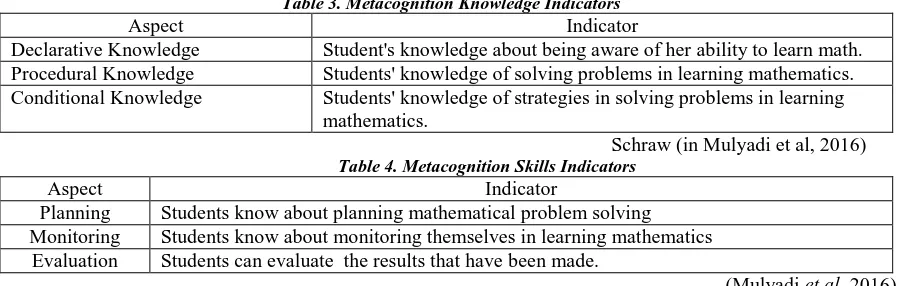
Table 3. Metacognition Knowledge Indicators
Aspect Indicator
Declarative Knowledge Student's knowledge about being aware of her ability to learn math. Procedural Knowledge Students' knowledge of solving problems in learning mathematics. Conditional Knowledge Students' knowledge of strategies in solving problems in learning
mathematics.
Schraw (in Mulyadi et al, 2016)
Table 4. Metacognition Skills Indicators
Aspect Indicator
Planning Students know about planning mathematical problem solving Monitoring Students know about monitoring themselves in learning mathematics
Evaluation Students can evaluate the results that have been made.
(Mulyadi et al, 2016) Pattern Numbers with Partition Techniques
In labeling is also known the term partition, the method used to group the labels on the graph based on the pattern. Partitions can be expressed in a matrix denoted by 𝑃𝑚,𝑑𝑛 (𝑖, 𝑗), where n denotes the number of columns, m
denotes the number of rows, d denotes a different value, i denotes a row, and j denotes a column with 1 ≤ 𝑖 ≤ 𝑚 𝑑𝑎𝑛 1 ≤ 𝑗 ≤ 𝑛. Pattern Numbers with partitioning techniques are pattern Numbers using two-dimensional arithmetic. Arithmetic in question is two-dimensional arithmetic (𝑖, 𝑗) with partitioning techniques. The symbol used (𝑃𝑚,𝑑𝑛 ) where P is the partition, n is the number of columns, m is the number of rows, and d is the
[Herawati * et al., 5(4): April, 2018]
ISSN: 2349-5197
Impact Factor: 3.765
I
NTERNATIONAL
J
OURNAL OF
R
ESEARCH
S
CIENCE &
M
ANAGEMENT
According to Dafik et al (2010) some of these patterns and the generalization formula are:
1. The first pattern is 𝑃𝑚,𝑑𝑛 = 𝑃𝑚,𝑚𝑛 , to get the generalization formula presented by using example: n = 6 and m
= 5
1 2 3 4 5 6
1 1 2 3 4 5 6
2 7 8 9 10 11 12
3 13 14 15 16 17 18
4 19 20 21 22 23 24
5 25 26 27 28 29 30
2. The second pattern is 𝑃𝑚,𝑑𝑛 = 𝑃𝑚,𝑚𝑛 2, to get the generalization formula presented by using the example n = 6
and m = 5
1 2 3 4 5 6
1 1 6 11 16 21 26
2 2 7 12 17 22 27
3 3 8 13 18 23 28
4 4 9 14 19 24 29
5 5 10 15 20 25 30
3. The third pattern is 𝑃𝑚,𝑑𝑛 = 𝑃𝑚,𝑚 2
𝑛
, generalizations are presented using the example n = 7 and m = 8.
1 2 3 4 5 6 7
1 1 8 2 9 3 10 4
2 11 5 12 6 13 7 14
3 15 22 16 23 17 24 18
4 25 19 26 20 27 21 28
5 29 36 30 37 31 38 32
6 39 33 40 34 41 35 42
7 43 50 44 51 45 52 46
8 53 47 54 48 55 49 56
Research method
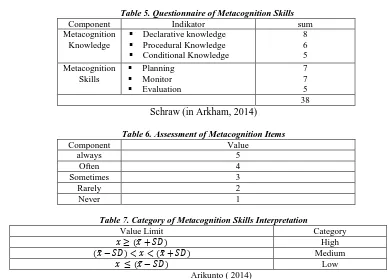
This research is a qualitative descriptive study. This study aims to describe the creative thinking skill of students of Mathematics Education class A discrete mathematics in solving numerical pattern problems with partition technique based on metacognitive ability and categorize their creative thinking level and collect student's answer result in solving numerical pattern problem with partition technique and findings of researchers in the monograph. There are several stages in this study that are arranged to obtain the desired research objectives that are a) Preliminary activities, determine the research area, research subjects, coordinate with Mathematics Education at jember university and determine the schedule of conducting research; b) Instrument making. At this stage the researcher makes four tests of creative thinking skill of the student that is creative thinking skill which contains test 1 about pattern discovery with previous partition discovery technique, test 2 about how to look for generalization formula, test 3 about student understanding on test 1 and test 2, test 4 about its implementation in graphs, interview guides and metacognition capability questionnaires. The student test contains the indicators of creative thinking made by the researcher. Interview guidelines are used to get some things about students' creative thinking skills in doing the tests. While the questionnaire of metacognition ability is used to categorize students ability in 3 categories that is high, medium and low which is associated with student creative skill; in this case the metacognition questionnaire used is a psychological test of Metacognitive Awarenes Inventory (MAI) which consists of 38 revelations filled with students. This metacognition questionnaire was adopted from Schraw (in Arkham, 2014). All statements are 38 with 5 variations of answers for each item. Questionnaire of metacognition ability was analyzed according to questionnaire rubric with value 1-5. Then categorize the ability of high metacognition, moderate metacognition, low metacognition with the following calculations:
j
i
j
i
j
i
The generalization formula is
The generalization formula is .
[Herawati * et al., 5(4): April, 2018]
ISSN: 2349-5197
Impact Factor: 3.765
I
NTERNATIONAL
J
OURNAL OF
R
ESEARCH
S
CIENCE &
M
ANAGEMENT
a. Determining the average student𝑥̅ =∑ 𝑥
𝑁 with 𝑥̅ = average, 𝑥= data dan 𝑁= the amount of data
b. Determining Standard Deviation (SD)
𝑆𝐷 = √∑ 𝑥2
𝑁 − (
∑ 𝑥 𝑁)
2
, with SD = Standard Deviation and x = data.
c. Define criteria in groups
Table 5. Questionnaire of Metacognition Skills
Component Indikator sum
Metacognition Knowledge
Declarative knowledge Procedural Knowledge Conditional Knowledge
8 6 5 Metacognition
Skills
Planning Monitor Evaluation
7 7 5 38 Schraw (in Arkham, 2014)
Table 6. Assessment of Metacognition Items
Component Value
always 5
Often 4
Sometimes 3
Rarely 2
Never 1
Table 7. Category of Metacognition Skills Interpretation
Value Limit Category
𝑥 ≥ (𝑥̅ + 𝑆𝐷) High
(𝑥̅ − 𝑆𝐷) < 𝑥 < (𝑥̅ + 𝑆𝐷) Medium
𝑥 ≤ (𝑥̅ − 𝑆𝐷) Low
Arikunto ( 2014)
c) Validation activity, Researcher will give validation sheet of test of creative thinking skill and interview guidance to 2 validator lecturer, if fulfill valid criterion then can proceed to next procedure. But if invalid it will be done revision and validation test again; d) Selection of research subjects, Subjects of this study were 15 students of class A in discrete mathematics courses in Mathematics Education of jember university; e) Data collection is done after the subject of research given the questionnaire of metacognition ability, test of creative thinking skill and conducted interview to get deeper data from written answer given by subject to researcher; f) Analyze data, Analyze completion to 4 student test, interview result, and metacognition ability questionnaire. Test creative thinking skills in corrections using keys made by researchers then categorize according to Thinking Skills Level; g) Researchers reported on the results of student answers in this study as well as the researchers' findings of this material in monographs. The monograph is also expected to assist other researchers in similar research and is expected to benefit researchers and educators (lecturers and teachers) as well as students in general; h) Make a conclusion of all data obtained in the implementation of research in accordance with the objectives achieved.
Results and discussion
[Herawati * et al., 5(4): April, 2018]
ISSN: 2349-5197
Impact Factor: 3.765
I
NTERNATIONAL
J
OURNAL OF
R
ESEARCH
S
CIENCE &
M
ANAGEMENT
well as the creative thinking skills test so that the test instrument can be used. Implementation of further research is the researchers distributed questionnaires to 44 students. The questionnaire was used to get the research subject set for 15 students from 44 students who were in discrete class of mathematics class A. There are three criteria of students metacognition ability desired in this research that is high metacognition ability, medium metacognition and low metacognition.
Students collect the questionnaire the researchers assessed in accordance with the questionnaire rubric so it was found that for the category of high metacognition value limit is x≥155.3, for the medium category limit value is 125.7 <x <155.3 and for the low category x≤125, 7. There were five students with high category each having M1 = 181, M2 = 175, M3 = 164, M4 = 163, and M5 = 162. Five students in the medium category each had M6 = 152, M7 = 152, M8 = 151, M9 = 151, and M10 = 147. Five low-class students were also obtained each with the values M11 = 124, M12 = 123, M13 = 123, M14 = 122, and M15 = 121. Furthermore, students with M1-M5 are categorized as students with high metacognition ability, students with M6-M10 are categorized with medium metacognition ability and M11-M15 is categorized with low metacognition ability.The result of one part of the test and the research interview on the category of Student with high metacognition category is as follows: 1. M1 student
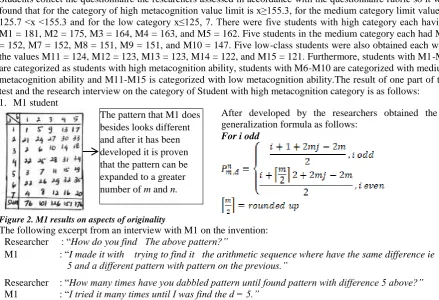
Figure 2. M1 results on aspects of originality
The following excerpt from an interview with M1 on the invention: Researcher : “How do you find The above pattern?”
M1 : “I made it with trying to find it the arithmetic sequence where have the same difference ie 5 and a different pattern with pattern on the previous.”
Researcher : “How many times have you dabbled pattern until found pattern with difference 5 above?”
M1 : “I tried it many times until I was find the d = 5.”
Researcher : “What is the pattern you find can you develop in bigger shape?
M1 : “It could be, I still am Trying in moderate form not a big one yet.
M1 has a high metacognition ability with a value of 181. M1 answers always = 12, often = 13 and sometimes = 23 on questionnaire metacognition ability. From the assessment questionnaire M1 knows her ability well. In the case of tests that have been done by M1 fluency aspect, M1 gives many answers and performs faster, in Flexibility aspect M1 can present variation of answer and aspect of Elaboration M1 can develop the idea well and Originality aspect M1 can create new partition different from already exist and will be able to be developed by researchers for generalization formula. Excerpts of the above interviews can be seen that Declarative Knowledge, procedural knowledge and Conditional Knowledge M1 is very good because he can state, demonstrate, and know well the results of his work. M1 can also plan, monitor and evaluate its patterns well proven he can say that the findings can be developed.
2. ………..M2 student
The pattern that M1 does besides looks different and after it has been developed it is proven that the pattern can be expanded to a greater number of m and n.
After developed by the researchers obtained the generalization formula as follows:
For i odd
[Herawati * et al., 5(4): April, 2018]
ISSN: 2349-5197
Impact Factor: 3.765
I
NTERNATIONAL
J
OURNAL OF
R
ESEARCH
S
CIENCE &
M
ANAGEMENT
Figure 3. M2 results on aspects of originality
Interview with M2:
Researcher : “how do you explain the pattern you created?”
M2 : “patterns are made intermittently begin number 1 there and continued second line as seen ditabel. "
Researcher : “how long you find the pattern?”
M2 : “I tried it long after I tried many times
Researcher : “can you make a formula its generalization?”
M2 : "No, I've tried but I have not can find. "
Researcher : “do you find it hard to find the formula geralisasinya?”
M2 : “yes.”
Researcher :” what is the pattern you find can be developed?”
M2 : “I feel it can be developed.”
M2 has Declarative Knowledge, Procedural Knowledge and Good Conditional Knowledge because it can state, demonstrate, and know well the results of its work. M2 can also plan, monitor and evaluate its findings as it proves that it can be developed even if it says it can not find its generalization formula.
3. ………M3 student
Figure 4. M3 results on aspects of originality
Quote interview with M3:
Researcher : “how do you think about the test?”
M3 : “medium, there are easy and some are difficult. "
Researcher : “are you interested about find the number pattern with partition technique
M3 : “yes, although sometimes in finding new patterns is not easy because often influenced by the previous pattern.”
Researcher : “can you find a New pattern more than the pattern you created? "
M3 : “I do not know yet, because I made a difficult one, made it long ago and tried it out first. "
The value of M3 is 164 including the category of high metacognition. Knowledge metacognition and metacognition skills M3 is very good because he can plainly explain his knowledge about the test well. Although he says it is not easy to find patterns that are different from the preceding ones but he is interested in learning them
4. ………M4 student
Patterns made by M2 have different pattern variations. Seen on the placement of the numbers in the partition table.
The pattern formed by M3 looks different from the pattern formed by M1 and M2. Patterns are formed from the first column.
[Herawati * et al., 5(4): April, 2018]
ISSN: 2349-5197
Impact Factor: 3.765
I
NTERNATIONAL
J
OURNAL OF
R
ESEARCH
S
CIENCE &
M
ANAGEMENT
Figure 5. M4 results on aspects of originality
The results of interviews with M4 are:
Researcher : :“how do you explain your pattern?”
M4 : “in the first row the number 1 starts just forwarded on the third row as seen so on.”
Researcher : “whether the pattern is found can be developed?”
M4 : “I think it can be but I have not tried it yet.”
Researcher : “which is the most difficult to do from the test?”
M4 : create a new pattern (originality)
The metacognition ability of M4 on the questionnaire is 163 and the value includes high category values. In tests of creative thinking skills M4 able to show aspects of fluently, flexibility and elaboration well. On the originality aspect of M4 is able to create different new patterns. Metacognition knowledge and metacognition skills of M4 are good because in the making of new patterns she can plan and evaluate her findings.
5. ………..M5 student
Figure 6. M5 results on aspects of originality
Interview with M5:
Researcher : “how do you explain your pattern?”
M5 : “the pattern starts at the first row and continues on the second row of the second column and so on is seen in the partition table.”
Researcher : “whether the pattern you find can be developed? "
M5 : “I do not know”
Researcher : “whether you can find the generalization formula?”
M5 : “no, I think it's too hard to find it.”
M5 scores 162 on assessment of metabolic ability and M5 is a high-metacognition-capable category. Metacognition knowledge and metacognition skills of M5 are good, although in some ways she has not done so.On the answers to the M5 test, show his creative thinking skills well. The four aspects are fulfilled although
The pattern created by M4 already involves 3 lines and already more lines associated with the pattern.
The pattern created
by M5 looks
creative in the placement of its numbers and this pattern can be developed with many n and m.
The generalization formula of pattern is:
[Herawati * et al., 5(4): April, 2018]
ISSN: 2349-5197
Impact Factor: 3.765
I
NTERNATIONAL
J
OURNAL OF
R
ESEARCH
S
CIENCE &
M
ANAGEMENT
not yet able to make the generalization formula in the aspect of originality but has been able to create a new pattern different from before
Students in the medium category are as follows: M6-M10 meets three aspects: fluency, flexibility, and elaboration. While students with low category M12, meet only two aspects of creative thinking of fluency (smoothness), and elaboration, while M11 meets two aspects of fluency (fluency) and flexibility (flexibility)
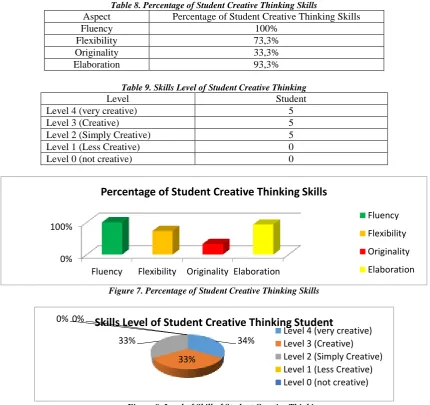
Table 8. Percentage of Student Creative Thinking Skills
Aspect Percentage of Student Creative Thinking Skills
Fluency 100%
Flexibility 73,3%
Originality 33,3%
Elaboration 93,3%
Table 9. Skills Level of Student Creative Thinking
Level Student
Level 4 (very creative) 5
Level 3 (Creative) 5
Level 2 (Simply Creative) 5
Level 1 (Less Creative) 0
Level 0 (not creative) 0
Figure 7. Percentage of Student Creative Thinking Skills
Figure 8. Level of Skill of Student Creative Thinking
Conclusion
In this study obtained questionnaire ability metakognisi produce subject 44 15 student with high ability of metacognisi, medium and low. The high metacognition category of the value limit is the metacognition ability value of more than 155.3, for the medium category the metacogical capacity is greater than 125.7 and smaller than 155.3 and for the lower category the metacogical ability is less than 125, 7.Creative thinking skills to 15 students can show their skill on fluency aspect, on flexibility aspect 11 students, while 5 students' originality aspect and elaboration aspects of 14 students. So the percentage of students with creative skill is on 100% fluency aspect, 73.3% flexibility aspect, 33,3% original level 4 of creative thinking skill of students (very creative), 5 students with level 3 of creative thinking skill of students (creative) where on the originality aspect
0% 100%
Fluency Flexibility Originality Elaboration
Percentage of Student Creative Thinking Skills
Fluency
Flexibility
Originality
Elaboration
34%
33% 33%
0% 0%
Skills Level of Student Creative Thinking Student
[Herawati * et al., 5(4): April, 2018]
ISSN: 2349-5197
Impact Factor: 3.765
I
NTERNATIONAL
J
OURNAL OF
R
ESEARCH
S
CIENCE &
M
ANAGEMENT
of five students have not been able to create new patterns and 5 students with level 2 of creative thinking skill of students (creative enough ) where the five students have not been able to demonstrate creative thinking skills on aspects of originality, flexibility and elaboration.
In five students with high metacognition skills their creative thinking skills meet in all four aspects as well as the procedural Knowledge and Conditional Knowledge of these five students either because they can demonstrate, demonstrate, and know well about the skills required to create partitions. In addition they can plan, monitor and evaluate the findings well proved the patterns they can be developed. In five students with metacognition skills while their creative thinking skills meet on three aspects as well as the procedural Knowledge and Conditional Knowledge of the five students is good enough because they can declare, demonstrate, and know well about the capabilities required to create partitions. But they have not been able to plan, monitor and evaluate their findings with a well proven pattern that they have not been able to develop. There are five students with low metacognitive skills. Their creative thinking skills fulfill two aspects as well as the procedural knowledge and the conditional knowledge of the five students is quite good.
Monograph development process was conducted on 15 students. From 15 students found 5 different partition pattern form from. Then researchers examined whether the 5 forms can be developed after being investigated into five forms can be developed. The next step the researchers make a generalization formula of the five patterns and will be written in the monograph. In addition the researchers also found two different patterns with existing ones and their generalization formula. So the total findings in this study are seven numerical patterns with partitioning techniques. The patterns found by researchers are as follows:
The First Pattern
1 2 3 4 5 6
1 48 45 44 41 40 37
2 47 46 43 42 39 38
3 36 27 32 31 28 35
4 25 34 29 30 33 26
5 24 21 20 17 16 13
6 23 22 19 18 15 14
7 12 3 8 7 4 11
8 1 10 5 6 9 2
sum 216 208 200 192 184 176
The Second Pattern
1 2 3 4 5 6 7 8
1 1 28 9 20 17 12 25 4
2 30 5 22 13 14 21 6 29
3 3 26 11 18 19 10 27 2
4 32 7 24 15 16 23 8 31
sum 66 66 66 66 66 66 66 66
References
[1] UNESCO.” Higher Education in the Twenty-first Century-vision and Action” (World Conference on higher Education).,Paris, UNESCO Publishing,1998.
[2] UNESCO. “The full text of Learning: the treasure Within “(Higher Education in the Twenty-first Century-vision and Action), Paris, UNESCO Publishing, 1998.
[3] Dafik.” High-Level Thinking Skills “(HOTS). http://dafik-fkip-unej.org/berita-199-keterampilan-hinking-the-high-hots.html, 2014.
[4] Mulyadi, S., Basuki, H., Raharjo, W. ”Educational Psychology”, Jakarta: Rajawali Pers, 2016. [5] Munir, R, “Discrete Mathematics”. Bandung, Informatics,2014.
[6] Wahyudin, “Learning and Model Learning model. Jakarta”, CV. Ipa Abong, 2008.
j
i
j
i
The generalization formula:
[Herawati * et al., 5(4): April, 2018]
ISSN: 2349-5197
Impact Factor: 3.765
I
NTERNATIONAL
J
OURNAL OF
R
ESEARCH
S
CIENCE &
M
ANAGEMENT
[7] Marinda, NLPM, “The Influence of Project-Based Learning Model to the Creative Thinking Ability and Student's Scientific Performance” Thesis, Science Study Program Science Education Post Graduate Program, Ganesha University of Education, 2012.
[8] Munandar, U, “ Creativity & Giftedness (Strategy to Achieve Creative Potential & Talent)” Jakarta. PT. Gramedia Pustaka Utama, 1999.
[9] Munandar, U, “ Development of Gifted Children Creativity”, Jakarta, PT. Rineka Cipta, 1999.
[10] Siswono, T.Y.E, “Leveling Students' Creative Thinking In Solving And Posing Mathematical Problem”, J.M.E, 1: 17-24. . 2010.
[11] Konzig. A. And Rosa, A, ”Magic Valuations of Finite Graph”, Canada Mathematics Bulletin, 13, 451-461, 1970.
[12] Gutierrez, A. And Llado, A, “Magic Covering' The Journal of Combinatorial Mathematics and Combinatorial Computing”, 55, 43-56, 2009.
[13] W.D. Wallis, “Magic Graphs”, Boston, Birkhauser. 2001.
[14] Dafik, Hasan, M., Azizah, Y. N., Agustin, I. H,” A Generalized Shackle of Any Graph H Admits a Super H-Antimagic Total Labeling”, Proceedings Mathematical Sciences, PMSC-D-16-00282,AMC Bali, 2010.
[15] Arkham, H.P, “ Student Metacognition Rate Ability Based on Schraw and Dennison on Mathematics Subjects” Essay, Surabaya,UIN Sunan Ampel, 2014..