University of New Hampshire
University of New Hampshire Scholars' Repository
Faculty Publications
10-10-2017
Nitrification increases nitrogen export from a
tropical river network
Lauren E. Koenig
University of Connecticut, Storrs
Chao Song
University of GeorgiaWilfred M. Wollheim
University of New Hampshire, Durham, [email protected]
Janine Ruegg
École Polytechnique Fédérale de Lausanne
William H. McDowell
University of New Hampshire, Durham, [email protected]
Follow this and additional works at:
https://scholars.unh.edu/faculty_pubs
This Article is brought to you for free and open access by University of New Hampshire Scholars' Repository. It has been accepted for inclusion in Faculty Publications by an authorized administrator of University of New Hampshire Scholars' Repository. For more information, please contact [email protected].
Recommended Citation
Nitri
fi
cation increases nitrogen export from
a tropical river network
Lauren E. Koenig1,4, Chao Song2,5, Wilfred M. Wollheim1,6, Janine Rüegg3,7, and William H. McDowell1,8
1Department of Natural Resources and the Environment, University of New Hampshire, Durham, New Hampshire 03824 USA 2Odum School of Ecology, University of Georgia, Athens, Georgia 30602 USA
3Stream Biofilm and Ecosystem Research, École Polytechnique Fédérale de Lausanne, 1015 Lausanne, Switzerland
Abstract: Scaling aquatic ecosystem processes like nutrient removal is critical for assessing the importance of streams and rivers to watershed nutrient export. We used pulse NH41enrichment experiments and measured
net NH41uptake in 7 streams throughout a mountainous tropical river network in Puerto Rico to assess spatial
variability in NH41uptake and to infer the physical, chemical, and biological characteristics that most influence
its variation. Across 14 experiments, NH41uptake velocity (vf) ranged from 0.3 to 8.5 (mean52.7) mm/min
and was positively related to algal biomass standing stock, measured as chlorophylla. On average, 49% of exper-imentally added NH41was immediately transformed to NO32, suggesting that nitrification can rival microbial and
algal assimilation as a fate of streamwater NH41. We considered the implications of our empirical results at the
river-network scale based on a simple mass-balance model parameterized for the Río Mameyes watershed. Most catchment NH41inputs are delivered to 1st-order streams. Therefore, model results indicated that high NH41
up-take rates in headwater streams limit NH41inputs to downstream reaches, thereby decreasing the role of larger
streams in NH41removal at the river-network scale. In-stream nitrification resulted in additional NO32inputs,
which were more likely than NH41 to be transported downstream because of lower biological demand for
NO32relative to NH41. Given our estimates of catchment N loading to streams and rivers, we estimated that
39% of modeled watershed NO32export was produced within the river network by nitrification. Together, these
results suggest that streams and rivers can significantly transform the N load from their catchments.
Key words:nitrification, nutrient spiraling, ammonium uptake, river network model, gross primary production, TASCC, tropical, stream, Puerto Rico
Streams and rivers receive, transport, and actively process energy and nutrient loads from the terrestrial landscape. River networks hydrologically connect the terrestrial envi-ronment to downstream lakes, estuaries, and the coastal ocean and regulate watershed nutrient delivery and export (Howarth et al. 1996, Peterson et al. 2001, Wollheim et al. 2008b). Therefore, evaluating the landscape characteristics and biological processes that affect the magnitude and spa-tial distribution of aquatic nutrient removal is critical to understanding how streams and rivers modulate delivery of nutrients to downstream ecosystems.
The role of aquatic nutrient removal in influencing
wa-tershed nutrient export depends on the fate of nutrients.
Nutrient consumption and uptake in fluvial ecosystems
can result in temporary storage through cycles of biotic
as-similation and remineralization, long-term retention or permanent removal (e.g., abiotic sorption, burial, or
denitri-fication) (Triska et al. 1994, Ashkenas et al. 2004, Mulholland
et al. 2008), or may simply transform one nutrient species into
another (e.g., nitrification). Nutrient uptake in streams is
influenced by nutrient availability (Dodds et al. 2002, Earl
et al. 2006, Mulholland et al. 2008), hydrology and stream geomorphology (Valett et al. 1996, Hall et al. 2002), aquatic primary productivity (Hall and Tank 2003, Newbold et al. 2006), and C availability (Bernhardt and Likens 2002, Dodds et al. 2004, Rodríguez-Cardona et al. 2016). These drivers can be used to predict how aquatic nutrient removal might vary with ecosystem size or network position (Stream Sol-ute Workshop 1990), but most inferences of the controls on nutrient uptake come from studies of individual streams
E-mail addresses:[email protected];[email protected];[email protected];7janine.ruegg@epfl.ch;[email protected]
and rivers across different watersheds, land uses, and bi-omes (Peterson et al. 2001, Hall et al. 2009). As a result, a fundamental understanding of the patterns and controls on nutrient uptake within individual river networks is
lack-ing (Ensign and Doyle 2006), and it remains difficult to
scale aquatic ecosystem processes from individual stream reaches to whole river networks and infer the role of aquatic ecosystems in global nutrient cycles (Wollheim et al. 2008b).
These scaling challenges are exacerbated in tropical en-vironments, where fewer studies of aquatic nutrient cycling have been conducted compared to temperate ecosystems. Anthropogenic N deposition and N inputs from urbaniza-tion are increasing throughout the tropics (Downing et al. 1999, Matson et al. 1999). Therefore, understanding N re-moval in river networks is important for predicting the ef-fects of anthropogenic activities on watershed N export, es-pecially in tropical mountainous watersheds like those in Puerto Rico, where short transit times from land to the ocean make downstream estuaries vulnerable to eutrophi-cation (Ortiz-Zayas et al. 2006). We know from previous
research in Puerto Rico that stream NO32 uptake rates
are relatively low across streams draining forested,
agricul-tural, and urban lands, but that NO32uptake increases with
aquatic gross primary production (Potter et al. 2010). In
ad-dition, nitrification is thought to be an important fate of
streamwater NH41, as reported by Merriam et al. (2002)
for one stream in northeastern Puerto Rico. However, no research to date has investigated the spatial variability in
ei-ther stream NH41uptake or the relative importance of
in-stream nitrification to NH41 uptake in these river
net-works, which contain considerable heterogeneity in their
topography, underlying geology, and hydrologicflowpaths
over relatively small watershed areas (Pike et al. 2010, Mc-Dowell et al. 1992, 2012).
The primary objectives of our study were to examine
the spatial variability in stream NH41uptake and nitrifi
ca-tion in a tropical mountain river network in Puerto Rico and to use a mass-balance model to analyze the implica-tions of measured N uptake rates for the spatial distribu-tion of N removal at the river-network scale. We predicted
that NH41uptake would increase with stream metabolism,
notably gross primary productivity (GPP), which should
increase biological demand for N in streams with sufficient
light availability. Furthermore, we expected that the
rela-tive importance of nitrification to stream NH41 uptake
would be highest in shaded headwaters, where streams may be energy-limited by lack of light inputs, high rates of de-composition, and low dissolved organic C (DOC) concen-trations (Merriam et al. 2002, Helton et al. 2015). Better un-derstanding of the patterns in N uptake and the processes
influencing its variation within individual river networks
will contribute to development of ecological scaling rela-tionships that inform the fate of energy and nutrients in catchments.
M E T H O D S Study sites
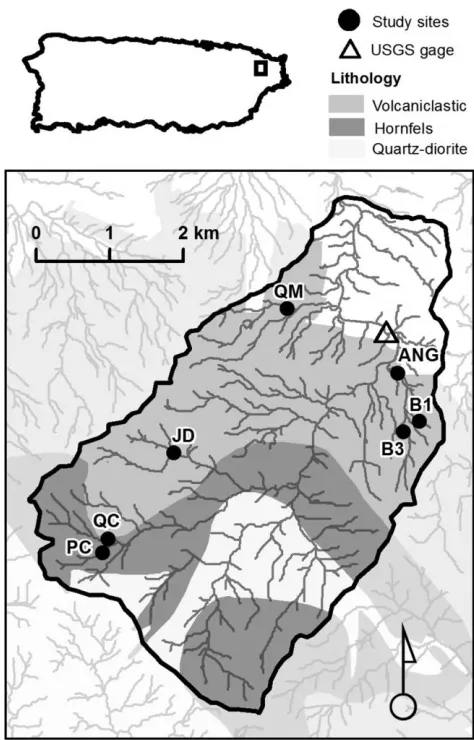
This study was conducted in the Luquillo Experimental Forest in northeastern Puerto Rico (Fig. 1). We selected
seven 1st- to 3rd-order streams within the upper Río
Ma-meyes watershed. Mean daily air temperature in the
Lu-quillo mountains ranges from 19 to 267C and annual
pre-cipitation ranges from 2500 to 4500 mm/y, with greater
rainfall observed at higher elevations (100–1000 m asl)
(Brown et al. 1983). The months of January to April typically have lower rainfall than the rest of the year (Heartsill-Scalley et al. 2007), but these tropical forests are not characterized by marked seasonality in precipitation, soil-solution chemis-try, or stream chemistry (McDowell 1998, McDowell et al. 2012). The dominant soils are highly weathered, clay-rich
Figure 1. Location of study sites within the upper Río Mameyes network, Puerto Rico. B15Bisley 1, B35Bisley 3, ANG5Angelito, PC5Piscina, JD5Juan Diego, QM5 Máquina, and QC5Caimitillo. The hollow triangle denotes the location of the US Geological Survey gaging station on the Río Mameyes (USGS 50065500).
Ultisols, Inceptisols, and Oxisols that generally lack a con-spicuous organic horizon (Silver et al. 1999).
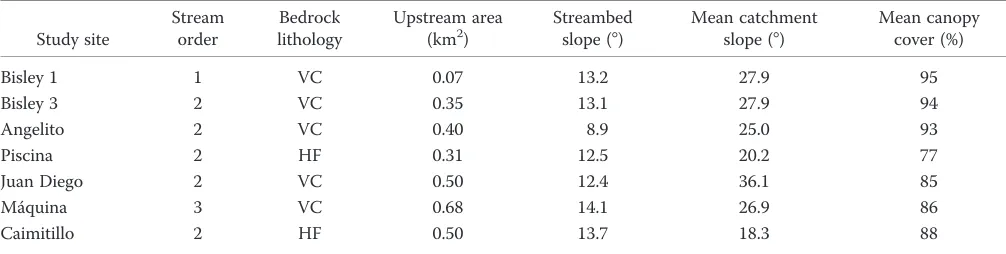
Our study streams were heavily shaded but varied in as-pect, catchment topography, and geology depending on their position in the watershed (Table 1). Four streams were situated in the western headwaters at higher elevation
(300–800 m asl). Two of these streams drain hornfels
fa-cies, outcrops of contact metamorphosed volcaniclastic bed-rock. Three streams were situated at lower elevation and drained north-facing slopes underlain by unmetamorphosed volcaniclastic bedrock, which is less resistant to erosion than the hornfels facies rock (Fig. 1) (Pike et al. 2010). Three of the
7 streams were identified as intensive study sites where we
replicated our NH41enrichment experiments (described in
detail below) in 2 reaches (Bisley 1, Bisley 3, Angelito) or at 2 points in time during a 6-wk period (Bisley 1, Bisley 3) to
assess within-stream variability in NH41uptake. In each of
the 7 streams, we chose study reaches that contained no
trib-utary inflows and had a mean hydrologic travel time between
20 and 60 min to ensure sufficient distance and time for
proper mixing and detectable uptake of solutes. The resulting
reach lengths were typical of small streams (40–80 m;
Web-ster and Valett 2006).
Stream metabolism and algal biomass
We estimated whole-stream metabolism for each stream
reach by measuring changes in dissolved O2concentration
(DO), water temperature, and light intensity at 10-min in-tervals over 1- to 5-d deployment periods with YSI (Yel-low Springs Instruments, Yel(Yel-low Springs, Ohio) ProODO
optical dissolved O2 sondes and Odyssey (Christchurch,
New Zealand) light loggers. We estimated daily gross pri-mary production (GPP) and ecosystem respiration (ER)
rates by fitting a 1-station Lagrangian model to diel O2
curves. We modified the approach taken by Riley and
Dodds (2013) by describing the temperature dependence of GPP and ER with an Arrhenius equation, and we used a Bayesian approach with a uniform prior distribution to estimate daily rates of GPP and ER (Song et al. 2016). For multiday deployments, we allowed parameters (GPP, ER,
and the gas-exchange coefficient [K-O2]) to vary from day
to day, but we assumed thatK-O2is relatively constant
be-tween days ifflow conditions do not change dramatically.
Therefore, for days where GPP, ER, and K-O2 were not
uniquely estimable, we constructed a gamma distribution
based on K-O2estimated from other deployment days in
the same stream and used it as the prior distribution forK-O2.
Logistical constraints required that we offset our stream metabolism measurements by as much as 3 to 9 d at 3 study sites (Piscina, Juan Diego, and Caimitillo). We pres-ent the metabolism data from these sites because no
sig-nificant precipitation occurred between the metabolism and
nutrient uptake measurements, and because climatic condi-tions, such as light and air temperature, remained similar (González 2015). In 3 other streams where multiday deploy-ments overlapped the offset time period in Piscina, Juan Di-ego, and Caimitillo, variability in daily stream metabolism was lower than variability observed over the 6-wk
experi-mental window (e.g., Bisley 1 reach 1, GPP CV568%
dur-ing overlappdur-ing offset period; CV 5119% all observations;
LEK, unpublished data). Therefore, we included stream me-tabolism data for Piscina, Juan Diego, and Caimitillo, but we acknowledge that short-term variability in daily GPP and ER at these sites may limit this comparison. In 6 of the 7 stream
sites, we measured chlorophylla(Chla) standing stock once
within 0 to 4 d of the nutrient-enrichment experiment as a proxy for autotrophic biomass. We sampled benthic substrata
for Chlaat 10 evenly spaced transects throughout the stream
reach either by scraping biofilm from a known surface area
or by whole-rock extraction (Murdock and Dodds 2007). We
analyzed Chlaafter hot-ethanol extraction on a Thermo
Scientific (Waltham, MA) Genesys 6 spectrophotometer
(Sartory and Grobbelaar 1984) and corrected for acidifi
ca-tion time (Parker et al. 2016).
Nutrient-enrichment experiments
We performed 14 NH41 enrichment experiments in
7 streams during January to March 2013. Prior to each reach-scale experiment, we collected background samples
Table 1. Physical characteristics of study streams in the Luquillo Experimental Forest. VC5unmetamorphosed volcaniclastic bedrock, HF5hornfels facies (contact metamorphosed volcaniclastic bedrock).
Study site
Stream order
Bedrock lithology
Upstream area (km2)
Streambed slope (7)
Mean catchment slope (7)
Mean canopy cover (%)
Bisley 1 1 VC 0.07 13.2 27.9 95
Bisley 3 2 VC 0.35 13.1 27.9 94
Angelito 2 VC 0.40 8.9 25.0 93
Piscina 2 HF 0.31 12.5 20.2 77
Juan Diego 2 VC 0.50 12.4 36.1 85
Máquina 3 VC 0.68 14.1 26.9 86
of stream water for chemical analyses and measured stream discharge by dilution-gauging of short-term NaCl releases (Kilpatrick and Cobb 1985, Payn et al. 2009). We
monitored specific conductance to ensure that Cl2
con-centrations had returned to background levels between NaCl dilution-gauging releases and nutrient-enrichment experiments.
During each experiment we added reactive NH41 (as
NH4Cl) and a conservative tracer (as NaCl) to the stream
as a single, pulse addition (Tank et al. 2008, Covino et al. 2010). We collected 20 to 35 samples over time (solute breakthrough curves) at the downstream end of each reach,
where we monitored specific conductance with a YSI 556
conductivity probe logging at 5-s intervals. We filtered
samples in the field through a 0.7-lm filter (Whatman
GF/F) into 60-mL, acid-washed, high-density polyethylene (HDPE) bottles and shipped them frozen to the Water Quality Analysis Laboratory at the University of New
Hampshire. Samples were analyzed for: 1) NH41-N by
the phenol–hypochlorite method (Solórzano 1969) on a
Westco (Brookfield, Connecticut) SmartChem 200 discrete
auto-analyzer, 2) Cl2with a Dionex (Waltham, Massachusetts)
ICS-1000 ion chromatograph, and 3) NO32-N with the
Cd-reduction technique on a Seal Analytical (Mequon, Wis-consin) discrete auto-analyzer. Background water-chemistry samples also were analyzed for DOC and total dissolved N (TDN) by the high temperature catalytic oxidation method on a Shimadzu (Columbia, Maryland) TOC-V CPH with TNM N unit. We calculated dissolved organic N (DON) by
subtracting dissolved inorganic N (DIN5NO321NH41)
from measured TDN concentrations.
Estimating NH41uptake and NO32production
We used 2 approaches to assess stream response to
ex-perimental NH41enrichments and to estimate rates of NH41
uptake. For each approach, we quantified nutrient-spiraling
parameters from the breakthrough curve of added solutes,
including the areal NH41uptake rate (U;lg N m22min21)
and NH41uptake velocity (vf; mm N/min), which
repre-sents uptake relative to NH41 availability (Stream Solute
Workshop 1990). We estimated Uof added N (hereafter
referred to as net uptake [Unet]; Payn et al. 2005) for each
sample across the breakthrough curve by using an
ap-proach modified from the tracer addition for spiraling
curve characterization (TASCC) method (Covino et al.
2010). We calculated the 1st-order kinetic rate (Kt; 1/min)
for each sample by assuming an exponential decline in nu-trient concentration over the stream reach (Stream Solute Workshop 1990):
Kt 5
ln NINJ
ClINJ
2ln NBC
ClBC
t , (Eq. 1)
whereNINJ,ClINJ,NBC, andClBCare the NH41-N and Cl2
concentrations of the injected solution and the
background-corrected NH41-N and Cl2concentrations of each sample,
respectively, andtis time elapsed since injection of the
nu-trient solution. Our use of Eq. 1 enabled us to account for variable travel times rather than using a single, average res-idence time throughout the breakthrough curve. This ap-proach was advantageous because a single, average residence time likely is not representative of our study streams and rel-atively short reach lengths.
We convertedKtfor each sample to netvfandUnet:
vf net 5Ktz, (Eq. 2)
Unet 5 vf netNadd, (Eq. 3)
Nadd 5
ffiffiffiffiffiffiffiffiffiffiffiffiffiffiffiffiffiffi
NconsNBC
p
, (Eq. 4)
where z is reach-averaged depth and Nadd represents
the reach-averaged concentration of added NH41 for a
given sample, calculated as the geometric mean of the
background-corrected NH41 concentration and the
esti-mated NH41 concentration given conservative transport
(Ncons; Eq. 4). We calculated Ncons by multiplying the
background-corrected Cl2concentration by the NH41∶Cl2
ratio of the injected solution. We used the geometric mean to represent the added nutrient concentration during the
experiment because the background-corrected NH41
con-centration at the measurement location probably underes-timates the N concentration experienced by stream
bio-films along the length of the experimental reach. In this
sense, the geometric mean concentration represents a best
approximation of background-corrected NH41
concentra-tion throughout the stream reach during the enrichment ex-periment (Covino et al. 2010). For each exex-periment, we used
the slope of the best-fit line betweenUnetand the total
reach-averaged NH41concentration in each sample (Ntotal), equal
to the sum of background NH41-N concentration andNadd,
to estimate the average netvf. Use of this approach carried
the inherent assumption that netvfis constant with
concen-tration (i.e., 1st-order kinetics), and therefore, net NH41vf
represents a reach-averagedvfduring the experiment.
We also used a transport-based modeling approach to
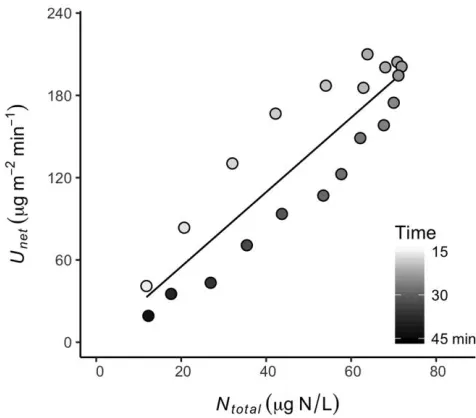
estimate NH41uptake. We observed significant hysteresis
in the relationship betweenUnetand reach-averaged NH41
concentration during all of our pulse nutrient-enrichment experiments (Fig. 2). This consistent pattern suggested
that NH41Unet might vary with flowpath in our study
reaches and motivated our use of an advection–dispersion
modeling approach to estimate separate NH41 uptake
rates for the stream channel and transient storage zone,
re-spectively. We used a 1-dimensional advection–dispersion
model with transient storage, and assumed 1st-order
up-take kinetics (Stream Solute Workshop 1990, Runkel 2007).
Specifically, we modeled solute dynamics as:
∂C
∂t 5 2V
∂C
∂x 1D
∂2
C
∂x2 2aðC2CtsÞ2KC, (Eq. 5)
dCts
dt 5
A
AsaðC2CtsÞ2KtsCts
, (Eq. 6)
whereCandCtsare solute concentration in the main
chan-nel and transient storage zone, respectively, V is mean
stream velocity,xis longitudinal distance,Dis the
disper-sion coefficient, anda is the exchange rate between the
main channel and the transient storage zone.AandAs
rep-resent the cross-sectional area of the stream channel and
transient storage zone, andKandKtsrepresent the 1st-order
kinetic rate (1/min) in the main channel and transient stor-age zone, respectively.
Wefit the advection–dispersion model separately to the
NH41 and Cl2 breakthrough curves to estimate best-fit
values for the relative size of transient storage (As/A), the
storage exchange-rate coefficient (a), and the 1st-order
ki-netic rates for the main stream channel (K) and transient
storage zone (Kts), respectively. We solved the model
nu-merically for any set of parameter values andfit the model
to the observed breakthrough curve using nonlinear least
squares. We used the ReacTran package in R (Soetaert
and Meysman 2012) to simulate the advection–dispersion
model and used a modified Levenberg–Marquardt
algo-rithm implemented in thenlmrt package (Nash 1990) to
estimate the hydrologic and biologic parameter values that
best fit the observed tracer data. We then used the
opti-mized solute transport simulations to calculate the mean
transient storage zone residence time for each stream
reach (Ts) asAs/(Aa) (Harvey and Wagner 2000).
We also estimated relative rates of NO32 production
during the NH41 addition experiment by integrating the
area under the breakthrough curve of observed NO32
con-centration over time. We calculated the percentage of
added NH41that was immediately nitrified as:
% NH41nitrified5 NO3REC
NH4INJ 2NH4REC
100, (Eq. 7)
where NO3REC is the mass of background-corrected
NO32-N recovered at the downstream sampling station,
NH4INJ is the mass of NH41-N injected, and NH4REC is
the mass of background-corrected NH41-N recovered at
the downstream sampling station during the experiment
(sensu Snyder and Bowden 2014). Estimates of % NH41
ni-trified based on Eq. 7 represent net nitrification and,
there-fore, are conservative because we do not account for any
NO32that may have been consumed in the stream reach.
Statistical analyses
We used net NH41vf to compare NH41 uptake rates
across streams because vf enables comparison of streams
with different hydrologic characteristics and background N concentrations (Hall et al. 2002, Ensign and Doyle 2006).
We present results from the advection–dispersion model
method because estimates of net vfwere similar between
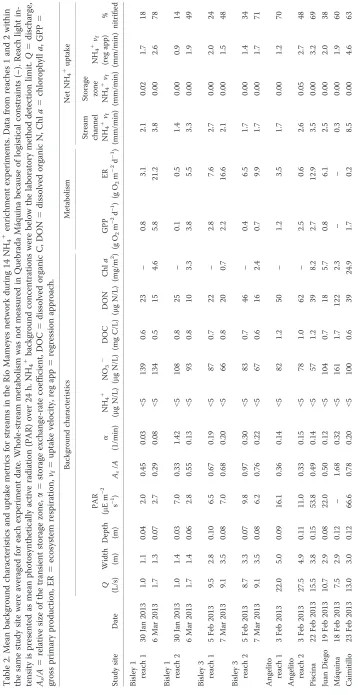
the 2 approaches presented above (Table 2) and because
the advection–dispersion method enabled us to isolate
NH41uptake in the main stream channel (hereafter, net
stream NH41vf) and in transient storage zones. We used
Pearson correlations to relate net stream NH41vf and %
NH41nitrified to physical, chemical, and biological
vari-ables that we hypothesized would influence their variation
in streams draining the Luquillo Mountains. We examined
bivariate relationships between net stream NH41vfand %
NH41nitrified and 9 potential covariates, including light
intensity, Ts, GPP, ER, Chl a, and N and C availability
(as NO32, DON, DOC, and the DOC∶DIN molar ratio).
To avoid bias toward the intensive study sites where nutrient-addition experiments were performed in multiple
reaches, we averaged values forvf, % NH41nitrified, and all
covariates when experiments were performed in multiple
reaches within a stream on the same day (resulting inn59).
All statistical analyses were conducted in R (version 3.3.2; R Project for Statistical Computing, Vienna, Austria).
River-network N dynamics and export
Our 2ndobjective was to analyze the implications of our
empirical results at the river-network scale. We applied an N mass-balance model to a statistical representation of the
5th-order Río Mameyes network following the approach
de-scribed by Wollheim et al. (2006), although we added an
Figure 2. The relationship between net NH41uptake rate
(Unet) and total reach-averaged NH41concentration (Ntotal),
Table 2. Mean background characteristics and uptake metrics for streams in the Río Mameyes network during 14 NH 4 1 enrichment experiments. Data from reaches 1 and 2 within the same study site were averaged for each experiment date. Whole-stream metabolism was not measured in Quebrada Máquina because of logistical const raints ( – ). Reach light in-tensity is presented as mean photosynthetically active radiation (PAR) over 24 h. NH 4 1 background concentrations were below the laboratory method detection limit. Q 5 discharge, As / A 5 relative size of the transient storage zone, a 5 storage exchange-rate coef fi cient, DOC 5 dissolved organic C, DON 5 dissolved organic N, Chl a 5 chlorophyll a , GPP 5 gross primary production, ER 5 ecosystem respiration, vf 5 uptake velocity, reg app 5 regression approach. Study site Date Background characteristics Metabolism Net NH 4 1 uptake Q (L/s) Width (m) Depth (m) PAR ( l Em – 2 s – 1) As / A a (1/min) NH 4 1 ( l g N/L) NO 3 2 ( l g N/L) DOC (mg C/L) DON ( l g N/L) Chl a (mg/m 2) GPP (g O2 m – 2d – 1) ER (g O2 m 2 2d 2 1) Stream channel NH
4
1v
f
(mm/min)
Storage zone NH
additional source of NO32from in-stream nitrification. We
estimated mean length, drainage area, and number of indi-vidual streams for each stream order in the river network
based on the stream-order area (Ra), number (Rb), and
length (RL) ratios developed by Horton (1945). The
empir-ical values of these ratios for the Río Mameyes network are 3.5, 3.3, and 1.7, respectively, and were obtained from a dig-ital topological river network developed from a 10-m digdig-ital elevation model. We estimated mean river width and depth for each stream order from hydraulic scaling relationships (Leopold and Maddock 1953) based on downstream scaling
exponents and coefficients developed specifically for the Río
Mameyes network (Pike et al. 2010). Direct drainage from land to each river order was estimated based on the propor-tion of total river-network length represented by that river order, assuming that inputs enter the upstream end of a stream reach, as described by Wollheim et al. (2006).
In our model, we assumed that NH41 and NO32 in
streams of a given order are sourced from: 1) local ground-water inputs and 2) upstream river reaches. N input from the
catchment (NLOAD, mg/d) into each stream orderiis
calcu-lated as:
NLOADi 5RODiNGW: (Eq. 8)
ROis the median daily runoff (4.9 mm/d; USGS 50065500,
38-y period of record),Diis the watershed area that drains
directly into each stream order, andNGWis the
concentra-tion of dissolved NH41 or NO32in groundwater. We
as-signedNGWas 0.14 mg NH41-N/L and 0.10 mg NO32-N/
L, respectively, based on the average concentration from soil lysimeters and shallow groundwater wells within the Río Mameyes and the neighboring Río Sonadora watersheds (McDowell et al. 1992, 1996, McDowell 1998, McDowell and Liptzin 2014, Cusack et al. 2016). In applying Eq. 8,
we assumed spatially uniform runoff andNLOADto isolate
the hydrological and biological processes that affect the dis-tribution of nutrient removal throughout the river network. A proportion of N inputs to an individual stream of
or-deriis removed by in-stream processing (Ri, unitless)
as-sociated with benthic sediments:
Ri5 12eð2vf=HLiÞ: (Eq. 9)
vfrepresents either the net NH41vf(mean; our study) or the
net NO32vf(0.41 mm/min; mean,n59 streams; Potter et al.
2010), respectively. HLis the hydraulic load, equivalent to
mean discharge over streambed area (Q/wl) for each stream
orderiof mean widthwand lengthl. We conservatively
as-sumed that neither NH41vf nor NO32vf vary with stream
size because: 1) the meanvfencompasses the observed range,
which was not strongly related to most of the covariates we considered (see Results below) and 2) across streams, syn-theses of empirical measurements of nutrient uptake
pro-vide little epro-vidence thatvfchanges systematically with stream
size (Ensign and Doyle 2006, Tank et al. 2008, Hall et al. 2013). We also assumed that a uniform fraction of
immobi-lized NH41is converted to NO32via nitrification (mean; our
study), and any N in excess of benthic demand is delivered downstream to larger stream reaches. We tested the sensitiv-ity of model results to these assumptions, especially
variabil-ity in NH41vf, NO32vf, and nitrification by: 1) testing all
combinations of parameter values representing the observed
mean±1 SE for NH41vf, NO32vf, and % NH41nitrified, and
2) testing a model scenario where NH41 and NO32vf
in-creased by 20% with each stream order from the meanvf
rates described above to simulate increasing N demand with stream size, as might be expected with downstream open-ing of the canopy and increased assimilative N demand (Tank et al. 2008).
This modeling exercise necessarily simplifies real systems
and is not meant to predict or forecast N exports from the Río Mameyes watershed. Rather, we used this heuristic mass-balance approach to ask: what are the implications
of observed rates of NH41uptake and nitrification when
ap-plied to an entire river network? In this way, our empirical
observations of stream NH41uptake and nitrification
en-abled us to assess the potential for these tropical streams to alter the amount and form of N that is exported from the river network.
R E S U LT S
Physicochemical characteristics and stream metabolism
Mean transient storage residence time (Ts) was short and
ranged from<0.5 to 16 min. Background NH41
concentra-tions were consistently below analytical detection, although
NO32 concentrations were relatively high for an
undis-turbed watershed (57–161lg N/L). Background DOC
con-centrations were low, ranging from 0.5 to 1.7 mg C/L, and
DOC∶DIN molar ratios varied from 3.4 to 16.6. Daily
aver-age light intensity ranged from 2.0 to 66.6lE m22s21
(Ta-ble 2), but was not significantly related to GPP over the
ob-served ranges in our study (r5 20.25,p5 0.413). Chla
standing stock ranged from 0.7 to 24.9 mg/m2. Loge(Chla)
was not significantly correlated with stream GPP (r5 20.01,
p50.982), but Chlawas greatest at Caimitillo, the stream
site with the highest daily average light intensity (Table 2).
NH41uptake across streams
In each of our 14 NH41enrichment experiments, we
ob-served significant hysteresis in the relationship betweenUnet
and reach-averaged NH41concentration. NH41Unetwas
con-sistently greater for samples on the rising limb than on the falling limb of the breakthrough curve, as shown for an ex-periment conducted in the Angelito stream (Fig. 2). Our
corroborate these patterns because net stream NH41vfwas
much greater than net NH41vf in transient storage zones,
which was undetectable (i.e., not different from 0) for most of our experiments (Table 2).
Mass removal of added NH41ranged from 25 to 80% in
our 14 experiments (data not shown), and net stream NH41vf
ranged from 0.3 to 8.5 mm/min (mean52.7 mm/min;
Ta-ble 2). Variability in NH41vfwas greater among streams
(co-efficient of variation [CV] 5 71%) than within intensive
study streams with>2 measurements (Bisley 1 CV542%;
Bisley 3 CV 524%). Net stream NH41vf was not signifi
-cantly correlated with most physical, chemical, and
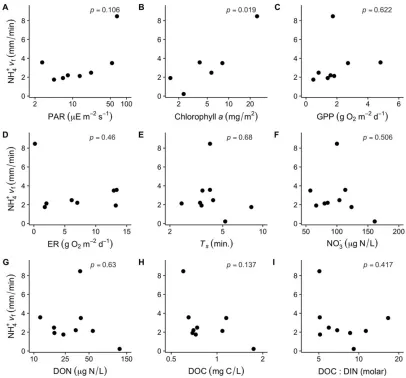
bio-logical covariates that we considered (Fig. 3A–I, Table 3)
with the exception of a positive correlation between net
stream NH41vfand Chla(Fig. 3B, Table 3), suggesting that
stream NH41demand increases with autotrophic biomass.
Nitrification
On average, 49% of added NH41was converted to NO32,
which suggests that nitrification was a significant fate of
added NH41. Across all experiments, 14 to 78% of added
NH41was nitrified immediately (Table 2), resulting in
nitri-fication rates ranging from 0.2 to 16.9lg N m22min21.
Per-cent NH41nitrified was not significantly correlated with net
stream NH41vf, background concentrations of dissolved N
and C, or daily average light intensity over their observed
range of variability (Table 3). Percent NH41nitrified varied
Figure 3. Scatterplots showing the correlations between net stream NH41uptake velocity (vf) and photosynthetically active
radia-tion (PAR) (A), algal biomass standing stock (chlorophylla) (B), gross primary production (GPP) (C), ecosystem respiration (ER) (D), transient storage zone residence time (Ts) (E), NO32(F), dissolved organic N (DON) (G), dissolved organic C (DOC) (H), and the
DOC:dissolved inorganic N (DIN) molar ratio (I). If experiments were performed in multiple reaches within a stream on the same day, we used mean values of covariates and net streamvf(resulting inn59), although sample size for individual bivariate
relation-ships varied depending on data availability (Table 3).
within intensive study streams (Bisley 1 CV576%, Bisley 3
CV546%), but we are unable to explain this variation at the
individual stream or landscape levels with our data.
River-network N dynamics and export
Based on stream hydrography and hydraulic measure-ments throughout the upper Río Mameyes network, stream length and benthic surface area were skewed toward the
headwaters. Total stream length for 1st- to 5th-order streams
was 45, 23, 12, 6, and 3 km, and total benthic surface area
was 0.041, 0.033, 0.026, 0.021, and 0.017 km2, respectively.
Direct inputs to the river network were distributed more
heavily toward 1st- and 2nd-order streams, which together
receive 76% of the direct drainage from land. Network-scale
NH41uptake declined from 6 kg N/d integrated across all
1st-order streams to 0.6 kg N/d in the 5th-order mainstem
river (Fig. 4A). This decline in NH41uptake with stream
or-der occurs because: 1) most NH41delivered to the river
net-work enters small streamsfirst, and 2) biological demand for
NH41is relatively high compared to the length and
resi-dence time of small streams (Fig. 4B), resulting in rapid
re-moval near the point where NH41enters the network.
Pro-portional removal of NH41inputs to a stream of a given
order declined from 0.90 for 1st-order streams to 0.52 in
the 5th-order mainstem river (Fig. 4B).
Network-scale NO32 uptake also declined with stream
size from 2.3 kg N/d (integrated across all 1st-order streams)
to 0.9 kg N/d in the 5th-order mainstem (Fig. 4A). NO32
up-take was more important than NH41uptake in the largest
stream orders. Similar to NH41, the pattern in NO32uptake
at the network scale results from the combined influence of
biotic demand and the distribution of NO32inputs from the
catchment, although NO32uptake is also influenced by
in-stream inputs from nitrification. Nitrification followed a
pattern similar to that of direct NH41 inputs and uptake
and declined with stream order (equal to 3.0, 1.7, 0.9, 0.5,
and 0.3 kg N/d in 1st- to 5th-order streams, respectively).
Therefore, downstream NO32 uptake was fueled by
up-stream nitrification. Proportional removal of NO32inputs
to a stream of a given order declined from 0.30 for 1st-order
streams to 0.11 in the 5th-order mainstem (Fig. 4B). For
in-puts to a given stream order, proportional N removal was
lower for NO32than NH41because of the low NO32vf
rel-ative to NH41vf(Ensign and Doyle 2006). Total inputs of
NH41and NO32 to the river network were similar (13.4
and 15.9 kg N/d, respectively, with 6.3 kg N/d of NO32
in-puts from in-stream nitrification), but differences in biotic
demand resulted in lower estimated NH41export (0.5 kg
N/d) than NO32export (7.5 kg N/d). At the network scale,
model results indicated that 2.9 kg N/d of the total NO32
export was produced within the river network by nitrifi
ca-tion.
The proportion of N inputs removed within individual streams, and therefore, the magnitude of network-scale
NH41and NO32uptake were only slightly sensitive to the
parameter values for NH41vf, NO32vf, and % NH41
nitri-fied, based on ranges in field measurements (Fig. 4A, B).
Small streams were relatively more important than larger streams for N uptake in the Río Mameyes network across all parameter combinations (Fig. 4A, B) regardless of our a
priori assumption of constantvfwith stream size (Fig. S1A,
B vs Fig. 4A, B). Network-scale NH41uptake was relatively
un-changed despite increasing NH41vfwith stream order (<7%
increase in NH41uptake for each stream order; Fig. S1A)
because NH41demand in small streams (based on
mea-suredvf) is high enough to limit downstream transport of
NH41to larger streams. Increased NO32vfwith stream size
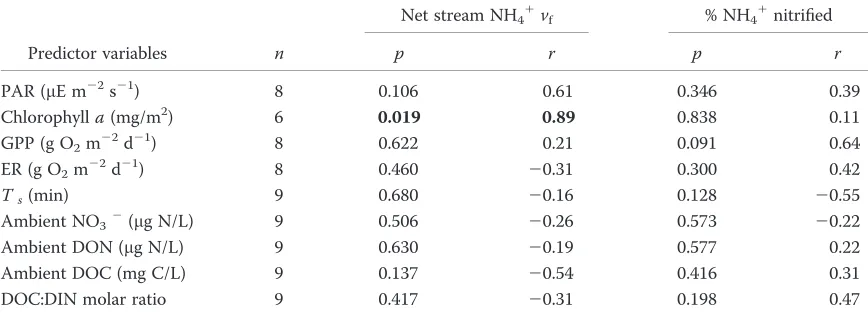
Table 3. Pearson correlation coefficients for the relationships between net stream channel NH41uptake velocity
(vf) and % NH41nitrified vs physical, chemical, and biological covariates. Photosynthetically active radiation (PAR),
chlorophylla, transient storage residence time (Ts), ambient dissolved organic C (DOC), ambient dissolved organic
N (DON), and DOC:dissolved inorganic N (DIN) molar ratio were ln(x-transformed) to meet normality assump-tions. Stream metabolism was not measured at the Máquina site, and chlorophyllawas not measured during the January/early February experiments at Bisley 1, Bisley 3, and Angelito. Bold indicates (p<0.05).
Predictor variables n
Net stream NH41vf % NH41nitrified
p r p r
PAR (lE m22s21) 8 0.106 0.61 0.346 0.39
Chlorophylla(mg/m2) 6 0.019 0.89 0.838 0.11
GPP (g O2m22d21) 8 0.622 0.21 0.091 0.64
ER (g O2m22d21) 8 0.460 20.31 0.300 0.42
Ts(min) 9 0.680 20.16 0.128 20.55
Ambient NO32(lg N/L) 9 0.506 20.26 0.573 20.22
Ambient DON (lg N/L) 9 0.630 20.19 0.577 0.22
Ambient DOC (mg C/L) 9 0.137 20.54 0.416 0.31
did result in slightly higher network-scale NO32uptake rates
compared to the base model scenario (e.g., NO32uptake
in-creased by 18% across 1st-order streams and increased by
62% in the 5th-order mainstem). However, NO32uptake in
this increasing NO32vfscenario was greatest in 2nd-order
streams, and small streams remained the more important
sites of NO32removal at the network scale (Fig. S1A).
D I S C U S S I O N
NH41uptake rates are high in the mountainous tropical
streams we studied. NH41vfwas consistently greater than
NO32vfpreviously measured in 9 streams spanning a range
of human land uses in Puerto Rico (Potter et al. 2010). Our
habitat-partitioned estimates of NH41vf suggest that the
stream channel is very reactive compared to transient
stor-age zones, possibly because of the influence of autotrophic
production and assimilatory uptake on stream NH41
dy-namics. Nitrification represented a large proportion of
NH41uptake, and when reach-scale N uptake and
transfor-mation rates were considered at the river-network scale, we
estimated that 39% of modeled watershed NO32 export
comes from nitrification within the river network itself.
Model results indicated that small streams were relatively
more important than large streams for NH41and NO32
re-moval because of the distribution of catchment N inputs and downstream hydraulic geometry. Taken together, these
results suggest that streams and rivers can significantly
transform catchment N loads, but that the spatial distribu-tion of N removal depends on river network geomorphology and biological N demand.
NH41uptake
NH41vfspanned a range commonly observed in streams
(Hall et al. 2002, Ensign and Doyle 2006). However, despite differences in watershed topography and geology (Table 1)
as well as stream chemistry and hydrology (Table 2), NH41vf
was relatively uniform across streams, and the variability was driven largely by 1 stream with a disproportionately
high NH41vf(Caimitillo). Stream metabolism should infl
u-ence NH41 uptake (Wollheim et al. 2001, Hall and Tank
2003, Newbold et al. 2006, Hoellein et al. 2007). However,
NH41vfwas positively correlated with Chlastanding stock
but not GPP (Fig. 3B, C). This result could be a consequence of the offset between metabolism and nutrient uptake in some streams because, despite similar weather conditions between measurements, other factors including turbidity or time since scour can affect daily variation in GPP
(Ueh-linger 2000). Our observation that benthic Chlawas related
to NH41 uptake is consistent with high rates of epilithon
uptake of isotopically labeled NH41in the Bisley 3 stream
(Merriam et al. 2002), suggesting that algae in biofilms can
contribute to inorganic N uptake even in relatively shaded
streams. Similar to previousfindings in temperate streams,
we did not observe a strong influence of ER on NH41uptake
(Webster et al. 2003, Fellows et al. 2006). In these tropical streams, leaf litter is decomposed rapidly (Heartsill-Scalley et al. 2012), so microbial heterotroph N demand might be
satisfied by recycling high-energy organic N during
decom-position (Sinsabaugh and Follstad-Shah 2012) rather than by using inorganic N from the water column. Our measure-ments were limited to small streams, and the variability in light intensity, GPP, and ER across our sites probably under-estimates the variability that might be observed at the scale of a larger river network. Further measurements in larger
rivers may help statistically examine the influence of
metab-olism on NH41uptake.
NH41uptake represents the net balance between
mul-tiple processes that consume and produce NH41and
inte-grates multiple habitats within a stream reach. We observed
Figure 4. Mean (±SE) network-scale N uptake (A) and reach-scale proportional removal of NH41and NO32inputs
(Ri) (B) in relation to stream order. Error bars represent results
from model-sensitivity analyses where parameter values were equal to mean±1 SE of observed NH41vf, NO32vf, and %
NH41nitrified.
clockwise hysteresis patterns inUnetduring each of our
periments. This observation suggests that: 1) hydrologic
ex-change with transient storage is significant, and 2)Ktdiffers
between the main channel and transient storage zones (e.g.,
subsurface hyporheicflow and surface pools). One
explana-tion for the clockwise hysteresis pattern is preferential
up-take in the stream channel combined with downstreamfl
ow-paths through less-reactive hyporheic zones. Alternatively,
calculations of sample-specific uptake rates (sensu Covino
et al. 2010) are sensitive to abiotic sorption of NH41to
sed-iments. Concentration-driven changes in net adsorption
could result in NH41sorption (and overestimation of NH41
removal) on the rising limb of the breakthrough curve
fol-lowed by desorption (and underestimation of NH41removal)
on the falling limb as sediment–water concentration
gradi-ents shift with NH41 concentration in the water column.
We observed increasing NH41∶Cl ratios on the falling limb
of the breakthrough curve in 4 of our experiments, as would
be expected given desorption of added NH41(Day and Hall
2017). However, we did not observe this pattern in most
ex-periments with clockwise hysteresis inUnet, so we assume
that the adsorption effect was limited across streams. Hys-teresis patterns have been observed by numerous investiga-tors conducting pulse nutrient-enrichment experiments (Gibson et al. 2015, Trentman et al. 2015) and may provide
useful information about habitat-specific uptake rates in
streams, although abiotic adsorption to sediments must be considered as well.
Nitrification
Nitrification was an important mechanism of NH41
re-moval during downstream transport. Our observation that
on average, 49% of added NH41was converted to NO32is
consistent with previous work in Bisley 3, where Merriam
et al. (2002) found that nitrification accounted for 57% of
total NH41uptake during a 6-wk15NH41tracer experiment.
In streams across the USA, Peterson et al. (2001) found that
on average, 20 to 30% of NH41uptake was nitrified, which,
taken together with our findings, indicates that nitrifi
ca-tion can rival assimilaca-tion as a short-term sink for dissolved
NH41. Our study confirms the generality of high nitrifi
ca-tion rates in mountainous tropical streams, where microbes are probably energy-limited because decomposition of terres-trial leaf litter is rapid (Heartsill-Scalley et al. 2012), dis-solved organic C is strongly retained by mineral soils (Mc-Dowell 1998, Neff and Asner 2001), and light availability limits primary production (Ortiz-Zayas et al. 2002, Tank
and Dodds 2003). However, our observations of nitrifi
ca-tion as a percentage of NH41uptake (14–78%) span a larger
range than was observed for 12 streams representing diverse biomes throughout the USA (Peterson et al. 2001). Much of the variation in our study occurred within the same stream,
suggesting that nitrification rates in streams can vary
tem-porally as much as spatially. In Bisley 1, for example, nitrifi
-cation varied from 18% of NH41uptake in late January to
78% when measured again in early March. This pattern was repeated in the 4 stream reaches in which we performed
multiple NH41enrichment experiments over a 6-wk period,
suggesting that conditions were more favorable for nitrifi
-cation later in the spring. We cannot explain the temporal
variability in net nitrification with our data, although we
speculate that leaf litter and particulate organic C standing stocks may have become depleted during the late winter when litterfall rates are lowest (Silver et al. 2014).
Percent NH41nitrified did not increase with background
inorganic N concentration, as has been previously observed in temperate streams (Bernhardt et al. 2002, Newbold et al.
2006). Nitrifiers are thought to be poor competitors for
NH41 relative to heterotrophic bacteria and autotrophs,
and Bernhardt et al. (2002) hypothesized that higher levels of inorganic N may alleviate heterotrophic demand and
al-low nitrifiers to use available NH41. However, streams
draining tropical forests in general, and the Luquillo
Moun-tains specifically, have high dissolved inorganic N
concen-trations relative to forested streams in temperate biomes
(Lewis et al. 1999, Brookshire et al. 2012), and nitrifiers
may not be in competition with heterotrophs for NH41.
We also found no relationship between nitrification rates
and DOC concentration despite the expectation that low
C availability favors nitrifiers over heterotrophic microbes
that rely on organic C as an energy source (Strauss and Lamberti 2000, Helton et al. 2015). High inorganic N and
low DOC availability may favor nitrification in tropical
moun-tainous streams in general, but other factors, such as micro-bial community composition, litterfall, or variable redox state
and hydrologic connectivity of groundwaterflowpaths likely
regulate stream nitrification rates.
River-network N dynamics and export
High nitrification potential in streams of the Luquillo
Mountains suggests that a significant amount of NO32may
be produced in tropical streams themselves. At the river-network scale, model results indicate that 39% of watershed
NO32export is produced in streams and rivers,
challeng-ing the idea that streamwater NO32provides an integrated
signal of plant–soil biogeochemical processes (Brookshire
et al. 2012). NH41uptake and nitrification in streams
trans-forms the catchment N load into NO32, which is less likely
to be consumed during the short transit times from land to
ocean. Thus, in-stream nitrification results in “shunting”
Doyle 2006, Wollheim et al. 2006, Hall et al. 2013). These conclusions appear contradictory, but the role of small vs large streams in river-network nutrient removal is not mu-tually exclusive, and the patterns in the Río Mameyes net-work are governed by the distribution of nutrient inputs,
nutrient-removal efficiency, and river-network morphology.
Direct N inputs from land are distributed toward
head-water streams in the Río Mameyes network, so high NH41
uptake efficiency in small streams means that little NH41
is transported downstream, producing a steep negative
re-lationship between NH41uptake and stream size (Fig. 4A).
Therefore, despite our a priori assumption of constant
NH41vfwith stream size, NH41removal in larger streams
is limited by NH41 availability. Larger streams remained
relatively more important for NO32 uptake because low
NO32vfand in-stream nitrification allow NO32transport
to downstream reaches. NO32uptake in larger streams also
would increase if NO32vfwere to increase with stream size
(e.g., with downstream opening of the canopy and increased assimilative N demand in downstream reaches) (Fig. S1A). Because uptake velocities typically differ considerably for
NH41 and NO32 (Ensign and Doyle 2006), the roles of
small vs large rivers in regulating watershed exports also shift with the strength of biotic demand (Wollheim et al. 2006).
Geomorphology is also a large driver of nutrient removal in river networks. Wollheim et al. (2006) found that the
pro-portion of NO32removal as a function of stream size was
sensitive to channel-width scaling and shifted from small-to large-stream dominance when the hydraulic width expo-nent increased from 0.36 to 0.52. In the Río Mameyes net-work, headwater streams are relatively wide, and width increases slowly in the downstream direction (hydraulic width
exponent50.35), probably because of high stormflows and
steep slopes that shape channel geometry (Pike et al. 2010). As a result of the slow increases in channel width in the Río Mameyes, the hydraulic load increases rapidly with in-creasing stream size, limiting the contact with reactive ben-thic sediments compared to smaller streams (Seitzinger et al. 2002).
The relationship between nutrient removal and river size varies depending on the distribution of nutrient inputs, bi-ological uptake rates, and hydraulic loads. The latter is also
influenced by daily runoff rates, the distribution of stream
length, and the downstream scaling of channel width (En-sign and Doyle 2006, Mulholland et al. 2008). Therefore, patterns in the spatial distribution of aquatic nutrient re-moval would be expected to differ in river networks with similar N uptake rates but different geomorphology, and our results highlight the need for further research compar-ing nutrient spiralcompar-ing in river networks with varycompar-ing hydro-logic and geomorphic characteristics. The modeling exercise that we presented here represents steady-state conditions
and considers only a snapshot in time during base flow.
We expect that high-flow events would decrease the
pro-portion of NH41removed by headwater streams, allowing
a greater role of larger rivers in network N uptake (Woll-heim et al. 2008a, Raymond et al. 2016). Further empirical
work quantifying N uptake and nitrification under different
flow conditions and in larger rivers would help refine these
expectations, but our approach is an important step toward understanding nutrient spiraling in a tropical river network. We suggest that systematic study of biogeochemical cycling throughout river networks will help bridge the gap between our understanding of site-level processes and large-scale biogeochemical patterns.
AC K N OW L E D G E M E N T S
Author contributions: LEK performed the research, analyzed the data, and wrote the paper. CS contributed new methods and analyzed the data. WMW, JR, and WHM performed the research. All authors discussed the results and contributed to development of the manuscript.
We thank Geoffrey Schwaner, Jonathan Torruellas, Jody Potter, Ford Ballantyne, Ken Sheehan, and Christina Baker for invaluable
field assistance, and Miguel Leon and Michelle Shattuck for pro-viding their expertise with the Luquillo Critical Zone Observatory spatial data sets. Two anonymous referees provided helpful com-ments and insights on earlier drafts of this manuscript. This re-search was supported by the National Science Foundation (NSF) as part of the Scaling Consumers and Lotic Ecosystem Rates (SCALER) project (EF1065255). Additional support for LEK was provided by an NSF graduate research fellowship (GRFP-0913620) and the Mulholland Award for Biogeochemical Research from the Society for Freshwater Science.
L I T E R AT U R E C I T E D
Alexander, R. B., R. A. Smith, and G. E. Schwarz. 2000. Effect of channel size on the delivery of nitrogen to the Gulf of Mexico. Nature 403:758–761.
Ashkenas, L. R., S. L. Johnson, S. V. Gregory, J. L. Tank, and W. M. Wollheim. 2004. A stable isotope tracer study of nitrogen up-take and transformation in an old-growth forest stream. Ecol-ogy 85:1725–1739.
Bernhardt, E. S., R. O. Hall, and G. E. Likens. 2002. Whole-system estimates of nitrification and nitrate uptake in streams at the Hubbard Brook Experimental Forest. Ecosystems 5:419–430. Bernhardt, E. S., and G. E. Likens. 2002. Dissolved organic carbon
enrichment alters nitrogen dynamics in a forest stream. Ecology 83:1689–1700.
Brookshire, E. N. J., L. O. Hedin, J. D. Newbold, D. M. Sigman, and J. K. Jackson. 2012. Sustained losses of bioavailable nitrogen from montane tropical forests. Nature Geoscience 5:123–126. Brown, S., A. E. Lugo, S. Silander, and L. Liegel. 1983. Research history and opportunities in the Luquillo Experimental Forest. General Technical Report SO-44. US Department of Agricul-ture Forest Service, New Orleans, Louisiana.
Covino, T. P., B. L. McGlynn, and R. A. McNamara. 2010. Tracer additions for spiraling curve characterization (TASCC): quan-tifying stream nutrient uptake kinetics from ambient to satura-tion. Limnology and Oceanography: Methods 8:484–498.
Cusack, D. F., J. Macy, and W. H. McDowell. 2016. Nitrogen ad-ditions mobilize soil base cations in two tropical forests. Bio-geochemistry 128:67–88.
Day, N. K., and R. O. Hall. 2017. Ammonium uptake kinetics and nitrification in mountain streams. Freshwater Science 36:41–54. Dodds, W. K., A. J. López, W. B. Bowden, S. Gregory, N. B. Grimm, S. K. Hamilton, A. E. Hershey, E. Martí, W. H. McDowell, J. L. Meyer, D. Morrall, P. J. Mulholland, B. J. Peterson, J. L. Tank, H. M. Valett, J. R. Webster, and W. Wollheim. 2002. N uptake as a function of concentration in streams. Journal of the North American Benthological Society 21:206–220.
Dodds, W. K., E. Martí, J. L. Tank, J. Pontius, S. K. Hamilton, N. B. Grimm, W. B. Bowden, W. H. McDowell, B. J. Peterson, H. M. Valett, J. R. Webster, and S. Gregory. 2004. Carbon and nitro-gen stoichiometry and nitronitro-gen cycling rates in streams. Oeco-logia 140:458–467.
Downing, J. A., M. McClain, R. Twilley, J. M. Melack, J. Elser, N. N. Rabalais, W. M. Lewis, Jr, R. E. Turner, J. Corredor, D. Soto, A. Yanez-Arancibia, J. A. Kopaska, and R. W. Howarth. 1999. The impact of accelerating land-use change on the N-cycle of tropical aquatic ecosystems: current conditions and projected changes. Biogeochemistry 46:109–148.
Earl, S. R., H. M. Valett, and J. R. Webster. 2006. Nitrogen satu-ration in stream ecosystems. Ecology 87:3140–3151. Ensign, S. H., and M. W. Doyle. 2006. Nutrient spiraling in streams
and river networks. Journal of Geophysical Research 111: G04009.
Fellows, C. S., H. M. Valett, C. N. Dahm, P. J. Mulholland, and S. A. Thomas. 2006. Coupling nutrient uptake and energyflow in headwater streams. Ecosystems 9:788–804.
Gibson, C. A., C. M. O'Reilly, A. L. Conine, and S. M. Lipshutz. 2015. Nutrient uptake dynamics across a gradient of nutrient concentrations and ratios at the landscape scale. Journal of Geophysical Research: Biogeosciences 120:326–340. González, G., and International Institute of Tropical Forestry.
2015. Bisley daily meteorologic data. University of Pennsylva-nia, Philadelphia, Pennsylvania. (Available from: https://www.sas .upenn.edu/lczodata/content/bisley-climate)
Hall, R. O., M. A. Baker, E. J. Rosi-Marshall, J. L. Tank, and J. D. Newbold. 2013. Solute-specific scaling of inorganic nitrogen and phosphorus uptake in streams. Biogeosciences 10:7323–7331. Hall, R. O., E. S. Bernhardt, and G. E. Likens. 2002. Relating
nutri-ent uptake with transinutri-ent storage in forested mountain streams. Limnology and Oceanography 47:255–265.
Hall, R. O., and J. L. Tank. 2003. Ecosystem metabolism controls nitrogen uptake in streams in Grand Teton National Park, Wyom-ing. Limnology and Oceanography 48:1120–1128.
Hall, R. O., J. L. Tank, D. J. Sobota, P. J. Mulholland, J. M. O'Brien, W. K. Dodds, J. R. Webster, H. M. Valett, G. C. Poole, B. J. Pe-terson, J. L. Meyer, W. H. McDowell, S. L. Johnson, S. K. Ham-ilton, N. B. Grimm, S. V. Gregory, C. N. Dahm, L. W. Cooper, L. R. Ashkenas, S. M. Thomas, R. W. Sheibley, J. D. Potter, B. R. Niederlehner, L. T. Johnson, A. M. Helton, C. M. Crenshaw, A. J. Burgin, M. J. Bernot, J. J. Beaulieu, and C. P. Arango. 2009. Nitrate removal in stream ecosystems measured by N addi-tion experiments: total uptake. Limnology and Oceanography 54:653–665.
Harvey, J. W., and B. J. Wagner. 2000. Quantifying hydrologic in-teractions between streams and their subsurface hyporheic zones. Pages 3–44inJ. B. Jones and P. J. Mulholland (editors).
Streams and groundwaters. Academic Press, San Diego, Cali-fornia.
Heartsill-Scalley, T., F. N. Scatena, C. Estrada, W. H. McDowell, and A. E. Lugo. 2007. Disturbance and long-term patterns of rainfall and throughfall nutrientfluxes in a subtropical wet for-est in Puerto Rico. Journal of Hydrology 333(2–4):472–485. Heartsill-Scalley, T., F. N. Scatena, S. Moya, and A. E. Lugo. 2012.
Long-term dynamics of organic matter and elements exported as coarse particulates from two Caribbean montane water-sheds. Journal of Tropical Ecology 28:127–139.
Helton, A. M., M. Ardón, and E. S. Bernhardt. 2015. Thermody-namic constraints on the utility of ecological stoichiometry for explaining global biogeochemical patterns. Ecology Letters 18:1049–1056.
Hoellein, T. J., J. L. Tank, E. J. Rosi-Marshall, S. A. Entrekin, and G. A. Lamberti. 2007. Controls on spatial and temporal vari-ation of nutrient uptake in three Michigan headwater streams. Limnology and Oceanography 52:1964–1977.
Horton, R. E. 1945. Erosional development of streams and their drainage basins; hydrophysical approach to quantitative mor-phology. Geological Society of America Bulletin 56:275–370. Howarth, R. W., G. Billen, D. Swaney, A. Townsend, N. Jaworski, K. Lajtha, J. A. Downing, R. Elmgren, N. Caraco, T. Jordan, F. Berendse, J. Freney, V. Kudeyarov, P. Murdoch, and Z. Zhao-Liang. 1996. Regional nitrogen budgets and riverine N and P
fluxes for the drainages to the North Atlantic Ocean: natural and human influences. Biogeochemistry 35:75–139.
Kilpatrick, F. A., and E. D. Cobb. 1985. Measurement of discharge using tracers. Chapter A16inTechniques in Water Resources Investigations of the United States Geological Survey, book 3. US Government Printing Office, Washington, DC.
Leopold, L. B., and T. Maddock. 1953. The hydraulic geometry of stream channels and some physiographic implications. US Government Printing Office, Washington, DC.
Lewis, Jr, W. M., J. M. Melack, W. H. McDowell, M. McClain, and J. E. Richey. 1999. Nitrogen yields from undisturbed watersheds in the Americas. Biogeochemistry 46:149–162.
Matson, P. A., W. H. McDowell, A. R. Townsend, and P. M. Vitousek. 1999. The globalization of N deposition: ecosystem consequences in tropical environments. Biogeochemistry 46: 67–83.
McDowell, W. H. 1998. Internal nutrientfluxes in a Puerto Rican rain forest. Journal of Tropical Ecology 14:521–536.
McDowell, W. H., W. B. Bowden, and C. E. Asbury. 1992. Riparian nitrogen dynamics in two geomorphologically distinct tropical rain forest watersheds: subsurface solute patterns. Biogeochem-istry 18:53–75.
McDowell, W. H., and D. Liptzin. 2014. Linking soils and streams: response of soil solution chemistry to simulated hurricane dis-turbance mirrors stream chemistry following a severe hurri-cane. Forest Ecology and Management 332:56–63.
McDowell, W. H., C. P. McSwiney, and W. B. Bowden. 1996. Effects of hurricane disturbance on groundwater chemistry and ripar-ian function in a tropical rainforest. Biotropica 28:577–584. McDowell, W. H., F. N. Scatena, R. B. Waide, N. Brokaw, G. R.
and ecological setting of the Luquillo Mountains. Pages 72–163
in: N. Brokaw, T. A. Crowl, A. E. Lugo, W. H. McDowell, F. N. Scatena, R. B. Waide, and M. W. Willig (editors). A Caribbean forest tapestry: the multidimensional nature of disturbance and response. Oxford University Press, New York.
Merriam, J. L., W. H. McDowell, J. L. Tank, W. M. Wollheim, C. L. Crenshaw, and S. L. Johnson. 2002. Characterizing nitro-gen dynamics, retention and transport in a tropical rainforest stream using an in situ N addition. Freshwater Biology 47: 143–160.
Mulholland, P. J., A. M. Helton, G. C. Poole, R. O. Hall, S. K. Ham-ilton, B. J. Peterson, J. L. Tank, L. R. Ashkenas, L. W. Cooper, C. N. Dahm, W. K. Dodds, S. E. G. Findlay, S. V. Gregory, N. B. Grimm, S. L. Johnson, W. H. McDowell, J. L. Meyer, H. M. Valett, J. R. Webster, C. P. Arango, J. J. Beaulieu, M. J. Bernot, A. J. Burgin, C. L. Crenshaw, L. T. Johnson, B. R. Niederlehner, J. M. O'Brien, J. D. Potter, R. W. Sheibley, D. J. Sobota, and S. M. Thomas. 2008. Stream denitrification across biomes and its response to anthropogenic nitrate loading. Nature 452: 202– 205.
Murdock, J. N., and W. K. Dodds. 2007. Linking benthic algal bio-mass to stream substratum topography. Journal of Phycology 43:449–460.
Nash, J. C. 1990. Compact numerical methods for computers: lin-ear algebra and function minimization. CRC Press, New York. Neff, J. C., and G. P. Asner. 2001. Dissolved organic carbon in ter-restrial ecosystems: synthesis and a model. Ecosystems 4:29–48. Newbold, J. D., T. L. Bott, L. A. Kaplan, C. L. Dow, J. K. Jackson, A. K. Aufdenkampe, L. A. Martin, D. J. Van Horn, and A. A. Long. 2006. Uptake of nutrients and organic C in streams in New York City drinking-water-supply watersheds. Journal of the North American Benthological Society 25:998–1017. Ortiz-Zayas, J. R., E. Cuevas, O. L. Mayo-Bracero, L. Donoso,
I. Trebs, D. Figueroa-Nieves, and W. H. McDowell. 2006. Ur-ban influences on the nitrogen cycle in Puerto Rico. Biogeo-chemistry 79:109–133.
Ortiz-Zayas, J. R., W. M. Lewis, Jr, J. F. Saunders, J. H. McCutchan, and F. N. Scatena. 2002. Metabolism of a tropical rainforest stream. Journal of the North American Benthological Society 24:769–783.
Parker, S. P., W. B. Bowden, and M. B. Flinn. 2016. The effect of acid strength and postacidification reaction time on the deter-mination of chlorophyllain ethanol extracts of aquatic periph-yton. Limnology and Oceanography: Methods 14:839–852. Payn, R. A., M. N. Gooseff, B. L. McGlynn, K. E. Bencala, and
S. M. Wondzell. 2009. Channel water balance and exchange with subsurfaceflow along a mountain headwater stream in Montana, United States. Water Resources Research 45:W11427. Payn, R. A., J. R. Webster, P. J. Mulholland, H. M. Valett, and W. K. Dodds. 2005. Estimation of stream nutrient uptake from nutrient addition experiments. Limnology and Oceanography: Methods 3:174–182.
Peterson, B. J., W. M. Wollheim, P. J. Mulholland, J. R. Webster, J. L. Meyer, J. L. Tank, E. Martí, W. B. Bowden, H. M. Valett, A. E. Hershey, W. H. McDowell, W. K. Dodds, S. K. Hamilton, S. Gregory, and D. D. Morrall. 2001. Control of nitrogen export from watersheds by headwater streams. Science 292: 86–90.
Pike, A. S., F. N. Scatena, and E. E. Wohl. 2010. Lithological and
fluvial controls on the geomorphology of tropical montane
stream channels in Puerto Rico. Earth Surface Processes and Landforms 35:1402–1417.
Potter, J. D., W. H. McDowell, J. L. Merriam, B. J. Peterson, and S. M. Thomas. 2010. Denitrification and total nitrate uptake in streams of a tropical landscape. Ecological Applications 20: 2104–2115.
Riley, A. J., and W. K. Dodds. 2013. Whole-stream metabolism: strategies for measuring and modeling diel trends of dissolved oxygen. Freshwater Science 32:56–69.
Raymond, P. A., J. E. Saiers, and W. V. Sobczak. 2016. Hydrological and biogeochemical controls on watershed dissolved organic matter transport: pulse-shunt concept. Ecology 97:5–16. Rodríguez-Cardona, B., A. S. Wymore, and W. H. McDowell.
2016. DOC:NO32ratios and NO32uptake in forested
headwa-ter streams. Journal of Geophysical Research: Biogeosciences 121:205–217.
Runkel, R. L. 2007. Toward a transport-based analysis of nutrient spiraling and uptake in streams. Limnology and Oceanogra-phy: Methods 5:50–62.
Sartory, D., and J. Grobbelaar. 1984. Extraction of chlorophylla
from freshwater phytoplankton for spectrophotometric anal-ysis. Hydrobiologia 114:177–187.
Seitzinger, S., R. V. Styles, E. W. Boyer, R. B. Alexander, G. Billen, R. W. Howarth, B. Mayer, and N. Van Breemen. 2002. Nitro-gen retention in rivers: model development and applications to watersheds in the northeastern U.S.A. Biogeochemistry 57: 199–237.
Silver, W. L., S. J. Hall, and G. González. 2014. Differential effects of canopy trimming and litter deposition on litterfall and nu-trient dynamics in a wet subtropical forest. Forest Ecology and Management 332:47–55.
Silver, W. L., A. E. Lugo, and M. Keller. 1999. Soil oxygen avail-ability and biogeochemistry along rainfall and topographic gradients in upland wet tropical forest soils. Biogeochemistry 44:301–328.
Sinsabaugh, R. L., and J. J. Follstad-Shah. 2012. Ecoenzymatic stoichiometry and ecological theory. Annual Review of Ecology, Evolution, and Systematics 43:313–343.
Snyder, L. E., and W. B. Bowden. 2014. Nutrient dynamics in an oligotrophic arctic stream monitored in situ by wet chemistry methods. Water Resources Research 50:2039–2049.
Soetaert, K., and F. Meysman. 2012. Reactive transport in aquatic ecosystems: rapid model prototyping in the open source soft-ware R. Environmental Modeling and Softsoft-ware 32:49–60. Solórzano, L. 1969. Determination of ammonia in natural waters
by the phenolhypochlorite method. Limnology and Oceanog-raphy 14:799–801.
Song, C., W. K. Dodds, M. T. Trentman, J. Rüegg, and F. Ballan-tyne. 2016. Methods of approximation influence aquatic eco-system metabolism estimates. Limnology and Oceanography Methods 14:557–569.
Strauss, E. A., and G. A. Lamberti. 2000. Regulation of nitrifi ca-tion in aquatic sediments by organic carbon. Limnology and Oceanography 45:1854–1859.
Stream Solute Workshop. 1990. Concepts and methods for as-sessing solute dynamics in stream ecosystems. Journal of the North American Benthological Society 9:95–119.
Tank, J. L., and W. K. Dodds. 2003. Nutrient limitation of epilithic and epixylic biofilms in ten North American streams. Fresh-water Biology 48:1031–1049.
Tank, J. L., E. J. Rosi-Marshall, M. A. Baker, and R. O. Hall. 2008. Are rivers just big streams? A pulse method to quantify nitro-gen demand in a large river. Ecology 89:2935–2945. Trentman, M. T., W. K. Dodds, J. S. Fencl, K. Gerber, J. Guarneri,
S. M. Hitchman, Z. Peterson, and J. Rüegg. 2015. Quantifying ambient nitrogen uptake and functional relationships of uptake versus concentration in streams: a comparison of stable isotope, pulse, and plateau approaches. Biogeochemistry 125:65–79. Triska, F. J., A. P. Jackman, J. H. Duff, and R. J. Avanzino. 1994.
Ammonium sorption to channel and riparian sediments: a tran-sient storage pool for dissolved inorganic nitrogen. Biogeo-chemistry 26:67–83.
Uehlinger, U. 2000. Resistance and resilience of ecosystem metabo-lism in aflood-prone river system. Freshwater Biology 45:319–332. Valett, H. M., J. A. Morrice, C. N. Dahm, and M. E. Campana. 1996. Parent lithology, surface–groundwater exchange, and nitrate retention in headwater streams. Limnology and Oceanography 41:333–345.
Webster, J. R., P. J. Mulholland, J. L. Tank, H. M. Valett, W. K. Dodds, B. J. Peterson, W. B. Bowden, C. N. Dahm, S. Findlay, S. V. Gregory, N. B. Grimm, S. K. Hamilton, S. L. Johnson, E. Martí, W. H. McDowell, J. L. Meyer, D. D. Morrall, S. A. Thomas, and W. M. Wollheim. 2003. Factors affecting
ammo-nium uptake in streams–an inter-biome perspective. Fresh-water Biology 48:1329–1352.
Webster, J. R., and H. M. Valett. 2006. Solute dynamics. Pages 169–185inF. R. Hauer and G. A. Lamberti (editors). Methods in stream ecology. 2ndedition. Academic Press, San Diego,
California.
Wollheim, W. M., B. J. Peterson, L. A. Deegan, J. E. Hobbie, B. Hooker, W. B. Bowden, K. J. Edwardson, D. B. Arscott, A. E. Hershey, and J. Finlay. 2001. Influence of stream size on ammonium and suspended particulate nitrogen process-ing. Limnology and Oceanography 46:1–13.
Wollheim, W. M., B. J. Peterson, S. M. Thomas, C. H. Hopkinson, and C. J. Vörösmarty. 2008a. Dynamics of N removal over an-nual time periods in a suburban river network. Journal of Geo-physical Research: Biogeosciences 113:G03038.
Wollheim, W. M., C. J. Vörösmarty, A. F. Bouwman, P. Green, J. Harrison, E. Linder, B. J. Peterson, S. P. Seitzinger, and J. P. M. Syvitski. 2008b. Global N removal by freshwater aquatic systems using a spatially distributed, within-basin approach. Global Biogeochemical Cycles 22:GB2026.