Carsey
T r ack ingchang es in T he n o r T h coun T ry
New eNglaNd Issue BrIef No. 17 WinTer 2010
Out-of-school Time Matters:
activity Involvement and Positive Development
among Coos County youth
E r i n H i l E y S H a r p
I n s T I T u T e
Key Findings
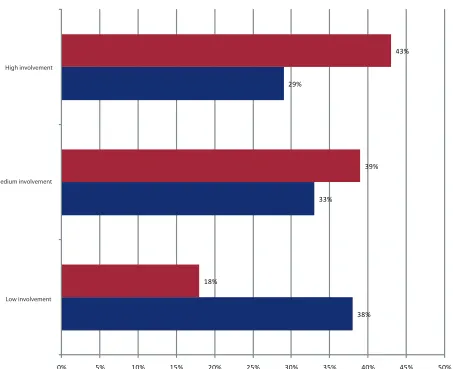
• coos county youth report participating in an average of five and a half out-of-school free time activities over twelve months. There were important differences between girls and boys; girls reported participation in an average of 6.3 activities, while boys reported participation in an average of only 4.9 activities. in addition, considerably more boys fell into the “low-involvement” group compared to girls (38 percent versus 19 percent).
• coos county youth who were the most involved in positive activities during their out-of-school time reported higher grades, a more positive attitude towards school, a stronger sense of belonging at school, and more positive expectations for the future than both their moderately and least involved peers.
• coos county youth who were least involved in out-of-school activities looked strikingly different from their more involved peers. This highlights a potential risk for the fairly large number of coos county youth, particularly boys, who have little involvement in out-of-school activities.
Background
youth in the united states spend about 50 percent of their
waking hours in out-of-school free time pursuits.1 How
they spend this time may facilitate positive development and growth experiences or place them at risk for negative outcomes. youth who are engaged in constructive pursuits, such as extracurricular activities, volunteering, or sports during their free time, are more likely to develop initiative, better understand themselves in relation to others, experi-ence optimism toward the future, and develop skills and competencies that promote a successful transition to
adult-hood.2 On the other hand, youth who report unconstructive
time use, such as “hanging out” and high levels of boredom during their free time, are at an increased risk for substance
use, delinquency, and school dropout.3
understanding free time use and its associated out-comes among youth may be particularly important in rural communities facing economic hardship. evidence suggests that youth in these communities have higher numbers of unoccupied hours in their daily lives and that rural com-munities may have fewer resources available to provide the infrastructure (for example, transportation and location)
or the funding needed to support positive youth activities.4
Despite concerns about rural school dropout,
unemploy-ment, and poverty,5 research on free time activities among
youth has so far focused mainly on those who live in urban or suburban settings. as part of an ongoing survey at the Carsey Institute, we are fortunate to have access to current survey data regarding self-reported free time use among youth in Coos County, new Hampshire, a rural county where residents have faced increased poverty and unem-ployment and where the loss of good manufacturing jobs in the pulp and paper industry have raised concerns about
the long-term availability of opportunities for youth.6 This
dium, and high involvement) based on the number of these out-of-school activities in which each youth was involved. The three groups were low, defined as fewer than three activities (28 percent of youth included); medium, defined as between three to six activities (36 percent of youth); and high, defined as being involved in more than seven activi-ties (36 percent of youth).
Following up on gender differences, we also found that a considerably larger proportion of boys were in the low-involvement group (38 percent) compared to girls (19 percent) and that significantly more girls were in the high-involvement group (43 percent) compared to boys (29 percent: see Figure 1). These findings are consistent with previous research, suggesting that adolescent girls partici-pate in both more activities overall and in a wider range of out-of-school activities.
How Involved are Coos County
youth in Constructive
Out-of-school activities?
students were asked whether they participated in sixteen different free-time activities,7 in the past twelve months.
students reported participating in an average of five-and-a-half activities. Because studies have found that gender may impact opportunities to participate and the choices that
youth make about participation,8 we looked at experiences
separately for boys and girls. There were significant sex dif-ferences, with boys participating in an average of just under five activities (M = 4.9) and girls participating in over six (M = 6.3). In order to describe patterns of activity involve-ment, we separated the youth into three groups (low,
me-38% 33%
29%
18%
39% 43%
0% 5% 10% 15% 20% 25% 30% 35% 40% 45% 50%
Female Male High involvement
Medium involvement
Low involvement
Level of Involvement and
educational Outcomes
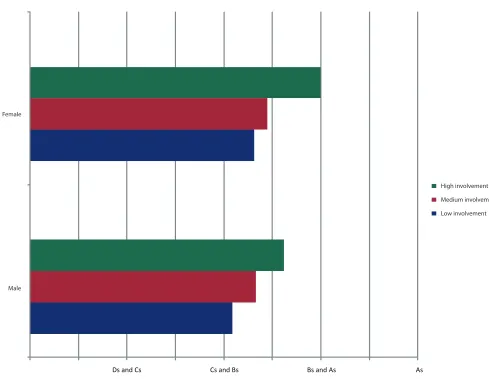
next we wanted to understand the relationship between activity involvement and the self-reported academic per-formance of Coos County youth. students who were highly involved in out-of-school activities reported grades in the a and B range, while youth who participated in the least num-ber of out-of-school activities reported grades in the B and C range. This pattern of findings was similar for boys and girls (see Figure 2).
Ds and Cs Cs and Bs Bs and As As
Female
Male
High involvement Medium involvement
Low involvement Figure 2: average self-reported grades by level of involvement
Level of Involvement and Future
expectations
How adolescents view their futures plays a critical role in their motivation, behavior, and preparation for adulthood, but we know fairly little about what factors and experiences influence their future expectations. using previous Carsey Institute data on Coos County youths’ reports about expec-tations of graduating from high school, getting a full-time job right after high school, and graduating from college, we
0 1 2 3 4 5 6
High involvement Medium involvement
Low involvement Female
Male
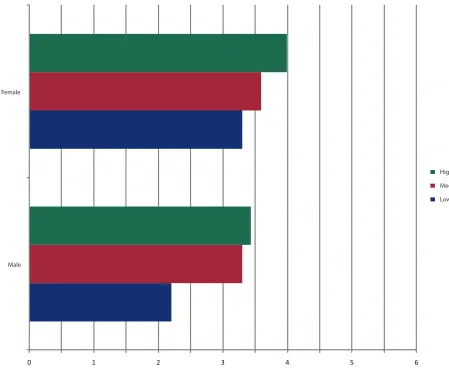
Figure 3: attitude towards school by level of involvement (range 0=least positive to 6=most positive)
0 1 2 3 4 5 6
High involvement Medium involvement Low involvement Female
Male
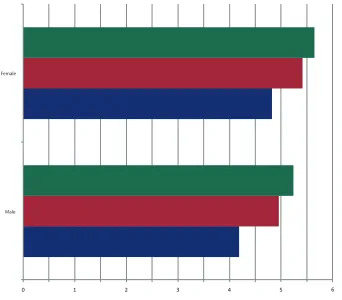
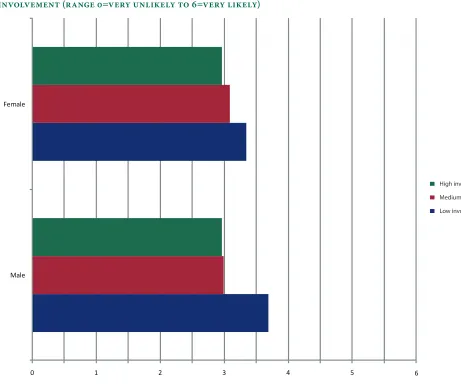
Figure 4: Expectations to graduate from high school by level of involvement (range 0=very unlikely to 6=very likely)
0 1 2 3 4 5
High involvement Medium involvement Low involvement Female
Male
Conclusion
There is mounting evidence that youths’ free time choices and experiences have the potential for either contribut-ing to or limitcontribut-ing positive development. Our results show that youth in rural Coos County who are most involved in activities during their out-of-school time also report higher grades, a more positive attitude towards school, a stronger sense of belonging at school, and more positive expecta-tions for the future than both their moderately and least involved peers. The Coos County youth who were the least involved in out-of-school activities look strikingly different from their more involved peers. These youth report lower grades, a fairly negative attitude towards school, less sense of belonging at school, and less optimistic views of their future. These results highlight the potential risks for the fairly large percentage of Coos County youth (28 percent) who reported very little involvement in constructive out-of-school activities.
Our pattern of findings was similar for boys and girls, but the associations between level of involvement and outcomes related to education and future expectations were often stronger for boys. This suggests that boys’ out-of-school activities may have an even greater impact on their development. These findings may also suggest that there are factors not accounted for in this brief that may influence boys’ level of activity involvement and their educational experiences and future expectations. These factors could include things like gender socialization, parental expecta-tions, and boys’ perceptions of opportunities available in their school and community. although more research is needed to understand these associations, it is concerning that almost 40 percent of boys in Coos County report little to no out-of-school activity involvement. These uninvolved boys are not only missing out on growth-enhancing oppor-tunities in constructive activities but may also be placed at a greater risk for negative outcomes.
0 1 2 3 4 5
Male Female
High involvement
Medium involvement Low involvement
THE CarSEy inSTiTuTE CooS youTH STudy
The Carsey Institute is conducting a panel study of Coos County youth that will provide data about the attitudes and experiences of the county’s youth as they approach young adulthood and face the decision to remain in their community, seek opportunities elsewhere, or leave for an education and then return. By following the entire popu-lations of two age groups over a ten-year period, we will help North Country leaders gain a better understanding of young people’s decision making.
rESEarCH TEam
Cesar rebellon is a faculty fellow at the Carsey In-stitute and an associate professor in the Department of sociology at the university of new Hampshire. His primary research interests focus on family and peer correlates of juvenile crime and delinquency, with a particular emphasis on the manner in which delinquency may yield reinforcing social rewards among adolescents.
erin Hiley sharp is a Carsey Institute faculty fellow and assistant professor in the Department of Fam-ily studies at the university of new Hampshire. Her research interests include activity involvement as a context for adolescent development; parental, fam-ily, and broader contextual influences on adolescent development; and prevention research and theory from a positive youth development perspective.
nena stracuzzi is an assistant research professor at the Carsey Institute. Her research focuses on vulner-able youth and families.
Corinna Jenkins Tucker is a faculty fellow at the Carsey Institute and an associate professor in the Department of Family studies at the university of new Hampshire. Her primary research interests focus on adolescents’ family relationships.
Heather Turner is a senior fellow at the Carsey In-stitute and a professor in the Department of sociology at the university of new Hampshire. Her research con-centrates on social stress processes and mental health. Karen Van Gundy is a faculty fellow at the Carsey Institute and an associate professor in the Department of sociology at the university of new Hampshire. Her work investigates the mechanisms by which life cir-cumstances and social statuses influence variations in health, emotional, and behavioral outcomes.
Taken together, our findings suggest that one effective approach to increasing youths’ academic performance, commitment to education, and future expectations may be to target adolescents’ out-of-school time use. More work is needed to understand how youth are spending their out-of-school time; the reasons why youth get involved in, stay in, or drop out of activities; and how families, schools, and communities facilitate or constrain constructive activity participation, particularly in rural communities. although more research is needed, we are building evidence to sug-gest the need for policies and programs that increase the number of constructive activities available to youth in Coos County; reduce potential barriers to participation like transportation and cost; communicate the value of out-of-school activity participation to community officials, parents, and youth; and help youth structure their free time in healthier ways. also, given the findings presented in this brief, it may be important for communities, schools, and families to be aware of gender differences in activity in-volvement and work toward equalizing participation among boys and girls in Coos County.
Panel study of Coos County
youth
Building knowledge for families and communities
The Carsey Institute conducts policy research on vulnerable children, youth, and families and on sustainable community development. We give policy makers and practitioners timely, independent resources to effect change in their communities.
Carsey Institute Reports on Tracking Change in the North Country are supported by the neil and Louise Tillotson Fund at the new Hampshire Charitable Foundation and the Carsey Institute endowment.
Huddleston Hall 73 Main street Durham, nH 03824 (603) 862-2821
www.carseyinstitute.unh.edu
endnotes
1. r. W. Larson and s. Verma, “How Children and adolescents spend Time across the World: Work, Play, and Developmental
Opportunities,” Psychological Bulletin, 125(1999): 701–736.
2. J. D. Coatsworth et al, “self-Defining activities, expressive
Identity, and adolescent Wellness,” Applied Developmental
Science, 10 (2006): 157–170; D. M. Hansen, r. W. Larson, and J. B. Dworkin, “What adolescents Learn in Organized youth activities: a survey of self-reported Developmental
experiences,” Journal of Research on Adolescence, 13 (2003):
25–55; J. P. Hunter and M. Csikszentmihalyi, „The Positive
Psychology of Interested adolescents,” Journal of Youth &
Adolescence, 32 (2003): 27–35; L. L. Caldwell, “recreation and youth Development,” in P. a. Witt and L. L. Caldwell,.
Recreation and Youth Development (state College, Pa: Venture Publishing, 2005), 169-191.
3. D. W. Osgood, a. L. anderson, and J. n. shaffer, “un-structured Leisure in the after-school Hours,” in J. L.
Mahoney, r. W. Larson, and J. s. eccles, eds., Organized
Activities as Contexts of Development: Extracurricular Ac-tivities, After-School and Community Programs (Mahmah, nJ: erlbaum, 2005), 45–64; e. H. sharp et al., “Predicting substance use Behavior among south african adolescents: The role of Free Time experiences.” (Manuscript submitted for publication, 2009).
4. r. W. Larson and s. Verma, “How Children and adoles-cents spend Time across the World: Work, Play, and Devel-opmental Opportunities.”; D. M. Casey, M. n. ripke, and a. C. Huston, “activity Participation and the Well-Being of Children and adolescents in the Context of Welfare re-form,” in J. L. Mahoney, r. W. Larson, and J. s. eccles, eds.,
Organized Activities as Contexts of Development: Extracur-ricular Activities, After-School and Community Programs
(Mahmah, nJ: erlbaum, 2005), 65–84.
5. a. Churilla, “urban and rural Children experience similar rates of Low-Income and Poverty,” Issue Brief no. 2 (Durham, nH: Carsey Institute, university of new Hamp-shire, 2008).
6. C. r. Colocousis, “The state of Coos County: Local Perspectives on Community and Change,” Issue Brief no. 7 (Durham, nH: Carsey Institute, university of new Hamp-shire, 2008).
7. activity choices were (1) sports; (2) student govern-ment; (3) band, choir, or music lessons; (4) drama, the-ater, dance; (5) art; (6) academic club; (7) community
service club; (8) 4-H or scouts; (9) volunteer work; (10) church group; (11) honor society; (12) school yearbook or newspaper; (13) hobby club; (14) community events; (15) outdoor activities; and (16) community center events. 8. s. McHale et al., “Links Between sex-Typed activi-ties in Middle Childhood and Gender Development in
early adolescence,” Developmental Psychology, 40 (2004):
868–881; e. H. sharp, et al., “Gender Differences in the self-Defining activities and Identity experiences of
ado-lescents and emerging adults,” Journal of Adolescence, 30
(2007): 251–269.
aBOuT THe auTHOr
erin Hiley sharp is a Carsey Institute faculty fellow and as-sistant professor of family studies at the university of new