EFFECT OF DISTANCE MEASURES ON
TRANSFORM BASED IMAGE
CLASSIFICATION
H. B. KEKRE
Sr. Professor,
MPSTME, NMIMS University, Vileparle(w) Mumbai-56, INDIA
TANUJA K. SARODE
Associate Professor,
Thadomal Shahani Engineering College, Bandra(W), Mumbai-50, INDIA
JAGRUTI K. SAVE
Ph.D. Research Scholar, MPSTME, NMIMS University,
Associate Professor,
Fr. CRCE, Bandra(W), Mumbai-50, INDIA [email protected]
Abstract :
Due to rapid growth of multimedia databases, there is a need to classify and organize these databases. Classification of image database is a computational procedure that sorts images into groups (classes) according to their similarities. Many algorithms have been developed for this purpose. Measuring similarity or distance between two feature vectors is a key step in all these algorithms. Choosing the right distance measure for a given database is a biggest challenge. In this paper, we study various distance measures and their effect on transform based image classification methods. The paper presents a comparison between different distance measures for various sizes of feature vectors. 8 classes of images from the Wang database are used to carry out the experiments. The experimental results and detailed analysis are presented.
Keywords: Classification; Similarity Measures; Image Transforms; Feature Vector; Nearest Neighbor Classifier; Minkowski Distances; Cosine Correlation Similarity;.
1. Introduction
its significance; in section 3, we present the classification algorithm; Section 4 gives the results followed by conclusion and future work.
2. Distance Measures
Many distance measures have been proposed in literature for image classification [14]. In this section we briefly elaborate six commonly used distance measures. An important family of distance measures is formed by Minkowski distances [15] [16]. If P = (P1,P2,…,Pn) and Q = (Q1,Q2,…,Qn) are two feature vectors, then the Minkowski distance of order p between them is given by Eq.1.
pn
i
p i i
Mink
P
Q
P
Q
D
1
,
(1)The L1 (1-norm) Minkowski distance is the Manhattan distance and the L2 distance is the Euclidean distance. When p goes to infinite, we get Chebyshev distance.
2.1. Euclidean Distance
Euclidean distance is a standard metric for geometrical problems. Euclid stated that the shortest distance between two points is a length of a straight line joining those two points and thus the Eq.2 is predominantly known as Euclidean distance. It is the ordinary distance between two points and can be easily measured with a ruler in two or three-dimensional space. Euclidean distance is widely used in K nearest neighbor classification problems [17].
n i i iEuc
P
Q
P
Q
D
1
2
,
(2)2.2. Manhattan Distance
It is a distance between two points measured along axes at right angles. It is also known as rectilinear distance or city block distance. It is given in Eq.3. It requires less computation than many other distance metrics.
n i i iMan P Q P Q
D
1
, (3)
2.3. Chebyshev Distance
In mathematics, Chebyshev distance, Maximum metric, is a metric defined on a vector space where the distance between two vectors is the greatest of their differences along any coordinate dimension. It is named after Pafnuty Chebyshev. It is as given in Eq.4.
i i iCheb
P
Q
P
Q
D
,
max
(4)It is also known as chessboard distance, since in the game of chess the minimum number of moves needed by a king to go from one square on a chessboard to another equals the Chebyshev distance between the centers of the squares.
2.4. BrayCurtis Distance
The Bray–Curtis dissimilarity, named after J. Roger Bray and John T. Curtis [18] is a statistic used to quantify the compositional dissimilarity between two different sites, based on counts at each site. The distance based on Bray-Curtis dissimilarity is given in Eq.5. It is widely used in ecology, biology and environmental science. It is also known as Sorensen distance. It views the space as grid similar to the city block distance.
n i i i n i i i BCQ
P
Q
P
Q
P
D
1 1,
(5)2.5. Canberra Distance
that the absolute difference between the variables of the two objects is divided by the sum of the absolute variable values prior to summing.
ni i i
i i
Can
P
Q
Q
P
Q
P
D
1,
(6)2.6. Cosine Correlation Distancee
Cosine similarity is a measure of similarity between two vectors by measuring the cosine of the angle between them. As the angle between the vectors shortens, the cosine angle approaches 1, meaning that the two vectors are getting closer, meaning that the similarity of images represented by the vectors increases. This distance is often used to compare documents in text mining [20] and given in Eq.7
n i i n i i n i i i Corr Q P Q P Q P D 1 2 1 2 1,
(7)
Euclidean distance varies with variation in the scale of the feature vector but cosine correlation distance is invariant to the scale transformation.
3. Classification Algorithm
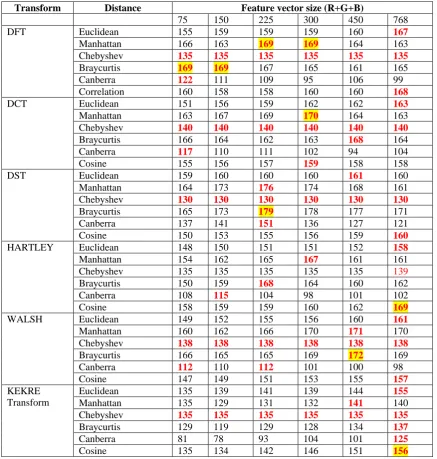
The image database (total 280 images) is divided into a training set (40 images that is 5 images from each class) and a testing set (240 images that is 30 images from each class). The feature vector of each training/testing image is generated as given below.
3.1. Generation of feature vector
(1)For each color image, generate its three color (R, G, and B) planes.
(2)one Apply following transforms on columns of an image for all three planes. (i) Discrete Fourier Transform (DFT)
(ii) Discrete Cosine Transform (DCT) (iii) Discrete Sine Transform (DST) (iv) Hartley Transform [21] (v) Walsh Transform[22] (vi) Kekre Transform[23]
(3)Calculate row mean vector of each column transformed image for three planes [24][25].
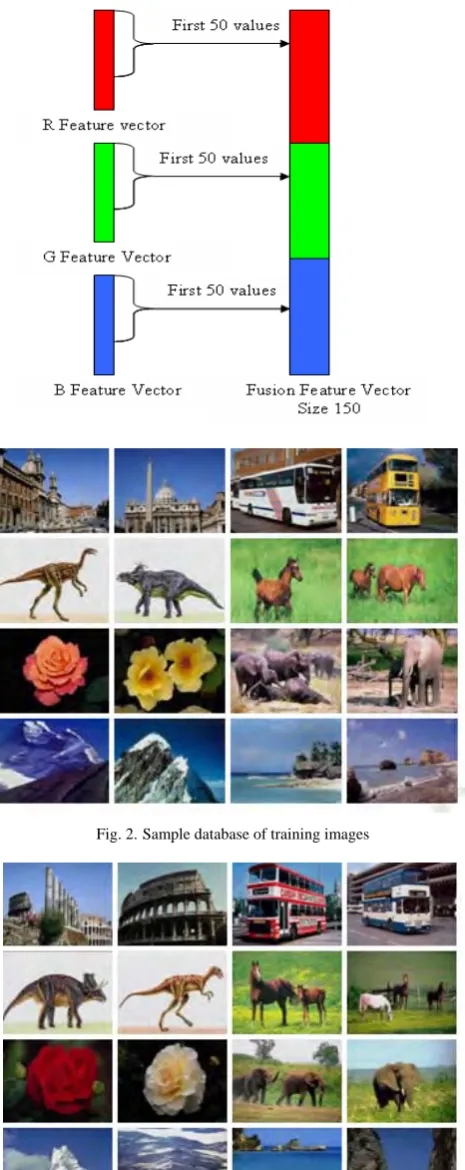
(4) Make a feature vector by fusing the row mean vectors of R, G, and B plane as shown in Fig.1. Different values of feature vector size like 150 (50R + 50G + 50B), 225 (75R + 75G + 75B) etc. are also considered to generate feature vectors.
3.2. Classification
Nearest neighbor classifier algorithm is used [26]. Similarity between training feature vector and testing feature vector is calculated using the different distance formulae. Minimum distance indicates the most similar training image for that testing image and the corresponding class. We have also considered another training set where each feature vector is the average of feature vectors of all training images of a particular class.
4. Results
Fig. 1. Fusion of three feature vectors
Fig. 2.Sample database of training images
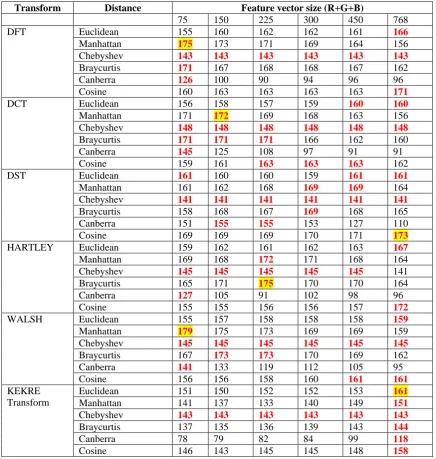
Table 1. Number of correctly classified images (out of 240) for various distance measures for different feature vector sizes Training set: Feature vectors of 5 images from each class.
Transform Distance Feature vector size (R+G+B)
75 150 225 300 450 768
DFT Euclidean 155 159 159 159 160 167
Manhattan 166 163 169 169 164 163
Chebyshev 135 135 135 135 135 135
Braycurtis 169 169 167 165 161 165
Canberra 122 111 109 95 106 99
Correlation 160 158 158 160 160 168
DCT Euclidean 151 156 159 162 162 163
Manhattan 163 167 169 170 164 163
Chebyshev 140 140 140 140 140 140
Braycurtis 166 164 162 163 168 164
Canberra 117 110 111 102 94 104
Cosine 155 156 157 159 158 158
DST Euclidean 159 160 160 160 161 160
Manhattan 164 173 176 174 168 161
Chebyshev 130 130 130 130 130 130
Braycurtis 165 173 179 178 177 171
Canberra 137 141 151 136 127 121
Cosine 150 153 155 156 159 160
HARTLEY Euclidean 148 150 151 151 152 158
Manhattan 154 162 165 167 161 161
Chebyshev 135 135 135 135 135 139
Braycurtis 150 159 168 164 160 162
Canberra 108 115 104 98 101 102
Cosine 158 159 159 160 162 169
WALSH Euclidean 149 152 155 156 160 161
Manhattan 160 162 166 170 171 170
Chebyshev 138 138 138 138 138 138
Braycurtis 166 165 165 169 172 169
Canberra 112 110 112 101 100 98
Cosine 147 149 151 153 155 157
KEKRE Transform
Euclidean 135 139 141 139 144 155
Manhattan 135 129 131 132 141 140
Chebyshev 135 135 135 135 135 135
Braycurtis 129 119 129 128 134 137
Canberra 81 78 93 104 101 125
Cosine 135 134 142 146 151 156
Note: For each distance, highest number of correctly classified images is shown in red color. For each transform, highest number of correctly classified images is shown in red color with yellow background.
Table 2. Highest Number of correctly classified images (out of 240) for each transform Training set: Feature vectors of 5 images from each class
TRANSFORM Highest Number of Correctly Classified Images(out of 240)
Distance Measure Feature Vector size
DFT 169 Manhattan 225&300
Bray-Curtis 75&150
DCT 170 Manhattan 300
DST 179 Bray-Curtis 225
HARTLEY 169 Cosine 768
WALSH 172 Bray-Curtis 450
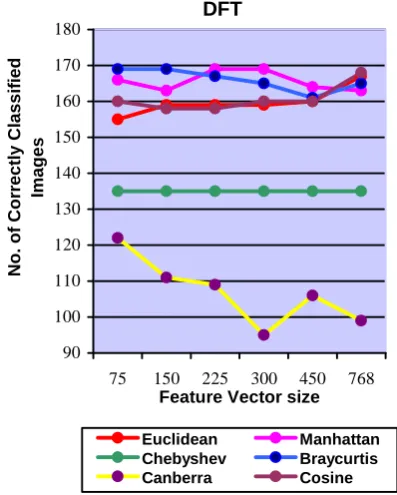
Table 3 Number of correctly classified images (out of 240) for various distance measures for different feature vector sizes Training set: Average of feature vectors of 5 images from each class.
Transform Distance Feature vector size (R+G+B)
75 150 225 300 450 768
DFT Euclidean 155 160 162 162 161 166
Manhattan 175 173 171 169 164 156
Chebyshev 143 143 143 143 143 143
Braycurtis 171 167 168 168 167 162
Canberra 126 100 90 94 96 96
Cosine 160 163 163 163 163 171
DCT Euclidean 156 158 157 159 160 160
Manhattan 171 172 169 168 163 156
Chebyshev 148 148 148 148 148 148
Braycurtis 171 171 171 166 162 160
Canberra 145 125 108 97 91 91
Cosine 159 161 163 163 163 162
DST Euclidean 161 160 160 159 161 161
Manhattan 161 162 168 169 169 164
Chebyshev 141 141 141 141 141 141
Braycurtis 158 168 167 169 168 165
Canberra 151 155 155 153 127 110
Cosine 169 169 169 170 171 173
HARTLEY Euclidean 159 162 161 162 163 167
Manhattan 169 168 172 171 168 164
Chebyshev 145 145 145 145 145 141
Braycurtis 165 171 175 170 170 164
Canberra 127 105 91 102 98 96
Cosine 155 155 156 156 157 172
WALSH Euclidean 155 157 158 158 158 159
Manhattan 179 175 173 169 169 159
Chebyshev 145 145 145 145 145 145
Braycurtis 167 173 173 170 169 162
Canberra 141 133 119 112 105 95
Cosine 156 156 158 160 161 161
KEKRE Transform
Euclidean 151 150 152 152 153 161
Manhattan 141 137 133 140 149 151
Chebyshev 143 143 143 143 143 143
Braycurtis 137 135 136 139 143 144
Canberra 78 79 82 84 99 118
Cosine 146 143 145 145 148 158
Note: For each distance, highest number of correctly classified images is shown in red color. For each transform, highest number of correctly classified images is shown in red color with yellow background.
Table 4. Highest Number of correctly classified images (out of 240) for each transform Training set: : Average of feature vectors of 5 images from each class
TRANSFORM Highest Number of
Correctly Classified Images(out of 240)
Distance Measure Feature Vector size
DFT 175 Manhattan 75
DCT 172 Manhattan 150
DST 173 Cosine 768
HARTLEY 175 Bray-Curtis 225
WALSH 179 Manhattan 75
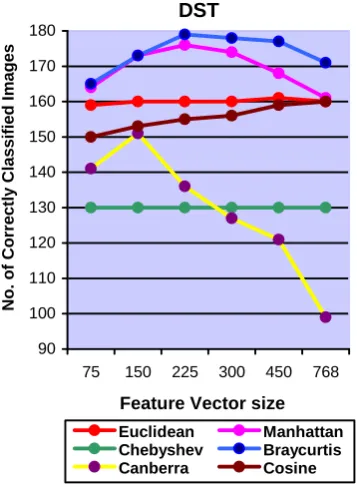
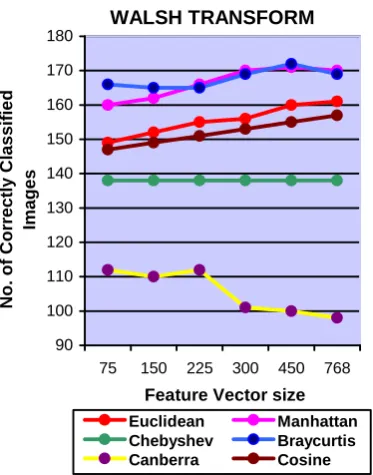
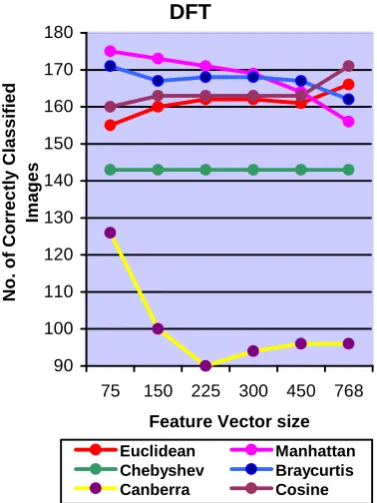
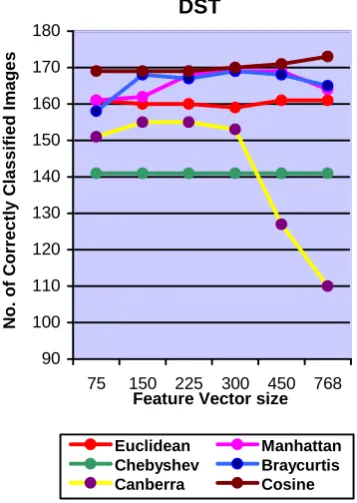
4.1. Observations
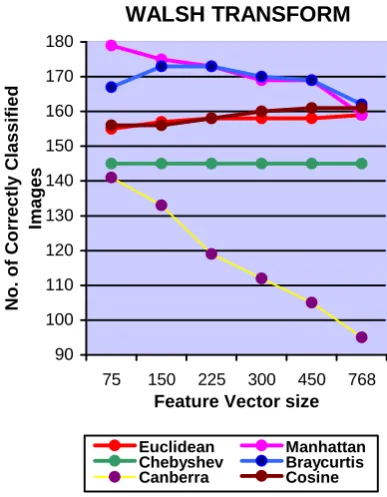
Euclidean and Cosine similarity gives better performance when we select larger size of feature vector. Manhattan, Bray Curtis and Canberra distances give good performance for comparatively smaller size of feature vectors in DFT, DCT, DST, WALSH and HARTLEY. In KEKRE transform all distances give better performance for large size of feature vector. Chebyshev distance remains almost constant with different sizes of feature vectors. Canberra distance gives worst performance when compared with other distances. Figure 4 to Figure 15 shows the number of correctly classified images for different transforms. These figures describe the performance of different distances for different feature vector size for particular transform. For Figure 4 to Figure 9, training set is the feature vectors of 5 images from each class. For Figure 10 to Figure 15, the training set is the average of feature vectors of 5 images from each class.
DFT
90 100 110 120 130 140 150 160 170 180
75 150 225 300 450 768
Feature Vector size
No.
of
Cor
rect
ly Cl
ass
if
ied
Im
ages
Euclidean Manhattan Chebyshev Braycurtis Canberra Cosine
DCT
90 100 110 120 130 140 150 160 170 180
75 150 225 300 450 768
Feature Vector size
No.
of
Cor
rect
ly Cl
assi
fi
e
d I
m
ages
Euclidean Manhattan Chebyshev Braycurtis Canberra Cosine
Fig. 5 Performance of distances for DCT
DST
90 100 110 120 130 140 150 160 170 180
75 150 225 300 450 768
Feature Vector size
N
o
. of
C
o
rr
ect
ly C
lassif
ied I
m
ages
Euclidean Manhattan Chebyshev Braycurtis Canberra Cosine
HARTLEY TRANSFORM
90 100 110 120 130 140 150 160 170 180
75 150 225 300 450 768
Feature Vector size
N
o
. o
f C
o
rrec
tly C
lassified
Im
ag
es
Euclidean Manhattan Chebyshev Braycurtis Canberra Cosine
Fig. 7 Performance of distances for HARTLEY
WALSH TRANSFORM
90 100 110 120 130 140 150 160 170 180
75 150 225 300 450 768
Feature Vector size
No.
of
Cor
rect
ly Cl
assi
fi
e
d
Im
ages
Euclidean Manhattan Chebyshev Braycurtis Canberra Cosine
KEKRE TRANSFORM
70 80 90 100 110 120 130 140 150 160 170 180
75 150 225 300 450 768
Feature Vector size
No.
of
Co
rr
ect
ly Cl
assi
fi
ed I
m
ages
Euclidean Manhattan Chebyshev Braycurtis Canberra Cosine
Fig. 9 Performance of distances for KEKRE Transform
DFT
90 100 110 120 130 140 150 160 170 180
75 150 225 300 450 768
Feature Vector size
No.
of
Cor
rec
tl
y Cl
assi
fi
ed
Im
ages
Euclidean Manhattan Chebyshev Braycurtis Canberra Cosine
DCT
90 100 110 120 130 140 150 160 170 180
75 150 225 300 450 768
Feature Vector size
N
o
. o
f C
o
rrectly C
lassified
Im
ag
es
Euclidean Manhattan Chebyshev Braycurtis Canberra Cosine
Fig. 11 Performance of distances for DCT Transform for average feature vector
DST
90 100 110 120 130 140 150 160 170 180
75 150 225 300 450 768 Feature Vector size
N
o
. o
f C
o
rr
ectly C
lassified
Im
ag
e
s
Euclidean Manhattan Chebyshev Braycurtis Canberra Cosine
HARTLEY TRANSFORM
90 100 110 120 130 140 150 160 170 180
75 150 225 300 450 768 Feature Vector size
N
o
. of
C
o
rr
ect
ly C
lassif
ied Ima
g
es
Euclidean Manhattan Chebyshev Braycurtis Canberra Cosine
Fig. 13 Performance of distances for HARTLEY TRANSFORM for average feature vector
WALSH TRANSFORM
90 100 110 120 130 140 150 160 170 180
75 150 225 300 450 768
Feature Vector size
N
o. of C
or
rectly C
lassified
Images
Euclidean Manhattan Chebyshev Braycurtis Canberra Cosine
KEKRE TRANSFORM
70 80 90 100 110 120 130 140 150 160 170 180
75 150 225 300 450 768
Feature Vector size
N
o. of C
or
rectly C
lassified Im
ages
Euclidean Manhattan Chebyshev Braycurtis Canberra Cosine
Fig. 15 Performance of distances for KEKRE TRANSFORM for average feature vector
5. Conclusions
This paper presents a comparative study of the different distance/similarity measure criteria in classification of images. The feature vector is generated from an image column transform. The performance of various distance criteria such as Minkowski Distances (Euclidean, Manhattan, Chebyshev), BrayCurtis, Canberra and Cosine similarity is tested thoroughly using different transforms (DFT, DCT, DST, HARTLEY, WALSH and KEKRE); on different sizes of feature vectors (75, 150, 225, 300, 450 and 768) for two training sets (feature vectors, average of feature vectors). From the results it can be concluded that the training set containing average of feature vectors, gives equally good results and since they are small in numbers (only 1 training feature vector per class), the computation is fast. Chebyshev distance measure performance is almost constant for any size of feature vector in any transform. Manhattan and Bray-Curtis distance measure give overall better performance compared to other distances for middle size of feature vector. Canberra distance measure does not give good performance for any transform for any feature vector size. For average training feature vector database, Cosine similarity works well with DST transform and Euclidean distance give better performance in KEKRE transform.
References
[1] S.V.Sakhare and V.Nasre, “Design of Feature Extraction in Content Based Image Retrieval (CBIR) using Color and Texture,”
International Journal of Computer Science & Informatics, Vol. 1, Issue- 2, pp. 57-61,2011.
[2] H.B.Kekre, S.D.Thepade, T.K.Sarode and V.Suryavanshi, “Image Retrieval using texture Features extracted from GLCM, LBG and
KPE,” International Journal of Computer Theory and Engineering, Vol. 2, No. 5, pp.695-700,Oct.2010.
[3] Ch.Kavitha, B.P.Rao and A.Govardhan, “Image Retrieval Based On Color and Texture Features of the Image Sub-blocks,”
International Journal of Computer Applications (0975 – 8887),Vol.15– No.7, pp.33-37,Feb.2011.
[4] H.B.Kekre, P.Mukherjee and S.Wadhwa, “Image Retrieval with Shape Features Extracted using Gradient Operators and Slope
Magnitude Technique with BTC,” International Journal of Computer Applications (0975 – 8887),Vol.6– No.8, pp.28-33,Sep.2010.
[5] M. Szummer and R. W. Picard, “Indoor-Outdoor Classification,” IEEE International workshop Content based Acess of Image and
Video Databases, in conjunction with ICCV’98, pp. 384-390, Jan 2009.
[6] O. Chapelle, P. Haffner, and V. Vapnik, “Support vector machines for histogram- based image classification,” IEEE Transactions on
Neural Networks, vol. 10, pp. 1055-1064, 1999.
[7] S. Agrawal, N. Verma, P. Tamrakar, and P. Sircar, “Content Based Color Image Classification using SVM,” in Proc. of IEEE
[8] M. Lotfi1, A. Solimani, A. Dargazany, H. Afzal, and M. Bandarabadi, “Combining wavelet transforms and neural networks for image classification,” the IEEE Symposium on System Theory, SSST, pp.44-48, Aug 2009.
[9] S. Sadek, A. Hamadi, B. Michaelis,and U. Sayed, “Robust Image Classification Using Multi-level Neural Networks,” Proc. of the
IEEE International Conference on Intelligent Computing and Intelligent Systems, Vol.: 4, pp. 180 – 183, Shanghai Dec 2009.
[10] Justin V.K., J.Anitha and D.J.Hemanth, “Genetic Algorithm for Retinal Image Analysis, ”IJCA Special Issue on “Novel Aspects of
Digital Imaging Applications” DIA, pp.48-52,2011
[11] S.Pandit and S.Gupta, “A Comparative Study on Distance Measuring Approaches for Clustering,” International Journal of Research in
Computer Science, Vol.2, Issue 1, pp. 29-31, 2011
[12] A.R.Babu, M. Markandeyulu and B. V.R. R. Nagarjuna, “Patteren Clustering with Similarity Measures,” International Journal on
Computer Technology and Application, Vol.3, Issue 1, pp. 365-369, Jan 2012.
[13] S.Santini and R.Jain, “Similarity Measures,” IEEE Transactions on Pattern Analysis and Machine Intelligence, Vol.21,
No.9,pp.871-883, Sept1999
[14] X.Chen and T.J.Cham, “Discriminative Distance Measures for Image Matching,” International Conference on Pattern Recognition
(ICPR), Cambridge, England, vol. 3, pp. 691-695, 2004.
[15] E.Deza and M.Deza, “Dictionary of Distances,” Elsevier, 16-Nov-2006 - 391 pages
[16] John P.Van De Geer, “Some Aspects of Minkowski distance”, Department of data theory,Leiden University. RR-95-03.
[17] M.Chun Su and C.H. Chou, “A Modified Version of the K-Means Algorithm with a Distance Based on Cluster Symmetry,” IEEE
Transactions on Pattern Analysis and Machine Intelligence, vol. 23, no. 6, june 2001
[18] Bray J. R and Curtis J. T., “An ordination of the upland forest of the southern Winsconsin. Ecological Monographies,” 27,1957, pp.
325-349.
[19] G. Jurman, S. Riccadonna, R. Visintainer and C. Furlanello., “Canberra Distance on Ranked List,” in Proceedings of Advances in
Ranking NIPS 09 Workshop,pp. 22-27, 2009.
[20] A.Huang, “Similarity Measures for Text Document Clustering,” in Proceedings of the New Zealand Computer Science Research
Student Conference, NZCSRSC 2008, April 2008, pp. 49-56
[21] Hartley, R. V. L., “A More Symmetrical Fourier Analysis Applied to Transmission Problems,” Proceedings IRE 30, pp.144–150,
Mar-1942.
[22] J.L.Walsh, “A Closed Set of Orthogonal Functions,” American Journal of Mathematics, vol. 45, pp. 5-24, 1923.
[23] H. B. Kekre nd S. D. Thepade, “Image Retrieval using Non-Involutional Orthogonal Kekre’s Transform”, In ternational Journal of
Multidisciplinary Research and Advances in Engg. (IJMRAE), Vol.1, No.1, pp. 189-203, Nov 2009
[24] H.B.Kekre, Sudeep D. Thepade, Akshay Maloo “Performance Comparison for Face Recognition using PCA, DCT &WalshTransform
of Row Mean and Column Mean”, ICGST International Journal on Graphics, Vision and Image Processing (GVIP), Volume 10, Issue II, pp.9-18, June 2010.
[25] H.B.Kekre, Tanuja Sarode, Sudeep D. Thepade, “DCT Applied to Row Mean and Column Vectors in Fingerprint Identification”, In
Proceedings of Int. Conf. on Computer Networks and Security (ICCNS), 27-28 Sept. 2008, VIT, Pune.
[26] H.B.Kekre, T.K.Sarode and J.K.Save, “Image Classification in Transform Domain,” International Journal of Computer Science and
Information Security (IJCSIS), Vol.10,No.3, pp.91-97, Mar 2012.
[27] Wang, J. Z., Li, J., Wiederhold, G.: SIMPLIcity: Semantics-sensitive Integrated Matching for Picture LIbraries, IEEE Trans. on