Prehospital: Emergency Care
Eleventh Edition
Chapter 23
Abdominal, Hematologic, Gynecologic, Genitourinary,
and Renal Emergencies
Copyright © 2018, 2014, 2010 Pearson Education, Inc. All Rights Reserved
Learning Readiness
• EMS Education Standards, text p. 696.
• Chapter Objectives, text p. 696.
• Key Terms, text p. 696-697.
Copyright © 2018, 2014, 2010 Pearson Education, Inc. All Rights Reserved
Setting the Stage
• Overview of Lesson Topics – Acute Abdomen
– Hematologic Emergencies – Gynecologic Emergencies
Case Study Introduction
Copyright © 2018, 2014, 2010 Pearson Education, Inc. All Rights Reserved
Case Study
(1 of 4)• How concerning is the patient's chief complaint? Explain your answer.
• What questions should you ask this patient?
Introduction
(1 of 2)• Abdominopelvic pain has many causes, and can be caused by serious underlying conditions.
• Care includes managing life threats, making the patient comfortable, and transport.
Copyright © 2018, 2014, 2010 Pearson Education, Inc. All Rights Reserved
Introduction
(2 of 2)• Gynecologic emergencies can present with abdominopelvic pain and vaginal bleeding.
• Some gynecologic emergencies can be life-threatening.
Acute Abdomen
(1 of 48)• Abdominal Structures and Functions
– The abdominal cavity extends from the diaphragm to the pelvis.
Copyright © 2018, 2014, 2010 Pearson Education, Inc. All Rights Reserved
Acute Abdomen
(2 of 48)• Abdominal Structures and Functions – Abdominal Quadrants and Regions
▪ Organs can be located the intraperitoneal or retroperitoneal space.
Copyright © 2018, 2014, 2010 Pearson Education, Inc. All Rights Reserved
Acute Abdomen
(3 of 48)• Abdominal Structures and Functions – Types of Abdominal Structures
▪ The abdominal cavity contains three types of structures:
– Hollow organs – Solid organs
Copyright © 2018, 2014, 2010 Pearson Education, Inc. All Rights Reserved
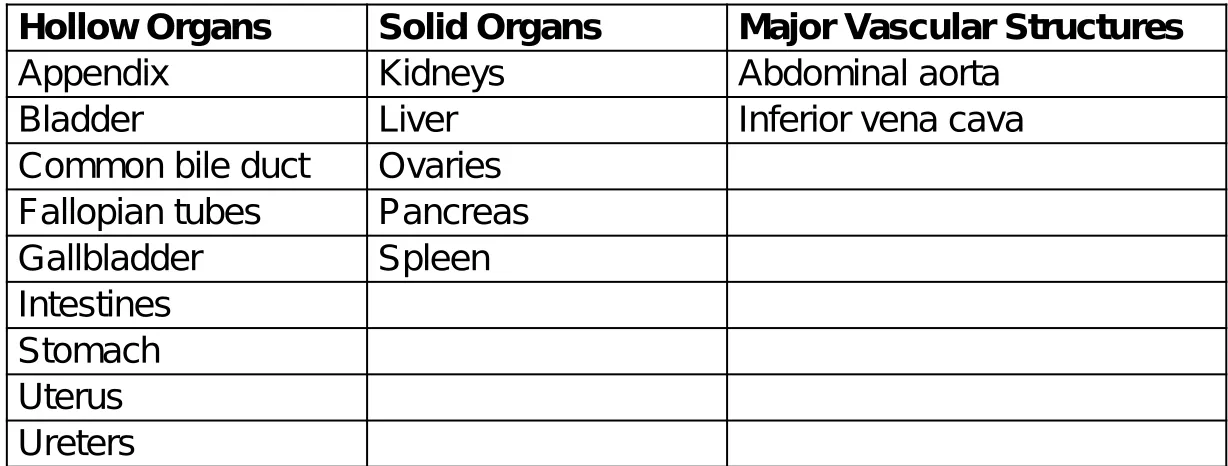
Table 23-1 Abdominal Structures
Hollow Organs Solid Organs Major Vascular Structures
Appendix Kidneys Abdominal aorta
Bladder Liver Inferior vena cava
Common bile duct Ovaries Blank
Fallopian tubes Pancreas Blank
Gallbladder Spleen Blank
Intestines Blank Blank
Stomach Blank Blank
Uterus Blank Blank
Table 23-2 Organs of the Abdomen and
Their Functions
(1 of 2)Stomach A saclike, stretchable pouch located below the diaphragm that receives food from the esophagus (tubelike structure from the throat). The stomach enables digestion by secreting a specialized fluid to aid in the breakdown and absorption of food.
Duodenum The first part of the small intestine that connects to the stomach.
Small intestine A tubelike structure beginning at the distal end of the stomach and ending at the beginning of the large intestine. Its digestive function is to absorb nutrients from intestinal contents.
Large intestine A tubelike structure beginning at the distal end of the small intestine and ending at the anus. It reabsorbs fluid from intestinal contents, enabling the excretion of solid waste from the body.
Liver A large, solid organ located in the RUQ just beneath the diaphragm with a
slight portion extending to the LUQ. It filters the nutrients from blood as it
Copyright © 2018, 2014, 2010 Pearson Education, Inc. All Rights Reserved
Table 23-2 Organs of the Abdomen and
Their Functions
(2 of 2)Gallbladder A pear-shaped sac that lies on the underneath right side of the liver. The gallbladder holds bile, which aids in the digestion of fats.
Spleen An elongated, oval, solid organ located in the LUQ behind and to the side of the stomach. It aids in the production of blood cells as well as the filtering and storage of blood. The spleen is proportionally larger in the pediatric patient.
Pancreas A gland composed of many lobes and ducts located in both the RUQ
and LUQ, just behind the stomach. It aids in digestion and regulates
carbohydrate metabolism.
Kidneys Paired organs located behind the abdominal wall lining (retroperitoneal), one on each side of the spine. The kidneys excrete urine and regulate water, electrolytes, and acid–base balance.
Acute Abdomen
(4 of 48)• Abdominal Pain
– Pathophysiology of Abdominal Pain
▪ Abdominal pain results from these mechanisms: – Stretching
Copyright © 2018, 2014, 2010 Pearson Education, Inc. All Rights Reserved
Acute Abdomen
(5 of 48)• Abdominal Pain
– Types of Abdominal Pain
▪ Visceral pain arises from organ and can be: – Less severe
– More generalized – Dull or aching
Acute Abdomen
(6 of 48)• Abdominal Pain
– Types of Abdominal Pain ▪ Parietal Pain
– Arises from the peritoneum – More severe
– More localized – Sharp
Copyright © 2018, 2014, 2010 Pearson Education, Inc. All Rights Reserved
Acute Abdomen
(7 of 48)• Abdominal Pain
– Types of Abdominal Pain ▪ Referred Pain
Copyright © 2018, 2014, 2010 Pearson Education, Inc. All Rights Reserved
Acute Abdomen
(8 of 48)• Conditions That Can Cause Acute Abdominal Pain – There are several causes.
– Hospital care is usually required.
Table 23-3 Some Conditions That May
Cause an Acute Abdomen
• Peritonitis
• Appendicitis
• Pancreatitis
• Cholecystitis
• Gastrointestinal bleeding
• Gastroenteritis
• Peptic ulcer disease
Copyright © 2018, 2014, 2010 Pearson Education, Inc. All Rights Reserved
Acute Abdomen
(9 of 48)• Conditions That Can Cause Acute Abdominal Pain – Peritonitis
▪ Caused by peritoneal inflammation ▪ Signs and symptoms include:
– Abdominal pain or tenderness – Nausea, vomiting, diarrhea – Fever, chills
– Lack of appetite
Acute Abdomen
(10 of 48)• Conditions That Can Cause Acute Abdominal Pain – Appendicitis
▪ Untreated, the tissue can die and rupture. ▪ It is more common in children.
Copyright © 2018, 2014, 2010 Pearson Education, Inc. All Rights Reserved
Acute Abdomen
(11 of 48)• Conditions That Can Cause Acute Abdominal Pain – Appendicitis
▪ Signs and Symptoms
– Periumbilical abdominal pain, localizing to the right lower quadrant
– Nausea, vomiting
– Low-grade fever, chills – Lack of appetite
Acute Abdomen
(12 of 48)• Conditions That Can Cause Acute Abdominal Pain – Pancreatitis
▪ Signs and Symptoms
– Pain, tenderness, distention; pain may radiate from the umbilicus to the back
– Jaundice – Fever
Copyright © 2018, 2014, 2010 Pearson Education, Inc. All Rights Reserved
Acute Abdomen
(13 of 48)• Conditions That Can Cause Acute Abdominal Pain – Cholecystitis
▪ Associated with gallstones
▪ Often occurs to patients between the ages of 30 and 50
▪ More common in women
Acute Abdomen
(14 of 48)• Conditions That Can Cause Acute Abdominal Pain – Cholecystitis
▪ Signs and Symptoms
– Upper middle to upper right quadrant abdominal pain
– Tenderness of the right upper quadrant – Belching or heartburn
Copyright © 2018, 2014, 2010 Pearson Education, Inc. All Rights Reserved
Acute Abdomen
(15 of 48)• Conditions That Can Cause Acute Abdominal Pain – Gastrointestinal Bleeding
▪ Can occur at any point in the gastrointestinal tract ▪ Classified as upper or lower
Acute Abdomen
(16 of 48)• Conditions That Can Cause Acute Abdominal Pain – Gastrointestinal Bleeding
▪ Signs and Symptoms
– Abdominal pain or tenderness
– Hematemesis, Hematochezia, Melena
– Altered mental status, weakness, syncope – Tachycardia
Copyright © 2018, 2014, 2010 Pearson Education, Inc. All Rights Reserved
Acute Abdomen
(17 of 48)• Conditions That Can Cause Acute Abdominal Pain – Esophageal Varices
▪ Engorged, weakened veins in the esophagus ▪ Commonly caused by heavy alcohol use or liver
disease
Acute Abdomen
(18 of 48)• Conditions That Can Cause Acute Abdominal Pain – Esophageal Varices
▪ Signs and Symptoms
– Large amounts of bright red hematemesis – No pain or tenderness in the abdomen
– Rapid pulse
– Difficulty breathing
Copyright © 2018, 2014, 2010 Pearson Education, Inc. All Rights Reserved
Esophageal Varices are Common to Heavy
Copyright © 2018, 2014, 2010 Pearson Education, Inc. All Rights Reserved
Acute Abdomen
(19 of 48)• Conditions That Can Cause Acute Abdominal Pain – Gastroenteritis
Acute Abdomen
(20 of 48)• Conditions That Can Cause Acute Abdominal Pain – Gastroenteritis
▪ Signs and Symptoms
– Abdominal pain, cramping – Nausea, vomiting, diarrhea – Abdominal tenderness
– Fever, dehydration
Copyright © 2018, 2014, 2010 Pearson Education, Inc. All Rights Reserved
Acute Abdomen
(21 of 48)• Conditions That Can Cause Acute Abdominal Pain – Ulcers
▪ Open sores in the stomach or beginning of the small intestine
Copyright © 2018, 2014, 2010 Pearson Education, Inc. All Rights Reserved
Acute Abdomen
(22 of 48)• Conditions That Can Cause Acute Abdominal Pain – Ulcers
▪ Signs and Symptoms
– Sudden onset of left upper quadrant or epigastric pain
– Nausea, vomiting
– Hematemesis, hematochezia, melena
Copyright © 2018, 2014, 2010 Pearson Education, Inc. All Rights Reserved
Acute Abdomen
(23 of 48)• Conditions That Can Cause Acute Abdominal Pain – Intestinal Obstruction
▪ May include small or large intestine
▪ May result from tumors, fecal impaction, or adhesions
Acute Abdomen
(24 of 48)• Conditions That Can Cause Acute Abdominal Pain – Intestinal Obstruction
▪ Signs and Symptoms – Abdominal pain – Nausea, vomiting – Constipation
– Abdominal distention, tenderness
Copyright © 2018, 2014, 2010 Pearson Education, Inc. All Rights Reserved
Acute Abdomen
(25 of 48)• Conditions That Can Cause Acute Abdominal Pain – Hernia
▪ Protrusion of the intestine through an opening or weakness in the abdominal wall
▪ Associated with increased pressure in the abdominal cavity
Acute Abdomen
(26 of 48)• Conditions That Can Cause Acute Abdominal Pain – Hernia
▪ Signs and Symptoms
– Abdominal pain with lifting or straining – Fever
– Rapid pulse
– Tender mass at site of hernia
Copyright © 2018, 2014, 2010 Pearson Education, Inc. All Rights Reserved
Acute Abdomen
(27 of 48)• Conditions That Can Cause Acute Abdominal Pain – Abdominal Aortic Aneurysm (AAA)
▪ Weakened, ballooned area of aorta ▪ May rupture
Copyright © 2018, 2014, 2010 Pearson Education, Inc. All Rights Reserved
Acute Abdomen
(28 of 48)• Conditions That Can Cause Acute Abdominal Pain – Abdominal Aortic Aneurysm (AAA)
▪ Signs and Symptoms
– Gradual onset of lumbar, groin, and abdominal pain
– With rupture, sudden onset of severe, constant pain of the lower back, flank, or pelvis;
Copyright © 2018, 2014, 2010 Pearson Education, Inc. All Rights Reserved
Acute Abdomen
(29 of 48)• Conditions That Can Cause Acute Abdominal Pain – Abdominal Aortic Aneurysm (AAA)
▪ Signs and Symptoms – Nausea, vomiting
– Mottled or spotty abdominal skin
– Pale, cool, clammy, cyanotic skin in legs – Absent/decreased femoral or pedal pulses – Skin below the waist may be cyanotic, cold,
Acute Abdomen
(30 of 48)• Conditions That Can Cause Acute Abdominal Pain – Abdominal Aortic Aneurysm (AAA)
▪ Do not palpate the abdomen.
▪ Do not continue to palpate a pulsating mass. ▪ Assess for shock.
Copyright © 2018, 2014, 2010 Pearson Education, Inc. All Rights Reserved
Acute Abdomen
(31 of 48)• Conditions That Can Cause Acute Abdominal Pain – Vomiting/Diarrhea/Constipation
▪ Associated with many acute abdominal disorders ▪ Can cause abdominal pain
Acute Abdomen
(32 of 48)• Considerations in Special Populations with Abdominal Pain
– Pediatrics
▪ Questions – Infants or Small Children
– Has the child been more irritable than normal recently?
– Can you console the child when they are crying or upset?
Copyright © 2018, 2014, 2010 Pearson Education, Inc. All Rights Reserved
Acute Abdomen
(33 of 48)• Considerations in Special Populations with Abdominal Pain
– Elderly (Geriatric)
▪ Have decreased perception of abdominal pain ▪ May wait longer to seek medical care
– Immunocompromised Patients
Acute Abdomen
(34 of 48)• Considerations in Special Populations with Abdominal Pain
– Bariatric Surgery Patients
Copyright © 2018, 2014, 2010 Pearson Education, Inc. All Rights Reserved
Click on the Term that is Used to Describe an
Inflammation of the Gallbladder
A. Cholecystitis
B. Peritonitis
C. Gastroenteritis
Acute Abdomen
(35 of 48)• Assessment-Based Approach – Acute Abdomen
– Assume the problem is potentially life-threatening. ▪ Low blood pressure, syncope, and pale, cool
clammy skin associated with abdominal pain indicates a serious condition.
Copyright © 2018, 2014, 2010 Pearson Education, Inc. All Rights Reserved
Acute Abdomen
(36 of 48)• Assessment-Based Approach – Acute Abdomen – Scene Size-up
▪ Take Standard Precautions.
▪ Look for a mechanism of injury.
Acute Abdomen
(37 of 48)• Assessment-Based Approach – Acute Abdomen – Primary Assessment
▪ Form a general impression.
– Patients with abdominal pain may assume a guarded position.
▪ Ensure an open airway. – Be alert for vomiting.
Copyright © 2018, 2014, 2010 Pearson Education, Inc. All Rights Reserved
Acute Abdomen
(38 of 48)• Assessment-Based Approach – Acute Abdomen – Primary Assessment
▪ Check the circulation. – Pulse
Acute Abdomen
(39 of 48)• Assessment-Based Approach – Acute Abdomen – Primary Assessment
▪ Categorize the patient as high priority if they exhibit any of the following:
– Poor general appearance – Unresponsive
– Responsive, not following commands – Shock
Copyright © 2018, 2014, 2010 Pearson Education, Inc. All Rights Reserved
Acute Abdomen
(40 of 48)• Assessment-Based Approach – Acute Abdomen – Secondary Assessment
▪ Ask the following:
– OPQRST questions
– If the patient has any allergies
Acute Abdomen
(41 of 48)• Assessment-Based Approach – Acute Abdomen – Secondary Assessment
▪ Ask the following:
– Has the patient’s appetite changed?
– What was the color of the patient’s last stools? – Has the patient had difficulty urinating?
Copyright © 2018, 2014, 2010 Pearson Education, Inc. All Rights Reserved
Acute Abdomen
(42 of 48)• Assessment-Based Approach – Acute Abdomen – Secondary Assessment
▪ Inspect the abdomen.
Inspect the Abdomen, Then Palpate Each Quadrant.
Copyright © 2018, 2014, 2010 Pearson Education, Inc. All Rights Reserved
Inspect the Abdomen, Then Palpate Each Quadrant.
Acute Abdomen
(43 of 48)• Assessment-Based Approach – Acute Abdomen – Secondary Assessment
▪ The abdomen normally should be soft and nontender.
▪ Assess for voluntary guarding, involuntary guarding, and rigidity.
▪ Palpate for masses.
Copyright © 2018, 2014, 2010 Pearson Education, Inc. All Rights Reserved
Acute Abdomen
(44 of 48)• Assessment-Based Approach – Acute Abdomen – Secondary Assessment
▪ Associated Signs and Symptoms – Tenderness
– Anxiety, fear
– Guarded position
Acute Abdomen
(45 of 48)• Assessment-Based Approach – Acute Abdomen – Secondary Assessment
▪ Associated Signs and Symptoms
– Blood pressure changes from pain or shock – Nausea, vomiting, diarrhea
– Abdominal rigidity or guarding – Distended abdomen
Copyright © 2018, 2014, 2010 Pearson Education, Inc. All Rights Reserved
Acute Abdomen
(46 of 48)• Assessment-Based Approach – Acute Abdomen – Secondary Assessment
▪ Associated Signs and Symptoms – Belching or flatulence
– Changes in bowel habits or urination – Signs and symptoms of shock
Acute Abdomen
(47 of 48)• Assessment-Based Approach – Acute Abdomen – Emergency Medical Care
▪ Keep the airway patent; be alert to vomiting. ▪ Place the patient in a comfortable position. ▪ Maintain an SpO2 of 94% or greater.
Copyright © 2018, 2014, 2010 Pearson Education, Inc. All Rights Reserved
Emergency Care Protocol: Acute
Abdominal Pain
1. Establish and maintain an open airway. Insert a nasopharyngeal or oropharyngeal airway if the patient is unresponsive and has no gag or cough reflex.
2. Suction secretions as necessary.
3. If breathing is inadequate, provide positive pressure ventilation with
supplemental oxygen at a minimum rate of 10–12 ventilations/minute for an adult and 12–20 ventilations/minute for an infant or child.
4. If breathing is adequate, administer oxygen to maintain an SpO of2 ≥ 94%.
5. Place the patient in a position of comfort, usually with knees flexed. If the patient is vomiting, place in a left lateral recumbent position only if no spinal injury is suspected.
6. Transport according to the patient’s condition.
Copyright © 2018, 2014, 2010 Pearson Education, Inc. All Rights Reserved
Acute Abdomen
(48 of 48)• Assessment-Based Approach – Acute Abdomen – Emergency Medical Care
▪ Calm and reassure the patient. ▪ Treat for shock, if present.
Case Study
(2 of 4)Mrs. Hill’s history reveals that she has been constipated for one to two days, and that she feels bloated. She has had previous abdominal surgeries for a hysterectomy,
appendectomy, and cholecystectomy. She takes
Copyright © 2018, 2014, 2010 Pearson Education, Inc. All Rights Reserved
Case Study
(3 of 4)The physical exam reveals a facial expression consistent with experiencing pain; the a patient, who is lying on her right side with her hips flexed, has very warm, dry skin, and a distended abdomen that is tender to palpation,
particularly in the lower right quadrant.
Case Study
(4 of 4)• What are some disorders that would explain Mrs. Hill's signs and symptoms?
Copyright © 2018, 2014, 2010 Pearson Education, Inc. All Rights Reserved
Hematologic Emergencies
(1 of 8)• Common Hematologic Conditions
– Hematologic problems that may be encountered in prehospital care include:
▪ Anemia
Hematologic Emergencies
(2 of 8)• Common Hematologic Conditions – Anemia
▪ Decrease in red blood cell volume ▪ May be chronic or acute
▪ Decrease in oxygen-carrying capability
Copyright © 2018, 2014, 2010 Pearson Education, Inc. All Rights Reserved
Hematologic Emergencies
(3 of 8)• Common Hematologic Conditions – Sickle Cell Anemia
▪ Hereditary disorder
▪ More common in African Americans, Africans, and those of Mediterranean, South and Central
Hematologic Emergencies
(4 of 8)• Common Hematologic Conditions – Sickle Cell Disease
▪ The four common patterns of sickle cell crisis, all of which are painful, are the following:
– Bone crisis
– Acute chest syndrome – Abdominal crisis
Copyright © 2018, 2014, 2010 Pearson Education, Inc. All Rights Reserved
Hematologic Emergencies
(5 of 8)• Common Hematologic Conditions – Sickle Cell Disease
▪ Signs and Symptoms of Sickle Cell Crisis – Bone and joint pain
– Fever
– Chest pain
– Shortness of breath – Fatigue
Hematologic Emergencies
(6 of 8)• Common Hematologic Conditions – Sickle Cell Disease
▪ Signs and Symptoms of Sickle Cell Crisis – Priapism
– Jaundice
– Tachycardia
– Ulcers on lower legs
Copyright © 2018, 2014, 2010 Pearson Education, Inc. All Rights Reserved
Hematologic Emergencies
(7 of 8)• Common Hematologic Conditions – Sickle Cell Disease
▪ Emergency Care
– Ensure an adequate airway, breathing, and circulation.
Hematologic Emergencies
(8 of 8)• Common Hematologic Conditions – Hemophilia
▪ Blood clotting is impaired.
▪ What normally is considered minor bleeding can be an emergency in hemophiliacs.
Copyright © 2018, 2014, 2010 Pearson Education, Inc. All Rights Reserved
Case Study Conclusion
Prehospital care for Mrs. Hill consists of placing her on her right side on the stretcher, with her knees drawn up, which is the position in which she is the most comfortable. It also allows for less risk to the airway if she vomits. Transport is expeditious, but with care to provide as smooth a ride as possible.
At the hospital, Mrs. Hill is diagnosed with a bowel
Gynecologic Emergencies
(1 of 27)• Gynecology deals with the female reproductive system.
• Signs and symptoms include abdominal pain, vaginal bleeding, or abnormal discharge.
Copyright © 2018, 2014, 2010 Pearson Education, Inc. All Rights Reserved
Case Study 2 Introduction
EMTs Donna Smith and Jade Gladstone have arrived at an assisted-living facility for a report of a sick person. Their
patient, Hugh Carpenter, is a 78-year-old man who has a history of urinary incontinence following surgery and
radiation for prostate cancer. He has a Foley catheter in place for that problem. His home health aide called today because Mr. Carpenter is confused, and he has a
Case Study 2
• Explain how there could there be a relationship between Mr. Carpenter’s medical history and his current problem.
• What questions should EMTs ask in obtaining Mr. Carpenter’s history?
Copyright © 2018, 2014, 2010 Pearson Education, Inc. All Rights Reserved
Gynecologic Emergencies
(2 of 27)• Female Reproductive Structures and Functions – The vagina functions as the birth canal during
childbirth.
– The ovaries are the primary sex glands.
– The fallopian tubes extend from near each of the ovaries to the uterus.
Copyright © 2018, 2014, 2010 Pearson Education, Inc. All Rights Reserved
Table 23-4 Gynecologic Conditions That
May Cause Abdominal Pain or Bleeding
• Sexual assault
• Vaginal bleeding
• Dysmenorrhea (primarily from menstruation)
• Ovarian cyst
• Endometritis
• Endometriosis
• Pelvic inflammatory disease
Gynecologic Emergencies
(3 of 27)• Gynecologic Conditions – Sexual Assault
▪ Follow protocols for reporting sexual assault. ▪ Sexual assault has physical and psychological
Copyright © 2018, 2014, 2010 Pearson Education, Inc. All Rights Reserved
Gynecologic Emergencies
(4 of 27)• Gynecologic Conditions – Sexual Assault
▪ Physical effects of sexual assault include: – Traumatic injuries
– Genital/rectal swelling, bleeding, pain – Sexually transmitted diseases
Gynecologic Emergencies
(5 of 27)• Gynecologic Conditions – Sexual Assault
▪ Psychological effects of sexual assault include: – Anxiety, depression, fear
– Inappropriate feelings of guilt – Flashbacks, nightmares
Copyright © 2018, 2014, 2010 Pearson Education, Inc. All Rights Reserved
Gynecologic Emergencies
(6 of 27)• Gynecologic Conditions – Sexual Assault
▪ Follow these sexual assault guidelines:
– Don’t allow the patient to change, bathe, comb, or clean any part of the body.
– Don’t cut holes or tears in the clothing. – Don’t touch or change the crime scene. – Don’t clean wounds.
Gynecologic Emergencies
(7 of 27)• Gynecologic Conditions – Sexual Assault
▪ Be nonjudgmental.
▪ Provide a safe environment.
▪ Respect confidentiality and privacy.
Copyright © 2018, 2014, 2010 Pearson Education, Inc. All Rights Reserved
Gynecologic Emergencies
(8 of 27)• Gynecologic Conditions
– Vaginal Bleeding (Nontraumatic)
▪ Bleeding may be related to menses or to medical problems.
Gynecologic Emergencies
(9 of 27)• Gynecologic Conditions
– Vaginal Bleeding (Nontraumatic)
▪ Signs and symptoms of spontaneous abortion include:
– Lower abdominal or pelvic pain – Abdominal tenderness
– Vaginal bleeding – Rapid pulse
Copyright © 2018, 2014, 2010 Pearson Education, Inc. All Rights Reserved
Gynecologic Emergencies
(10 of 27)• Gynecologic Conditions – Menstrual Pain
▪ Strong uterine cramping that causes severe pain during menstruation is called dysmenorrhea.
Gynecologic Emergencies
(11 of 27)• Gynecologic Conditions – Ovarian Cysts
▪ Fluid-filled sacs that form on the ovary. ▪ Signs and symptoms include:
– Unilateral abdominopelvic pain – Abdominal tenderness
– Vaginal bleeding
Copyright © 2018, 2014, 2010 Pearson Education, Inc. All Rights Reserved
Gynecologic Emergencies
(12 of 27)• Gynecologic Conditions – Endometritis
▪ Inflammation of the endometrium, commonly caused by infection.
▪ Signs and symptoms include:
– Abdominopelvic pain or tenderness – Fever
– Abdominal distention
– Vaginal bleeding or discharge
Gynecologic Emergencies
(13 of 27)• Gynecologic Conditions – Endometriosis
▪ Signs and symptoms include:
– Abdominopelvic pain or tenderness – Dysmenorrhea
– Vaginal bleeding
Copyright © 2018, 2014, 2010 Pearson Education, Inc. All Rights Reserved
Gynecologic Emergencies
(14 of 27)• Gynecologic Conditions
– Pelvic Inflammatory Disease (PID)
▪ Infection of the female reproductive tract ▪ Signs and symptoms include:
– Abdominopelvic pain or tenderness – Abnormal vaginal discharge
– Fever and chills/nausea or vomiting – Anorexia
Gynecologic Emergencies
(15 of 27)• Gynecologic Conditions
– Sexually Transmitted Diseases
▪ Infections contracted through sexual contact
▪ Most sexually transmitted diseases are caused by bacteria, viruses, parasites, or fungi.
Copyright © 2018, 2014, 2010 Pearson Education, Inc. All Rights Reserved
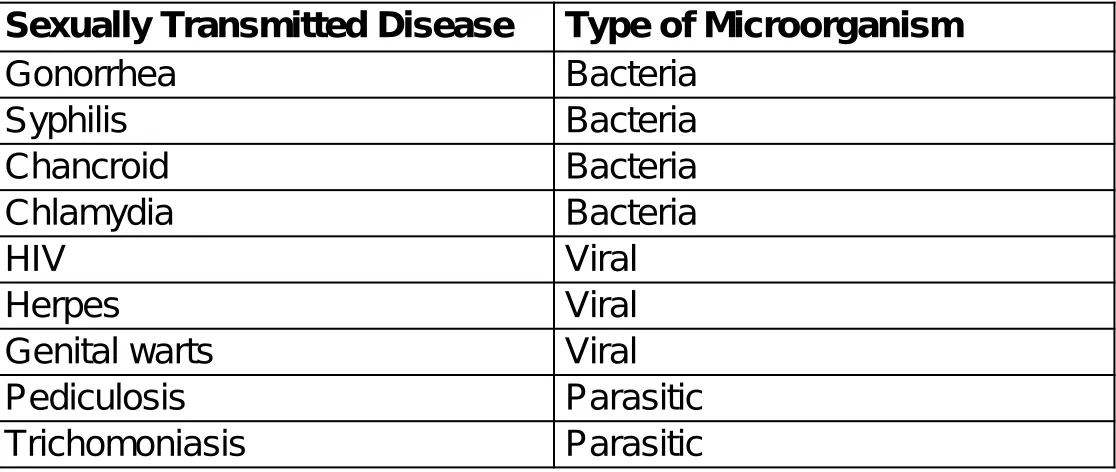
Table 23-5 Common Sexually Transmitted
Diseases and Their Causes
Sexually Transmitted Disease Type of Microorganism
Gonorrhea Bacteria
Syphilis Bacteria
Chancroid Bacteria
Chlamydia Bacteria
HIV Viral
Herpes Viral
Genital warts Viral
Pediculosis Parasitic
Gynecologic Emergencies
(16 of 27)• Gynecologic Conditions
– Sexually Transmitted Diseases ▪ Signs and symptoms include:
– Abdominopelvic pain or tenderness – Abnormal vaginal discharge
– Nausea, vomiting, fever, chills
– Irregular vaginal bleeding or cramping
Copyright © 2018, 2014, 2010 Pearson Education, Inc. All Rights Reserved
Gynecologic Emergencies
(17 of 27)• Assessment-Based Approach – Gynecologic Emergencies
– Scene Size-Up
▪ Take Standard Precautions.
▪ Determine the nature of the illness or mechanism of injury.
Gynecologic Emergencies
(18 of 27)• Assessment-Based Approach –Gynecologic Emergencies
– Primary Assessment
▪ Determine the patient’s mental status.
▪ Ensure an open airway and adequate breathing. ▪ Administer oxygen to maintain an SpO2 of 94% or
greater.
Copyright © 2018, 2014, 2010 Pearson Education, Inc. All Rights Reserved
Gynecologic Emergencies
(19 of 27)• Assessment-Based Approach – Gynecologic Emergencies
– Primary Assessment
▪ Categorize as high priority for transport if the patient exhibits any of these symptoms:
– Poor general appearance – Unresponsive
– Responsive, not following commands – Severe pain
Gynecologic Emergencies
(20 of 27)• Assessment-Based Approach –Gynecologic Emergencies
– Secondary Assessment
▪ Protect privacy and modesty.
▪ Be compassionate and professional. ▪ Obtain a history and vital signs.
Copyright © 2018, 2014, 2010 Pearson Education, Inc. All Rights Reserved
Gynecologic Emergencies
(21 of 27)• Assessment-Based Approach –Gynecologic Emergencies
– Secondary Assessment ▪ Ask the following:
– What are the signs and symptoms?
– Have the signs and symptoms gotten better or worse?
– How long have the signs and symptoms been present?
Gynecologic Emergencies
(22 of 27)• Assessment-Based Approach – Gynecologic Emergencies
– Secondary Assessment ▪ Ask the following:
– What was the patient doing at the onset? – Does the patient have allergies?
Copyright © 2018, 2014, 2010 Pearson Education, Inc. All Rights Reserved
Gynecologic Emergencies
(23 of 27)• Assessment-Based Approach – Gynecologic Emergencies
– Secondary Assessment ▪ Ask the following:
– What is the patient’s past medical history?
– When was the patient’s last menstrual period? – Is there any vaginal bleeding? If so, how many
menstrual pads have been saturated?
Gynecologic Emergencies
(24 of 27)• Assessment-Based Approach – Gynecologic Emergencies
– Secondary Assessment ▪ Ask the following:
– Is there any vaginal discharge?
Copyright © 2018, 2014, 2010 Pearson Education, Inc. All Rights Reserved
Gynecologic Emergencies
(25 of 27)• Assessment-Based Approach – Gynecologic Emergencies
– Secondary Assessment
▪ Signs and symptoms include:
– Vaginal discharge and/or pain
– Abdominopelvic pain or tenderness – Nausea, vomiting
– Fever, chills
Gynecologic Emergencies
(26 of 27)• Assessment-Based Approach – Gynecologic Emergencies
– Secondary Assessment ▪ Physical Exam
– Examine the abdomen.
Copyright © 2018, 2014, 2010 Pearson Education, Inc. All Rights Reserved
Gynecologic Emergencies
(27 of 27)• Assessment-Based Approach – Gynecologic Emergencies
– Emergency Medical Care
▪ If trauma is involved, consider spine motion restriction.
▪ Maintain a patent airway.
▪ Maintain adequate oxygenation. ▪ Control external bleeding.
Click on the Term That is Used to Describe the
Condition in Which Tissue from the Lining of the
Uterus is Implanted Outside of the Uterus, Where It
May Cause Inflammation, Scarring, Bleeding, and
Adhesions
A. Pelvic inflammatory disease
B. Endometriosis
C. Endometritis
Copyright © 2018, 2014, 2010 Pearson Education, Inc. All Rights Reserved
Genitourinary/Renal Emergencies
(1 of 29)• Organs of the female reproductive system are separate from those in the female urinary system.
• In males, some of the structures are shared.
Genitourinary/Renal Emergencies
(2 of 29)• Genitourinary/Renal Structures and Functions
– The urinary system produces, stores, and eliminates urine.
– The kidneys filter the blood to excrete waste products into the urine.
Copyright © 2018, 2014, 2010 Pearson Education, Inc. All Rights Reserved
Genitourinary/Renal Emergencies
(3 of 29)• Genitourinary/Renal Structures and Functions
– The ureters carry urine from the kidneys to the urinary bladder.
– The urinary bladder stores urine until it is eliminated through the urethra.
Copyright © 2018, 2014, 2010 Pearson Education, Inc. All Rights Reserved
Table 23-6 Common Genitourinary/Renal
Conditions
• Urinary tract infections
• Kidney stones
Copyright © 2018, 2014, 2010 Pearson Education, Inc. All Rights Reserved
Genitourinary/Renal Emergencies
(4 of 29)• Genitourinary/Renal Conditions – Urinary Tract Infection
▪ Most frequently caused by bacteria that enter through the urethra
▪ More common in women, the elderly, diabetics, and patients who are immobile or catheterized ▪ May affect the urethra, bladder, ureters, kidneys,
Genitourinary/Renal Emergencies
(5 of 29)• Genitourinary/Renal Conditions – Urinary Tract Infection
▪ Signs and symptoms include:
– Abdominopelvic pain or tenderness – Blood in the urine
– Cloudy urine, strong odor to the urine
Copyright © 2018, 2014, 2010 Pearson Education, Inc. All Rights Reserved
Genitourinary/Renal Emergencies
(6 of 29)• Genitourinary/Renal Conditions – Kidney Stones
▪ Crystals form in the kidneys and must travel through the urinary system.
▪ Family history and dehydration are risk factors. ▪ Stones can cause severe pain.
Genitourinary/Renal Emergencies
(7 of 29)• Genitourinary/Renal Conditions – Kidney Stones
▪ Signs and symptoms include:
– Abdominopelvic pain or tenderness – Colicky, severe back, or flank pain – Groin pain, fever, chills
Copyright © 2018, 2014, 2010 Pearson Education, Inc. All Rights Reserved
Genitourinary/Renal Emergencies
(8 of 29)• Genitourinary/Renal Conditions – Kidney Failure
▪ The kidneys do not adequately filter wastes and maintain homeostasis.
▪ Kidney failure may be acute or chronic.
Genitourinary/Renal Emergencies
(9 of 29)• Genitourinary/Renal Conditions – Kidney Failure
▪ Chronic renal failure occurs over years. ▪ Symptoms progress from mild to severe.
▪ Diabetes and hypertension are leading causes. ▪ Condition is not reversible.
Copyright © 2018, 2014, 2010 Pearson Education, Inc. All Rights Reserved
Genitourinary/Renal Emergencies
(10 of 29)• Genitourinary/Renal Conditions – Kidney Failure
▪ Complications of kidney failure include: – Pulmonary edema
– Cardiac tamponade or pericarditis
– Electrolyte and other metabolic problems – Cardiac dysrhythmias
– Congestive heart failure – Hypertension
Genitourinary/Renal Emergencies
(11 of 29)• Genitourinary/Renal Conditions – Kidney Failure
▪ Signs and symptoms include: – Blood in urine or stools – Altered mental status
Copyright © 2018, 2014, 2010 Pearson Education, Inc. All Rights Reserved
Genitourinary/Renal Emergencies
(12 of 29)• Genitourinary/Renal Conditions – Dialysis
▪ In hemodialysis, blood is removed from the body and circulated through a machine that filters it before returning it to the body.
Genitourinary/Renal Emergencies
(13 of 29)• Genitourinary/Renal Conditions – Dialysis
▪ In peritoneal dialysis, fluid is placed in the
abdomen by a tube and the peritoneum functions as a dialysis membrane.
Copyright © 2018, 2014, 2010 Pearson Education, Inc. All Rights Reserved
In Hemodialysis, a Dialysis Machine is Connected to
an Access Site Such as a Shunt Formed by an
Artificial Graft between an Artery and a Vein
(1 of 2)In Hemodialysis, a Dialysis Machine is Connected to
an Access Site Such as a Shunt Formed by an
Copyright © 2018, 2014, 2010 Pearson Education, Inc. All Rights Reserved
In Peritoneal Dialysis, Dialysate is Run
Genitourinary/Renal Emergencies
(14 of 29)• Genitourinary/Renal Conditions – Dialysis
▪ Complication include:
– Hemorrhage, hypotension – Muscle cramps
– Peritonitis
– Nausea, vomiting
Copyright © 2018, 2014, 2010 Pearson Education, Inc. All Rights Reserved
Genitourinary/Renal Emergencies
(15 of 29)• Genitourinary/Renal Conditions – Dialysis
▪ Complications of Missed Dialysis – Weakness
– Pulmonary edema
▪ Dialysis Emergency Management
– Support airway, breathing, circulation. – Provide oxygen, as needed.
Genitourinary/Renal Emergencies
(16 of 29)• Genitourinary/Renal Conditions – Urinary Catheters
▪ Urinary catheters drain urine from the bladder.
▪ An indwelling (Foley) catheter is the most common type.
Copyright © 2018, 2014, 2010 Pearson Education, Inc. All Rights Reserved
Indwelling Catheters Have a Balloon That is
Inserted into the Urinary Bladder Via the Urethra.
The Urine That Drains from the Bladder is
Indwelling Catheters Have a Balloon That is
Inserted into the Urinary Bladder Via the Urethra.
The Urine That Drains from the Bladder is
Copyright © 2018, 2014, 2010 Pearson Education, Inc. All Rights Reserved
Genitourinary/Renal Emergencies
(17 of 29)• Genitourinary/Renal Conditions – Urinary Catheters
▪ Catheter Management
– Note any unusual color, bleeding, swelling, or odor.
Genitourinary/Renal Emergencies
(18 of 29)• Assessment-Based Approach – Genitourinary/Renal Emergencies
– Scene Size-Up
▪ Ensure that the scene is safe. ▪ Take all Standard Precautions.
Copyright © 2018, 2014, 2010 Pearson Education, Inc. All Rights Reserved
Genitourinary/Renal Emergencies
(19 of 29)• Assessment-Based Approach – Genitourinary/Renal Emergencies
– Primary Assessment
▪ Form a general impression from the following: – Mental status
– Airway – Breathing – Oxygenation
Genitourinary/Renal Emergencies
(20 of 29)• Assessment-Based Approach – Genitourinary/Renal Emergencies
– Primary Assessment
▪ The patient is a high priority for transport if they exhibit any of the following symptoms:
– Poor general appearance – Unresponsive
Copyright © 2018, 2014, 2010 Pearson Education, Inc. All Rights Reserved
Genitourinary/Renal Emergencies
(21 of 29)• Assessment-Based Approach – Genitourinary/Renal Emergencies
– Secondary Assessment
▪ Protect privacy and modesty.
▪ Be compassionate and professional.
Genitourinary/Renal Emergencies
(22 of 29)• Assessment-Based Approach – Genitourinary/Renal Emergencies
– Secondary Assessment ▪ History
– Signs and symptoms-what, when, how fast – What was the patient doing at the time?
– Does the patient have any known allergies? – When was the patient’s last oral intake?
Copyright © 2018, 2014, 2010 Pearson Education, Inc. All Rights Reserved
Genitourinary/Renal Emergencies
(23 of 29)• Assessment-Based Approach – Genitourinary/Renal Emergencies
– Secondary Assessment ▪ History
– When was the patient’s last menstrual period? – Is there any genital pain or discharge?
– Is there a change in urine?
– Does the patient receive dialysis?
Genitourinary/Renal Emergencies
(24 of 29)• Assessment-Based Approach – Genitourinary/Renal Emergencies
– Secondary Assessment ▪ History
– Has there been any nausea or vomiting? ▪ Signs and Symptoms
– Abnormal color, consistency, or odor of urine – Abdominopelvic pain or tenderness
Copyright © 2018, 2014, 2010 Pearson Education, Inc. All Rights Reserved
Genitourinary/Renal Emergencies
(25 of 29)• Assessment-Based Approach – Genitourinary/Renal Emergencies
– Secondary Assessment ▪ Signs and Symptoms
– Fever or chills
– Syncope or altered mental status
– Pain or burning during sexual intercourse – Flank, groin, or back pain
Genitourinary/Renal Emergencies
(26 of 29)• Assessment-Based Approach – Genitourinary/Renal Emergencies
– Secondary Assessment ▪ Signs and Symptoms
– Edema of feet, ankles, legs – Hypertension
– Anorexia
Copyright © 2018, 2014, 2010 Pearson Education, Inc. All Rights Reserved
Genitourinary/Renal Emergencies
(27 of 29)• Assessment-Based Approach – Genitourinary/Renal Emergencies
– Secondary Assessment ▪ Physical exam
– Assess the abdomen.
– Assess other systems such as the lungs and cardiovascular system.
– If there is a catheter, observe the amount and appearance of the urine.
Genitourinary/Renal Emergencies
(28 of 29)• Assessment-Based Approach – Genitourinary/Renal Emergencies
– Emergency Medical Care
▪ Establish spine motion restriction, if needed. ▪ Maintain the airway and ventilation.
▪ Maintain oxygenation. ▪ Control major bleeding.
Copyright © 2018, 2014, 2010 Pearson Education, Inc. All Rights Reserved
Genitourinary/Renal Emergencies
(29 of 29)• Assessment-Based Approach – Genitourinary/Renal Emergencies
– Emergency Medical Care
▪ Calm and reassure the patient. ▪ Transport.
– Reassessment
Lesson Summary
(1 of 4)• Gynecologic conditions can present with abdominopelvic pain and vaginal discharge or bleeding.
• Be aware of special considerations in managing sexual assault patients.
Copyright © 2018, 2014, 2010 Pearson Education, Inc. All Rights Reserved
Case Study 2 Conclusion
(1 of 4)During the assessment, Donna and Jade learn that Mr. Carpenter seemed fine 24 hours ago, but today when the aide arrived, he was disoriented in person, place, and time. Jade notices that the collection bag for the catheter has
Case Study 2 Conclusion
(2 of 4)Mr. Carpenter’s skin is hot and moist. His lungs sound are clear and equal, and he complains of tenderness to his lower abdomen and right flank area. His vital signs are: pulse 96 and regular, respirations 20 with good tidal
Copyright © 2018, 2014, 2010 Pearson Education, Inc. All Rights Reserved
Case Study 2 Conclusion
(3 of 4)The EMTs recognize the altered mental status as a
condition that makes the patient a high priority for transport. Using care, Donna empties the urine collection bag, noting the time, amount, and appearance of the urine. The EMTs use care to avoid pulling on the catheter tubing. Once in
Case Study 2 Conclusion
(4 of 4)Donna and Jade reassess the patient en route, and they transfer his care to staff at the hospital, where he is
Copyright © 2018, 2014, 2010 Pearson Education, Inc. All Rights Reserved
Lesson Summary
(2 of 4)• There are many potential causes of abdominopelvic pain, many of which can be serious.
• In emergency care, anticipate vomiting and be prepared to manage the airway; make the patient as comfortable as possible.
Lesson Summary
(3 of 4)• Hematologic conditions are problems with the blood and blood components.
Copyright © 2018, 2014, 2010 Pearson Education, Inc. All Rights Reserved
Lesson Summary
(4 of 4)• Genitourinary disorders can present with abdominopelvic pain.
• Urinary tract infections and kidney stones are common problems.
Correct!
(1 of 2)The term that is used to describe inflammation of the gallbladder is cholecystitis.
Copyright © 2018, 2014, 2010 Pearson Education, Inc. All Rights Reserved
Incorrect
(1 of 6)Peritonitis is a term used to describe inflammation of the lining of the abdominal cavity, which is known as the
peritoneum.
Incorrect
(2 of 6)Gastroenteritis is a term used to described irritation and inflammation of the stomach and intestines.
Copyright © 2018, 2014, 2010 Pearson Education, Inc. All Rights Reserved
Incorrect
(3 of 6)Varices are distended veins. One area in which varices may occur is the lower end of the esophagus, in which case they are known as esophageal varices.
Correct!
(2 of 2)The condition in which tissue from the lining of the uterus, the endometrium, is implanted outside the uterine cavity, is called endometriosis. This condition can result in
inflammation, scarring, and adhesions.
Copyright © 2018, 2014, 2010 Pearson Education, Inc. All Rights Reserved
Incorrect
(4 of 6)Pelvic inflammatory disease is an infection of the female reproductive tract, often due to a sexually transmitted
infection, which can lead to scarring, sepsis, and infertility.
Incorrect
(5 of 6)Endometritis is an inflammation or infection of the lining of the uterus, the endometrium.
Copyright © 2018, 2014, 2010 Pearson Education, Inc. All Rights Reserved
Incorrect
(6 of 6)Mittelschmerz is pain experienced by some women when ovulation, the release of an egg from the ovary, occurs.