Honors Theses and Capstones Student Scholarship
Spring 2018
The Effect of Remittance Inflows to India: An
Empirical Analysis
Justin Poisson
University of New Hampshire, Durham, [email protected]
Follow this and additional works at:https://scholars.unh.edu/honors
Part of theFinance and Financial Management Commons, and theInternational Business Commons
This Senior Honors Thesis is brought to you for free and open access by the Student Scholarship at University of New Hampshire Scholars' Repository. It has been accepted for inclusion in Honors Theses and Capstones by an authorized administrator of University of New Hampshire Scholars' Repository. For more information, please [email protected].
Recommended Citation
1 | P a g e
The Effect of Remittance Inflows to
India: An Empirical Analysis
Justin Poisson with Advisor Professor Yin Germaschewski
University of New Hampshire
May 2018
Abstract:
2 | P a g e
Table of Contents
Introduction ... 3
Literature Review ... 4
Data Description and Methodology ... 6
Results and Analysis ... 7
Panel Regression Approach: Application to Select Emerging Market Economies ... 8
Conclusion ... 9
3 | P a g e
1.
Introduction
Economic theory has proven that human capital is the key to long-run economic growth. Put simply, it’s the idea that workers, via education or trainings, have the skill sets that make them more valuable and productive in the workforce. Just as the machines and factories that use factor inputs to fuel the economy, humans can design, make, and work on them. The great and innovative minds behind new technologies and scientific advancements as well as those who are otherwise highly skilled and educated, are valuable assets to both collective knowledge and their respective country’s economy. An important question for researchers and policy makers is to understand what would happen if these workers and scholars leave their country to work or continue education elsewhere. With their absence, what is the effect of the remittances that these migrants send back to their families? How is GDP affected by this phenomenon and to what degree? This paper seeks to address these important questions. India stands out as a perfect case study for these questions because in the past decade, it has experienced significant outflows of skilled workers and resultantly, large inflows of remittances.
Specifically, this paper primarily focuses on how the level of GDP as well as GDP growth in India have been affected by the remittance inflows in recent years. Existing studies have not reached any consensus on the role remittance plays in the economy or in what ways. Figure 1 shows a clear correlation between the level of remittance and GDP, which motivates our analysis. This existing literature often points to either the merits or the drawbacks of remittance’s effect on GDP growth or the level of GDP. Because there is an inherent time element associated with the analysis of “growth” and “level” – with the former including a
4 | P a g e change over time (long run) and the latter being more concerned with GDP in any given year (short run), it is therefore important to look at the data in the context of both time frames. It’s that exact argument that this paper further develops, analyzes data for and as a result, acts to lend itself to creating a more comprehensive analysis of the topic.
Results from our regression analysis point to the idea that in the short run, there is a positive and significant effect of remittance inflows to the level of India’s GDP (See section 4) which suggests a short-run positive effect of remittance on the level of GDP as the figure indicates. When we apply the regression analysis for the growth of GDP, however, it yields positive but insignificant results. Drawing on economic theory, these ideas are in fact intuitive. In particular, when families in a remittance receiving country obtain funds, it’s presumable that they would use this money to purchase short term necessities (consumption spending). With the current state of Indian institution and property rights, it would be unlikely for families to use these funds for long-term capital investment. This may be one of the reasons we did not find a statistically significant result for remittance inflows on GDP growth (synonymous here with the idea of “long term”). We further test our hypothesis using a panel regression analysis on a group of emerging market economies (a methodology
employed later in the paper) and find a similar outcome.
The rest of the paper is organized as follows. Section 2 is a review of the literature which seeks to illustrate the current landscape of scholars’ work on remittances. Section 3 discusses the methodology employed and justifies its usage while explaining variables. A report of the results is then provided and discussed in Section 4. Section 5 applies panel regression analysis on a group of emerging market economies, and Section 6 concludes.
2.
Literature Review
The outflow of skilled workers from developing countries to industrialized nations has been widely studied in economic literature. There is a general agreement on the intricacies of the concept, but existing studies have not yet reached consensus on the overall effects of remittances or Brain Drain. After a “mass emigration” following WWII, London Royal Society has described the Brain Drain as what occurs with the departure of “skilled specialists who perform crucial services that contribute to global competitiveness in medical or scientific research, entrepreneurship and technological advances for the host country.” (Balmer, Brian et al.(2009)) The term itself has been widely accepted in academia although some researchers refer to it as “human capital leakages” or “migration leakages”. There is little debate,
however, about the existence of this phenomena and the fact that there are complex effects involved.
5 | P a g e nations. The total value of remittances in 2010 is estimated at $325 billion according to the World Bank, a significant increase from previous year (World Bank Indicators). Gayla concludes that brain drain is certainly beneficial to the home country. Lawan et al. (2013) show that the monetary value and inflow of these remittances are ways to counterbalance the losses incurred by sending countries. When those workers return to home countries, they will have more skills and knowledge than before, which is of course beneficial to countries they originally came from. This process has network effects as well. Assuming these ex-pats do actually return, his serves to raise the domestic wage because those applying for jobs at the home country are now especially qualified and have foreign experience. Michel Beine et al. (2006) find that the very idea of the Brain Drain creates more education in the sending countries in their attempt to take advantage of the demand for education as a precursor to emigration. This strand of studies concludes that there can in fact be gains and that at times, it’s the sending country that is on the receiving end of such gains.
Another line of existing literature argues that the flow out of home (or sending) countries negatively affects the home country because often it’s the talented and highly-educated citizens that are leaving. For example, Oded Stark (2004) finds that this practice of workers leaving in hopes of better working conditions or wages as the act of “robbing poor countries of the people they are least able to do without.” Others have similar viewpoints. In discussing skilled manpower fleeing Africa, George Odhiambo (2012) concludes that “While there is little doubt that highly skilled workers are scarce in many developing countries, it is also true that many academics, scientists, engineers, medical doctors and other highly trained professionals from developing countries work in the developed world.” Lawan et al. (2013) have findings that did not correspond to Beine et al.’s (2006) study. Their results show that there’s rarely an increase in domestic educational investment and that there are no increases to home wages in most cases. Apart from this, the concept in itself is suggestive of many consequences. With the obvious unilateral directionality of skilled workers leaving developing countries to avoid such things as persecution, political instability, economic turmoil or civil conflict, many often don’t return, and are very presumably some of the best and brightest that the country once had to offer.
6 | P a g e
3.
Data Description and Methodology
Following the Catrinescu et. al. (2009) paper, entitled Remittances, Institutions, and Economic Growth, the data for this paper come from the World Bank’s indicators. Six data series including GDP, population, remittance, consumption, exports and investment for India are taken from their database and are adapted to fit into the framework of the regression. The data used in our paper are specific to India and are annual data from 1995 to 2015. We
converted the nominal GDP in real terms using 2010 as base year. Population data are used to convert all variables into per capita terms. All data series are transformed by natural logs.
Regarding some of the data, there are limitations. One difficulty is gathering data for all variables (investment, consumption etc.) at a time frame during which there are reported figures for each. This becomes a bit of a largest common denominator situation. One example of this was the hope to include literacy rate as a measure of educational attainment for India between the years of 1995-2015, the problem being that the Indian government only reports these data sporadically. Furthermore, another limitation is the complete validity of remittance data from India. As is mentioned in many works regarding remittances, the scale of workers’ remittances can at times, be difficult to quantify. On top of that there’s a prevalence of undocumented funds and unofficial channels wherein money can be sent to home countries clandestinely. For that reason, complete reliability of the numbers in that category may not be available.
Following Kalandi Charan Pradhan, our empirical estimation is done using the given model. (Pradhan, K. C. (2016)) The equations used to quantify the level and growth effect, respectively, are found below:
Equation (1):
Level Effect: Log Yt = a1 + a2 · log(𝑟𝑒𝑚𝑡𝑌𝑡 ) + a3 · log(𝑒𝑥𝑝𝑡𝑌𝑡 ) + a4 · log(𝑌𝑡𝐼𝑡) + a5 · log(popt)
Equation (2):
Growth Effect: Log ∆Yt = a1 + a2 · log(∆Yt-1 ) + a3 · log(𝑟𝑒𝑚𝑡𝑌
t ) + a4 · log(
𝑒𝑥𝑝𝑡
𝑌t ) + a5 · log(
𝐼𝑡
𝑌t) + a6 · log(popt)
Variables are as follows:
log(popt) = Log of population at time ‘t’
[Yt] = GDP
[remt] = remittance to GDP ratio
[expt] = exports to GDP ratio
7 | P a g e
4.
Results and Analysis
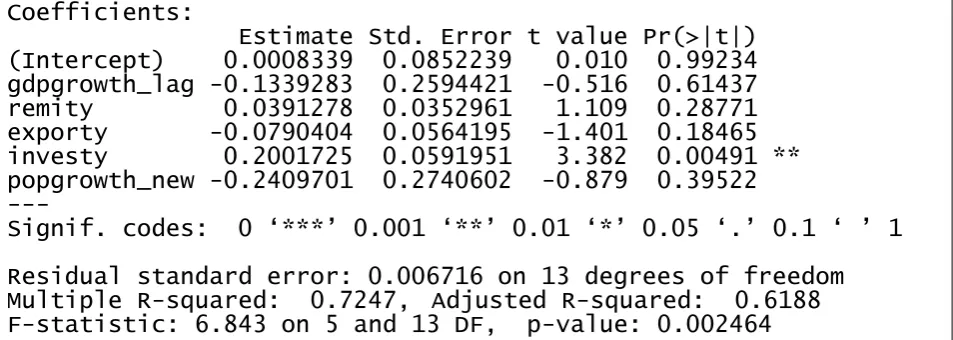
Given the outputs from R, there are a few items to analyze. For one, positive and significant results are found for the effect of remittance inflows on the level of GDP. What this means is that a 1% increase in remittance to GDP ratio leads to a 0.56% increase in GDP. This result, as shown in the first table, is significant at the 1% level. On the other hand, remittance inflows have a positive but insignificant effect on GDP growth in India as the second output table shows.
Table 1: Short-run effect of remittance inflows to the level of GDP. Regression results come from the empirical model, presented as equation 1.
Table 2: Long-run effect of remittance inflows to GDP growth. Regression results come from the empirical model, presented as equation 2.
Coefficients:
Estimate Std. Error t value Pr(>|t|) (Intercept) 2.37234 0.31548 7.520 1.83e-06 *** logremit 0.56412 0.13902 4.058 0.00103 ** logexport 0.03054 0.22300 0.137 0.89289 loginvest -0.25593 0.26181 -0.978 0.34381 popgrowth 0.87579 1.06893 0.819 0.42543
---Signif. codes: 0 ‘***’ 0.001 ‘**’ 0.01 ‘*’ 0.05 ‘.’ 0.1 ‘ ’ 1
Residual standard error: 0.03294 on 15 degrees of freedom
Multiple R-squared: 0.9653, Adjusted R-squared: 0.956
F-statistic: 104.2 on 4 and 15 DF, p-value: 9.368e-11
Coefficients:
Estimate Std. Error t value Pr(>|t|) (Intercept) 0.0008339 0.0852239 0.010 0.99234 gdpgrowth_lag -0.1339283 0.2594421 -0.516 0.61437 remity 0.0391278 0.0352961 1.109 0.28771 exporty -0.0790404 0.0564195 -1.401 0.18465 investy 0.2001725 0.0591951 3.382 0.00491 ** popgrowth_new -0.2409701 0.2740602 -0.879 0.39522
---Signif. codes: 0 ‘***’ 0.001 ‘**’ 0.01 ‘*’ 0.05 ‘.’ 0.1 ‘ ’ 1
8 | P a g e
5.
Panel Regression Approach: Application to Select Emerging Market
Economies
The analysis is further extended to a group of representative emerging countries. The same empirical models as the ones for India are used. Countries studied include Egypt, Nigeria, the Philipines and Mexico. These countries were chosen due to their high values of annual remittances according to the world bank database as well as their geographical location. There was an original hope to have a panel analysis of an emerging country from each continent to better test the methodology being applied to India. The panel data as it currently stands, includes countries spanning Africa, Asia, Europe, North America, Central America though makes no consideration for South America and Australia because of the limited remittance flows. The five continents included in the panel data as it is now, provide a good background for comparison to India as well as a solid grouping of data to test the
methodology. Data for each of the 4 additional countries are the same as india and included GDP per capita, remittance to GDP, exports to GDP, investment to GDP and population growth. Data for each of these metrics are found for the same 20-year period (1995-2015) and are also from the World Bank. The countries are pooled together and a regression for panel data is run.
Table 3 presents the panel regression results for the effect of remittance inflows on the level of these countries’ GDP. Table 3 demonstrates that remmitance inflows have positive and significant effect on the level of GDP. It’s significant at the 1% level for the pooled data from India, the Phillipines, Mexico, Egypt and Nigeria. A 1% increase in remittance to GDP ratio increases the level of GDP by 0.24%. This effect is moderately smaller compared to the result from India. Countries such as the Philippines and Mexico do not receive remittance inflows as large as India, which could be said to weaken the short-run effect for the panel data analysis.
Table 4 shows the effect of remittance inflows to GDP growth for this group of
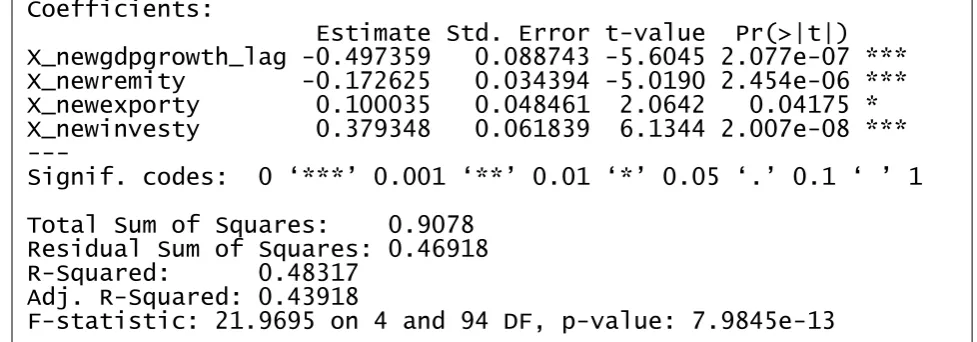
developing countries based on the panel fixed effect regression analysis. What’s interesting is that remittance inflows have negative and significant effect on the growth of GDP. This is consistent with the empirical literature (Balmer, Lawan etc.) that the negative effect of brain drains on the growth of GDP outweighs the positive impact of remittances inflows on GDP growth over the long time spans.
Coefficients:
Estimate Std. Error t-value Pr(>|t|) Xlogremit 0.242520 0.027832 8.7136 7.994e-14 *** Xlogexport 0.106442 0.037125 2.8671 0.005081 ** Xloginvest 0.094612 0.068596 1.3793 0.170981 ---
Signif. codes: 0 ‘***’ 0.001 ‘**’ 0.01 ‘*’ 0.05 ‘.’ 0.1 ‘ ’ 1
Total Sum of Squares: 1.078 Residual Sum of Squares: 0.26094 R-Squared: 0.75793
Adj. R-Squared: 0.74046
9 | P a g e
Table 3: Short-run effect of remittance inflows to the level of GDP for a group of emerging market economies. Panel regression results come from the fixed effect model.
Table 4: Long-run effect of remittance inflows to the level of GDP for a group of emerging market economies. Panel regression results come from the fixed effect model.
6.
Conclusion
As many exisiting studies have pointed out, the effect of remittance payments is multi-faceted. On one side of the coin, there is a short term benefit to families because they’re able to use these funds for consumption spending; presumably for non-durable goods. Their spending serves of course to augment the country’s GDP in that year. Additionally, it’s the general consensus that inherently linked to these remittances are the skilled and talented workers leaving the country to work elsewhere. Consistent with the concept of the Brain Drain, there is much support for the idea that in the long run, the loss of these intellectuals detracts from the sending country’s potential for research, technology, advancement and therefore sustainable economic growth.
As stated, our results work to reconcile the two prominent strands of literature. Outputs show that remmitance has a statistically significant short run effect on the GDP of India. A 1% increase in remittance to GDP ratio leads to a 0.56% increase in GDP in India. Furthermore, there was no statistically significant result found for the effect of remittance on GDP growth. Regarding the panel data, the statistically significant results for a negative output provide a basis to justify the concept of Brain Drain. Figure 4 makes obvious the idea that although remmitance inflows still occur in the long run, the dominating effect is the impact of losing skilled workers and the ‘minds behind the machines.’
Results from this paper are consistent with what’s been written on the effect of remittances, but provides a more comprehensive analysis as to why there are in fact varied effects from these payments. In the short run, it’s sensible that the effect is positive and statistically significant. When consumption goes up, the level of GDP, which is a function of C+I+G+NX, is going up as well. This short term spending however may not necessarily spur
Coefficients:
Estimate Std. Error t-value Pr(>|t|) X_newgdpgrowth_lag -0.497359 0.088743 -5.6045 2.077e-07 *** X_newremity -0.172625 0.034394 -5.0190 2.454e-06 *** X_newexporty 0.100035 0.048461 2.0642 0.04175 * X_newinvesty 0.379348 0.061839 6.1344 2.007e-08 *** ---
Signif. codes: 0 ‘***’ 0.001 ‘**’ 0.01 ‘*’ 0.05 ‘.’ 0.1 ‘ ’ 1
Total Sum of Squares: 0.9078 Residual Sum of Squares: 0.46918 R-Squared: 0.48317
Adj. R-Squared: 0.43918
10 | P a g e long run growth because these payments are most likely not allocated towards investment and education. Because India is one of the largest receivers of remittances, they should
11 | P a g e
7.
Bibliography
Balmer, B., Godwin, M. & Gregory, J. (2009). The royal society and the ‘brain drain’: Natural
scientists meet social science.
Beine, M., Docquier, F., & Oden-Defoort, C. (2006). A Panel Data Analysis of the Brain Gain. World Development, 39(4), 523-532.
Catrinescu, N., Leon-Ledesma, M., Piracha, M., & Quillin, B. (2009). Remittances,
institutions, and economic growth doi:https://doi.org/10.1016/j.worlddev.2008.02.004 Gjini, A. (2013). The role of remittances on economic growth:An empirical investigation of
12 CEE countries. International Business and Economics Research Journal, 12(2), 193.
Koerting, G. (2013). Brain drain. Salem Press Encyclopedia
Lawan Ngoma, A., & Wana Ismail, N. (2013). The Impact of Brain Drain on Human Capital in Developing Countries. South African Journal Of Economics, 81(2), 211-224. Odhiambo, G. (2012). Brain Drain in Higher Education: Lost Hope or Opportunity? Pradhan, K. C. (2016). Does remittance drive economic growth in emerging economies:
Evidence from FMOLS and panel VECM. Theoretical and Applied Economics, XXIII(No. 4(609)), 57.
Stark, O. (2004). Rethinking the brain drain
doi:https://doi.org/10.1016/j.worlddev.2003.06.013 World Bank. (Oct. 2017). Migration and remittances data.