This text was adapted by The Saylor Foundation under a
Creative
Commons Attribution-NonCommercial-ShareAlike 3.0 License
without
Preface
In this new millenium, as the world faces new and extreme challenges, the importance of acquiring a solid foundation in chemical principles has become increasingly important to understand the challenges that lie ahead. Moreover, as the world becomes more integrated and interdependent, so too do the scientific disciplines. The divisions between fields such as chemistry, physics, biology, environmental sciences, geology, and materials science, among others, have become less clearly defined. The goal of this text is to address the increasing close relationship among various disciplines and to show the relevance of chemistry to contemporary issues in a pedagogically approachable manner. Because of the enthusiasm of the majority of first-year chemistry students for biologically and medically relevant topics, this text uses an integrated approach that includes explicit discussions of biological and environmental applications of chemistry. Topics relevant to materials science are also introduced to meet the more specific needs of engineering students. To facilitate integration of such material, simple organic structures, nomenclature, and reactions are introduced very early in the text, and both organic and inorganic examples are used wherever possible. This approach emphasizes the distinctions between ionic and covalent bonding, thus enhancing the students’ chance of success in the organic chemistry course that traditionally follows general chemistry.
The overall goal is to produce a text that introduces the students to the relevance and excitement of chemistry. Although much of first-year chemistry is taught as a service course, there is no reason that the intrinsic excitement and potential of chemistry cannot be the focal point of the text and the course. We emphasize the positive aspects of chemistry and its relationship to students’ lives, which requires bringing in applications early and often.
Unfortunately, one cannot assume that students in such courses today are highly motivated to study chemistry for its own sake. The explicit discussion of biological, environmental, and materials issues from a chemical perspective is intended to motivate the students and help them appreciate the relevance of chemistry to their lives. Material that has traditionally been relegated to boxes, and thus perhaps perceived as peripheral by the students, has been incorporated into the text to serve as a learning tool.
third, it provides a review for those students who have already had relatively sophisticated high school chemistry and math courses, although the sections are designed primarily for students unfamiliar with the topic.
Our specific objectives include the following:
1. To write the text at a level suitable for science majors, but using a less formal writing style that will appeal to modern students.
2. To produce a truly integrated text that gives the student who takes only a single year of chemistry an overview of the most important subdisciplines of chemistry, including organic, inorganic, biological, materials, environmental, and nuclear chemistry, thus emphasizing unifying concepts.
3. To introduce fundamental concepts in the first two-thirds of the chapter, then applications relevant to the health sciences or engineers. This provides a flexible text that can be tailored to the specific needs and interests of the audience.
4. To ensure the accuracy of the material presented, which is enhanced by the author’s breadth of professional experience and experience as active chemical researchers.
5. To produce a spare, clean, uncluttered text that is less distracting to the student, where each piece of art serves as a pedagogical device.
6. To introduce the distinction between ionic and covalent bonding and reactions early in the text, and to continue to build on this foundation in the subsequent discussion, while emphasizing the relationship between structure and reactivity.
7. To utilize established pedagogical devices to maximize students’ ability to learn directly from the text. These include copious worked examples in the text, problem-solving strategies, and similar unworked exercises with solutions. End-of-chapter problems are designed to ensure that students have grasped major concepts in addition to testing their ability to solve numerical, problems. Problems emphasizing applications are drawn from many disciplines.
8. To emphasize an intuitive and predictive approach to problem solving that relies on a thorough understanding of key concepts and recognition of important patterns rather than on memorization. Many patterns are indicated
throughout the text as notes in the margin.
Chapter 1
Introduction to Chemistry
As you begin your study of college chemistry, those of you who do not intend to become professional
chemists may well wonder why you need to study chemistry. You will soon discover that a basic
understanding of chemistry is useful in a wide range of disciplines and career paths. You will also discover
that an understanding of chemistry helps you make informed decisions about many issues that affect you,
your community, and your world. A major goal of this text is to demonstrate the importance of chemistry
in your daily life and in our collective understanding of both the physical world we occupy and the
biological realm of which we are a part. The objectives of this chapter are twofold: (1) to introduce the
breadth, the importance, and some of the challenges of modern chemistry and (2) to present some of the
fundamental concepts and definitions you will need to understand how chemists think and work.
1.1 Chemistry in the Modern World
L E A R N I N G O B J E C T I V E
1. To recognize the breadth, depth, and scope of chemistry.
Chemistry is the study of matter and the changes that material substances undergo. Of all the scientific disciplines, it
is perhaps the most extensively connected to other fields of study. Geologists who want to locate new mineral or oil deposits use chemical techniques to analyze and identify rock samples. Oceanographers use chemistry to track ocean currents, determine the flux of nutrients into the sea, and measure the rate of exchange of nutrients between ocean layers. Engineers consider the relationships between the structures and the properties of substances when they specify materials for various uses. Physicists take advantage of the properties of substances to detect new subatomic particles. Astronomers use chemical signatures to determine the age and distance of stars and thus answer questions about how stars form and how old the universe is. The entire subject of environmental science depends on chemistry to explain the origin and impacts of phenomena such as air pollution, ozone layer depletion, and global warming. The disciplines that focus on living organisms and their interactions with the physical world rely heavily
the cell to reproduce. Biological phenomena such as vision, taste, smell, and movement result from numerous chemical reactions. Fields such as medicine, pharmacology, nutrition, and toxicology focus specifically on how the chemical substances that enter our bodies interact with the chemical components of the body to maintain our health and well-being. For example, in the specialized area of sports medicine, a knowledge of chemistry is needed to understand why muscles get sore after exercise as well as how prolonged exercise produces the euphoric feeling known as “runner’s high.”
Examples of the practical applications of chemistry are everywhere (Figure 1.1 "Chemistry in Everyday Life"). Engineers need to understand the chemical properties of the substances when designing biologically compatible implants for joint replacements or designing roads, bridges, buildings, and nuclear reactors that do not collapse because of weakened structural materials such as steel and cement. Archaeology and paleontology rely on chemical techniques to date bones and artifacts and identify their origins. Although law is not normally considered a field related to chemistry, forensic scientists use chemical methods to analyze blood, fibers, and other evidence as they investigate crimes. In particular, DNA matching—comparing biological samples of genetic material to see whether they could have come from the same person—has been used to solve many high-profile criminal cases as well as clear innocent people who have been wrongly accused or convicted. Forensics is a rapidly growing area of applied
chemistry. In addition, the proliferation of chemical and biochemical innovations in industry is producing rapid growth in the area of patent law. Ultimately, the dispersal of information in all the fields in which chemistry plays a part requires experts who are able to explain complex chemical issues to the public through television, print journalism, the Internet, and popular books.
By this point, it shouldn’t surprise you to learn that chemistry was essential in explaining a pivotal event in the history of Earth: the disappearance of the dinosaurs. Although dinosaurs ruled Earth for more than 150 million years, fossil evidence suggests that they became extinct rather abruptly approximately 66 million years ago. Proposed
accounting for only 0.0000001% of Earth’s crust, it is much more abundant in comets and asteroids. Because corresponding samples of rocks at sites in Italy and Denmark contained high iridium concentrations, the Alvarezes suggested that the impact of a large asteroid with Earth led to the extinction of the dinosaurs. When chemists analyzed additional samples of 66-million-year-old sediments from sites around the world, all were found to contain high levels of iridium. In addition, small grains of quartz in most of the iridium-containing layers exhibit microscopic cracks characteristic of high-intensity shock waves (part (b) in Figure 1.2 "Evidence for the Asteroid Impact That May Have Caused the Extinction of the Dinosaurs"). These grains apparently originated from terrestrial rocks at the impact site, which were pulverized on impact and blasted into the upper atmosphere before they settled out all over the world.
Scientists calculate that a collision of Earth with a stony asteroid about 10 kilometers (6 miles) in diameter, traveling at 25 kilometers per second (about 56,000 miles per hour), would almost instantaneously release energy equivalent to the explosion of about 100 million megatons of TNT (trinitrotoluene). This is more energy than that stored in the entire nuclear arsenal of the world. The energy released by such an impact would set fire to vast areas of forest, and the smoke from the fires and the dust created by the impact would block the sunlight for months or years, eventually killing virtually all green plants and most organisms that depend on them. This could explain why about 70%
Figure 1.3Asteroid Impact
The location of the asteroid impact crater near what is now the tip of the Yucatan Peninsula in Mexico.
beginning scientist who intends to spend your career studying such problems or as an informed observer who is able to participate in public debates that will certainly arise as society grapples with scientific issues.
Summary
Chemistry is the study of matter and the changes material substances undergo. It is essential for understanding much of the natural world and central to many other scientific disciplines, including astronomy, geology, paleontology, biology, and medicine.
K E Y T A K E A W A Y
An understanding of chemistry is essential for understanding much of the natural world and is central to
many other disciplines.
1.2 The Scientific Method
L E A R N I N G O B J E C T I V E
1. To identify the components of the scientific method.
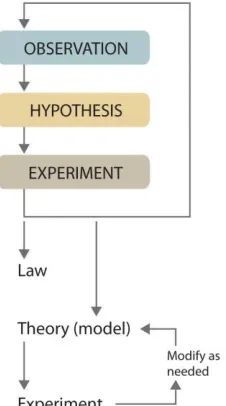
Scientists search for answers to questions and solutions to problems by using a procedure called the scientific method. This procedure consists of makingobservations, formulating hypotheses, and designing experiments, which in turn lead to additional observations, hypotheses, and experiments in repeated
cycles (Figure 1.4 "The Scientific Method").
Figure 1.4 The Scientific Method
Observations can be qualitative or quantitative.Qualitative observationsdescribe properties or occurrences in ways that do not rely on numbers. Examples of qualitative observations include the following: the outside air temperature is cooler during the winter season, table salt is a crystalline solid, sulfur crystals are yellow, and dissolving a penny in dilute nitric acid forms a blue solution and a brown gas.Quantitative observationsare measurements, which by definition consist of both anumberand aunit. Examples of quantitative observations include the following: the melting point of crystalline sulfur is 115.21 degrees Celsius, and 35.9 grams of table salt— whose chemical name is sodium chloride—dissolve in 100 grams of water at 20 degrees Celsius. For the question of the dinosaurs’ extinction, the initial observation was quantitative: iridium concentrations in sediments dating to 66 million years ago were 20–160 times higher than normal.
After deciding to learn more about an observation or a set of observations, scientists generally begin an investigation by forming a hypothesis, a tentative explanation for the observation(s). The hypothesis may not be correct, but it
puts the scientist’s understanding of the system being studied into a form that can be tested. For example, the observation that we experience alternating periods of light and darkness corresponding to observed movements of the sun, moon, clouds, and shadows is consistent with either of two hypotheses: (1) Earth rotates on its axis every 24 hours, alternately exposing one side to the sun, or (2) the sun revolves around Earth every 24 hours. Suitable experiments can be designed to choose between these two alternatives. For the disappearance of the dinosaurs, the hypothesis was that the impact of a large extraterrestrial object caused their extinction. Unfortunately (or perhaps fortunately), this hypothesis does not lend itself to direct testing by any obvious experiment, but scientists can collect additional data that either support or refute it.
elements by mass. Thus sodium chloride (table salt) always contains the same proportion by mass of sodium to chlorine, in this case 39.34% sodium and 60.66% chlorine by mass, and sucrose (table sugar) is always 42.11% carbon, 6.48% hydrogen, and 51.41% oxygen by mass.[1](For a review of common units of measurement, see Essential Skills 1
in Section 1.9 "Essential Skills 1".) The law of definite proportions should seem obvious—we would expect the composition of sodium chloride to be consistent—but the head of the US Patent Office did not accept it as a fact until the early 20th century.
Whereas a law states onlywhathappens, a theory attempts to explainwhynature behaves as it does. Laws are
unlikely to change greatly over time unless a major experimental error is discovered. In contrast, a theory, by definition, is incomplete and imperfect, evolving with time to explain new facts as they are discovered. The theory developed to explain the extinction of the dinosaurs, for example, is that Earth occasionally encounters small- to medium-sized asteroids, and these encounters may have unfortunate implications for the continued existence of most species. This theory is by no means proven, but it is consistent with the bulk of evidence amassed to date.Figure 1.5 "A Summary of How the Scientific Method Was Used in Developing the Asteroid Impact Theory to Explain the
Disappearance of the Dinosaurs from Earth"summarizes the application of the scientific method in this case.
Figure 1.5A Summary of How the Scientific Method Was Used in Developing the Asteroid Impact Theory to Explain
1. Classify each statement as a law, a theory, an experiment, a hypothesis, a qualitative observation, or a
quantitative observation.
a. Ice always floats on liquid water.
b. Birds evolved from dinosaurs.
c. Hot air is less dense than cold air, probably because the components of hot air are
moving more rapidly.
d. When 10 g of ice were added to 100 mL of water at 25°C, the temperature of the
water decreased to 15.5°C after the ice melted.
e. The ingredients of Ivory soap were analyzed to see whether it really is 99.44% pure,
as advertised.
2. Given: components of the scientific method
Strategy:
Refer to the definitions in this section to determine which category best describes each statement.
Solution:
a. This is a general statement of a relationship between the properties of liquid and solid
water, so it is a law.
b. This is a possible explanation for the origin of birds, so it is a hypothesis.
c. This is a statement that tries to explain the relationship between the temperature and
the density of air based on fundamental principles, so it is a theory.
d. The temperature is measured before and after a change is made in a system, so these are
quantitative observations.
e. This is an analysis designed to test a hypothesis (in this case, the manufacturer’s claim of
purity), so it is an experiment.
3) Exercise
Classify each statement as a law, a theory, an experiment, a hypothesis, a qualitative observation, or a
quantitative observation.
a.
Measured amounts of acid were added to a Rolaids tablet to see whether it really
“consumes 47 times its weight in excess stomach acid.”
b.
Heat always flows from hot objects to cooler ones, not in the opposite direction.
c.
The universe was formed by a massive explosion that propelled matter into a vacuum.
d.
Michael Jordan is the greatest pure shooter ever to play professional basketball.
e.
Limestone is relatively insoluble in water but dissolves readily in dilute acid with the
evolution of a gas.
f.
Gas mixtures that contain more than 4% hydrogen in air are potentially explosive.
Answers:
d. hypothesis
e. qualitative observation
f. quantitative observation
Because scientists can enter the cycle shown in Figure 1.4 "The Scientific Method" at any point, the actual application of the scientific method to different topics can take many different forms. For example, a scientist may start with a hypothesis formed by reading about work done by others in the field, rather than by making direct observations. It is important to remember that scientists have a tendency to formulate hypotheses in familiar terms simply because it is difficult to propose something that has never been encountered or imagined before. As a result, scientists sometimes discount or overlook unexpected findings that disagree with the basic assumptions behind the hypothesis or theory being tested. Fortunately, truly important findings are immediately subject to independent verification by scientists in other laboratories, so science is a self-correcting discipline. When the Alvarezes originally suggested that an extraterrestrial impact caused the extinction of the dinosaurs, the response was almost universal skepticism and scorn. In only 20 years, however, the persuasive nature of the evidence overcame the skepticism of many scientists, and their initial hypothesis has now evolved into a theory that has revolutionized paleontology and geology. In Section 1.3 "A Description of Matter", we begin our discussion of chemistry with a description of matter. This discussion is followed by a summary of some of the pioneering discoveries that led to our present understanding of the structure of the fundamental unit of chemistry: the atom.
Summary
Chemists expand their knowledge by making observations, carrying outexperiments, and
testing hypotheses to develop laws to summarize their results and theories to explain them. In doing so, they are using the scientific method.
K E Y T A K E A W A Y
Chemists expand their knowledge with the scientific method.
[1]
You will learn in
Chapter 12 "Solids"
that some solid compounds do not strictly obey
the law of definite proportions.
1.3 A Description of Matter
L E A R N I N G O B J E C T I V E
Chemists study the structures, physical properties, and chemical properties of material substances. These consist of matter, which is anything that occupies space and has mass. Gold and iridium are matter, as are peanuts, people, and postage stamps. Smoke, smog, and laughing gas are matter. Energy, light, and sound, however, are not matter; ideas and emotions are also not matter.
The mass of an object is the quantity of matter it contains. Do not confuse an object’s mass with its weight, which is a force caused by the gravitational attraction that operates on the object. Mass is a fundamental property of an object that does not depend on its location. [1] Weight, on the other hand, depends on the location of an object. An astronaut
whose mass is 95 kg weighs about 210 lb on Earth but only about 35 lb on the moon because the gravitational force he or she experiences on the moon is approximately one-sixth the force experienced on Earth. For practical purposes, weight and mass are often used interchangeably in laboratories. Because the force of gravity is considered to be the same everywhere on Earth’s surface, 2.2 lb (a weight) equals 1.0 kg (a mass), regardless of the location of the laboratory on Earth.
Under normal conditions, there are three distinct states of matter: solids, liquids, and gases (Figure 1.6 "The Three States of Matter"). Solids are relatively rigid and have fixed shapes and volumes. A rock, for example, is a solid. In contrast, liquids have fixed volumes but flow to assume the shape of their containers, such as a beverage in a can. Gases, such as air in an automobile tire, have neither fixed shapes nor fixed volumes and expand to completely fill their containers. Whereas the volume of gases strongly depends on their temperature and pressure (the amount of force exerted on a given area), the volumes of liquids and solids are virtually independent of temperature and pressure. Matter can often change from one physical state to another in a process called a physical change. For example, liquid water can be heated to form a gas called steam, or steam can be cooled to form liquid water. However, such changes of state do not affect the chemical composition of the substance.
Pure Substances and Mixtures
A pure chemical substance is any matter that has a fixed chemical composition and characteristic properties.
Oxygen, for example, is a pure chemical substance that is a colorless, odorless gas at 25°C. Very few samples of matter consist of pure substances; instead, most are mixtures, which are combinations of two or more pure substances in
and the tap water we drink. Homogeneous mixtures are also called solutions. Thus air is a solution of nitrogen, oxygen, water vapor, carbon dioxide, and several other gases; tap water is a solution of small amounts of several substances in water. The specific compositions of both of these solutions are not fixed, however, but depend on both source and location; for example, the composition of tap water in Boise, Idaho, is notthe same as the composition of tap water in Buffalo, New York. Although most solutions we encounter are liquid, solutions can also be solid. The gray substance still used by some dentists to fill tooth cavities is a complex solid solution that contains 50% mercury and 50% of a powder that contains mostly silver, tin, and copper, with small amounts of zinc and mercury. Solid solutions of two or more metals are commonly called alloys.
If the composition of a material is not completely uniform, then it is heterogeneous(e.g., chocolate chip cookie
dough, blue cheese, and dirt). Mixtures that appear to be homogeneous are often found to be heterogeneous after microscopic examination. Milk, for example, appears to be homogeneous, but when examined under a microscope, it clearly consists of tiny globules of fat and protein dispersed in water (Figure 1.7 "A Heterogeneous Mixture"). The components of heterogeneous mixtures can usually be separated by simple means. Solid-liquid mixtures such as sand in water or tea leaves in tea are readily separated by filtration, which consists of passing the mixture through a barrier, such as a strainer, with holes or pores that are smaller than the solid particles. In principle, mixtures of two or more solids, such as sugar and salt, can be separated by microscopic inspection and sorting. More complex operations are usually necessary, though, such as when separating gold nuggets from river gravel by panning. First solid material is filtered from river water; then the solids are separated by inspection. If gold is embedded in rock, it may have to be isolated using chemical methods.
Homogeneous mixtures (solutions) can be separated into their component substances by physical processes that rely on differences in some physical property, such as differences in their boiling points. Two of these separation methods are distillation and crystallization.Distillation makes use of differences in volatility, a measure of how easily a
substance is converted to a gas at a given temperature. Figure 1.8 "The Distillation of a Solution of Table Salt in Water" shows a simple distillation apparatus for separating a mixture of substances, at least one of which is a liquid. The most volatile component boils first and is condensed back to a liquid in the water-cooled condenser, from which it flows into the receiving flask. If a solution of salt and water is distilled, for example, the more volatile component, pure water, collects in the receiving flask, while the salt remains in the distillation flask.
kerosene, diesel fuel, and lubricating oil (in the approximate order of decreasing volatility). Another example is the distillation of alcoholic spirits such as brandy or whiskey. This relatively simple procedure caused more than a few headaches for federal authorities in the 1920s during the era of Prohibition, when illegal stills proliferated in remote regions of the United States.
Crystallization separates mixtures based on differences in solubility, a measure of how much solid substance
remains dissolved in a given amount of a specified liquid. Most substances are more soluble at higher temperatures, so a mixture of two or more substances can be dissolved at an elevated temperature and then allowed to cool slowly. Alternatively, the liquid, called the solvent, may be allowed to evaporate. In either case, the least soluble of the
dissolved substances, the one that is least likely to remain in solution, usually forms crystals first, and these crystals can be removed from the remaining solution by filtration. Figure 1.9 "The Crystallization of Sodium Acetate from a Concentrated Solution of Sodium Acetate in Water" dramatically illustrates the process of crystallization.
Most mixtures can be separated into pure substances, which may be either elements or compounds. An element, such as gray, metallic sodium, is a substance that cannot be broken down into simpler ones by chemical changes; a compound, such as white, crystalline sodium chloride, contains two or more elements and has chemical and physical properties that are usually different from those of the elements of which it is composed. With only a few exceptions, a particular compound has the same elemental composition (the same elements in the same proportions) regardless of its source or history. The chemical composition of a substance is altered in a process called
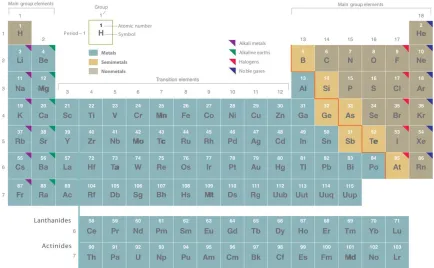
achemical change. The conversion of two or more elements, such as sodium and chlorine, to a chemical compound, sodium chloride, is an example of a chemical change, often called a chemical reaction. Currently, about 115 elements are known, but millions of chemical compounds have been prepared from these 115 elements. The known elements are listed in the periodic table (see Chapter 32 "Appendix H: Periodic Table of Elements").
In general, a reverse chemical process breaks down compounds into their elements. For example, water (a compound) can be decomposed into hydrogen and oxygen (both elements) by a process calledelectrolysis. In electrolysis,
electricity provides the energy needed to separate a compound into its constituent elements (Figure 1.10 "The Decomposition of Water to Hydrogen and Oxygen by Electrolysis"). A similar technique is used on a vast scale to obtain pure aluminum, an element, from its ores, which are mixtures of compounds. Because a great deal of energy is required for electrolysis, the cost of electricity is by far the greatest expense incurred in manufacturing pure
aluminum. Thus recycling aluminum is both cost-effective and ecologically sound.
The overall organization of matter and the methods used to separate mixtures are summarized in Figure 1.11 "Relationships between the Types of Matter and the Methods Used to Separate Mixtures".
E X A M P L E 2
1. Identify each substance as a compound, an element, a heterogeneous mixture, or a homogeneous mixture
(solution).
a.
filtered tea
b.
freshly squeezed orange juice
c.
a compact disc
d.
aluminum oxide, a white powder that contains a 2:3 ratio of aluminum and oxygen
atoms
e.
selenium
2, Given: a chemical substance
Asked for: its classification
Strategy:
A Decide whether a substance is chemically pure. If it is pure, the substance is either an element or a
compound. If a substance can be separated into its elements, it is a compound.
B If a substance is not chemically pure, it is either a heterogeneous mixture or a homogeneous mixture. If its
Solution:
a.
A
Tea is a solution of compounds in water, so it is not chemically pure. It is usually
separated from tea leaves by filtration.
B
Because the composition of the solution is
uniform throughout, it is a homogeneous mixture.
b.
A
Orange juice contains particles of solid (pulp) as well as liquid; it is not chemically
pure.
B
Because its composition is not uniform throughout, orange juice is a
heterogeneous mixture.
c.
A
A compact disc is a solid material that contains more than one element, with regions
of different compositions visible along its edge. Hence a compact disc is not chemically
pure.
B
The regions of different composition indicate that a compact disc is a
heterogeneous mixture.
d.
A
Aluminum oxide is a single, chemically pure compound.
e.
A
Selenium is one of the known elements.
3. Exercise
Identify each substance as a compound, an element, a heterogeneous mixture, or a homogeneous mixture
(solution).
a.
white wine
b.
mercury
c.
ranch-style salad dressing
d.
table sugar (sucrose)
Answers:
a.
solution
b.
element
c.
heterogeneous mixture
d.
compound
All matter has physical and chemical properties. Physical properties are characteristics that scientists can measure without changing the composition of the sample under study, such as mass, color, and volume (the amount of space occupied by a sample). Chemical properties describe the characteristic ability of a substance to react to form new substances; they include its flammability and susceptibility to corrosion. All samples of a pure substance have the same chemical and physical properties. For example, pure copper is always a reddish-brown solid (a physical property) and always dissolves in dilute nitric acid to produce a blue solution and a brown gas (a chemical property).
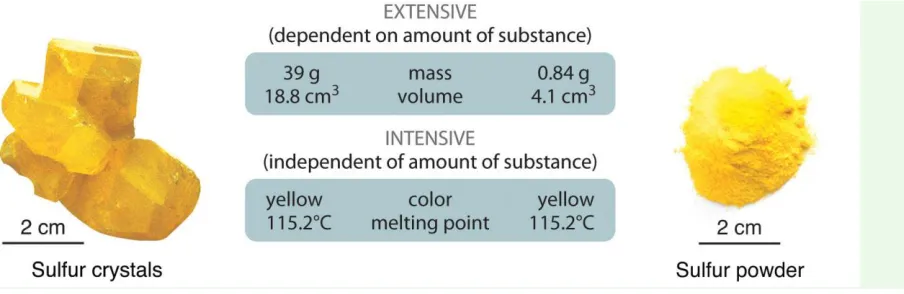
Physical properties can be extensive or intensive. Extensive properties vary with the amount of the substance and include mass, weight, and volume.Intensive properties, in contrast, do not depend on the amount of the substance; they include color, melting point, boiling point, electrical conductivity, and physical state at a given temperature. For example, elemental sulfur is a yellow crystalline solid that does not conduct electricity and has a melting point of 115.2°C, no matter what amount is examined (Figure 1.12 "The Difference between Extensive and Intensive Properties of Matter"). Scientists commonly measure intensive properties to determine a substance’s identity, whereas extensive properties convey information about the amount of the substance in a sample.
Figure 1.12 The Difference between Extensive and Intensive Properties of Matter
Because they differ in size, the two samples of sulfur have different extensive properties, such as
mass and volume. In contrast, their intensive properties, including color, melting point, and
electrical conductivity, are identical.
centimeter (g/cm3). As mass increases in a given volume, density also increases. For example, lead, with
its greater mass, has a far greater density than the same volume of air, just as a brick has a greater density than the same volume of Styrofoam. At a given temperature and pressure, the density of a pure substance is a constant:
Equation 1.1
density =mass volume ⇒d=m v
Pure water, for example, has a density of 0.998 g/cm3at 25°C.
The average densities of some common substances are in Table 1.1 "Densities of Common Substances". Notice that
corn oil has a lower mass to volume ratio than water. This means that when added to water, corn oil will “float.” Example 3 shows how density measurements can be used to identify pure substances.
Table 1.1 Densities of Common Substances Substance Density at 25°C (g/cm3)
blood 1.035
body fat 0.918
whole milk 1.030
corn oil 0.922
mayonnaise 0.910
honey 1.420
E X A M P L E 3
The densities of some common liquids are in Table 1.2 "Densities of Liquids in Example 3". Imagine you have five bottles containing colorless liquids (labeled A–E). You must identify them by measuring the
density of each. Using a pipette, a laboratory instrument for accurately measuring and transferring liquids,
you carefully measure 25.00 mL of each liquid into five beakers of known mass (1 mL = 1 cm3). You then
weigh each sample on a laboratory balance. Use the tabulated data to calculate the density of each
sample. Based solely on your results, can you unambiguously identify all five liquids?[2]
Masses of samples: A, 17.72 g; B, 19.75 g; C, 24.91 g; D, 19.65 g; E, 27.80 g
T A B L E 1 . 2
D E N S I T I E S O F L I Q U I D S I N E X A M P L E 3
Substance Density at 25°C (g/cm3)Substance Density at 25°C (g/cm3)
ethanol (the alcohol in beverages) 0.789
methanol (wood alcohol) 0.792
ethylene glycol (used in antifreeze) 1.113
diethyl ether (“ether”; once widely used as an anesthetic) 0.708
isopropanol (rubbing alcohol) 0.785
Given: volume and mass
Asked for: density
Strategy:
A Calculate the density of each liquid from the volumes and masses given.
B Check to make sure that your answer makes sense.
C Compare each calculated density with those given in Table 1.2 "Densities of Liquids in Example 3". If the calculated density of a liquid is not significantly different from that of one of the liquids given in the table,
then the unknown liquid is most likely the corresponding liquid.
D If none of the reported densities corresponds to the calculated density, then the liquid cannot be
unambiguously identified.
Solution:
A Density is mass per unit volume and is usually reported in grams per cubic centimeter (or grams per
milliliter because 1 mL = 1 cm3). The masses of the samples are given in grams, and the volume of all the
samples is 25.00 mL (= 25.00 cm3). The density of each sample is calculated by dividing the mass by its
volume (Equation 1.1). The density of sample A, for example, is
17.72g/25.00cm(cubed) = 0.7088 g/cm (cubed)
Both the volume and the mass are given to four significant figures, so four significant figures are permitted
in the result. (See Essential Skills 1, Section 1.9 "Essential Skills 1", for a discussion of significant figures.) The densities of the other samples (in grams per cubic centimeter) are as follows: B, 0.7900; C, 0.9964; D,
0.7860; and E, 1.112.
B Except for sample E, the calculated densities are slightly less than 1 g/cm3. This makes sense because the
contrast, the mass of sample E is slightly greater than 25 g, so its density must be somewhat greater than 1
g/cm3.
C Comparing these results with the data given in Table 1.2 "Densities of Liquids in Example 3" shows that sample A is probably diethyl ether (0.708 g/cm3 and 0.7088 g/cm3 are not substantially different),
sample C is probably water (0.998 g/cm3 in the table versus 0.9964 g/cm3 measured), and sample E is
probably ethylene glycol (1.113 g/cm3 in the table versus 1.112 g/cm3 measured).
D Samples B and D are more difficult to identify for two reasons: (1) Both have similar densities (0.7900
and 0.7860 g/cm3), so they may or may not be chemically identical. (2) Within experimental error, the
measured densities of B and D are indistinguishable from the densities of ethanol (0.789 g/cm3), methanol
(0.792 g/cm3), and isopropanol (0.785 g/cm3). Thus some property other than density must be used to
identify each sample.
Exercise
Given the volumes and masses of five samples of compounds used in blending gasoline, together with the
densities of several chemically pure liquids, identify as many of the samples as possible. Sample Volume (mL) Mass (g)
A 337 250.0
B 972 678.1
C 243 190.9
D 119 103.2
E 499 438.7
Substance Density (g/cm3)
benzene 0.8787
toluene 0.8669
m-xylene 0.8684
isooctane 0.6979
methyl t-butyl ether 0.7405
t-butyl alcohol 0.7856
Matter is anything that occupies space and has mass. The three states of matter are solid, liquid, and gas. A physical change involves the conversion of a substance from one state of matter to another, without changing its chemical composition. Most matter consists of mixtures of pure substances, which can behomogeneous (uniform in composition) or heterogeneous (different regions possess different compositions and properties). Pure substances can be either chemical compounds or
elements. Compounds can be broken down into elements by chemical reactions, but elements cannot be separated into simpler substances by chemical means. The properties of substances can be classified as either physical or chemical. Scientists can observe physical properties without changing the
composition of the substance, whereas chemical propertiesdescribe the tendency of a substance to undergo chemical changes (chemical reactions) that change its chemical composition. Physical properties can be intensive or extensive. Intensive properties are the same for all samples; do not depend on sample size; and include, for example, color, physical state, and melting and boiling points. Extensive properties depend on the amount of material and include mass and volume. The ratio of two extensive properties, mass and volume, is an important intensive property called density.
K E Y T A K E A W A Y
Matter can be classified according to physical and chemical properties.
C O N C E P T U A L P R O B L E M S
Please be sure you are familiar with the topics discussed in Essential Skills 1 (Section 1.9 "Essential Skills 1")
before proceeding to the Conceptual Problems.
1. What is the difference between mass and weight? Is the mass of an object on Earth the same as the mass of
the same object on Jupiter? Why or why not?
2. Is it accurate to say that a substance with a mass of 1 kg weighs 2.2 lb? Why or why not?
3. What factor must be considered when reporting the weight of an object as opposed to its mass?
4. Construct a table with the headings “Solid,” “Liquid,” and “Gas.” For any given substance, state what you
expect for each of the following:
a.
the relative densities of the three phases
b.
the physical shapes of the three phases
c.
the volumes for the same mass of compound
e.
the sensitivity of the volume to changes in pressure
5. Classify each substance as homogeneous or heterogeneous and explain your reasoning.
a.
platinum
b.
a carbonated beverage
c.
bronze
d.
wood
e.
natural gas
f.
Styrofoam
6. Classify each substance as homogeneous or heterogeneous and explain your reasoning.
a.
snowflakes
b.
gasoline
c.
black tea
d.
plastic wrap
e.
blood
f.
water containing ice cubes
7. Classify each substance as a pure substance or a mixture and explain your reasoning.
a.
seawater
b.
coffee
c.
14-karat gold
d.
diamond
e.
distilled water
8. Classify each substance as a pure substance or a mixture.
a.
cardboard
b.
caffeine
c.
tin
d.
a vitamin tablet
e.
helium gas
9. Classify each substance as an element or a compound.
b.
silver
c.
rust
d.
rubbing alcohol
e.
copper
10. Classify each substance as an element or a compound.
a.
water
b.
iron
c.
hydrogen gas
d.
glass
e.
nylon
11. What techniques could be used to separate each of the following?
a.
sugar and water from an aqueous solution of sugar
b.
a mixture of sugar and sand
c.
a heterogeneous mixture of solids with different solubilities
12. What techniques could be used to separate each of the following?
a.
solid calcium chloride from a solution of calcium chloride in water
b.
the components of a solution of vinegar in water
c.
particulates from water in a fish tank
13. Match each separation technique in (a) with the physical/chemical property that each takes advantage of in
(b).
a.
crystallization, distillation, filtration
b.
volatility, physical state, solubility
14. The following figures illustrate the arrangement of atoms in some samples of matter. Which figures are
15.
Classify each statement as an extensive property or an intensive property.
a.
Carbon, in the form of diamond, is one of the hardest known materials.
b.
A sample of crystalline silicon, a grayish solid, has a mass of 14.3 g.
c.
Germanium has a density of 5.32 g/cm
3.
d.
Gray tin converts to white tin at 13.2°C.
e.
Lead is a bluish-white metal.
16. Classify each statement as a physical property or a chemical property.
f.
Fluorine etches glass.
g.
Chlorine interacts with moisture in the lungs to produce a respiratory irritant.
h.
Bromine is a reddish-brown liquid.
i.
Iodine has a density of 11.27 g/L at 0°C.
N U M E R I C A L P R O B L E M S
Please be sure you are familiar with the topics discussed in Essential Skills 1 (Section 1.9 "Essential Skills 1")
1. If a person weighs 176 lb on Earth, what is his or her mass on Mars, where the force of gravity is 37% of that
on Earth?
2. If a person weighs 135 lb on Earth, what is his or her mass on Jupiter, where the force of gravity is 236% of
that on Earth?
3. Calculate the volume of 10.00 g of each element and then arrange the elements in order of decreasing
volume. The numbers in parentheses are densities.
a.
copper (8.92 g/cm
3)
b.
calcium (1.54 g/cm
3)
c.
titanium (4.51 g/cm
3)
d.
iridium (22.85 g/cm
3)
4. Given 15.00 g of each element, calculate the volume of each and then arrange the elements in order of
increasing volume. The numbers in parentheses are densities.
a.
gold (19.32 g/cm
3)
b.
lead (11.34 g/cm
3)
c.
iron (7.87 g/cm
3)
d.
sulfur (2.07 g/cm
3)
5. A silver bar has dimensions of 10.00 cm × 4.00 cm × 1.50 cm, and the density of silver is 10.49 g/cm3. What is
the mass of the bar?
6. Platinum has a density of 21.45 g/cm3. What is the mass of a platinum bar measuring 3.00 cm × 1.50
cm × 0.500 cm?
7. Complete the following table.
Density (g/cm
3)
Mass (g)
Volume (cm
3)
Element
3.14
79.904
Br
3.51
3.42
C
39.1
45.5
K
11.34
207.2
Pb
107.868
10.28
Ag
8. Gold has a density of 19.30 g/cm3. If a person who weighs 85.00 kg (1 kg = 1000 g) were given his or her
weight in gold, what volume (in cm3) would the gold occupy? Are we justified in using the SI unit of mass for
the person’s weight in this case?
9. An irregularly shaped piece of magnesium with a mass of 11.81 g was dropped into a graduated cylinder
partially filled with water. The magnesium displaced 6.80 mL of water. What is the density of magnesium?
10. The density of copper is 8.92 g/cm3. If a 10.00 g sample is placed in a graduated cylinder that contains 15.0
mL of water, what is the total volume that would be occupied?
11. At 20°C, the density of fresh water is 0.9982 kg/m3, and the density of seawater is 1.025 kg/m3. Will a ship
float higher in fresh water or in seawater? Explain your reasoning.
A N S W E R S
1. Unlike weight, mass does not depend on location. The mass of the person is therefore the same on Earth and
Mars: 176 lb ÷ 2.2 lb/kg = 80 kg.
2: a. Cu: 1.12 cm3
b. Ca: 6.49 cm3
c. Ti: 2.22 cm3
d. Ir: 0.4376 cm3
Volume decreases: Ca > Ti > Cu > Ir
[1] In physical terms, the mass of an object is directly proportional to the force required to change its speed or direction. A more detailed discussion of the differences between weight and mass and the units used to measure
them is included in Essential Skills 1 (Section 1.9 "Essential Skills 1").
1.4 A Brief History of Chemistry
L E A R N I N G O B J E C T I V E
1.
To understand the development of the atomic model.
It was not until the era of the ancient Greeks that we have any record of how people tried to explain the chemical changes they observed and used. At that time, natural objects were thought to consist of only four basic elements: earth, air, fire, and water. Then, in the fourth century BC, two Greek philosophers, Democritus and Leucippus, suggested that matter was not infinitely divisible into smaller particles but instead consisted of fundamental, indivisible particles called atoms. Unfortunately, these early philosophers did not have the technology to test their hypothesis. They would have been unlikely to do so in any case because the ancient Greeks did not conduct experiments or use the scientific method. They believed that the nature of the universe could be discovered by rational thought alone.
Over the next two millennia, alchemists, who engaged in a form of chemistry and speculative philosophy during the
Middle Ages and Renaissance, achieved many advances in chemistry. Their major goal was to convert certain elements into others by a process they called transmutation (Figure 1.13 "An Alchemist at Work"). In particular,
alchemists wanted to find a way to transform cheaper metals into gold. Although most alchemists did not approach chemistry systematically and many appear to have been outright frauds, alchemists in China, the Arab kingdoms, and medieval Europe made major contributions, including the discovery of elements such as quicksilver (mercury) and the preparation of several strong acids.
Modern Chemistry
The 16th and 17th centuries saw the beginnings of what we now recognize as modern chemistry. During this period, great advances were made in metallurgy, the extraction of metals from ores, and the first systematic quantitative experiments were carried out. In 1661, the Englishman Robert Boyle (1627–91) published The Sceptical Chymist, which described the relationship between the pressure and the volume of air. More important, Boyle defined an element as a substance that cannot be broken down into two or more simpler substances by chemical means. This led to the identification of a large number of elements, many of which were metals. Ironically, Boyle himself never thought that metals were elements.
know to be carbon dioxide, is the same as one of the gaseous products of combustion. Priestley’s studies of this gas did not continue as he would have liked, however. After he fell into a vat of fermenting beer, brewers prohibited him from working in their factories. Although Priestley did not understand its identity, he found that carbon dioxide dissolved in water to produce seltzer water. In essence, he may be
considered the founder of the multibillion-dollar carbonated soft drink industry.
Joseph Priestley (1733–1804)
Priestley was a political theorist and a leading Unitarian minister. He was appointed to Warrington Academy in Lancashire, England, where he developed new courses on history, science, and the arts. During visits to London, Priestley met the leading men of science, including Benjamin Franklin, who encouraged Priestley’s interest in electricity. Priestley’s work on gases began while he was living next to a brewery in Leeds, where he noticed “fixed air” bubbling out of vats of fermenting beer and ale. His scientific discoveries included the relationship between electricity and chemical change, 10 new “airs,” and observations that led to the discovery of photosynthesis. Due to his support for the principles of the French Revolution, Priestley’s house, library, and laboratory were destroyed by a mob in 1791. He and his wife emigrated to the United States in 1794 to join their three sons, who had previously emigrated to Pennsylvania. Priestley never returned to England and died in his new home in Pennsylvania.
Despite the pioneering studies of Priestley and others, a clear understanding of combustion remained elusive. In the late 18th century, however, the French scientist Antoine Lavoisier (1743–94) showed that combustion is the reaction of a carbon-containing substance with oxygen to form carbon dioxide and water and that life depends on a similar reaction, which today we call respiration. Lavoisier also wrote the first modern chemistry text and is widely regarded as the father of modern chemistry. His most important contribution was the law of conservation of mass, which states that in any chemical reaction, the mass of the substances that react equals the mass of the products that are formed. That is, in a chemical reaction, mass is neither lost nor destroyed. Unfortunately, Lavoisier invested in a private corporation that
collected taxes for the Crown, and royal tax collectors were not popular during the French Revolution. He was executed on the guillotine at age 51, prematurely terminating his contributions to chemistry.
In 1803, the English schoolteacher John Dalton (1766–1844) expanded Proust’s development of the law of definite proportions (Section 1.2 "The Scientific Method") and Lavoisier’s findings on the
conservation of mass in chemical reactions to propose that elements consist of indivisible particles that he called atoms (taking the term from Democritus and Leucippus). Dalton’s atomic theory of
matter contains four fundamental hypotheses:
1.
All matter is composed of tiny indivisible particles called atoms.
2.
All atoms of an element are identical in mass and chemical properties, whereas atoms of
different elements differ in mass and fundamental chemical properties.
3.
A chemical compound is a substance that always contains the same atoms in the same
ratio.
4.
In chemical reactions, atoms from one or more compounds or elements redistribute or
rearrange in relation to other atoms to form one or more new compounds.
Atoms
themselves do not undergo a change of identity in chemical reactions.
This last hypothesis suggested that the alchemists’ goal of transmuting other elements to gold was impossible, at least through chemical reactions. We now know that Dalton’s atomic theory is essentially correct, with four minor modifications:
1.
Not all atoms of an element must have precisely the same mass.
2.
Atoms of one element can be transformed into another through nuclear reactions.
3.
The compositions of many solid compounds are somewhat variable.
4.
Under certain circumstances, some atoms can be divided (split into smaller particles).
These modifications illustrate the effectiveness of the scientific method; later experiments and observations were used to refine Dalton’s original theory.
The Law of Multiple Proportions
Despite the clarity of his thinking, Dalton could not use his theory to determine the elemental
as did the first. But what was the correct formula for each compound? If the first compound consisted of particles that contain one carbon atom and one oxygen atom, the second must consist of particles that contain one carbon atom and two oxygen atoms. If the first compound had two carbon atoms and one oxygen atom, the second must have two carbon atoms and two oxygen atoms. If the first had one carbon atom and two oxygen atoms, the second would have one carbon atom and four oxygen atoms, and so forth. Dalton had no way to distinguish among these or more complicated alternatives. However, these data led to a general statement that is now known as the law of multiple proportions: when two elements form a series of compounds, the ratios of the masses of the second element that are present per gram of the first element can almost always be expressed as the ratios of integers. (The same law holds for mass ratios of compounds forming a series that contains more than two elements.) Example 4 shows how the law of multiple proportions can be applied to determine the identity of a compound.
E X A M P L E 4
A chemist is studying a series of simple compounds of carbon and hydrogen. The following table lists the
masses of hydrogen that combine with 1 g of carbon to form each compound. Compound Mass of Hydrogen (g)
A 0.0839
B 0.1678
C 0.2520
D
a.
Determine whether these data follow the law of multiple proportions.
b.
Calculate the mass of hydrogen that would combine with 1 g of carbon to form
D
,
the fourth compound in the series.
Given: mass of hydrogen per gram of carbon for three compounds
Asked for:
a.
ratios of masses of hydrogen to carbon
b.
mass of hydrogen per gram of carbon for fourth compound in series
Strategy:
A Select the lowest mass to use as the denominator and then calculate the ratio of each of the other
B If the ratios are small whole integers, the data follow the law of multiple proportions.
C Decide whether the ratios form a numerical series. If so, then determine the next member of that series
and predict the ratio corresponding to the next compound in the series.
D Use proportions to calculate the mass of hydrogen per gram of carbon in that compound.
Solution:
A Compound A has the lowest mass of hydrogen, so we use it as the denominator. The ratios of the
remaining masses of hydrogen, B and C, that combine with 1 g of carbon are as follows:
C/A =0.2520g/0.0839g= 3.00 = 3/1
B/A = 0.1678g/0.0839g = 2.00 = 2/1
C/B = 0.2520g/0.1678g = 1.502 = 3/2
B The ratios of the masses of hydrogen that combine with 1 g of carbon are indeed composed of small whole integers (3/1, 2/1, 3/2), as predicted by the law of multiple proportions.
C The ratios B/A and C/A form the series 2/1, 3/1, so the next member of the series should be D/A = 4/1.
D Thus, if compound D exists, it would be formed by combining 4 × 0.0839 g = 0.336 g of hydrogen with 1 g
of carbon. Such a compound does exist; it is methane, the major constituent of natural gas.
Exercise
Four compounds containing only sulfur and fluorine are known. The following table lists the masses of
fluorine that combine with 1 g of sulfur to form each compound. Compound Mass of Fluorine (g)
A 3.54
B 2.96
C 2.36
D 0.59
a.
Determine the ratios of the masses of fluorine that combine with 1 g of sulfur in
these compounds. Are these data consistent with the law of multiple proportions?
b.
Calculate the mass of fluorine that would combine with 1 g of sulfur to form the
next two compounds in the series:
E
and
F
.
b.
Ratios of 3.0 and 2.0 give 1.8 g and 1.2 g of fluorine/gram of sulfur, respectively. (Neither
of these compounds is yet known.)
Avogadro’s Hypothesis
In a further attempt to establish the formulas of chemical compounds, the French chemist Joseph Gay-Lussac (1778–1850) carried out a series of experiments using volume measurements. Under conditions of constant temperature and pressure, he carefully measured the volumes of gases that reacted to make a given chemical compound, together with the volumes of the products if they were gases. Gay-Lussac found, for example, that one volume of chlorine gas always reacted with one volume of hydrogen gas to produce two volumes of hydrogen chloride gas. Similarly, one volume of oxygen gas always reacted with two volumes of hydrogen gas to produce two volumes of water vapor (part (a) in Figure 1.14 "Gay-Lussac’s Experiments with Chlorine Gas and Hydrogen Gas").
Figure 1.14 Gay-Lussac’s Experiments with Chlorine Gas and Hydrogen Gas
(a) One volume of chlorine gas reacted with one volume of hydrogen gas to produce two volumes of hydrogen chloride gas, and one volume of oxygen gas reacted with two volumes of hydrogen gas to produce two volumes of water vapor. (b) A summary of Avogadro’s hypothesis, which interpreted Gay-Lussac’s results in terms of atoms. Note that the simplest way for two molecules of hydrogen chloride to be produced is if hydrogen and chlorine each consist of molecules that contain two atoms of the element.
of gas particles.Avogadro’s hypothesis, which explained Gay-Lussac’s results, is summarized here and in part
(b) in Figure 1.14 "Gay-Lussac’s Experiments with Chlorine Gas and Hydrogen Gas":
One volume one volume two volumes
(or particle) of + (or particle) of ==== (or particles) of
hydrogen chlorine hydrogen chloride
If Dalton’s theory of atoms was correct, then each particle of hydrogen or chlorine had to containat least two atomsof hydrogen or chlorine because two particles of hydrogen chloride were produced. The simplest—but not the
only—explanation was that hydrogen and chlorine contained two atoms each (i.e., they werediatomic) and that hydrogen chloride contained one atom each of hydrogen and chlorine. Applying this reasoning to Gay-Lussac’s results with hydrogen and oxygen leads to the conclusion that water contains two hydrogen atoms per oxygen atom.
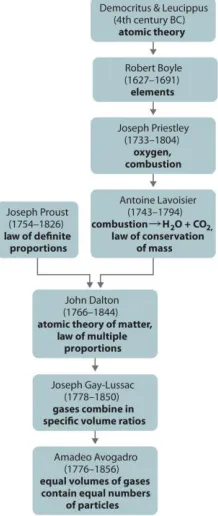
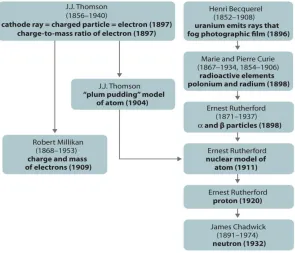
Unfortunately, because no data supported Avogadro’s hypothesis that equal volumes of gases contained equal numbers of particles, his explanations and formulas for simple compounds were not generally accepted for more than 50 years. Dalton and many others continued to believe that water particles contained one hydrogen atom and one oxygen atom, rather than two hydrogen atoms and one oxygen atom. The historical development of the concept of the atom is summarized in Figure 1.15 "A Summary of the Historical Development of the Concept of the Atom".
Summary
The ancient Greeks first proposed that matter consisted of fundamental particles called atoms.
Chemistry took its present scientific form in the 18th century, when careful quantitative experiments by Lavoisier, Proust, and Dalton resulted in the law of definite proportions, the law of conservation of mass, and the law of multiple proportions, which laid the groundwork for Dalton’s atomic theory of matter. In particular, Avogadro’s hypothesis provided the first link between the macroscopic properties of a substance (in this case, the volume of a gas) and the number of atoms or molecules present.
K E Y T A K E A W A Y
The development of the atomic model relied on the application of the scientific method
over several centuries.
C O N C E P T U A L P R O B L E M S
1. Define combustion and discuss the contributions made by Priestley and Lavoisier toward understanding a
combustion reaction.
2. Chemical engineers frequently use the concept of “mass balance” in their calculations, in which the mass of
the reactants must equal the mass of the products. What law supports this practice?
3. Does the law of multiple proportions apply to both mass ratios and atomic ratios? Why or why not?
4. What are the four hypotheses of the atomic theory of matter?
5. Much of the energy in France is provided by nuclear reactions. Are such reactions consistent with Dalton’s
hypotheses? Why or why not?
6. Does 1 L of air contain the same number of particles as 1 L of nitrogen gas? Explain your answer.
N U M E R I C A L P R O B L E M S
Please be sure you are familiar with the topics discussed in Essential Skills 1 (Section 1.9 "Essential Skills 1")
before proceeding to the Numerical Problems.
1. One of the minerals found in soil has an Al:Si:O atomic ratio of 0.2:0.2:0.5. Is this consistent with the law of
multiple proportions? Why or why not? Is the ratio of elements consistent with Dalton’s atomic theory of
matter?
2. Nitrogen and oxygen react to form three different compounds that contain 0.571 g, 1.143 g, and 2.285 g of
3. Three binary compounds of vanadium and oxygen are known. The following table gives the masses of oxygen
that combine with 10.00 g of vanadium to form each compound.
Compound
Mass of Oxygen (g)
A
4.71
B
6.27
C
a.
Determine the ratio of the masses of oxygen that combine with 3.14 g of vanadium in
compounds
A
and
B
.
b.
Predict the mass of oxygen that would combine with 3.14 g of vanadium to form the third
compound in the series.
4. Three compounds containing titanium, magnesium, and oxygen are known. The following table gives the
masses of titanium and magnesium that react with 5.00 g of oxygen to form each compound.
Compound
Mass of Titanium (g)
Mass of Magnesium (g)
A
4.99
2.53
B
3.74
3.80
C
a.
Determine the ratios of the masses of titanium and magnesium that combine with 5.00 g
of oxygen in these compounds.
b.
Predict the masses of titanium and magnesium that would combine with 5.00 g of oxygen
to form another possible compound in the series:
C
.
1.5 The Atom
L E A R N I N G O B J E C T I V E
1.
To become familiar with the components and structure of the atom.
To date, about 115 different elements have been discovered; by definition, each is chemically unique. To understand why they are unique, you need to understand the structure of the atom (the fundamental, individual particle of an element) and the characteristics of its components.
Atoms consist of electrons, protons, and neutrons. [1] Some properties of these subatomic particles are summarized
1.
Electrons and protons have electrical charges that are identical in magnitude but
opposite in sign. We usually assign
relative
charges of
−
1 and +1 to the electron and
proton, respectively.
2.
Neutrons have approximately the same mass as protons but no charge. They are
electrically neutral.
3.
The mass of a proton or a neutron is about 1836 times greater than the mass of an
electron. Protons and neutrons constitute by far the bulk of the mass of atoms.
The discovery of the electron and the proton was crucial to the development of the modern model of the atom and provides an excellent case study in the application of the scientific method. In fact, the elucidation of the atom’s structure is one of the greatest detective stories in the history of science.
Table 1.3 Properties of Subatomic Particles*
Particle Mass (g) Atomic Mass (amu) Electrical Charge (coulombs) Relative Charge
electron 9.109 × 10⁻²⁸ 0.0005486 −1.602 × 10⁻¹⁹ −1
proton 1.673 × 10⁻²⁴ 1.007276 +1.602 × 10⁻¹⁹ +1
neutron 1.675 × 10⁻²⁴ 1.008665 0 0
* For a review of using scientific notation and units of measurement, see Essential Skills 1 (Section 1.9 "Essential Skills 1").
The Electron
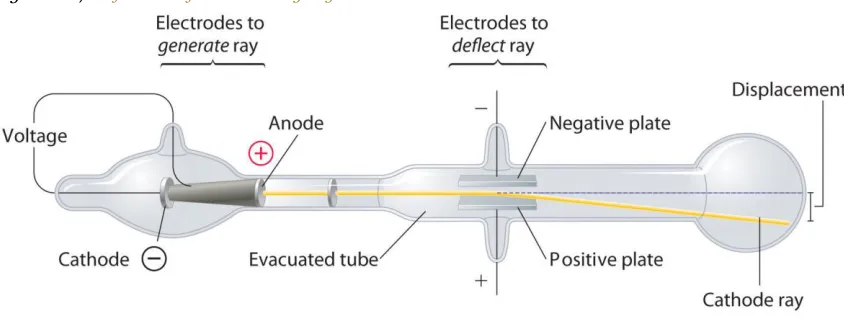
Long before the end of the 19th century, it was well known that applying a high voltage to a gas contained at low pressure in a sealed tube (called a gas discharge tube) caused electricity to flow through the gas, which then emitted light (Figure 1.16 "A Gas Discharge Tube Producing Cathode Rays"). Researchers trying to understand this phenomenon found that an unusual form of energy was also emitted from the cathode, or negatively charged electrode; hence this form of energy was calledcathode rays. In 1897, the British physicist J. J. Thomson (1856– 1940) proved that atoms were not the ultimate form of matter. He demonstrated that cathode rays could be deflected, or bent, by magnetic or electric fields, which indicated that cathode rays consist of charged particles (Figure 1.17 "Deflection of Cathode Rays by an Electric Field"). More important, by measuring the extent of the deflection of
the cathode rays in magnetic or electric fields of various strengths, Thomson was able to calculate the mass-to-charge ratio of the particles. These particles were emitted by the negatively charged cathode and repelled by the
chemistry, Thomson found that the mass-to-charge ratio of cathode rays was independent of the nature of the metal electrodes or the gas, which suggested that electrons were fundamental components of all atoms.
Figure 1.17 Deflection of Cathode Rays by an Electric Field
As the cathode rays travel toward the right, they are deflected toward the positive electrode (+), demonstrating that they are negatively charged.
Subsequently, the American scientist Robert Millikan (1868–1953) carried out a series of experiments using
electrically charged oil droplets, which allowed him to calculate the charge on a single electron. With this information and Thomson’s mass-to-charge ratio, Millikan determined the mass of an electron.
Mass/Charge(crossed-out) x charge (crossed out) = ma ss
It was at this point that two separate lines of investigation began to converge, both aimed at determining how and why matter emits energy.