For your convenience Apress has placed some of the front
matter material after the index. Please use the Bookmarks
and Contents at a Glance links to access them.
Contents at a Glance
About ApressOpen ����������������������������������������������������������������������������
iii
Foreword �������������������������������������������������������������������������������������������
v
About the Author ����������������������������������������������������������������������������
xiii
Preface ��������������������������������������������������������������������������������������������
xv
Acknowledgments �������������������������������������������������������������������������
xvii
Chapter 1: Introduction
■
������������������������������������������������������������������
1
Chapter 2: The Misperception of Risk
■
������������������������������������������
15
Chapter 3: Governance and Internal Partnerships
■
�����������������������
27
Chapter 4: External Partnerships
■
�������������������������������������������������
43
Chapter 5: People Are the Perimeter
■
��������������������������������������������
57
Chapter 6: Emerging Threats and Vulnerabilities
■
�������������������������
71
Chapter 7: A New Security Architecture to Improve
■
Business Agility ����������������������������������������������������������������������������
87
Chapter 8: Looking to the Future
■
������������������������������������������������
103
Chapter 9: The 21st Century CISO
■
����������������������������������������������
113
Chapter 10: References
■
��������������������������������������������������������������
125
Chapter 1
Introduction
There are two primary choices in life: to accept conditions as they exist,
or accept the responsibility for changing them.
—Denis Waitley
Given that security breaches and intrusions continue to be reported daily across organizations of every size, is information security really effective? Given the rapid evolution of new technologies and uses, does the information security group even need to exist?
Obviously, this is a somewhat rhetorical question. I cannot imagine that any sizeable organization would operate well without an information security function. The real issue is whether the information security group should continue to exist as it does today, with its traditional mission and vision.
As information security professionals, we should be asking ourselves pointed questions if we wish to remain valuable and relevant to our organizations. Why do we exist? What should our role be? How are new consumer technologies shaping what we do—and can we shape the world of the consumer? How is the evolving threat landscape shaping us—and can we shape the threat landscape? Given the bewildering pace at which technology changes and new threats appear, how do we focus and prioritize our workload? What skills do we need?
Traditionally, information security groups within businesses and other organizations have taken a relatively narrow view of security risks, which resulted in a correspondingly narrow charter. We focused on specific types of threats, such as malware. To combat these threats, we applied technical security controls. To prevent attacks from reaching business applications and employees’ PCs, we fortified the network perimeter using firewalls and intrusion detection software. To prevent unauthorized entry to data centers, we installed physical access control systems. Overall, our thinking revolved around how to lock down information assets to minimize security risks.
As I’ll explain in this book, we need to shift our primary focus to adopt a broader view of risk that reflects the pervasiveness of technology today. Organizations still need traditional security controls, but they are only part of the picture.
There are several reasons for this. All stem from the reality that technology plays an essential role in most business activities and in people’s daily lives.
Technology has become the central nervous system of a business, supporting the flow of information that drives each business process from product development to sales. The role of technology in peoples’ personal lives has expanded dramatically, too, and the boundaries between business and personal use of technology are blurring. Marketers want to use social media to reach more consumers. Employees want to use their personal smartphones to access corporate e-mail.
Meanwhile, the regulatory environment is expanding rapidly, affecting the way that information systems must manage personal, financial, and other information in order to comply—and introducing a whole new area of IT-related business risks.
Threats are also evolving quickly, as attackers develop more sophisticated
techniques—often targeted at individuals—that can penetrate or bypass controls such as network firewalls.
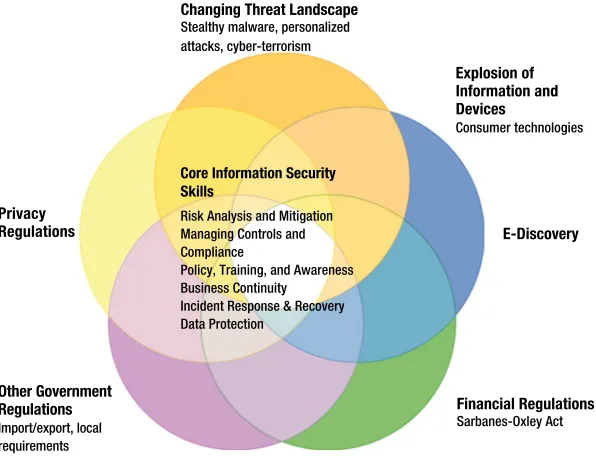
In combination, these factors create a set of interdependent risks related to IT, as shown in Figure 1-1.
Privacy Regulations
Changing Threat Landscape
Stealthy malware, personalized attacks, cyber-terrorism
Other Government Regulations
Import/export, local requirements
Financial Regulations
Sarbanes-Oxley Act
E-Discovery
Core Information Security Skills
Risk Analysis and Mitigation Managing Controls and Compliance
Policy, Training, and Awareness Business Continuity Incident Response & Recovery Data Protection
Explosion of Information and Devices
Consumer technologies
Traditional security thinkers would respond to this by saying “no” to any technology that introduces new risks. Or perhaps they would allow a new technology but try to heavily restrict it to a narrow segment of the employee population. Marketers should not engage consumers with social media on the company’s web site, because this means accumulating personal information that increases the risk of noncompliance with privacy regulations. Employees cannot use personal devices because they are less secure than managed business PCs.
The reality is that because IT is now integrated into everything that an organization does, security groups cannot simply focus on locking down information assets to minimize risk. Restricting the use of information can constrain or even disable the organization, hindering its ability to act and slowing its response to changing market conditions. A narrow focus on minimizing risk therefore introduces a larger danger: it can threaten a business’s ability to compete in an increasingly fast-moving environment.
Protect to Enable
To understand how the role of information security needs to change, we need to reexamine our purpose. We need to Start with Why, as author Simon Sinek argues convincingly in his book of the same name (Portfolio, 2009). Why does the information security group exist?
As I considered this question and discussed it with other members of Intel’s internal information security team, I realized that we needed to redefine our mission. Like the IT organization as a whole, we exist to enable the business—to help deliver IT capabilities that provide competitive differentiation. Rather than focusing primarily on locking down assets, the mission of the information security group must shift to enabling the business while applying a reasonable level of protection. To put it another way, we provide the protection that enables information to flow through the organization.
The core competencies of information security groups—such as risk analysis, business continuity, incident response, and security controls—remain equally relevant as the scope of information-related risk expands to new areas like privacy and financial regulations. But rather than saying “no” to new initiatives, we need to figure out how to say “yes” and think creatively about how to manage the risk.
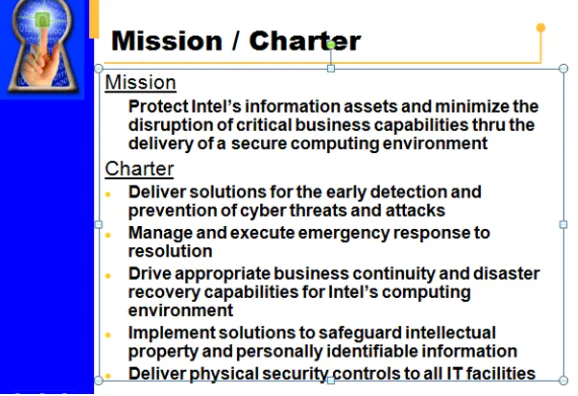
Within Intel, the role of our security group has evolved toward this goal over the past several years, as we have helped define solutions to a variety of technology challenges.
Figure 1-2a. How the mission of Intel’s Information Security Group has changed: the mission and priorities in 2003. Source: Intel Corporation, 2012
A more recent example: for years, Intel—like many other organizations—didn’t allow employees to use personal smartphones for business, due to privacy concerns and risks such as the potential for data theft. However, we experienced growing demand from employees who owned personal smartphones, and we realized that letting them use these consumer devices to access e-mail and other corporate systems would help boost employee satisfaction and productivity.
By working closely with Intel’s legal and human resources (HR) groups, we defined security controls and usage policies that enabled us to begin allowing access to corporate e-mail and calendars from employee-owned smartphones in early 2010. The initiative has been highly successful, with a massive uptake by employees, overwhelmingly positive feedback, and proven productivity benefits (Evered and Rub 2010, Miller and Varga 2011).
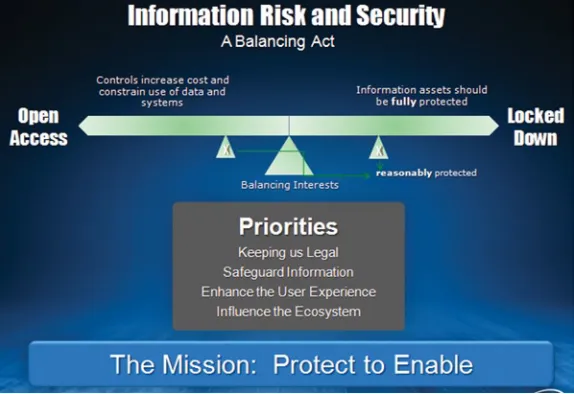
Figure 1-2b. How the mission of Intel’s Information Security Group has changed: the mission and priorities in 2012. Source: Intel Corporation, 2012
By late 2011, we had changed our mission to Protect to Enable. Our primary goal is now to find ways to enable the business while providing the protection that’s necessary to reduce the risk to an acceptable level.
I think of information security as a balancing act. We try to find the right balance between providing open access to technology and information—to enable the business— and locking down assets. Providing open access allows greater business agility. The business can move more quickly with fewer restrictions. Employees can work more freely, and the faster flow of information allows the company to grow and transform.
Within this mission, our priorities reflect the shift in emphasis and our broader view of information risk, as well as the way that the security landscape has changed since 2003.
• Keeping the company legal. Compliance, which didn’t merit a mention in our 2003 priority list, surged to the top of the list in 2011. This is driven by the growing regulatory environment and the resulting impact on IT.
• Safeguarding information. Protecting information assets—our overall mission in 2003—has not disappeared from our list of priorities. However, it has become only one of several items on the list.
10 minutes can mean losing a sale. When faced with a choice of following policy or losing a customer’s business, which do you think a salesperson would choose?
• Influencing the ecosystem. In most industries, companies are collaborating more—they are partnering, specializing, and outsourcing. The growing need to exchange information means that compromise to one company can more easily spread to business partners. However, there are also opportunities for businesses to collaborate on security initiatives and standards that help the industry overall; think of the benefits to healthcare companies of being able to securely exchange patient information. Each company benefits by influencing the ecosystem to become more secure.
Though this list represents our current priorities at Intel, I hope that it may be useful for information security groups at other organizations to think about how these priorities relate to their own businesses.
The balancing point between providing open access and locking down assets depends on the organization’s appetite for risk. At Intel, informed risk-taking is part of a culture that is designed to help foster innovation. Other businesses may have a different level of risk tolerance.
To analyze the context that has led to our security mission and top priorities, I’ll explore some of the key changes in the landscape that affect how we view and manage risk: the rapidly expanding regulatory environment, the emergence of new devices and technologies, and the changing threat landscape.
Keeping the Company Legal: The Regulatory Flood
Until the early 2000s, I didn’t see regulatory compliance as a top priority for information security. That’s simply because there weren’t many regulations that impacted IT, at least in the United States. There were a few exceptions that affected a subset of companies, including Intel, such as controls on certain high-tech exports. And in European countries, there were already regulations that sought to protect personal information. But in general, IT groups didn’t have to dedicate much of their time—or budget—to regulatory compliance.
The change in the last decade has been extraordinary. We have seen a flood of new regulations implemented at local, national, and international levels. They affect the storage and protection of information across the entire business, from the use of personal information for HR and marketing purposes, to financial data, to the discovery of almost any type of document or electronic communication in response to lawsuits. And with growing concerns about cyberwarfare, cyberterrorism, and hacktivism, several countries are evaluating additional cybersecurity legislation in an attempt to protect critical infrastructure and make industries more accountable for strengthening security controls.
people, procedures, devices, and applications. The business risk includes a significant IT-related component, but we must take a holistic view of risk management.
Noncompliance can damage a company’s brand image, profitability, and stock price— not just through resulting legal problems, but through bad publicity.
Let’s take a brief look at some of the key areas and regulations that are having the biggest impact.
Privacy: Protecting Personal Information
For many US companies, the wake-up call was the California data security breach notification law (State Bill 1386), which became effective in 2003. A key aspect of this law requires companies that store personal information to notify the owner of the information in the event of a known or suspected security breach. Businesses could reduce their exposure, as well as the risk to individuals, by encrypting personal data.
After this, other states quickly followed suit, implementing regulations that generally follow the basic tenets of California’s original law: companies must promptly disclose a data breach to customers, usually in writing.
In addition, federal laws, such as the Health Insurance Portability and Accountability Act (HIPAA), have addressed specific categories of personal information. Further regulations have been added in other countries, too, such as the updated data-protection privacy laws implemented in Europe (European Commission 2011, 2012).
The implications of these local and national regulations extend beyond geographical boundaries. As companies do more business online, they’re increasingly likely to acquire and store information about customers from other countries—and find they also need to comply with regulations around the world. For example, citizens of European countries may register on the web site of a US business so that they can receive information and product updates.
The issue becomes even more complex when businesses outsource application development or HR functions to providers located in yet another country. Now, software developers in India may be building and operating the systems that collect information about Europeans for US companies, making it even more difficult for businesses to navigate compliance with all relevant privacy regulations.
Personalization versus Privacy
Privacy concerns are set to become even more important over time, as businesses increasingly seek to create online experiences tailored to the needs of individual users. The more a business knows about each individual, the more it can personalize services and offer targeted advertising based on income and preferences.
However, there’s an inevitable conflict between personalization and privacy. The personalization trend is fueling the growth of an industry focused on collecting, analyzing, and reselling information about individuals. This industry existed long before the Web; personal information has been used in mass-mailing campaigns for decades. However, the Web is both increasing demand for this information while providing new ways to collect it. Companies now have opportunities to collect information from multiple online sources, correlate and analyze this information, and then sell it to others. And of course, consumers’ fears that information will be lost or misused have increased accordingly.
For businesses, however, offering personalized services also can increase compliance concerns. As companies store more personal information, they are responsible
for safeguarding that information and are liable for any loss or compromise. In many parts of the world, companies are also required to explain why they are collecting personal data, how they are protecting it, and how long they will keep it.
We can expect continuing tension due to conflicting desires for personalization and privacy—and more regulation as a result. Governments clearly believe that businesses cannot be relied upon to regulate themselves, so they will continue to add regulations designed to protect the privacy of individuals. Meanwhile, businesses will seek new ways to collect more information so that they can further personalize services. Developing compliance strategies and guidelines becomes even more pressing.
Financial Regulations
Financial regulation surfaced as a top priority in the United States with the Sarbanes-Oxley Act (SOX), which emerged from the public outrage over corporate and financial accounting scandals at companies such as Enron and WorldCom. These scandals cost investors billions of dollars and damaged public confidence. To help avoid similar catastrophes in future, SOX imposed financial tracking requirements designed to ensure that a company’s financial reporting is accurate and that there hasn’t been fraud or manipulation. Once enacted, SOX required publicly held companies to meet specific financial reporting requirements by the end of 2004.
e-Discovery
Regulations governing the discovery of information for litigation purposes officially extended their reach into the electronic realm in 2006. That’s when the US Supreme Court’s amendments to the Federal Rules of Civil Procedure explicitly created the requirement for e-discovery—the requirement to archive and retrieve electronic records such as e-mail and instant messages.
This created an immediate need not just to archive information, but to automate its retrieval. This is because records must be produced in a timely way—and manual retrieval would take too long and be prohibitively expensive. The business risks of noncompliance are considerable: unlike many countries, US practice allows for potentially massive information disclosure obligations in litigation. Companies that fail to meet e-discovery requirements may experience repercussions that include legal sanctions. The implications are correspondingly onerous. Lawsuits may draw on information that is several years old, so businesses must have the capability to quickly search and access archived information as well as current data. E-discovery is further complicated by the growth of cloud computing models such as software as a service (SaaS). As organizations outsource more business processes and data to cloud service suppliers, they need to ensure that their suppliers comply with their e-discovery needs.
Expanding Scope of Regulation
The regulatory universe continues to expand, with the likelihood of more regulations that explicitly address IT, as new technologies emerge and governments try to control its use and inevitable misuse.
Some technology-specific regulations have been triggered by specific events. In India, for example, after terrorists used unsecured Wi-Fi access points to communicate information about their attacks, the government created a legal requirement that any access point must be secured (Government of India Department of Telecommunications 2009).
In other countries, businesses that operate unsecured Wi-Fi access points—a common way to provide Internet access for visitors—may find themselves facing other legal problems. For example, unscrupulous individuals may tap into the network to access web sites for purposes such as illegally downloading music or pornography. Access appears to originate from the company hosting the access point, which may then find itself on the receiving end of correspondence or raids from the music industry or government agencies.
The Rapid Proliferation of Information and Devices
This is a dramatic acceleration and expansion of a long-running trend that began when businesses first started equipping employees with desktop and then laptop PCs. Now, employees are using millions of smartphones and other devices, such as tablets, to access and store information.
At the same time, the boundaries between work and personal technology are dissolving. Whether businesses officially allow it or not, employees are increasingly using their personal devices for work—sending e-mails from and storing information on their personal smartphones and computers. Furthermore, people may forward e-mail from business accounts to personal accounts created on external systems—without considering that when they signed up for the personal account, they agreed to a license that allows the external provider to scrutinize their e-mails.
The use of personal technology can considerably enhance business productivity because employees can now communicate from anywhere at any time. However, this also creates a more complex, fragmented environment with more potential points of attack. Information is now exposed on millions of new devices and disparate external networks, many of which do not have the same type of security controls as corporate PCs—and all of which are outside corporate network firewalls.
Statistics show that malware producers are already responding to the growing popularity of these new devices; security firm McAfee (owned by Intel) (2011) reported significant growth in malware targeting mobile devices during the second quarter of 2011—with a 76 percent increase in malware aimed at devices running Google’s Android software.
We can expect an ever-growing variety of networked devices. In fact, in the not too distant future, almost any device with a power supply might have a network address and be capable of communicating—and being attacked—over the Internet.
Already, cars contain dozens of control computers that communicate over internal networks. Some have IP addresses, and with a mobile phone app, owners can remotely control a variety of functions, including starting the car. Researchers have shown that it’s possible to insert malicious code into a car’s computers to control the brakes and accelerator. They have also shown that navigation systems in cars can be spoofed to send the driver to the wrong destination. Consider the possibilities if a family member is driving the car, or a company executive.
The boundaries between work and personal lives are dissolving in other ways, too. Employees store more information on the Internet—on business and consumer social media sites, for example—than ever before. These sites have become powerful tools for communicating with audiences outside the corporate firewall.
The Changing Threat Landscape
The threat landscape is evolving rapidly, with an increase in highly organized and well-funded groups capable of executing sustained attacks to achieve long-term goals. Such a group is thought to have created Stuxnet, a sophisticated worm that targeted specific industrial systems and is suspected to have set back the Iranian nuclear program by as much as two years. These attackers, generally known as advanced persistent threats (APTs), were originally focused mainly on governments. However, more recent data indicates that APTs are now targeting private-sector organizations, with the goal of grabbing proprietary data and intellectual property.
A related trend is the steady rise of organized cybercrime online. This is entirely logical. As the exchange of money and information has moved online, organized crime has followed, focusing on theft of valuable assets such as intellectual property. This has spawned a mature malware industry that increasingly resembles the legitimate software industry, complete with a broad set of services, guarantees, and price competition among suppliers.
Stealthy Malware
This evolving set of threat agents is using new, more sophisticated tools and methods to mount attacks. Once upon a time, attackers were amateurish—often driven by personal motives such as the prestige of bringing down a big company’s network. Accordingly, the arrival of malware on a user’s machine was easy to detect: the malware announced itself with icons or messages, and the system often became unusable.
Now the trend is toward malware that is stealthy and uses sophisticated techniques to avoid detection. Attackers plant malware that lies undetected over a long period while it captures information. Another common technique is to quietly spread malware by injecting malicious code into an unsuspecting company’s web site; users who visit the site then unknowingly download the code onto their systems.
Accompanying this is a shift from spam mass e-mails to carefully crafted attacks aimed at individuals or specific groups: so-called spearphishing. These typically use social engineering techniques, such as providing enough contextual or personal information in an e-mail to tempt people to download malware or click on a link to an infected web site created specifically for that purpose.
Compromise Is Inevitable
The result of this intersection of trends—increasingly sophisticated attackers and methods combined with the enormous proliferation of devices and information—is that traditional prevention methods such as firewalls are no longer adequate. In fact, enterprises need to assume that compromise is inevitable; no defenses can be entirely effective.
I’ve summarized the reasons why in the following Six Irrefutable Laws of Information Security (with acknowledgements to Culp [2000], Venables [2008], Lindstrom [2008], and other sources):
Law #1:
• Information wants to be free. People want to talk, post, and share information—and they increase risk by doing so. Some examples:
A senior executive at a major technology company updated his profile on a business social networking site. In doing so, he inadvertently pre-announced a shift in his employer’s strategy—a mistake that was promptly and gleefully picked up by the press.
An employee found a novel way to fix a piece of equipment more quickly, and—to help others across the company—decided to videotape the procedure. Because video files are so large, it didn’t make sense to e-mail the video, so the employee posted it online. Unfortunately, by doing so, he exposed confidential information.
At one time or another, many people have experienced this disconcerting event: when composing a message, the e-mail software helpfully autofills the address field, but it selects the wrong name from the address book. You hit send without realizing the error, thus dispatching a company-confidential message to someone outside the organization.
It’s worth noting that that this rule is not new. Information has always wanted to be free: think of the World War II slogan “loose lips sink ships.” People communicate, and sometimes they share more information than they should. It’s just the methods that have changed—and the fact that, with the Internet, a carelessly mentioned detail is instantly available to anyone across the globe.
Law #2:
• Code wants to be wrong. We will never have 100-percent error-free software. In fact, the more widely used the software, the more malicious individuals will hunt for vulnerabilities in the code. They have found and exploited errors in the world’s most widely used web sites, productivity applications, and enterprise business software.
Law #3:
Law #4:
• Users want to click. People naturally tend to click when they see links, buttons, or prompts. Malware creators know this, and they take advantage of it. In fact, the entire phishing industry is based on the assumption that users will click on enticing e-mails, web sites, or pop-up ads, triggering the download of malicious code to their systems. The evolution of highly targeted attacks such as spearphishing has taken this to a new level, as when e-mails purporting to be letters discussing legal action from a circuit court were sent to senior executives at a number of companies.
Law #5:
• Fake antivirus software—designed to actually spread viruses and malware—is becoming a growing menace online. Posting such fake software on the Web is proving to be an effective way for bad guys to get users to install malware on work and home PCs. According to Google researchers, fake antivirus software accounted for 15 percent of malicious content detected on web sites in a recent 13-month period (Rajab 2010).
Even a security feature can be used for harm. Security tools can be exploited by attackers, just like other software. This means that laws 2, 3, and 4 are true for security capabilities, too.
According to the San Francisco Chronicle (Van Derbeken 2008), the network engineer who built San Francisco’s new multimillion-dollar computer network locked the city out of its own network—refusing to divulge the passwords—when he heard about impending layoffs.
More recently, the systems of a well-known provider of security certificates were compromised. Beyond announcing that the compromise had occurred, the provider didn’t share much information about the event, leaving the businesses who had purchased the certificates in an odd position of not knowing whether their systems were secure or not. This is like hearing that your local locksmith has been burgled—without details about exactly was taken—and trying to decide whether you should immediately invest in new locks or wait to see whether you experience an attempted burglary yourself.
Law #6:
• The efficacy of a control deteriorates with time. Once put in place, security controls tend to remain static—while the environment in which they operate is dynamic. As a result, a control’s ability to produce the intended effect diminishes over time, and the effectiveness of the controls progressively degrades.
There are also external reasons for this trend. Recently, researchers at the University of Pennsylvania analyzed the rate at which vulnerabilities were discovered following 700 major software releases (Clark et al. 2010). They found that, in most cases, there was a honeymoon period, averaging about 110 days, during which time relatively few vulnerabilities appeared. After this period, the discovery rate increased exponentially. Their conclusion: the honeymoon essentially represented the hackers’ learning curve!
A New Approach to Managing Risk
Given the ever-broadening role of technology and the resulting information-related business risk, we need a new approach to information security built on the concept of protecting to enable. Because compromise is inevitable, managing risk and surviving compromise are key elements of this strategy. This approach should:
• Incorporate privacy and regulatory complianceby design, to encompass the full scope of business risk. Also, because technology is now key to every business process, the information security organization must work closely with other business groups to understand and manage risk.
• Recognize that people and information—not the enterprise network boundary—are the security perimeter. Information is no longer restricted to tightly managed systems within data centers; it now also resides outside the firewall, on users’ personal devices, and on the Internet. Managing risk therefore requires a range of new tools, including user awareness and effective security controls for personal devices.
Be dynamic and flexible enough to quickly adapt to new
•
technologies and threats. To provide maximum benefit to users, we need to be able to quickly accommodate new devices as they emerge. Our security approach must also be flexible to respond to the changing threat landscape: a static model will inevitably be overtaken by the dynamic nature of threats.
Chapter 2
The Misperception of Risk
The moment we want to believe something, we suddenly see all the
arguments for it, and become blind to the arguments against it.
—George Bernard Shaw
One hundred years ago, the “unsinkable” Titanic foundered after striking an iceberg off the coast of Newfoundland. More than 1,500 people died in what became one of the deadliest maritime accidents ever. Several factors contributed to this massive death toll, but perhaps the most critical was that there simply weren’t enough lifeboats. The ship carried 2,224 people, but fewer than half of them could squeeze into the boats.
As we know, passengers who didn’t get a spot in one of those lifeboats quickly died in the freezing waters of the North Atlantic. What’s less well known is that the Titanic’s supply of lifeboats was in full compliance with the British marine regulations in force at time. The law required the ship to carry 16 lifeboats; the Titanic actually had 20 lifeboats.
The ship’s owners did a good job of providing enough boats to address the regulatory risk of noncompliance. Unfortunately, meeting regulatory requirements did little to prevent the tragic loss of life.
This is a case of misperception of risk. The owners focused on mitigating the
regulatory risk, apparently blind to the much larger risk of disaster. A sad footnote: reports suggest the Titanic had enough capacity to easily add enough lifeboats for everyone on board, had the owners chosen to do so.
What does this example have to do with information security? We encounter misperceptions every day within the realm of enterprise risk and security. Furthermore, unless we mitigate these misperceptions, they can have disastrous consequences. As a result, I believe the misperception of risk is the most significant vulnerability facing enterprises today.
The Subjectivity of Risk Perception
As security professionals, we tend to think about objective ways to estimate risk—to assess the likelihood and extent of harm that can occur due to specific threats and vulnerabilities.
and potential impact of harm from specific actions or situations. Within an organization, each individual’s perception of risk varies depending on his or her job role, goals, background, and peer group. This means managers, security professionals, and end users all may have a different view of the risk associated with a specific technology or action.
Misperceiving risk has serious consequences because our actions are shaped by our perception of risk. An employee may think posting personal and work-related information on a social-media site is relatively harmless. However, hackers might use this publicly available information in phishing e-mails to gain access to enterprise systems via the employee’s computer, ultimately resulting in detrimental security breaches.
End users are not the only members of the organization who can misperceive risk. Everyone is capable of misperceiving risk, including risk and security professionals. As I’ll explain later in this chapter, misperceptions occur at the group level as well as the individual level. Members of a group may share the same bias in their perception of risk and benefit.
The decisions that result from these misperceptions can weaken the entire organization’s security posture. If an organization underestimates a risk, it will under spend on controls to mitigate that risk, increasing the likelihood and potential impact of major problems such as data breaches. On the other hand, if the organization overestimates a risk, it will allocate a disproportionately large share of its security resources to the risk, leaving other parts of the risk landscape underprotected.
In this chapter, I’ll discuss how and why different people within an organization misperceive risk—whether they are acting as information technology users, security professionals, or managerial decision makers. To explore these misperceptions, I’ve drawn on research across the broader field of risk psychology, notably The Psychology of Risk, a book by Professor Dame Glynis Breakwell, Vice Chancellor of the University of Bath (Cambridge University Press, 2007). I’ll examine how these ideas about risk perception apply to information risk and security. I’ll explain some of the consequences of those misperceptions, and I’ll discuss some of the ways an organization can address them.
How Employees Misperceive Risk
Research shows that if we like an activity, we tend to judge its benefits to be high and its risk to be low (Slovic 2010). Conversely, if we dislike the activity, we judge it as low-benefit and high-risk. Because of this, the perception of risk by individuals and groups within an organization tends to be biased by their preferences, roles, and objectives. Everyone is trying to achieve their individual or group goals within the organization, so they tend to see activities and technologies that support those goals as beneficial, and therefore they tend to underestimate the risk.
So if employees like social media, their attraction to the technology skews their perception of benefit and risk. Because they judge the benefit to be high and the risk to be low, they feel comfortable posting information such as their job title, location, and even the projects they’re working on. They may even allow sites to capture their location, using the global positioning system in their cell phone, and display the location in real time.
available personal information to craft spearphishing e-mails that are particularly convincing because they appear to demonstrate a relationship with the recipient, making the employee more likely to click on a link that downloads malware to the system. From there, the attack spreads to the rest of the corporate network. In addition, information posted by individuals is now routinely aggregated, analyzed to identify patterns, and sold, often to a company’s competitors.
The risk and security team may also misperceive the risk of social media, but in the opposite direction—they overestimate the risk and underestimate the benefits. They may not like social media because it creates vulnerabilities, and their perception then drives them to focus on minimizing the risk by trying to block the use of the technology.
Other psychological factors also come into play in shaping end users’ risk perception. People in general tend to believe they are personally less likely than others to experience negative events, and more likely to experience positive events, leading to a sense of personal invulnerability (Breakwell 2007). In addition, users also are more likely to behave in risky ways if their colleagues do so. “It’s conformity—being seen to be doing what everybody else is doing,” Breakwell says (pers. comm.). Many social media sites encourage this conformist tendency—if all your friends are using a social media site, you’re likely to join the site too because it enables you to see what they are doing and share information with them more easily.
The likelihood that individuals will behave in ways risky to the organization also increases when their individual interests don’t align with the company’s. This divergence is most likely when employees are discontented, resentful, demoralized, or simply don’t trust IT or the broader organization.
In economic theory, the problem resulting from this lack of alignment is known as a
moral hazard: a situation in which someone behaves differently from the way they would if they were fully exposed to the risk. A useful moral hazard analogy is renting a car with full insurance coverage. People are likely to be less careful with the rental car than they would be with their own car if they’re not responsible for the consequences. The attitude is “if it’s not mine, it doesn’t matter.”
In the realm of enterprise IT, moral hazards may be a bigger concern than many appreciate. A Cisco survey (2011a) found that 61 percent of employees felt they were not responsible for protecting information and devices, believing instead that their IT groups or IT service providers were accountable. Ominously, 70 percent of these surveyed employees said they frequently ignored IT policies.
One indicator of the extent of moral hazard within an organization may be how employees treat company-provided laptops. Higher-than-average loss or damage rates might suggest employees don’t care about the laptops and may be an indication they don’t care about other corporate assets either. As I’ll discuss in Chapter 5, I believe allowing reasonable personal use of laptops can help reduce the risk of moral hazard because it aligns personal interests with those of the organization.
One further point to remember is that everyone in the organization, regardless of the job role, is an end user. Therefore, we can all fall prey to the same tendencies. For example, we may be attracted to new consumer technologies and tend to ignore the risks.
How Security Professionals Misperceive Risk
While end users tend to underestimate the risks of a desirable activity or technology, security professionals sometimes display the opposite tendency. We focus obsessively on the information risk associated with a specific threat or vulnerability. In doing so, we completely miss bigger risks.
This phenomenon is known as target fixation—a term originally coined to describe a situation in which fighter-bomber pilots focus so intently on a target during a strafing or bombing run that they fail to notice the bigger risk to themselves and crash into the target as a result (Colgan 2010, 44). As information security professionals, we can develop a similar fixation. We focus so intently on one risk that our awareness of larger hazards is diminished. This target fixation can also occur in other groups with “control” functions within the organization, such as internal audit, legal compliance, and corporate risk management.
Here is an example from our own experience at Intel, which I’ll discuss further in Chapter 9. Several years ago, we discovered that malware had been introduced onto our network from an employee’s personal computer. We became so focused on this source of danger that we eliminated all personal devices from our network. We further fueled our target fixation by labeling these devices non-Intel managed systems (NIMS), a term that reflected the frustration over our lack of control. I vowed we would never again allow network access from devices that we didn’t fully control.
However, by becoming fixated on a single threat, we may have created some larger risks and additional costs. For example, we needed to issue contract employees with corporate PCs, each of which allowed broader access to the Intel environment. If we had instead focused on how we could provide limited access to the environment from “untrusted” devices, we might have managed the risk with lower total cost and obtained a head start in developing a key aspect of our current security strategy, as I’ll describe in Chapter 8.
As security professionals, we also may misperceive risk due to the tendency to “set and forget” security controls. This common security loophole is described in the sixth Irrefutable Law of Information Security in Chapter 1, which states that the efficacy of a control deteriorates with time. Once in place, controls tend to remain static, while the threats they are intended to mitigate continue to evolve and change, sometimes in very dynamic ways. Controls that are initially very effective can become inadequate over time. Ultimately, an adverse event may occur and may even have disastrous consequences.
Within enterprise IT, a typical “set and forget” error is the failure to keep controls up-to-date, particularly if the controls are designed to mitigate a relatively low risk. A case in point: distributed denial of service (DDoS) threats were a big concern more than a decade ago, due to widely publicized attacks by worms such as Code Red, Nimda, and SQL Slammer. These attacks disabled corporate web sites or flooded internal networks by overloading them with requests. To mitigate the availability risk, many organizations invested in defenses against DDoS attacks.
Over time, however, DDoS attacks became less frequent, and organizations were assailed by newer threats. With limited resources, information security groups focused on mitigating these new threats rather than continuing to build defenses against DDoS attacks. At the same time, though, businesses were increasing their online presence. Web sites evolved from being used primarily for advertising and displaying static corporate information to managing business-critical data and applications. Some organizations began conducting all their business online. Even traditional brick-and-mortar businesses moved customer support, order management, and other critical business processes onto the Web. The larger online presence multiplied the potential impact of a successful attack. As a result, when DDoS attacks from a variety of groups resurfaced in the past few years, they created even greater disruption to business operations as well as damage to corporate brands.
Another example: over the past few years, many organizations have become much more diligent about scrubbing data from the hard drives of old computers before disposing of them or reselling them. But they failed to follow similar precautions for other business devices that have evolved to include hard drives.
Nearly every digital copier contains a drive storing an image of each document copied, scanned, or e-mailed by the machine. When CBS News reporters visited a company that specialized in reselling used copiers, they found businesses and agencies had discarded machines containing lists of wanted sex offenders, drug raid targets, pay stubs with Social Security numbers, and check images. One copier’s hard drive even contained 300 pages of individual medical records, including a cancer diagnosis, which is a potential breach of federal privacy law (Keteyian 2010).
MISMatChING CONtrOLS tO threatS
Businesses sometimes devote considerable time and resources to implement
security controls that are completely irrelevant to the threats the companies are
trying to mitigate. these mismatches reveal a lack of understanding of the security
technology and the threat. the controls may further add to the risk by providing
a false sense of security. in reality, deploying the wrong control is like carrying a
lightning rod to protect oneself from getting wet in a storm.
typical mismatches include:
Using firewalls to prevent data theft from applications that
•
are allowed to operate through the firewall
Using standard antivirus tools that are effective only against
•
Using controls at the operating-system level to detect
•
application-layer attacks
this mismatch does not mean that these controls are worthless. it simply means
that if our goal is to deal with a specific threat, we must understand both the attacks
and the controls well enough to identify which controls are applicable, and where it
is necessary to add other controls. for example, if a firewall cannot prevent attacks
against an application, we might deploy an additional control behind the firewall.
How Decision Makers Misperceive Risk
A manager makes decisions based on information from technical specialists and other experts. Therefore, the decisions managers make are only as good as the information they receive. Decision makers can misperceive risk when their decisions are based on biased or incomplete information.
Bias can influence these decisions every day. If people are trying to sell a particular proposal or point of view to their manager, what are they likely to do? They tend to select data supporting their arguments and often ignore data contradicting those arguments.
The danger of misperception is particularly acute when decision makers rely on a narrow range of sources who all share similar viewpoints. Without obtaining a diversity of viewpoints, managers don’t get a full picture of the risk. Like-minded individuals tend to agree with each other, as you might expect. When a group is composed solely of people with similar backgrounds and viewpoints, it may be particularly prone to group polarization (Breakwell 2007, 99) and the group’s decision may be more extreme than the mean of their individual views. This problem may be especially acute when the people involved share the same mental model of the world, as is likely to be the case when the group consists only of specialists from the same organization.
An even broader concern is how a focus on business goals can drive people to make unethical decisions. When these decisions are made by managers at the organizational level rather than at the individual level, the impact is compounded by the potential for widespread disaster.
After the Challenger space shuttle exploded in 1986, extensive post-crash analysis revealed the tragedy was caused because an O-ring on one of the shuttle’s booster rockets failed to seal due to the low ambient temperature at launch time.
For Morton Thiokol’s managers, the desire to meet the business goal of pleasing the company’s customer, NASA, apparently caused the ethical dimensions of the problem to fade from consideration—with terrible consequences.
According to Tenbrunsel, this “ethical fading” is not uncommon. The way a decision is framed can limit our perspective. If the decision is framed purely in terms of meeting business goals, ethical considerations may fade from view. In fact, we may become blind to the fact that we are confronting an ethical problem at all (Joffe-Walt and Spiegel 2012).
Another infamous ethical lapse involved the Ford Pinto, whose gas tank exploded in a number of rear-end collisions, resulting in fatalities. As Bazerman and Tenbrunsel describe (2011, 69–71), Ford discovered the dangers in preproduction testing. However, facing intense business competition, the company decided to go ahead with manufacturing anyway. The decision was based on a cost-benefit analysis. Ford apparently considered the choice as a business decision rather than an ethical decision and determined it would be cheaper to pay off lawsuits than make the repair. The impact of dehumanizing this risk decision was disastrous.
In the past, many information technology risk decisions have often been considered only in terms of their potential business impact. As information technology is integrated into more and more products, decisions about information risk will increasingly affect the lives of millions of people, making it essential to consider the ethical as well as the business dimensions of information risks. It becomes even more important that we, as CISOs, keep ethical considerations to the forefront. What is the potential impact of a security breach when a car’s sensors and control systems can be accessed via the Internet? Or when medical life-support equipment can be remotely controlled using wireless links?
How to Mitigate the Misperception of Risk
It should be apparent by now that the tendency to misperceive risk is universal. We need to find ways to help compensate for this misperception, given that it is our job to manage risk. As security professionals and managers, how can we mitigate the misperception of risk?
We can start by ensuring we include a diversity of viewpoints when making risk management decisions. Whenever possible, we should involve a broad cross-section of individuals representing groups across the organization. This diversity helps compensate for individual biases.
However, assembling the right mix of people is only the first step in building a more complete picture of risk. As information security professionals, we need to ensure that the discussion brings up new perspectives and views. We must ask penetrating questions designed to bring alternative viewpoints to the surface. We need to continually seek out the minority report, the view that is contrary to perceived wisdom. If the majority is telling me to turn right, are we missing something important that we’d find out by turning left?
Uncovering New Perspectives During Risk Assessments
Risk assessment models can be valuable tools for helping to evaluate risks and to prioritize security resources. But all models have limitations. If we base our decisions solely on the results generated by a model, we may miss important risks.At Intel, we typically use a risk assessment model based on a standard methodology. The model scores each risk using the formula:
Impact of Asset Loss × Probability of Threat × Vulnerability Exposure = Total Risk Points
For each risk, we assign a rating to each of the three contributing factors in the formula. To illustrate, I’ll use a scale of 1 to 5. A high-value asset, such as a microprocessor design, might warrant a rating of 5.
We then multiply the three ratings to obtain the total risk points. In this example, the maximum possible risk score is therefore 53, or 125.
A simple approach to risk management, using the output of the model, would be to divide the security budget among the highest-scoring risks.
The model is valuable because it provides a consistent method for helping compare and prioritize a broad spectrum of risks. However, allocating resources based only on the overall risk score can miss potentially disastrous “black swan” events that have very low probability but extremely high impact (Taleb 2007). Because the formula simply multiplies three ratings to obtain the overall score, black swans tend not to score as highly as lower-impact events with higher probability.
To counteract this problem, we can examine the information in the model in more detail, from different perspectives. We can create a list of the 20 most valuable assets and consider whether they need additional controls. In the same way, we can examine the top threats and vulnerability areas.
The point is that any model used to calculate risk should be used as a framework to drive a dialogue about all the variables and options, rather than as a tool that generates the answers to our problems. By discussing the issues from a variety of perspectives, we may identify important concerns we’d miss if we simply look at the overall risk scores.
Before I moved into the information security field, I worked in finance. In our finance group, we found the same principle held true when conducting ROI (return on investment) analysis. Our ROI model generated forecasts. However, it was by discussing the model’s assumptions that we determined whether or not the model’s predicted financial returns were reasonable.
Another method for prioritizing information systems risk management is to examine systems from the perspective of critical business processes and to consider the impact of a loss of confidentiality, integrity, or availability.
The potential impact to a business process of losing confidentiality, integrity, or availability may also vary depending on the stage of the business cycle. Consider a payroll system. Information confidentiality and integrity are always important; but availability is exceptionally critical on payday.
Communication Is Essential
Communication is an essential part of any strategy to mitigate the misperception of risk. To alter the way people behave, we need to change their perception of risk. To effect that change, we must communicate with them.
Changing perceptions is difficult. We may need to address long-held preconceptions about what is risky and what is not. Once people form an initial estimate of risk, they can be remarkably resistant to adjusting their perception, even when given new information (Breakwell 2007, 59).
In addition, each person may have a different perception of risk. To communicate effectively, we may need to understand an individual’s viewpoint and then tailor our communication accordingly. Consider the example of taking laptops to countries with a high risk of information theft (see sidebar). People who are extremely concerned may need a patient, thorough explanation of the risks and benefits of taking their laptop versus leaving it in the office. A less fearful individual may just need a quick reassurance and a few basic facts.
Though changing risk perceptions can be challenging, we don’t have any choice but to try. Employees will use social media whether we like it or not. When they do, they may not only put themselves at risk; they could be putting the company at risk too, if they are not careful.
Communication can reduce the issue of misperception due to asymmetry of information. This asymmetry is created when security professionals know about risks but don’t share the information with end users within their organization. When two parties differ in their knowledge of a threat or vulnerability, their perception of risk is likely to differ also. In other words, it is difficult for users to care about a hazard if they don’t even know it exists.
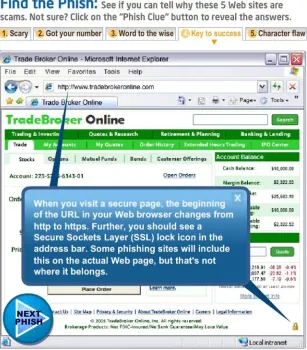
To succeed in changing users’ perceptions, we must communicate in ways that engage them, using language they understand rather than technical jargon. At Intel, we have employed entertaining, interactive video tools to help engage users and teach them how to spot dangers such as phishing web sites. As I’ll explain further in Chapter 5, we’ve found these methods have been highly effective in changing users’ awareness and perceptions, and ultimately in shaping their behavior.
unable to ship it to customers, which means a significant loss of revenue. Of course, employees may experience personal consequences too: if they copy software, they run a high risk of losing their jobs.
Organizations as a whole may also be blind to risks, or simply choose to ignore them. One way to overcome this misperception is to patiently build up a list of examples showing how other organizations ignored similar risks and experienced adverse consequences as a result, according to Breakwell, the University of Bath psychologist (pers. comm. 2012). The more examples in the list, the harder they are to ignore.
“Organizations stick their heads in the sand, ostrich-like,” she says. “But if you have a database of examples illustrating where things have gone wrong elsewhere, it becomes harder and harder to find enough sand to stick your head in.”
ChaLLeNGING preCONCeptIONS: taKING LaptOpS
tO hIGh-rISK COUNtrIeS
it may be necessary to challenge perceived wisdom in order to expose a clear
picture of the real risks, and consequently make the right decision.
some companies react to the higher rates of intellectual property theft in certain
countries by barring employees from taking their corporate laptops on business
trips to those countries. in some cases, the companies issue employees with a new
“clean” system from which all corporate data has been purged.
the goal is to prevent situations in which information theft might occur, such as
when an employee leaves a laptop containing corporate data unattended in a hotel
room. a malicious individual could then get physical access to the system and copy
the data or implant software that will surreptitiously steal information over time.
But does preventing employees from taking their familiar laptops really solve the
problem? Let’s suppose we issue employees with a new, data-free laptop. to do
their jobs, they’ll still need to use this system to log into their corporate e-mail and
other applications—providing an opportunity for hackers to intercept the network
traffic.
Building Credibility
Ultimately, our ability to influence people’s risk perception depends on our credibility. We need to build trusted relationships with executives and specialists across the
organization to ensure our security concerns are seriously considered rather than seen as fearmongering or target fixation.
Trust is hard to create and easy to destroy. If business groups think we are providing unreliable and exaggerated information, will they trust us to provide their security? If we create a security scare about a threat that turns out to be irrelevant or overblown, we may be seen as just another source of misperception.
As I’ll describe in more detail in Chapter 9, we can establish credibility by
Chapter 3
Governance and Internal
Partnerships
How to Sense, Interpret, and Act on Risk
If we are together nothing is impossible. If we are divided all will fail.
—Winston Churchill
To reduce cost, the company’s human resources group wants to outsource payroll processing. At first glance, this might seem a low-risk decision. There’s a clear business case, and outsourcing payroll doesn’t create risks to corporate information assets such as intellectual property. Most businesses regard payroll as a commodity application, so they might tend to select the supplier who can process the payroll at the lowest cost.
But there’s more to consider. Employees’ personal information will be transferred to the outsourcer, creating new privacy concerns. And imagine the impact if thousands of our employees don’t get paid because the supplier experiences system problems on payday and lacks adequate disaster recovery capabilities.
Clearly, the HR group owns the business process. However, outsourcing payroll can introduce risks for the entire business, not just for HR. Payroll processes involve systems that can create information risk. Outsourcing also involves procurement. The business needs a clear overview of all the factors, including the risks, in order to make the best decision. To provide this view, the HR, procurement, and information risk and security groups need to work together.
A typical organization makes many decisions that require this kind of internal partnership to manage the risk. A product group wants to outsource development work to bring a product to market more quickly. A marketing team wants to engage a developer for a new social media initiative.
For example, when Intel IT was considering whether to migrate to Microsoft Windows 7, the information security team partnered with other groups in a broad evaluation of the OS. We identified several features that could improve security compared with previous versions of Microsoft Windows, and these security capabilities were an important factor in the decision to deploy Microsoft Windows 7 across Intel’s enterprise environment (Fong, Kohlenberg, and Philips 2010).
The ability to make these decisions with an accurate view of risk depends on having the right organizational structure in place. In this chapter, I’ll discuss two key aspects of this structure:
• Clearly defined information risk governance. Governance defines who makes decisions, who can block them, and who is allowed to provide input.
• Strong partnerships. Partnerships between the information risk and security team and other internal groups are critical in forming an accurate view of risk and managing risk overall. Some partnerships are formally defined as part of the risk governance structure; others are informal relationships. These formal and informal partnerships are so important that I’ll dedicate a large part of the chapter to them.
Information Risk Governance
The Massachusetts Institute of Technology Center for Information Systems Research (MIT CISR) provides a useful definition of IT governance that neatly encapsulates some of the benefits: “. . . A framework for decision rights and accountability to encourage desirable behavior in the use of IT. Governance identifies who will make key IT decisions and how will they be held accountable.”
Information risk governance is the component of IT governance that enables the organization to effectively sense, interpret, and act on risk. Information risk governance focuses on enabling the business while protecting the confidentiality, integrity, and availability of information—whether it is corporate data or personal information about employees or customers. Through partnerships between the information risk and security team and other groups, the organization can make tactical and strategic risk management decisions based on business priorities and a full view of the risks. We gather risk perspectives from across the organization and obtain buy-in to risk management decisions: a diversity of input leading to unity in decision-making.
Research at MIT CISR shows that the more businesses leverage the structure, tools, and techniques of governance, the greater the potential benefits. In fact, MIT CISR’s work suggests that firms with effective IT governance enjoy profits that average at least 20 percent higher than their competitors (MIT CISR 2012).
However, leveraging governance doesn’t imply slavishly following rules and procedures. A few years ago, I encountered an IT professional who was regarded by some people, including himself, as one of the best managers in IT. He rigorously based his project decisions on the prescribed practices and procedures, and gathered the correct metrics for reporting progress. Yet the projects he was responsible for generally turned out to be large, expensive failures. His obsession with correct procedures often impeded, rather than facilitated, the projects he was working on.
To use an analogy, if you gave the same recipe to a top chef and an average cook, would you expect them to produce exactly the same result? Probably not. Expert chefs don’t simply follow the rules; they continually make adjustments using their senses and experience to achieve the best results. The temperature of a cooking surface is not exactly uniform, so a chef may move the pots until they’re simmering just right. Fresh ingredients vary from day to day; the experienced chef is alert to the differences and tweaks the recipe and seasoning accordingly.
Like recipes, IT policies provide a valuable framework. However, their value lies in what we can achieve by following the guidelines. Sometimes we need to make adjustments based on sensing changes in business needs. Otherwise, like the procedure-obsessed IT project manager, we may scrupulously adhere to the rules but fail to achieve the desired outcome.
This is one reason that partnerships are so critical. They provide channels for dialogue, helping us sense changing business priorities so that we mitigate risk based on those priorities rather than our preconceptions.
Without a governance structure that facilitates this dialogue, organizations may take too rigid an approach when applying controls to manage and mitigate risks. For example, some security groups try to ban the business use of social media due to the risks, but attempting to stop the use of external social media web sites is counterproductive and, in any case, impossible. At Intel, we have found it’s more effective to embrace social media and shape the way that employees use it, as I’ll describe in Chapter 5. This approach, developed in partnership with other internal groups, enables the organization to enjoy the benefits of social media while managing the risk.
Finding the Right Governance Structure
It GOVerNaNCe arChetYpeS
Table 3-1. IT Governance ArchetypesStyle
Who has decision or input rights
Business Monarchy A group of business or individual executives (CxOs). Includes committees of senior business executives (may include CIO)
IT Monarchy IT executives
Feudal Business unit leaders, key process owners, or their delegates
Federal C-level executives and business groups; may also include IT executives. Equivalent of central and state governments working together
IT Duopoly IT executives and one other group (for example, CxO or business unit leaders)
Anarchy Each individual user
Source: Weill and Ross 2000