Sustaining Arts Programs in Public
Education
cal, state, and national branches of government (Anne, 2010; Beveridge, 2010). Amid bureaucratic levels of accountability at schools, administrative leaders, de-partment leaders, and leadership teams make deci-sions that impact their visual and performing arts pro-grams. However, some school leaders continue to maintain viable arts programs in the face of these changes. This research study investigated the admin-istrative and funding decisions that contribute to the success of a viable arts program at Eastland High School.
Benefits of Arts Programs
The arts have the potential to promote motivation, confidence, and social skills among children and teens (Alejandro, 1994; Creedon, 2011; Tredway & Wheat, 2010). Children have the potential to embrace a life-long appreciation for the arts through school curricu-lums that support comprehensive, interdisciplinary arts programs. As children enter their teen years, their involvement in arts programs provides opportu-nities to collaborate and interact with others, develop leadership skills, and become global citizens.
Alejandro (1994), Creedon (2011), and Olshansky (2008) agreed that arts programs provide academic and social benefits for at-risk students.
Creedon (2011) observed that at-risk students in urban schools responded favorably to arts programs. He argued their participation in a multidisciplinary arts program provides students with an educational solution that counters stress they may develop from other classes, interactions with peers and teachers, their families, and urban neighborhoods. Music, dance, theater, and visual arts have the capacity to connect productively with the emotional and physical needs of children. Olshansky (2008) found at-risk stu-dents experienced significant improvement on read-ing and writread-ing tests in a controlled case study that measured the use of visual literacy to support instruc-tion and the learning process.
The current educational landscape threatens the
sur-vival of arts programs in public education throughout the United States. Current trends in education indi-cate public schools have increasingly narrowed their curriculums to enroll underachieving students in ad-ditional remedial reading and math courses with less time available to pursue visual and performing arts (Beveridge, 2010). Political and societal pressures have forced school districts to improve academic per-formance among students struggling to improve their reading and math scores on standardized tests. As a result of these shifting priorities and accountability demands, many school leaders have reduced their arts programs (Anne, 2010). Accountability to increase standardized testing results impacts all stakeholders, from teachers and administrators to leaders at the lo-David DunstanUniversity of Southern California
ABSTRACT: The purpose of this qualitative research case study was to investigate leadership and funding decisions that determine key factors responsible for sustaining arts programs in public schools. While the educational climate, financial constraints, and stand-ardized testing continue to impact arts programs in public education, Eastland High School, the site of this case study, managed to sustain its visual and perform-ing arts program. The foundation of this research study was shaped around understanding the key fac-tors that sustained the arts program at Eastland High School. A qualitative lens utilized three research questions that investigated arts programs at the school, leadership decisions that supported the arts program, and funding decisions made at the site. Da-ta triangulation was used to identify several emerging themes relevant to the three research questions. The implications of this case study indicated collaborative leadership and resourceful funding decisions sustain viable arts programs in public schools.
In a case study with elementary students, Alejandro (1994) found that her methodology using visual literacy in her English language arts curriculum effectively motivated students to improve their read-ing and writread-ing skills. Students created colorful visual narratives to demonstrate their reading comprehen-sion, and they produced artistic paintings to aid in memorization of new vocabulary. These students posted significant gains on standardized tests, and findings from her study contributed to a growing awareness among students, faculty, parents, and other stakeholders of the benefits of arts in education (Alejandro, 1994).
Arts programs are also experiencing success in al-ternative curriculum formats at charter schools. The growing charter school movement, which began in 1992, accounts for over 4,000 schools throughout the nation (Zimmer & Buddin, 2009). Given the con-straints evident in traditional public schools, parents, educators, and community leaders have embraced autonomy in a concentrated effort to develop curricu-lum and educational missions at their charter schools (Gratto, 2002). In her analysis of alternative arts pro-grams at charter schools, Gratto (2002) found arts cur-riculums produce favorable learning outcomes among both at-risk and high-achieving students.
An education grounded in the arts elevates the ca-pacity for students to collaborate with each other and foster metacognitive abilities across all subjects (Music, 2010). A comprehensive arts education em-powers students to share their learning experiences across the curriculum. Understanding the value of learning through active participation in an arts pro-gram that is integrated across the curriculum provides life-long benefits for students (Heilig, Cole, & Aguilar, 2010; Juno, 2010). Findings from recent research stud-ies support the assertion that students enrolled in in-terdisciplinary curriculum involving core subjects and the arts enjoyed notable academic outcomes (Gratto, 2002; Kratochvil, 2009; Juno, 2010). Moreover, it seems arts programs are gaining in popularity. Bar-one and Eisner (2006) cited the emergence of arts-based educational research, while several case studies found visual literacy continues to expand its appeal beyond elementary education and gain wider ac-ceptance at secondary schools (Bryce, 2012; Carpenter & Cifuentes, 2011; Frey & Fisher, 2008).
Arts and Student Achievement
Active participation in arts education programs has produced positive learning outcomes with interdisci-plinary curriculum tied to standardized testing and student academic achievement. Vygotsky recognized
that arts contribute to the learning process and con-struction of knowledge (Gullatt, 2008). An interdisci-plinary nature is evident in successful arts programs that bind together curricular themes and encourage cross-department collaboration. Recent case studies have documented success at public school arts pro-grams and their impact on academic achievement among disadvantaged students and long-term contri-butions to low-income neighborhoods through com-munity partnerships (Kratochvil, 2009; Noblit, Cor-bett, Wilson, & McKinney, 2008; Olshansky, 2008; Tredway & Wheat, 2010).
Case studies investigating at-risk, low-income, and struggling students enrolled in arts-integrated courses at public schools found their standardized test scores increased (Kratochvil, 2009; Gullatt, 2008; Rabkin & Redmond, 2003; Strickland, 2008). Skills gained in dramatic arts and music programs encouraged stu-dents to apply their knowledge and motivation to learn other core subjects (Gullat, 2008). Alternatively, patterns of discouraging enrollment in arts courses were noticeable among at-risk and low-income stu-dents who had dropped out of school. According to Strickland (2008), high school dropouts reported that they spent significantly less time enrolled in arts courses and more time in remedial instruction to learn math and reading skills.
Students living in low socio-economic neighbor-hoods have performed academically better on stand-ardized tests when actively enrolled in arts courses (Rabkin & Redmond, 2003). Rabkin and Redmond’s (2003) research found current educational leadership tends to ignore research studies that document the social and academic benefits that at-risk and low-income students gain from their participations in arts programs. At 23 schools in Chicago with
art-integrated programs, case studies found noticeable increases in reading and math standardized test scores among students identified as disadvantaged and at-risk to drop out (Rabkin & Redmond, 2003). Rabkin and Redmond also discovered low-income, at-risk students showed more motivation to participate and learn at schools when involved in interdisciplinary arts programs.
reported significant academic improvement and suc-cess among students when he fully integrated arts into a school-wide curriculum and made a long-term com-mitment to support the arts program. Their research found that a single leader who makes an arts program an active element in an interdisciplinary curriculum yields academic gains in student achievement. Addi-tionally, a single leader with exceptional social and political skills can advocate for interdisciplinary col-laboration among faculty to accept an arts curriculum (Tredway & Wheat, 2010). Trends evident in the liter-ature suggest academic achievement increased at schools where administrators supported the arts (Farbman, Wolf, & Sherlock, 2013; Freedman, 2011; Kratochvil, 2009; Olshansky, 2008).
In her case study at a middle school in California, Kratochvil (2009) found sustained long-term leader-ship and faculty collaboration contributed to the suc-cessful school-wide integration of arts across all sub-jects. The school underwent a collaborative trans-formative process to develop a school-wide action plan to support a dance program. The success of the dance program defined the culture of the school with intrinsic and extrinsic benefits for students, parents, and community members (Kratochvil, 2009). Howev-er, measuring success and achievement in performing and visual arts disciplines requires a mixture of pro-fessional arts experience and objective reflection with respect to the individual artistic achievement of each student (Davis, 2008). Although recent case studies show pockets of success throughout the educational landscape, the literature reflects the ongoing struggles to maintain and sustain arts programs in public schools.
Funding for Arts Programs
The decline in traditional public school funding sources, which arts programs relied on for financial support, has motivated the implementation of pru-dent fiscal accountability, innovative fundraising initi-atives, and community partnerships. Title I funds were originally intended to support schools with low-income students across all subjects, including the arts, and they have become the financial lifeline to support remedial intervention courses and improve standard-ized test results that meet Annual Measurement Achievement Objectives (Stillwell-Parvensky, 2011). In response to less availability of Title I funds to sup-port arts programs, recent research has focused atten-tion on arts programs with leaders that cultivate fi-nancial investment through community partnerships (Anne, 2010; Beveridge, 2010; Sabol, 2010). As tradi-tional funding sources decline, school leaders seeking
to support their arts programs have proactively devel-oped partnerships with local and national arts organi-zations as well as coalitions with social media and corporate organizations to recognize artistic talent among students (Music, 2010; Tredway & Wheat, 2010).
The growth of charter and magnet schools has trig-gered a concurrent emergence of arts academies de-signed with progressive mission statements and vi-sionary leadership teams that support arts programs in local communities (Zimmer & Buddin, 2009). Grat-to (2002) found successful arts programs at alternative public schools. One example is Orange County High School of Arts in Santa Ana, California, which is a spe-cialized high school with a comprehensive arts curric-ulum and active community partnerships. Business and community partnerships among arts organiza-tions represent a core element of charter schools, alter-native schools, and specialized schools throughout the nation (Gratto, 2002).
Castaneda and Rowe (2006) conducted an analysis of the 10-year Los Angeles Unified School District Arts Prototype program, and they found schools with high academic reputations and consistent leadership were more inclined to develop strong partnerships with arts organizations. Trends among the 200 arts organizations that partnered with Los Angeles Uni-fied schools suggested that successful partnerships involve schools with an arts-focused professional de-velopment plan and an interdisciplinary arts curricu-lum. In addition, the schools implemented an active calendar of art exhibits, musicals, and theater perfor-mances that appealed to parents and the local commu-nity (Castaneda & Rowe, 2006). These partnerships provided an ongoing culture of collaboration between the arts programs and the community.
arts programs and contribute positive outcomes to the neighborhood.
Arts education programs in public schools face a restrictive climate of accountability and financial con-straints. Alejandro (1994), Creedon (2011), and Ol-shansky (2008) found effective school leaders advocat-ed for the benefits of arts programs and their influence on student achievement. Intersecting political and societal agendas and issues will determine the future sustainability and success of arts education programs in K-12 curriculums. The history of arts education reflects an ongoing, persistent struggle to remain rele-vant in the current climate of accountability and high-stakes testing. Policy makers, educational leaders, and teachers represent a cross-section of stakeholders with the capacity to advocate for arts programs in public schools that serve disadvantaged students in low socioeconomic neighborhoods (Anne, 2010; Creedon, 2011; Kratochvil, 2009; Tredway & Wheat, 2010). Sustaining arts education programs in public schools requires investigating and justifying the bene-fits of arts programs and their impact on academic student achievement in the current era of high stakes standardized testing and accountability.
This review of literature identified the significance of school leaders who embrace arts education and support the integration of interdisciplinary arts pro-grams across core subject curriculums to enhance aca-demic achievement (Anne, 2010; Castaneda & Rowe, 2006; Gratto, 2002; Music, 2010; Tredway & Wheat, 2010). While past case studies and research acknowl-edged the benefits of arts education programs in K-12 public schools, a gap in the scholarly literature fails to sufficiently identify and explain the factors involved in sustaining arts education programs (Anne, 2010; Beveridge, 2010; Creedon, 2011). The review of litera-ture indicated a gap existed regarding how leadership and funding decisions impact arts programs in public schools (Merriam, 2009). This case study was con-ducted to investigate and understand the key factors in sustaining an arts program by utilizing three re-search questions:
What are the arts programs that exist at Eastland High School?
How does leadership at Eastland High School support arts?
How are funding decisions made at Eastland High School?
Methods Research Design
The research design used a qualitative case study approach to collect and analyze data required to un-derstand the phenomenon explored in the three re-search questions that defined the foundation of the research study (Creswell, 2009). The rationale behind the survey, interview protocol, and observation proto-col was developed from the literature. Data triangula-tion was achieved by using four data collectriangula-tion instru-ments to provide four distinct data sources to address the three research questions.
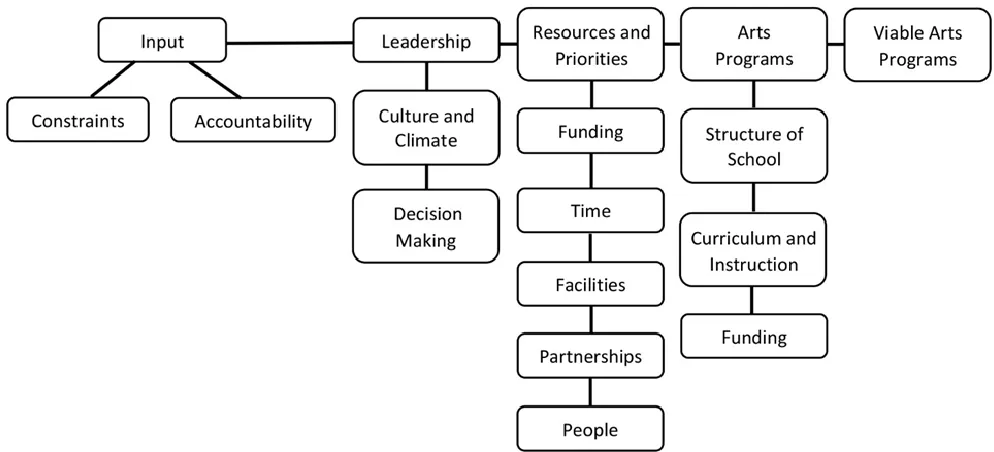
A conceptual framework, displayed in Figure 1, was developed to understand the system of concepts, assumptions, expectations, beliefs, and theories that supported and informed the research (Maxwell, 2009). A viable arts program involves two essential intercon-nected components that contribute to effective leader-ship: financial constraints and accountability. As ex-pressed in the conceptual framework, the term viable indicates that an enduring arts program has longevity, capable leadership, funding, and other foundational, influential components.
The conceptual framework reveals how faculty make decisions and how those decisions influence the culture, climate, and leadership at the school. The model shows how the two inputs determine school leadership decisions and impact resources and priori-ties. Stakeholders, partnerships, facilities, time, and funding impact the use of resources and priorities in-volved in a successful, viable arts program. The con-ceptual framework also indicates how multiple as-pects of the school infrastructure, including the curric-ulum, instructional components, and the staffing, con-tribute to a viable arts program. The conceptual framework provided a road map with a visual repsentation of a viable arts program to guide the re-search study (Maxwell, 2013).
Setting
The setting for this case study was selected based up-on several criteria:
The presence of a viable visual and performing arts program.
Graduate placement with awards, recognition, and success of graduates.
Similar Schools Ranking of 8, 9, or 10 (with a via-ble arts program).
Diverse student body.
Evidence of planning as a visual and performing arts school.
Eastland High School, the selected school site, is one of eight comprehensive high schools in a rural, urban district, located in California. The school has approximately 2,600 students, 100 teachers, and five administrators. The language of the majority of stu-dents is English-only, while 12% of the population is designated as ELLs. Over 50% of students are His-panic, 31% are African-American, 14% are White, and 2% are Asian/Filipino/Pacific Islanders. The majority of students are economically disadvantaged, and over 80% of students qualify for free or reduced price lunch.
Eastland has an active visual and performing arts program that met the school site criteria required to participate in the research study. The arts program has maintained a stable leadership team that has guid-ed it in successful operation since the school openguid-ed in 2005. The program includes an annual awards and district-wide student recognition system, a diverse student body, and consistent organizational and cross-curricular planning. The visual and performing arts program has also received numerous accolades. Rob-bie, the department chair of the visual and performing arts program, was one of the co-founders of the school in 2005. Under her leadership since 2005, Robbie has
improved the quality and reputation of the visual and performing arts program among students, parents, and alumni. In 2009, when the school moved to a newly constructed campus, the school opened a new theater with modern technology to serve the campus and local community. Since 2012-13, the Eastland High School theater has hosted musicals, dramas, dances, symphony performances and art exhibitions. Procedure
A review of documents preceded the implementa-tion of a school-wide survey and a structured se-quence of interviews and observations. The varied approach to data collection reinforced reliability and validity of the data (Creswell, 2009). Participants in the study were informed of the purpose of the study. The researcher discussed with participants the re-search questions, interview questions, data collection instruments, and timeline to conduct the data collec-tion process. Each participant was identified with a pseudonym to protect his or her privacy. Participants were assured that the research study was objective and purposeful.
occurred on campus in their natural classroom set-tings. The interviews and observations complement-ed each other as separate sources of data for triangula-tion. The researcher wrote field notes based on the context of each interview, adding observations to complement transcribed interviews with additional descriptive data (Bogdan & Biklen, 2003). The review of documents and implementation of surveys, obser-vations, and interviews transpired at one site during a limited time in fall 2013. Therefore, the responses were unique and reflect a designated time period among participants in the study.
Data Analysis
Data from an analytical review of documents, tran-scribed interviews, observation notes, and survey re-sults underwent a thematic coding process conducted by the guidelines recommended by Creswell (2009). Bolman and Deal’s (2003) four frames, or perspectives, of understanding and analyzing the workings of or-ganizations were used to analyze the data. The four frames, identified as the structural, human resource, political, and symbolic, informed the thematic inter-pretation of the data to examine the organizational aspects of the arts program at the school (Bolman & Deal, 2003). For the purpose of this case study, the structural frame applies to the organizational struc-ture of the school and departments in the school. The human resource frame concerns the interpersonal re-lationships and needs of teachers, administrators, par-ents, and students within the school organization. The political frame concerns the bureaucratic nature at Eastland High School and how each stakeholder and department navigates the political structure of the organization. The symbolic frame refers to the reputa-tion of the school and the symbols that define its cul-ture as a brand and institution within the community (Bolman & Deal, 2003).
Results and Discussion
While the review of literature acknowledged de-clines in school budgets and other constraints to main-tain arts programs, the literature also discussed re-search studies regarding viable arts programs and key factors responsible for their success in the current edu-cational climate (Anne, 2010; Beveridge, 2010; Music, 2010; Sabol, 2010; Tredway & Wheat, 2010). Funding, leadership, partnerships, promising practices, and student achievement through arts programs were ex-plored in the literature and applied to the design of data collection instruments. Each topic influenced the themes and trends found in the data analysis. Data was coded into three emergent thematic categories,
finding that leaders at the site embraced a collabora-tive leadership style, developed community partner-ships, and implemented resourceful funding deci-sions. These themes represented the three key factors responsible for sustaining the visual and performing arts program at Eastland High School.
The first theme recognized the strength of collabo-rative leadership that cultivated support for the arts programs at Eastland High School. The principal and the leaders of the visual and performing arts depart-ments showed a consistent effort to collaborate, con-tributing toward a supportive culture in the campus community. A collaborative culture contributes to-ward the longevity of arts programs in public schools (Robert, 2010). Bolman and Deal (2008) recognized the importance of leadership in the four frames of an organization.
Findings from this research study found that de-partment leaders Kate, Robbie, and Ted cultivated significant social and political capital as leaders of their departments. Each leader developed his or her individual effective, visionary leadership style. While Kratochvil (2009) found consistent leadership and fac-ulty collaboration helped arts programs succeed across the curriculum, leaders with longevity in their positions held more influence. The findings comple-mented evidence reported in the literature review, which recognized the importance of leaders capable of building social and political capital among all stake-holders to support and sustain arts programs (Anne, 2010; Castaneda & Rowe, 2006; Gratto, 2002; Music, 2010; Tredway & Wheat, 2010).
Interviews and observations captured an example of collaborative leadership at an interdisciplinary meeting on October 23, 2013. Robbie led the meeting with visible support from Kate and other administra-tors and department chairs. She sought to connect core subjects with the arts curriculum through com-mon themes and collaboration. As a successful art teacher with a highly regarded reputation among her colleagues, students, and parents, Robbie demonstrat-ed she was a capable instructional leader who influ-enced positive learning outcomes at interdisciplinary art department meetings. Robbie acknowledged the need for teachers to recognize emerging trends with the California Common Core State Standards. She encouraged faculty to proactively collaborate with each other to support the college and career themes found in the new standards.
Turning Illegally Dumped Waste into Art. The school-wide project initially involved the visual and perform-ing arts faculty, their partnership with the local muse-um, and approximately 660 visual and performing arts students who took action against illegal dumping in the local community. Students collected objects from trash dumpsites to create works of recycled art. Exceptional pieces of recycled art premiered at the annual Eastland High School visual and performing arts showcase and at the local museum. As more de-partments and faculty integrated learning objectives from Wasteland into their curriculum, the project even-tually motivated over 2,000 students and approxi-mately 60 faculty members to become involved in supportive activities. Learning outcomes from the Wasteland project inspired stakeholders at all school levels and the local museum to support the subse-quent Crosswinds interdisciplinary project, which un-derscored the importance of collaborative leadership as a central theme that emerged from the data analy-sis.
A second theme found school leaders developed community partnerships with local organizations and museums to support the arts. The Wasteland and Crosswinds projects represented two interdisciplinary art projects financed with grants through the local museum and other organizations. Without communi-ty partnerships, Eastland High School and the local community may never have experienced the benefits gained from each project. The significance of commu-nity partnerships that support public school arts pro-grams was discussed in the literature review
(Castaneda & Rowe, 2006; Music, 2010; Sabol, 2010; Tredway & Wheat, 2010). The interdisciplinary art projects, marching band performances, and plays pro-duced in the new school theater represented work achieved through a collaborative culture and strong leadership that resonated with the community. Each project and event defined symbolic activities that de-fined the school culture and further strengthened the reputation of the school in the local community. A clear example of community partnerships was evident within the performing arts program, which holds a strong reputation in the local community. The marching band and color guard were considered sym-bols of pride at Eastland High School and in the city. Their parades, dance performances, and pep rallies at football games, tournaments, and local events defined members’ reputations as high quality leaders and rep-resentatives of the performing arts program. Leaders of the arts program at Eastland High School found it mutually beneficial to forge long-term community partnerships with the local museum, civic leaders, and
the annual fair. In an interview, Saul, a performing arts leader, explained the significance of the marching band and its role as a symbol of pride in the local com-munity:
We're the pride of the school. We keep the school moving, kind of like the heartbeat of the school when we play at football games and at the pep ral-lies. We want to be a presence on campus to show the students that high school is very important. The third theme involved the resourceful funding decisions made among leaders to support the visual and performing arts program. While Eastland High School remains under program improvement and re-ceives Title I funds to close the achievement gap, lead-ers of the visual and performing arts program imple-mented resourceful strategies to raise funds through parent-led booster programs and community partner-ships. Ted, Robbie, and Saul expressed concerns re-garding the narrowing of core curriculum with fewer ninth grade students enrolled in arts courses. While previous research indicated many Title I public schools tend to exclude at-risk, low-income students from the arts in favor of enrolling them in reading and math courses (Sabol, 2010; Stillwell-Parvensky, 2011), evidence from this case study offered a counterpoint. Eastland High School has maintained high enrollment numbers for marching bands, color guards, drama courses, and visual arts courses. Given the success and growth of the visual and performing arts pro-gram, as traditional funding sources decline, imple-menting resourceful funding decisions represented a significant theme responsible to sustain the arts pro-grams at Eastland High School.
and performing arts leadership team seeks to trans-form their operations with an arts pathway into a for-mal academy with financial and creative autonomy based on the original vision of the school as the main visual and performing arts school in the district. While this case study found two interdisciplinary art projects cultivated school-wide support, a visual and performing arts academy may limit future school-wide, cross-department support among faculty unaf-filiated with the academy. Given the financial con-straints and declining budgets available to support the arts, educational leaders have learned to cultivate community partnerships and implement resourceful funding decisions. Robbie and Ted believe a visual and performing arts academy would ensure financial and creative autonomy for the arts programs.
Results from data triangulation collected from the site documents, survey, interviews, and observations found school leadership should reevaluate its organi-zational approach to support arts education at Eastland High School. Based on the results, adminis-trators and faculty should consider the creation of a unified arts education policy that clearly supports arts education at the site. An arts education plan would define the role of the visual and performing arts pro-gram at Eastland High School and determine the pros and cons of a proposed visual and performing arts academy.
From a structural perspective, the visual and per-forming arts program has hired the best and most qualified instructors. The structural frame of an or-ganization informs all stakeholders of its expectations and goals and connects with the human resource, po-litical, and symbolic frames (Bolman & Deal, 2008). While many aspects of the organizational structure were evident, including supportive administrative leadership and interdisciplinary collaboration, the evidence suggested that the visual and performing arts program should revisit its structural design and support the creation of a school-wide arts education plan. A strong organizational structure, with goals and objectives, would influence the other three frames.
Limitations
The limitations in this qualitative case study in-cluded conditions that the researcher could not con-trol. The case study was limited by its geographic location and the time constraints to collect data. While the researcher conducted the case study at a site where he also worked as a teacher, the principal and school leadership team held the power to approve or
deny his research proposal. To address the limita-tions, the researcher reflected on research bias and his direct and indirect influence on responses from partic-ipants (Maxwell, 2013).
Implications and Recommendations This case study provided a qualitative lens to un-derstand how effective leadership and funding deci-sions support a viable arts program that empowers students and faculty to share learning experiences through the arts and across an interdisciplinary curric-ulum (Creswell, 2009). Sustaining the arts in public education is increasingly relevant as schools wrestle with financial constraints and external pressure to in-crease standardized test scores in math and reading. Educators in visual and performing arts programs found students enrolled in art, music, and drama pro-grams develop an intrinsic motivation to succeed across all disciplines (Posnick-Goodwin, 2013). A viable arts program provides life-long benefits for students. This research study determined that the arts program has elevated the social and political sta-tus of Eastland High School among students, faculty, parents, and other stakeholders in the local communi-ty. Results from this case study found administrative, departmental, and faculty leadership exercised a con-sistent, collaborative leadership style responsible for the successful visual and performing arts program at Eastland High School.
Given the current challenges confronting educa-tional leaders to adopt the California Common Core State Standards, the arts have endured as a source of stability throughout the history of public education. Findings from this case study will contribute to the scholarly literature devoted toward understanding the benefits that students and school communities experi-ence as a result of effective leadership that supports and sustains arts programs. While financial con-straints, standardized testing, accountability de-mands, educational reform, and other interconnected challenges remain visible on the horizon, effective, collaborative leadership emerged as the essential fac-tor responsible to influence productive funding deci-sions that sustain viable arts programs in public schools.
pub-lic education. Data analysis and exploration of the findings encouraged five recommendations for future research:
Investigate Title I funding in public education with a research focus to understand their availa-bility to support visual and performing arts pro-grams.
Explore how public schools with viable arts pro-grams integrate the arts across the curriculum and improve math and reading skills.
Investigate the positive learning outcomes among children enrolled in student-centered arts curricu-lums at public schools that integrate arts across an interdisciplinary curriculum.
Align arts education with a school-wide and dis-trict-wide instructional plan.
Improve the visibility of the arts program in the local community to strengthen community part-nerships with local museums, organizations, and businesses that share an interest to financially support the arts.
References
Alejandro, A. (1994). Like happy dreams: Integrating visual arts, writing, and reading. Language Arts, 71(1), 12-12. Re-trieved from http://search.proquest.com/
docview/196877974?accountid=14749
Anne, C. G. (2010). No child left behind in art education policy: A review of key recommendations for arts language revi-sions. Arts Education Policy Review, 111(1), 8-15. Retrieved from http://search.proquest.com/docview/609259357? accountid=14749
Barone, T., & Eisner, E. (2006). Arts-based educational research. In J. L. Green, G. Camilli, & P. B. Elmore (Eds.), Handbook of
complementary methods in education research (pp. 95–109).
Mahwah, NJ: Erlbaum.
Beveridge, T. (2010). No Child Left Behind and fine arts classes. Arts
Education Policy Review, 111(1), 4-7. Retrieved from
http://search.proquest.com/docview/609292495? accountid=14749
Bogdan, R. C., & Biklen, S. K. (2003). Qualitative research for education:
An introduction to theory and methods (5th ed.). New Jersey:
Pearson.
Bolman, L. G., & Deal, T. E. (2008). Reframing organizations: Artistry, choice and leadership (4th ed.). San Francisco: Jossey Bass.
Bryce, N. (2012). "Mano a mano": Arts-based nonfiction literacy and content area learning. Language Arts, 89(3), 179-193. Re-trieved from http://search.proquest.com/
docview/913135312?accountid=14749
Carpenter, B. S., & Cifuentes, L. (2011). Visual culture and literacy online: Image galleries as sites of learning. Art Education, 64(4), 33-40. Retrieved from http://search.proquest.com/ docview/1022336929?accountid=14749
Castaneda, L. W., & Rowe, M. K. (2006). Partnerships in arts educa-tion: An examination of factors predicting schools' use of arts organization.Journal of Arts, Management, Law and Society. 36(1), 7-23.
Creedon, D (2011). Fight the stress of urban education with the arts.
Phi Delta Kappan, 92(6), 34-36.
Creswell, J. W. (2009). Research design: Qualitative, quantitative and
mixed methods approaches (3rd ed.). Thousand Oaks, CA:
Sage Publications, Inc.
Farbman, D., Wolf, D. P., & Sherlock, D. (2013). Advancing arts edu-cation through an expanded school day: Lessons from five
schools. Boston, MA: National Center on Time & Learning.
Freedman, K. (2011). Leadership in art education: Taking action in schools and communities. Art Education,64(2), 40-45.
Frey, N., & Fisher, D. (Eds.). (2008). Teaching visual literacy: Using comic books, graphic novels, anime, cartoons, and more to
de-velop comprehension and thinking skills. Thousand Oaks,
California: Corwin Press.
Gratto, S. (2002). Arts education in alternative school formats. Arts Education Policy Review, 103(5), 17-24.
Gullatt, D (2008). Enhancing student learning through arts integra-tion: Implications for the profession. The High School Jour-nal, 91(4), 12-25.
Heilig, J. V., Cole, H., & Aguilar, A. (2010). From Dewey to No Child Left Behind: The evolution and devolution of pub-lic arts education. Arts Education Policy Review, 111(4), 136-145. Retrieved from
http://search.proquest.com/docview/759963251 accountid=14749
Juno, S. V. (2010). Seeing is believing: Making our learning through the arts visible. In D. M. Donahue & J. Stuart (Eds.), Artful teaching:
Integrating the arts for understanding across the curriculum, K-8
(71-78). New York, NY: Teachers College Press.
Kratochvil, K. R. (2009). The survival of arts education in the NCLB era: A case study of one K-8th grade arts-focused charter school in a
California program improvement school district (Doctoral
dissertation). Retrieved from ProQuest Dissertations and Theses. (304859703).
Maxwell, J. A. (2013). Qualitative research design: An interactive
ap-proach (3rd ed.). Los Angeles, CA: Sage Publications, Inc.
Merriam, S. B. (2009). Qualitative research: A guide to design and
imple-mentation. San Francisco: Jossey-Bass.
Music, L. (2010). Creating alliances for arts learning and arts inte-gration. In D. M. Donahue & J. Stuart (Eds.), Artful teach-ing: Integrating the arts for understanding across the
curricu-lum, K-8, (pp. 45-56). New York, NY: Teachers College
Noblit, G. W., Corbett, H. D., Wilson, B. L., & McKinney, M. (2008).
Creating and sustaining arts-based school reform: The A+
schools program. New York, NY: Routledge.
Olshansky, B. (2008). The power of pictures: Creating pathways to
litera-cy through art. San Francisco, CA: Jossey-Bass.
Posnick-Goodwin, S. (2013). 5 reasons to bring back the arts. Califor-nia Educator, 18(1), 9-13.
Rabkin, N., & Redmond, R. (2003). The arts make a difference. Edu-cational Leadership,63(5), 60-64.
Robert, D. G. (2010). Should I stay or should I go? Factors that influ-ence the retention, turnover, and attrition of K-12 music teachers in the United States. Arts Education Policy Review, 111(3), 112-121. Retrieved from http://
search.proquest.com/docview/746431811? accountid=14749
Sabol, R. F. (2010). No Child Left Behind: A study of its impact on art
education. West Lafayette, IN: Purdue University.
Stillwell-Parvensky, M. (2011). Reforming Title I: Closing the academic
achievement gap for disadvantaged students (Unpublished
master’s thesis). Harvard Kennedy School, Harvard, MA.
Strickland, P. (2008). Teachers arts education: Integrating arts in the
classroom (Doctoral dissertation).Retrieved from
ProQuest Dissertations and Theses. (304381266)
Tredway, L., & Wheat, R. (2010). Leadership for and in the arts. In D. M. Donahue & J. Stuart (Eds.), Artful teaching:
Integrat-ing the arts for understandIntegrat-ing across the curriculum, K-8 (pp.
71-78). New York, NY: Teachers College Press.
Zimmer, R., & Buddin, R. (2009). Is charter school competition in California improving the performance of traditional pub-lic schools? Public Administration Review, 69(5), 831-845. Retrieved from http://search.proquest.com