Pak. J. Anal. Environ. Chem. Vol. 9, No. 1 (2008)
Selective extraction of Co(II) in the presence of Mn(II), Ni(II)
and Cu(II) using salting-out phase separation method
Ahsan Habib*, Md. Wahiduzzaman, Harun-Or Rashid, Anarul Islam, Farhana
Khanom Ferdoushi and A M Shafiqul Alam
Faculty of Science, Department of Chemistry, University of Dhaka, Dhaka 1000
---
Abstract
Extraction of Co(II) in the presence of Mn(II), Ni(II) and Cu(II) has been studied using the mixture of 2-propanol with water upon the addition of CaCl2 in the concentration range of 3.0 –
5.0 mol dm-3 (M). Co(II) was extracted selectively to the extent of 80% into the 2-propanol phase at 5.0 M CaCl2. The percent of extraction of other transition metal ions, for example Mn(II), Ni(II)
and Cu(II) was much lower than that of Co(II), but they were stripped in the aqueous phase upon addition of CaCl2. Therefore, selective extraction of Co(II) from these metal ions was attained by
using the mixture of water and 2-propanol. Co(II) was extracted as CoCl42- from the aqueous
phase into the 2-propanol phase through the formation of ion pair, Ca2+ - CoCl42-. A mechanism is
proposed to explain the extraction.
---Introduction
The solvent extraction is one of the most popular methods used for separation of metal ions from industrial and waste solutions, which are frequently required in hydrometallurgical processing. The separation of cobalt from copper, nickel and manganese is of major interest, and a number of works have been conducted on the solvent extraction in the hydrometallurgical field [1]. Some raw materials such as oxide, sulfide, wastes, dusts etc are the major source for production of cobalt. Hydrometallurgical methods of dissolution of such material using hydrochloric acid result in solution containing cobalt along with some impurities. Moreover, cobalt readily form alloys with other metals such as chromium, nickel, copper and tungsten which have special properties used for cutting tools [2] as drill bits for high-speed machine. Cobalt is recovered from the alloys through treatment with acids in order to dissolve cobalt. Therefore, simple and selective separation of cobalt from other metal ions in acidic solutions has been interested to hydrometallurgists. Extraction of cobalt(II) have been carried out by using several complexing agents. For example, cobalt(II) can be separated from nickel(II) by using pyridinecarboxylate esters [3], di(2-ethylhexyl) phosphoric acid (D2EHPA), 2-ethylhexyl phosphonic
acid (PC88A) and bis(2,4,4 trimethylpentyl) phosphonic acid (Cyanex 272) [4-7], 1-(2- thiazolylazo)-2-naphthol (TAN) [8], polyoxyethylene nonyl phenyl ether with 10 ethylene oxide units (PONE10) and 2-ethylhexyl phosphonic acid mono 2-ethylhexyl ester (EHPNA) [9]. Other complexation reactions between metals and ligands have been used to extract Co(II) by using PC88A [10], sodium di(2-ethylhexyl) phosphate (D2ENa) and tributyl phosphate (TBP) into cyclohexane
and n-dodecane [11,12], NPhenyl- N’ -(2-butylthiophenyl)thiourea (PBT) into chlorobenzene [13]. Cobalt(II) has also been extracted as ion-pair complexes together with other transition metal ions by using N,N’ -bis(2-pyridylmethylidene)-1,2-diiminoethane(BPIE), N,N’-bis[1-(2- pyridyl)ethylidene]-1,2-diiminoethane (BPEE) and N,N’-bis(2-pyridylmethylidene)- trans-1,2-diiminocyclohexane (BPIC) into nitrobenzene [14], N,N’-bis(2-hydroxyphenylmethyl)-N,N’
-bis(2-pyridylmethyl)-1,2 ethanediamine (BBPEN) into chloroform [15], N,N-dibutyl-N’-benzoylthiourea (DBBT) into paraffin [16], mixture of four trialkyl phosphine oxides (cyanex 923) into toluene [17], and trioctylphosphine oxide (TOPO) into chloroform [18]. A range of pH (4 to 10) is usually maintained for the extraction of cobalt. Since the extraction ratio of cobalt(II) is not enough high in acidic medium (pH < 2)
that cobalt(II) can be separated by one step extraction, some extraction stages have been carried out to extract cobalt(II) completely.
Phase separation of homogeneous mixed solvents has been performed by addition of salts or changing temperature to organic solvents. For example, phase separation occurs by organic salt of (NH4)2SO4 added to a polyethylene glycol [19], or induced temperature raised to 30 ºC in diethylether-water system [20]. Tabata et al. [21] reported that phase separation of homogeneous mixtures of 2-propanol and water is occurred upon the addition of sodium chloride. It was found that different charged species of metal ions were formed at high concentration of Cl- in aqueous solution. This led to selective extraction of specific chemical species such as AuCl4- and TlCl4- as their ion-pair complexes with Na+ into the 2-propanol phase [21-24].
In the present study, we have investigated the phase separation that occurred by the addition of CaCl2 to the mixtures of 2-propanol and water. We have utilized the phase separation processes for selective extraction of cobalt(II) in the presence of manganese(II), nickel and copper(II) into 2-propanol phase without using any other extracting reagents. The extraction mechanism will be described.
Experimental
Reagents and apparatus
2-propanol (99.97%), chloride salts of cobalt(II), nickel(II), manganese(II) and copper(II) were purchased from E Merck, India; Sodium chloride, calcium chloride and EDTA were purchased from BDH, England; Silver nitrate was purchased from E Merck, Germany. Sodium chloride, calcium chloride and EDTA were dried in an electric oven for 2 hours at 105 ºC before use. Aqueous solutions of CaCl2 and NaCl were
prepared by taking requisite amount of the respective salt in separate volumetric flask. Concentration of the prepared CaCl2 and NaCl were measured by EDTA
titration and Volhard’s method [25], respectively.
1000 mg/L (ppm) stock solution of each metal salt was prepared separately in 100 mL volumetric flask. A number of 15 mL graduated centrifuge tubes were taken and poured required volume of each metal solution in such a way that the final concentration of each metal ion was 200 ppm in the aqueous phase. The acid concentration ([H+]) in each tube was adjusted at 0.10 M by dilute HCl. A range of concentration of CaCl2 (3.0 to 5.0 M) and NaCl (3.0 to 4.40 M) was
maintained by adding concentrated aqueous solution of the salts in the aqueous phase. In case of higher concentration, solid salts were added directly in the
aqueous phase and dissolved. The volume of the aqueous layer was adjusted to 5 mL by adding deionized water. Then 5 mL of 2-propanol was added in each tube. Then the mixtures were shaken vigorously for about 10 minutes and left for 3 hrs to reach a complete equilibrium. The solutions were then centrifuged (Model YJ03—043-4000; Cycles: 50 C/ S) for 10 minutes. After that the aqueous and organic phases were allowed to stand for few minutes. The volume of the aqueous and organic phase in each tube was measured from the scale of the graduated tubes. The concentrations of metal ions distributed between the two phases were determined by atomic absorption spectrometry (AAS) ( Model AA-680, Japan). The distribution coefficient and extraction percent were calculated from the concentrations determined. The separation factor (â = D1 / D2) between the two metals was calculated as the ratio of the distribution ratios of the two metals D1 and D2. Deionized water was used through out the experiments. All experiments were carried out at room temperature.
Determination of the concentration of Co(II), Ni(II), Cu(II) and Mn(II) by AAS.
2, 4, 6, 8 and 10 ppm standard solution of Cu(II) was prepared in 100 mL volumetric flask by diluting respectively 0.2, 0.4, 0.6, 0.8 and 1.0 mL of 1000 ppm stock solution. Similarly, the standard solutions for other metal ions were prepared. About 3 mL of aqueous phase was taken from each centrifuge tube and poured in a series of 25 mL volumetric flask and then diluted by addition of deionized water. Further dilution was done when necessary. First of all, AAS was run using the 3/4 standard solution for each metal ion and then run for unknown samples which are prepared from the aqueous phase. The percent of extraction was calculated by subtracting the measured concentration from the initial concentration 200 ppm by considering the dilution factor.
Results and Discussion
Effect of salts and their concentration on the extraction of Co(II)
Figure 1 shows the percent extraction of Co(II) as a function of CaCl2 concentration in the aqueous
solution. Co(II) was extracted to the extent of about 80% into the organic phase at 5.0 M CaCl2 whereas
with Co(II); and (3) it acts as counter ion for the formation ion pair e.g., Ca2+ - CoCl42- resulting
migration of Co(II) ion in the organic phase. Tabata et al.[21] reported that different charged species of the metal ions may form at high concentration of Cl- in the aqueous phase.
Figure 1. Effect of initial concentrations of calcium chloride on the
extraction of Co(II) (●) Mn (II) (■), Ni(II) (▲), Cu(II) (♦) from a 1:1 (vol/vol) mixture of 2-propanol and aqueous solution at different concentrations of CaCl2. Concentration of H+ was
adjusted at 0.1 M. Initial concentration of each metal ion is 200 ppm.
This may be explained by consideration of separation factor (â=D1/D2) of different transition metal
ions where D1 and D2 indicate the distribution ratios of
Co(II) and other metal ions, respectively. Some separation factors (â=D1/D2) for the extraction of Co(II) from the other transition metal ions and CaCl2
into 2-propanol after salting out process at high concentration of CaCl2 are as follows: â(Co-Mn) =
2.6x10²; â(Co-Ni) = 4.8x10²; â(Co-Cu) = 1.9x10² and â (Co-CaCl2) = 6.7x101 [22]. It has been reported that the pink
color of Co(II) changes to blue along with shifting of absorption maximum (ëmax) to higher wavelength as a
function of CaCl2 concentration. This suggests that the
structure of Co(II) changes from octahedral species (CoClx(H2O)6-x) to tetrahedral species (CoCl42-) through
the replacement of water molecules bound to the Co(II) by chloride ion [22, 26-30].
However, the chemical species of Mn(II), Ni(II) and Cu(II) are mixtures of many ionic species at high concentrations of Cl-: MnCl2 and MnCl3-; NiCl3
-and NiCl2-: CuCl+, CuCl2, CuCl3- and CuCl42- [22]
which resulted low extraction due to their strong hydration and the difficulty in charge neutralization by
Ca2+. On the other hand, Co(II) ion forms tetrahedral of CoCl42- and the coordination sites of the anionic species
is fully occupied by the chloride ions. Therefore, water molecules do not bind to CoCl42- species [22]. As a
result, CoCl42- is extracted as the ion pair Ca2+ -CoCl4
2-into the organic phase as compared to the other transition metal ions e.g., Mn(II), Ni(II) and Cu(II).
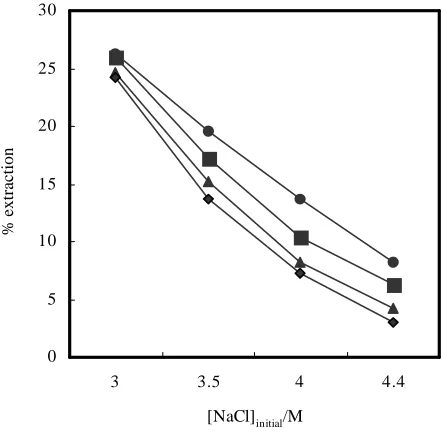
On the other hand, percent extraction of Co(II) is about 27% at 3.0 M NaCl concentration. The extraction is decreased not only for Co(II) but also for other metal ions with increasing of NaCl concentration as shown in Figure 2. This can be explained by considering the increasing tendency of aqueous phase as a function of NaCl concentration that explained in the following section.
Figure 2. Effect of initial concentrations of sodium chloride on the
extraction of Co(II) (●) Mn (II) (■), Ni(II) (▲), Cu(II) (♦) from a 1:1 (vol/vol) mixture of 2-propanol and aqueous solution at different concentrations of NaCl. Concentration of H+ was
adjusted at 0.1 M. Initial concentration of each metal ion is 200 ppm.
Effect of amount of water on the extraction of Co(II)
Table 1 and 2 show the volume change in the aqueous and organic phases with increasing concentration of CaCl2 and NaCl, respectively. Table 1
shows the volume of the aqueous phase decreases with increasing of CaCl2. We also observed that the percent
of extraction of Co(II) increased with increasing of CaCl2 concentration. Therefore, it is suggested that the
extraction of Co(II) increases with increasing of water amount in the organic phase. Mixing of water with
0 2 0 4 0 6 0 8 0 1 0 0
3 3 .5 4 4 .5 5
[CaCl2]in itial/M
%
E
x
tr
a
c
ti
o
n
0 5 10 15 20 25 30
3 3.5 4 4.4
[NaCl]initial/M
%
e
x
tr
ac
ti
o
organic solvent has strong effect on changing of chemical as well as properties of solvent. The high amount of water in the organic phase enhances the polarity of 2-propanol [22] and can extract ion pairs, which is followed by dissociation in the 2-propanol phase, as observed in aqueous acetonitrile [23]. In addition, water in the 2-propanol phase enhances the formation of solvent clusters of 2-propanol molecules that preferentially solvate the ion pairs [24]. These effects increase the extraction of metal ions with increasing the amount of water in the 2-propanol phase.
Table 1. Volume change in the aqueous and organic phase upon
addition of CaCl2.
[CaCl2] with
2-propanol. [ M]
Volume of organic phase
(mL)
Volume of aqueous phase
(mL)
3.0 5.70 4.26
3.5 5.74 4.17
4.0 5.82 4.11
4.5 5.95 3.98
5.0 6.02 3.87
Table 2. Volume change in the aqueous and organic phase upon
addition of NaCl
[NaCl] [ M]
Volume of organic phase
( mL)
Volume of aqueous phase
(mL)
3.0 4.25 5.72
3.50 4.43 5.55
4.0 4.57 5.41
4.40 4.65 5.30
On the contrary, the extraction of Co(II) in the presence of 3.0 M NaCl is much lower than that for CaCl2 and percent extraction decreased with increasing
of NaCl concentration. The percent extraction of Co(II) is about 5 % at 4.4 M NaCl whereas that for 4.0 M CaCl2 is about 60 %. Co(II) ion forms di-negative
CoCl42- species at high concentration of chloride.
The high percent extraction of Co(II) in the presence of CaCl2 is due to formation of stable ion pair
of Ca2+-CoCl42- and can easily migrate into the organic
phase but Na+ may not form stable ion pair like Ca2+ resulting in lower percent of extraction. In addition, the increasing trend of volume of aqueous layer suggested that migration of water molecules into the 2-propanol phase is not suitable where for efficient extraction water molecules is necessary in the organic phase. But in the
case of CaCl2, the volume in aqueous phase decreased
with increasing of CaCl2. This indicates that upon
addition of CaCl2, maximum water molecules migrated
into the 2-propanol phase. The presence of water molecules in the organic phase changes the chemical properties of the organic molecules e.g., increased polarity etc.
Mechanism of Extraction of Cobalt(II) by 2-Propanol and water mixture in the presence of CaCl2
According to the high percent extraction of Co(II) in the presence of CaCl2, the following
mechanism is suggested as shown in Figure 3. The figure shows an equilibrium scheme involving Ca2+, Cl -and CoCl42-. The mechanism indicates that initially
Co(II) reacts with chloride ions to form CoCl4 2- at higher concentration of CaCl2. Since the organic phase contains water, Ca2+ and Cl- , CoCl42- is extracted into the organic phase with Ca2+ and partly ionize to CoCl4
and Ca2+ in the organic phase. CaCl2 plays the following roles in the present system: (1) phase separation from the mixed aqueous solution of 2-propanol, (2) the formation of CoCl42- in both aqueous and organic phases and (3) charge-neutralization of CoCl42- with Ca2+, resulting in the extraction of cobalt(II) into the organic phase.
Figure 3. Extraction scheme for the extraction of cobalt (II) in the
presence of Ni(II), Mn(II) and Cu(II) where the salt was calcium chloride.
Conclusion
Cobalt(II) was extracted selectively to the extent of 80% into the 2-propanol phase at 5.0 M CaCl2.
The percent of extraction of other transition metal ions, for example Mn(II), Ni(II) and Cu(II) was much lower than that of Co(II), but they were stripped in the aqueous phase upon addition of CaCl2. Therefore,
selective extraction of Co(II) from these metal ions was attained by using the mixture of water and 2-propanol. Moreover, the results indicated that the extraction of Co(II) enhanced with increasing concentration of water in the 2-propanol phase. Co(II) was extracted as CoCl4
References
1. J. Rydberg, C. Musikas, and G. R. Choppin,
(Eds.), Principles and Practices of Solvent
Extraction, Marcel Dekker, New York., (1992). 2. J. E. Brady, General Chemistry Principles and
Structure, Jonh Wiley & Sons, New York., 1990. 3. J. S. Preston and A. C. D. Preez, Solvent
Extraction and Ion Exchange., 13 (1995) 465.
4. K. Yoshizuka, Y. Sakomoto, Y. Baba and K. Inoue, Hydrometallurgy., 23 (1990) 309.
5. N. B. Devi, K. C. Nathsarma and V. Chakravortty, Hydrometallurgy., 49 (1998) 47. 6. K. Sarangi, B. R. Ready, R. P. Das,
Hydrometallurgy., 52 (1999) 253.
7. P. Zhang, T. Yokoyama, T. M. Suzuki, K. Inoue,
Hydrometallurgy., 61(2001) 223.
8. J. Chen and K. C. Teo, Anal. Chim. Acta., 434 (2001) 325.
9. S. Akita, L. P. Castillo, S. Nii, K. Takahashi and H. Takeuchi, J. Membrane Science., 162 (1999) 111.
10. N. V. Thakur, Hydrometallurgy 48 (1998)125. 11. J. R. Dean, Extraction Method for environmental
Analysis, John Wiley & Sons, Chichester., (1998).
12. E. M. Thurman and M. S. Mills, Solid-Phase Extraction, Principle and Practice. John. Wiley &
Sons, New York., (1998).
13. P. Triangle, Method for Chemical Analysis of Water and Waste, US-EPA., (1983).
14. B. M. Sutton and M. J. Dimartino, In Handbook on Toxicity of Inorganic Compounds, Marcel
Dekker, New York., (1988).
15. C. S. Holgate, P. Jackson, P. N. Cowen and C. C. Bird, J. Histochem. Cytochem., 31 (1983) 938.
16. F. J. Wacker, R. W. Giles, P. B. Hoffer, R. C. Lange, H. J. Berger and B. L. Zaret, Am. J.
Cardiol., 50 (1982) 89.
17. J. C. Van Loon and R. R. Barefoot, Determination of the Precious Metals: Selected Instrumental Methods, John Wiley ad Sons, New
York., (1991) 45.
18. T. Zhang, W. Li, W. Zhou, H. Gao, J. Wu, G. Xu, and H. Liu, J. Chen, Hydrometallurgy., 62 (2001) 41.
19. J. Zhao and Z. Wu, J. Chen, Hydrometallurgy., 48 (1998) 133.
20. G. M. Ritcey and A. W. Ashbrook, Solvent
Extraction, Part II, Elsevier, Amsterdam., (1979).
21. N. H. Chung, J. Nishimoto, O. Kato and M. Tabata, Anal. Chim. Acta., 477 (2003) 243. 22. N. H. Chung and M. Tabata, Hydrometallurgy.,
73 (2004) 81.
23. M. Tabata, M. Kumamoto and J. Nishimoto,
Anal. Sci., 10 (1994) 383.
24. M. Tabata, M. Kumamoto and J. Nishimoto,
Anal. Chem., 68 (1996) 758.
25. G. H. Jeffery, J. Bassett, J. Mendham, R. C. Denney, Vogel’s Textbook of Quantitative Chemical Analysis, Longman, London., (1989).
26. A. H. Zeltmann and N. A. Matwiyoff, L. O. Morgan, J. Phys. Chem., 72 (1968) 121.
27. K. Sawada, T. Onoda and T. Suzuki, J. Inorg.
Nucl. Chem., 43 (1981) 3263.
28. L. Menabue and G. C. Pellacani, J. Coord.
Chem., 7 (1977) 1.
29. D. A. Fine, J. AM. Chem. Soc., 84 (1962) 1139. 30. F. A. Cotton, G. Wilkinson, Advanced Inorganic