LINKING ANXIETY IN SECOND LANGUAGE WITH STUDENTS’ WRITING
PERFORMANCE
Dr. Jovelyn M. Cantina
---Abstract
Language learning anxiety is a specific anxiety reaction that occurs only when a language learner is thinking about language learning, participating in a language class, or studying a language. The study aimed to establish how anxiety affects the writing performance among the college students of JRMSU System enrolled in English 12 class during the second semester of the academic year 2015-2016. The correlational research method was employed in the study which administered Cheng English Writing Anxiety Scale (EWAS) and writing performance. The statistical tools used were frequency count, mean computations, t-test, Kruskal-Wallis Test, Mann-Whitney Test, and Spearman Rank. The study revealed that students’ language anxiety was moderate. Findings rejected the hypothesis that test anxiety significantly correlates with students’ academic achievement. Findings also indicate the statistically significant effect of difference on the writing performance of the respondents as to campus and age, yet there is no significant difference as to sex. Moreover, there was no significant difference on the level of anxiety of the students as to age, sex and campus. This study recommends that instructors should seek more effective ways to ease the anxiety that students might feel when learning and writing English so as to support successful language learning experiences.
Introduction
Anxiety plays a significant role in language learning and communication and is a real challenge in second and foreign language teaching and learning. Language anxiety can manifest as: self-evaluation, excessive concern about failure, concern about what others think, apprehension and worry, avoidance of the target language, careless errors, and excessive studying (Horwitz as cited by DeDeyen (2011). Cubukcu (2007) noted that the students with low self-efficacy have a higher level of anxiety than students with high self-efficacy. Azher, Anwar and Naz (2010) also suggested that speaking in the L2 in front of others heightened students' levels of anxiety, while Naz (2010) pointed out, students also worried about grammatical mistakes, pronunciation and being unable to respond quickly, noting that those factors were the biggest causes of anxiety.
Dr. Jovelyn M. Cantina, OIC Director for IMD, Jose Rizal Memorial State University Main Campus situation in classroom performances, including listening to the teacher, speaking before the whole class, class quizzes, evaluations by teachers and classmates and apprehension about classroom activities (Di, 2010). Further, Horwitz as cited by Choi (2013)stated that writing anxiety is a “language-skill specific anxiety,” which is different from a general classroom type of anxiety. Writing apprehension is a “situation and subject-specific individual difference” and highly apprehensive writers have a tendency to avoid the very activities they need to be successful writers: writing, practicing writing, and getting feedback on writing. As a result, many apprehensive learners end up showing quite poor performances in writing. Daly as cited by Choi (2013) also mentioned that highly anxious writers produced shorter and less fluent writing than writers with low anxiety.
Language anxiety is more or less present in every person. But we tend not to disclose it in front of everyone. This anxiety is considered to hinder the language learning process and thus it needs to be removed to make language learning relaxed, smooth, easy and interesting. Second Language anxiety is important because it can represent an emotionally and physically uncomfortable experience for some students. If the students are very anxious in class, they are probably not full engaged – or engaged at all. Second language anxiety has been found to have potential negative effects on academic achievement (e.g., lower course grades), cognitive processes (e.g., not being able to produce the language) the social context (e.g., communicating less), and the reaction for the language learner (e.g., traumatic experiences) .
Along this context, this study aimed to establish how anxiety affects writing performance among the college students of JRMSU System enrolled in English 12 class (Communication Arts Skills) during the second semester of the academic year 2015-2016. It also aimed to determine possible sources of anxiety from the learners’ perspective, which should provide better understanding of possible obstacles that L2 learners may face during language learning; and determined the significant difference of writing performance as to age, gender and campus. In so doing, research-based findings will be established regarding the writing performance of the students to lessen their anxiety, thus improving their writing performance. Results of the study will also be the basis of the English instructors in a writing class to shift strategies which are friendlier, simpler and more effective so as not to alleviate the level of anxiety of the students. The results will provide insights to the instructors in developing module in writing to provide guided questions in the writing process.
speaking. Writing skill is part of their work. They will need this in preparing business proposals, making reports, developing researches and others.
Theoretical/Conceptual Consideration
This study is anchored on the Foreign Language Anxiety of Horwitz and Cope as cited by Trang (2011). Foreign Language Anxiety is a distinct complex construct of self-perceptions, beliefs, feelings, and behaviors related to classroom language learning arising from the uniqueness of language learning process. They suggested that foreign language anxiety should be viewed as a situation-specific anxiety arising from the uniqueness of the formal learning of foreign language study, not just a case of general classroom anxiety being transferred to foreign language learning. According to them, no other fields of study implicate self-concept and self-expression to the same degree as foreign language study. The feature makes the anxiety caused by foreign language learning distinctive from other academic anxieties. It is possible that students with general anxiety are likely to experience FLA; however, it is not uncommon to find those who are very good at other subjects frustrated in learning a foreign language. Therefore, there must be something unique to the language learning experience that makes some students anxious.
Language anxiety is attributable to different causes. The primary sources of language anxiety is explicated by Horwitz et al as cited by Nimat (2013) are learner characteristics, teacher characteristics, and classroom procedures. Learner characteristics can cause second language anxiety which includes inability to comprehend, perceived low level of anxiety, competitiveness, perfectionism, self-awareness, speaking activities, test anxiety, fluent speakers’ presence, students’ beliefs about language learning, lack of group membership with peers, fear of negative evaluation, negative classroom experiences, etc.
The most disturbing aspect of the ESL classroom, was directly related to the teachers; that “the teacher was trying to make you feel stupid,” and this indicated a lack of respect on the part of the teacher. A judgmental teaching attitude and a harsh manner of teaching are linked to students’ fear in the classroom.
Moreover, classroom procedure was counted another source of anxiety. Young as cited by Nimat (2013) compiled list of classroom activities which were perceived by students as producing anxiety: Spontaneous role-play in the class; Speaking in front of the class; Oral presentations or skits in front of the class; Presenting an unprepared dialogue in front of the class; and Writing on the board.
Methods and Materials
This study utilized a correlational method to determine how foreign language anxiety is related to second language writing among the 158 college students of JRMSU System enrolled in a writing class (Communication Arts/Skills 2) during the Second Semester of Academic Year 2015-2016. A purposive sampling is employed utilizing one English writing class from each campus.
The research instrument of this study is composed of three parts. The first part dealt with the socio-demographic profile of the respondents as to age, gender, and campus.
The second part was an adaptation of Cheng (2004) English Writing Anxiety Scale (EWAS), which was designed for assessing English writing anxiety among students .The EWAS consisted of two sections. The first section had 15 items, each to be rated on a 5-point Likert scale: 1=Strongly Disagree, 2=Disagree, 3=Are Uncertain 4=Agree, 5=Strongly Agree which will be interpreted as 1=Not Anxious, 2=Less Anxious, 3=Moderately Anxious, 4=Much Anxious, 5= Very Much Anxious. The second section was an open-ended question that asked the students to explain, from their own perspective, what factors make them nervous when they write in English for class assignments. While individual interviews would have provided more information, there was no opportunity to interview the students; this open-ended question was an alternative measure to find out students’ own explanations for their nervousness about English writing.
Part III dealt with the performance-based test scores on the free writing of the students. In this free-writing activity, students will choose one topic out of the given five topics to develop a 100-150 word composition. The researcher provided them with the rubric to be used in assessing students’ writing. In the rubric, there were four major criteria for assessment: organization and content, linguistic accuracy, fulfilment of the writing task or purposes, and neatness. Each of the first three criteria consisted of four intervals of scores with brief descriptions, while neatness has two intervals, either legible or not. Organization and content accounted for 10 pts. and the other three criteria accounted for 5 pts. each. This suggests that the teacher put more emphasis on content and creativity than linguistic accuracy, reflecting the characteristics of free writing. The following ranges was used (1-5 poor, 6-10 fair, 11-15 average 16-20 above average, 21-25 excellent).
A letter request to the instructor of a writing class in the five campuses was sent.
Scores were tallied, tabulated and further analyzed and interpreted using statistical tools: frequency count, percent , mean, T-test, Pearson R.
Results
According to Choi (2013), students with less English writing anxiety are expected to have better grades on their writing portfolios than students with more English writing anxiety, because highly anxious students are not expected to produce lengthy or fluent written pieces, due to their lack of confidence or their tendency to avoid writing.
Table 1 Level of Anxiety of the Respondents
Descriptors AWM SD Description
1 While writing in English, I’m nervous. 3.7 0.83 Much Anxious 2 I feel my heart pounding when I write English compositions
under time constraint.
3.61 0.82 Much Anxious
3 While writing English compositions, I feel worried and uneasy if I know they will be evaluated.
3.75 0.99 Much Anxious
4 I often choose to write down my thoughts in English. 4.98 0.81 Very Much Anxious 5 I usually do my best to avoid writing English compositions. 2.73 1.13 Moderately Anxious 6 My mind often goes blank when I start to work on an English
composition.
2.89 0.92 Moderately Anxious
7 I don’t worry that my English compositions are a lot worse than others.
2.80 0.94 Moderately Anxious
8 I tremble or perspire when I write English compositions under time pressure.
3.43 0.99 Moderately Anxious
9 If my English composition is to be evaluated, I would worry about getting a very poor grade.
3.74 0.97 Moderately Anxious
10 I do my best to avoid situations in which I have to write in English
3.01 1.09 Moderately Anxious
11 My thoughts become jumbled when I write English compositions under time constraint.
3.37 0.99 Moderately Anxious
12 Unless I have no choice, I would not use English to write compositions.
2.66 1.03 Moderately Anxious
13 I often feel panic when I write English compositions under time constraint.
3.05 1.11 Moderately Anxious
14 I’m afraid that the other students would think my English composition was terrible if they read it.
3.25 1.08 Moderately Anxious
15 I freeze up when unexpectedly asked to write English compositions.
2.94 0.94 Moderately Anxious
16 I would do my best to excuse myself if asked to write English compositions.
2.45 1.01 Less Anxious
17 I don’t worry at all about what other people would think of my English composition.
3.36 0.98 Moderately Anxious
18 I usually seek every possible chance to write English compositions outside of class.
3.21 0.99 Moderately Anxious
19 I usually feel my whole body rigid and tense when I write English compositions.
2.81 0.97 Moderately Anxious
20 I’m afraid of my English composition being chosen as a sample for discussion in class.
3.07 1.07 Moderately Anxious
21 I’m not afraid at all that my English compositions would be rated as very poor.
2.84 1.19 Moderately Anxious
22 Whenever possible, I would use English to write compositions. 3.89 0.84 Much Anxious
This implies that language teachers may engage students in writing workshops that can help them improve their disposition and probably reduce their level of writing anxiety. A positive disposition does not necessarily mean that the student will be good writers but future researchers can focus on the contents of writing workshops that can help students overcome difficult moments during the writing process.
Table 2 Writing Performance of the Respondents
Criteria Mean Standard
Deviation
Description
Organization &Content 5.88 1.91 Average
Linguistic accuracy 2.28 0.99 Fair
Fulfilment of the writing task or purpose 2.51 1.02 Fair
Neatness 2.38 1.22 Fair
AVERAGE WEIGHTED MEAN 13.02 4.26 AVERAGE
Table 2 presents the writing performance of the respondents along with the four criteria. As shown on the table, the respondents got an average level of writing performance. This means that the writers put more emphasis on content and creativity than linguistic accuracy, reflecting the characteristics of free writing.
The table further shows that out of the four criteria, the respondents got the lowest mean on linguistic accuracy. On content and organization, the respondents were average which means that their writing is not coherent and consistent frequently, and only lists information. On linguistic accuracy, fulfilment of the writing task or purpose, and neatness, the respondents performed fairly which means that there are over 10 grammatical mistakes or misspellings, writings were relevant to the topic but with falling short of expected amount of writing, and illegible handwriting and irritating smudges
Daly as cited by Aljafen (2013) had examined the negative impact of a high level of writing anxiety on performance, and found that those who experienced low anxiety tended to be successful in the writing test. This test was run on more than 2500 students at a Midwestern University. Moreover, Dally and Miller as cited by Aljafen (2013) indicated that apprehensive writers tended to be less successful and less willing to sign up for future, advanced writing courses.
Al-Ahmad (2003) argued that writing anxiety was a challenging experience for both L1 and L2 learners, and consequently it negatively affected their writing practices. For SL learners, it was shown to be even more challenging, since the language was systematically different from their native language. This implies that writing is a demanding activity especially for learners of a second/foreign language and writing apprehension is a real problem facing ESL/EFL students’ apprehension, and something should be done to reduce students’ apprehension”.
Table 3Sources of Students’ English Writing Anxiety
Sources of Anxiety Frequency Percent
Fear of committing grammatical mistakes 92 57.5%
Negative Evaluation 34 21.25%
Insufficient knowledge on the topic 25 15.6%
Other Sources 9 5.6%
Table 3 presents the sources of the respondents’ anxiety on second language writing. Of the students’ comments in response to the open-ended question at the end of the survey questionnaire, more than half (57.5%) were related to the fact that students were afraid that they might make grammatical mistakes in English writing. The second most reported source of anxiety is negative evaluation (21.25%). The third most common reason that the students gave was lack of knowledge regarding the topic (15.6%). The “other” category comprised a mixed category (5.6%) and offered many interesting insights. For example, one of the students revealed the lack of confidence in writing. Another student stated his or her unwillingness to write in English, attributing it to lack of vocabulary. One student responded on the short time given in writing.
These findings were similar with that of Choi (2013) in which several causes of anxiety in the classroom from the students’ point of view were uncovered but half (50.2%) were related to the fact that students were afraid that they might make grammatical mistakes in English writing. At Philippines, a proposed study intended to investigate the causes of anxiety in English language learning of foreign students in the Philippines in the year 2011. It was also found that test anxiety and fear of negative evaluation constitute the type of learning anxieties these were students experiencing. It can be gleaned from the results that foreign learners experience anxiety if they are being evaluated by both their peers and their teachers as to their performance in using the target language (Lucas, Miraflores & Go, 2011)
In addition, Hassan (2001) pointed out some possible causes of writing anxiety from a linguistic and cognitive perspective, such as poor skill development, inadequate role models, lack of understanding of the composing process, and authoritative, teacher-centered, product-based model of teaching. He stressed that self-confidence is extremely important in determining students’ affective response to writing task.
This goes to show that the anxiety which was experienced by the students in English writing came from different sources. According to Jackson as cited by Numaya (2013), the cause of language anxiety is also attributed to cultural and personal factors. Similarly, research has shown that, there are a number of factors that can cause anxiety for the language learners. The causes can be broken down into three main sources: learner characteristics, teacher characteristics, and classroom procedures. Numaya (2013). This implies that instructors should seek more effective ways to ease the anxiety that students might feel when learning and writing English so as to support successful language learning experiences.
Extracts onFear of committing grammatical mistakes
I am afraid that I might make grammatical mistakes in English writing. Grammar rules are too difficult to memorize
I am not sure if my sentences are ungrammatical or not I am not good in observing subject-verb agreement
Extracts on Negative Evaluation
I am afraid that when my classmates can read my writing they will laugh at my mistakes I feel shy to express my idea because I know my teacher will read it.
I feel nervous every time I write in English because I am afraid my grammar will be evaluated. The teacher might get angry because I can’t write well in English even if I’m already in college.
The topic is not familiar to me
I don’t have much knowledge on the topic.
Sometimes I am out of the topic because of the number of words required
Extracts on Other Sources
I think that I am not confident with my writing. I am confused on what exact word am I going to use.
I don’t have enough time to finish my writing. Time makes me nervous whenever I’m writing because there is always a time limit.
I run out of vocabulary
Table 4 Test of Difference in the Students’ Writing Performance when Analysed as to Campus
Campus Mean Sum of
Squares
df Mean
Square
F Sig. Decision
Dap 14.27 Between
Groups
201.910 4 50.477 2.923 .023 Reject
Ho
Dip 13.6 Within
Groups
2677.034 155 17.271
Kat 11.88 Total 2878.944 159
Tam 13.08
Sio 11.18
Table 4 presents the test of significant difference in the student’s writing performance when analyzed as to campus. The findings rejected the hypothesis. This means that there is a significant difference as to the writing performance of the respondents and the writing performances differ by campus. Respondents from Dapitan Campus performed better among other campuses while the respondents from Siocon Campus performed least. This implies that teachers from Siocon campus may provide more writing activities to the students to improve their writing performance. Such findings contrasted the study of Sedeeg (2015) in which a convenience sample of 705 students is taken from the target population which is the students of medical sciences in the four major universities in the Sudan: University of Khartoum, Sudan University for Science and Technology, Al-Neelein University, and Omdurman Islamic University. Results of the study showed no significant difference on the writing performances of the students.
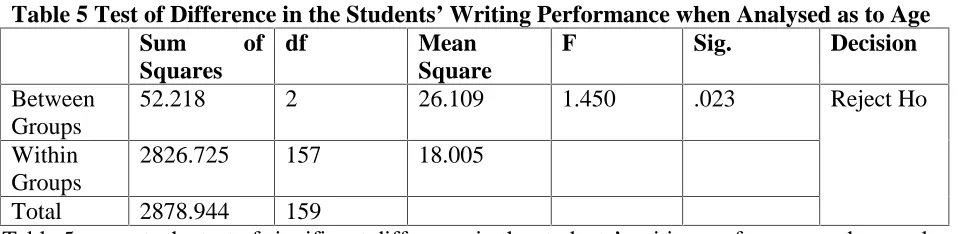
Table 5 Testof Difference in the Students’ Writing Performance when Analysed as to Age
Sum of
Squares
df Mean
Square
F Sig. Decision
Between Groups
52.218 2 26.109 1.450 .023 Reject Ho
Within Groups
2826.725 157 18.005
Total 2878.944 159
Regarding “ language proficiency level ” , Liu (2006) explored the language anxiety of 100 EFL students at three different proficiency levels . The results showed that students with advanced English proficiency tended to be less anxious. Elkhafaifi (2005) explored 233 graduate and undergraduate students’ language anxiety, and found that advanced students had lower language anxiety than beginning or intermediate students. As for “ length of language learning ” , Elkhafaifi (2005) found that the older students (sophomores, juniors, and seniors) who spent more years learning English in school had lower anxiety than younger students (freshmen). However, Casado and Dereshiwsky (2001) compared the anxiety level of first and Anxiety exists for learners from every level of education , and experiences of writing anxiety can vary both from person to person and from grade to grade.
Table 6 Test of Difference in the Students’ Writing Performance when Analysed as to Gender
Category Mean SD t-value p-value Decision on HO
Male 11.26 5.16 3.205 0.002 Accept Ho
Female 13.64 3.711
Table 6 presents the significant difference on the students’ writing performance when analysed as to gender. As shown on the table there is no significant difference on the performance of the students between male and female with a p-value of 0.002. This goes to show that female writers performed similarly than male writers.
However, on the study conducted by Cantina and Flores (2015) t-test revealed that the levels of linguistic errors of the respondents in terms of phonology, morphology, semantics and syntax is significantly different between the male and female respondents; phonology ( t=2.44, p=0.016), morphology (t=2.82, p=0.006), semantics (t=2.04, p=0.044), and syntax (t= 3.00, p= 0.003). Female proved to be superior on the four levels of language. This means that the female respondents performed better than the male respondents on all levels. Morover, the study of Ervin-Tripp as cited by Wellms (2004) that the average girls seem more superior to boys in overall language development.
Table 7 Test of Difference on the Level of Anxiety of the Students as to their Profile.
Kruskal-Wallis test
Mann-Whitney Test
P-value Decision on HO
Campus 8.808 0.066 Reject HO
Age 1.351 0.509 Reject HO
Sex 17.500 0.581 Reject HO
Table 7 presents the test of difference on the level of anxiety of the respondents as to their profile. As shown on the table, there is no significant difference as to the level of anxiety of the respondents as to campus, age and sex with the following P-values: 0.066, 0.509, and 0.581 respectively.
administrations fell within the Average range of anxiety. The research says that females tend to be more anxious than males.
Table 8 Test of Relationship between Language Anxiety and Writing Performance Variables
Correlated
Spearman Rank p-value Decision on HO Remarks
Language Anxiety vs. Writing Skills
0.012 0.884 Accept Ho Almost negligible
correlation and no significant correlation
Table 8 presents the significant relationship between language anxiety and writing performance of the respondents.Pearson r Product Moment Coefficient of Correlation revealed that the language anxiety of the students is not significantly related to the writing performance of the respondents with a p-value of 0.884 which accepted the hypothesis. This means that language anxiety does not affect the writing performance of the students.
The findings are similar to the results of the study of Erkan and Saban(2010) in which they investigated writing anxiety among 188 EFL students in Turkey. The purpose of the study was to identify whether writing anxiety was correlated with the performance of the students in English. The results indicated that the relation between writing apprehension and English performance was negative. According to Aljafen (2013) that it is beneficial to investigate the factors that create a level of writing anxiety among ESL/EFL learners in order to better understand the sources of writing anxiety that might impact their writing performance.
Discussion
It is widely accepted that anxiety plays a crucial role while learning a second language. The impact of such an emotional arousal in language learning and its debilitating effects has long been considered in language classroom. So in this study, it was found that although the level of language anxiety of the students is not that high but the answers of the students on the open-ended questions revealed some sources of anxiety which affect students’ writing activity. Writing is a demanding activity especially for learners of a second/foreign language, and writing anxiety is a real problem facing ESL/EFL students’ apprehension, and something should be done to reduce students’ apprehension. First of all, there should be more English writing instruction especially to the students from the other campuses because lack of opportunities to write in English might be one of the reasons that this activity produces anxiety among students. Some students expressed a lack of confidence in English writing, and a few said they had no idea how to start writing in English even when they were engaged in free writing. Whether this lack of confidence and uncertainty come from previous L1 writing experience or L2 writing experience needs further research. But it is clear that many students were not confident enough to write in English and took writing not as enjoyable communication between a writer and a reader but as a demanding test. If instructors carefully design more writing tasks that consider students’ proficiency levels in English as well as previous L1 and L2 writing experience, and if they provide learning aids such as teaching common expressions and giving supportive feedback, students themselves may see writing as a less daunting and more pleasant experience in the classroom.
anxious about writing may be to establish collaborative writing activities. Collaborative writing could be a particularly good alternative for those students who have struggled in L2 writing because they consider writing an extremely solitary act in which they do not have much assistance from others. Unlike individual writing, collaborative writing engages students in interaction, and writing.
References
Awan, R. U.N., Azher, M., Anwar, M. N., & Naz, A., (2010). An Investigation of Foreign Language Classroom Anxiety and its Relationship with Students’ Achievement. Journal of College Teaching & Learning, 7, 33-34. Retrieved from www.journals.cluteonline.com/index.php/TLC/article/.../249/239 on March 3, 2016.
Cheng, Y. (2004). A measure of second language writing anxiety: Scale development and preliminary validation. Journal of Second Language Writing. Retrieved from on March 1, 2016
Choi, S. (2013).Language Anxiety in Second Language Writing: Is It Really a Stumbling Block? Retrieved from http://www.hawaii.edu/sls/wp-content/uploads/2014/09/Choi-Sujeong.pdf onMarch 1, 2016.
Cubukcu, F. (2007). Foreign Language Anxiety. Iranian Journal of Language Studies (IJLS), 1(2), 133. Retrieved from core.kmi.open.ac.uk/download/pdf/1053574 on March 5, 2016
DeDeyn (2011). Student Identity, Writing Anxiety, and Writing Performance: A Correlational Study. Retrieved from
http://dspace.library.colostate.edu/webclient/DeliveryManager/digitool_items/csu01_storage/2012/02/07 /file_1/on March 2, 2016
Di, Q. (2010). A study of English language anxiety among Chinese college students. 1-6. Retrieved from http://www.google.com/url?sa=t&rct=j&q=research%20paper%20on%20english%20language%20anxie ty&source=web&cd=4&cad=rja&sqi=2&ved=0CEUQFjAD&url=http%3A%2F%2Fminds.wisconsin.ed u%2Fbitstream%2Fhandle%2F1793%2F43769%2FQiu%2C%2520Di.pdf&ei=E5LiULz9HpDyrQe5jIH 4BA&usg=AFQjCNGhRxjmChRfwlKKeOwBpDHN5dPOA&bvm=bv.1355534169,d.bmk on March 3, 2016
Horwitz, E. (2010). Foreign and Second Language Anxiety. Language Teaching. Retrieved from http://dx.doi.org/10.1017/S026144480999036X on March 4, 2016.
Nimat N. (2013). An investigation of English Language Anxiety-Experiences of Undergraduate Students in
Bangladesh. Retrieved from
http://dspace.bracu.ac.bd/bitstream/handle/10361/3555/Numaya%20nimat.pdf?sequence=1 on March 3, 2016.
Trang, T. (2011) . A Review of Horwitz, Horwitz and Cope’s Theory of Foreign Langauge Anxiety and the Challenges to the Theory. The University of Queensland Australia. Vol. 5. No. 1 January 2012. Retrieved fromhttp://dx.doi.org/10.5539/elt.v5n1p69 on March 6, 2016
Lee, S. (2005). Facilitating and inhibiting factors on EFL writing: A model testing with SEM. Language Learning Retrieved on March 5, 2016.