Gender Bias Within the Superintendency:
A Comparative Study
Carolyn Bernal
California State University, Channel Islands & California State University, Fresno
Ashley Lajoie
California State University, Channel Islands & California State University, Fresno
Nadezhda Monosov
California State University, Channel Islands & California State University, Fresno
Alison Raigoza
California State University, Channel Islands & California State University, Fresno
Amy Stencler
California State University, Channel Islands & California State University, Fresno
Nancy Akhavan
California State University, Fresno
McCord, Peterson, Young, & Ellerson, 2010). This number was a substantial improvement since the last time it was measured in 2000, when only 13.2% were women. Although women comprise the majority of classified staff and teachers in the P-12 education sys-tem (in 2011-2012, 76% of public school teachers were female as indicated by a 2011-2012 report by the U.S. Department of Education), males held just under 80% of the superintendent positions. A few recent studies on women superintendents (Derrington & Sharatt, 2009; Muñoz, Pankake, Murakami, & Simonsson, 2014; Sperandio & Devdas, 2014) describe the current issues female leaders are facing, which includes per-sonal issues such as marriage, children, and relocation as well as professional challenges such as opportunity and gender bias. Obtaining the position of the super-intendent is challenging enough without having to navigate external factors that women are currently subject to enduring. Women are often typecast as teachers or other personnel, making the pressure to exceed that first impression even greater (Muñoz et al., 2014).
Barriers
There are certain unwritten rules for women for obtaining a superintendent position. Tallerico (2000) explained, “These unwritten rules involve
headhunters’ and school board members’ (a) defining quality in terms of hierarchies of particular job titles, (b) stereotyping by gender, (c) complacency about acting affirmatively, and (d) hypervaluing feelings of comfort and interpersonal chemistry with the success-ful candidate” (p. 37). Understanding the potential issues, both known and unknown, can help break down barriers to ensure that every candidate, female
A
ccording to the American Association of SchoolAdministrators, in 2010, approximately 24.1% of American superintendents were female (Kowalski, ABSTRACT: Current research reveals a large per-centage of teaching positions and administrative ser-vices credentials are held by women, although histori-cally, men dominate the superintendent role. Specifi-cally in the area of women in the superintendency, a discrepancy exists between men and women in re-cruitment practices, types of barriers and challenges, and the length of time one stays in the superintendent position. This study examines the superintendent role and the perceived leadership qualities necessary, bar-riers, challenges and opportunities, as well as the ca-reer pathway taken by those in the superintendent role. With a mixed-method design, the study reflects upon responses from six superintendents, three wom-en and three mwom-en, using semi-structured interview questions and data collected with Bolman and Deal’s (1990) Leadership Orientations (Self) Instrument and a demographics survey. A theoretical framework of management and leadership styles was utilized to analyze the data for themes relating to the three re-search questions. The findings generally indicated women superintendents perceive they are expected to act and behave differently to succeed in the role, while men are more at ease with making decisions and lead-ing others. Gender biases were found to be prevalent for women, as the role of parenthood was the biggest barrier when considering their career pathway. This was not found to be a barrier for men.
or male, has an equitable opportunity to become a superintendent.
The underrepresentation of women in the superin-tendency and the possible reasons attributed with it requires additional research. Studies have shown that it is not the lack of training or experience necessary to succeed in the position that has led to the underrepre-sentation of female superintendents, but rather socie-tal norms and beliefs regarding leadership,
(Shakeshaft, 1989), school board expectations
(Tallerico, 2000) and issues with the overall search and selection processes. Selection process issues include school boards not considering female candidates for positions, lack of mobility, and perceptions held by school board members that women are unqualified for the responsibilities of the position (Glass, Bjork, & Brunner, 2000).
One barrier women face as they move to the super-intendency is the attitudes of gatekeepers. In this con-text, gatekeepers are defined as school board members who help to hire women superintendents and consult-ants working in superintendency searches who place women among the top candidates for superintendent positions (Chase & Bell, 1990). In a study by Chase and Bell (1990), the ideologies and discourse of indi-vidual achievement and gender neutrality were exam-ined by exploring the explanations and descriptions of women’s actions and situations as told by the gate-keepers. Little attention had been paid to gatekeepers’ experiences and perspectives in relation to women in positions of power. The focus of studying gatekeep-ers’ speech was on “how gatekeepers talk about wom-en, that is, on the kinds of understandings about women’s actions and situations that are produced by gatekeepers’ speech” (Chase & Bell, 1990, p. 164). Re-search supports the fact that there are qualified wom-en who wom-enjoy the work and have the expertise to lead systems who are actively seeking the superintendency (Grogan & Brunner, 2005); however, the gatekeepers– –school board members and search firms––are not hiring women at the same rate as men.
Another barrier involves headhunting, gender, and color. Tallerico (2000) explored the process of filling the position of superintendency from a gatekeeping and career mobility theory while looking specifically at gender and color. The idea of head hunting ties into the gatekeeping theory because headhunters may be able to personally control portions of the hiring process early on (i.e., the initial paper screening). They have the power to control who proceeds at vari-ous levels of the hiring process. There are three major categories in this area of inquiry. First, although there are guidelines on which a candidate is evaluated, they
are viewed differently based on the positions the can-didate has previously held. This impacts women and people of color because these two groups are more likely to hold principalships at an elementary school than at the secondary levels (Tallerico, 2000). Cultural norms also play a role and prejudicial gender stereo-typing does exist. Specifically females are often as-sumed to lack prior knowledge about particular issues related to the superintendency. Male candidates are expected to understand appropriate disciplinary ac-tions, budgeting, and other non-instructional technical abilities, while the competencies of women are ques-tioned. If a woman does make it as a finalist, the school board often questions whether they need to pay her as much as a male contender (Tallerico, 2000). The third category inquires about how a school board makes selection decisions. Many of the participants involved in the interviews described the chemistry or connection they feel with a candidate as crucial. Psy-chologically, humans are more likely to connect with others who are similar to them (Baltzell & Dentler, 1983). This means that this ‘fit’ being assessed is more than likely to push women and people of color out of the position (Baltzell & Dentler, 1983 ).
Breaking Barriers and Challenging Life Styles Derrington and Sharratt (2009) offered several sug-gestions for overcoming the continuous struggles fe-male superintendents face. The strategies fall under four subcategories: resolve, balance, negotiate, and decide. To cultivate resolve, individuals need to be clear about professional and personal goals, stick to career goals and develop an action plan, and realize that sacrifice is necessary while determining limita-tions. In order to maintain balance, it is important for women to take care of their health, seek the advice of women who have created balance, and accept assign-ments that allow family participation. Women may also need to consider negotiating boundaries or ask for alternatives such as negotiating flexible time with their school board or compromising expectations with the board before making strong decisions.
very little help from their family or paid help. The findings indicate the responsibilities of a superinten-dent and lifestyle preferences of women who are qual-ified to take these positions are at odds, making it more difficult for women to obtain these positions. This in turn makes it more challenging to close the gender gap that exists in the position of superinten-dent and the gender balance in educational decisions that are made within school districts. The problem becomes more complex due to the realization that the responsibilities of the superintendent are unlikely to change, meaning women may continue to be faced with these challenging decisions between career and home life.
Although many studies have looked at leadership traits of superintendents, few have focused on gender biases that exist in this important leadership position. The current study used three research questions to address this this gap in the literature:
1) What are the leadership qualities that a su-perintendent needs to possess to have a suc-cessful tenure?
2) What strengths, weaknesses, opportunities, and threats are experienced in the role of su-perintendent?
3) What commonalities exist as it relates to the career pathway towards becoming a superin-tendent?
Methods Participants
Six superintendents (n = 6), all from Southern Cali-fornia, participated in this study. Five participants were currently serving as superintendent and one was retired. Three participants were female and three were male. Participants ranged between 41 and 61 years of age, with a male being the youngest and a female being the oldest. Of the six participants, three reported being married (two females and one male), two reported being single (one female and one male), and one reported being divorced (male). All partici-pants reported they had children, with no participant having more than three. The age of their children ranged from 22 months to 39 years old, with a male having the youngest child and a female having the oldest child. The participants served districts ranging from 2,600 to 18,000 students, with a male leading the smallest district and a female leading the largest dis-trict. Five superintendents represented elementary school districts (non-unified), while one represented a unified district that included high schools. All of the participants held doctoral degrees. Superintendent
tenure length ranged from five months to fourteen years, with females holding both the shortest and longest tenure.
Instrumentation
Bolman and Deal’s (1990) Leadership Orientation (Self) Instrument (LOI), considered a valid and relia-ble instrument, was used as the main instrument of the study. Proposed in 1984, the Bolman and Deal leadership model has been widely accepted in organi-zational theory and applied to various organizations across an extensive time period. Bolman and Deal’s (1990) model provides four specific frameworks: structural, human resource, political, and symbolic. The four frameworks provide structure that leaders can employ to gain a better understanding of chal-lenging situations. The authors believed reframing offers leaders “a chance to get beyond constricted, oversimplified views of leadership” and provides four distinct lenses through which each situation may be perceived (Bolman & Deal, 2013, p. 355).
each superintendent’s scores for the frame were aver-aged. Lastly, the entire group’s scores were averaged, and the statistical results were distributed across the four leadership frames.
Data Collection and Analysis
Data was collected using semi-structured inter-views and a survey using Bolman and Deal’s (1990) LOI. Each participant received a phone call or an email and was invited to be interviewed. Upon agree-ment, individual in-person interviews were set up between the participant and at least two researchers to discuss the research questions presented in this study. Participants were also asked to complete a short de-mographic survey prior to the LOI. Each interview was recorded with the participant’s permission. The researchers also took handwritten notes.
Qualitative data was manually transcribed to give the researchers an opportunity to become deeply fa-miliar with the source material. Through a manual coding process, transcriptions were open, axial, and finally selective coded (Corbin & Strauss,
2008). Emergent themes were identified and then grouped together and described in rich descriptive text.
The strengths, weaknesses, opportunities, threats (SWOT) analysis is another tool used to analyze the results of our study. SWOT is one way to examine the environment around an issue or institution
(Balamuralikrishna & Dugger, 1995). This strategic planning activity has been in practice since the 1950s (DeSilets, 2008) and allows organizations to explore their interconnections prior to making decisions or changes.
Results and Discussion
The findings from this study are separated into three sections, addressing each of the three research questions. Each section looks at the female responses, male responses, and finally a comparison of the fe-male and fe-male responses. The themes that emerged from the female interviews include communication, soft language, relationships, vision, and the implica-tions of being a female superintendent. The theme that emerged from the male interviews was a unique approach to the position of superintendency. The fe-male participants had multiple areas of overlap, using similar terms, language, and similar experiences. Conversely, each male participant had very unique responses that did not contain overlap similar to their female counterparts. As reported in the findings, the responses from each participant highlight these themes.
Research Question 1: What are the leadership quali-ties that a superintendent needs to possess to have a successful tenure?
Female Responses
The responses of the female participants to the first research question were analyzed and divided into four themes: communication, relationships, vision, and overall female superintendent issues.
Communication. Communication was discussed throughout all of the female interviews. The ability to communicate was examined in regards to organiza-tional (i.e., the vision and mission, staff, faculty, etc.) and interpersonal needs. In addition, the other female superintendents discussed spending much of their day “just talking to people.” Whether it was about a bad day or layoffs, they needed to hear people out and have the ability to facilitate two-way communica-tion. This was an overarching theme evident through-out the female superintendent interviews.
In considering the topics of communication and leadership, Participant 1 stated, “You need the ability to communicate the vision and the mission of the or-ganization, need the ability to articulate that vision.” Participant 2 added, “You need to be caring, com-municate extremely well, and need to be very good at multitasking. The communication is number one.” Participant 3 discussed the importance of commu-nication with her school board. She was the predeces-sor to a male superintendent who held the position for 33 years. She described the prior superintendent as “legendary” and talked candidly about communi-cating with the board, her staff, and the community. She attributed much of her success in the district to open communication:
It goes back to communication. I communi-cate everything with that board. And they are shocked; they’ve never had it before. They are well informed. There are no surprises . . . If there is something coming up, I tell my cab-inet team [that] you need to write a transmit-tal. This is what we need to do. It is a whole cultural shift to bring to the district to ensure that people are communicating.
styles were effective, as they achieved success in their tenure as superintendents; however, this required ex-tensive thought, effort, and understanding of what they were asking as leaders. They understood the dynamics they were entering and found effective ways to ensure the correct processes were being im-plemented.
Reflecting upon the topics of soft language and leadership, Participant 2 recalled the following when working with her male-dominated executive cabinet:
I remember once, I said right in the beginning: ‘You know, you might want to consider’ or ‘Have you ever thought about,’ ‘I would en-courage you to.’ And after I had done that, all of them said, oh my gosh, that’s your way of telling us what to do. And I said, actually, you’re right. And I laughed about that. Participant 3 added, “How you project as a female to men to get your point across has to be orchestrated well, it has to be strategic.” This participant provided an example: “I always told a story and I always told my team and my directors, ‘Tell me ahead of time so I can front load them two to three weeks in advance.’ And then I would tell them, ‘I just want you to know that this is what was going on . . . this might be com-ing.’ ”
Relationships. Another evident theme was the need to build relationships. Each female described the importance of relationships with groups ranging from their day-to-day staff to outside colleagues they need-ed to call on for help. Relationships were at the core of the work each superintendent was doing and con-tinued to be a vital part of the success of each female leader. This theme aligns with Bolman and Deal’s (2013) Human Resources Framework. The relation-ships theme emerged through the interviews, even beyond the initial question of leadership qualities. The female participants spoke highly of their teams and how they benefitted from building close, working relationships. As one female mentioned, much of her day was spent talking to people. She described how this is still a hard concept for her to grasp because her prior job required paperwork and completing multi-ple reports, resulting in something tangible to show for each day. The superintendent described her un-derstanding that while there was no need to produce a report, building relationships helped her do a better job. Each female superintendent felt her relationships were a vital part of their current or prior successes. Participant 1 noted the following on the topics of relationships and leadership: “You also need strong interpersonal skills. This is really imperative. So
much of my day is just talking to people.” Participant 3 mentioned the importance of relationships in help-ing to build resources. Participant 2 confirmed this notion by adding, “The superintendent has to have a strong ability to build established relationships, rap-port, confidence, and trust with the people she/he serves . . . It’s all about building that relationship, that of trust.”
Vision. The theme vision arose as an early indica-tor of what female superintendents felt was an im-portant quality of being successful. Senge’s (1990) Fifth Discipline discusses the importance of vision when leading an organization and being aware of how an individual vision may or may not support an organization. Each superintendent emphasized that it was not their personal ideals that were of most con-cern, but those of the students they were serving that should be most important. They each discussed their own visions helping to guide their decisions, especial-ly those that were difficult to make. It is important to note that while their personal vision was not what drove their decisions, they chose organizations that aligned to those visions. They worked with organiza-tions that had similar principles, values, and ideas so they were comfortable with the mission they were perpetuating. The idea of visionary leadership sup-ports Bolman and Deal’s (2013) Symbolic Framework. Each female interviewee was connected to their dis-trict without losing sight of doing work that was im-portant to each of them.
In considering vision and leadership, Participants 2 and 3 remarked on the importance of being a vision-ary. Participant 2 highlighted the value of the super-intendent being someone who “really understands the qualities of leadership” and can “inspire and motivate others to not only come on board but to share in the vision.” She provided an example of this by stating,
mission for the entire district. We spent so much time on identifying the right words or phrases to use.” Issues. The female participants expressed areas that were issues specifically related to being a female superintendent. Their experiences corresponded to those experiences documented in the literature re-view. Their direct quotes demonstrate the issues, per-ceived or real, that women in leadership positions face. Along with the challenges of the job, female su-perintendents are tasked with possessing a strong sense of self and the ability to depersonalize some of their experiences. One female participant shared her experience of being evaluated on her professional dress––an area her male predecessors had never been evaluated on. These responses imply that female su-perintendents require skills to know what it means to be a female superintendent
Participant 2, who was the first female superinten-dent of her district (16 years prior), talked about the challenges of her experience. When attending confer-ences, she described being directed to the teacher gathering area and garnering surprised reactions from attendees when she declared her superintendent posi-tion. She often felt like she had to prove herself and her strength, as she described a scenario in which she was asked by a female board member to be “more of a boss.” Participant 2 went on to ask the board member for clarification by stating, “So what I’m really hearing from you is that you want me to slam my fist down once in a while and yell at someone periodically, and she said, ‘Yea, be more of a boss . . . ’ That’s just one example of what I had. I have stories, and stories like that, that were interesting, that I knew if I were a male, I wouldn’t be dealing with.”
Participant 1 spoke of the challenges of being a fe-male superintendent and the societal expectation re-garding familial obligation that are traditionally placed on women. When considering the acceptance of the superintendent position, Participant 1 recalled a conversation she had with her former boss:
When I was looking at moving into the super-intendent position, my former boss told me I didn’t want to work in a district with a high school. My youngest is seven years old. He said I would be away at events every night, and he is still so young. I knew I wasn’t will-ing to give up that time with him. He is still so young so that impacted my decision in terms of moving into this role.
Participant 3 spoke of the importance of self-talk in monitoring personal moods and emotions during in-terpersonal relationships within the workplace:
One of the first things I believe in and tell my staff is that as a leader, you don’t have a right to wake up in the morning in a bad mood. You can be in a bad mood, but you go do it somewhere else, cannot show your team that. There are days, trust me that I am down. But I don’t allow myself to be projected out. I catch myself, so I constantly self-talk myself. Put myself in check. I started this as an assistant superintendent. Especially for women, you have to self-talk, all the time; it never goes away. You have to put yourself in check all the time.
Male Responses
Male participants did not display any overlapping themes for leadership qualities needed for the super-intendent position. However, the male responses did provide insight into their unique perspectives on the necessary skills required to be a successful superinten-dent. The participants’ distinctive responses demon-strate how each male had a unique approach to suc-cessful leadership.
The participants’ responses aligned with Bolman and Deal’s (2013) Structural Framework. In general, the male participants were action-oriented and fo-cused on the organization as a whole. They presented skills that were fairly concrete and tangible. Partici-pant 6 explained that leader success requires having a concrete purpose and commitment. Alternatively, Participant 5 focused on the importance of being able to make a decision, as he described the need to “take some action to make those things happen over time,” but also being flexible when things do not work out. Participant 4 stressed the importance of knowing yourself:
So the first thing I think of is kind of know thyself. So you know you never completely know yourself. But I think knowing what attributes and characteristics you have and how those things might relate to the structural generic position of superintendent is im-portant, but you don’t know that until you actually do the job. . . . So really developing understanding of yourself and understanding of the organization.
ex-clusive to his perspective for the position of superin-tendent.
Comparison of Responses
In reviewing the themes that emerged from the in-terviews, the responses differed from female to male. The first difference is in the topics discussed. The fe-males’ comments did have reoccurring themes, while the males’ comments did not. While this is a surpris-ing findsurpris-ing, the data indicate that the males have a broad number of topics to discuss and therefore the data did not overlap. Many of the qualities the fe-males participants discussed were interpersonal in nature and people-centered, which aligns with Bol-man and Deal’s (2013) HuBol-man Resource Framework. While each female superintendent had her own ap-proach to leadership, each perceived the necessary qualities to be a leader similarly. In contrast, the males interviewed had little to no overlap in their per-ception of qualities needed to be successful as a suintendent. While there was some discussion of per-sonal qualities by the male participants, many of the qualities were related to the organization and overall success. The difference in responses clearly demon-strates the distinction in perceived leadership qualities between males and females. All six interviewees ei-ther held or were currently holding the same position, in a relatively small radius of geographic location, and yet presented very different qualities needed for su-perintendent success.
Leadership Qualities as Assessed Through Bolman and Deal
Bolman and Deal’s (1990) LOI provided additional information about participants’ leadership qualities. Based on the results, many superintendents in this study utilized a multi-frame approach. The partici-pants’ means were highest for the Human Resources Framework, followed by the Symbolic Framework. The Structural and Political Frames were low scoring, which indicates that they are not as heavily utilized as the other two frames.
Research Question 2: What strengths, weaknesses, opportunities, and threats are experienced in the role of superintendent?
The analysis of an organization is a crucial step in the discovery process. SWOT analysis is one tool that has been a simple yet effective framework, allowing organizational features to quickly be defined as strengths, weaknesses, opportunities, and threats. For the purpose of this case study, a SWOT analysis was utilized to review the responses of those interviewed to discover common emergent themes. This was done to provide deeper insight into understanding the
var-ying perspectives that males and females feel in their role as superintendent.
Female Responses
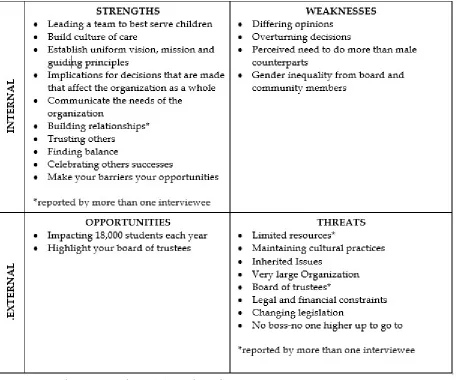
Findings from the SWOT analysis uncovered com-mon themes within the female participants (Figure 1). These themes were identified as communication, rela-tionships, vision, and gender issues. Several internal strengths emerged while reviewing the participants’ responses through the SWOT. Communication, rela-tionships, and vision were identified as strengths and opportunities for female superintendents. Communi-cating the needs of the organization, being in cohesion with the board of trustees, and communicating a cul-ture of care were highlighted as strengths. However, communicating the differing opinions of individuals and overturning established practices were both de-fined as weaknesses.
Participants noted the importance of building rela-tionships inside and outside the organization. Rela-tionships were identified as trusting others, finding balance, and celebrating others’ successes. However, the relationship with the board of trustees was also perceived as a potential threat and opportunity. One superintendent pointed out, “When you’re able to highlight your board of trustees and establish trust within your relationship, you’re able to be more im-pactful within the organization.”
The development and establishment of a cohesive vision within the organization of the district was not-ed as a strength and opportunity. One superintendent stated she was a firm believer in vision, mission, and guiding principles within an organization. She also remarked it would be challenging to lead a district if the norms and values of the organization were not clearly articulated.
posi-tion, was not feasible for a mother with young chil-dren.
Male Responses
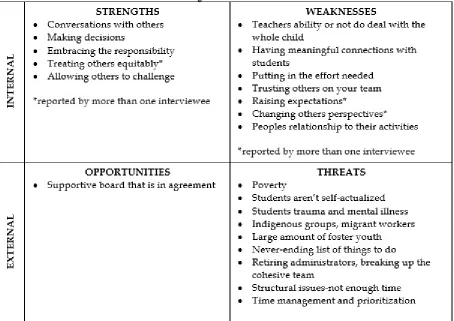
Similar themes were uncovered for the male par-ticipants within the findings from the SWOT analysis (Figure 2). These themes were identified as communi-cation, relationships, and vision. Gender issues and feel-ings of inequality were not a defined theme from male participants. The importance of communication for the superintendency was defined as a strength, as was making decisions and embracing the responsibility of the position. A weakness, which was noted by more than one participant, was the challenge in changing others’ perspectives. Raising the expectations of indi-viduals was also stated as a weakness from more than one participant. In both instances, superintendents described the difficulty in reforming practices that have always been in place, which had not been chal-lenged or changed throughout the years. Encouraging and requiring these changes were viewed as
challeng-es, which we defined as weaknesses within the organ-ization.
Establishing and maintaining relationships within the organization were defined as both a strength and opportunity. One superintendent remarked when you “treat everyone from a board member to a food service worker with the same level of respect, I think that transforms a district and sets the tone that every-one has a seat at the table and everyevery-one’s voice will be heard.” Another participant stated the importance of being “hard on the issues but soft on people.” This resonated a common sentiment of the participants of the importance of building solid relationships within the organization.
The challenge of creating a shared vision within the organization was a perceived weakness to several par-ticipants. One superintendent stated he felt people’s expectations could be barriers to the organization. Conversely, some superintendents viewed individuals who challenge the system or vision as an opportunity for growth within the organization. They also viewed
those hard-handed decisions and the responsibility that is accompanied with the job as an opportunity. The male participants were able to define more threats and weaknesses than strengths and opportuni-ties as compared to the female participants. The fe-male participants noted more strengths and opportu-nities above all others. Additionally, male partici-pants did not recognize gender issues. Communica-tion and relaCommunica-tionship building were both identified as areas of strength by both groups of participants. Both groups noted there are opportunities available given their ongoing interactions with the boards of trustees. Both groups also agreed that working with differing opinions, raising expectations, and changing decisions and perspectives were a defined weakness within their organizations. Lastly, the cultural practices of the district and how to approach what has been main-tained within the organization were noted as threats. One obvious theme missing from the male partici-pants as compared to females was the feeling of ine-quality and gender issues. None of the male partici-pants recognized any threats or weaknesses of being a male superintendent, whereas several of the female participants noted feelings of inequality being a fe-male and the challenges accompanied with serving as
superintendent. Although the number of females within the role of superintendent has steadily in-creased over the past few decades, there continues to be obvious challenges that females face that their male counterparts do not.
Research Question 3: What commonalities exist as it relates to the career pathway towards becoming a superintendent ?
The last area considered in this case study was that of the career pathway of each person interviewed as they worked towards becoming a superintendent. Unlike the responses to previous research questions, the interviewees did not elaborate on their career pathways, thus their responses were concise. Female Responses
Prior to taking on the role of the superintendent, all three female participants held the positions of teacher, assistant principal, and principal. The female partici-pants all pursued education and did not consider oth-er careoth-ers choices.
All three females spoke of the importance of hold-ing different positions leadhold-ing up to the superintend-ency. All participants explained that their experiences
in the different positions helped better prepare them for the challenges that they face in the role of superin-tendent. The amount of time spent in each position was not as important as how effective they were as a leader in those positions. Additionally, the
knowledge they were able to gain while serving in prior roles allowed them to be more effective in the educational leadership position.
Male Responses
Similar to the female participants, all three males held the positions of teacher, assistant principal, and principal. While none changed careers mid-life, two of the three did speak of how education was not their original field of study in college. However these two participants expressed their need and desire to make a difference in children’s lives as a factor in their ulti-mate decision to pursue a career in education.
There were no common themes that emerged in the male responses to career pathways when they elabo-rated on this particular question. One spoke of the need to become more assertive in the leadership role. He spoke about having tough conversations with peo-ple and how this was a weakness of his, so to help improve this skill, he sought out a position in human resources to build on this area. He stated he used to be a “fixer,” but using his experience in the variety of positions held helped him to understand that it is his job to challenge the barriers of his team. Another spoke about the superintendency as the opportunity for personal growth and the ability to do a million jobs in one. He also said the superintendency pro-vides great opportunity for “scaling,” which he de-scribed as going from micro-granular to the big pic-ture and back. He sees his role in the bigger picpic-ture as making the world a better place. Another spoke of the influence of his father being a migrant farm worker, which caused his family to move around a lot as a child. This personal experience led to a better under-standing and appreciation for the struggles and chal-lenges that children of farm workers face each day. He noted that as a superintendent, “you have an op-portunity each day to make a difference”.
Combined Female and Male Responses and Emer-gent Themes
While discussing their career pathways, all six par-ticipants described an obvious passion for the work they do and displayed a strong commitment to im-proving school environments and fostering student learning. All six highlighted similar themes of the im-portance of knowing thyself, having a defined mission and vision that is developed and shared with the stakeholders,
and answering the call to serving and making a difference in the lives of children.
Limitations
For the findings of this study to be properly under-stood, they should be considered in the context of their limitations. The researchers were required to complete the study within a limited timeframe, thus resulting in a relatively small sample size of male and female participants. A larger sample size may have provided a more in-depth analysis highlighting addi-tional themes for exploration. Second, because this study relied on self-reported data, it may have been influenced by poor understanding and could be vul-nerable to intentional deception that comes from the desire to conform to social expectations. Although our participants seemed to speak candidly in response to the research questions, some may not have felt safe to be forthcoming, resulting in guarded responses.
Implications and Future Research
Issues of gender bias are ever present. When com-pared to men, women are still perceived as being infe-rior in both strength and intelligence. Many still fear that women will make decisions based on emotion rather than facts. This is an area that would be worth exploring by further interviewing and surveying mul-tiple stakeholders regarding their perspectives on women in positions of power and their abilities to ef-fectively lead an organization. An additional area for future research is the decision-making process behind a woman’s choice of pursuing a high-power educa-tional leadership position such as superintendent. With more men choosing to adopt the role of the stay-at-home parent or follow the non-traditional path and support and accept the woman as the top salary earn-er, women may begin to feel more inclined to pursue a superintendent position without feeling any sense of guilt in doing so. Lastly, additional areas of research may include expanding the study sample size, com-paring urban versus rural school district superinten-dents, and comparing challenges of women and men seeking administrative roles in higher education. Continued research on this topic will add to the grow-ing knowledge base of female leaders.
Conclusion
super-intendent role. Each male supersuper-intendent gave unique responses, but no common themes emerged. Using a SWOT analysis, female participants highlight-ed more strengths and opportunities of the superin-tendency than males, while male participants noted more threats and weaknesses. Female participants noted that being a female carried a unique set of chal-lenges, and along with feelings of inequality, acted as a barrier to their leadership position. Male partici-pants did not mention any gender-related concerns.
References
Balamuralikrishna, R., & Dugger, J. C. (1995). SWOT analysis: A management tool for initiating new programs in voca-tional schools. Journal of Vocational and Technical Education, 12.
Baltzell, D., & Dentler, R. (1983). Selecting American school principals: A sourcebook for educators. Washington, DC: U.S. Dept. of Education, National Institute of Education.
Bolman, L. G., & Deal, T. E. (1990). Leadership orientations instrument. San Francisco, CA: Jossey-Bass.
Bolman, L. G., & Deal, T. E. (2013). Reframing organizations (5th ed.). San Francisco, CA: Jossey-Bass.
Chase, S. E., & Bell, C. S., (1990). Ideology, discourse and gender: How gatekeepers talk about women school superinten-dents. Social Problems, 37(2), 163-177.
Corbin, J., & Strauss, A. (2008). Basics of qualitative research (3rd ed.). Thousand Oaks, CA: Sage.
DeSilets, L. D. (2008). SWOT is useful in your tool kit. The Journal of Continuing Education in Nursing, 39(5), 196-197.
Derrington, M. & Sharrat, G. (2009). Women superintendents: Breaking barriers and challenging lifestyles. Delta Kappa Gamma Bulletin, 75(2), 8-12.
Glass, T. E., Bjork, L., & Brunner, C. C. (2000). The study of the Ameri-can school superintendency, 2000. Arlington, Va.: American Association of School Administrators.
Grogan, M., & Brunner, C. C. (2005). Women leading systems. School Administrator,62(2), 46-50.
Kowalski, T., McCord, R., Peterson, G., Young, P., & Ellerson, N.
(2011). The American school superintendent: 2010 decennial
study. Lanham, MD: Rowman & Littlefield Education/ American Association of School Administrators.
Muñoz, A., Pankake, A., Murakami, E., Mills, S., & Simonsson, M.
(2014). A study of female central office administrators and
their aspirations to the superintendency. Educational
Man-agement Administration and Leadership,42(5), 764-784. Senge, P. M., (1990). The Fifth Discipline: The art & practice of the
learn-ing organization. New York: Random House.
Shakeshaft, C. (1989). Women in educational administration (Rev. ed.).
Newbury Park, CA: Sage Publications, Inc.
Sperandio, J., Devdas, L. (2014). Staying close to home: Women's life
-choices and the superintendency. Journal of Educational
Administration, 53(3), 335-353.
Tallerico, M. (2000), Gaining access to the superintendency:
Headhunting, gender, and color. Educational
Administra-tive Quarterly, 36(1), 18-24.