R E S E A R C H
Open Access
Regularized super-resolution restoration
algorithm for single medical image based
on fuzzy similarity fusion
Xingying Li
1and Weina Fu
2,3*Abstract
Medical images are blurred and noised due to various reasons in the acquirement, transmission and storage. In order to improve the restoration quality of medical images, a regular super-resolution restoration algorithm based on fuzzy similarity fusion is proposed. Based on maintained similarity in multiple scales, the fused similarity of the medical images is computed by fuzzy similarity fusion. First, fuzzy similarity is determined by the regional features. The images with certain similarity are obtained according to the maximum value, and the fused image is obtained by all obvious regional features. Then, an adaptive regularized restoration algorithm is employed. In order to ensure the objective function has a global optimal solution, regularized parameters of the global minimum solution of nonlinear function are solved iteratively. Finally, experimental results show that mean square error (MSE) and peak signal-to-noise ratio (PSNR) of the restored image are visibly improved. The restored image also has an obvious improvement in the burr of local edge. Moreover, the algorithm has good stability with significantly enhanced PSNR.
Keywords:Fuzzy similarity, Fusion, Medical image, Regular super-resolution, Image restoration, Burr of edge
1 Introduction
In clinical practice, imaging is widely used in medical diagnosis and treatment because of its high safety and strong real-time performance. With the rapid develop-ment of medical technology, a large number of high-resolution images have emerged, such as computed tom-ography (CT), positron emission tomtom-ography (PET), magnetic resonance imaging (MRI), diffuse weighted im-aging (DEI), single photon emission computed tomog-raphy (SPECT), etc. These imaging techniques provide a variety of functional and anatomical information at dif-ferent spatial and temporal resolutions [1]. All these kinds of medical images with super-resolution play an important role in life science research, medical diagnosis and clinical treatment. Therefore, super-resolution res-toration improves the resolution of medical images, real-izes the detection and recognition of more subtle
lesions, and assists doctors to provide more accurate in-formation for reducing the misdiagnosis rate.
However, original medical images are far from these re-quirements. Therefore, it is of great significance to recover the acquired image, which plays an important role in image recognition, detection and classification. Obtaining satisfied high-resolution images by improving physical hardware is difficult and expensive. Therefore, the restor-ation technology that improves the image resolution through software has become a research hotspot [2].
For restoration of single image with traditional methods, since only one input image is utilized, the en-hancement of restoration and resolution is greatly lim-ited [3]. Therefore, current research focuses on super-resolution image restoration based on sequence images by assuming that imaging conditions (light, lens focal length, etc.) at different times are identical with no major change in an one-time application (such as large deformation, occlusion) [4]. However, the registration accuracy, which is the key to super-resolution recovery by using sequence images, is affected heavily because these conditions are difficult to fully satisfy. Super-Resolution (SR) refers to recover a high-resolution image
© The Author(s). 2019Open AccessThis article is distributed under the terms of the Creative Commons Attribution 4.0 International License (http://creativecommons.org/licenses/by/4.0/), which permits unrestricted use, distribution, and reproduction in any medium, provided you give appropriate credit to the original author(s) and the source, provide a link to the Creative Commons license, and indicate if changes were made.
* Correspondence:[email protected] 2
College of Compute and Information Enginnering, Inner Mongolia Agricultrual University, Hohhot 010018, China
3College of Information Science and Engineering, Hunan Normal University,
Changsha 410081, China
(HR) with a richer detail from low-resolution image (Lower Resolution, LR) with multi-frames, and it soon becomes a hotspot in medical imaging [5]. The SR tech-nique is based on some prior knowledge of image deg-radation, which is degraded to classic image restoration when the impulse response of the system (the point spread function) is known. However, in most cases, the point spread function is difficult to determine. In this way, super-resolution image restoration extracts the deg-radation information from the observed image in a spe-cific way to find out image restoration method.
Current research of the super-resolution has made some achievements in image restoration algorithms. However, its application range has certain limitations. Jeong et al. assumed that the Point Spread Function (PSF) was a circle and used a cyclic square matrix as the degenerate matrix to use fuzzy system in super-resolution image estimation [6]. Their method is an iter-ation which identifies PSD and estimate real image itera-tively. In the iteration, they set one in PSD and real image to a known result when the other is estimating by generalized crossover criteria. Meantime, Alqadah et al. effectively dealt PSF with the Linear Spatial Invariant (LSI) fuzzy conditions, and estimated the fuzzy parame-ters by Gaussian quadratic criterion and Lanczos algo-rithm [7]. They also improved the secondary and cyclical requirements of the PSF matrix, and increased robust-ness and effectiverobust-ness of the algorithm. Recently, an adaptive regular blind reconstruction algorithm was also proposed by a regular processing based on local smooth features of images [8].
In order to improve the resolution of medical images, it is considered to constrain the super-resolution solu-tion space for LR images by using fusion of fuzzy simi-larity and multi-scale retention of the image. This paper studies the regularized super-resolution restoration of medical images to improve restoration effectiveness. Sec-tion 2 provides materials and methods used in this paper; Section 3 provides results of our method by ex-periments; Section4 discussed the results and Section5 concludes the whole paper.
2 Materials and methods 2.1 Super resolution analysis
In general, function of medical image degradation is un-known. Super-resolution image restoration assumes that the LR sequence is an LSI degenerate of the HR image [9]. Blurr ing, down-sampling, and displacement of image are simulated separately. Then, because down-sampling and blurring are unchanged during the forma-tion of the LR sequence, the LR frame is shown in Eq.1.
yk¼DBMkþnk¼Hkxþnk 1≤k≤p ð1Þ where x, yk and nk are the vector of the restored HR
medical image, the k-th frame of degraded image and its additive noise, respectively, the matricesD,BandMkare the down-sampling operator of the imaging system, the fuzzy operator, and the displacement operator of the k -frame medical image, respectively, Hk is the degradation matrix of thek-th frame of medical image. In Eq.1, Dis determined by the down-sampling rate, Mk is estimated by the inter-frame displacement, and the fuzzy operatorB
is related to the PSF. B andnk are generally not directly available and need to be estimated from the LR sequence.
A general super-resolution algorithm adds detail of medical image and improves resolution by fusing all the information in the LR sequence [10]. Assuming that the size of the restored LR medical image is M×N, and the resolution of the medical image is enhanced byr times. The Eq.2is provided by adding Eq.1when k is set from 1 to p.
y¼Hxþn ð2Þ
where y∈RpMN× 1, H∈RpMNr2MN , n∈RpMN× 1, x∈ Rr2MN1
. Therefore, a high-dimensional calculation is re-quired to recover HR medical images from Eq. 2 even for a medium-scale LR image sequence.
Since the fuzzy operatorBis a discrete matrix form of PSF with finitely support, the matrix Bis degraded [11]. Furthermore, in order to fully recover a true HR medical image, an image sequence containing r2frames that in-cludes all non-redundant complementary information is needed. However, the frames’ number of LR image in practical applications is often limited, which makes Eq.2 an ill-conditioned equation. Therefore, regularization is used to solve the problem in this paper.
It is assumed that SR has been accurately estimated in medical image motion, and the blur of image is un-known. In order to simplify the estimation of image blur, we assume that the structure of the PSF is known and the parameters of PSF are unknown. The fuzzy matrixB
is re-expressed as a function with parameterσby Eq.3.
y¼Hð Þσ xþn ð3Þ
In this way, restoration of SR medical image estimates the HR medical image from LR images withpframes by Eq.3.
2.2 Fuzzy similarity fusion strategy based on local feature information
2.2.1 Fuzzy similarity
If the pixel matrix of a fused image is regarded as a two-dimensional fuzzy set, according to the fuzzy mathemat-ical theory, similarity degree between the two fuzzy sets is measured by the closeness of them [12,13]. In a gen-eral data fusion process, it is assumed that there are N
same information collection system respectively. Let xi denotes the data measured by thei-th sensor at a certain time and the random variableXidenotes an observation corresponding to xi. Due to the randomness of external disturbance factors, the true degree of Xi is only deter-mined by the information which is hidden in the datax1,
x2, ⋯xN. The authenticity of xi is high if the similarity betweenxiand the rest data is high [14].
Then, similarity function in fuzzy mathematics is used to quantify the similarity of the observations in each sensor at the same time [15]. Though there are several ways to define the similarity function, the following two definitions are se-lected by applying low computational complexity. At time
k, the similarity of the data measured byNsensors is:
α1;2;⋯;Nð Þ ¼k
minfx1ð Þk ;x2ð Þk ;⋯;xNð Þk g maxfx1ð Þk ;x2ð Þk ;⋯;xNð Þk g
ð4Þ
or
α1;2;⋯;Nð Þ ¼k
N minfx1ð Þk ;x2ð Þk ;⋯;xNð Þk g
x1ð Þk ;x2ð Þk ;⋯;xNð Þk
ð5Þ
wherexi(k) is the result of thek-th sampling of thei-th sen-sor, andα1, 2, ⋯, N∈(0, 1]. When the value is 1, it means that thek-th sampling result ofNsensors is the same, and the maximum similarity is obtained at this time. When the value is close to 0, it means that thek-th sampling result of
Nsensors is almost different and has the smallest similarity.
2.2.2 Regional features
In order to directly extract or weight the average extracted pixels from the fused medical image, Eqs.4–5are used to describe the relation degree of the regional features around each pixel. Since the source image is obtained through a certain pre-processing algorithm, it contains a few noise and has a good visual effect. Therefore, the key point of improvement for the fusion effect is the abundant details of the fused image. In this way, the regional vari-ance, regional gradient, and regional mean are used as re-gional features [16]. The medical image contains more details and the fusion effect of medical image is better when these indicators are large enough.
If a pixel pointI(i,j) is centered, the area variance, region gradient, and region mean of pointI(i,j) are defined as:
V ið Þ ¼;j 1 d
Xiþk
m¼i−k Xjþk
n¼j−k
I mð ;nÞ−I mð ;nÞ
2
ð6Þ
G ið Þ ¼;j 1 d
Xiþk
m¼i−k Xjþk
n¼j−k
G2xðm;nÞ−G2yðm;nÞ
h i1
2
ð7Þ
M ið Þ ¼;j 1 d
Xiþk
m¼i−k Xjþk
n¼j−k
I mð ;nÞ−I mð ;nÞ
ð8Þ
where d is the number of pixels in the area with size (2k+ 1) × (2k+ 1) centered on the point I(i,j), Gx(m,n) and Gy(m,n) represent the first order derivative of the medical image in horizontal direction and vertical direc-tion at the point (m,n), respectively. Then, Iðm;nÞ is used to represent the average of the pixels in the area by Eq.9.
I mð ;nÞ ¼1 d
Xiþk
m¼i−k Xjþk
n¼j−k
I mð ;nÞ ð9Þ
Therefore, the regional featurec(i,j) is used as the meas-urement data of sensor [17]. Similarity α1, 2, ⋯, N of this pixel point in the plurality of fused images is obtained by using Eq.4or Eq.5. Thereby, we select a corresponding ex-traction to obtain an approximate value of the pixel point. In real application, when the similarity α1, 2,⋯,N is lower than a defined lower thresholdTα(Tα> 0), the regional
fea-tures c1(i,j), c2(i,j), ⋯cN(i,j) are considered to be com-pletely different. A general value ofTαis between 0.3 to 0.5.
2.2.3 Rules of fusion decision
Determining the decision rules is the core of fusion strategy. It refers to how we can select information from the source image and add it into the fused image [18]. The simplest method is that we take the mean of source image coefficients as the coefficients of fused image. However, this fusion strategy reduces the contrast of re-sults. It is known from the optical system imaging principle that the high frequency component of sharp image is much larger than blurred image [19]. If gradi-ent, variance, and mean value of a certain area are larger, the more high-frequency information is included in the area and image information is richer. Therefore, the choice of pixels is guided by the size of region gradient, variance, and mean. This decision rule is called the
“maximum selection” [20]. The “maximum selection” rule will reach the best result if only one image provides the most useful information in the corresponding pos-ition of source image. However, not all fusion source im-ages satisfy this assumption in reality. Therefore, the following decision rules are used:
I ið Þ ¼;j
Ik; arg maxfc1ð Þi;j ;c2ð Þi;j;⋯cNð Þi;j g;
α1;2;⋯;N≤Tα
ω1ð Þi;jI1ð Þ þi;j ω2ð Þi;j I2ð Þ þi;j ⋯þ
ωNð Þi;j INð Þi;j ;α1;2;⋯;N >Tα
8 > > < > > : ð10Þ
ωkð Þ ¼i;j ck i;j
ð Þ
c1ð Þ þi;j c2ð Þ þi;j ⋯þcNð Þi;j k
¼1;2;⋯;N ð11Þ
similarityα1, 2, ⋯, N plays a decision-making role in the integration. When the similarity is small, it is considered that only one image provides useful information. At this time, the extraction strategy of fused image is“take one from multiple”, that is, the pixel with best fusion quality is extracted as the final pixel point of the fused image according to region features, and other pixels at same position are dropped. When the similarity is large, the extraction strategy of medical image is“multiple fusion”, that is, the pixel points of the plurality of medical images are weighted and averaged based on regional features to obtain the pixels of the fused image.
The innovation of this decision rule is as follows. A weighted combination of these medical images is used as the fused image, and the weight coefficient is de-termined by regional features at the pixel for a plurality of medical images with a certain degree of relevance [21, 22]. It reduces noise and ensures the stability of fusion when the source image contains similar information. The saliency information in the source image is pre-served when no similar information is included.
Through the above process, multiple medical images are fused based on the fuzzy similarity fusion to obtain a single medical fusion image. Then, a single medical image is restored by using a regularized super-resolution restoration algorithm.
2.3 Adaptive regularization super-resolution restoration Super-resolution image restoration is essentially a mor-bid problem that needs to be solved by a regularization algorithm:
L xð Þ ¼X
K
k¼1
yk−Hkx
T
yk−Hkx
þαk kCx 2 ð12Þ
Considering the penalty effect of similarity in value function, we have
L xð Þ ¼X
K
k¼1
Lkð Þx
¼XK
k¼1
yk−Hkx
T
Sk yk−Hkx
þαkð Þx k kCx 2
h i
ð13Þ
whereαk(x) is a regular parameter,Cis a smoothing op-erator, and is generally taken as a Plass operator.
2.3.1 Selection of regular parameters
A regular parameter is selected to make the nonlinear function L(x) have a global minimum solution. In fact,
L(x) has a global minimum solution ifL(x) is guaranteed to be a convex function [23,24]. Also ifLk(x) is a convex function, L(x) is a convex function by property of the
convex function. Therefore, in order to make that the general function L(x) has a global minimum solution, it is only necessary to ensure that Lk(x) is a convex function.
Proposition 1.If regular parameters satisfy the follow-ing two attributes, Lk(x) is a convex function.
(1)αk(x) is a linear, monotonically increasing function ofLk(x):
αkð Þ ¼x f Lð kð Þx Þ þγkLkð Þx ð14Þ
that is
αkð Þ ¼x yk−Hkx
T
Sk yk−Hkx
1
γk −k kCx 2
ð15Þ
(2)
∂f Lð Þk ∂Lk
< 1
Cx
k k2 ð16Þ
Proof.Let
Lkð Þ ¼x Lkðp;qÞ ¼pþf Lð kðp;qÞÞq ð17Þ wherep= (yk−Hkx)TSk(yk−Hkx),q=‖Cx‖2.
To makeLk(x) a convex function,∀z1,z2and 0 <λ< 1 we have
Lkð Þ ¼x ðλz1þð1−λÞz2Þ≤λLkð Þz1
þð1−λÞLkð Þz2 ð18Þ
wherez1= (p1,q1)T,z2= (p2,q2)T, that is
Lk¼ðλp1þð1−λÞp2;λq1þð1−λÞq2Þ ≤λLkðp1;q1Þ þð1−λÞLkðp2;q2Þ
ð19Þ
According to Eq.17, Eq.19is converted into:
λq1f Lð kðλp1þð1−λÞp2;λq1þð1−λÞq2ÞÞþ 1−λ
ð Þq2f Lð kðλp1þð1−λÞp2;λq1þð1−λÞq2ÞÞ ≤λq1f Lð kðp1;q1ÞÞ þð1−λÞq2f Lð kðp2;q2ÞÞ
ð20Þ
Since αk(x) satisfies Eq. 14, Eq. 20 is further trans-formed into:
λq1Lkðλp1þð1−λÞp2;λq1þð1−λÞq2Þþ 1−λ
ð Þq2Lkðλp1þð1−λÞp2;λq1þð1−λÞq2Þ ≤λq1Lkðp1;q1Þ þð1−λÞLkðp2;q2Þ
ð21Þ
λq1Lkðλp1þð1−λÞp2;λq1þð1−λÞq2Þþ 1−λ
ð Þq2Lkðλp1þð1−λÞp2;λq1þð1−λÞq2Þ≤
λq1½λLkðp1;q1Þ þð1−λÞLkðp2;q2Þþ 1−λ
ð Þq2½λLkðp1;q1Þ þð1−λÞLkðp2;q2Þ ¼
λ2
q1Lkðp1;q1Þ þð1−λÞ 2
q2Lkðp2;q2Þ þλð1−λÞ
q1Lkðp2;q2Þ þq2Lkðp1;q1Þ
½
ð22Þ
Eq.21is equivalent to following Eq.23.
λq1Lkðp1;q1Þ þð1−λÞq2Lkðp2;q2Þ−
λ2
q1Lkðp1;q1Þ−ð1−λÞ2q2Lkðp2;q2Þ−
λð1−λÞ½q1Lkðp2;q2Þ þq2Lkðp1;q1Þ ¼
λð1−λÞðq1−q2Þ½Lkðp1;q1Þ−Lkðp2;q2Þ
ð23Þ
Becauseλ(1−λ) > 0, Eq.23is equivalent to Eq.24.
q1‐q2
ð Þ½Lkðp1;q1Þ−Lkðp2;q2Þ≥0 ð24Þ
We have Eq.25becauseLk(p,q) is a monotonically in-creasing function for q by Eq.24[25].
∂Lk
∂q ≥0 ð25Þ
Because Lk ¼pþfðLkÞq;∂∂Lqk¼
∂f
∂Lk• ∂Lk
∂q•qþfðLkÞ; which is same as
∂Lk ∂q ¼
f Lð Þk 1−q∂∂f Lk
≥0 ð26Þ
And because off(Lk)≥0, thus
∂f
∂Lk< 1
q¼
1
Cx
k k2 ð27Þ
Proposition 1 is proved. ■
2.3.2 Iterative solution
The selection of regularized parameters makes L(x) a convex function. Thus,L(x) has a global minimum solution ^
x, thenΔxLð^xÞ ¼0, andΔx
PK
k¼1αkð^xÞ ¼0. Because
ΔxLkð Þ ¼x −2HkTSk yk−Hkx
þk kCx 2Δxαkð Þx
þ2αkð Þx CTCx ð28Þ
Then,
ΔxLkð Þ ¼x 2 XK
k¼1
HTkSkHkþαkð Þx CTC
x−HTkSkyk
þXK
k¼1
Cx
k k2Δ
xαkð Þx
ð29Þ
Thus, an iterative formula of x is obtained by Eq.30.
xnþ1¼xn−ε XK
k¼1
HTkSkHkþαkð Þx CTC
xn−HTkSkyk
ð30Þ
3 Results
With experimental comparisons between the two differ-ent provided similarities, we find the improved signal-to-noise ratio (ISNR) of the fused image is similar, and ex-perimental results are almost the same. In this way, this paper chooses Eq.4as the similarity measure.
3.1 Recovery analysis of medical images
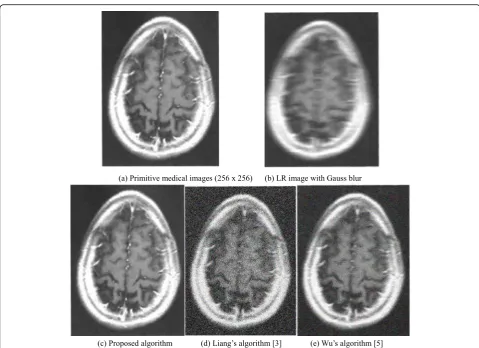
A medical image with size 256 × 256 pixels is used as the test image in our experiment. The test image is con-volved by using the point spread function of a 5 × 5 Gaussian matrix. Then, horizontal and vertical directions are down-sampled to produce an LR image of 128 × 128 pixels by the factor 2, which is used as a reference frame. Moreover, 5 LR image frames with size 128 × 128 are generated with fuzzy similarity matching, and a total of 6 frames of LR images are obtained. Finally, numerical experiment is carried out by using the proposed algo-rithm, and image restoration result is compared with Ref. [3] and Ref. [5]. The results are shown in Fig.1and Table1.
Evaluation of the results is generally divided into two types. One is subjective evaluation, considering the hu-man eye’s feelings for the details of restored image. The other is objective evaluation criterion, generally using MSE and PSNR. Assuming x is the original image, ^x is the restored image, andNis the number of pixels, then MSE and PSNR are shown in Eqs.31–32.
MSE¼ 1 N
XN−1
i¼0
xi−^xi
ð Þ2 ð31Þ
PSNR¼10 lg 255 2 1
N
X N−1
i¼0
xi−^xi
ð Þ2
ð32Þ
improvement on the local edge glitch phenomenon, which is due to the proposed fuzzy similarity fusion algorithm.
3.2 Fusion analysis of fuzzy similarity
Standard medical image 1 (512 × 512) and image 2 (512 × 512) are selected for testing. First, gray value of the real image is normalized. The image is then sub-jected to fuzzy convolution and noise addition to obtain a contaminated image. The PSF of the fuzzy convolution uses a Gaussian function with a standard deviation of 10. Additive noise is Gaussian white noise with a vari-ance of 0.001. Quality of the fused image is measured in terms of ISNR.
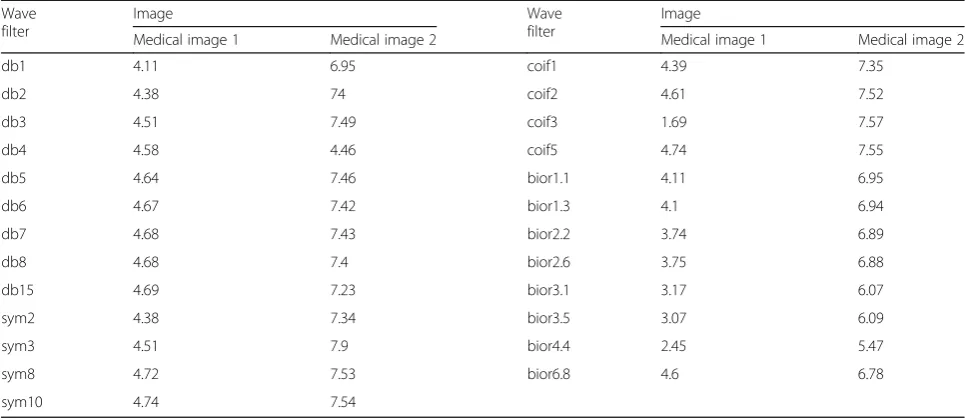
Experiment 1: the image processed by different wavelet bases are used as fused source images, and then image fusion is performed by the proposed algorithm. Compar-ing the performance with fusion image, the results are shown in Tables2and3.
It is known that fusion image’s ISNR of the proposed al-gorithm is significantly improved from Tables2and3. For example, in the fourth group of experiments for image 2 in Table3, source image is an image restored by wavelets db3, sym8, sym10, and ISNR thereof is 7.49, 7.53 and 7.54, respectively. ISNR of the restored image after restoration is 8.01, 8.01 and 8.06, which is 0.5 dB higher than ISNR before fusion, and fusion effect is obvious.
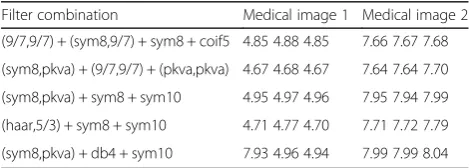
Experiment 2: images from different Contourlet bases and images from different wavelet bases are used as fu-sion source images to compare the image performance using a single Contourlet basis (Table 4) and the per-formance with fusion image (Table5).
It is known that ISNR of the image after fusion is sig-nificantly improved from Tables 4 and 5. For example, in the first group of experiments in Table5, for image 1, ISNR of the image after (9/7, 9/7), (sym8, 9/7), sym8, Fig. 1Comparison of restoration results of different restoration methods.aPrimitive medical images (256 × 256).bLR image with Gauss blur.c Algorithm in this paper.dLiang’s algorithm.eWu’s algorithm
Table 1Comparison of the effects of different methods of single hospital
MSE PSNR
Paper algorithm 237.11 24.38
Liang’s algorithm [3] 141.91 26.61
and coif5 fusion is 4.29, 4 35, 4.72, and 4. 74, respect-ively. ISNR of the fused image processed by the pro-posed algorithm is 4.85 and 4.82, which is improved by 0.1–0.6 dB, and the effect is improved obviously. Com-bined with the results of the first set of experiments, the proposed algorithm has a good fusion effect.
3.3 Stability analysis of the algorithm
The experiment tests stability of the algorithm. For med-ical images of different sizes, image restoration is per-formed using three different restoration algorithms. The image restoration results of different algorithms are compared in Table6.
By analyzing Table 6, when medical image size is 1 MB, difference between MSE and PSNR of the three al-gorithms is both small. The obtained MSE and PSNR values by the proposed algorithm show a gradual as-cending and downward trend with continuous incre-ment of medical image size when medical images with
different sizes are restored. However, the results ob-tained by Ref. [3] and Ref. [5] show an upward trend and a downward trend with more significant volatility when the size of medical image increases. In this way, experimental results show that stability of the proposed algorithm is better than traditional algorithms.
3.4 Comparative analysis of image restoration integrity Taking the integrity of image restoration as an index, the proposed algorithm in this paper is compared with Ref. [3] and Ref. [5]. The results are shown in Fig.2:
From Fig. 2, we find that the algorithm of this paper has the highest recovery integrity, especially when the pixel is 300, the recovery of this algorithm reaches a maximum of 90% for medical images with different pixel conditions. Liang’s algorithm is the algorithm with the lowest complete degree of image restoration in the three algorithms. The maximum degree of integrity is 41%, and the image restoration integrity of the algorithm of
Table 2Performance analysis of wavelet-based image fusion algorithms
Wave filter
Image Wave
filter
Image
Medical image 1 Medical image 2 Medical image 1 Medical image 2
db1 4.11 6.95 coif1 4.39 7.35
db2 4.38 74 coif2 4.61 7.52
db3 4.51 7.49 coif3 1.69 7.57
db4 4.58 4.46 coif5 4.74 7.55
db5 4.64 7.46 bior1.1 4.11 6.95
db6 4.67 7.42 bior1.3 4.1 6.94
db7 4.68 7.43 bior2.2 3.74 6.89
db8 4.68 7.4 bior2.6 3.75 6.88
db15 4.69 7.23 bior3.1 3.17 6.07
sym2 4.38 7.34 bior3.5 3.07 6.09
sym3 4.51 7.9 bior4.4 2.45 5.47
sym8 4.72 7.53 bior6.8 4.6 6.78
sym10 4.74 7.54
Table 3Performance analysis of the algorithm in this paper
Experimental serial number
Filter combination Medical image 1 Medical image 2
Gradient Variance Mean value Gradient Variance Mean value
1 db1 + sym8 + sym10 4.8 4.83 4.82 7.84 7.85 7.91
2 sym8 + sym10 + coif5 4.84 4.84 4.84 7.76 7.76 7.78
3 db1 + sym8 + coif5 4.81 4.84 4.83 37.83 7.84 7.9
4 db3 + sym8 + sym10 4.91 4.93 4.92 8.01 8.01 8.06
5 db4 + sym8 + sym10 4.91 4.92 4.91 7.96 7.96 8.01
6 db1 + sym8 4.67 4.71 4.7 7.64 7.67 7.73
7 sym8 + sym10 4.83 4.83 4.83 7.76 7.76 7.78
8 db3 + sym10 4.84 4.87 4.83 7.95 7.95 8.04
the Wu’s algorithm is up to 50%. It can be seen that the image restoration integrity of the proposed algorithm is high, which indicates that the regular super-resolution restoration algorithm in this paper has a strong feasibility.
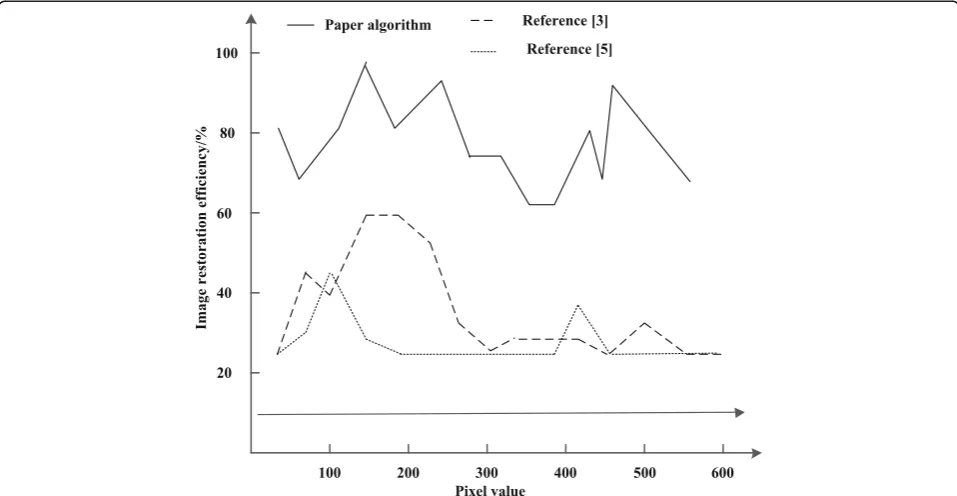
3.5 Comparative analysis of image restoration efficiency Taking the image restoration efficiency as an index, the algorithm in this paper is compared with Ref. [3] and Ref. [5]. The results are shown in Fig.3.
According to Fig.3, the overall image restoration effi-ciency of this algorithm is high, and the average recovery efficiency is up to 80%. The restoration efficiency of al-gorithms in Ref. [3] and Ref. [5] first showed an upward trend, and after the pixel value is 300, the restoration ef-ficiency began to decrease. The average recovery effi-ciency of Liang’s algorithm is 40%, and the average recovery efficiency of Wu’s algorithm is 30%, which shows the superiority of this algorithm.
3.6 Image recovery time-consuming comparison
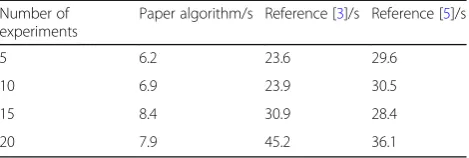
Taking the image recovery time-consuming as an index, the algorithm in this paper is compared with Ref. [3] and Ref. [5]. The results are shown in Table7:
It is clearly in Table 7 that the time consuming is about 7.9 s when the single-amplitude medical image is recovered by the proposed algorithm, the average time consumption of the image recovery of Liang’s algorithm is about 31 s, and the average time of the image recovery
of Wu’s algorithm is about 31 s. It seems that the pro-posed algorithm has obvious advantages, less time-consuming, and can quickly complete the regular super-resolution restoration of single medical images.
4 Discussion
This paper focuses on restoration algorithm of single medical image. The following conclusions are obtained from the proposed experiment. The MSE and PSNR of proposed method are significantly improved by compar-ing with Liang’s algorithm. Though the MSE and PSNR are slightly improved by comparing with Wu’s algo-rithm, the restored image has an obvious improvement on burr phenomenon of local edge. ISNR is enhanced when primitive image is fused by the proposed algo-rithm. When the size of medical images increases, MSE and PSNR values of the proposed algorithm are the most gradual, which means that the proposed algorithm has strongest stability.
The reason that the proposed algorithm has achieved such a good restoration effect is mainly because it im-proves the basic idea of image fusion. In view of the fact that different restoration algorithms have different ad-vantages for different features of an image (texture infor-mation, boundary inforinfor-mation, smooth regions, sharp regions, etc.), multiple images are merged into one image. It allows one image to be restored more com-pletely and accurately by using complementarity of fuzzy similarity fusion.
Research of medical image restoration algorithm is still in its infancy. It mainly focuses on the case where degrad-ation model is linear with no noise. Systematic analysis methods and filter design methods have not yet been formed. In addition, basic theory and applied research are far from mature. Further, research direction of the algo-rithm is roughly divided into the following aspects.
(1) Research on improvement of algorithm
It is known from the above discussion that there are still many shortcomings in various existing algorithms, and it is necessary to further improve the algorithm. For example, how to choose the initial conditions to ensure
Table 4Performance comparison of ontourlet-based restoration algorithms
(LP/DFB) Medical image 1 Medical image 2
(9/7,9/7) 4.29 7.12
(pkva,pkva) 4.35 6.09
(haar,pkva) 4.08 6.59
(haar,pkva6) 3.95 6.19
(haar,5/3) 3.71 6.45
(sym8,pkva6) 3.53 7.14
(sym8,pkva) 4.65 7.3
(sym8,9/7) 4.35 7.13
(sym8,5/3) 3.94 6.83
Table 5Performance analysis of the algorithm in this paper
Filter combination Medical image 1 Medical image 2
(9/7,9/7) + (sym8,9/7) + sym8 + coif5 4.85 4.88 4.85 7.66 7.67 7.68
(sym8,pkva) + (9/7,9/7) + (pkva,pkva) 4.67 4.68 4.67 7.64 7.64 7.70
(sym8,pkva) + sym8 + sym10 4.95 4.97 4.96 7.95 7.94 7.99
(haar,5/3) + sym8 + sym10 4.71 4.77 4.70 7.71 7.72 7.79
(sym8,pkva) + db4 + sym10 7.93 4.96 4.94 7.99 7.99 8.04
Table 6Comparisons of stability of different algorithms
Image size/ MB
Algorithm in this paper Liang’s algorithm Wu’s algorithm
MSE PSNR MSE PSNR MSE PSNR
1 96.34 199.24 100.53 186.42 99.51 191.55
10 96.93 196.57 112.68 180.66 106.63 180.02
100 97.36 194.84 139.83 164.58 122.20 151.31
1000 97.42 190.62 175.86 133.80 151.09 122.64
convergence of the algorithm. How to choose an algo-rithm termination condition to guarantee the restoration quality? How to choose the noise parameters in filter to reduce influence of noise is a hot topic in the future.
(2) Research on denoising processing algorithm
Presence of additive noise makes image restoration a challenge. Since general assumption is that only statistical properties of the noise are known, it is impossible to com-pletely remove the noise from a degraded image. In addition, due to the presence of noise, restoration effect is not ideal. Research on image restoration algorithm Fig. 2Integrity comparison of image restoration
combined with noise reduction has very practical signifi-cance. In most algorithms, noise is described as Gaussian noise, which has great limitations in practical applications. It is also an important research direction for the study of non-Gaussian cases using noise-based high-order statis-tical characteristics of denoising algorithms.
(3) Real-time processing algorithm
Complexity of the algorithm is an important direction that restricts its application. In related data, a method of regularized discrete periodic Radon transform is pro-posed to transform two-dimensional convolution into one-dimensional processing to improve algorithm’ speed. And real-time processing algorithms using neural networks. Real-time nature of the algorithm is a pre-requisite for its practical application.
(4) Applied research
Application of algorithms is a driving force behind re-search. Although image restoration algorithms have gained great applications in astronomy, medical science, and remote sensing. However, there is still a lot of work to be done to apply algorithms to general industrial image real-time detection, machine vision, and image transmission in network environment to recover crim-inal investigation.
5 Conclusion
In most electronic imaging systems, people are eager to obtain images with high resolution because these images provide more details, especially in medical research field. However, during the imaging process, there are many factors which cause descending and degradation of image quality. Such as optical system aberrations, air dis-turbances, motion, defocusing, discrete sampling, and system noise, which cause image blur and distortion. In the actually solution to the problem of image quality de-scending and degradation, image processing with super-resolution is emerged. It provides many different methods to solve the above problems, and it has very important ap-plication value and broad apap-plication prospects in many fields such as medicine.
In this paper, a regularized super-resolution restor-ation algorithm for single medical image is proposed based on fuzzy similarity fusion. The fuzzy similarity fusion algorithm is used to obtain the fused image, and regularized super-resolution restoration is performed for the fused image, which greatly improves image restor-ation effect.
In addition, we will focus on the improvement of algo-rithm, including the strategy of convergent initial parameter choice, as well as algorithm termination condition choice.
Abbreviations
CT:Computed tomography; DEI: Diffuse weighted imaging; HR: High-resolution; ISNR: Improved signal-to-noise ratio; LR: Low-High-resolution; LSI: Linear spatial invariant; MRI: Magnetic resonance imaging; MSE: Mean square error; PET: Positron emission tomography; PSF: Point spread function; PSNR: Peak signal-to-noise ratio; SPECT: Single photon emission computed tomography; SR: Super-Resolution
Acknowledgements
We want to thank Dr. Ma from Surrey University for his help of English improvement.
Authors’contributions
XL designs and codes total algorithm. WF find the motivation and analyze the results. Both authors read and approved the final manuscript.
Funding
This research is supported by following grants:
Natural Science Foundation of Inner Mongolia [No. 2018MS6010]; Foundation Science Research Start-up Fund of Inner Mongolia Agriculture University. [JC2016005];
Scientific Research Foundation for Doctors of Inner Mongolia Agriculture University. [NDYB2016–11].
Availability of data and materials
Data sharing not applicable to this article as no datasets were generated or analyzed during the current study.
Competing interests
The authors declare that they have no competing interests.
Author details 1
School of Culture Management, Wuhan University of Communication, Wuhan 430000, China.2College of Compute and Information Enginnering, Inner Mongolia Agricultrual University, Hohhot 010018, China.3College of Information Science and Engineering, Hunan Normal University, Changsha 410081, China.
Received: 3 April 2019 Accepted: 3 October 2019
References
1. Y. Zhang, H. Wang, H. Liu, Medical image segmentation fusion based on finite naive Bayes mixture model. J. Med. Imaging Health Inform.6(8), 1865– 1871 (2016)
2. B. Moon, S. Yu, S. Ko, Continuous digital zooming using local self-similarity-based super-resolution for an asymmetric dual camera system. J. Opt. Soc. Am. A Opt. Image Sci. Vis.34(6), 991–1003 (2017)
3. G. Liang, P. Shivakumara, T. Lu, Multi-spectral fusion based approach for arbitrarily oriented scene text detection in video images. IEEE Trans. Image Process.24(11), 4488–4501 (2015)
4. X. Luo, Z. Zhang, X. Wu, A novel algorithm of remote sensing image fusion based on shift-invariant Shearlet transform and regional selection. Int. J. Electron. Commun.70(2), 186–197 (2016)
5. D. Wu, G. Zhang, J. Lu, A fuzzy preference tree-based recommender system for personalized business-to-business e-services. IEEE Trans. Fuzzy Syst.23(1), 29–43 (2015)
Table 7Image recovery time-consuming comparison
Number of experiments
Paper algorithm/s Reference [3]/s Reference [5]/s
5 6.2 23.6 29.6
10 6.9 23.9 30.5
15 8.4 30.9 28.4
6. S. Jeong, I. Yoon, J. Paik, Multi-frame example-based super-resolution using locally directional self-similarity. IEEE Trans. Consum. Electron.61(3), 353–358 (2015)
7. F. Alqadah, C. Reddy, J. Hu, Biclustering neighborhood-based collaborative filtering method for top-n recommender systems. Knowl. Inf. Syst.44(2), 475–491 (2015)
8. S. Ma, Y. Tan, G. Xu, Image completion based on fusion of patch associated matching and low-rank matrix super resolution. J. Comput. Aided Des. Comput. Graph.27(2), 271–278 (2015)
9. M. Nilashi, O. Ibrahim, N. Ithnin, A multi-criteria recommendation system using dimensionality reduction and Neuro-fuzzy techniques. Soft. Comput.
19(11), 3173–3207 (2015)
10. S. Huang, J. Ma, P. Cheng, A hybrid multigroup coclustering
recommendation framework based on information fusion. ACM Trans. Intell. Syst. Technol.6(2), 1–22 (2015)
11. D. D’Addona, A. Ullah, D. Matarazzo, Tool-wear prediction and pattern-recognition using artificial neural network and DNA-based computing. J. Intell. Manuf.28(6), 1–17 (2017)
12. F. Xiao, An improved method for combining conflicting evidences based on the similarity measure and belief function entropy. Int. J. Fuzzy Syst.20(1), 1–11 (2017)
13. T. Gonzálezarteaga, J. Alcantud, R. Calle, A cardinal dissensus measure based on the Mahalanobis distance. Eur. J. Oper. Res.251(2), 575–585 (2016) 14. W. Li, X. Hu, J. Du, Adaptive remote-sensing image fusion based on
dynamic gradient sparse and average gradient difference. Int. J. Remote Sens.38(23), 7316–7332 (2017)
15. V. Kek, S. Vinodh, P. Brajesh, Rapid prototyping process selection using multi criteria decision making considering environmental criteria and its decision support system. Rapid Prototyp. J.22(2), 225–250 (2016)
16. Y. Hang, L. Jiao, L. Fang, CRIM-FCHO: SAR image two-stage segmentation with multifeature ensemble. IEEE Trans. Geoscience Remote Sensing54(4), 2400–2423 (2016)
17. S. Liu, W. Bai, N. Zeng, A fast fractal based compression for MRI images. IEEE Access7, 62412–62420 (2019)
18. S. Anitha, T. Subhashini, M. Kamaraju, A novel multimodal medical image fusion approach based on phase congruency and directive contrast in NSCT domain. Int. J. Comput. Appl.129(10), 30–35 (2015)
19. S. Liu, W. Bai, G. Liu, Parallel fractal compression method for big video data. Complexity2018, 2016976 (2018)
20. S. Liu, Z. Pan, X. Cheng, A novel fast fractal image compression method based on distance clustering in high dimensional sphere surface. Fractals
25(4), 1740004 (2017)
21. Y. Shen, J. Wu, D. Wu, Fault diagnosis technology for three-level inverter based on reconstructive phase space and SVM. J. Power Supply15(6), 108– 115 (2017)
22. L. Mengye, L. Shuai, Nucleosome positioning based on generalized relative entropy, soft computing, (online published). Soft Computing23(19), 9175– 9188 (2019).https://doi.org/10.1007/s00500-018-3602-2
23. R. Chou, H. Cheng, W. Sun, An improved BRISK image registration method based on adaptive threshold. Automation Instrum.5, 172–173 (2015) 24. L. Shuai, L. Gaocheng, Z. Huiyu, A robust parallel object tracking method for
illumination variations. Mobile Netw. Appl.24(1), 5–17 (2019)
25. C. Guo, B. Wu, Z. Qin, Y. Wang, Total bounded variation fourth-order PDE image restoration model. Comput. Simul.32(7), 239–243 (2015)
Publisher’s Note