O R I G I N A L A R T I C L E
T a k u y a A k i y a m a 9 T o m o k o S u g i m o t o 9 Y u j i M a t s u m o t o G y o s u k e M e s h i t s u k a
Erythro/threo ratio of
fl-O-4
structures as an important structural
characteristic of lignin, h Improvement of ozonation method for the
quantitative analysis of lignin side-chain structure
Received: February 13, 2001 / Accepted: July 23, 2001
A b s t r a c t Ozonation as a quantitative tool to analyze the stereo structures of arylglycerol-fi-aryl ether linkages was examined using wood meal, milled wood lignin, and a lignin model compound, 1-(3,4-dimethoxyphenyl)-2- (2-methoxyphenoxy)-l,3-propanediol (ver atrylglycerol-[3- guaiacyl ether, VG). The procedure was improved. When mild postreduction was conducted for ozonation products, the total yield of erythronic and threonic acids from this model compound was 74%, which is 15% higher than the yield without postreduction. A decrease in the recovery of these two acids under prolonged ozonation treatment was successfully suppressed by postreduction. The erythro/threo ratio of V G determined by the ozonation method with pos- treduction is in good agreement with the ratio determined by tH-nuclear magnetic resonance. Excellent reproduci- bility of the yield was obtained by adopting a procedure that included trimethylsilylation of a m m o n i u m salts of o z o n a t i o n p r o d u c t s using a d i m e t h y l s u l f o x i d e - hexamethyldisilazane-trimethylchlorosilane mixture and subjecting it to gas c h r o m a t o g r a p h y analysis. It was con- cluded that arylglycerol-[3-aryl ether structures comprise at least 35% of the C3-C6 structure in birch wood meal, with an erythro/threo ratio of 2.8.
K e y w o r d s L i g n i n 9 Arylglycerol-[3-aryl ether structure 9 Ozonation Erythro. Threo
T. Akiyama ([]) 9 T. Sugimoto. Y. Matsumoto. G. Meshitsuka Wood Chemistry Laboratory, Department of Biomaterial Sciences, Graduate School of Agricultural and Life Sciences, The University of Tokyo, 1-1-1 Yayoi, Bunkyo-ku, Tokyo 113-8657 Japan Tel. +81-3-5841-5263; Fax +81-3-5802-8862
e-mail: [email protected]
This paper was presented at the 43rd Lignin Symposium, Fuchu, Japan, October 1998; and at the 10th ISWPC, Yokohama, Japan, June 1999
Introduction
Selective degradation of the aromatic nuclei of lignin by ozone gives low-molecular-weight compounds that retain the stereo structures of the original stereo side-chain structures of lignin. This m e t h o d was first applied by A u l i n - E r d t m a n et al. 1 for configuration analysis of a phenylcoumaran-type compound obtained as a major prod- uct by dehydrogenative condensation of isoeugenol. Later, this m e t h o d was developed in our laboratory to analyze various side-chain structures of lignin including [3-0-4 struc- tures (Fig. 1). Many applications of this method have been reported, and some important chemical characteristics of side-chain structures in various lignins were discussed: The main configuration of the phenylcoumaran ([3-5)-type struc- ture in spruce milled wood lignin (MWL) was confirmed to be the trans form2; the diarylpropane ([3-1)-type structure, if present, and glyceraldehyde-2-aryl ether structure are not the major structures in spruce lignin) -~ Recently, use of the ozonation method for analysis of lignin-carbohydrate bonds of the benzylic ether type has been reported, 6 which suggests a wide application for this method.
This method is applicable not only to soluble lignin in ozonation solvent but also to an insoluble one, such as lignin in wood meal or pulp, highly polymerized dehydrogenation p o l y m e r (DHP), Klason lignin, etc. This applicability to insoluble samples is a great advantage over other spectro- scopic methods using isolated soluble lignins because isola- tion usually cannot be p e r f o r m e d quantitatively and is always accompanied by chemical modification.
C. H20H
....
"'"
"/~
"OC H3 erjrthro0 3
l=
NaOH
C, H20H
H--(~-OH
J. I
H - - C - - O H I C O O H
erythronic acid
H20H
H-C-O--# \7 ....
HO-&H CO .
. " ' ~ O C H 3
threo
O3 NaOH
CH2OH
I
H - - C - - O H
" HO--(~--H
(~OOH
threonic
acid
Fig. 1. Formation of two tetronic acids from side chains of arylglycerol- fl-aryl ether structures by ozonation
ozone treatment
]in CHaCOOH,H 20,CH3OH
at 0~
[ reductive treatment ]
by adding Na 2S203
[ saponification ]
with aq
NaOHinternal standard
I
cation exchange
1
(NH 4§
form)
I trimethylsilylation
}with HMDS,TMCS,DMSO
I
GC
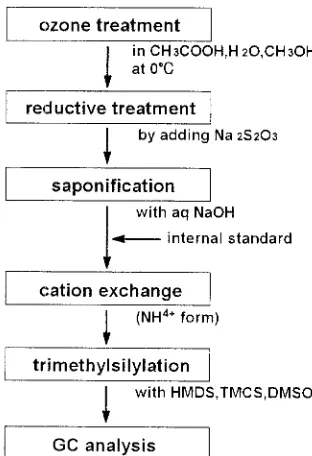
analysisFig. 2. Experimental scheme for modified ozonation method, aq. aque- ous; HMDS, hexamethyldisilazane; TMCS, trimethylchlorosilane; DMSO, dimethylsulfoxide; GC, gas chromatography
relative to the internal standard are not always satisfactory. Therefore, it became necessary to develop a suitable proce- dure for quantitative analysis.
In this study, p o s t t r e a t m e n t procedures after ozone treatment were examined in detail, and two modifications are proposed. The modified experimental scheme for the ozonation method is shown in Fig. 2. One is the reductive posttreatment of ozonation products with sodium thiosul- fate. A n o t h e r is the trimethylsilylation of a m m o n i u m salts without forming lactones for gas chromatography (GC). 8'9 We aimed to improve the ozonation method for quantita- tive analysis of the fi-O-4 substructure in lignin.
Experiment
Materials
Model compounds. D-Erythronic and L-threonic acid a m m o n i u m salts were p r e p a r e d f r o m c o m m e r c i a l o- erythronolactone and L-threonic acid calcium salt as fol- lows. 9 D-Erythronolactone and L-threonic acid calcium salt were kept at pH 10 with N a O H overnight at r o o m temperature, and each solution was then passed through a column filled with cation-exchange resin (NH4 form). 1 - ( 3 , 4 - D i m e t h o x y p h e n y l ) - 2 - ( 2 - m e t h o x y p h e n o x y ) - l , 3 - propanediol (veratrylglycerol-fi-guaiacyl ether, V G ) was synthesized according to the method of Adler et al. t~ Milled wood lignin. M W L was p r e p a r e d f r o m ethanol/ benzene-preextracted beech (Fagus crenata B1.) wood meal. The wood meal was milled for 24h according to Bj0rkman's m e t h o d 11 except that the milling was conducted without dispersing in toluene.
Wood meal. An 80-mesh-pass birch (Betula maximowiczii Regel) wood meal was extracted with ethanol/benzene (1:2, v/v) for 6h. The lignin content determined by acetyl bromide was 21%.
NaC102-delignified wood meal. A 5-g sample of wood meal was treated with 2g of NaC102 in diluted acetic acid aqueous solution at 70~176 for l h . This treatment was repeated five times. The treated wood meal was extracted with 1M N a O H solution at room temperature.
Ozonation
Samples (200mg of wood meal, 10-30mg of MWL, and 0.02mmol of erythronic and threonic acid ammonium salts) were suspended or dissolved in 30ml of ozonation solvent consisting of acetic acid/water/methanol (16:3 : 1 v/v/v). Oxygen containing ca. 3% ozone was bubbled into the solu- tion at the rate of 0.51/min for 5, 10, 20, 30, 40, 60, 120, 180, and 240min at 0~ with stirring. The ozone generator used was a Nippon Ozone type ON-3-2.
Posttreatment steps
Preparation of trimethylsilyl derivatives
Ozonation products containing ammonium salts of organic acids were subjected to trimethylsilylation, which was carried out for 30min with 300,ul of dimethylsulfoxide (DMSO), 200/A of hexamethyldisilazane (HMDS), and 100/A of trimethylchlorosilane (TMCS) at 60~ .2 The reac- tion mixture was separated into two phases. The upper layer consisted of aimed derivatives and the excess of silylating agents. The silylation of erythronolactone was carried out with pyridine instead of DMSO.
Gas chromatography and IH-nuclear magnetic resonance
The trimethylsilylated compounds were subjected to gas chromatography (GC) analysis on a Shimadzu 17A gas chromatograph equipped with a flame ionization detector under the following conditions.
Column: G L science NB1 fused-silica capillary column (30m, 0.25mm i.d)
Column temperature: held for 5min at 120~ raised by 4~ to 170~ and by 10~ to 280~
Injection port temperature: 250~ Detector port temperature: 280~ Column flow: 1.9 ml helium/min
The E/T ratio of V G acetylated with acetic anhydride and pyridine was determined by ~H-nuclear magnetic reso- nance (NMR) according to the chemical shift of Ha. ~3 The spectrometer used was a Bruker A C 300, and the solvent was CDC13.
Results and discussion
The quantitativeness during the posttreatment procedure of the o z o n a t i o n m e t h o d was investigated. The loss of ozonation products by the sample drying procedure before trimethylsilylation was suspected to cause poor reproduc- ibility. Figure 3 shows the influence of the drying time in vacuo on the yield of erythronolactone. The peak area of erythronolactone by GC analysis decreased with increasing drying time, whereas that of erythritol used as the internal standard was fairly stable. The loss of erythronolactone confirmed here must have resulted in the poor reproducibil- ity of the relative molar responses of erythronolactone to the internal standard. To avoid this and to exclude the influence of Na salts and N a O H on silylation, erythronic and threonic acids were converted to their trimethylsilyl ethers directly from their a m m o n i u m salts without lactonization and then were subjected to GC analysis. 9
The calibration curves of erythronic and threonic acids with erythritol as an internal standard are shown in Fig. 4. When ammonium salts were silylated with DMSO, HMDS, and TMCS, the calibration curves of both acids fit well with straight lines. The absolute peak area of erythritol was re- producible (1805 +- 169) when the same volumes of sample solutions with the same erythritol concentration were in-
7000
.~ 6000 5000 4000 3000
g
2000 1000
0
I
0 1.5 36
D r y i n g time (hr)
o.6
0.5 0.4 ~ ~
0.3 '- ~ 0 . 2 < ~
0.1 g 0
Fig. 3. Influence of drying time in vacuo on the loss of erythrono- lactone. Open bars, area on GC analysis of erythritol; filled bars,
area on GC analysis of erythronolactone; diamonds, area ratio (erythronolactone/erythritol)
.-. 2.5 "r. a= 2
1,5
0.5
t _
~- 0 "~ 0
+ Erythronic acid
I I I
0.5 1 1.5 A r e a ratio (acid / erythritol)
Fig. 4. Calibration curves of erythronic and threonic acids with eryth- ritol. Erythronic acid: Y = 1.036X + 0.096 (]{2 = 0.999); Threonic acid: Y = 1.123X + 0 . 0 7 7 (]{2 = 0.999)
loo
80 60 40 20 0
E~,thronic acid (with postreduction)
- - ~ Threonic acid (with postreduction) -4~ Erythronic acid
Threonic acid
[ r I
0 60 120 180 240
R e a c t i o n time (min)
100
80 "-" 60 40 20
- r Total
* - ~ - E ~ ' t h r o n i c acid A Threonic acid
A
I P i
0 3 0 60 9 0 1 2 0 R e a c t i o n t i m e ( m i n )
Fig. 6. Yields of ozonation products from veratryl glycerol-fi-guaiacyl ether (VG) without postreduction
100
80
60 40
20
0
---r Total
r3'thronic acid
[ r - - [
60 120 180
R e a c t i o n t i m e (min)
2 4 0
Fig. 7. Yields of ozonation products from VG with postreduction
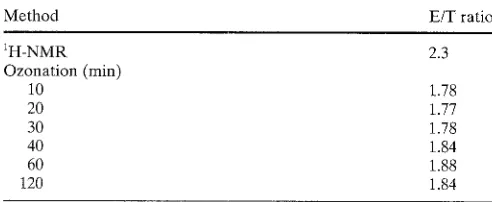
Table 1. Erythro/threo ratio of VG determined by the ozonation method without postreduction
Method E/T ratio
1H-NMR 2.3
Ozonation (min)
i0 1.78
20 1.77
30 1.78
40 1.84
60 1.88
120 1.84
VG, veratrylglycerol-fi-guaiacyl ether; E/T, erythro/threo ratio; NMR, nuclear magnetic resonance
Table 2. Erythro/threo ratio of VG determined by the ozonation method with postreduction
Method E/T ratio
1H-NMR 2.3
Ozonation (min)
5 1.91
10 2.21
20 2.26
40 2.37
60 2.21
120 2.18
240 2.17
jected. From these results, the quantitativeness of this derivatizing procedure was confirmed.
The stability of erythronic and threonic acids toward ozone was examined in their free acid forms. As shown in Fig. 5, although erythronolactone was fairly stable with prolonged ozone treatment, TM free acids of erythronic and
threonic acids were unstable, with the recoveries falling to 57% and 59%, respectively, after ozonation for 120min. However, they increased to 89% and 99%, respectively, by adding sodium thiosulfate immediately after ozone treat- ment (postreduction).
As a lignin model compound, V G was subjected to ozonation with and without postreduction. Figure 6 and Table 1 show the results without postreduction. Total yields of erythronic and threonic acids reached 59% at 120min, and the E/T ratio based on the yield of these two acids obtained by ozonation was 1.8, which was smaller than the 2.3 determined by IH-NMR of acetylated VG. On the other hand, as shown in Fig. 7 and Table 2, the ozonation of V G with postreduction gave these acids in a total yield of 69% at 40min and 74% at 120min. These yields were maintained at a similar level during ozonation for 40-120min, and the E/T ratio determined by this method was in good agree- ment with that derived by 1H-NMR. Based on these results obtained for model compounds, it was demonstrated that the postreduction and trimethylsilylation of ozonation
products in the form of ammonium salts ensures the quan- titativeness of the ozonation method for the/3-0-4 struc- ture.
This improved ozonation method was applied to wood meal and MWL. The reproducibility of the yields of erythronic and threonic acids from M W L and wood meal was examined. The results obtained for 10mg of beech MWL and 200 mg of birch wood meal are illustrated in Figs. 8 and 9, respectively. When 200 mg of wood meal was sub- jected to the improved ozonation method for 2h, the mean total yield (per gram of sample) of these two acids for three trials was 0.318 _+ 0.018mmol, and that of the E/T ratio was 2.79 _+ 0.05. When the sample weight was changed from 200mg to 50mg, almost the same results were obtained (Fig. 9, dotted line). In the case of M W L (10mg and two 30-mg samples), the mean yield and E/T ratio were 1.078 _+ 0.02mmol and 1.68 _+ 0.02, respectively. Those data confirmed the reproducibility of this improved ozonation method even when the sample amount varied.
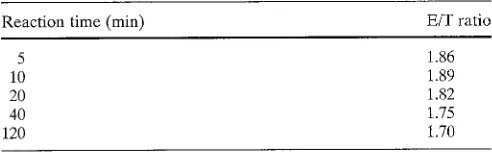
In the cases of M W L and wood meal, the yields of erythronic and threonic acids significantly increased until 40-60min. After that the yields increased only gradually, and the E/T ratio became almost constant, as shown in Tables 3 and 4.
E 1.5
0.5
S
--r Total
-or- Erythronic acid
Threonic acid
I I I
0
0 30 60 90 120
R e a c t i o n time (min)
Fig. 8. Yields of ozonation products from beech milled wood lignin (MWL) with postreduction
0.5
m
0.4
p,m ~
",~ 0.3 0.2
-~ 0.1 0
0
* Total (from wood meal)
+ Ervthronic acid (from wood meal) ThYeonic acid (from wood meal)
I 9 I
60 120 180 240 R e a c t i o n time (min)
Fig. 9. Yields of ozonation products from birch wood meal and NaC102-delignified wood meal with postreduction. Open circles, tetronic acids obtained from NaC1Oz-delignified wood meal; filled circles, tetronic acids obtained from NaC1Oa-delignified wood meal extracted with aqueous NaOH
Table 3. Erythro/threo ratio of beech MWL determined by the ozonation method with postreduction
Reaction time (min) E/T ratio
5 1.86
10 1.89
20 1.82
40 1.75
120 1.70
MWL, milled wood lignin
E / T ratio of l i g n i n samples, t h o u g h the size of i n s o l u b l e samples such as wood meal m a y affect the rate of ozonation. T h e o z o n a t i o n of finer wood meal m a y give erythronic a n d t h r e o n i c acids as rapidly as MWL.
Yields were expressed as m o l a r yields calculated based o n the a s s u m p t i o n that an e q u i v a l e n t m o l e c u l a r weight of o n e u n i t of lignin is 200. T h e total yield of these two acids from M W L was 22.1% at 120 min, a n d that from wood meal t h a t c o n t a i n s 21% l i g n i n (acetyl b r o m i d e m e t h o d ) was 35.3% at 240rain. It was thus c o n c l u d e d that arylglycerol-fi- guaiacyl ether a n d arylglycerol structures comprise at least 22% of the C6-C3 s t r u c t u r e i n b e e c h M W L a n d at least 35.3% of the C6-C3 s t r u c t u r e in birch w o o d meal. T h o s e values are expressed w i t h o u t t a k i n g a n y o t h e r factors (the yields of t h e s e acids f r o m t h e m o d e l c o m p o u n d ) i n t o consideration.
W o o d m e a l delignified with NaC1Oa a n d successively extracted with a q u e o u s N a O H solution gave erythronic a n d t h r e o n i c acids at o n l y 0 . 0 0 3 3 m m o l / g of s a m p l e b y o z o n a t i o n . This value was a b o u t 1% of the yield from the same a m o u n t of w o o d meal. I n t e r e s t i n g l y , w h e n NaC102- delignified wood meal without successive N a O H extraction was s u b j e c t e d to the o z o n a t i o n m e t h o d , a c o n s i d e r a b l e a m o u n t of t h e s e two acids was p r o d u c e d ; the yield was 42.2% of that from the same a m o u n t of wood meal. These results indicate that a d e g r a d a t i o n m e t h o d p e r f o r m e d u n d e r acidic conditions, such as NaC102 t r e a t m e n t , c a n n o t r e m o v e
Table 4. Erythro/threo ratio of birch wood meal determined by the ozonation method with postreduction
Reaction time (min) E/T ratio
30 2.83
60 2.73
120 2.79
240 2.81
all the d e g r a d e d lignin fragments, especially those derived from the side chain parts, a n d that those fragments still act as p r e c u r s o r s of e r y t h r o n i c a n d t h r e o n i c acids w h e n sub- jected to ozonation.
This i m p r o v e d o z o n a t i o n m e t h o d has already b e e n ap- plied to two topics, the chirality of the asymmetric carbon at the fi-position of the fi-O-4 side-chain structures 15 a n d the changes in the E / T ratio of the fi-O-4 structures d e p e n d i n g o n the degree of delignification. 16
Acknowledgment This work was supported by a Grant-in-Aid for Scientific Research (10460071) from the Ministry of Education, Sci- ence, and Culture of Japan.
References
1. Aulin-Erdtman G, Tomita Y, Forsen S (1963) Studies on the deg- radation of liguin and model compounds. I. The configuration of dehydrodiisoeugenol. Acta Chem Scand 17:535-536
2. Habu N, Matsumoto Y, Ishizu A, Nakano J (1988) Configurational study of phenylcoumaran type structure in lignin by ozonation. Mokuzai Gakkaishi 34:732-738
3. Matsumoto Y, Ishizu A, Nakano J (1981) Estimation of glyceralde- hyde-2-aryl ether type structure in lignin by the use of ozonolysis. Mokuzai Gakkaishi 27:750-751
4. Matsumoto Y, Ishizu A, Nakano J (1984) Determination of glycer- aldehyde-2-aryl ether type structure in lignin by the use of ozonoly- sis. Mokuzai Gakkaishi 30:74-78
6. Karlson O, Ikeda T, Kishimoto T, Magara K, Matsumoto Y, Hosoya S (2000) Ozonation of a lignin-carbohydrate complex model compound of the benzyl ether type. J Wood Sci 46:263- 265
7. Matsumoto Y, Ishizu A, Nakano J (1986) Studies on chemical structure of lignin by ozonation. Holzforschung 40(suppl):81-85 8. Tsutsumi Y, Islam A, Anderson CD, Sarkanen KV (1990) Acidic
permanganate oxidations of lignin and model compounds: com- parison with ozonolysis. Holzforschung 44:59-66
9. Hypp~inen T, Sj6str6m E, Vuorinen T (1983) Gas-liquid chromato- graphic determination of hydroxy carboxylic acids on a fused-silica capillary column. J Chromatogr 261:320-323
10. Adler E, Lindgren BO, Saed~n U (1952) The beta-guaiacyl ether of alpha-veratrylglycerol as a lignin model. Svensk Papperstidn 57:245-254
11. Bj6rkman A (1956) Studies on finely divided wood. Part I. Extrac- tion of lignin with neutral solvents. Svensk Papperstidn 59:477-485 12. Verhaar L A T h , de Wilt H G J (1969) The gas chromatographic
determination of potyhydroxy monocarbonic acids obtained by oxygeneration of hexoses in aqueous alkaline solutions. J Chromatogr 41:168-179
13. Lundquist K (1977) NMR studies of lignins. 3.1H NMR spectro- scopic data for lignin model compounds. Acta Chem Scand B 33:418-420
14. Akiyama T, Matsumoto Y, Meshitsuka G (1998) Investigation of lignin stereo structure by ozonation (in Japanese). In: Proceedings of the 43rd Lignin Symposium, pp 21-24
15. Akiyama T, Magara K, Matsumoto Y, Meshitsuka G, Ishizu A, Lundquist K (2000) Proof of the presence of racemic forms of arylglycerol-fl-aryt ether structure in lignin: studies on the stereo structure of lignin by ozonation. J Wood Sci 46:414-415