J Wood Sci (2002) 48:179-184 9 The Japan Wood Research Society 2002
D e d e H e r m a w a n 9 T o s h i m i t s u H a t a . Shuichi K a w a i W a k a t s u N a g a d o m i 9 Y a s u o K u r o k i
[fleet of carbon dioxide-air concentration in the rapid curing process on
the properties of cement-bonded partieleboard
Received: September 22, 2000 / Accepted: May 23, 2001
Abstract This study deals with the effects of carbon dioxide (CO2)-air concentration in the rapid curing method on the properties of cement-bonded particleboard manufactured using conventional cold pressing as the setting method. The hydration of cement was examined using X-ray diffrac- tometry, thermal gravimetry, and scanning electron micros- copy. The results are as follows: (1) The properties of CO2-cured boards improved with increasing CO2 concen- tration. When 10% or 20% CO2 was applied for 10min of curing time, the properties of the CO2-cured boards were comparable to those obtained by conventional 2-week cur- ing. (2) The hydration process of cement could be acceler- ated within several minutes using CO2 curing, even with a low concentration of 10%-20% CO2; a reduction in calcium hydroxide was observed followed by rapid formation of calcium carbonate.
K e y w o r d s W o o d cement composites 9 Carbon dioxide - Curing cement
Introduction
During the manufacture of a cement-bonded wood compos- ite, the curing of cement normally requires 2-3 weeks to achieve a high degree of hydration and to develop sufficient board strength. In our previous studies 1'2 the utilization of carbon dioxide (CO2) for curing cement-bonded particle- board (CBP) manufactured by a conventional cold-pressing m e t h o d was r e p o r t e d to be successful, where the curing time was shortened to a few minutes, with significant im- provement in the board properties. Accelerated formation of calcium silicate hydrate and calcium carbonate and the D. Hermawan ( ~ ) - T. Hata 9 S. Kawai
Wood Research Institute, Kyoto University, Uji, Kyoto 611-0011, Japan
Tel. +81-774-38-3670; Fax +81-774-38-3678 e-mail: [email protected] W. Nagadomi 9 Y. Kuroki
Nichiha Company, Nagoya, Japan
interlocking of these hydration products are the main rea- sons for the superior strength of CO2-cured boards. How- ever, the concentration of the CO~ used in the previous studies was almost 100%. This study investigates the possi- bility of recycling CO2 from the exhaust gases of boilers and engines of wood industries, which contain about 20% CO2, to accelerate the curing of CBP.
The objective of this study was to assess the fundamental properties of CBP manufactured by the conventional cold- pressing method for setting the cement and cured using various CO2-air concentrations. The degree of cement hy- dration in relation to the mechanism of strength develop- ment using the CO2 curing method was also investigated.
Materials and methods
Mixtures with equal proportions of Japanese cypress
(Cha-
maecyparis obtusa
Endl) and Japanese cedar(Cryptomeria
japonica
D. Don) particles were used to m a n u f a c t u r e CBP.Ordinary Portland cement (Osaka Sumitomo Co.) was used as a binder. The CBPs with a target density of 1.2g/cm 3 were manufactured at a cement/oven-dried particle/water weight ratio of 2.2:1.0:1.1. H a n d - f o r m e d mats measuring 300 • 3 0 0 m m were cold-pressed to a target thickness of 12mm and kept in an oven at 60~ for 24h. The specimens measuring 50 • 210mm cut from these boards were then used for each treatment condition.
For the treatments with CO2, the specimens were placed in a reaction cell surrounded by a water jacket set at 6 0 ~ 1 In this experiment, the specimens were subjected to carbon dioxide pressures of 1.0 and 7.5 MPa at about 50~ The CO2/air concentration ratios applied were 10%, 20%, 50%, and 100%. Following curing times of 10, 30, and 60min, they were placed in an oven set at 80~ for 10h. Later the specimens were conditioned at ambient temperature prior to property evaluation.
180
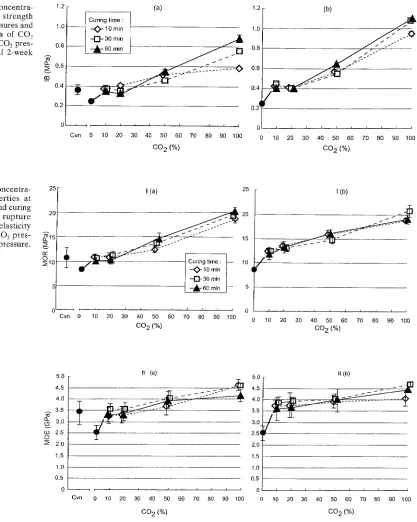
Fig. 1. Effect of CO2 concentra- tion o n i n t e r n a l b o n d s t r e n g t h
(IB) a t v a r i o u s C O 2 p r e s s u r e s a n d c u r i n g t i m e s , a 1 . 0 M P a o f C O 2 p r e s s u r e , b 7 . 5 M P a o f C O 2 p r e s - s u r e . Cvn, c o n v e n t i o n a l 2 - w e e k
c u r i n g
2
A m
0.8
06 t
0.4
0 . 2 ] -
0 ~
(a)
Curing lime : - ~ 10 min
--,-~- 30 min
. - - ~ 60 min
i i i i r i i i i i i
Cvn 0 10 20 30 40 50 60 70 80 90 100 C O 2 ( % )
1.2
1.0 0.8
0.6
0.4
0 0
(b)
10 20 30 40 50 60 70 80 90 100
c o 2 (%)
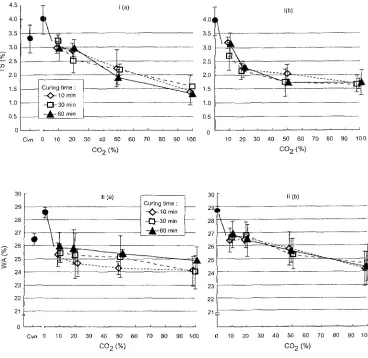
Fig. 2. Effect of CO2 concentra- tion on bending properties at various CO2 pressures and curing times. I Mondulus of rupture
(MOR). II Modulus of elasticity
(MOE). a 1.0MPa of CO2 pres-
sure. b 7.5MPa of CO2 pressure.
See Fig. 1
25
20
r~
I ( a ) 25
1
J~
5
Cvn
i i i i i i i r ~ i i i 0
0 10 20 30 40 50 60 70 80 90 100 C O 2 (%)
I ( b )
i r i i i i i r i i
10 20 30 40 50 60 70 80 90 100 C O 2 (%)
g_
5.0 4.5 4,0 3.5 T 3.0 T 2.5
1.5
1.0
0.5 i Cqn
II (a)
I
i i i i i i i r i i i 0 10 20 30 40 50 60 70 80 90 100
C O 2 (%)
5.0 4.5 4.0 3.5 3.0 2.51
2.0"
1.5 1.0 0.5 0
II (b)
'T x
q i i i i i i i i i
10 20 30 40 50 60 70 80 90 100 C O 2 (%)
and were kept at room temperature for 2 weeks. This period was followed by drying and conditioning.
The mechanical and dimensional properties of the boards were tested in accordance with the Japan Industrial Standard JIS A 5908 (1994). The boards were cut into 50 • 2 1 0 m m pieces for the static bending test and 50 • 50mm pieces for internal bond (IB)strength, thickness swelling (TS), and water absorption (WA) tests. Three test samples were prepared from each treatment for the above tests. The static bending tests were conducted using a three-point loading system over an effective span of 180mm (15 times the board thickness) at a loading speed of 10mm/min. The hydration degrees of composites were examined using X-
ray diffractometry (XRD), thermal gravimetry (TG-DTG), and scanning electron microscopy (SEM).
X R D analysis
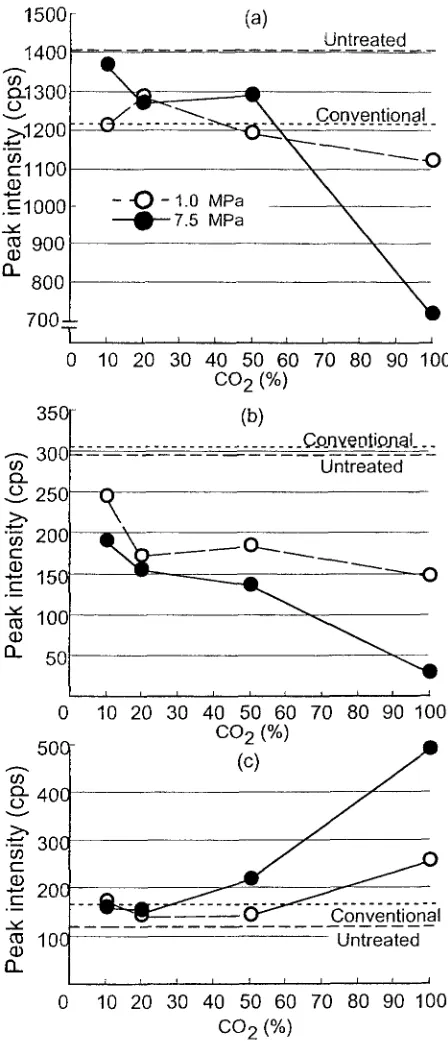
Fig. 3. Effect of CO2 concentra- 4.5
tion on dimensional stability at
4.O
various CO2 pressures and curing
times. I T h i c k n e s s swelling 3.5
(TS). 1I Water absorption (WA). 3.0
a 1.0MPa of CO2 pressure. --g
b 7.5MPa of CO 2 pressure. See ~ 2.5 m
Fig. 1 ~-
2.13--
1.5
1.0 0.5 0
~ ~ _ _
,.o,
- - - - 3 . 5 3.0
2 0
i i i i i_!
0Cvn 0 10 20 30 40 50 60 70 80 90 100
CO 2 (%)
i(b)
10 20 30 40 50 6Q 70 80 90 100
co 2 (%)
30 [ il (a) 1 30
I Curing time : | 29 ~ , ~ - - - , ~ - 10 min ~ - - 29,
2 a F - - ~ - - 43-30mi. F-- 2~
=r ~ \ ~ - - - & - - e o mi_____._~n j _ _ 27
~
~
~
26
~
- -
~ - -
-- 26
25
-
25
24 . . . ~" -':" -~ 24
23 23
22 ~ =
21 ~
T
210 | | i~ i i i ~ i i ~ i r
Cvn O 10 20 30 40 50 60 70 80 90 100
CO 2 (%)
I1 (b)
10 20 30 40 50 60 70
80
90 100CO 2 (%)
20 = 35.9 ~ 39.4 ~ 43 1 ~ and 48.5 ~ were determined and compared with those of the samples, t'3'4
Thermal analysis
Powdered samples passing through 200 mesh size were ex- amined using the thermogravimetric analyzer T G A 2050 (TA Instruments). The thermal degradation of the speci- mens ranging from room temperature to 1000~ at 10~ min heating rate and nitrogen flow of 100ml/min were ob- served. The amounts of calcium hydroxide and calcium car- bonate generated were determined. 4-12
SEM observations
The test specimens for SEM observation were prepared by cutting small sections from the fractured surfaces of the IB test samples. The small samples were mounted on specimen stubs and then coated with gold for examination in the JSM- 5310 (Jeol).
Results and discussion
Properties of CO2-cured boards
The average values for the IB strength of the CBPs cured at different pressures and concentration ratios of CO2 are presented in Fig. 1. The IB strength of COz-cured boards improved proportionally when the concentration ratio of CO2 applied was increased. When 10% or 20% CO2 and 1.0 MPa of pressure was applied for curing, the IB strength increased to about 0.4MPa. These IB values were similar to those obtained by conventional 2-week curing, and they were insignificantly different for curing times of 10, 30, and 60rain. A similar trend was observed for boards cured at pressure of 7.5MPa; addition of 10% or 20% CO2 resulted in improved IB strength, from about 0.2MPa to 0.4MPa and remained almost constant at all curing times.
The IB strength of the CBPs increased to about 0.5 and 0.6MPa, respectively, when 50% CO2 was added. Extension of the curing time up to 60min did not result in any differ- ences in the IB values. When 100% CO2 was applied, the longer curing time gave rise to higher IB values, especially at 1.0MPa of CO2 pressure, where the IB increased drasti- cally to about 1.0MPa.
182
different CO2 pressures. It was evident that the bending properties improved when the concentration ratio of CO2 was increased, and they showed insignificant fluctuation over curing times of 10, 30, and 60 min. The M O R and M O E values of the CO2-cured boards were similar to those of the conventionally cured boards when up to 20% CO2 was added, irrespective of the curing time.
Figure 3 shows the TS and W A values of the boards after 24h of water soaking. Increasing the CO2 concentration ratio enhanced the dimensional stability, and no significant differences were indicated up to 60min of curing time. Simi- lar to other properties, the dimensional stability of CO2- cured boards was c o m p a r a b l e to that of conventionally cured board when up to 20% CO2 was applied.
It was evident that the curing process using CO2-air mixtures had a favorable effect on the mechanical and di- mensional properties of CBP, especially at pressure of 7.5MPa, where the properties of CBP increased at a faster rate. Because the mixture of CO2-air is used for the curing process, the phase behavior of the mixture is difficult to determine. The pressure of the mixture at 7.5MPa and about 50~ is higher than that of the supercritical point of each component (e.g., nitrogen, oxygen, carbon dioxide). In addition, no interaction or reaction is expected between the CO2 and air under these conditions due to the rather stable condition of those components. According the finding by to Reid, et al. 13 that the properties of the mixture are deter- mined by averaging the pure component constants, which hopefully characterize the constant of the critical point, the pressure of 7.5 MPa in this study could be estimated as a supercritical phase. However, no drastic differences in the properties were observed between the CBPs of 1.0 and 7.5 MPa. Because the ideal critical point of pure CO2 pres- sure is 7.3 MPa, a uniform supercritical condition may not be obtained in the pressure range of this experiment. This trend was also observed in our previous study, ~ where pure CO2 was introduced in the pressure range of 0.5-10.0MPa. Therefore, further study with a wider range of pressure and t e m p e r a t u r e applied is necessary to identify the effect of both pure CO2 and CO2-air mixture phases on the proper- ties of cement-bonded board.
The effectiveness of the CO2 addition also depends on the degree of the initial setting of cement from which the calcium hydroxide [Ca(OH)2] is provided as a medium to produce the crystalline formation of calcium carbonate ( C a C O 3 ) . The initial setting of cement is also important to produce the calcium silicate hydrate (CSH). This CSH and CaCO3 are mainly responsible for the strength development of CBP. t In this experiment, the board was manufactured using the conventional cold-pressing method for setting the cement.
I m p r o v e m e n t mechanism of the C O 2 curing X R D analysis
The CO2 curing treatment produced significantly faster cur- ing of CBP than the conventional curing method. Rapid
1500[ (a)
t Untreated
._.14oo[--- . . . .
0 I , . , / ' w - ' ~ - - - ~ ... -,~ Conventional ...
"~lnno
- - 0 - 1.0 MPa "N _" ~ ' ~ ~ 7 . 5 MPa X
eoo
13_ 800 700
I I ~ I I 1 I T I I
0 10 20 30 40 50 60 70 80 90 100 CO 2 (%)
350[
(b)
300r . . . C.o.n,zet~tigj~al...
%--
/
El. O
v
"5 200 t'-
~0 150 r
100 n 50
Untreated 2 5 0 ~ 0 X ,
I I I
0 10 20 30
oo Q . r,3
v
> . , o3 l - (D i ' - t13 13..
500
400
300
200
100
0
40 50 60 70 80 90 100 CO 2 (%)
"- ~ - - ~ o n v e n i i o n - a l Untreated
I F I I F f I I t I
0 10 20 30 40 50 60 70 80 90 100 CO 2 (%)
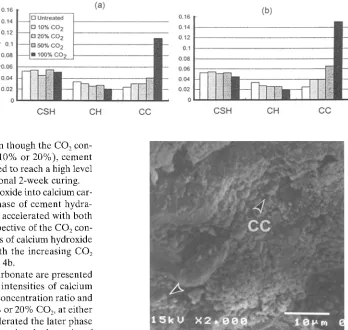
Fig, 4. X-ray diffractometry (XRD) patterns of cement-bonded par- ticleboards (CBPs). a Cement clinkers, b Calcium hydroxide, e Cal- cium carbonate
carbonization has been reported to enhance cement hydra- tion and cause inhibitors (e.g., free carbohydrates) that retard the hydration of cement to lose their inhibitory ef- fects.~ 12.14
Fig. 5. Effect of CO2 concentra- tion on the thermal property of CBPs at various CO; pressures after 60min of curing, a 1.0MPa of CO2 pressure, b 7.5MPa of CO2 pressure
183
tion ratio of CO2 was increased. Even though the CO 2 con- centration ratio used was low (i.e., 10% or 20%), cement hardening was accelerated and seemed to reach a high level of hydration, similar to the conventional 2-week curing.
The carbonization of calcium hydroxide into calcium car- bonate occurred during the later phase of cement hydra- tion. This carbonization process was accelerated with both 1.0 and 7.5 MPa CO2 pressures, irrespective of the CO2 con- centration levels. The peak intensities of calcium hydroxide of the treated boards decreased with the increasing CO2 concentration ratio, as shown in Fig. 4b.
The peak intensities of calcium carbonate are presented in Fig. 4c. It was observed that the intensities of calcium carbonate increased with increasing concentration ratio and pressure of CO2. The addition of 10% or 20% CO2, at either 1.0 or 7.5 MPa of CO2 pressure, accelerated the later phase of cement hydration. After 10min of curing the intensity of calcium carbonate of the CO2-cured boards were similar to that of conventionally cured board. In addition, the degree of cement hydration of CBPs cured at 7.5 MPa of CO2 pres- sure was higher than that of 1.0MPa of COa pressure.
TG-D TG analysis
Figure 5 shows the typical results of D T G analysis of CBPs after 60min of curing. Successive decomposition reactions occurred with an increase in temperature, as reflected in the decreased weight of all samples. It is evident that decom- position of CSH and Ca(OH)2 occurred at temperatures
around 100~ and 400~ respectively. Decomposition of
CaCO3, on the other hand, occurred at around 700~ s Ac- cording to the D T G curves, the decomposition rate of Ca(OH) decreased with increasing CO2 concentration ratio. The degree of cement hydration at the later stage was accelerated when CO 2 was added, irrespective of its concen- tration. The rate of the weight loss of CaCO3 increased from about 0.02%/~ to 0.03%/~ when up to 20% CO2 and 1.0MPa of CO2 pressure were applied; and it was acceler- ated to 0.04%/~ at 7.5 MPa of CO2 pressure. The addition of 50% and 100% CO2 accelerated the hydration process of cement, as indicated by the faster rate of decomposition of CaCO 3.
S E M observations
To confirm the findings in the above analyses, the fractured surface of the CBP was examined using SEM. Figure 6
Fig. 6. Scanning electron microscopy of the fractured surface of CBP
under 20% CO2 addition and 7.5MPa of CO2 pressure. CC, calcium
carbonate (arrowheads)
shows an example of the fractured surface of the CBP under 20% CO2 addition. CaCO3 was formed as a result of the hydration of all basic cement compounds. It was noted in our previous study and other research work 1'15't~ that these formations are believed to interlock with CSH and wood surfaces.
Conclusions
The mechanical and dimensional properties of CO2-cured boards improved as the COz concentration ratio during the curing process increased. When 10% or 20% of CO2 was applied for 10rain of curing time, the properties of CO2- cured boards were similar to those of the 2-week curing.
The hydration process of cement accelerated with in- creasing CO2 pressure, irrespective of the CO2 concen- tration. The intensities of Ca(OH)2 decreased with an increasing CO2 concentration ratio, followed by accelerated formation of CaCO3.
184
References
1. Hermawan D, Hata T, Umemura K, Kawai S, Nagadomi W, Knroki Y (2001) Rapid production of high-strength cement- bonded particleboard by using gaseous or supercritical carbon dioxide. J Wood Sci 47:294-300
2. Hermawan D, Hata T, Umemura K, Kawai S, Kaneko S, Kuroki Y (1999) New technology for manufacturing high-strength cement- bonded particleboard using supercritical carbon dioxide. J Wood Sci 46:85-88
3. Nagadomi W, Kuroki Y, Eusebio D A , Ma L, Kawai S, Sasaki H (1996) Rapid curing of cement-bonded particleboard. V. Mechanism of strength development with fortifier and accelera- tor during steam injection pressing. Mokuzai Gakkaishi 42:977- 984
4. Ma L, Kuroki Y, Nagadomi W, Kawai S, Sasaki H (1998) Manu- facture of bamboo-cement composite. III. Effects of sodium car- bonate on cement curing by steam injection pressing. Mokuzai Gakkaishi 44:262-272
5. Klimesch DS, Ray A (1997) The use of D T A / T G A to study the effect of ground quartz with different surface areas in autoclaved cement: quartz pastes use of the semi-isothermal thermogravi- metric technique. Thermochim Acta 306:159-165
6. Abdelrazig BEI, Main SD, Noweel DV (1992) Hydration studies of modified OPC pastes by differential scanning calorimetry and thermogravimetry. J Thermal Anal 38:495-504
7. Zhou X, Lin X, Huo M, Zhang Y (1996) The hydration of saline oil-well cement. Cement Concrete Res 26:1753-1759
8. Bhatty JI (1991) A review of the application of thermal analysis to cement-admixture systems. Thermochim Acta 189:313-350 9. Ramachandran VS (1969) Application of DTA in cement chemis-
try. Chemical Publishing, New York
10. Barta R (1972) In: Mackenzie RC (ed) Differential thermal analy- sis. Academic, London, p 207
11. Mackenzie RC (1964) In: Taylor (ed) The chemistry of cement. Academic, London, p 271
12. Ben-Dor L (1983) In: Ghosh A (ed) Advances in cement technol- ogy. Pergamon, Exeter, UK, p 673
13. Reid RC, Prausnitz JM, Poling BE (1987) The properties of gases and liquids. McGraw-Hill, New York
14. Simatupang MH, Habighorst C (1993) The carbon dioxide process to enhance cement hydration in manufacturing of cement-bonded composites: comparison with common production method. For Prod Soc 3:114-120
15. Ahn WY, Moslemi A A (1980) SEM examination of wood- portland cement board. Wood Sci 13:77-82