Katamalla Siddartha
M.Tech Computer Science Engineering
Sreyas Institute of Engineering and Technology, Beside INDU Aranya,Nagole, Hyderabad Dr.M.Purushotham, M.Tech., M.S.PhD.
Associate Professor, Department of Computer Science And Engineering
Sreyas Institute of Engineering and Technology, Beside INDU Aranya,Nagole, Hyderabad Dr.Suresh Akella
Principal
Sreyas Institute of Engineering and Technology, Beside INDU Aranya,Nagole, Hyderabad
Abstract:Collaborative Filtering (CF) is one of themost a better advice measures to bring aboutwith data overload inside the actual world.However, common CF techniques similarly deal with everyuser and object, and can not distinguish the rangeof consumer’s hobbies throughout special domains. A recommender system is utilized in various fields to propose objects of interest to users. One of the primary regions wherein this idea is currently used is e-trade that interacts at once with clients by way of suggestingproducts of interest with the goal of improving its income. Motivated by means of the
statement, a singular Domain-sensitive
Recommendation (DsRec) algorithm is proposed, to make the rating prediction with the assistance of
exploring the user-item subgroupevaluation
concurrently, wherein a consumer-item subgroup is deemed as a site including a subset of items withsimilar attributes and a subset of users who have interests in these objects. Collaborative Filtering (CF)
is a powerfuland extensively followed
recommendation technique. Different from content material-primarily based recommender systems which depend on theprofiles of customers and devices for predictions, CF approaches make predictions by best utilizing the person-item interactionstatistics such as transaction history or object pride expressed in ratings, and so forth.
Keywords-Recommender system, user-item subgroup, collaborative filtering.
I. INTRODUCTION
With the wide variety of products and
servicesavailable on the web, it is difficult for users
tochoose the product or service that most meets theirneeds. In order to reduce or even eliminate thisdifficulty, recommender systems have emerged. Arecommender system is used in various fields torecommend items of interest to users. One of themain areas where this concept is currently used is ecommerce that interacts directly with customers bysuggesting products of interest with the aim ofimproving its sales. For this purpose, making the useof context is important work. Context is amultifaceted concept that has been studied
acrossdifferent research disciplines, including
computerscience (primarily in artificial intelligence
andubiquitous computing), cognitive science,
linguistics,philosophy, psychology, and
organizational sciences.The contextual information can be obtained in anumber of ways, including
Explicitly, Implicitly,Inferring. Context-aware
recommendation system iscategories into three types: 1) Contextual prefiltering (or contextualization of recommendationinput): In this recommendation paradigm, contextualinformation drives data selection or data constructionfor that specific context. In other words, informationabout the current context is used for selecting orconstructing the relevant set of data records (i.e.,ratings). Then, ratings can be predicted using anytraditional 2D recommender system on the
selecteddata. 2) Contextual post-filtering: In
thisrecommendation paradigm, contextual
information isinitially ignored, and the ratings are predicted usingany traditional 2D recommender system on the entiredata. Then, the resulting set of recommendations isadjusted (contextualized) for each user using thecontextual information. 3)
Contextual modeling: Inthis recommendation
paradigm, contextualinformation is used directly in the modelingtechnique as part of rating estimation [7].
Collaborative Filtering (CF) is an effectiveand widely adopted recommendation approach [11].Different from content-based recommender systemswhich rely on the profiles of users and items forpredictions, CF approaches make predictions by onlyutilizing the user-item interaction information suchas transaction history or item satisfaction expressedin ratings, etc. As more attention is paid on personalprivacy, CF systems become increasingly popular,since they do not require users to explicitly state theirpersonal information. There still exist some problemswhich might limit the performance of typical CFmethods. On one hand, user’s interests always centeron some specific domains but not all the domains.However, typical CF approaches do not treat thesedomains distinctively. On the other hand, thefundamental assumption for typical CF approaches isthat user’s rate similarly on partial items, and hencethey will rate on all the other items similarly.
However, it is observed that this assumption is
notalways so tenable. A novel
Domain-sensitiveRecommendation (DsRec) algorithm, to make therating prediction by exploring the user-item subgroupanalysis simultaneously, in which a user-itemsubgroup is deemed as a domain consisting of asubset of items with similar attributes and a subset ofusers who have interests in these items. Sometimesthe time required for finding the rating predictions ismore but still don’t create the quality predictions.The proposed approach is used to overcome suchproblem and utilize less time and give betterpredictions [11].
II. RELATED WORK
Y. Zhang, B. Cao, and D.-Y. Yeung proposedthat Collaborative filtering is an effectiverecommendation approach in which the preference of
a user on an item is predicted based on thepreferences of other users with similar interests. Abig challenge in using collaborative filteringmethods is the data sparsity problem which oftenarises because each user typically only rates veryfew items and hence the rating matrix is extremelysparse. To solve the MCF problem, we matrixfactorization to model the rating
problem in eachdomain and allows the knowledge to be adaptivelytransferred across different domains
byautomatically learning the correlation
betweendomains.
Zhang, J. Cheng, T. Yuan, B. Niu, and H. Luhave revealed Collaborative Filtering assumes thatsimilar
users have similar responses to similar
items.However, human activities exhibit
heterogenousfeatures across multiple domains such that usersown similar tastes in one domain may behave quitedifferently in other domains. Moreover, highlysparse data presents crucial challenge in preferenceprediction. Intuitively, if users’ interested domainsare captured first, the recommender system is morelikely to provide the enjoyed items while filter outthose uninterested ones .we propose TopRec, whichdetects topical communities to construct interpretable
domains for domain-specific collaborative
filtering.Experimental results on real-world data fromEpinions and Ciao demonstrate the effectiveness ofthe proposed framework.
Jiang, J. Liu, X. Zhang, Z. Li, and H. Lureviewed to develop a novel productrecommendation method called TCRec, whichtakes advantage of consumer rating historyrecord,social-trust network and product
categoryinformation simultaneously. Compared
experimentsare conducted on two real-world datasets
andoutstanding performance is achieved,
whichdemonstrates the effectiveness of TCRHan, S. Chee, J. Han, and K. Wang havesuggested Many people rely on therecommendations of trusted friends to findrestaurants or movies, which match their tastes.CFis a promising tool for dealing challenging to scalethese methods to large databases. In this study, wedevelop an RecTree (which stands
forRECommendation Tree) that addresses
thescalability problem with a divide-
and-conquerapproach. In addition, the partitions contain usersthat are more similar to each other than those
inother partitions. This characteristic allows
RecTreeto avoid the dilution of opinions from goodadvisors by a multitude of poor advisors and thusyielding a higher overall accuracy. Based on
ourexperiments and performance study,
M. Sarwar, J. Konstan, and J. Riedlhave suggested Recommender systems applyknowledge discovery techniques to the problem ofmaking personalized product recommendationsduring a live customer interaction. These systems,especially the k-nearest neighbor collaborativefiltering based ones, are
achieving widespreadsuccess in E-commerce
nowadays. These areproducing high quality
recommendations andperforming many
recommendations per second formillions of
customers and products. We addressthe performance issues by scaling up theneighborhood formation process through the use ofclustering techniques.
G.-R. Xue, C. Lin, Q. Yang, W. Xi, H.-J.Zeng, Yu, and Z.Chen have provided Memorybased approaches for collaborative filtering identifythe similarity between two users by comparingtheir ratings on a set of items. In the past, thememory-based approaches have been shown to sufferfrom two fundamental problems: data sparsity anddifficulty in scalability. In our approach, clustersgenerated from the training data provide the basis fordata smoothing and neighborhood selection. As aresult, we provide higher accuracy as well asincreased efficiency in recommendations. Empiricalstudies on two datasets (EachMovie andMovieLens) show that our new proposed approachconsistently outperforms other
state-of-the-artcollaborative filtering algorithms.
Categories andSubject Descriptors.
III. PROPOSED WORK
Domain-sensitive Recommendation Algorithm is proposed in this paper. This approach gives the normal way toperceive the area and them grouping them into subgroups relying on the area of the intrest. So the overall performance of theRecommendation Systems will enhance and supply better instructions. This paper offers the efficient manner toimprove the performance of the prevailing strategies, additionally offers efficient recommendation via combining the existingstrategies to enhance the overall performance of the structures and higher prediction can be made the usage of proposed method.
A. Architecture of Proposed System
Rating Prediction Model : As a typical solution, matrix factorization is adopted for rating prediction in
our work. Suppose we have a useritem rating matrix describing N users’ numerical ratings on M items. Since in the real-world, each user usuallyrates a very small portion of items, the matrix R is extremely sparse. A matrix factorization approach seeks toapproximate the rating matrix R by a multiplication of K-rank factors.
Domain Detection Model: In this step, we will systematically interpret how to detect user-item subgroups (domains) with a bi-clusteringmodel, which is also a two-sided clustering solution. It has been shown that the two-sided clustering often yieldsmpressive performance over traditional one-sided clustering algorithms. More importantly, the resulting coclustered subgroups may reveal valuable insights from the item attributes. For example, John likes bothiPhone6Plus and a Louis Vuitton bag. If our bi-clustering model groups John, iPhone6Plus, and Louis Vuittontogether, we can explain the domain is
related to luxury consumption, since both
iPhone6Plus and Louis Vuittonare luxury products.
Regression regularization: In the regression regularization is that the latent factor representations of users (and items) are required to reflectthe preferences of users (and the attributes of items) across different domains. In other words, the latent
factorrepresentations should be discriminative
enough to find the subgroup distributions of users and items, and in turnsome domain information should be embedded into the latent factor representations for rating prediction
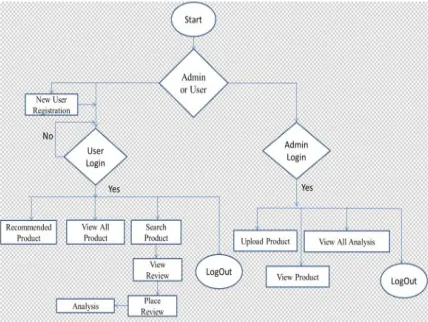
The solution that proposed here is basically helps in reducing the extra efforts to recommend good products tousers. The working of system in stepwise representation is as follows:
Step 1: (Initial step)
Creating new user account and searching product of interest
Step 2: (Storing Process)
Store user’s history and user details in the database. Step 3: (Evaluation Process)
Evaluate the recommendations using user history stored in database.
Step 4: (Clustering Process) Forming High Rating product clusters Step 5: (Analysis Process)
Creating the graph of count v/s no. of user reviews Step 6: (Recommendation Process)
Recommend product to user according to user interest and the analysis.
Following flowchart describes the proposed system step by step
Fig 2: Flowchart of proposed system
B. Modelling of Proposed Methodology
Modelling is the representation of a method which is used by simulation. Models may be mathematical, physical, orlogical representations of a system, entity, phenomenon, or process. Models are, in turn, used by simulation to predict afuture state. The Models of proposed method are as follows:
Domain-sensitive Recommendation Systems
Input : Any real time database of e-commerce website.
Output:
a. Rating prediction model. b. Domain detection model. c. Regression regularization terms d. Group of Item Analysis Algorithm
Step 1: Create user account Step 2: Login to user account Step 3: Searching of items Step 4: View product of interest
Step 5: Store user searching history in database Step 7: If user=new then go to step 1 and repeat the procedure
Else
Step 8: Find the ratings and recommend top rating products
Fig 3: Flowchart of DsRec algorithm
C. Implementation of Proposed Work
Implementation encompasses all the processes involved in getting new software or hardware operating properly in itsenvironment, including installation, configuration, and running, testing, and making necessary changes. As such,implementation is the action that must be followed by users as any preliminary things in order to see how it works.The issues considered for implementing new approach are,
1) Prediction Calculation Time: It considers the processing time of calculation using the contextual information to find the appropriate rating
2) Prediction Quality: It considers the quality of the predictions required in the recommendation systems. If the quality of the predictions is
bad, then performance will decrease
IV. CONCLUSION
In this paper, we develop a unique Domain-touchy Recommendation set of rules, which makes score predictionassisted with the user-item subgroup evaluation. The recommended approach affords the efficient method to locate the ideal score predictions. In different phrases, offers the better suggestions to the users of same option. This method calculates the ratings of the objects searched viathe users. The critiques at the product help within the evaluation section. The use of few pointers optimizes the much less time required for calculation of rankings the use of all pointers. It makes the analysis segment clean. It
additionally takes lesstime to discover best
recommendations.
REFERENCES
[1] Y. Zhang, B. Cao, and D.-Y.Yeung, “Multi-domain collaborative filtering,” in Proc. 26th Conf. Annu.Conf. Uncertainty Artif.Intell., 2010, pp.725– 732.
[2] X. Zhang, J. Cheng, T. Yuan, B. Niu, and H. Lu, “TopRec: Domainspecific recommendation through community topic mining in social network,”in Proc. 22nd Int. Conf. World Wide Web, 2013, pp. 1501– 1510.
[3] Y. Jiang, J. Liu, X. Zhang, Z. Li, and H. Lu, “TCRec: Product recommendation via exploiting
social-trust network and product
categoryinformation,” in Proc. 22nd Int. Conf. World Wide Web, 2013, pp. 233–234.
[4] S. Han, S. Chee, J. Han, and K. Wang, “RecTree: An efficient collaborative filtering method,” in Proc. 3rd Int. Conf. Data Warehousing Knowl.Discovery, 2001, pp. 141–151.
[5] B. M. Sarwar, J. Konstan, and J. Riedl, “Recommender systems for large-scale e-commerce: scalable neighborhood formation using clustering,”in
Proc. 5th Int. Conf. Comput. Inf. Technol., 2002, pp. 1–6.
[6] G.-R. Xue, C. Lin, Q. Yang, W. Xi, H.-J.Zeng, Y. Yu, and Z. Chen, “Scalable collaborative filtering
using cluster-based smoothing,” in Proc.Res.
Develop. Inf. Retrieval, 2005, pp. 114–121.
[7]Adomavicius, G., Tuzhilin, A.” Context-awarerecommender systems” In: Proceedings of the 2008 ACMConference on Recommender Systems, pp. 335–336 (2008)
[8] M. O’Connor and J. Herlocker, “Clustering items for collaborative filtering,” in Proc. ACM SIGIR Workshop Recommender Syst., 1999, pp. 1–4.
[9] L. Ungar, D. Foster, E. Andre, S. Wars, F. S. Wars, D. S. Wars, and J. H. Whispers, “Clustering
methods for collaborative filtering,” in
Proc.Workshop Recommendation Syst., 1998, pp. 114–129.
[10] L. Si and R. Jin, “Flexible mixture model for collaborative filtering,” in Proc. 20th Int. Conf. Mach. Learn., 2003, pp. 704–711
[11]Jing Liu, Yu Jiang, Zechao Li, Xi Zhang. “DomainSensitive Recommendation with User-Item SubgroupAnalysis” In: IEEE Transaction on Knowledge and DataEngineering, Vol. 28, No. 4, April 2016.
[12] B. M. Sarwar, G. Karypis, J. A. Konstan, and J.
Reidl, “Item-based collaborative filtering
recommendation algorithms,” in Proc. 10th Int. WorldWide Web Conf., 2001, pp. 285–295.
[13] T. Hofmann and J. Puzicha, “Latent class models for collaborative filtering,” in Proc. 6th Int. Joint Conf. Artif.Intell., 1999, pp. 688–693.
[14] S. Zhang, W. Wang, J. Ford, and F. Makedon, “Learning from incomplete ratings using non-negative matrix factorization,” in Proc. 6th SIAMInt. Conf. Data Mining, 2006, pp. 549–553.