O R I G I N A L R E S E A R C H A R T I C L E
Open Access
Informed consent: do information
pamphlets improve post-operative
risk-recall in patients undergoing total
thyroidectomy: prospective randomized
control study
Hussain Alsaffar
*, Lindsay Wilson, Dev P. Kamdar, Faizullo Sultanov, Danny Enepekides and Kevin M. Higgins
Abstract
Background:Informed consent consists of basic five elements: voluntarism, capacity, disclosure, understanding, and ultimate decision-making. Physician disclosure, patient understanding, and information retention are all essential in the doctor-patient relationship. This is inclusive of helping patients make and manage their decisions and expectations better and also to deal with any consequences and/or complications that arise. This study investigates whether giving patients procedure-specific handouts pre-operatively as part of the established informed consent process significantly improves overall risk-recall following surgery. These handouts outline the anticipated peri-operative risks and complications associated with total thyroidectomy, as well as the corrective measures to address complications. In addition, the influence of potential confounders affecting risk-recall, such as anxiety and pre-existing memory disturbance, are also examined.
Methods:Consecutive adult (≥18 years old) patients undergoing total thyroidectomy at a single academic tertiary care referral centre are included. Participants are randomly assigned into either the experimental group (with pamphlets) or the control group by a computerized randomization system (Clinstat). All participants filled out a Hospital Anxiety and Depression Scale (HADS) and they are tested by the physician for short-term memory loss using the Memory Impairment Screen (MIS) exam. All patients are evaluated at one week post-operatively. The written recall questionnaire test is also administered during this clinical encounter.
Results:Forty-nine patients are included - 25 of them receive verbal consent only, while another 24 patients received both verbal consent and patient education information pamphlets. The overall average of correct answers for each group was 83 % and 80 % in the control and intervention groups, respectively, with no statistically significant differences. There are also no statistically significant differences between the two groups, in both interview duration, in time between interviews, and in recall tests. No correlation is also apparent between the pre-op HADS score and the recall questionnaire overall score.
Conclusions:A pre-operative thyroid surgical information pamphlet alone might not be sufficient to enhance patient test scores and optimally educate the patient on their expected care pathway in thyroid surgery. Supplementation with alternative means of patient education perhaps using emerging technologies needs to be further investigated.
Keywords:Informed consent, Pamphlets, Post-operative risk-recall, Total thyroidectomy and patient education
* Correspondence:[email protected]
Sunnybrook Health Sciences Centre, University of Toronto, Toronto, ON, Canada
Background
Informed consent consists of basic five elements: volun-tarism, capacity, disclosure, understanding, and ultimate decision-making [1]. Physician disclosure, patient under-standing, and information retention are essential in the doctor- patient relationship. This is inclusive of helping patients make and manage their decisions and expecta-tions better and also dealing with any consequences and/or complications that arise.
There are many factors that can affect understanding and information retention. Some examples include, the language of communication, the psychological impact of diagnosis, the intellectual characteristics of an individual, the educational status, the level of general fund of know-ledge, and the preexisting conditions affecting memory impairment and social support [2].
The understanding and retention of peri-operative expec-tations, possible complications, and appropriate corrective action plans can possibly avert catastrophic outcomes, un-necessary emergency visits, and decrease patient anxieties.
To enhance verbal communication, other means have been used such as pamphlets; multimedia and/or web based interactive media. Studies, especially in clinical tri-als [3], have demonstrated that the singular act of sign-ing consent paperwork alone does not correlate with understanding the overall comprehensive picture of the consent, nor does it reflect on the overall quality of process. Total thyroidectomy, as it is one of the most common procedures in head and neck surgical practice with a widely understood risk profile, is chosen as the test procedure.
Objectives
It is important to investigate whether giving patients procedure-specific handouts pre-operatively as part of the established informed consent process significantly improves overall risk-recall following surgery. These handouts outline the anticipated peri-operative risks and complications associated with total thyroidectomy, as well as the corrective measures to address some of those complications. In addition, the influences of poten-tial confounders affecting risk-recall, such as anxiety and pre-existing memory disturbance are also examined.
Methods
Consecutive adult (≥18 years old) patients undergoing total thyroidectomy at a single academic tertiary care referral centre are included. Patients included in the study who undergo total thyroidectomy are based on pre-operative cytopathology that is suggestive or is stratified as a high risk for thyroid cancer with Betheseda V or VI cytopathology. This also means that patients demonstrated no cognitive impairment, patients signed pre-operative consent paperwork, and patients are
English-speaking, or they are able to effectively utilize available translational services. Participants are ran-domly assigned into either the experimental group (with pamphlet), or the control group with a computer-ized randomization system.
All patients are given verbal informed consent by se-nior staff surgeons. This included a review of possible post-operative complications and the associated risks and the benefits for the procedure. Signs and symptoms of major complications are carefully explained to the pa-tient and the best corrective action plans explicitly out-lined. In order to ensure uniformity and consistency of the verbal consent process, the senior staff surgeons in-volved in the study followed a standardized script (see Additional file 1: A.1). Concurrently, patients are asked to complete the Hospital Anxiety and Depression Scale (HADS) and they are screened for short-term memory loss using the Memory Impairment Screen (MIS) by the study coordinator [4].
In the experimental group, additional pamphlets are provided at the beginning of the interview, which is dis-cussed point-by-point after patients are instructed and give time to read the pamphlet in its entirety. The pamphlet is a pre-existing pamphlet that is used at our institution. Translational services are offered to both control and experimental interventions as necessary. (See Additional file 1: A.2)
All participants underwent total thyroidectomy. All patients are also screened for renal dysfunction and they are prepared and sent home with prophylactic calcium and Vitamin D3 oral supplements in accordance with well-established clinical practice norms. Patients are evaluated one-week post-operatively for wound inspec-tions, biochemical follow-ups, suture removals, and voice assessments. The written recall test is administered during this clinical encounter.
The recall test is a 12 - point multiple-choice test with two principal domains. The first six questions test patients on information in relation to the described post-operative risks; the second six questions test informa-tion in relainforma-tion to the management of those highlighted post-operative complications and appropriate corrective action steps. (See Additional file 1: A.3).
Patient demographics, ethnicity, native language, inter-view duration, time to surgery while on a waiting list, HADS score, cognitive status, post-operative complica-tions, unplanned clinic or emergency room visits, post-operative PTH, Vitamin D and ionized calcium levels are all collected. Statistical analysis are conducted with SPSS withp< 0.05 considered significant for a two-tailed testing.
Results
from the study because he deferred his surgery. Of the forty-nine patients, 25 received verbal consent only, while 24 received both verbal consent and patient edu-cation information pamphlets. The mean age was 48 (27–77) years and 50 (34–74) years in the control and in the intervention groups, respectively. There are no statistically significant differences in age between the two groups withP = 0.697. None of the study popula-tion demonstrated cognitive impairments, while two patients in the intervention group required transla-tional services. Patient demographic details are listed in Table 1.
Overall score
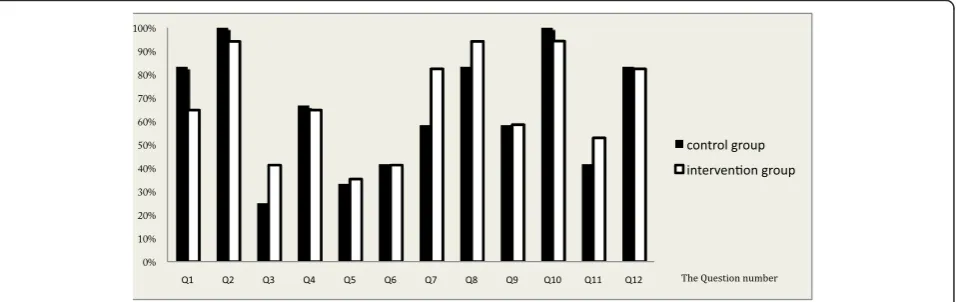
The overall average correct answer for each group was 83 % (25–100 %) and 80 % (35.3–94.2 %) in the control and intervention groups, respectively, with no statisti-cally significant differences (Fig. 1). There is also no statistical significance between answers to the questions that are in the pamphlets in comparison to questions that are not in the pamphlets (Q4, Q5, Q6, Q11, and Q12).
Overall score, interview duration and waiting time The mean interview durations are 16.9 (5–40) and 15.8 (5–30) minutes in control and in intervention groups, re-spectively. The duration of two patients at the interview
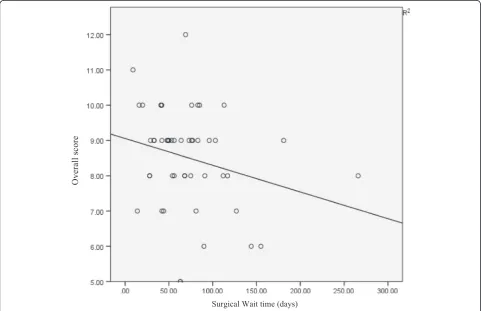
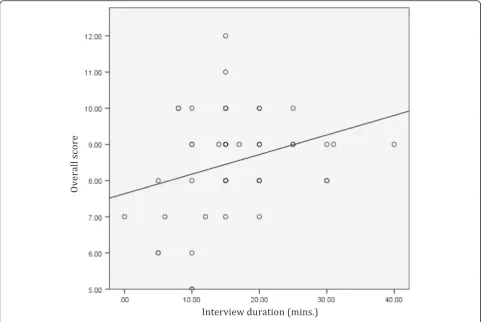
who required translators in the intervention group are 20 and 30 min, respectively. There are also no statistically sig-nificant differences between the two groups in regards to both interview duration and in time between interview and in recall tests (p= 0.663 and 0.629, respectively). This is in reference to Table 2. Further analysis between these two factors using a Pearson correlation coefficient test showed an inverse correlation between time duration with consents and with interviews in respect of an overall score correlation (−0.291) (P= 0.093). A notable trend towards statistical significance is also observed. For the interview duration, parametric Pearson correlation tests showed positive correlations between interview duration and over-all score (0.243) with statistical significance (P = 0.042) (Figs. 2 and 3).
Relation of anxiety and depression score with overall score
All patients filled the HADS questionnaire. Pre-operative anxiety scores are borderline in 10 patients (41.6 %) and none in the control group. In the interventional group, six (24 %) are borderline and three (12 %) have abnormal scores. On the other hand, pre-operative depression scores are borderline in one patient for each group. There are no statistically significant differences between the two groups in both anxiety and in depression score with aP value of 0.842, 0.4163, respectively (See Table 3). There are also no correlations between the pre-op HADS score and the overall score of the recall test.
Post-operative complication
Immediate post-operative parathyroid hormone (PTH) was within normal range (1.6–6.9 pmol/L) with no symptomatic hypocalcaemia. There are no unplanned clinic or emergency room visits during the first week post-operatively. All calcium and Vitamin D3 supple-mentation, that were given preoperatively as prophylaxis
Table 1Participants demographics, cognitive status and language
Control group Intervention group Pvalue
Total number 24 25
Gender N/A
Male 6 (25 %) 11 (44 %)
Female 18 (75 %) 14 (56 %)
Mean age (years) 48 (27–77) 50 (34–74) 0.697
Cognitive impairment None None N/A
Require translator None 2 N/A
preoperatively, were stopped by the third post-operative based on previously established best practice protocols.
Discussion
Aside from legal and ethical requirements, informed consent serves as an important role in patient education in regards to post-operative expectations, consequences, and complications. It is apparent that patient satisfaction correlates strongly with the amount of information re-ceived [5, 6]. The process of informed consent often oc-curs in one or two encounters in the outpatient clinic before surgery. This is typically done verbally and occa-sionally through the use of information pamphlets or through the use of audiovisual aids. This can lead to possible information overload, resulting confusion and poor information retention [7]. Previous research indi-cates that, just five minutes after a consultation, patients
already forget half of what the doctor told them. The percentage of retained information can be raised from approximately 20 to 50% by providing visual or written information as additional support [8, 9].
This paper investigates whether presenting patients with procedure-specific handouts pre-operatively signifi-cantly improves overall risk-recall following total thy-roidectomy. In addition, it examines the influence of potential confounders affecting risk-recall such as anx-iety and pre-existing memory disturbances. In our study, the addition of a pre-operative handout in thyroid sur-gery did not improve the overall test score on post-operative recall testing between the two groups. There are no statistically significant differences between the overall test scores and the waiting times for surgery and interview durations, however there is a noticeable trend toward the negative impact of the former and positive impact of the latter. There are no correlations between pre-operative anxiety and depression and between over-all recover-all.
Pre-operative written information demonstrates im-provements in recalls on admission [10–12].
Chan et al. [10] studied the effect of written leaflets with illustrations on the ability to list three complica-tions in 93 patients undergoing thyroid surgery. The
Table 2Duration of interview, time lapse to test recall and post-operative complication
Control group Intervention group Pvalue
Mean interview duration (mins)
16.9 15.8 0.633
Duration between consent–test recall (Days)
68 (14–181) 75 (9–266) 0.629
Surgical Wait time (days)
O
v
erall score
overall recall rates are 30.6 and 50.4 % between the con-trol and intervention groups, respectively. Similarly, in our study waiting time is not a factor between groups (average wait time to surgery of 33 days). Siau et al. re-ported that patients prefer to receive information leaflets and reading them subsequently demonstrated improved recall of the nature of the procedures and risks in adult tonsillectomy [13]. With regards to patient satisfaction, a cohort of patients with no significant differences between control and intervention groups for the Hospital Anxiety and Depression Scale, Clode-Baker et al. found that pa-tients were more satisfied with information they had re-ceived and they felt less confronted by information on arrival for the hospital stay [14]. Ihedioha et al. conducted a randomized control trial to assess additional benefits of
video education when combined with a written pamphlet in the psychological preparedness of patients undergoing elective colorectal surgery [15]. No differences in short-term outcomes in the hospital or in the complication rates are observed. Another important category of educational tools are web-based platforms. Advancements in social media and improved Internet access permit easy, access-ible, interactive, and comprehensive tools for informed consent delivery. Farval et al. conducted a randomized control trial comparing the quality of informed consent provision in order to augment discussions with online education resources. The result is a statistically significant increase in patient knowledge with an average score of 69.25 % correct answers in the intervention group as com-pared to 47.38 % in the control arm with a higher patient
Fig. 3Simple linear regressions plot between duration of interview and overall score
Table 3Anxiety and depression scores in the two groups
Anxiety score Depression score
Control Intervention Pvalue Control Intervention Pvalue
Mean score 6.54 6.36 0.842 3.5 2.92 0.416
Normal 14 16 n/a 23 24 n/a
Borderline 10 6 n/a 1 1 n/a
satisfaction (p = 0.043). There are no statistically signifi-cant differences in anxiety scores withPvalue of 0.195.
Unlike these studies, our study has an emphasis on testing not only the inherent complication risk-recalls for medico-legal purposes, but also testing a critical edu-cational component in respect to the corrective action plans post-operatively. Our study reveals a higher overall average recall score than other studies in both groups (80 and 83 %). This fact may relate to the multiple choice question format and study power. A limitation is that that we used a recall test which is developed for the purposes of this study, however, it has not been validated as a method of assessment.
Despite the importance of pamphlets in patient satis-faction, risk conveyance, and addressing complications, pamphlets per se might not be sufficient to optimally educate the patient on their pre-operative care pathway in thyroid surgery. Future directions point to an expan-sion of web-based platforms coupled with embedded in-formational videos which are currently being rolled out.
Conclusion
A pre-operative thyroid surgical information pamphlet alone might not be sufficient to enhance patient test scores and optimally educate the patient on their expected care pathway in thyroid surgery. Supplementation with al-ternative means of patient education perhaps using emer-ging technologies needs to be further investigated.
Additional file
Additional file 1:The script read for risk listing (See A.1).The Pamphlet (See A.2). Risk-recall questionnaire test (See A.3). (DOCX 810 kb)
Abbreviations
HADS:Hospital anxiety and depression scale; MIS: Memory impairment screen; PTH: Parathyroid hormone.
Competing interests
The authors declare that they have no competing interests.
Authors’contributions
H. A., acquisition of data, or analysis and interpretation of data, drafting the manuscript. D. P. K. contributions to conception and design. L. W. contributions to conception and design and acquisition of data. F. S. acquisition of data. D. E. contributions to conception and design. K. M. H. contributions to conception and design, critically revised the manuscript. All authors read and approved the final manuscript.
Acknowledgements None.
Received: 2 September 2015 Accepted: 4 February 2016
References
1. Lidz CW. The therapeutic misconception and our models of competency and informed consent. Behav Sci Law. 2006;24:535–46.
2. Falagas ME, Korbila IP, Giannopoulou KP, Kondilis BK, Peppas G. Informed consent: how much and what do patients understand? Am J Surg. 2009; 198:420–35.
3. Jefford M, Moore R. Improvement of informed consent and the quality of consent documents. Australia lancet oncology. 2008;9:485–93.
4. Buschke H, Kuslansky G, Katz M, Stewart WF, Sliwinski MJ, Eckholdt HM, et al. Screening for dementia with the memory impairment screen. Neurology. 1999;52:231.
5. Krishel S, Baraff LJ. Effect of emergency department information on patient satisfaction. Ann Emerg Med. 1993;22:568–72.
6. Robbins JA, Bertakis KD, Helms LJ, Azari R, Callahan EJ, Creten DA. The influence of physician practice behaviors on patient satisfaction. Fam Med. 1993;25:17–20.
7. Hutson MM, Blaha JD. Patients’recall of preoperative instruction for informed consent for an operation. J Bone Joint Surg Am. 1991;73:160–2. 8. Kitching JB. Patient information leaflets–the state of the art. J R Soc Med.
1990;83:298–300.
9. Gauld VA. Written advice: compliance and recall. J R Coll Gen Practice. 1981; 31:553–6.
10. Chan Y, Irish JC, Wood SJ, et al. Patient education and informed consent in head and neck surgery. Arch Otolaryngol Head Neck Surg. 2002;28:1269–74. 11. Winterton RIS, Alaani A, Loke D, et al. Role of infor-mation leaflets in
improving the practice of informed consent for patients undergoing septoplasty. J Laryngol Otol. 2007;121:134–7.
12. Langdon IJ1, Hardin R, Learmonth ID. Informed consent for total hip arthroplasty: does a written information sheet improve recall by patients? Ann R Coll Surg Engl. 2002;84:404–8.
13. Siau D1, List RJ, Hussin N, Woolford TJ. Do printed information leaflets improve recall of the procedure and risks in adult tonsillectomy? How we do it. Clin Otolaryngol. 2010;35:503–6.
14. Clode-Baker E1, Draper E, Raymond N, Haslam C, Gregg P. Preparing patients for total hip replacement: a randomized controlled trial of a preoperative educational intervention. J Health Psychol. 1997;2:107–14. 15. Ihedioha U, Vaughan S, Mastermann J, Singh B, Chaudhri S. Patient
education videos for elective colorectal surgery: results of a randomized controlled trial. Colorectal Dis. 2013;15:1436–41.
• We accept pre-submission inquiries
• Our selector tool helps you to find the most relevant journal
• We provide round the clock customer support
• Convenient online submission
• Thorough peer review
• Inclusion in PubMed and all major indexing services
• Maximum visibility for your research
Submit your manuscript at www.biomedcentral.com/submit