S T U D Y P R O T O C O L
Open Access
Evaluation of a program for routine
implementation of shared decision-making
in cancer care: study protocol of a stepped
wedge cluster randomized trial
Isabelle Scholl
1*, Pola Hahlweg
1, Anja Lindig
1, Carsten Bokemeyer
2, Anja Coym
2, Henning Hanken
4,
Volkmar Müller
3, Ralf Smeets
4, Isabell Witzel
3, Levente Kriston
1and Martin Härter
1Abstract
Background:Shared decision-making (SDM) has become increasingly important in health care. However, despite
scientific evidence, effective implementation strategies, and a prominent position on the health policy agenda, SDM is not widely implemented in routine practice so far. Therefore, we developed a program for routine implementation of SDM in oncology by conducting an analysis of the current state and a needs assessment in a pilot study based on the Consolidated Framework for Implementation Research (CFIR). Based on these results, the main aim of our current study is to evaluate the process and outcome of this theoretically and empirically grounded multicomponent implementation program designed to foster SDM in routine cancer care.
Methods:We use a stepped wedge design, a variant of the cluster randomized controlled trial. The intervention to be implemented is SDM. Three participating clinics of one comprehensive cancer center will be randomized and receive the multicomponent SDM implementation program in a time-delayed sequence. The program consists of the following strategies: (a) SDM training for health care professionals, (b) individual coaching for physicians, (c) patient activation strategy, (d) provision of patient information material and decision aids, (e) revision of the clinics’quality management documents, and (f) critical reflection of current organization of multidisciplinary team meetings. We will conduct a mixed methods outcome and process evaluation. The outcome evaluation will consist of four measurement points. The primary outcome is adoption of SDM, measured by the 9-item Shared Decision Making Questionnaire. A range of other implementation outcomes will be assessed (i.e., acceptability, readiness for implementing change, appropriateness, penetration). The implementation process will be evaluated using stakeholder interviews and field notes. This will allow adapting interventions if necessary.
Discussion:This study is the first large study on routine implementation of SDM conducted in German cancer care. We expect to foster implementation of SDM at the enrolled clinics. Insights gained from this study, using a theoretically and empirically grounded approach, can inform other SDM implementation studies and health policy developments, both nationally and internationally.
Trial registration:clinicaltrials.gov,NCT03393351. Registered 8 January 2018.
Keywords:Shared decision-making, Implementation science, Cancer, Health services research, Stepped wedge design, Cluster randomized controlled trial
* Correspondence:[email protected]
Isabelle Scholl and Pola Hahlweg shared first authorship. Levente Kriston and Martin Härter shared senior authorship. 1Department of Medical Psychology, University Medical Center
Hamburg-Eppendorf, Martinistraße 52, 20246 Hamburg, Germany Full list of author information is available at the end of the article
© The Author(s). 2018Open AccessThis article is distributed under the terms of the Creative Commons Attribution 4.0
International License (http://creativecommons.org/licenses/by/4.0/), which permits unrestricted use, distribution, and
Background
Many patients wish to play an active role in their health
care [1–5]. Shared decision-making (SDM) is a
promis-ing means towards patient participation in health care. SDM is defined as an interactional process in which the patient and the health care professional (HCP) aim to reach medical decisions together, based on shared
infor-mation and the best available evidence [6, 7]. The HCP
supports the patient in weighing the costs and benefits
of different options [8]. SDM is especially relevant in
oncology, where complex treatment options with varying short- and long-term side effects exist and where the disease and its treatments often have a considerable
impact on the patient’s health-related quality of life [9].
For years, national and international health care pol-icies call for SDM implementation. Reasons are among
others an ethical imperative for SDM [10], reduction of
unwarranted healthcare practice variation [11], reduced
use of options not clearly associated with benefits, and increased use of options clearly associated with benefits
[12]. However, despite the legal commitment towards
SDM in several countries (e.g., Germany [13, 14], the
UK [15], the USA [16]), the implementation of SDM in
routine care is lacking [3,4,17–22].
Research on SDM focused on clinician- or
patient-mediated interventions to foster SDM [23]. A Cochrane
review [12] showed that a combination of clinician- and
patient-mediated interventions is most likely to be
suc-cessful. As for clinician-mediated interventions, SDM
trainings can teach HCPs how to involve patients in the decision-making process. Several studies conducted in Germany showed positive effects of training programs such as better SDM skills of physicians and increased
patient participation and satisfaction [24–26]. A
system-atic review concluded that patients need to be informed and empowered in order to be able to play an active role
in decision-making [27]. Patient-mediated interventions
can strengthen the patient’s abilities to engage in the
decision-making process. A considerable number of studies showed that patients who learned to use ques-tion prompt sheets (i.e., tools that encourage patients to ask their HCPs a range of questions) participated more
actively in clinical encounters [28–32]. Patient decision
aids (DAs) are another means to increase SDM. These are supportive materials (e.g., brochures) that present different medical options and their costs and benefits to inform patients, and enable them to engage in the
decision-making process [33]. There are DAs to be used
during the clinical encounter (the so-called encounter decision aids) and others for before or between
encoun-ters [8,33]. A Cochrane review of 105 randomized
con-trolled studies showed positive effects of DAs, e.g., DAs improved the correct perception of benefits and risks of different options, and increased active involvement of
patients [34]. The use of DAs in oncology increased
knowledge and reduced decisional conflict [35].
There have been efforts to implement SDM in routine
practice. A systematic review [36] of implementation
studies on DAs concluded that the majority of included studies did not base their design on implementation
the-ory [36]. While this review focused on routine
imple-mentation of DAs to foster SDM, there are also SDM implementation projects with multiple implementation strategies to facilitate SDM. Process evaluation of a large-scale multicomponent SDM implementation pro-gram in the UK revealed that for successful implementa-tion of SDM in routine care, it was essential to pay
attention to the stakeholders’attitudes, involve all
stake-holders at an early stage, and analyze barriers and
facili-tators [37–39]. This is in line with recommendations
from implementation research [40].
Grol et al. [41] emphasize the relevance of theory-based
implementation programs to change health care processes, to avoid missing fundamental factors, and to enable transfer and adaptation to other settings. One approach to develop a theory-based implementation program is the Consoli-dated Framework for Implementation Research (CFIR) by
Damschroder et al. [42], a comprehensive framework for
routine implementation in the context of health services research. It describes the need of a pre-implementation phase to understand the viewpoints of different stake-holders and develop an empirically based implementation
program [42]. Thus, we conducted a pilot study preceding
the study at hand that consisted of a thorough analysis of current state and implementation needs. The results of the
pilot study are described in detail elsewhere [17,18,43–45].
We identified a lack of SDM-specific HCP communication behavior as the main barrier towards the uptake of SDM in the pilot study. The development of our multicomponent implementation program is based on these empirical results as well as the CFIR for theoretical grounding.
Methods Aim
The main aim of this study is to evaluate the process and outcome of a theoretically and empirically grounded multicomponent implementation program designed to foster implementation of shared decision-making into routine clinical practice in cancer care clinics (clinics are the clusters).
Study design
We consider the implementation program that is to be evaluated as a complex intervention consisting of mul-tiple interacting components, characterized by
variabil-ity, adaptivvariabil-ity, and interactions with the context [46,47].
controlled trial. It is increasingly used to evaluate rou-tine implementation of interventions when individual randomization is either not feasible or inappropriate
[47,48], which is the case for our research objective. In
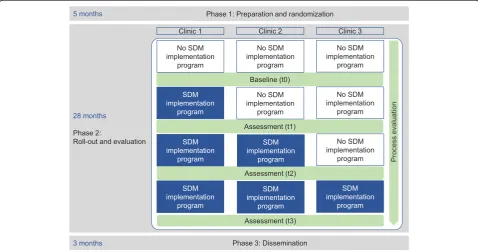
the stepped wedge design, participating clinics will receive the multifaceted implementation program in a
randomized sequence, as shown in Fig.1. For preparing
this protocol report, we followed CONsolidated Stan-dards of Reporting Trials (CONSORT) extension for
Cluster Trials [49] (see Additional file1), the Standards
for Reporting Implementation Studies (StaRI) [50], the
Criteria for Reporting the Development and Evaluation of Complex Interventions in Healthcare (revised
guide-line CReDECI 2) [51], and the Standard Protocol Items
for Clinical Trials (SPIRIT) [52], where applicable.
Setting
The study will be carried out in three clinics at a university
hospital’s comprehensive cancer center in Germany:
De-partment of Medical Oncology, DeDe-partment of Gynecology, and Department of Oral and Maxillofacial Surgery. Conducting the study in three clinics within the same center allows for controlling the influence of outer setting
to a certain degree [53]. These clinics were chosen because
the heads of department expressed willingness and interest in implementing SDM in their clinics. They consented to participate in the study before randomization. Active promotion of a culture change towards SDM by the heads of department was identified as a key facilitator for the
implementation of SDM in the previously conducted pilot
study and has also been described in the literature [54].
Participants
Participants of this study will be both patients and HCPs. Inclusion criteria for participating patients are (a) being diagnosed with a neoplasm (ICD 10: C00-D49), (b) receiving inpatient or outpatient treatment at one of the participating clinics, (c) being at least 18 years of age, and (d) speaking German. Severe cognitive impair-ment is an exclusion criterion. Participating HCPs are the physicians and nurses working at the respective clinics. No exclusion criteria apply for HCPs.
Intervention
The intervention to be implemented within this study is SDM, as defined above. The implementation program to foster shared decision-making in routine cancer care consists of multiple components. It is theoretically grounded in the CFIR as well as existing literature on SDM implementation and empirically based on the results of the pilot study mentioned above. It consists of six clinician- and patient-mediated components. Those pertain to the individual participant level, the cluster
level, or both. Details can be found below and in Table1.
The components will be delivered as standardized as pos-sible across the participating clinics. All materials and tools used in the different components will use the same
study label and slogan (“Behandlungswege gemeinsam
entscheiden”, English: deciding treatment paths together).
SDM trainings for HCPs
The group training for this study is based on the training program developed and evaluated by the research groups around Bieber and Härter (the latter being part of the
project group) [23–25] as well as a modified version
[55, 56], designed for training interprofessional teams
rather than physicians only. Physicians and nurses will be trained. This will take into account the pilot study result that it could be beneficial to better include
nurses in the decision-making processes [17, 18, 45].
It uses a train-the-trainer approach, where a small group of HCPs will be trained in SDM skills (step 1) and will then train their colleagues in collaboration with the project team (step 2). To standardize this component, all trainers will adhere to a single train-ing protocol and use the same core set of traintrain-ing materials (e.g., definition and models of SDM, ration-ale for implementing SDM). However, clinical exam-ples will be tailored to each specific clinic.
Individual coaching for physicians
Individual coaching (also known as audit and feedback)
will be used to improve physicians’ adoption of SDM
practice. In line with current research on this strategy
[57], it will be provided more than once, both verbally
and written. A member of the research team will visit each physician twice to observe clinical encounters and provide oral and written feedback. The coaching will be delivered after the SDM trainings to support the effect of the training component. It will use a standardized form across all clinics.
Patient activation strategy
This patient-mediated strategy consists of the Ask Three Questions program, developed and evaluated by Shepherd
and colleagues in Australia [58], and implemented in
large-scale implementation programs in the UK and the
Netherlands [37, 59]. It consists of three short questions
that patients can ask their HCP in order to empower the patients to become more involved in medical decision-making. For this study, the three questions will be translated to German and pilot tested using cognitive interviews with patients. This component will be dis-seminated via multiple pathways (e.g., flyers, posters, postcards). The dissemination material will use one single design throughout all clinics.
Provision of patient information material and decision aids General disease-related patient information material as well as DAs that are available in German will be com-piled by the research team. The material will be made available to patients of the respective clinic via multiple
pathways (e.g., in folders that patients’receive, in waiting
rooms, on the clinic website). These materials will be
clinic-specific. This strategy will also include informing patients about where to find evidence-based health information online (e.g., on the website of the German Guideline Program in Oncology). The latter is a stan-dardized strategy in all clinics.
Revision of the clinics’quality management documents In order to facilitate better integration of SDM in these documents, a revision of the quality management docu-ments of the specific clinics is initiated together with the responsible stakeholders from the quality management department and the participating clinics. Across all clinics, such a revision will include a comprehensible definition of SDM and specific recommendations on how to implement SDM and the implications of the
current German patients’ rights law will be highlighted.
These revisions will be announced to all staff members during the implementation phase in each clinic.
Critical reflection of current organization of multidisciplinary team meetings (MDTMs)
In order to integrate SDM better into existing workflows at MDTMs, quality improvement meetings will be held with the leading physicians of clinics and members of the clinical teams responsible for the MDTMs to evalu-ate and possibly re-organize existing MDTMs. The first meeting will follow the same guideline across all clinics. Subsequent changes will be developed in the process and hence might vary from clinic to clinic.
As described in the CFIR [42], slight adaptations of
the implementation components over the course of the study are possible, in order to reflect real-world differ-ences in clinic organization and to take into account the
nature of implementation research [60].
Measures and outcomes
The focus of the evaluation will be on implementation
outcomes based on Proctor’s taxonomy [61]. The
pri-mary outcome will be the uptake of SDM measured by
the patient-reported 9-item Shared Decision Making
Questionnaire (SDM-Q-9, [62]). The questionnaire was developed in German, and item development was based
on nine process elements characterizing SDM [62].
Items are scored on a 6-point Likert scale, ranging from
0 (“strongly disagree”) to 5 (“strongly agree”). A
SDM-Q-9 sum score (ranging from 0 to 100) is calculated with higher values indicating a higher extent of SDM. The
SDM-Q-9 showed good psychometric properties [62],
was used in a range of studies on SDM [63], and
currently exists in 16 languages (www.sdmq9.org). The
SDM-Q-9 will be administered at all clinics at baseline, 8 months, 16 months, and 24 months.
Secondary outcomes will be the following: (1) Uptake
assessed by the German version of theObserver OPTION5
scale ([64,65], German version: [66]), using audio-recorded
medical encounters. This measure will be administered at all clinics at baseline, 8 months, 16 months, and 24 months.
Assessors using the Observer OPTION5will be trained by
experienced members of the study team (IS, PH). (2) Acceptability of SDM(i.e., perception that SDM is agreeable
or satisfactory) from the HCPs’perspective as measured by
an adapted version of the acceptability survey developed by
McColl et al. [67]. The measure assesses HCPs’attitudes
towards evidence-based medicine. Three members of the study team (AL, PH, IS) chose those items that were deemed relevant for the research questions of the study at hand. Item wording was adapted to specifically address SDM. This measure will be administered at all clinics at baseline, 8 months, 16 months, and 24 months. (3) Organizational readiness for implementing changefrom the
HCPs’ perspective as measured by an adapted version of
the Organizational Readiness for Implementing Change
(ORIC, [68]) measure. The measure assesses two facets: (1)
change commitment (i.e., organizational members’shared
resolve to implement SDM) and (2) change efficacy (i.e.,
organizational members’ shared belief in their collective
capability to implement SDM) [68]. This measure will be
administered analogously to the SDM acceptability
meas-ure. (4) Appropriateness of SDM (i.e., perceived fit,
rele-vance, or compatibility of SDM for the given practice
setting) from the HCPs’ perspective as measured by an
adapted version of theIcanSDMmeasure [Coudert L,
Car-michael P-H, Renaud J-S, Légaré F, Witteman, H. Marti-neau B, Kröger E, et al. Validation of the IcanSDM
instrument to assess clinicians’perceptions of their ability
to adopt shared decision making [in preparation]]. The
IcanSDM measures HCPs’perceived ability to adopt SDM.
This measure will be administered analogously to the SDM
acceptability measure. (5)Penetration of SDM at the clinic
level will be assessed using routine data from patient experience surveys of the clinics. Those surveys are admin-istered every 3 years at the clinics and include questions on
patients’ experience of the decision-making process. Data
from July 2017 (i.e., before the beginning of this study) and data from 3 years into the study (approximately July 2020)
will be compared. (6) Penetration of SDM in MDTMs as
measured by an adapted version of the Metric for the
Observation of Decision Making in Multidisciplinary Team Meetings (MDT-MODe, [69]). The MDT-MODe assesses the quality of the clinical treatment recommendation process in MDTMs (including the quality of different areas of information presented and the quality of team behavior). MDTMs will be observed and evaluated using this measure at all clinics at baseline, 8 months, 16 months, and 24 months.
Additionally, basic demographic information will be assessed from study participants.
Data collection
A mixed methods evaluation, which has been described
as particularly suitable in implementation research [60],
will be carried out. It will include qualitative and quanti-tative formative and summative evaluation steps.
Preparation phase
During the preparation phase, cognitive interviews to assess comprehensibility of translated measures and
interventions will be conducted with N= 10–12 patients
and N= 10–12 HCPs. Patients will be recruited through
the collaborating clinics. HCPs will be recruited at the university medical center. HCPs participating in cogni-tive interviews will not be those working at the three clinics receiving the implementation program.
Allocation
The methodologist of the research team (LK) will generate the randomized allocation sequence for the participating clinics (the units of randomization) using computer-generated random numbers. Enrollment of the clusters (done by IS) will be completed before randomization (allo-cation sequence concealed). Randomization will be open label due to the sequential nature of the extensive imple-mentation program that makes blinding of clinics and HCPs within clinics unfeasible. Patients are blinded.
Outcome evaluation
The outcome evaluation will consist of four measure-ment points (i.e., baseline, 8 months, 16 months, 24 months). Each measurement point will consist of an assessment phase of 2 months. Due to the design of this study, different samples of individual patients will con-tribute to each measurement point (no follow-up assess-ment: independent samples). Clinical staff working at the clinics at the time of data collection will contribute to each measurement point (combination of new and previously surveyed participants with follow-up assess-ments: partly dependent samples). Patients will be recruited consecutively in the three clinics at all meas-urement points by a researcher of the study team. They will be approached individually (e.g., after registration at the front desk for outpatients, in wards for inpatients). Patients can participate in this study in three ways: (a) filling in the SDM-Q-9 after the encounter with the HCP, (b) agreeing to the encounter being audio recorded
in order to be assessed using the Observer OPTION5
measure, or (c) both. The researcher will ask each pa-tient for informed consent. The measures addressing the
HCPs’ perspective will be administered in each clinic
24 months for clinic 3). All HCPs working at the re-spective clinic will be invited to fill in the questionnaires (complete enumeration).
Process evaluation
The process evaluation has two main purposes: (1) to understand the possible effects of the implementation program and (2) to allow adapting interventions, if necessary (e.g., due to limited use of implementation
components). As described by Damschroder [42], the
CFIR will be used to guide the process evaluation, aided
by additional recommendations [70,71].
The process of implementation will be evaluated using mainly qualitative research methods through collection of (a) field notes, (b) interview data, and (c)
documen-tary data. We will generate qualitative field notes [72],
capturing observations (e.g., interactions with HCPs and other staff ) made when present in the clinics (e.g., during data collection and delivery of implementation strategies). Furthermore, to assess the experience and response to the implementation program, we will
con-duct short interviews with different HCPs throughout
the study, using a purposive sampling strategy with max-imum variation approach (e.g., different professions, different hierarchy levels). Interviews will be
audio-recorded. We will also document how the different
implementation strategies are actually delivered to each cluster by continuously writing short reports about the delivery of each strategy in each clinic. By doing so, we will gain insight into the fidelity and reach the implemen-tation program is administered with. Documenimplemen-tation will include internal facilitators and barriers potentially influ-encing the delivery of the implementation components. In terms of reach, we will monitor who and how many participated in the implementation components. Also, external conditions or factors occurring during the study that might have influenced the delivery of the implemen-tation components will be monitored.
Handling of potential adverse events and study risks Due to the empirical evidence for positive effects of SDM for patients (cp. background), no adverse events for patients are expected. The assessments including the SDM-Q-9 and/or audio-recordings of medical encoun-ters are only minimally disruptive. Investment of partici-pating HCPs will be in the form of participation in trainings and coaching. Potentially, through those HCPs will be stimulated to reflect their own work culture and processes. However, we expect the implementation pro-gram to increase HCP satisfaction with decision-making rather than decrease it. The planned process evaluation will ensure that potential adverse events will be detected promptly and responded to.
Assessment phases were planned in close collaboration with the participating clinics. Nevertheless, patient flows might fluctuate between months. In case of difficulties reaching the planned sample size, it would be possible to extend data collection phases in order to reach accept-able sample sizes.
Data analysis
Sample size calculation
We aim to identify a small to moderate effect of the
intervention on the patients’ assessment of experienced
SDM (Cohen’sdof 0.3). Although the existing empirical
findings are subject to uncertainty, this effect seems both
practically relevant and realistic [12]. To identify this
effect in a two-sided individual-level parallel group trial with an alpha error probability of 0.05 and a power of 0.80, a total sample of 352 participants would be needed. If an intra-class correlation coefficient of 0.05 is expected and three clinics are measured at four time
points each (resulting in a total of 12 clusters; see Fig.1),
around 100 participants per cluster are necessary to maintain the specified alpha and beta error levels of 0.05
and 0.20, respectively [73,74]. In order to be able to deal
flexibly with frequently encountered issues (e.g., unequal-sized clusters, incomplete participant responses), we aim to recruit 360 participants at each time point across all clinics and 1440 participants in total.
As part of the process evaluation, we aim to conduct
approx. N= 8–15 interviews with different HCPs per
clinic. Participant observation will be conducted bi-weekly for 2 to 4 h per clinic. These are estimates and final sample sizes for qualitative data collection will be informed by theoretical saturation.
Analysis plan
Phase 1 The audio-recordings of cognitive interviews in
phase 1 will be transcribed and imported into MAXQDA software (VERBI GmbH, Berlin, Germany). They will be
analyzed drawing on the principles of content analysis [75].
Phase 2 Data will be entered by members of the
research team consecutively, checked for range of data values and possible inconsistencies, and stored at secured servers of the department of the research team. Data will be analyzed using a mixed linear model with a random effect for clinic, a fixed effect for the time
inter-val, and a fixed effect for the intervention effect [76]. An
will be used. Missing data patterns will be analyzed and dealt with adequately (e.g., by using maximum likelihood estimation). Two-sided testing will be applied throughout, and findings with an alpha error rate below 0.05 will be considered statistically significant.
Process evaluation The audio-recordings of HCP
inter-views will be transcribed. Transcripts of interinter-views, field notes, and documentary data will be imported into MAXQDA software (VERBI GmbH, Berlin, Germany) and will be analyzed drawing on the principles of
con-tent analysis [75].
Data monitoring
The research team will meet once weekly during the entire duration of the study for executive as well as qual-ity management purposes. An international study advis-ory board with six members from Germany, the USA, and Australia that cover different aspects of scientific expertise beneficial to the project will meet in the form of conference calls (60 to 90 min) approximately twice a year. Prior to each meeting, members of the advisory board will receive a short written summary on the current stage of the study and topics to be discussed during the meeting. The advisory board is independent from the sponsor of this study.
Discussion
This study is the first of its kind to focus on implement-ing SDM in routine cancer care in Germany. Other health care institutions (e.g., comprehensive cancer cen-ters) and implementation researchers can use the results of this study to inform future large-scale implementation programs on SDM. The results could also be interesting for health policy activities, specifically the German National Cancer Plan, which also calls for a better
im-plementation of SDM in cancer care [77].
In case of successful adoption of SDM through the proposed program, further research could also assess other, more distant, implementation outcomes, such as implementation costs (i.e., the cost impact of implemen-tation efforts) and sustainability (i.e., the extent to which SDM is maintained or institutionalized within a service
setting’s on-going, stable operations) [61]. This could be
done in a follow-up study.
Dissemination
The results of the project will be published in scientific journals, possibly in open-access format to ensure high accessibility to the research and the clinical community as well as other interested individuals and institutions. Results will also be presented at national and inter-national conferences. Social media will be used for dissemination of results (e.g., via Twitter accounts of the
research group and the international collaboration part-ners). Furthermore, the material of the different implemen-tation strategies described above will be made available either as online open-access appendices to the publications or for download and free use through the well-known German website on shared decision-making hosted by the
research group (www.patient-als-partner.de).
Additional file
Additional file 1:CONSORT extension for cluster trials checklist. (DOCX 28 kb)
Abbreviations
AC:Anja Coym; AL: Anja Lindig; CB: Carsten Bokemeyer; CFIR: Consolidated Framework for Implementation Research; DAs: Decision aids; HCP: Health care professional; HH: Henning Hanken; IQWIG: Institute for Quality and Efficiency in Health Care; IS: Isabelle Scholl; IW: Isabell Witzel; LK: Levente Kriston; MDTM: Multidisciplinary team meeting; MDT-MODe: Metric for the Observation of Decision Making in Multidisciplinary Team Meetings; MH: Martin Härter; ORIC: Organizational Readiness for Implementing Change; PH: Pola Hahlweg; RS: Ralf Smeets; SDM: Shared decision-making; SDM-Q-9: 9-Item Shared Decision Making Questionnaire; VM: Volkmar Müller
Acknowledgements
We thank Glyn Elwyn, Dominick Frosch, Mirjam Körner, Heather Shepherd, Monica Taljaard, and Michel Wensing for agreeing to be part of the scientific advisory board of this study. We also thank our student assistants Tanja Kloster and Nina Elpers for their help in preparing the study and the manuscript.
Funding
This study is funded by the German Research Foundation (Deutsche Forschungsgemeinschaft, grant number 232160533).
Availability of data and materials
Not applicable as no datasets were generated or analyzed for the production of this study protocol.
Authors’contributions
IS and PH made substantial contributions to the conception and design of the study, writing the grant proposal, and preparation of the study. IS and PH were involved in drafting and critically revising the manuscript for important intellectual content. AL, AC, and RS were involved in the preparation of the study and critically revised the manuscript for important intellectual content. CB, IW, VM and HH were involved in the conception and design of the study and preparation of the study and critically revised the manuscript for important intellectual content. LK and MH made substantial contributions to the conception and design of the study, writing the grant proposal, and preparation of the study. LK and MH critically revised the manuscript for important intellectual content. All authors gave final approval of the version to be published.
Ethics approval and consent to participate
Consent for publication
Not applicable.
Competing interests
IS’s, PH’s, AL’s, LK’s, and MH’s institution receives the grant from the German Research Foundation for the study described in this study protocol (cp. funding). IS conducted one physician training in shared decision-making for which she received travel compensation from Mundipharma GmBH in 2015. MH declares that he is a co-PI in SDM training projects, one funded by the German Cancer Aid and one by Mundipharma. CB is the president of the German Society for Hematology and Oncology and receives support for clin-ical trials from several pharmaceutclin-ical companies (> 70 trails in his depart-ment) and holds grants, e.g., from the German Cancer Aid, Hubertus Wald Foundation and others. The authors did not receive industry funding for this paper, nor were pharmaceutical companies involved in any steps of the study or publication process. PH, AL, AC, HH, VM, RS, IW and LK declare that they have no competing interests.
Publisher’s Note
Springer Nature remains neutral with regard to jurisdictional claims in published maps and institutional affiliations.
Author details 1
Department of Medical Psychology, University Medical Center Hamburg-Eppendorf, Martinistraße 52, 20246 Hamburg, Germany.2II. Department of Medicine, University Medical Center Hamburg-Eppendorf, Martinistraße 52, 20246 Hamburg, Germany.3Department of Gynecology, University Medical Center Hamburg-Eppendorf, Martinistraße 52, 20246 Hamburg, Germany.4Department of Oral and Maxillofacial Surgery, University Medical Center Hamburg-Eppendorf, Martinistraße 52, 20246 Hamburg, Germany.
Received: 31 January 2018 Accepted: 12 March 2018
References
1. Bastiaens H, Van Royen P, Pavlic DR, Raposo V, Baker R. Older people’s preferences for involvement in their own care: a qualitative study in primary health care in 11 European countries. Patient Educ Couns. 2007;68:33–42. 2. Chewning B, Bylund CL, Shah B, Arora NK, Gueguen JA, Makoul G. Patient
preferences for shared decisions: a systematic review. Patient Educ Couns. 2012;86:9–18.
3. Coulter A, Jenkinson C. European patients’views on the responsiveness of health systems and healthcare providers. Eur J Pub Health. 2005;15:355–60. 4. Coulter A, Magee H. The European patient of the future. Maidenhead: Open
University Press; 2003.
5. Mühlhauser I, Steckelberg A. Evidence-based patient information: preferences of patients [German]. Dtsch Arztebl. 2009;51–52:2554–6. 6. Charles C, Gafni A, Whelan T. Shared decision-making in the medical
encounter: what does it mean? (or it takes at least two to tango). Soc Sci Med. 1997;44:681–92.
7. Härter M. Shared decision making—an approach requested by patients, physicians, and health politics prevails [German]. Z Evid Fortbild Qual Gesundhwes. 2004;98:89–92.
8. Elwyn G, Laitner S, Coulter A, Walker E, Watson P, Thomson R. Implementing shared decision making in the NHS. BMJ. 2010;341:971–5. 9. Reuter K, Loh A, Härter M. Patient as partner in oncology—opportunities for
shared decision-making [German]. In: Koch U, Weis J, editors. Psycho-oncology—a discipline in development. Göttingen: Hogrefe; 2009. p. 131–45. 10. Salzburg Global Seminar. Salzburg statement on shared decision making.
BMJ. 2011;342:d1745.
11. Mulley AG, Trimble C, Elwyn G. Stop the silent misdiagnosis: patients’ preferences matter. BMJ. 2012;345https://doi.org/10.1136/bmj.e6572. 12. Légaré F, Stacey D, Turcotte S, Cossi MJ, Kryworuchko J, Graham ID, et al.
Interventions for improving the adoption of shared decision making by healthcare professionals. Cochrane Database Syst Rev. 2014;9:CD006732. 13. Bundesgesetzblatt. Law for improving the rights of patients [German]. Bonn:
Bundesanzeiger Verlag; 2013.
14. Härter M, Dirmaier J, Scholl I, Donner-Banzhoff N, Dierks ML, Eich W, et al. The long way of implementing patient-centered care and shared decision making in Germany. Z Evid Fortbild Qual Gesundhwes. 2017;123–124:46–51.
15. Department of Health. Equity and excellence: liberating the NHS. London: The Stationery Office; 2010.
16. Braddock CH III. The emerging importance and relevance of shared decision making to clinical practice. Med Decis Mak. 2010;30(Suppl. 5):5–7. 17. Hahlweg P, Härter M, Nestoriuc Y, Scholl I. How are decisions made in
cancer care? A qualitative study using participant observation of current practice. BMJ Open. 2017;7:e016360.
18. Frerichs W, Hahlweg P, Müller E, Adis C, Scholl I. Shared decision-making in oncology—a qualitative analysis of healthcare providers’views on current practice. PLoS One. 2016;11:e0149789.
19. Charles C, Gafni A, Whelan T. Self-reported use of shared decision-making among breast cancer specialists and perceived barriers and facilitators to implementing this approach. Health Expect. 2004;7:338–48.
20. Coulter A. Implementing shared decision making in the UK: a report for the Health Foundation. London: Health Foundation; 2009.
21. Foundation for Informed Medical Desicion Making. Informing and involving patients in medical decisions: the primary care physicians’perspective. Boston: Findings from a national survey of physicians; 2009. 22. Vogel BA, Helmes AW, Hasenburg A. Concordance between patients’
desired and actual decision-making roles in breast cancer care. Psychooncology. 2008;17:182–9.
23. Loh A, Simon D, Kriston L, Härter M. Patient participation in medical decision-making: effects of shared decision-making from systematic reviews [German]. Dtsch Arztebl. 2007;104:1483–9.
24. Härter M, Buchholz A, Nicolai J, Reuter K, Komarahadi F, Kriston L, et al. Shared decision making and the use of decision aids. Dtsch Arztebl Int. 2015;112:672–9. 25. Loh A, Simon D, Wills CE, Kriston L, Niebling W, Härter M. The effects of a
shared decision-making intervention in primary care of depression: a cluster-randomized controlled trial. Patient Educ Couns. 2007;67:324–32. 26. Bieber C, Müller KG, Blumenstiel K, Hochlehnert A, Wilke S, Hartmann M, et
al. A shared decision-making communication training program for physicians treating fibromyalgia patients: effects of a randomized controlled trial. J Psychosom Res. 2008;64:13–20.
27. Joseph-Williams N, Elwyn G, Edwards A. Knowledge is not power for patients: a systematic review and thematic synthesis of patient-reported barriers and facilitators to shared decision making. Patient Educ Couns. 2014;94:291–309. 28. Brown R, Butow PN, Boyer MJ, Tattersall MHN. Promoting patient
participation in the cancer consultation: evaluation of a prompt sheet and coaching in question-asking. Br J Cancer. 1999;80:242–8.
29. Brown RF, Butow PN, Dunn SM, Tattersall MHN. Promoting patient participation and shortening cancer consultations: a randomised trial. Br J Cancer. 2001;85:1273–9.
30. Clayton J, Butow P, Tattersall M, Chye R, Noel M, Davis JM, et al. Asking questions can help: development and preliminary evaluation of a question prompt list for palliative care patients. Br J Cancer. 2003;89:2069–77. 31. Clayton JM, Butow PN, Tattersall MHN, Devine RJ, Simpson JM, Aggarwal G,
et al. Randomized controlled trial of a prompt list to help advanced cancer patients and their caregivers to ask questions about prognosis and end-of-life care. J Clin Oncol. 2007;25:715–23.
32. Glynne-Jones R, Ostler P, Lumley-Graybow S, Chait I, Hughes R, Grainger J, et al. Can I look at my list? An evaluation of a“prompt sheet”within an oncology outpatient clinic. Clin Oncol. 2006;18:395–400.
33. Elwyn G, Frosch D, Volandes AE, Edwards A, Montori VM. Investing in deliberation: a definition and classification of decision support interventions for people facing difficult health decisions. Med Decis Mak. 2010;30:701–11. 34. Stacey D, Légaré F, Lewis K, Barry MJ, Bennett CL, Eden KB, et al. Decision
aids for people facing health treatment or screening decisions. Cochrane Database Syst Rev. 2017;4:CD001431.
35. O’Brien MA, Whelan TJ, Villasis-Keever M, Gafni A, Charles C, Roberts R, et al. Are cancer-related decision aids effective? A systematic review and meta-analysis. J Clin Oncol. 2009;27:974–85.
36. Elwyn G, Scholl I, Tietbohl C, Mann M, Edwards AGK, Clay C, et al.“Many miles to go...”: a systematic review of the implementation of patient decision support interventions into routine clinical practice. BMC Med Inform Decis Mak. 2013;13(Suppl. 2):14.
38. Thomson R, Elwyn G. Implementation of shared decision making in practice. Emerging learning from MAGIC, a UK implementation study. 6th International Shared Decision Making Conference in Maastricht. Maastricht; 2011. 39. Joseph-Williams N, Lloyd A, Edwards A, Stobbart L, Tomson D, Macphail S,
et al. Implementing shared decision making in the NHS: lessons from the MAGIC programme. BMJ. 2017;357:j1744.
40. Grol R, Grimshaw J. From best evidence to best practice: effective implementation of change in patients’care. Lancet. 2003;362:1225–30. 41. Grol RP, Bosch MC, Hulscher ME, Eccles MP, Wensing M. Planning and
studying improvement in patient care: the use of theoretical perspectives. Milbank Q. 2007;85:93–138.
42. Damschroder LJ, Aron DC, Keith RE, Kirsh SR, Alexander JA, Lowery JC. Fostering implementation of health services research findings into practice: a consolidated framework for advancing implementation science. Implement Sci. 2009;4:50. 43. Hahlweg P, Hoffmann J, Härter M, Frosch DL, Elwyn G, Scholl I. In absentia:
an exploratory study of how patients are considered in multidisciplinary cancer team meetings. PLoS One. 2015;10:e0139921.
44. Hahlweg P, Didi S, Kriston L, Härter M, Nestoriuc Y, Scholl I. Process quality of decision-making in multidisciplinary cancer team meetings: a structured observational study. BMC Cancer. 2017;17:772.
45. Müller E, Hahlweg P, Scholl I. What do stakeholders need to implement shared decision making in routine cancer care? A qualitative needs assessment. Acta Oncol (Madr). 2016;55:1484–91.
46. Kühne F, Ehmcke R, Härter M, Kriston L. Conceptual decomposition of complex health care interventions for evidence synthesis: a literature review. J Eval Clin Pract. 2015;21:817–23.
47. Craig P, Dieppe P, Macintyre S, Michie S, Nazareth I, Petticrew M. Developing and evaluating complex interventions: the new Medical Research Council guidance. Br Med J (Clin Res Ed). 2008;337:978–83. 48. Mdege ND, Man MS, Taylor CA, Torgerson DJ. Systematic review of stepped
wedge cluster randomized trials shows that design is particularly used to evaluate interventions during routine implementation. J Clin Epidemiol. 2011;64:936–48.
49. Campbell MK, Piaggio G, Elbourne DR, Altman DG, CONSORT Group. Consort 2010 statement: extension to cluster randomised trials. BMJ (British Med J). 2012;345:e5661.
50. Pinnock H, Barwick M, Carpenter CR, Eldridge S, Grandes G, Griffiths CJ, et al. Standards for reporting implementation studies (StaRI) statement. BMJ. 2017;356:i6795.
51. Möhler R, Köpke S, Meyer G. Criteria for reporting the development and evaluation of complex interventions in healthcare: revised guideline (CReDECI 2). Trials. 2015;16:204.
52. Chan AW, Tetzlaff JM, Altman DG, Laupacis A, Gøtzsche PC, Krleža-JerićK. Research and reporting methods annals of internal medicine SPIRIT 2013 statement: defining standard protocol items for clinical trials. Ann Intern Med. 2013;158:200–7.
53. Chaudoir SR, Dugan AG, Barr CH. Measuring factors affecting implementation of health innovations: a systematic review of structural, organizational, provider, patient, and innovation level measures. Implement Sci. 2013;8:22. 54. Frosch D, Tietbohl C, Scholl I. Overcoming implementation challenges to
advance shared-decision making in routine practice. In: Elwyn G, Thompson R, Edwards A, editors. Shared decision making in health care: achieving evidence-based patient choice. 3rd ed. Oxford: Oxford University Press; 2016. 55. Körner M, Ehrhardt H, Steger A-K. Designing an interprofessional training
program for shared decision making. J Interprof Care. 2013;27:146–54. 56. Körner M, Wirtz M, Michaelis M, Ehrhardt H, Steger AK, Zerpies E, et al. A
multicentre cluster-randomized controlled study to evaluate a train-the-trainer programme for implementing internal and external participation in medical rehabilitation. Clin Rehabil. 2014;28:20–35.
57. Ivers N, Jamtvedt G, Flottorp S, Young JM, Odgaard-Jensen J, French SD, O’BrienMA, Johansen M, GrimshawJ, Oxman AD. Audit and feedback: effects on professional practice and healthcare outcomes. Cochrane Database Syst Rev. 2012;13(6):CD000259.
58. Shepherd HL, Barratt A, Trevena LJ, McGeechan K, Carey K, Epstein RM, et al. Three questions that patients can ask to improve the quality of information physicians give about treatment options: a cross-over trial. Patient Educ Couns. 2011;84:379–85.
59. van der Weijden T, Post H, Brand PLP, van Veenendaal H, Drenthen T, van Mierlo LAJ, et al. Shared decision making, a buzz-word in the Netherlands, the pace quickens towards nationwide implementation…. Z Evid Fortbild Qual Gesundhwes. 2017;123–124:69–74.
60. Peters DH, Adam T, Alonge O, Agyepong IA, Tran N. Republished research: implementation research: what it is and how to do it. Br J Sports Med. 2014;48:731–6.
61. Proctor E, Silmere H, Raghavan R, Hovmand P, Aarons G, Bunger A, et al. Outcomes for implementation research: conceptual distinctions, measurement challenges, and research agenda. Admin Pol Ment Health. 2011;38:65–76. 62. Kriston L, Scholl I, Hölzel L, Simon D, Loh A, Härter M. The 9-item Shared
Decision Making Questionnaire (SDM-Q-9). Development and psychometric properties in a primary care sample. Patient Educ Couns. 2010;80:94–9. 63. Doherr H, Christalle E, Kriston L, Härter M, Scholl I. Use of the 9-item Shared
Decision Making Questionnaire (SDM-Q-9 and SDM-Q-Doc) in intervention studies—a systematic review. PLoS One. 2017;12:e0173904.
64. Barr PJ, O’Malley AJ, Tsulukidze M, Gionfriddo MR, Montori V, Elwyn G. The psychometric properties of observer OPTION (5), an observer measure of shared decision making. Patient Educ Couns. 2015;98:970–6.
65. Elwyn G, Tsulukidze M, Edwards A, Legare F, Newcombe R. Using a“talk” model of shared decision making to propose an observation-based measure: observer OPTION 5 item. Patient Educ Couns. 2013;93:265–71. 66. Kölker M, Topp J, Elwyn G, Härter M, Scholl I. Psychometric properties of the
German version of Observer OPTION5. BMC Health Serv Res. 2018;18:74. 67. McColl A, Smith H, White P, Field J. General practitioners’perceptions of the route
to evidence based medicine: a questionnaire survey. BMJ. 1998;316:361–5. 68. Shea CM, Jacobs SR, Esserman DA, Bruce K, Weiner BJ. Organizational
readiness for implementing change: a psychometric assessment of a new measure. Implement Sci. 2014;9:7.
69. Lamb BW, Sevdalis N, Benn J, Vincent C, JSA G, Lamb BW, et al.
Multidisciplinary cancer team meeting structure and treatment decisions: a prospective correlational study. Ann Surg Oncol. 2013;20:715–22. 70. Moore GF, Audrey S, Barker M, Bond L, Bonell C, Hardeman W, et al. Process
evaluation of complex interventions: Medical Research Council guidance. BMJ. 2015;350:h1258.
71. Grant A, Treweek S, Dreischulte T, Foy R, Guthrie B. Process evaluations for cluster-randomised trials of complex interventions: a proposed framework for design and reporting. Trials. 2013;14:15.
72. Frosch DL, Singer KJ, Timmermans S. Conducting implementation research in community-based primary care: a qualitative study on integrating patient decision support interventions for cancer screening into routine practice. Health Expect. 2009;14(Suppl. 1):73–84.
73. Woertman W, de Hoop E, Moerbeek M, Zuidema SU, Gerritsen DL, Teerenstra S. Stepped wedge designs could reduce the required sample size in cluster randomized trials. J Clin Epidemiol. 2013;66:752–8. 74. Baio G, Copas A, Ambler G, Hargreaves J, Beard E, Omar RZ. Sample size
calculation for a stepped wedge trial. Trials. 2015;16:354.
75. Hsieh H-F, Shannon SE. Three approaches to qualitative content analysis. Qual Health Res. 2005;15:1277–88.
76. Hussey MA, Hughes JP. Design and analysis of stepped wedge cluster randomized trials. Contemp Clin Trials. 2007;28:182–91.
77. Bundesministerium für Gesundheit [German federal ministry of health]. Brochure: German National Cancer Plan—areas of activity, aims, and recommendations for implementation [German] [government document]. Berlin: Bundesministerium für Gesundheit; 2012.
78. Taljaard M, Weijer C, Grimshaw JM, Eccles MP. The Ottawa statement on the ethical design and conduct of cluster randomised trials: precis for researchers and research ethics committees. BMJ. 2013;346:f2838. 79. Hutton J, Eccles M, Grimshaw J. Ethical issues in implementation research: a
discussion of the problems in achieving informed consent. Implement Sci. 2008;3:52.
80. Proctor E, Powell B, McMillen JC. Implementation strategies:
recommendations for specifying and reporting. Implement Sci. 2013;8:139. 81. Härter M, Buchholz A, Nicolai J, Reuter K, Komaradhi F, Kriston L, et al.
Training in shared decision making and the use of decision aids in breast and colon cancer: a cluster-randomized trial. Dtsch Arztebl. 2015;112:672–79. 82. Stacey D, Legare F, Col NF, Bennett CL, Barry MJ, Eden KB, et al. Decision