ScholarlyCommons
Publicly Accessible Penn Dissertations
1-1-2016
The Choreography of Everday Life: Rudolf Laban
and the Making of Modern Movement
Whitney Elaine Laemmli
University of Pennsylvania, [email protected]
Follow this and additional works at:http://repository.upenn.edu/edissertations
Part of theHistory Commons, and theTheatre and Performance Studies Commons
This paper is posted at ScholarlyCommons.http://repository.upenn.edu/edissertations/1823 For more information, please [email protected].
Recommended Citation
Laemmli, Whitney Elaine, "The Choreography of Everday Life: Rudolf Laban and the Making of Modern Movement" (2016).Publicly Accessible Penn Dissertations. 1823.
The Choreography of Everday Life: Rudolf Laban and the Making of
Modern Movement
Abstract
“The Choreography of Everyday Life: Rudolf Laban and the Making of Modern Movement,” explores how an inscription technology developed in German expressionist dance found unlikely application in some of the key institutions of twentieth-century modernity. Called “Labanotation,” it used a complicated symbology to record human bodily movement on paper. Initially used to coordinate mass-dance spectacles in Weimar Germany, the system was quickly adopted in the United States and the United Kingdom in fields ranging from management theory to psychiatry to anthropology. My research analyzes the widespread appeal of this seemingly quixotic tool and to situates it within broader literatures on modern technology, art, media, and politics. Ultimately, I argue that Labanotation succeeded so spectacularly because it promised to reconcile the invented and the authentic, the individual and the group, and the body and the machine at moments
threatened by massive social upheaval. Laban’s work thus not only served to preserve a fading past, but opened up new possibilities for the literal choreographing of modern life.
Degree Type
Dissertation
Degree Name
Doctor of Philosophy (PhD)
Graduate Group
History and Sociology of Science
First Advisor
John Tresch
Keywords
History of information, History of science, History of technology, History of the body, Labanotation, Movement
Subject Categories
History | Theatre and Performance Studies
MAKING OF MODERN MOVEMENT
Whitney Elaine Laemmli
A DISSERTATION
in
History and Sociology of Science
Presented to the Faculties of the University of Pennsylvania
in
Partial Fulfillment of the Requirements for the
Degree of Doctor of Philosophy
2016
Supervisor of Dissertation
______________________________
John Tresch
Associate Professor, History and Sociology of Science
Graduate Group Chairperson
_______________________________
Beth Linker
Associate Professor, History and Sociology of Science
Dissertation Committee
M. Susan Lindee, Janice and Julian Bers Professor, History and Sociology of Science
THE CHOREOGRAPHY OF EVERYDAY LIFE: RUDOLF LABAN AND THE
MAKING OF MODERN MOVEMENT
COPYRIGHT
2016
ACKNOWLEDGEMENTS
Over the past seven years, I have never regretted my decision to join the
Department of History and Sociology of Science at the University of Pennsylvania. Both
the Department’s sense of community and its uniquely creative vision of the field
produced a graduate career that I simply could not have envisioned elsewhere. My
dissertation committee members, in particular, provided incredible support for an unusual
project from its earliest days. My advisor, John Tresch, has been a model of intellectual
curiosity and generosity, an example I hope to follow in my own career. Beth Linker’s
astute insights about the history of medicine, the body, and disability have been matched
only by her kindness and her willingness to offer advice about all of life’s dilemmas.
Susan Lindee shaped many of my most foundational intellectual experiences in the
history of science, and her analytical sharpness and savvy continue to inspire me. I would
also like to thank Ruth Schwartz Cowan for introducing me to the history of technology
and encouraging me to pursue work on dance, and Rob Kohler for advocating “thinking
big” about the field. Finally, my thanks to the late Riki Kuklick, whose unstinting
enthusiasm for scholarship and life I miss daily.
Penn’s graduate student community is matchless in its camaraderie, and I am
grateful for its continued dedication to making the third floor of Cohen one of the most
intellectually dynamic spaces on campus. Every member of the Department enriched and
shaped my thinking, but I would particularly like to thank Rachel Elder, Andy Hogan,
encouragement, and friendship. Special thanks also to Nellwyn Thomas, who made my
first two years here truly special, to Brittany Shields, for doing and knowing everything
exactly one year before I do, and to Sarah Campana, for making Philadelphia a home. My
debt to Matthew Hersch—for his unconditional belief, endless editing, and inhuman
persistence—is difficult to measure, but I hope to repay him over many, many years.
Early in my graduate career, I was fortunate to receive a Social Science Research
Council Dissertation Proposal Development Fellowship in Art/Science Studies, which
provided me with both early research funding and intellectual guidance. Peter Galison
and Caroline Jones were inspiring leaders and colleagues Jeremy Blatter, Stephanie
O’Rourke, Tim Prizer, Christy Spackman, Rebecca Uchill, Julia Yezbick, Lee Douglas,
Fiona Greenland, David Baylis, Amanda Bevers, and Eszter Polonyi transformed how I
thought about my incipient project. Thanks also to the University of Pennsylvania’s
Dissertation Research Fellowship for funding the bulk of my archival research and to the
ACLS/Mellon Dissertation Completion Fellowship for supporting my final year of
writing.
Both a six-month predoctoral fellowship and several recent workshops at the Max
Planck Institute for the History of Science provided invigorating intellectual experiences.
My heartfelt thanks to Lorraine Daston for the invitation and for fostering a place so full
of vitality and good cheer. Thanks too to Christine von Oertzen, David Sepkowski,
Veronika Lipphardt, Rebecca Lemov, John Carson, Harun Kucuk, Sigrid Leyssen, Rohan
Deb Roy, Elena Aronova, Elena Serrano, Skuli Sigurdsson and Nina Lerman for
feedback and fun. I am also particularly grateful to have met Judy Kaplan, Jenny
Over the past year, I have also been fortunate to be associated with Harvard University’s
Department of History of Science, which provided a congenial home as I finished the
project; particular thanks go to Jenna Tonn and the entire DAWGs writing group.
Finally, I could not have completed this project without the help of many
dedicated, creative archivists. In particular, I would like to thank Sharon Maxwell at the
University of Surrey NRCD Collections, Jane Fowler at the Trinity Laban Conservatoire
of Music and Dance, Todd Harvey at the Library of Congress’ American Folklife Center,
Mei-Chen Lu at the Dance Notation Bureau, and the entire staff of the New York Public
ABSTRACT
THE CHOREOGRAPHY OF EVERYDAY LIFE: RUDOLF LABAN AND THE
MAKING OF MODERN MOVEMENT
Whitney Elaine Laemmli
John Tresch
“The Choreography of Everyday Life: Rudolf Laban and the Making of Modern
Movement,” explores how an inscription technology developed in German expressionist
dance found unlikely application in some of the key institutions of twentieth-century
modernity. Called “Labanotation,” it used a complicated symbology to record human
bodily movement on paper. Initially used to coordinate mass-dance spectacles in Weimar
Germany, the system was quickly adopted in the United States and the United Kingdom
in fields ranging from management theory to psychiatry to anthropology. My research
analyzes the widespread appeal of this seemingly quixotic tool and to situates it within
broader literatures on modern technology, art, media, and politics. Ultimately, I argue
that Labanotation succeeded so spectacularly because it promised to reconcile the
invented and the authentic, the individual and the group, and the body and the machine at
moments threatened by massive social upheaval. Laban’s work thus not only served to
preserve a fading past, but opened up new possibilities for the literal choreographing of
TABLE OF CONTENTS
ACKNOWLEDGEMENTS ... iii
ABSTRACT ... vi
LIST OF ILLUSTRATIONS ... viii
INTRODUCTION ... 1
SCIENCE, POLITICS, AND THE BODY IN MOTION ... 19
PAPER DANCES: THE DANCE NOTATION BUREAU’S RATIONAL REPOSITORY ... 56
CORPORATE BODIES: MOVEMENT PATTTERN ANALYSIS AND WHITE-COLLAR WORK ... 87
MOVING ON: DANCE THERAPY AND PSYCHOLOGICAL TRAUMA ... 112
FROM VOLK TO FOLK: ALAN LOMAX AND THE WORLD GEOGRAPHY OF MOVEMENT ... 150
CONCLUSION ... 179
LIST OF ILLUSTRATIONS
Figure 1. “Beispiele” (Example). From Schrifftanz (1929). Courtesy of Trinity Laban Conservatoire of Music & Dance Archives, Greenwich, UK. ... 24 Figure 2. Basic Labanotation key. Adapted from Ann Hutchinson Guest, Labanotation
(1961). ... 26 Figure 3. Cover of Schrifttanz, 1929. Courtesy of Trinity Laban Conservatoire of Music
& Dance Archives, Greenwich, UK. ... 28 Figure 4. Bakers dressed as traditional breads in the Festive Procession of Crafts and
Industries, 1929. Courtesy of Trinity Laban Conservatoire of Music & Dance
Archives, Greenwich, UK. ... 44 Figure 5. Men’s movement choir. Hamburg, late 1920s. Courtesy of Trinity Laban
Conservatoire of Music & Dance Archives, Greenwich, UK. ... 46 Figure 6. Movement choir advertisement, late 1920s. Courtesy of Trinity Laban
Conservatoire of Music & Dance Archives, Greenwich, UK. ... 47 Figure 7. Rehearsal for Of the Thaw Wind and the New Joy, Berlin Olympics, 1936.
INTRODUCTION
In 1973, IBM announced an unexpected addition to its line of Selectric
typewriters, the promotional materials for which featured an unusual juxtaposition:
alongside the iconic piece of office machinery, bunned and be-ribboned ballerinas leapt
and lounged. The product, developed in collaboration with a New York City organization
known as the Dance Notation Bureau (DNB), was a typing element which contained “88
different symbols which can be arranged to form a complete vocabulary for recording
movement of any kind.”1
Since the 1940s, the DNB had been promoting a system known as
“Labanotation,” a “universal” technique for recording human bodily movement on paper.
Previously, the work of notation had proceeded by hand, but Bureau leaders believed that
the new Selectric would streamline the process, further facilitating Labanotation’s
diffusion. IBM was similarly optimistic: in a press release, the company praised
Labanotation’s “scientific approach to recording movement,” touted its diverse uses—
from dance to medicine to industrial operations—and situated the Labanotation Ball as
part of “a growing collection of special-purpose typing fonts which IBM has designed for
the technical disciplines.”2 The company expected sales of at least 2,000 units at a price
of $18 each.3
1 “Press Release: New IBM ‘Selectric’ Typewriter Element Permits Recording of Dance and
Movement” (International Business Machines Corporation, December 20, 1973), Courtesy of Dance Notation Bureau.
2 Ibid.
3 Herbert Kummel, “Letter to Dance Notation Bureau Members,” October 26, 1971, Courtesy of
In fact, both IBM and the DNB had good reason to be confident. For a technology
that earned relatively little public attention, Labanotation was everywhere in the postwar
world. It was crucial to efforts to copyright movement in the 1950s United States (the
Labanotated dance for Kiss Me, Kate was the first copyrighted choreographic score) and
underpinned gendered changes in staffing at mid-century corporate behemoths including
IBM, Monsanto, and British Petroleum. American folklorist Alan Lomax used
Labanotation as part of an effort to comprehensively chart ethnic difference, and a new
cadre of psychiatrists believed that movement analysis represented a revolutionary
method for accessing and altering the inner lives of their patients. What was once a
technique for recording dance became a crucial tool for anthropologists and ethologists,
therapists and robotics designers, NASA engineers and IBM human resource
professionals.
Many of these mid-century users of Labanotation, however, were likely unaware
of its origins. The technique, which involved translating three-dimensional bodily
movement into a series of triangles, dots, and boxes on the flat surface of paper, was
originally developed by the Hungarian-born choreographer Rudolf Laban in the ferment
of Weimar Germany. First published in 1928 under the name “Kinetographie Laban,” the
system was designed to preserve on paper performances that otherwise seemed
impossibly ephemeral. With a symbology evoking complicated Art Deco metalwork,
Laban claimed to make dance—previously the epitome of ephemerality—permanent,
standardized, and replicable.
In truth, however, Labanotation was far from a neutral technique for preserving
that bodily movement held the power to alter both the individual psyche and the world
that surrounded it. Notation was a tool for managing embodied expression, and Laban
employed it accordingly: to stimulate spiritual growth, to organize massive,
geographically-dispersed “movement choirs,” and, eventually, while serving as the
German Minister of Dance under Josef Goebbels. Labanotation was as much a tool for
shaping the present as it was for conserving the past.
Laban’s obsessive efforts to harmonize expression and control, romanticism and
modernity, the individual and the nation, might seem worlds away from the mid-century
engineering offices of IBM. Labanotation, however, bound these and many other sites of
movement analysis together. Rather than concentrating on Laban as an individual,
therefore, this dissertation explores the surprising staying power of his notation system
and the worldview it concretized. Each chapter explores a new episode in Labanotation’s
history—from dance to management to psychiatry—and examines the corresponding
shifts in its social and political meaning.
The project also, however, seeks to illuminate what Labanotation carried with it
across time and space: a vision in which human movement would reveal important truths
about the world and create more efficient, harmonious, and manipulable societies.
Ultimately, I argue that Labanotation succeeded so spectacularly because it promised to
reconcile the invented and the authentic, the individual and the group, and the body and
the machine at moments threatened by massive social upheaval. Laban’s work thus not
only served to preserve a fading past, but seemed to open up new possibilities for the
Science, Technology, and the History of the Body
Within the community of dance scholars, Laban’s notation work is well-known,
though rarely seriously analyzed. Most historical treatments—whether of Laban’s life or
his work on notation—have been written by friends, protégés, or admirers.4 As such,
these texts present a useful starting point for analysis, though they tend to lack the
methodological and critical apparatus of historical scholarship. The few critical works
which do exist focus on the question of Laban’s Nazi sympathies. Again, such work has
great value, but its narrow focus does not do justice to the complex contours of Laban’s
intellectual, political, and social life and legacy.5
Moreover, because the full story of Labanotation’s impact travels far beyond the
boundaries of the dance studio, it has tended to elude the notice of those who see such
endeavors as peripheral to dance scholarship. In recent years, however, scholars in dance
studies have argued that the field should expand to encompass the study of all forms of
“socially structured movement,” from sports to work to everyday gesture.6 In
illuminating one case in which widely divergent forms of movement practice are clearly
in dialogue, I see this project as a contribution to that important effort.
4 See, for example: Valerie Preston-Dunlop, Rudolf Laban: An Extraordinary Life (London: Dance Books Ltd, 1998); Karen K. Bradley, Rudolf Laban (London: Routledge, 2009); Evelyn Doerr, Rudolf Laban: The Dancer of the Crystal (Lanham, Maryland: The Scarecrow Press, Inc., 2008); Isa Partsch-Bergsohn and Harold Bergsohn; The Makers of Modern Dance in Germany: Rudolf Laban, Mary Wigman, Kurt Jooss (Princeton: Princeton Book Company, 2002).
5 Marion Kant’s Hitler’s Dancers has been particularly important to my work, both because of its unusually unflinching treatment of Laban’s politics and because of Kant’s decision to translate and publish the archival documents she used in preparing the manuscript. Marion Kant and Lilian Karina, Hitler’s Dancers: German Modern Dance and the Third Reich, trans. Jonathan Steinberg (New York: Berghan Books, 2003).
6 Norman Bryson, “Cultural Studies and Dance,” in Meaning in Motion: New Cultural Studies of
In a similar way, historians of science and technology have not always paid
sufficient attention to the arts; dance, perhaps, has been particularly neglected because of
its long association with women, the body, and the Romantic tradition.7 Nevertheless, in
recent years, much progress has been made. In particular, studies by scholars including
Robert Brain, Jimena Canales, Linda Henderson, Stephen Kern, Marta Braun, and
Francois Dagonet have revealed that—especially at the fin-de-siècle—artists, scientists,
and engineers frequently shared both material tools and ideological preoccupations.8
Their work, along with new scholarship on art and science more generally, has
demonstrated the ways in which the study of these intersections can be transformative for
our understanding of both realms of practice.9
7 For a work in dance studies that demonstrates the dialogue between dance and technological
enthusiasm in the early twentieth-century, see: Felicia McCarren, Dancing Machines: Choreographies of the Age of Mechanical Reproduction (Stanford, CA: Stanford University Press, 2003).
8 Robert Michael Brain, The Pulse of Modernism: Physiological Aesthetics in Fin-de-Siecle
Europe (Seattle, WA: University of Washington Press, 2015); Jimena Canales, A Tenth of a Second: A History (Chicago: University of Chicago Press, 2009); Marta Braun, Picturing Time: The Work of Etienne-Jules Marey (1830-1904) (Chicago: University of Chicago Press, 1995); Francois Dagognet, Etienne-Jules Marey: A Passion for the Trace (New York: Zone Books, 1992). Stephen Kern, The Culture of Time and Space, 1880-1918 (Cambridge, MA: Harvard University Press, 1983); Linda Dalrymple Henderson, “Vibratory Modernism: Boccioni, Kupka, and the Ether of Space,” in From Energy to Information: Representation in Science and
Technology, Art, and Literature, ed. Bruce Clarke and Linda Dalrymple Henderson (Stanford, CA: Stanford University Press, 2002).These works also fulfill Peter Galison and Caroline Jones’ early call to focus not solely on the products of scientific or artistic efforts, but on the
“commonalities in the practices that produce them.” Caroline A. Jones and Peter Galison, eds.,
Picturing Science, Producing Art (New York: Routledge, 1998).
9 Caroline A. Jones and Peter Galison, Picturing Science, Producing Art; Thompson, Emily, The
Soundscape of Modernity: Architectural Acoustics and the Culture of Listening in America, 1900-1933 (Cambridge, MA: The MIT Press, 2004; John Tresch, The Romantic Machine: Utopian Science and Technology After Napoleon (Chicago: University of Chicago Press, 2012); Svetlana Alpers, The Art of Describing: Dutch Art in the Seventeeth Century (Chicago: University of Chicago Press, 1983); Lorraine Daston, “Fear and Loathing of the Imagination in Science,”
Additionally, over the past few decades, a variety of otherwise dissimilar scholars
have become convinced that the physical body plays a crucial role in knowledge-making.
In their studies of tacit knowledge, for example, Michael Polanyi, Harry Collins, and
Donald MacKenzie have illuminated how the transmission of information and practices
has frequently depended upon local—and often somatic—interpersonal interactions.10
Historians of technology have sung a similar refrain, seeking to elevate the “hand work”
of engineers and technicians beyond mere tinkering and into the realm of epistemology.
Feminist accounts of the undue degradation of bodily labor echo that theme as does, for
example, Steven Shapin’s work on Robert Boyle’s “invisible technicians.”11 Taking an
even stronger stance, Pamela Smith has contended that the Scientific Revolution itself
owes a deep, unacknowledged debt to artisanal epistemologies, seeing the artisanal
“bodily encounter with nature” as a necessary precursor to the experimental practice of
the Royal Society. Smith’s ongoing efforts to unite historical and laboratory practice also
speak to her continued belief in the scholarly importance of preserving—and
resurrecting—embodied knowledge.12
University Press, 1983); David Nye, American Technological Sublime (Cambridge, MA: MIT Press, 1994).
10 Michael Polanyi, The Tacit Dimenion (Chicago: University of Chicago Press, 2009); Michael Polanyi, Personal Knowledge: Towards a Post-Critical Philosophy (Chicago: University of Chicago Press, 2015).Harry M. Collins, "Tacit Knowledge, Trust and the Q of Sapphire," Social Studies of Science 31(1): 71-85, 2001; Donald MacKenzie and Graham Spinardi, “Tacit
Knowledge, Weapons Design, and the Uninvention of Nuclear Weapons,” American Journal of Sociology 101 (July 1995): 44-99.
11 Sandra Harding, ed., The Feminist Standpoint Theory Reader: Intellectual and Political
Controversies (New York: Routledge, 2003); Steven Shapin, “The Invisible Technician,”
American Scientist 77: 6 (November-December 1989): 554-563; Lissa Roberts, Simon Schaffer, and Peter Dear, eds., The Mindful Hand: Inquiry and Invention from the Late Renaissance to Early Industrialisation (Chicago: University of Chicago Press, 2008).
Therein lies another asset of this study. Whatever their faults, long before the
current historiographical and theoretical interest in tacit knowledge, Labanotators
grappled with the question of how to account for—and, eventually, to analyze, codify and
preserve—the evanescent movements of the human body. As historians interested in
embodiment begin to do the same, the story of Labanotation may provide both fruitful
models and cautionary tales. At the same time, paying attention to the explosion of
interest in the body Labanotation catalyzed may help us begin, as anthropologist Richard
Handler suggested in 2009, to “historicize the trend to see ‘bodily practices’ as an
important topic for cultural and historical studies.”13
As a unique inscription technology, the study of Labanotation also contributes to
the burgeoning interest in the political and epistemological dimensions of science’s paper
tools: diagrams, graphs, figures, and notation systems. Works by David Kaiser, Bruno
Latour, Geoffrey Bowker, Susan Leigh Star, Lorraine Daston, and Peter Galison have
drawn attention to these inscription technologies in practice, demonstrating the ways in
which they shape ways of seeing, create communities, and embed particular values and
structures of power.14 In exploring the history of Labanotation, I illuminate both the
pragmatic and the symbolic value of written inscriptions as well as their role the
emergence of new fields of inquiry. Moreover, I pay particular attention to questions—
13 Richard Handler, “Erving Goffman and the Gestural Dynamics of Modern Selfhood,” Past and
Present 203 (2009): 280–300.
14 David Kaiser, Drawing Theories Apart: The Dispersion of Feynman Diagrams in Postwar
Physics (Chicago: University of Chicago Press, 2005); Lorraine Daston and Peter Galison,
Objectivity (New York: Zone Books, 2010); Bruno Latour, “Drawing Things Together,”
raised, for example, by Bruno Latour and David Kaiser—about whether systems of
recording inevitably retain their theoretical and political baggage when they move into
new contexts.15 Such questions are particularly important given contemporary discussions
about archival practice, “big data,” and information storage, and the issues they raise
about power, surveillance, and autonomy.
Many existing histories have emphasized the ways in which human bodies in the
twentieth century were increasingly analyzed, broken down into their constituent parts,
and subjected to regimes of mechanical discipline. This is the story of Taylorism, of the
modern medical gaze, of the commodification of cell lines, blood, and tissues.16 These
narratives are powerful for a reason; they reflect clear historical patterns. Some scholars,
however, have begun to suggest that characterizing the twentieth century as a wholescale
slide toward reductionism may be too simple. In work like David Cantor’s discussion of
twentieth-century holistic medicine, Hillel Schwartz’s powerful discussion of “torque” as
a fundamental kinesthetic category, or analyses of how doctors’ jokes work as a
subversive discourse that challenge ideals of rationalized order, the body emerges as an
15 Kaiser’s investigation of Feynman diagrams in post-WWII physics has been a useful theoretical
model for my own exploration of the varied work inscription systems do in scientific practice. Kaiser, Drawing Theories Apart.
16 Anson Rabinbach, The Human Motor: Energy, Fatigue, and the Origins of Modernity (New York: Basic Books, 1990); Jennifer Karns Alexander, “Efficiency and Pathology: Mechanical Discipline and Efficient Worker Seating in Germany, 1929-1932,” Technology and Culture 47 (April 2006): 286–310; Richard Gillespie, “Industrial Fatigue and the Discipline of Physiology,” in Physiology in the American Context, 1850-1940 (Bethesda, MD: American Physiological Society, 1987); Lisa Cartwright, Screening the Body: Tracing Medicine’s Visual Culture
(Minneapolis: University of Minnesota Press, 1995); Hannah Landecker, Culturing Life: How Cells Became Technologies (Cambridge, MA: Harvard University Press, 2007); Lori Andrews and Dorothy Nelkin, “Whose Body Is It Anyway? Disputes over Body Tissues in an
entity that retained some of the slipperiness, mystery, and ineffable power with which it
has long been associated.17
Schwartz in particular seeks to illuminate the ways in which rhythm, wholeness,
fluidity, and the cultivation of direct body-mind connections remained influential ideals
throughout the twentieth century. Responding to the preponderance of literature
emphasizing bodily control, he concedes that many of the changes scholars have
chronicled were indeed pervasive. Schwartz argues, however, that the ability to recognize
and criticize this “mechanization of the body” is itself a result of the power of the
opposing kinesthetic he reveals: “The ideals of movement embedded within the
assumptions of that critique are precisely the ideals of the new kinesthetic.”18 Thus,
“torque” can be seen as a powerful evidence for the existence of an ongoing alternative to
the trend toward mechanization.
Like many of his contemporaries—artistic and otherwise—Laban believed in the
power of the expressive body to change the world. In organizing massive dance
spectacles, Laban hoped to catalyze emotional and metaphysical awakenings: dancers, he
wrote, “experience a complete spiritual reversal which elevates them above everyday
17 The belief that the is inherently elusive is, of course, itself a historical construct. David Cantor,
“The Diseased Body,” in Companion to Medicine in the Twentieth Century, ed. Roger Cooter and John Pickstone (London: Routledge, 2000); Hillel Schwartz, “Torque: The New Kinaesthetic of the Twentieth Century,” in Incorporations, ed. Jonathan Crary and Sanford Kwinter (New York: Zone Books, 1992); Lisa Gabbert, Antonio Salud II, and Elizabeth Klaver, “On Slanderous Words and Bodies-Out-Of-Control: Hospital Humor and the Medical Carnivalesque” (Albany, NY: SUNY Press, 2009). See also: Annemarie Mol, The Body Multiple: Ontology in Medical Practice (Durham, NC: Duke University Press, 2003).
18 Schwartz, “Torque: The New Kinaesthetic of the Twentieth Century,” 105. See also: Michael
attitudes of life and harmonises [sic] their mind.”19 He railed against the strictures of the
factory, and believed that integrating dance-like movements into industrial work would
mean that “work shall not torture, kill, and exhaust, but invigorate and exalt.”20
At the same time, much of Laban’s career was devoted to anatomizing and
controlling the body. His seemingly spontaneous movement choirs were tightly
controlled via notation scores, with little to no improvisation permitted, and his later
work in industrial contexts was similarly characterized by top-down control. Most
troubling, in 1933 Laban was appointed Minister of Dance by Nazi Propaganda Minister
Joseph Goebbels. From 1933 until his departure from Germany in 1936, Laban worked
for the National Socialist State, standardizing national curricula and purifying German
dance of “alien gesticulations.”
These contradictory tendencies can found throughout Labanotation’s history,
whether in the dance studio, the corporate board room, or the hospital. In all these cases,
at the same time rhythmic bodily movement was touted as a way of circumventing
modernity’s too-tight grasp, it was also being monitored, broken down into its constituent
parts, and stripped of its messy, changeable, idiosyncratic nature. At its heart, the
dissertation is an exploration of this seeming paradox. What does it mean that the
analysis, standardization, and control of liberating, expressive movement was crucial to
the functioning of some of the key economic political, economic, and social institutions
of twentieth-century life?
As such, I hope this work will shift our understanding of how the body—and, in
particular, the moving body—was understood and manipulated in the modern age.21 In
particular, I aim to illuminate the ways in which the body served as a site where agency
was both enacted and constrained as well as a crucial arena for negotiating the
individual’s relationship to a larger society.22 Contests about how human beings could
and should move were also arguments about who belonged to the body politic—and who
did not.
Dissertation Structure
The first chapter of the project, “Science, Politics, and the Body in Motion”
describes Labanotation’s genesis. It asks how and why Laban became interested in
translating the four-dimensional fleshiness of the moving body into something relatively
simple, written, replicable, and universally valid. Following Laban from his childhood in
the Austro-Hungarian empire to the publication of Kinetographie in 1928, it outlines
Laban’s development of a unique theory of movement and the ways in which his thinking
was shaped by influences as diverse as German romanticism, nineteenth-century
physiology, and contemporary physics.
21 My dissertation will also shed light on the complex ways in which such beliefs are constructed:
not merely the product of medical science, the twentieth-century moving body was fashioned out of the ongoing interplay between artistic credos, technical practice, scientific theory, and
industrial necessities
22 This question has been explored by scholars in a variety of fields, and my dissertation will
The chapter then moves to an analysis of Labanotation in practice, focusing first
on Laban’s use of notation in coordinating massive movement choirs in the 1920s before
turning to his three-year tenure as the Nazi Dance Minister. Most scholars have taken for
granted Laban’s contention that his notation represented a neutral method for preserving
important works of art. In this chapter, however, I argue that Labanotation was
fundamentally a technology for preserving and solidifying national identity. For Laban,
notation was intended to facilitate the creation of an embodied community—of a
collective past, a vibrant present, and a unified future—for a dispersed and anxious
people.
Chapter Two, “Paper Dances: The Dance Notation Bureau’s Rational Repository”
focuses on the efforts of the Dance Notation Bureau (DNB), an organization founded in
New York City in 1940 by several of Laban’s disciplines. Using the DNB’s institutional
archives as a starting point, this chapter chronicles how Labanotation was altered,
expanded upon, and used in the America of the 1940s and 1950s. The Bureau’s stated
aim was simply to popularize Laban’s system, but this overarching goal translated into a
variety of discrete tasks, from working with IBM to creating an “international notation
standard” to drawing attention to the need for cultural preservation in the age of the
atomic bomb.
Relatively quickly, the Bureau experienced notable success. Its leaders preserved
the work of some of the twentieth century’s most distinguished choreographers
(including George Balanchine and Doris Humphrey), taught hundreds of students a year,
and became key nodes in the New York City dance scene. Bureau President Ann
objectivity” and lured dance luminaries with the promise of artistic immortality. At the
same time, the Bureau labored to ensure its financial future by working with the U.S.
Copyright Office to make Labanotation the standard medium of legal protection. In 1952,
they were successful, and it was perhaps this achievement that ultimately assured
notation’s persistence within the American dance world.
Chapter Two expands on the thematic questions surrounding the recording of
movement introduced in Chapter One. It considers, for example, the ways in which
Labanotation not only served to preserve an artistic product for posterity, but also to
coordinate movement across time and space and to make money. Additionally, it explores
the profound consequences of notation’s entry into American dance, demonstrating how
ideas about the body, artistic creativity, ownership, and dance itself were altered
alongside Labanotation’s widespread use. 23 Ironically, in their fervent effort to preserve
the evanescent movements of the body for posterity, the women of the Dance Notation
Bureau fostered a vision of dance in which the body was almost entirely absent.
As the twentieth century progressed, Labanotation was used less frequently for
the purpose of recording and more often as an interpretive aid. Accordingly, the
following chapters of the dissertation address a slightly different set of thematic concerns.
23 For relevant secondary literature on these themes, see: Geoffrey C. Bowker and Susan Leigh Star,
Sorting Things Out: Classification and Its Consequences (Cambridge: MIT Press, 1999); Theodore Porter, Trust in Numbers: The Pursuit of Objectivity in Science and Public Life (Princeton: Princeton University Press, 1995); James C. Scott, Seeing Like a State: How Certain Schemes to Improve the Human Condition Have Failed.(New Haven: Yale University Press, 1998); Benedict Anderson, Imagined Communities (London: Verso, 1983); Marshall McLuhan, The Gutenberg Galaxy: The Making of
In the 1950s, 60s, and 70s, a number of anthropologists, psychologists, and business
consultants began to use Labanotation as a research tool. Chapter Three, “Corporate
Bodies: Movement Pattern Analysis and White-Collar Work,” explores the proliferation
of Laban-based analysis in postwar management consulting. After World War II, “body
language” emerged as a subject of popular interest, and chief among its boosters was
Warren Lamb, a one-time student of Rudolf Laban. By the 1950s, Lamb was an
internationally sought-after management consultant whose claim to fame was
“Movement Pattern Analysis,” a system that assessed employees’ potential by observing
their unconscious ways of moving. For Lamb, a movement profile was like a fingerprint:
impossible to fake, it signaled a specific set of strengths and weaknesses. In his long
career, Lamb advised corporations including IBM, Mars, Monsanto, Hewlett Packard,
General Motors, and British Petroleum.
At each company, Lamb had two aims: increasing profitability and ensuring
employees’ ongoing contentment and loyalty, goals he saw as inextricably linked.
Chapter Three, therefore, uses Lamb’s work to demonstrate how the management of
movement was crucial to the functioning of the twentieth-century corporation. In
particular, it emphasizes how mid-century executives increasingly categorized employees
not by experience or education but—via the medium of Laban-based analysis—by
purportedly innate, unconscious personality traits.
The chapter also pays special attention to the ways in which Lamb’s ideas about
movement both reflected and reinforced prevailing notions about gender. Throughout his
career, Lamb wrote extensively about what he believed to be inherent differences in the
he argued, would both boost productivity and reveal new evidence of gender dimorphism
“at a time when there is a lot of talk about equality.”24 Here, I contend that Lamb’s work
on gendered movement patterns quite literally shaped what it meant for men and women
to move through the halls of the twentieth-century corporation, whether sitting behind a
desk, gesturing at colleagues, or asking for a promotion. In doing so, I aim to demonstrate
how the moving body served as a site for the active negotiation and performance of
gender.25
The fourth chapter, “Moving On: Dance Therapy and Psychological Trauma,”
represents in part a mirror image of the third, as it considers not the ideal bodies of
mid-century corporate America, but the pathologized bodies of the mentally ill. In the decades
following WWII, psychiatrists in New York City and in Washington, D.C. began to use
Labanotation to evaluate and treat their patients. Working alongside dance notators and
new “movement therapists,” they believed that movement analysis represented a
revolutionary method for accessing and altering the inner lives of the often
uncommunicative individuals they confronted. At the same time, they hoped that
24 Warren Lamb, Body Code (London: Routledge and Kegan Paul, 1979), 72.
25 This chapter will put my work in dialogue with both theorists of gender and historians of its
workings in the twentieth-century corporation. It will also speak to the role of “technological scripts” in maintaining gender binaries during this period. In particular, see: Judith Butler, Gender Trouble: Feminism and the Subversion of Identity (New York: Routledge, 1990); Sally Gregory Kohlstedt, ed., “Science and the Construction of Gendered Bodies” in Gender and Scientific Authority (Chicago: University of Chicago Press, 1996); Angel Kwolek-Folland, Engendering Business: Men and Women in the Corporate Office (Baltimore: The Johns Hopkins University Press, 1998); Ruth Milkman, Gender at Work: The Dynamics of Job Segregation by Sex during World War II (Illinois, University of Illinois Press, 1987); Madeline Akrich, “The De-Scription of Technical Objects,” in Shaping Technology/Building Society: Studies in Sociotechnical Change,
Wiebe EBijker and John Law, eds. (Cambridge: MIT Press, 1992): 205-223; Ellen van
Oost, “Materialized Gender: How Shavers Configure the Users’ Femininty and Masculinity,” in
teaching their patients to move in healthier ways could reverse the effects of maladies
ranging from depression to schizophrenia.
Focusing on the efforts of individuals like Judith Kestenberg, Irmgard Barteniff,
and Franziska Boas (the daughter of the founding figure of anthropology in the United
States), the chapter describes a field very much in-the-making. Practitioners of movement
therapy disagreed about many things: from the settings in which it should be performed
to the mechanism by which it worked. Their educational backgrounds and the
demographics of their chosen patient populations—Holocaust survivors and their
children, war veterans, inner city youth—also varied widely. They were knit together,
however, by an anxiety about the body’s ability to incubate trauma, fear, and aggression
and the consequences of that persistence for society at large. Chapter Four, therefore,
considers how therapists used the body to negotiate the uneasy, Cold War territory
between expressive subjectivity and top-down control, individual autonomy and group
cohesion.
The fifth and final chapter, “From Volk to Folk: Alan Lomax and the World
Geography of Movement,” describes Laban’s influence within anthropology and folklore.
As early as the 1950s, Labanotation had attracted the interest of prominent
anthropologists interested in bodily expression, among them Margaret Mead and Ray
Birdwhistell. It was in 1965, however, that American folklorist Alan Lomax made
Labanotation the central to a mammoth research project known as “Choreometrics.”
Along with his collaborators, therapist Irgmard Bartenieff and her student, Forrestine
Paulay, Lomax believed that dance was a unique, untapped resource for understanding
put it, it was “as if the body was a semaphore,” signaling the presence of certain climatic
conditions, work practices, and cultural values by “wig-wagging a special set of body
parts.” These signs, however, were not the gross stylistic differences immediately
obvious to the untrained eye, but rather subtler elements—palm placement, force
trajectories, degree of curvature—visible only through careful recording and analysis.
To reveal these “underground rivers of style,” Lomax devised a coding system
based on Labanotation, and began a decades-long project to view, code, catalogue, and
preserve the totality of the world’s dance traditions. The chapter traces the history of
Choreometrics, illuminating the ways in which human bodily movement came to be
understood as carrying important and otherwise inaccessible information about social
structures, work practices, and human history.
Lomax thus saw Choreometrics as a serious contribution to the human sciences.
He also, however, conceived of his work as part of an activist project. He noted with
disdain the ways in which globalization had begun to destroy minority cultures across the
earth and reserved particular vitriol for the obliteration of “traditional” ways of moving,
arguing that “when tides of cultural conquest sweep the human landscape, perhaps the
most pervasive, painful, and disorienting demand is that the vanquished conform the
invader’s standards of physical comportment.” By making both his findings and his data
available for broad public consumption, Lomax intended to reverse this slide while
“recalibrating” Americans’ “perceptual apparatus”26 to fit a new, multicultural world.
26 Alan Lomax, “Dance and Human Culture,” n.d., 4/18-01, Library of Congress, Alan Lomax
In many ways, therefore, the dissertation ends as it begins. Though the vision of
the community Lomax hoped to create stands in stark contrast to the one Laban himself
envisioned, their beliefs about the body’s role in achieving those goals were remarkably
similar. Indeed, in all the episodes this dissertation chronicles, debates about the body in
motion were inextricably enmeshed with discussions about the nature of modern human
society. Not all the actors who used Labanotation answered these questions in the same
way—as a system, it was malleable enough to transform in response to new cultural
realities, political goals, and aesthetic visions—but its ubiquity and persistence indicates
that the human body continued to wield tremendous power, even in the seemingly
SCIENCE, POLITICS, AND THE BODY IN MOTION
One cloudy afternoon in the late 1880s, Rudolf Laban found himself upside-down
in a dim mountain cavern, suspended only by a rope knotted around his ankles. From
above, his father, Laban de Varalja, yelled directions, urging the boy to train his attention
on the cave’s walls. Then the military governor of Bosnia and Herzegovina, the elder
Laban was engaged in the hot pursuit of a group of local rebels; he suspected they had
hidden a cache of munitions in one of the local “narrow, deep mountain-clefts.”1 After
several of his burlier men tried to gain access to the space with no success, little Rudy
was summoned and promptly inverted.
Upon being lowered, Rudolf saw no rifles or revolvers. Instead, he found himself
transported to another world, surrounded by “glistening shapes and shadows presenting a
movement-display so different from that of leaping animals or undulating forests.”
Gazing at the cave’s mineral formations, he became sure “that the stone was alive and
possessed a will of its own in its tenacious, slow crystallisation, and its fight against
destruction by sun or water.” So stunned was the boy that upon being returned to solid
ground, he was rendered nearly mute. Annoyed, the expedition’s leader decided “the best
thing to do would be to widen the opening and send a level-headed adult into the
innermost grotto.”2
Laban recounted this story in his memoir, A Life for Dance, originally published
in Dresden in 1935.The tale may or may not be apocryphal, but it testifies nevertheless to
1 Rudolf von Laban, A Life for Dance: Reminiscences, trans. Lisa Ullmann (New York: Theatre Arts Books, 1975), 24.
the strange intertwining of the romantic and the modern, the artistic and the militaristic
that would shape Laban’s life and legacy. This chapter chronicles these confrontations,
illuminating how the youth who once sought enlightenment in Novalis’ mystical “blue
flower” found it instead through science, technology, and the regimentation of the Third
Reich.3
Known as the symbolic “father” of German expressionist dance, Laban’s artistic
work has been well-catalogued by dance scholars. His many students and protégés have
penned loving biographies, outlining the basic contours of a life that spanned many of the
key moments and movements of the long 20th century. Born Rudolf Jean-Baptiste Attila
Marquis de Laban de Varalja in 1879, Laban’s childhood was spent partly at the family
residence in Pressburg (now Bratislava) and partly in the more far-flung environs of
Sarajevo and Mostar, where he accompanied his father, recently appointed governor of
Bosnia and Herzegovina, on military exercises. After a failed stint in the Weiner Neustadt
military academy in the empire’s capital—he was dismissed in 1899 after purportedly
shooting off his superior officer’s cap with a revolver—Rudolf turned to his true love:
art. He sought training in painting and architecture at the Munich Kunstakademie and the
3 Ibid, 7. On the nineteenth-century relationship between science, technology, and romanticism,
see: Tresch, The Romantic Machine: Utopian Science and Technology After Napoleon; Robert J. Richards, The Romantic Conception of Life: Science and Philosophy in the Age of Goethe
(Chicago: University of Chicago Press, 2002). On the relationship between German romanticism, science, and reactionary politics, see: Anne Harrington, Reenchanted Science: Holism in German Culture from Wilhelm II to Hitler (Princeton, NJ: Princeton University Press, 1999); Jeffrey Herf,
Reactionary Modernism: Technology, Culture, and Politics in Weimar and the Third Reich
Ècole des Beaux-Artes in Paris and spent time in Vienna and at the famed Monte Veritá
artists’ colony in Ascona, Switzerland.4
By 1911, however, he had shifted his attention to dance and opened the Rudolf v.
Laban-Varalja Studio in Munich, where he offered courses in gymnastics, eurhythmics,
pantomime, dance, and harmonic movement, urging his students to explore themes of
tension, balance, and line. He also began performing publicly, both alone and with a
small company, inaugurating a decades-long period in which he premiered as many as a
dozen works each year. With titles like Hymne vom Traum von der Erde (Hymn of the
Dream of the Earth, 1912), Das Fest (The Celebration, 1912), Sonnenfest (Sun Festival,
1917), Fausts Erlosung (Faust’s Salvation, 1922), Der schwingende Tempel (The
Swinging Temple, 1922), Laban’s oeuvre centered around two themes: the unity of nature
and the decadence of Weimar culture. The initial reception of his choreography was
sometimes less than enthusiastic; as he recalled in A Life for Dance, “to judge by the
ingenious selection of objects which were chosen to bombard us now and then [eggs,
over-ripe plums, potatoes, pieces of wood] it was obvious that the ammunition had been
carefully brought from home beforehand.”5 By the late nineteen-teens, however, Laban’s
star was rising. He was sought after as a choreographer and performer across central
Europe, took on leadership roles at Monte Veritá, and founded schools in Munich,
4 On the intellectual and artistic currents that shaped Monte Veritá, see: Martin Green, Mountain
of Truth: The Counterculture Begins, Ascona, 1900-1920 (Hanover, NH: University Press of New England, 1986). On Vienna at the turn of the century, see: Carl E. Schorske, Fin-de-Siecle
Vienna: Politics and Culture (New York: Vintage, 1980); Christian Brandstatter, ed., Vienna 1900: Art, Life & Culture (New York: Vendome Press, 2011); Deborah R Coen, Vienna in the Age of Uncertainty: Science, Liberalism, and Private Life (Chicago: University of Chicago Press, 2007).
Nuremburg, Stuttgart, Mannheim, Hamburg, and Wurzburg. His students—including the
famous Mary Wigman and Kurt Jooss—fanned out across Europe, further elevating
Laban’s status and securing his place in the dance canon.
Laban’s most powerful contribution to history was not, however, his performing
career. In 1928, he published what he called Kinetographie Laban in the new
German-language journal Schrifttanz (Written Dance). This “kinetographie,” later known as
Labanotation, sought to capture dance on paper by arranging a diverse array of symbols
on a three-lined, vertical staff.
Within the dance community, Laban’s notation work is well-known, though rarely
critically analyzed.6 As a result of this lack of attention, many have seen Labanotation
simply as a neutral method for preserving important works of art. Here, however, I argue
that Labanotation was far more complex and far more political. The chapter outlines of
Laban’s early work on notation and excavates the unique constellation of influences—
from 19th century German romanticism to 20th century physiology to fin-de-siècle
anxieties about modern society—that framed his thinking. It describes Laban’s
intellectual heritage and demonstrates how he stitched together insights from a variety of
scientific disciplines to develop his own theory of movement. The chapter then examines
Labanotation itself, first focusing on its formal structure and then exploring its practical
uses, from 1920s movement choirs to the construction of national dance syllabi under the
Third Reich. Drawing on new ideas in physics, physiology, and development biology,
Laban’s work indeed represented an attempt to make dance “scientific.” The theoretical
6 For biographical treatments of Laban, see: Evelyn Doerr, Rudolf Laban: The Dancer of the
premises underlying Laban’s understanding of movement, however, also meant that he
envisioned Labanotation as a technology for the preservation and solidification of
national identity.7
Making Notation
Laban had been interested in the recording of movement in written form for some
time: he reports that his first experiments with notation occurred just after the turn of the
century in Paris, where he watched people’s behavior in the streets and attempted to
record it symbolically. As early as 1916, students were performing from a modified form
of Labanotation at his school in Munich, but it was not until the mid-1920s that Laban
arrived at what he considered a complete, workable system.
The first official publication of that system occurred in 1928, in Schrifttanz,
founded by Alfred Schlee, then a young member of the staff of the well-known music
publisher, Universal Edition. Earlier in the year Schlee had attended Laban’s presentation
of the system at the Second Dancers’ Congress in Essen, and he was quickly swept up in
the groundswell of enthusiasm.
The figures below illustrate Laban’s basic approach, though several aborted
attempts preceded it. The first is the Labanotated score for a few measures of a variety of
“traditional” German dances, published in 1929. The second is a key for understanding
the system, published by the Dance Notation Bureau in the 1960s. A blank Labanotation
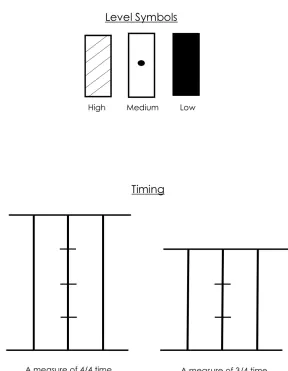
score consists of three parallel lines. It is read from the bottom upward, and the bar lines
7 For an contemporary analysis of nationalism, feminism, and German dance, see: Susan
Manning, Ecstasy and the Demon: Feminism and Nationalism in the Dances of Mary Wigman
function to indicate time, just as they do in music notation. The center line serves as the
spine: actions taking placing the right side of the body are written on the right side of the
staff and vice versa. Symbols clustered around this line indicate movements of the feet
and, moving outward, successive columns designate movements of the legs, torso, arms,
and head.
Figure 2. Basic Labanotation key. Adapted from Ann Hutchinson Guest, Labanotation (1961).
With such a system, Laban believed, the “science of living movement” could progress,
and dance would no longer be subject to the vagaries of human memory. Instead, it could
be broken down into its parts, accurately described in its entirety, and easily preserved
Eventually, Schrifttanz widened its mission to include analysis of the modern
dance scene more generally, but its theoretical core—and, indeed, its name—was still the
recording of dance on paper.8 Almost every edition included the insertion of notated
dance material, whether short excepts from well-known social dances, avant-garde
expressionist works, or folk dances. In this interest in using graphic recording
technologies to understand the body, Laban and Schrifttanz were not alone. As
Etienne-Jules Marey’s sphymograph transformed the peregrinations of the human pulse into a
single line and Eadweard Muybridge’s chronophotography broke down the movements of
humans and animals alike, the moving body, heretofore elusive, seemed newly ripe for
analysis.9
8 One impetus for Schlee’s involvement may have been a desire to use written texts to create a
critical dialogue around dance similar to that in existence for music, the fine arts, or literature. 9 See: Francois Dagognet, Etienne-Jules Marey: A Passion for the Trace; Marta Braun, Picturing
Time: The Work of Etienne-Jules Marey (1930-1904) (Chicago: University of Chicago Press, 1995); Robert Brain, “Representation on the Line: Graphic Recording Instruments and Scientific Modernism,” in From Energy to Information: Representation in Science and Technology, Art, and Literature, ed. Bruce Clarke and Linda Henderson (Stanford, CA: Stanford University Press, 2002); Rebecca Solnit, River of Shadows: Eadweard Muybridge and the Technological Wild West
Figure 3. Cover of Schrifttanz, 1929. Courtesy of Trinity Laban Conservatoire of Music & Dance Archives, Greenwich, UK.
Through venues like Schrifttanz, Labanhoped to communicate preserve dance for
the future. As he lamented in 1935:
faces of dance, has yet to be created and made universally applicable. I have paved the way for this and I shall develop it still further. The dances of a Pavlova have already been buried with her. Must we also lose the works of our present dance-generation?10
Laban also, however, imagined his system as a crucial tool for the present. He believed
that movement was perhaps the most powerful influence on the human personality, and,
with a growing understanding of the “the muscles, nerves, and nervous mechanisms
involvement in the complex function of single movements and bodily actions,” new
information on its precise effects was coming to light. As such, movement had to be
managed properly: a gesture, an emphasis, a limb out of place could spoil the whole
effect, leaving the participants in a choir not only unchanged, but worse off,
disconnected, and dissolute. Writing down movement graphically was thus also a means
of understanding and controlling individual psyches with a new degree of exactitude. As
Laban once stated, for any dancer, “the writing down of [a] composition is both a
stimulus and a controlling means for his abilities and for his temperament, which a
developed art of the dance cannot be without.”11
Part of Laban’s interest in the radical potential of theatrical movement likely
sprang from his time in Munich in the years immediately following the turn of the 20th
century. During this period, both Berlin and Munich served as German centers for
theatrical experimentation. While Berlin was the key site for the development of
naturalist drama, “the less verbal and more gestural variants of theatrical modernism
tended to flourish in Munich, a city that attracted a growing number of important young
10 Rudolf von Laban, A Life for Dance: Reminiscences, trans. Lisa Ullmann (New York: Theatre Arts Books, 1975), 184.
dramatists and directors.”12 Despite their relatively disparate political sympathies,
individuals like Georg Fuchs, Max Reinhardt, Peter Behrens, and Max Littmann all
sought to explore the expressive potential of the human body and—at the same time—to
probe the extent of theater’s ability to facilitate a sense of community, a goal that seemed
particularly meaningful only three decades removed from German unification.13 This
inclination manifested itself through theatrical productions, but also in new architectural
designs for the stage; Laban credits this ferment with inspiring his 1904 move to Paris to
study architecture at the Ècole des Beaux-Arts.14
At the same time, Laban’s understanding of dance owed much to contemporary
developments in the sciences, which he followed enthusiastically, albeit chaotically. In
particular, he was fascinated by new work in the increasingly intertwined disciplines of
physiology and physics, research which catalyzed his attempt to articulate a unique new
theory of the moving body.
Nervous Systems
Though the vigorous traffic between art and science would have been difficult to
avoid anywhere in fin-de-siècle central Europe, Laban’s interest in scientific thought was
catalyzed during his time at Munich Kunstakademie and the Teaching and Research
12 Peter Jelavich, Munich and Theatrical Modernism: Politics, Playwriting, and Performance,
1880-1914 (Cambridge, MA: Harvard University Press, 1985), 4.
13 Fuchs, for example, contended that “drama is possible without word and sound, without sets
and costumes, purely as rhythmic movement of the human body” and wrote extensively about the role theater could play in “solidify[ing] the German Volk into a homogenous community through the medium of art.” Ibid, 225.
Studio for Fine and Applied Arts (Lehr- und Versuchsatelier fur Freie und Angewandte
Kunst). At the Kunstakademie, Laban studied the anatomy and physiology of the human
body with the celebrated anatomist and embryologist Julius Kollman.15 At the Teaching
and Research Studio, Laban took courses in nature studies led by Hermann Obrist (who
ultimately became a friend) and was introduced to the drawings of Ernst Haeckel.16
In later years, Laban’s understanding of the inner workings of the body was also
strongly influenced by the work of Scottish surgeon and artist Charles Bell (1174-1842).
Trained as a physician in Edinburgh, Bell was a well-known anatomist who made his first
scientific splash in 1802 with the publication of a multi-volume anatomical study, A
System of Dissection Explaining the Anatomy of the Human Body, co-authored with his
older brother John. Shortly thereafter, Bell moved to London, where he continued his
both his medical practice and his anatomical research, first at Great Windmill Street
School of Anatomy, and later at the Middlesex Hospital, the College of Surgeons, and
King’s College, before returning to the University of Edinburgh in 1836.
To physiologists, Bell was best known for his research on the nervous system,
particularly for his efforts to distinguish the operations of the sensory and motor nerves.
As Leonard Carmichael put it in 1926, before Bell, the fibers of the central nervous
system were generally understood to “promiscuously” transmit, receive, and interpret
both movement and sensation. Bell, however, argued that though the motor and sensory
nerves might appear to form a single fiber, they remained functionally distinct. Sensory
15 Among Kollmann’s most heralded works was a massive visual encyclopedia of embryological
development in both humans and other animal species. Von Julius Kollmann, Handatlas Der Entwickelungsgeschichte Des Menschen (Jena: Verlag von Gustav Fischer, 1907).
16 Kandinsky’s Phalanx School was also in operation in Munich, though it is unclear whether
nerves carried information about the environment to the brain, while motor nerves
transmitted signals between the brain and the muscles, organs, and tissues.17
Bell’s work has been credited with laying the foundation for much
physiologically informed psychology. Carmichael, for example, notes that “from the
early experiments of Wundt’s institute down to the work of the present day there are few
laboratory problems which do not make use, in the course of their development, of
certain generalizations which are based on Bell’s law.” Bell did not, however, (unlike
some of his later interpreters) take an entirely mechanistic view of the human sensorium.
He was, for example, “just as willing to write of a nervous action as resulting from ‘the
will’ or from ‘an idea’ as from a stimulus,”18 and he conceived a circular—though
infrequently cited—theory of the relationship between the motor nerves and human
emotions.
For Bell, human emotional life was intimately entangled with the physical body.
If the sensory nerves were the conduits for intellectual life—conveying information about
the properties of the material world—the motor nerves provided the medium for
emotional expression. As art historian Frederick Cummings summarized, to Bell, “the
organs of the breast were to the ‘affections’ what the eyes, ears, and fingers were to the
mind. They took in emotional information; they were ‘aware’ of emotional stimuli just as
the eye was sensitive to light stimuli or the ear to sound.”19
17 Leonard Carmichael, “Sir Charles Bell: A Contribution to the History of Physiological
Psychology,” Psychological Review 33, no. 3 (1926): 188–217. 18 Ibid.
More concretely, this meant that Bell was fascinated by the connections between
movements of the body and internal mental states. He noted with relish, for example, that
the same nerves activated during rapid breathing were also those stimulated by fear and
anxiety. Bell argued that his fellow scholars had “too much overlooked this relation
between the mental operations and the condition of the bodily frame”20 and contended
that emotional states simply could not persist in the absence of appropriate physical cues.
As a corollary, he posited that certain forms of physical expression could alter a person’s
state of mind. In other words, movement didn’t merely express emotion; it also
transformed it.
Bell’s work was widely read in the mid-19th and early 20th centuries, garnering
readers as varied as Queen Victoria and Goethe. He also gained fame with artists with the
publication of the 1806 text, “An Essay on the Anatomy of Expression in Painting,”
which was revised and republished multiple times over the succeeding decades.21 In the
text, Bell sought to apply his physiological training to the practice of painting and
sculpture, arguing that the insights of science—and, in fact, the practical experience in
anatomy—were necessary tools for any fine artist that aspired to greatness. He also
20 Charles Bell, The Anatomy and Philosophy of Expression as Connected with the Fine Arts, Third edition (London: Henry G. Bohn, 1865).
21 For a recent treatment of Bell, his scientific work, and his approach to art, see: Carin
provided an overview of his thinking about the physiological roots of emotional
expression.22
It is unknown where Laban first encountered Bell’s work, but his personal papers
contain extensive notes on “The Anatomy and Philosophy of Expression as Connected
with the Fine Arts.” Alongside drawings of “reflex arcs,” Laban paraphrases various
passages from Bell’s text, noting, for example, that the “organs of the body, which are
moving sympathetically with the mind, produce uniform expressions of states of mind
and passion in all people…If one investigates the connection between passions and their
outer signs, one comes to the conviction that they are not depending upon the direct
influence of the spirit. Though strange this might be it is the heart and the lungs as well as
the whole breathing apparatus, which must be looked upon as the source of these
expressions.” Further, Laban writes that he hopes to “establish that what eye, ear, hands
are for the mind in producing ideas, are the breathing organs for the development of our
emotions. Without these organs we would see, hear and smell; but we would be without
feelings which make ideas and actions attractive and charming for us.” Though he found
Bell lacking on certain points—the expressive potential of blood flow, for example,
Laban called Bell’s work “far ahead of its time,” captivated by its vision of an
unbreakable bond between body and mind.23
Laban’s papers also contain notes on the work of Carl Lange, the Danish
physician and physiologist who, along with American psychologist William James, is
22 As Robert Brain discusses, similar physiological approaches to aesthetics were also key to the
practice of artistic modernism at the turn of the twentieth century. Robert Michael Brain, The Pulse of Modernism: Physiological Aesthetics in Fin-de-Siècle Europe.
23Rudolf Laban, “Miscellaneous Notes, Charles Bell,” Rudolf Laban Collection, University of