SMART DIGITAL NOTICE BOARD USING IoT
Arunkumar.M
1, Sivasankaran.P
2, Aarthi.C
3, Dr.Venkatesh.C
41,2,3,4Professor, Department of ECE, Sengunthar Engineering College, Tiruchengode, (India)
ABSTRACT
The paper presents a digital speaker and a smart circular system for hospitals, framers, fishermen railway stations, schools, institutions, and industries using personal computer. This idea provides the users with a simple, secure and fast way to announce important circulars through speaker instantaneously. The message can be sent through internet. The input data can be given through web server and the data are stored in cloud server (data base) then it is transmitted to receiver side. The function of Arduino Uno controller is to check the server’s database and if any new circular info is present the kit gets the data and updates it to the speaker. Similarly, a smart automation system has been developed to control appliances such as lights, fans, machines .The circulars can be put up in web server for displaying from any location in the world. The project consists of a Wi-Fi module, power supply, Arduino Uno controller and a speaker. The proposed system is flexible, durable without any risk of getting hacked. Such a system has a moderate cost of installation and maintenance.
Key Words
:
Android system, Electronic components, Arduino Uno controller, Relay, Web server.
I. INTRODUCTION
In today’s world of connectedness, people are becoming accustomed to easy access to information. Whether it’s through the internet or television, people want to be informed and up-to-date with the latest events happening around the world (J. S. Lee 2007). Wired network connection such as Ethernet has many limitations depending on the need and type of connection. Now a day’s people prefer wireless connection because they can interact with people easily and it require less time. The main objective of this project is to develop a wireless notice board that display message sent from the user and to design a simple, easy to install, user friendly system, which can receive and display notice in a particular manner with respect to date and time which will help the user to easily keep the track of notice board every day and each time he uses the system. GSM and Wi-Fi are the wireless technology used.
1.1
INTERNET OF THINGS (IOT)
The Internet of Things (IoT) is a system of interrelated computing devices, mechanical and digital machines, objects, animals or people that are provided with unique identifiers and the ability to transfer data over a network without
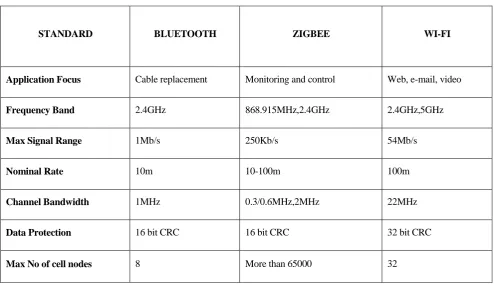
TABLE -1: COMPARISON OF BLUETOOTH, ZIGBEE AND WI-FI PROTOCOLS
II. REMOTE CONTROL EXAMPLE:
2.1 DOMESTIC EQUIPMENT FROM AN ANDROID APPLICATION:
We offer the example of a system for remotely send a notice, using a "Arduino uno controller " card for receiving commands from an Android application on mobile phone. Our electronic system is composed of a "Arduino uno controller " card for receipt of commands sent by the user and the conversion is made from the text to voice signal. The implementation of this system requires:
The Programming of a Arduino Uno controller capable of receiving commands sent by a remote user and the conversion is made.
The development of a mobile application "Android" in order to control our system.
Switch speakers on and off using a custom-built relay board.
Control the sound system. You can switch, change the volume and turn the system on/off. The controller emits IR signals that simulate the sound system’s remote control.
STANDARD BLUETOOTH ZIGBEE WI-FI
Application Focus Cable replacement Monitoring and control Web, e-mail, video
Frequency Band 2.4GHz 868.915MHz,2.4GHz 2.4GHz,5GHz
Max Signal Range 1Mb/s 250Kb/s 54Mb/s
Nominal Rate 10m 10-100m 100m
Channel Bandwidth 1MHz 0.3/0.6MHz,2MHz 22MHz
Data Protection 16 bit CRC 16 bit CRC 32 bit CRC
III. SOLUTION OVERVIEW
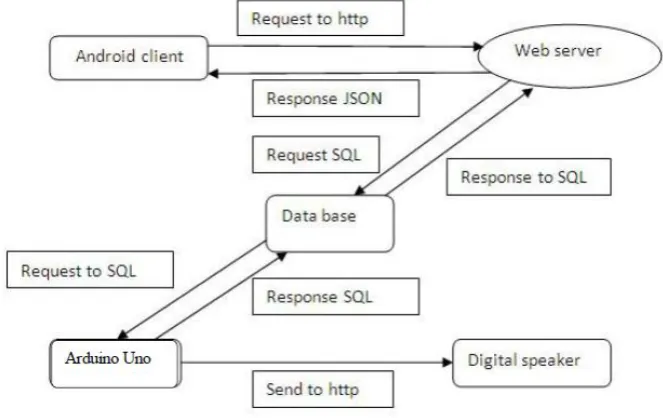
The following diagram (Fig. 1) illustrates the components of the system, and the interactions between them.
Fig -1: Solution overview scheme
3.1 PROPOSED TECHNOLOGIES FOR THE PROGRAMMING PART:
REPRESENTATION OF USE CASE DIAGRAMS:
Fig -2: Architecture at three levels (3-tiers)
a) The actors: There are four actors: the main actor is the remote user, two secondary actors which are the web service and the "Arduino uno controller " card, the fourth is an external actor: user manual.
b) Architecture at three levels (3-tiers):
Web Service: its role is to register the commands from the remote user in the database, retrieve the current state of the Notice, and return a failure / success message under the JSON as a response on the commands performed by the user.
Manual user: This actor will put a notice on Notice Board manually.
3.2
GENERAL USE CASES:
Fig.3 General User Cases
Authenticate: It allows the user to access the application after entering his login and password.
Remotely send Text/Notice: It allows the remote user to send text on digital notice board.
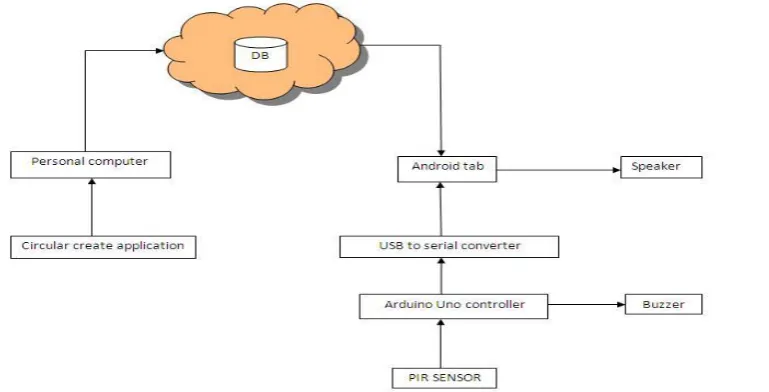
IV. BLOCK DIAGRAM:
Fig - 4: Block Diagram of the Proposed System
4.1 PROPOSED SOLUTION FOR THE HARDWARE PART
:
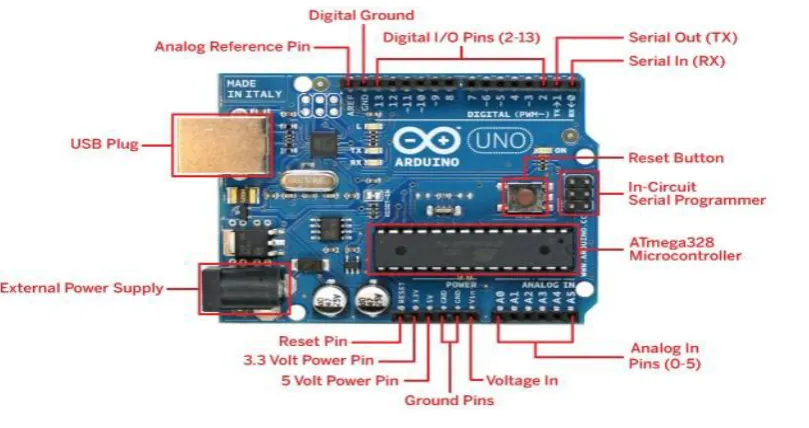
The solution that we have adopted consists of the exploitation of the Arduino Uno controller . It is a single nano computer card ARM processor designed by designer David Braben video games, as part of its foundation "Arduino uno controller ". The following photo presents the Arduino uno controller .
Remotely send text
Fig -5: Arduino Uno controller
Arduino Uno controller Model. A 700 MHz ARM-based Linux computer with 512 MB RAM. Ten programmable GPIO pins control the five relays: simply pulse the on or off coil for ~50ms. Another GPIO controls the IR diode.
IDE cable connector. I cut up an old 40-pin IDE connector to connect to the 26-pin GPIO header.
DPDT latching signal relays. Each relay controls left and right channels (hence dual poles). I opted for two-coil relays, so I could activate one coil to turn the relay on and the other coil to turn it off.
ULN2003A ICs to drive the relays. The Arduino Uno controller ’s GPIOs can’t drive the relays directly, so we control them with this transistor array. Each chip has 7 NPN Darlington pairs. It also has built-in fly back diodes that will dissipate the inductive kickback from the relay coils.
Stick-on IR diode. I had this emitter lying around. It came with a long cable that terminates in a mono 3.5mm headphone jack. I cut off a female headphone jack from a patch cable to make a plug for this and wired a 270 ohm current-limiting resistor to this.
4.2 PROPOSED SOLUTION FOR THE SOFTWARE PART:
ANDROID CLIENT:
Fig -6: Sign in and Registration
To control the relays and a Flask/jQuery Mobile web app for control from our phones/tablets. This project also leverages other open-source software:
Raspbian. The Debian distribution for Arduino uno controller .
Python, Flask, and jQuery Mobile for the control app.
RPi.GPIO to control GPIO ports from Python.
ShairPort, to enable AirPlay streaming to the Pi.
LIRC to learn and send IR commands to the sound system, using the lirc_rpi module.
uWSGI and Supervisor to run and deploy the webapp.
V. CONCLUSIONS
Now the world is moving towards automation, so in this world if we want to do some changes in the previously used system we have to use the new techniques. Wireless operation provides fast transmission over long range communication. It saves resources and time. Data can be sent from remote location. User authentication is provided. Previously the notice board using GSM was used in that there was the limit of messages but in our system Multimedia data can be stored on chip or on SD card. Text messages and multimedia data can be seen whenever we want to see.
REFERENCES
[1] Ms.Shraddha J Tupe, Ms A. R. Salunke, “Multi Functional Smart Display Using Raspberry-PI” Volume 2, Special Issue (NCRTIT 2015), January 2015. ISSN 2348 – 4853
[2] Li, B., Hathaipontaluk, P., and Luo, S., “Intelligent oven in smart home environment,” International Conference on Research Challenges in Computer Science (ICRCCS ’09), pp. 247–250, Shanghai, 28–29 December 2009.