A School-based Chlamydia Control Program Using DNA Amplification
Technology
Deborah A. Cohen, MD, MPH*‡; Malanda Nsuami, MD, MPH*; Roger Bedimo Etame, MD, MSc*; Susanne Tropez-Sims, MD*§; Sue Abdalian, MDi; Thomas A. Farley, MD, MPH‡; and
David H. Martin, MD*
ABSTRACT. Objectives. Chlamydia trachomatis is the most prevalent bacterial sexually transmitted disease (STD) in the United States, with the highest rates re-ported among adolescents. Chlamydia has severe conse-quences including pelvic inflammatory disease and in-fertility, and is believed to be a cofactor in human immunodeficiency virus transmission. Given that chla-mydia is predominantly asymptomatic, most cases are identified through routine screening in health care set-tings. Over time, screening and treatment appear to be associated with a decrease in the prevalence of disease in areas with consistent chlamydia control programs. The new availability of sensitive and specific urine tests for chlamydia (polymerase chain reaction [PCR] and ligase chain reaction [LCR]) provides the opportunity to screen large numbers of at-risk youth in a noninvasive manner. We used PCR/LCR testing to investigate the feasibility of a school-based chlamydia control program and to deter-mine the prevalence of chlamydia infection among jun-ior and senjun-ior high school students.
Design. At three junior/senior high schools, all stu-dents, regardless of symptoms or sexual history, were given the opportunity to be tested for chlamydia using urine-based PCR or LCR testing. Only students with parental consent were eligible. Parents could not obtain test results, except if their children told them. During the five 3-week testing periods, throughout the day, classes were escorted to the testing area and each student was individually counseled regarding the opportunity to par-ticipate in the testing.
Setting. Three urban public schools in Louisiana. Participants. A total of 1933 students in grades 7 through 12, including 861 girls and 1072 boys.
Intervention. All students were informed about the test and taught about chlamydia during the homeroom period. Students were asked to provide a first-void urine specimen of not more than 30 mL. Specimens were re-frigerated and delivered to the laboratory on the same day. Infected students were counseled and offered treat-ment with azithromycin, 1 g orally. They were also re-ferred for or offered additional STD and human immu-nodeficiency virus testing. Infected students were asked to refer their sex partners to the city STD clinic for treatment.
Main Outcome Measure. Prevalence ofC trachomatis infection by grade and gender.
Results. Parental consent was obtained for 2849 (86.9%) of the 3278 matriculated students in grades 7 through 12. Fifty-one parents (1.6%) returned consent forms refusing permission for their child to participate in this screening and treatment program. The remaining 378 (11.5%) could not be reached by mail or telephone. Among all students with consent, 1933 (67.8% of those consented and 59.0% of those matriculated) were tested. Girls were less likely to be tested than boys (861/1363 [63.2%] vs 1072/1465 [73.2%]).
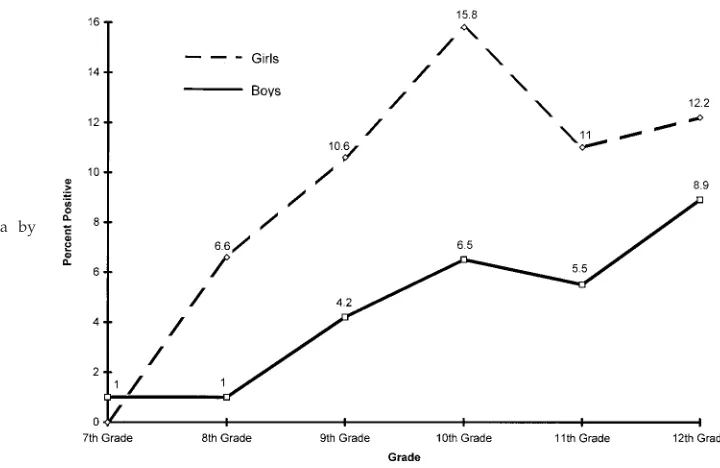
The overall prevalence ofC trachomatiswas 6.5%, with rates among girls more than twice that of boys (9.7% vs 4.0%). Generally, rates of infection increased with age. The prevalence rates among boys were for 7th grade, 2/208 (1%); 8th grade, 2/196 (2%); 9th grade, 10/236 (4.2%); 10th grade, 12/185 (6.5%); 11th grade, 8/146 (5.5%); and 12th grade, 9/101 (8.9%). For boys 15 to 19 year old, the prevalence of chlamydia was 5.7%. Among girls, the prevalence rates were 7th grade, 0/105 (0%); 8th grade, 11/166 (6.6%); 9th grade, 23/218 (10.6%); 10th grade 23/146 (15.8%); 11th grade, 13/118 (11%); and 12th grade, 13/107 (12.1%). Among girls 15 to 19 years old, 12.7% were in-fected. Of 126 infected students, treatment was provided to 111 (88%).
For this project, the laboratory cost of LCR testing was $17.76 per test. Without considering clinical staff time to collect the specimens, the average laboratory cost per infected student identified was $272. For students 15 to 19 years of age, of whom 104 (8.9%) of 1170 were infected, the laboratory cost was $200 per case identified.
Conclusion. School-based chlamydia screening and treatment is feasible, acceptable, relatively inexpensive, and has a high yield. The higher prevalence among girls might be explained in part by greater incidence of symp-toms among boys, prompting earlier diagnosis and treat-ment. Also, girls may have older, more experienced part-ners and may have greater exposure to chlamydia early in their sexual lives. The fact that girls are probably more susceptible to infection than boys could play a role as well.
DNA amplification technology as represented by PCR and LCR, the two types of tests currently available, offers the pediatrician who deals with adolescents greater flex-ibility in diagnosing chlamydia infections. Because the majority of chlamydia infections are asymptomatic and the disease can only be controlled through screening programs, urine-based screening may be the only practi-cal way to accomplish this on a large spracti-cale. Schools are settings that can be used to reach the majority of adoles-cents.
Urine-based screening for chlamydia in school settings should be considered a routine part of programs to
con-From the *Louisiana State University Medical Center; the ‡Louisiana De-partment of Health and Hospitals, Office of Public Health; the §New Orleans Health Department; and theiTulane University School of Medicine, New Orleans, Louisiana.
Received for publication Jun 6, 1997; accepted Aug 22, 1997.
Reprint requests to (D.A.C.) HIV Program Office, 1600 Canal St, New Orleans, LA 70112.
trol STDs nationally. Because, over time, screening and treatment appear to be associated with a decrease in the prevalence of disease in areas with consistent chlamydia control programs, a national school-based chlamydia control program conceivably could lead to eradication of endemic C trachomatis in the United States. Pediatrics 1998;101(1). URL: http://www.pediatrics.org/cgi/content/ full/101/1/e1;chlamydia, school health, polymerase chain reaction, ligase chain reaction, STD control.
ABBREVIATIONS. STD, sexually transmitted disease; PCR, poly-merase chain reaction; LCR, ligase chain reaction; LE, leukocyte esterase; EIA, enzyme immunoassay.
I
nfection with Chlamydia trachomatis is the most prevalent bacterial sexually transmitted disease (STD) in the United States, with the highest rates reported among adolescents.1The long-termconse-quences of chlamydia infection may be severe, par-ticularly in women; it is estimated that of those in-fected with chlamydia and not adequately treated, 20% to 40% develop pelvic inflammatory disease.2
Among those with pelvic inflammatory disease, 20% develop tubal infertility as a result of scarring, 9% experience ectopic pregnancy, and 18% develop chronic pelvic pain.3 Given that chlamydia is
pre-dominantly asymptomatic among as many as 70% to 80% of infected women and 50% of infected men, most cases are identified through routine screening in health care settings.4 –7 Over time, screening and
treatment appear to be associated with a decrease in the prevalence of disease in areas with consistent chlamydia control programs.8,9
Adolescents are a group considered to be under-served medically. Over the past decade, there has been a burgeoning growth in school-based health clinics to address adolescent health care needs.10
These clinics are available to respond on a reactive basis to complaints initiated by youth.
A proactive chlamydia screening and treatment program of school-age youth has the potential to identify disease at an early stage, prevent later mor-bidity, and decrease transmission in the community. The new availability of sensitive and specific urine tests for chlamydia (polymerase chain reaction [PCR] and ligase chain reaction [LCR]) provides the oppor-tunity to screen large numbers of at-risk youth in a noninvasive manner.11–13
LCR and PCR are DNA amplification-based diag-nostic methods that have been adopted for the de-tection ofC trachomatisin clinical specimens. Because these tests theoretically have the potential of detect-ing a sdetect-ingle organism in a specimen, they are highly sensitive. Studies of both LCR and PCR using
endo-pelvic examination in women and obtaining a ure-thral swab in men.
We developed a chlamydia screening and treat-ment program using PCR/LCR technology in three inner city junior/senior high schools in Louisiana. All students were African-American and;70% qual-ified for the free or reduced lunch program. Al-though many other programs have conducted chla-mydia screening among students seeking medical care,18our program was unique in that we attempted
to screen all students, regardless of symptoms or sexual history.
METHODS
All youth in the school were eligible to participate if they had parental consent to receive clinical services in the school-based clinic or if the parents had signed a specific consent allowing the student to participate in the chlamydia screening and treatment program. Consent was obtained in writing or verbally by tele-phone. During the five 3-week testing periods, throughout the day, classes were escorted to the testing area and each student was individually counseled regarding the opportunity to participate in the testing. Students whose parents had not provided consent were sent back to their classrooms. Students whose parents had provided consent were asked to provide a first-void urine speci-men of not more than 30 mL. Leukocyte esterase (LE) testing was performed on samples provided by males, but not used as a guide for treatment purposes. Specimens were refrigerated and deliv-ered to the laboratory on the same day. The first 444 specimens were tested by using the PCR test. Subsequently, the LCR test was used in all patients. The switch from PCR to LCR was done to increase the efficiency of testing in the laboratory. Both tests were performed entirely according to the company’s package insert (Amplicor Chlamydia Test, Roche Molecular Systems, Branch-burg, NJ and LCX Probe Systems, Abbot Laboratories, Abbot Park, IL).
Infected students were counseled and offered treatment with azithromycin, 1 g orally. They were also referred for or offered additional STD and human immunodeficiency virus testing. In-fected students were also asked to refer their sex partners to the city STD clinic for treatment.
We assured all students of confidentiality. All specimens were labeled with a code number. No results were divulged to anyone except to students. Parents could not obtain test results, except if their children told them.
RESULTS Participation
Parental consent was obtained for 2849 (86.9%) of the 3278 matriculated students in the schools. Fifty-one parents (1.6%) returned consent forms refusing permission for their child to participate in this screening and treatment program. The remaining 378 (11.5%) could not be reached by mail or telephone. There were no differences in gender between stu-dents with and without consent (Table 1). Consent was obtained from 87.0% of parents of students 15 to 18 years of age and from 87.9% of parents of students
to be infected as boys (83/858 [9.7%] vs 42/1071 [4.0%] in boys;P,.001). Rates among girls increased from 6.6% in 8th grade to 15.8% in 10th grade and were slightly lower thereafter (Fig 1). Rates rose steadily in boys from 1% in 7th graders to 8.9% among 12th graders. Of 126 infected students, treat-ment was provided to 111 (88%). Of the 15 students not treated, 7 had dropped out of school, 1 was treated the following year, 3 were negative on retest and presumably had been treated elsewhere, and 4
could not be located even though they still were enrolled in school.
The sensitivity and specificity of LE testing per-formed for males only, using PCR and LCR as the standard, were 73.8% (31/42) and 85.6% (870/1016), respectively. The positive predictive value of the LE test was 17.5% (31/177).
Cost
For this project, the laboratory cost of LCR testing was $17.76 per test. Without considering clinical staff time to collect the specimens, the average laboratory cost per infected student identified was $272. For students 15 to 19 years of age, of whom 104 (8.9%) of 1170 were infected, the laboratory cost was $200 per case identified. Among the girls 15 to 19 years of age, 68 (12.7%) of 536 were infected, lowering the cost to $140 per case; among the boys, 36 (5.7%) of 634 were infected, and the laboratory cost was $313 per case identified.
COMMENT
We found that school-based chlamydia screening and treatment are feasible, acceptable, and relatively inexpensive, and has a high yield. A limitation on the interpretation of our data is that only 59% of the students enrolled were tested. We cannot be sure that the students not tested did not have a higher or lower rate of infection than those tested. However, even if all other students not tested were uninfected, the minimum prevalence ofC trachomatisin this pop-ulation would be 3.9%. The prevalence of 9.7% for all girls, 12.7% for girls age 15 to 19, 4% for all boys, and 5.7% for boys age 15 to 19 is quite high, exceeding that reported in many studies in which all patients are sexually active. Studies have reported prevalence rates of 5.9% among women attending STD and fam-ily planning clinics,129% among pregnant women in
rural settings,19 and 8.2% among active-duty army
females.20 The prevalence of chlamydia infection
TABLE 1. Number and Percent of Students for Whom Consent was Obtained and Testing was Performed*
Matriculated† Consented (%)‡
Tested (%)§
Sex
Male 1658 1465 (88.4) 1072 (73.2)\ Female 1584 1363 (86.0) 861 (63.2) Race
African-American 3278 2849 (86.9) 1933 (59.0) Age*
,13 130 115 (88.5) 86 (74.8)¶
13 359 313 (87.2) 250 (79.9)
14 527 463 (87.9) 358 (77.3)
15 598 527 (88.1) 368 (69.8)
16 623 533 (85.6) 351 (65.9)
17 512 446 (87.1) 288 (64.6)
18 305 272 (89.2) 163 (59.9)
19 119 103 (86.6) 51 (49.5)
.20 51 46 (90.2) 15 (32.6)
Grade*
7 469 400 (85.3) 313 (78.3)¶
8 544 473 (86.9) 362 (76.5)
9 806 677 (84.0) 454 (67.1)
10 591 529 (89.5) 331 (62.6)
11 474 422 (89.0) 264 (62.6)
12 393 348 (88.5) 208 (59.8)
* Numbers may not equal 100% of total because of missing data. † Total school population.
‡ Percent of those matriculated. § Percent of those consented.
\P,.0001 for comparing participation between consenting males and females.
¶P,.0001 for linear trend.
among adolescent girls 15 to 19 years of age seen in New Orleans family planning clinics is 11.5%.21 C
trachomatisprevalence rates of 20% to 30% have been reported in pregnant adolescent girls.22,23 Among
males seen in teen clinics, detention centers, military clinics, and colleges clinics, chlamydia prevalence has been found to be 7%.24Another study of males in
a primary care setting found a prevalence of only 1%.25The Youth Risk Behavior Survey of high school
students in New Orleans, conducted by Centers for Disease Control and Prevention, has shown that 52.4% of girls and 77.6% of boys admitted to ever having sex.26If only the sexually active youth were
used as the denominator, infection rates reported here would have been significantly higher.
There are a number of possible reasons for girls having higher rates of infection and lower participa-tion than boys. The higher prevalence of infecparticipa-tion might be explained in part by greater incidence of symptoms among boys, prompting earlier diagnosis and treatment. Also, girls are likely to have older, more experienced partners and may have greater exposure to chlamydia early in their sexual lives.27,28
The fact that girls are probably more susceptible to infection than boys could play a role as well.29
Al-though we stressed that universal participation would protect everyone’s confidentiality, some stu-dents refused on the grounds that they were not sexually active and would not be at risk for chla-mydia. That girls were less likely to accept the test compared with boys may be a reflection of girls’ reluctance to be seen as sexually active. On the other hand, boys may have wanted to be tested so as to appear sexually active, even if they were not. Older students were less likely to be tested, probably be-cause the absentee rate was higher in this group than among younger students. Some of the older girls refused to participate because they said they were already enrolled at family planning or prenatal clin-ics and had been tested recently. Thus, selection bias could explain the lower rates among 11th and 12th grade girls, compared with 10th grade girls.
The laboratory costs of our program compare fa-vorably with the laboratory costs required to test asymptomatic males using LE and/or enzyme im-munoassay (EIA). Shafer and coworkers24reported a
laboratory cost of $434 using EIA to identify a case in a population with a prevalence of 7%. The use of LE followed by EIA brought the laboratory cost down to $192. In our male population, LE would have missed 26% of the cases. LE screening has a low sensitivity and predictive value in females, and its use is not recommended.30 In contrast to EIA, a major
advan-tage of urine LCR is that special facilities are not necessary to perform physical examinations,
allow-would be important in defining further the epidemi-ology ofC trachomatis infection in this student pop-ulation.
DNA amplification technology as represented by PCR and LCR, the two types of tests currently avail-able, offers the pediatrician who treats adolescents greater flexibility in diagnosing chlamydia infec-tions. In symptomatic girls in whom a pelvic exam-ination is indicated and in symptomatic boys in whom a urethral swab can be justified, the best di-agnostic specimens remain endocervical and urethral secretions, respectively, obtained by direct swabbing. However, there are many asymptomatic sexually ac-tive adolescents in whom screening is important, but it is not possible to perform an optimal examination. Both PCR and LCR have adequate sensitivity for the detection of chlamydial infections in both boys and girls.31
Considering the high rate of sexual activity among junior and senior high school youth, the high rates of asymptomatic chlamydia transmission, and the rela-tive ease of screening and treating large numbers of youth, school-based screening in inner-city schools is likely to be cost-effective.
Screening programs should be attempted in schools not in inner-city areas to determine whether the yield would be as high and would justify routine school-based screening as part of all STD control programs. Although it seems likely that school-sys-tem-wide screening and treatment forC trachomatis, at least in high prevalence areas, would lower the community incidence of infection and the long-term sequelae of chlamydial infection, a community-level controlled trial will be necessary to answer defini-tively these questions. If, in fact, it can be demon-strated clearly that repeated school-based screening and treatment has such an effect, a national program conceivably could lead to eradication of endemic C trachomatisin the United States.
ACKNOWLEDGMENT
This project was supported in part by the Centers for Disease Control and Prevention and the STD Control Program, Office of Public Health, Louisiana Department of Health and Hospitals.
REFERENCES
1. Recommendations for the prevention and management ofChlamydia trachomatisinfections, 1993.MMWR.1993;42:1–39
2. Stamm WE, Guinan ME, Johnson C, Starcher T, Holmes KK, McCor-mack WM. Effect of treatment regimens for Neisseria gonorrhoeaeon simultaneous infection withChlamydia trachomatis. N Engl J Med.1984; 310:545–549
3. Westrom L, Joesoef R, Reynolds G, Hagdu A, Thompson SE. Pelvic inflammatory disease and fertility: cohort study of 1844 women with laparoscopically verified disease and 657 control women with normal laparoscopic results.Sex Transm Dis.1992;19:185–192
8. Hillis SD, Nakashima A, Amsterdam L, et al. The impact of a compre-hensive chlamydia prevention program in Wisconsin.Fam Plann Per-spect.1995;27:108 –111
9. Herrmann B, Egger M. GenitalChlamydia trachomatisinfections in Upp-sala County, Sweden, 1985–1993: declining rates for how much longer?
Sex Transm Dis.1995;22:253–260
10. McPherson-Corder MD. The integrated school health center: a new medical homePediatrics.1995;96:864 – 866
11. de Barbeyrac B, Rodriguez P, Dutilh B, LeRoux P, Bebear C. Detection ofChlamydia trachomatisby ligase chain reaction compared with poly-merase chain reaction and cell culture in urogenital specimens Genito-urin Med.1995;71:382–386
12. Schachter J, Moncada J, Whidden R, et al. Noninvasive tests for diag-nosis of Chlamydia trachomatis infection: application of ligase chain reaction to first-catch urine specimens of womenJ Infect Dis.1995;172: 1411–1414
13. Ridgway GL, Mumtaz G, Robinson AJ, et al. Comparison of the ligase chain reactions with cell culture for the diagnosis ofChlamydia tracho-matisinfection in women.J Clin Pathol.1996;49:116 –119
14. Buimer M, van Doornum GJJ, Ching S, et al. Detection ofChlamydia trachomatisandNeisseria gonorrhoeaeby ligase chain reaction-based as-says with clinical specimens from various sites: implications for diag-nostic testing and screening.J Clin Microbiol.1996;34:2395–2400 15. Chernesky MA, Jang D, Lee H, et al. Diagnosis ofChlamydia trachomatis
infections in men and women by testing first-void urine by ligase chain reaction.J Clin Microbiol.1994;32:2682–2685
16. Schachter J, Stamm WE, Quinn TC, Andrews WW, Burczak JD, Lee HH. Ligase chain reaction to detectChlamydia trachomatisinfection of the cervix.J Clin Microbiol.1994;32:2540 –2543
17. Lee HH, Chernesky MA, Schachter J, et al. Diagnosis ofChlamydia trachomatisgenitourinary infection in women by ligase chain reaction of assay urine.Lancet.1995;345:212–216
18. Wasserheit J. Setting the stage for STD prevention in the next millen-nium. Presented at the National STD Conference; December 12, 1996; Tampa, FL
19. Shaw E, Roberts D, Connor PD. Prevalence of and risk factors for
Chlamydiain a rural pregnant populationJ Fam Pract.1995;41:257–260 20. Catterson ML, Zadoo V. Prevalence of asymptomatic chlamydia
cervi-cal infection in active duty Army females.Mil Med.1993;158:618 – 619 21. Louisiana Office of Public Health.Chlamydia trachomatissurveillance
data. Patty Kissinger, personal communication, CDC Infertility Preven-tion Study, New Orleans site. 1996
22. Shafer MA, Schachter J, Moncada J, et al. Evaluation of a urine based screening strategies to detect Chlamydia trachomatis among sexually active asymptomatic young males.JAMA.1993;270:2065–2070 23. Sellors JW, Mahony JB, Pickard L, et al. Screening urine with a leukocyte
esterase strip and subsequent chlamydial testing of asymptomatic men attending primary care practitioners.Sex Transm Dis.1993;20:152–157 24. Martin DH, Pastorek J, Faro S. Risk factors forChlamydia trachomatisin
a high risk population of pregnant women. In: Oriel D, Ridgway G, Schachter J, Taylor-Robinson D, Ward M, eds. Chlamydial Infections. Cambridge, UK: Cambridge University Press; 1986:189 –192
25. Harrison HR, Alexander ER, Weinstein L, Lewis M, Nash M, Sim DA. Cervical Chlamydia trachomatis and mycoplasmal infections in preg-nancy. Epidemiology and outcomes.JAMA.1983;250:1721–1727 26. Centers for Disease Control and Prevention.New Orleans Public Schools
Youth Risk Behavior Survey Report.1995
27. Landry DJ, Forrest JD. How old are US fathers?Fam Plann Perspect.
1995;27:159 –161, 165
28. Wilson AL. The state of South Dakota’s child, 1994.S D J Med.1995;48: 5–13
29. Lycke E, Lowhagen GB, Hallhagen, G, Johannisson G, Ramstedt K. The risk of transmission of genitalChlamydia trachomatisinfections is less than that of genital Neisseria gonorrhoeae infection. Sex Transm Dis.
1980;7:6 –10
30. Chow JM, Moncada J, Brooks D, Bolan G, Shaw H, Schachter J. Is urine leukocyte esterase test a useful screening method to predict chlamydia trachomatis infection in women?J Clin Microbiol.1996;34:534 –536 31. Black CM. Current methods of laboratory diagnosis ofChlamydia
DOI: 10.1542/peds.101.1.e1
1998;101;e1
Pediatrics
Sue Abdalian, Thomas A. Farley and David H. Martin
Deborah A. Cohen, Malanda Nsuami, Roger Bedimo Etame, Susanne Tropez-Sims,
Technology
A School-based Chlamydia Control Program Using DNA Amplification
Services
Updated Information &
http://pediatrics.aappublications.org/content/101/1/e1
including high resolution figures, can be found at:
References
http://pediatrics.aappublications.org/content/101/1/e1#BIBL
This article cites 25 articles, 7 of which you can access for free at:
Subspecialty Collections
ne_sub
http://www.aappublications.org/cgi/collection/maternal_fetal_medici
Maternal and Fetal Medicine
http://www.aappublications.org/cgi/collection/gynecology_sub
Gynecology
http://www.aappublications.org/cgi/collection/school_health_sub
School Health
_sub
http://www.aappublications.org/cgi/collection/community_pediatrics
Community Pediatrics
following collection(s):
This article, along with others on similar topics, appears in the
Permissions & Licensing
http://www.aappublications.org/site/misc/Permissions.xhtml
in its entirety can be found online at:
Information about reproducing this article in parts (figures, tables) or
Reprints
http://www.aappublications.org/site/misc/reprints.xhtml
DOI: 10.1542/peds.101.1.e1
1998;101;e1
Pediatrics
Sue Abdalian, Thomas A. Farley and David H. Martin
Deborah A. Cohen, Malanda Nsuami, Roger Bedimo Etame, Susanne Tropez-Sims,
Technology
A School-based Chlamydia Control Program Using DNA Amplification
http://pediatrics.aappublications.org/content/101/1/e1
located on the World Wide Web at:
The online version of this article, along with updated information and services, is
by the American Academy of Pediatrics. All rights reserved. Print ISSN: 1073-0397.