action plan – Northland 2014
Kenneth F.D. Hughey
Susanne Becken
An evaluation of the visitor action plan –
Northland 2014
Land Environment and People Research Report No. 36
November 2014
ISSN 2230-4207 (on-line)
ISBN 978-0-86476-370-9 (print)
ISBN 978-0-86476-371-6(PDF)
Reviewed by:
Dr Hamish Rennie,
Senior Lecturer and Director of Planning Programmes
Faculty of Environment, Society and Design
Lincoln University
Canterbury, New Zealand.
Acknowledgements
We thank the survey participants for their input into the research, and Graeme MacDonald and Brian Roberts for taking the time to have additional meetings with us and to read over and provide helpful comments on a draft of this report. Finally we thank Dr Hamish Rennie from Lincoln University for peer review.
©LEaP, Lincoln University, New Zealand 2014
Contacts - email:
[email protected]
Table of Contents
Acknowledgements ... i
Executive Summary ... iv
Introduction ... 6
1.1 The tourism emergency management contextin Northland - 2012 ... 6
1.2 Aims and objectives ... 7
2.1 Broader evaluation literature ... 9
2.2 Climate change and DRR evaluation... 9
3.1 Data collection ... 11
3.2 Data analysis ... 12
4.1 CDEM meeting minutes ... 13
4.2 Interview findings ... 14
4.3 Value groupings ... 16
4.4 Building on the existing VAPs ... 17
5.1 Regional level lessons ... 21
5.2 Local tourism communities – Key lessons ... 21
5.3 Recommendations ... 23
References ... 25
List of Tables
Table 1 Key points made in Coordinating Executive Group meetings ... 13Table 2 Key issues (positive and negative) identified in the interviews (N=13) and meetings (N=1) presented by value grouping ... 17
Table 3 Possible decision tree to determine the need for CRPs and VAPs in regional CDEM planning ... 22
Executive Summary
In response to increasing interest in improving the Disaster Risk Preparedness of tourism, this report presents a formal evaluation of the implementation of Visitor Action Plans (VAP) and planning generally in Northland, which were designed to improve the preparedness of the Northland tourism sector to natural disasters. The insights gained from this evaluation will inform future developments of future DRR initiatives in other New Zealand regions.
Evaluation is a core component of most planning cycles, being an integral component of learning and feedback. Based on the relevant literature, this project recognised the need for formative evaluation that takes account of changing experiences over time, and it also acknowledges that a values-based approach is most suitable to capture different perspectives on DRR progress on the local and regional levels.
In this case an ex poste evaluation of policy implementation was undertaken, involving stakeholder meetings and personal interviews with key tourism and Civil Defence and Emergency Management (CDEM) actors. Most of the tourism industry interviews were in the Paihia VAP area, the results of which are presented below. Second, this detail from the particular case of the Paihia destination was then ‘verified’ against six other VAPs. As part of this verification process, six representatives with leadership roles participated in short phone interviews.
The feedback by all stakeholders was exclusively positive, providing evidence to: a) the salience of the topic, b) the collective spirit of the tourism sector in Northland, and c) success of past engagement and awareness raising of the need to prepare for natural disasters. There was explicit support for the notion of integrating tourism into the CDEM structure and a temporary lack of involvement due to changes in structure and personnel was noted as an important issue that needed to be addressed.
At the regional level, two key issues emerged as requiring ongoing improvement. Both roading and dealing with media were discussed in several interviews as critical to the ongoing success of tourism in Northland. It was also recognised that both of these issues require a concerted approach and one that is linked in with other activities or organisations, for example the New Zealand Transport Agency, the Northland Regional Council and the individual district councils.
At the local level, and for the destination of Paihia the feedback from tourism stakeholders on the VAP approach was very positive. Having been involved in developing the VAP, including various DRR workshops, evaluation participants felt more aware and prepared, and better connected, for natural disasters. The need to update VAPs annually and provide a ‘refresher’ became apparent, especially given the high turn-over of staff. Local leadership is critical to the success of VAPs, bearing a risk when key people leave the region. Leadership problems seem to have been one factor in the less successful outcomes of VAPs in other tourist regions, alongside limited broader community buy-in, and little ongoing interest.
for a dual indicators system (e.g. process and outcome oriented, and local versus regional-level) has been proposed.
Introduction
Globally and nationally there is increasing interest in Disaster Risk Reduction (DRR) and how it relates to tourists and their management. A variety of response frameworks have been developed (see for example Tourism Queensland 2009, or the Hyogo Framework for Action (2005-2015) more broadly). In this report we evaluate the implementation of tourism and DRR approaches within the context of Northland, New Zealand. In 2012, research led to a tourism-specific disaster response template - the Visitor Action Plan (VAP). The VAP was specifically developed in response to concerns about actual and potential effects of cyclonic weather events and tsunamis on the Northland tourism sector and a lack of integration between Civil Defence and Emergency Management (CDEM) activities and tourism (Becken and Hughey 2013).
The main purpose of this report is to present a formal evaluation of VAP implementation in Northland as a contribution to developing a DRR approach for tourism on the West Coast of the South Island. The remainder of this report is structured around: specifying aims and objectives, reviewing (briefly) pertinent evaluation literature and developing a framework against which to implement the evaluation, outlining the research methods, reporting and discussing the results, identifying issues and areas for improvement, and recommending future actions.
1.1
The tourism emergency management contextin Northland - 2012
Around 5 million people visit Northland annually with most of these being domestic (about 71%) and from the greater Auckland area. More specifically, in the year ended December 2012 there were 309,744 international visitors in Northland, compared with 1,074,818 domestic visitors (Ministry of Business, Innovation and Employment, 2014).
While attractions are spread around the region the single most important tourist location is the Bay of Islands. Main access ways are via State Highway 1 to the south, the airports at Kerikeri, Kaitaia and Whangarei, and via cruise ships in the Bay of Islands. From a natural hazard perspective the main and ongoing threats to Northland are from the weather (strong winds, heavy rains and associated flooding) and tsunamis. Previous experience has shown that remnants of sub-tropical cyclones pose threats particularly to the roading network, and as a result access to the region.
The research had highlighted that concerns from a tourism management perspective focused on issues around how best to manage tourists and their expectations, on dealing with media requests and media coverage (particular after an event), and on immediate visitor needs in the event of a potential major disaster (e.g., tsunami warning). Within this context it was found there was a disjuncture at the regional CDEM system level where the tourism industry and the Department of Conservation (DOC) were not formally involved; and at the local level where tourism operators were often not integrated into local response efforts. Both of these issues were addressed in 2012: the first, by involvement of both the tourism industry (via Destination Northland) and DOC within the Northland CDEM groups (in particular the Coordinating Executive Group [CEG]), and the second through the development of VAPs at a local level (being complementary to or as a part of existing Community Response Plan developments). In 2012 Northland received $50,000 from the Community Resilience Fund to run a series of DRR workshops – leading ultimately to seven VAPs, including Paihia in the Bay of Islands.
1.2
Aims and objectives
Within the above context the aim of this report is to evaluate the 2012 Northland tourism DRR initiatives, and in particular progress in relation to VAPs, with a view to identifying lessons that will improve the management of tourists and tourism in disaster contexts elsewhere. Specific objectives are:
Evaluate the nature and extent of tourism DRR approaches in Northland with particular emphasis on regional and local contexts (as envisaged in Becken and Hughey 2013);
Identify strengths and weaknesses of the VAP approach and any related issues;
Suggest areas for improvement within the Northland context with the view to revising the VAP for further application in other regions, particularly in the first instance on the West Coast of the South Island;
Brief literature review and framework for the research
Evaluation is a systematic approach of assessing progress or success relative to a specified goal or outcome of a particular initiative, guided by a set of standards. Importantly, the main purpose of evaluation is to enable reflection and provide guidance on future initiatives or ‘next steps’.
2.1
Broader evaluation literature
There is a vast evaluation theory and practice literature that traverses a wide range of disciplinary perspectives, and takes into account both formative and summative approaches. The different evaluation approaches represent conceptually and epistemologically distinct ways of conducting evaluations. Broadly, evaluations based on an objectivist epistemology assume that knowledge (e.g. about a particular intervention) can be collected in an objective way and externally verified, for example through quantifiable data and indicators. In contrast, a subjectivist epistemology is based on the assumption that experiences and knowledge are personal in nature and differ for each individual. Further, each of these approaches could focus on either a small elite (e.g. managers) or be more inclusive by considering a mass perspective (House, 1978).
Many of the theories and models have been reviewed, compared and classified by Hansen et al. (2013) and Dillman (2013). The latter identifies three ‘models’:
Practical Participatory Evaluation; Values-engaged Evaluation; Emergent Realist Evaluation.
Dillman concluded that no model is completely specific, or unique and that each presents challenges for field application (p. 53), and also that often approaches differ in terms of the degree to which those being evaluated contribute to the design of the evaluation criteria or not.
2.2
Climate change and DRR evaluation
Following the above brief insight into emerging theory we next turn to evaluation of climate change adaptation because of its relation to natural disasters (especially those that are weather-related) and tourism, a much smaller area of literature.
Understanding that processes and systems, at each policy level, need to be understood as part of any evaluation.
This framework can be envisioned by the following understanding, articulated to us by Alistair Wells, Civil Defence controller in the Far North district (pers. comm. 4 September 2014):
At the national level of CDEM the key evaluation criteria are built around understanding and operationalising systems and processes from the top down (i.e. most akin to an objective and elite-focused approach);
At the local tourism community (destination) level the evaluation is driven by understanding how contacts-relationships-leadership work to drive response from the bottom up (i.e. a more subjective and participatory approach); and
At the regional CDEM and tourism management levels (RTO or equivalent) the evaluation is driven by a combination of the above two approaches.
Methods
Evaluation is a core component of most planning cycles, being an integral component of learning and feedback. In this case we are undertaking an ex poste evaluation of policy implementation, to inform ongoing progress in Northland and partly to inform future implementation efforts in other regions.
In preparation for the actual data collection in Northland, we made presentations to a range of conferences and seminars. Feedback and ideas from those events have led to us consider also:
The need for specific tourism plans (such as the VAP) in the existence of functioning emergency management systems that – by default – should include tourism;
The extent to which the tourism sector in general has an ethical obligation to ‘protect’ tourists – the notion of a global charter of tourist rights;
Whether a tool such as a multi-language tourist mobile phone APP could be provided to all incoming tourists. Such an APP would include VAP relevant information, suggested alternative activities, road information, weather forecasts and other relevant safety information;
Opportunities for integrating tourism businesses’ disaster preparedness with existing quality schemes (e.g. Qualmark) through an indicator-based system.
3.1
Data collection
We used qualitative interviews with interviewees chosen via purposeful sampling and snowballing as the basis for gathering relevant data. These interviews and associated meetings have been complemented by interviews with six people who hold leadership roles in either VAP or, where appropriate, CRP developments in tourism areas. These interviews served as a further reference point for the main empirical research. In addition, the Situation Report (SitRep Number 4, 1500hrs 14/7/14) prepared by Northland CDEM Group in relation to the July 2014 weather-related civil defence issue was examined to confirm aspects of disaster response mentioned in several interviews. Thus, this evaluation involved four phases (see also Figure 1):
Pre-evaluation information gathering to identify a suitable evaluation approach (the ‘what’) process, and stakeholders to be interviewed. Interviews/meetings were held with Brian Roberts (former CEO of Destination Northland) and Graeme MacDonald (CDEM Regional Controller) to obtain an overview of events since 2012 and finalise an approach.
De-brief with key tourism and CDEM stakeholders: Following the detailed ‘on-the-ground’ examination of issues, progress, and further opportunities, debriefs with Brian Roberts and Graeme MacDonald were held to calibrate the findings and fill remaining gaps.
Verification: Brief interviews with key contacts for six VAPs/CRPs prepared in Northland were conducted to provide a benchmark against which to assess VAP implementation in Paihia in detail. The contact details for these interviewees were taken from the VAP documents’ contact list.
We also examined the records (minutes) of CDEM and CEG meetings over the years since design and implementation of the VAP to trace progress and verify the findings from the interviews.
Figure 1
Data collection stages for the Northland tourism DRR evaluation
3.2
Data analysis
Analysis of empirical data, mainly from interviews and meetings, was undertaken in the following ways:
Recorded interviews were transcribed and all interview notes typed up and cross-checked (when both researchers were present; all bar four interviews and one meeting);
Analysis proceeded then by identifying key themes and issues, including an assessment of points put forward by interviewees into positive and negative categories. Interviews were also analysed for suggestions on how to improve the regional and VAP initiatives;
Results
Before presenting detailed findings it is important to mention that every tourism stakeholder contacted for this evaluation immediately agreed to participate and made themselves available despite limited time frames. All participants expressed keen interest and support for DRR activities in tourism and were willing to share their views and experiences. This in itself highlights: a) the salience of the topic, b) the collective spirit of the tourism sector in Northland, and c) success of past engagement and awareness raising of the need to prepare for natural disasters.
In the following the results are presented in four main ways. First, a summary of relevant notes/minutes from CDEM meetings provides the necessary context. Second, key issues that emerged in the meetings and interviews are presented and discussed. Third, based on three different value groupings (i.e. regional, community and business), an overview of positive and negative changes is given. Fourth, gaps in the VAPs are summarised briefly and thoughts about the evaluation approach and ‘measures of success’ are provided.
4.1
CDEM meeting minutes
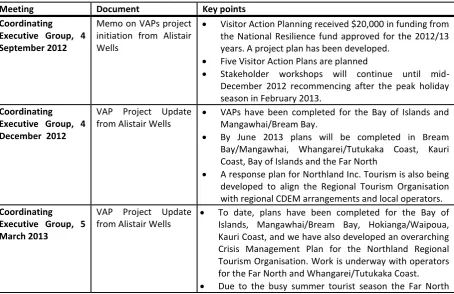
The minutes of CDEM and CEG meetings in the time period of 2012 to 2014 were examined and reference to the VAPs was found in CEG meeting records. In particular, four memos provided by Project Leader and Civil Defence Controller, Alistair Wells, documented progress on the implementation of the VAPs. The development of VAPs, including stakeholder workshops, was facilitated by a $20,000 fund from the Central Government.
Table 1
Key points made in Coordinating Executive Group meetings
Meeting Document Key points
Coordinating Executive Group, 4 September 2012
Memo on VAPs project initiation from Alistair Wells
Visitor Action Planning received $20,000 in funding from the National Resilience fund approved for the 2012/13 years. A project plan has been developed.
Five Visitor Action Plans are planned
Stakeholder workshops will continue until mid-December 2012 recommencing after the peak holiday season in February 2013.
Coordinating Executive Group, 4 December 2012
VAP Project Update from Alistair Wells
VAPs have been completed for the Bay of Islands and Mangawhai/Bream Bay.
Plan was planned to commence mid-February and the Whangarei/Tutukaka Coast plan in early March.
Coordinating Executive Group, 4 June 2013
VAP Project Update from Alistair Wells
VAPs have been completed for the Bay of Islands, Mangawhai/Bream Bay, Hokianga/Waipoua, Kauri Coast and Far North.
An overarching Crisis Management Plan for the Northland Regional Tourism Organisation has been developed.
Plans are currently being completed for Whangarei Heads and the Tutukaka Coast, thus completing the project.
In working with the sector and using existing networks and relationships eight plans (seven VAPs and one regional plan) across the region have been finished.
4.2
Interview findings
4.2.1 Integrating tourism with CDEM activities
There is widespread recognition of, and support for tourism’s involvement with DRR activities, both amongst businesses and other stakeholders. The CEG members also acknowledged in their September meeting that there was merit in the inclusion of tourism interests but there was no longer (at least in 2014) a dedicated tourism input through either the RTO or DOC. Interviews with the previous RTO and DOC representatives indicated that ongoing restructuring pressures were the main reason for this absence – for the RTO this was confirmed by interviews with other tourism leaders. The DOC representative also expressed the view that once these restructuring pressures declined he would again be able to participate in the CEG process. The CEG suggested they should follow up on this shortcoming as there was perceived value in tourism interests attending.
Two key issues emerged that highlighted the regional interests of the tourism sector and the need to take a broader perspective that goes beyond individual businesses or key locations. Both roading and dealing with media were discussed in several interviews, sometimes as part of the same ‘incident’, as critical to the ongoing success of tourism in Northland. It was also recognised that both of these issues require a concerted approach and one that is linked in with other activities or organisations, for example the New Zealand Transport Authority, the Northland Regional Council and the individual district councils.
4.2.2 Visitor Action Plans (VAPs)
Two approaches were used to evaluate the VAPs in Northland. First, most of the tourism industry interviews were in the Paihia VAP area, the results of which are presented below. Second, this detail from the particular case of the Paihia destination was then ‘verified’ against six other VAPs and CRPs located within significant tourism areas. As part of this verification process, six representatives with leadership roles participated in short phone interviews. The results of this work are presented after the Paihia case results.
Paihia
Feedback from tourism stakeholders on the VAP approach was very positive regarding Paihia. Having been involved in developing the VAP, including various DRR workshops, evaluation participants felt more aware and prepared for natural disasters. They also felt more connected and in control (“we now have a plan and know what to do”). In particular, the VAPs have focused on establishing contact trees that enable tourism stakeholders to quickly connect to other people in case of emergency. The Paihia contact tree was activated in the July 2014 event when Paihia was short on drinking water and water restrictions had to be put into place.
It also emerged that it is essential that VAPs are updated at least once a year. This is necessary to keep the plan fresh in people’s mind, and update contact details. This is particularly important given that tourism employees or managers often change business and whilst they might stay in the region, they might work in another role that means they are not part of the VAP group any more. There was a view that updates or future initiatives should be instigated by Council rather than by tourism businesses themselves. As one business owner put it: “It’s easy, maybe council can just say ‘let’s get together and have a cup of tea and talk about disaster planning and the VAP’”. There was a general sense that tourism businesses would attend such a gathering. The benefit of local or regional council driving the updates of the plans is that these organisations are less volatile than tourism organisations.
The interviews highlighted the importance of local level leadership to make the VAPs work and keep them active. While this is an asset in the sense that tourism can look after the sector’s interests from within its own community, it also bears a risk of dependence on a small number of key people. Incidentally, the local tourism leaders who were instrumental in establishing the VAPs were often identified by the RTO, highlighting again the benefit of having an umbrella organisation that ‘knows’ about tourism in the region. Further, some industry players were not able or willing to see the full regional picture, for example the connectedness via State Highway networks, or the reputation risks associated with failures in some sub-destinations and their impact on the overall destination image.
Other VAPs/CRPs
have made significant effort to maintain the group and develop the plan further than a contact tree. In one case the group was involved in civil defence awareness programmes including ongoing media updates and presence at summer markets. This same group also had ideas for further developments of the plan.
Overall conclusions about VAPs
Interview results indicate there is not always a clear distinction between VAPs and CRPs, except in Paihia which is clearly a tourism destination and the focus was unambiguous as a result. This finding leads to a question about the role and place of VAPs, in relation to both CRPs and more potentially also in relation to CDEM planning generally. Do VAPs have a role where:
1. Tourism is not the major, or at least a very significant, economic activity in the area?
2. There is already an overarching and existing CRP in place that incorporates significant tourism interests?
3. There is an all-encompassing CDEM plan in place?
Our initial conclusion is that a well-developed CDEM plan that properly accounts for tourism and local-level interests and needs might suffice in most circumstances. A process would be needed to verify such conclusions. This could be managed from the regional CDEM level (assuming such incorporates tourism and DOC interests) with explicit input from local-level participants. Where a generic CDEM plan is not sufficient, an overarching CRP that addresses local issues (including tourism) might apply and suffice in most cases. Exceptions to the above could include key tourism destinations such as Milford Sound or Mt Cook Village, or perhaps places like Paihia if no CRP is in place. Thus, there is a place for tourism-specific VAPs, but their need should be assessed within the bigger picture of other CDEM approaches.
4.3
Value groupings
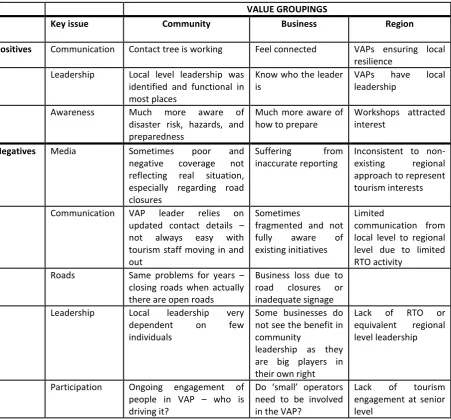
The findings from the 13 qualitative interviews could be grouped based around three broadly identifiable value-groupings (Table 2):
community oriented (local businesses and stakeholders with a people-community focus, including: motel, YHA, I-site, CRP/VAP development consultant, hotel, airport). At this level it was clear the contact tree was a great initiative and part of connecting the community, thus linking with heightened awareness of disaster related questions. But, from the negative perspective the community remained concerned about ongoing issues, e.g., the often connected and difficult to manage issue of media coverage and road closure management. There are implications for vertical policy integration here, including with the regional level of policy and management oversight. From a tourism perspective a functioning and vertically integrated RTO or equivalent would seem imperative.
business operation oriented (systems and processes with a business focus: including: Fullers, Far North Holdings, and other ‘business’ interests). Businesses generally felt positive and considered themselves to be better connected and aware; but, on the downside they shared community level concerns about and the business implications of road closures. Again there are implications of connectivity between the business and region levels of CDEM, and as above with a functioning RTO or equivalent.
Overall then, while there are very positive messages from all value groupings, there is an important negative issue, namely concerning ongoing communication and relationships, especially vertically between community and local business initiatives, and regional level, to ensure ongoing issues are properly dealt with at all levels of planning and response activity.
Table 2
Key issues (positive and negative) identified in the interviews (N=13) and meetings (N=1) presented by value grouping
VALUE GROUPINGS
Key issue Community Business Region
Positives Communication Contact tree is working Feel connected VAPs ensuring local
resilience Leadership Local level leadership was
identified and functional in most places
Know who the leader is
VAPs have local leadership
Awareness Much more aware of disaster risk, hazards, and preparedness
Much more aware of how to prepare
Workshops attracted interest
Negatives Media Sometimes poor and
negative coverage not reflecting real situation, especially regarding road closures
Suffering from inaccurate reporting
Inconsistent to non-existing regional approach to represent tourism interests
Communication VAP leader relies on updated contact details – not always easy with tourism staff moving in and out
Sometimes
fragmented and not fully aware of existing initiatives
Limited
communication from local level to regional level due to limited RTO activity
Roads Same problems for years – closing roads when actually there are open roads
Business loss due to road closures or inadequate signage Leadership Local leadership very
dependent on few individuals
Some businesses do not see the benefit in community
leadership as they are big players in their own right
Lack of RTO or equivalent regional level leadership
Participation Ongoing engagement of people in VAP – who is driving it?
Do ‘small’ operators need to be involved in the VAP?
(e.g. due to severe weather). Contingency planning involves the provision of accommodation and/or buses to transport passengers to their next port of call (e.g. Auckland). To date the plan has not been activated. It was unclear from the interviews to what extent this plan is integrated with the VAPs or even CDEM plans more broadly. However, Graeme MacDonald (email 7th November 2014) notes
that “the development of a cross agency plan to deal with a “Cruise Ship” emergency is well underway, has engagement with the emergency services, welfare agencies as well as the tourism sector. (The Police and Fire Service Operations managers are currently leading the development of this region specific cross agency plan).”
Further, several discussions made it clear that land use planning and reduction of hazards in the first place continue to be critical in terms of reducing tourism’s vulnerability to extreme weather events. In particular exposure to flooding was mentioned by interviewees. The Northland Regional Council is well aware of flood risks and works with hydrologists to mitigate hazards as much as possible. It is important to consider tourism stakeholders’ input into these initiatives.
Finally, as already discussed in 2012, there is a great risk for free and independent travellers, especially campervan tourists, who may not be aware of local hazards. While their safety is important, it was not possible to include them in the VAP. However, in the meantime a mobile-phone based APP has been developed1 to provide visitors with different kinds of safety information. This APP is currently being promoted and it is hoped that it will be used widely by tourists. It might be worthwhile to consider how the APP (and information presented through it) could be integrated with the VAPs.
4.4.2 Measuring success
The discussions with the representatives from CDEM highlighted the difficulty of evaluating and measuring the success of initiatives such as the VAPs, or also the CRPs that follow the same principle of local level leadership and initiatives.
Key points to emerge from this discussion were:
There is a regional emphasis on people as well as processes and systems;
There are still fragmented and different views on the same event (i.e. highlighting the subjectivist approach and need to consider different perspectives and values);
There is a challenge to measure civil defence performance based solely on systems and processes when in an around of isolated communities it is really about people, their preparedness, etc.; and
Local-level indicators could be developed that reflect bottom-up progress in terms of increased awareness and connectedness amongst people;
Integrating traditional emergency management structures with newer approaches of community engagement provides a new avenue for increasing resilience – one that may require adapted systems for evaluating CDEM initiatives.
The need to increasingly involve local communities is one of the guiding principles in the preparation for the post-2015 framework for disaster risk reduction, leading on from the existing Hyogo Framework for Action. More specifically, the Preparatory Committee (see United Nations, 2014) for the Third United Nations World Conference on Disaster Risk Reduction (held in 2015 in Japan), proposes a range of elements to be included in the new framework, including:
Alistair Wells (pers. comm.) has facilitated development of this APP, TravelSafeNZ (see
Discussion and recommendations
The work undertaken for and reported on in this report is rare – it is rare because it involves an evaluation of policy initiatives set up as a result of earlier research in the area of tourism and disaster risk reduction. It is clear from the empirical results reported that considerable progress has been made in Northland, but some of it not to the extent expected two years ago. We thus report on practical insights that should inform DRR from a tourism perspective in Northland, but which might also provide insight into new initiatives elsewhere. These insights and lessons are reported on regional (Northland) and local tourism community (VAP and CRP) levels.
5.1
Regional level lessons
Two outcome-related issues are very obvious at the regional level:
There has been an ongoing and persistent failure to properly deal with media (often linked to roading – see below) questions from a tourism perspective; and
Equally, and despite some improvements, there continues to be systemic failure to deal with roading notification issues to the satisfaction of tourism interests.
It seems plausible to suggest that the regional focus on process, arguably driven from a national perspective, may be stifling innovative responses to the above issues, e.g., tourism specific roading and media related opportunities. And, it seems likely that the lack of consistent representation of Northland Inc. and Department of Conservation on the CDEM and CEG could be contributing to the above issues and missed opportunities. Further, it is possible that those involved in VAPs have not sufficiently accepted their own responsibilities, especially for media related activities (Graeme MacDonald, email 7 November 2014).
5.2
Local tourism communities – Key lessons
From the perspectives of local communities and tourism business there is generally a reasonable level of satisfaction with VAPs (and CRPs where applicable) and with DRR planning in general, although there is some view that VAPs are little more than contact trees. Interviewees have raised the question whether a whole process is required to set up these contact trees, although others commented that exactly this process (and associated workshops) has led to greater awareness of hazards amongst tourism stakeholders.
Key points to note are that any system must, and the VAP does, allow for: Innovation;
Adaptive capacity and flexibility;
A process that is engaging and viewed positively;
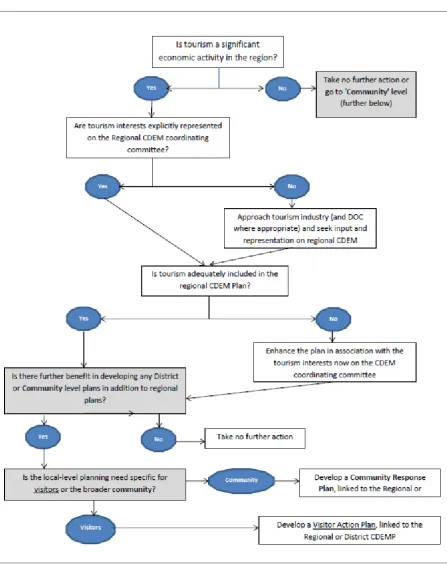
Another key question emerged with regards to the extent to which there is a decision pathway against which the need for CRPs and/or VAPs can be assessed at sub-district levels. Such a pathway could be designed and implemented by regional-level CDEM organisations in consultation with local communities. A proposed pathway, or decision support system, is shown in Figure 2.
Table 3
5.3
Recommendations
Based on the above findings the following are three very clear recommendations for Northland: 1. In order to deal with ongoing tourism and disaster management issues (e.g., roading), and
communication with local interests, that the Northland CDEM team continue to engage with and ensure Northland Tourism Inc. and DOC involvement with ongoing high level planning; 2. That related to the above, regional CDEM work with the tourism industry to improve road
closure management notification, and ongoing media relations on a real time basis (and consistent with this recommendation explore the use of the ‘TravelSafe NZ’ ‘APP’ which was developed in Northland as a result of our original research);
3. That Northland Region consider developing a decision tree for determining the need for CRPs or VAPs within local communities, in consultation with those communities.
References
Adger, N., Agrawala, S., Mirza, M. M. Q., Conde, C., O'Brien, K., Pulhin, J., Pulwarty, R., Smit, B. and Takahashi, K. (2007). Assessment of adaptation practices, options, constrains and capacity. In: Parry, M. L., Canziani, O. F., Palutikof, J. P., Van der Linden, P. J. & Hanson, C. E. (eds.) Climate Change 2007: Impacts, Adaptation and Vulnerability. Contribution of the Working Group II to the Fourth Assessment Report of the Intergovernmental Panel on Climate Change. Cambridge: Cambridge University Press.
Becken, S. and Hughey, KFD. (2013). Linking tourism into emergency management structures to enhance disaster risk reduction. Tourism Management, 36, 77–85.
http://dx.doi.org/10.1016/j.tourman.2012.11.006.
Dillman, L. (2013). Comparing evaluation activities across multiple theories of practice. Evaluation and Program Planning, 38, 53–60.
Hansen, M., Alkin, M.C., LeBaron Wallace, T. (2013). Depicting the logic of three evaluation theories. Evaluation and Program Planning, 38, 34–43.
House, E. R. (1978). Assumptions underlying evaluation models. Educational Researcher. 7(3), 4-12.
Ministry of Business, Innovation and Employment (2014). Tourism Statistics. Available (06/10/14)
http://www.med.govt.nz/sectors-industries/tourism/tourism-research-data
Tourism Queensland (2009). Weather proof your business: Incident response kit. Available (20/01/13)
http://www.tq.com.au/tqcorp_06/fms/tq_corporate/industrydevelopment/Climate%20Chang e%20update%20v2/Weatherproof%20Your%20Business%20Workbook%202010.pdf.
United Nations (2014). General Assembly. Third United Nations World Conference on Disaster Risk Reduction, Preparatory Committee. Considerations on the post-2015 framework for disaster risk reduction: Suggested elements for the post-2015 framework for disaster. Geneva, 14-15
July 2014. Available at (14/10/14)
http://www.preventionweb.net/files/37865_06elementswithdisclaimer.pdf