91
Review Article
CODEN: IJPNL6
Paediatric Dosage Forms: A Review of Age Development and Dosage Forms of
Choice
Hamad Alyami
1,2*and Afzal R Mohammed
11
Aston Pharmacy School, Aston University, Birmingham, United Kingdom
2
Najran Pharmacy School, Najran University, Najran, Saudi Arabia
*Corresponding author e-mail: [email protected]
Received on: 29-01-2018; Revised on: 3-02-2018; Accepted on: 5-02-2018
ABSTRACT
Paediatric medication development has advanced extensively worldwide due to legislative encouragements and requirements directed
towards the development of studies of drugs for use in the paediatric population (FDA, 1994). European Medicines Agency (EMA)
has reviewed its legislative requirements to drive innovations in paediatric formulations (European Commission, 2013). An approved
paediatric investigation plan is required for all new drugs and all line extensions that are submitted for EMA approval after January
2009. Such plans should cover all paediatric age groups. Furthermore, the EMA has issued guidelines on pharmaceutical development
of medicines for paediatric use including route of administration, dosing frequency, excipients, patient acceptability, container closure
systems and devices and user information (CHMP, 2006, Gauthier and Cardot, 2011). The FDA has issued in 2012, a law requiring the
implementation of the Paediatric Research Equity Act and Best Pharmaceuticals for Children Act (Christensen, 2012). Similar to the
EMA requirements, a paediatric study plan (PSP) is required for submission and approval by the FDA (FDA, 2013). Oral route of
administration is inevitably the most popular route of delivery due to ease of ingestion, availability of a wide variety of dosage forms
and most significantly enhanced compliance and adherence. Different drug formulations can be administered orally, including solid
and liquid dosage forms (Fasano, 1998, Sastry et al.,).
Keywords: Paediatric dosage, Drugs, Children act.
INTRODUTION
The provision of safe, as well as effective, pharmacotherapy
in paediatric necessitates the availability of medicines
alongside information for proper utilization, which is compliant with the patient’s age, physiology and body
surface area (Mulberg et al.,). Therefore, dosage forms
formulated specifically for children, are often required. Till
date, the utilization of unlicensed (medicine with no
marketing authorisation) as well as off-label medicines in
paediatric is extensive (Mason et al.,). The
disadvantages of this being that there are limited studies on their
effects on the paediatric population; age-appropriate
formulations are usually not presented, and available
formulations are not licensed for paediatric use (Choonara and
Conroy, 2002) [1-5]. The paediatric population is heterogeneous;
ranging from new-born to young people, with large physical as
well developmental differences, regarding pharmacokinetics and
pharmacodynamics. Organ development, metabolic competence
and skin maturation are some factors that may vary based on
International Journal of Pharmacy
Hamad Alyami, et al. Int J Pharm 2018; 8(1): 91-97
ISSN 2249-1848
92
age, particularly in early infancy. The paediatric age groups recognized by ICH are shown in Table 1 (EMA, 2006).
Table 1: Classification of paediatric based on age groups
• Preterm new born infants • Term new born infants (0–28 days) • Infants and toddlers (28 days–23 months) • Children (2–11 years)
• Adolescents (12 to 16 or 18 years (dependent on region)
Paediatric dosage forms
Paediatric dosage forms should be versatile so that drugs can
be administered to neonates, children, and adolescents. The
common paediatric dosage forms include solid dosage forms
(such as tablets); powders, solutions, and syrups (Viner and
Barker, 2005). Solid dosage forms are drugs, which have
been compounded to give a definite shape and a standard
dose, as is the case with tablets. Powders are a type of solid
dosage form, which have been ground and are finely divided.
They are usually administered topically on the skin, sprinkled
on food or mixed with liquid diet. On the other hand,
solutions are dosage forms which are made up of an aqueous
base (majority) and other pharmaceutical ingredients which
give the solution its therapeutic effect. Syrups form sugary
and have a thicker consistency than solutions, a factor which
makes them more viscous (Ansel et al.,) [6-10].
Age development and dosage forms of choice
Dealing with children is quite challenging, particularly when
it comes to diseases and their remedies. For neonates, the
challenge is even more pronounced because diagnosis alone
poses a difficult step. After diagnosis, other challenges
include the appropriate choice of formulation and route of
administration. Children are remarkably sensitive to the
effects of drugs; not just on the internal effects that the drugs
have but also on the outward appearance and the taste. A
child may refuse to take a drug because the colour is not
appealing or because it smells ‘weird’. Even after succeeding in
making the child swallow the drug in the first instance, this
result may not be repeated for subsequent doses. This is because
children have a unique fine memory to conditions,
circumstances, and experiences of their past (Sahler et al.,). To
say the least, it will pose a massive challenge trying to convince
them to take the drug again. For this reason, paediatric dosage
forms need to be tailored to address the fears and the
expectations of the target users. This request for a higher level of
interest during manufacturing and even prescribing, since
children require lower dose amounts to achieve the same effects
as seen in adults. In addition, various factors need to be taken
into consideration, notably taste masking. For drugs that come in
the form of powders, the dosage form can be changed by
tableting the powders and converting them into solid dosage
forms. Powders can also be granulated to make it easier to
determine the dose since this becomes a major issue, especially
with regard to children (van Riet-Nales et al.,).
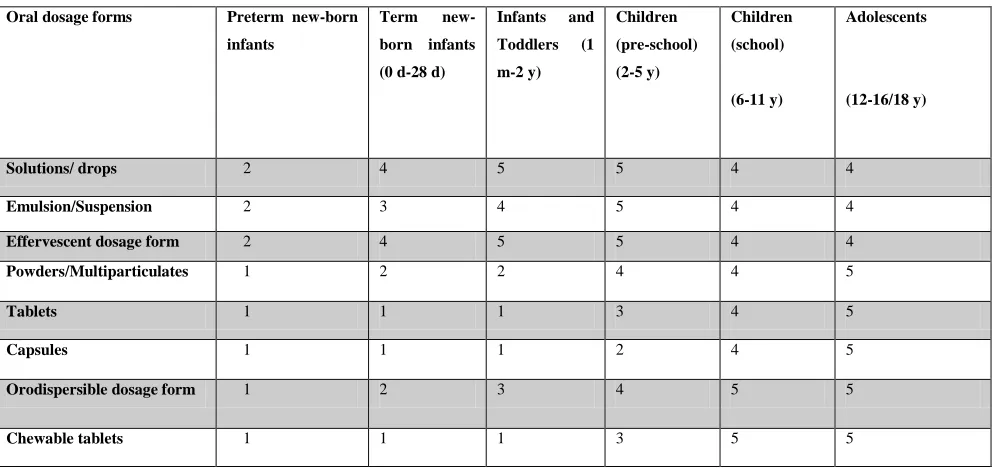
Table 2 shows a matrix developed by the EMA from responses
to questionnaires sent out to 40 participants (including parents,
pharmaceutical scientists and clinical pediatricians) in different
European countries to develop a relationship between age
development, dosage form and route of administration (Cram et
al.,). Moving from the left to the right, the emphasis in the
93
Table 2: EMA matrix relating oral dosage forms/ route of administration to dosage form and age; adapted from references (EMA, 2006, Breitkreutz and Boos, 2007)
Oral dosage forms Preterm new-born infants
Term new-born infants (0 d-28 d)
Infants and Toddlers (1 m-2 y)
Children (pre-school) (2-5 y)
Children (school)
(6-11 y)
Adolescents
(12-16/18 y)
Solutions/ drops 2 4 5 5 4 4
Emulsion/Suspension 2 3 4 5 4 4
Effervescent dosage form 2 4 5 5 4 4
Powders/Multiparticulates 1 2 2 4 4 5
Tablets 1 1 1 3 4 5
Capsules 1 1 1 2 4 5
Orodispersible dosage form 1 2 3 4 5 5
Chewable tablets 1 1 1 3 5 5
Key
Younger ages (preterm-pre-school): 1- not applicable, 2 -
applicable with problems, 3 - probably applicable but not
preferred, 4 - good applicability, 5 - best and preferred
applicability.
Older ages (school-adolescents): 1 -not accepted, 2 -
accepted under reserve, 3 -acceptable, 4 -preferred
acceptability, 5 - dosage form of choice.
Definition of acceptability
The acceptability of a drug is its ability to meet the patient’s
requirements and needs. Acceptability also entails the quality
of the drug to realize the objectives set out by the physician.
It involves a number of aspects including the dosage amount
and proper diagnosis. Of the two, proper diagnosis is of
immense importance before embarking on managing an
ailment, a condition, or a disorder. Proper diagnosis not only
gives the physician the knowledge of the condition in
question, but also provides a head start on the best way of
managing it. Managing in this case, refers to administration
of the right medicine. As mentioned earlier, the
administration is determined by a number of factors. This
calls for a choice on the route of administration to be used.
The route of administration should be in line with the
pharmacokinetic properties of the drug. For example, drugs
that are absorbed in the stomach are administered orally. Care
has to be taken regarding some drugs taken orally, as they may
undergo breakdown while in the stomach. Such drugs (proton
pump inhibitors, omeprazole) are usually enteric-coated to
minimize, if not effectively curb, their breakdown as they pass
through the gastrointestinal tract (Standing and Tuleu, 2005).
Enteric coating provides a layer that inhibits the action of acids
enzymes present in gastric juice and other stomach secretions, which contribute to the breakdown of the acid sensitive’s active
pharmaceutical ingredients (APIs) in the formulation. If such
drugs are not enteric-coated, there is a high likelihood that they
will undergo breakdown while still in the stomach, and the APIs
may fail to reach their intended area of absorption, which could
be the ileum or even the large intestine (van Riet-Nales et al.,
2013).
Important factors in the overall acceptability of an oral
paediatric medicine
For oral paediatric medicines to be acceptable and therefore
effective there are a number of factors that need to be
considered. One of these is elegance. Elegance refers to the
outward appearance of the dosage form and its ability to appeal
to the eye. Among children, this factor becomes crucial because
of the sensitivity of children to seemingly unimportant matters
Hamad Alyami, et al. Int J Pharm 2018; 8(1): 91-97
ISSN 2249-1848
94
because it does not look appealing. A factor related toacceptability and which is closely related to elegance, is
palatability. Children will rarely take drugs that are bitter
tasting (Hoppu, 2008). For this reason, most drugs which
have a bitter taste are coated with a sweet tasting substance.
If the bad taste is not masked, such drugs may predispose the
child to vomiting. If the smell of the drug is putrid, it may
also negatively influence the acceptability of the drug. The
ability of children to differentiate drugs by their smell is
testimony of their attention to detail. In the same way, a
dosage form needs to be convenient for it to be acceptable
among children. The term convenience refers to the method
by which it is administered, for instance, as a tablet, syrup or
as a powder. Among children of school age, tablets are more
popular compared to powders because they can easily be
administered (Nunn and Williams, 2005). Dosage is also
accurate and can be easily determined since most tablets are
already portioned in specific doses. Syrups are also more
popular compared to solutions, which in turn are preferred
over powders (Maheshwari et al.,). Excipients added in
solutions to increase their volume should be neutral and need
not have an effect on the ultimate intended therapeutic effect
of the drug. Lastly, the stability of a drug is of great
importance with regard to its acceptability. Stability is the
ability of a drug to maintain its original form in terms of
physical appearance, its therapeutic effects, and its chemical
composition (Allen and Ansel, 2013). A medicine whose
chemical structure varies after a period, or changes taste, is
likely to have low acceptability compared to the one whose
properties do not vary. In addition, the drug may not produce
the intended outcome, especially if both chemical and
therapeutic variations occur (Overgaard et al.,) [16-20].
A WHO consultation on paediatrics and guidelines
The World Health Organization (WHO) is the international
body that controls products and services with regard to
human health. As such, it has laid down guidelines and
procedures for production of paediatric dosage forms. WHO
recognizes the need to develop drugs and formulations that
specifically target children. It admits that even though the
search for the appropriate dosage formulation with regard to
the age, physical and physiological conditions of children has
been challenging, it is not a lost war (Hill, 2011). However,
WHO warns against administering unlicensed drugs to the
paediatric population, as this is likely to culminate in grave
consequences. WHO recommends that dosage formulations
should be prepared to cover as wide an age bracket as possible.
This is because the age bracket of children is vaguely defined
and stretches from preterm infants to term infants, to toddlers
and even adolescents. It also recommends that manufacturers
uphold good manufacturing practices with regard to obtaining
and processing raw materials, up to preparation of the final
pharmaceutical product. WHO stipulates that the dosage
administered should be in line with the age and specific needs of
the child. More importantly, the dosage, whether in volume or
size, needs to be accurate. An overdose or an under dose may
result in toxicity or sub therapeutic effect respectively. In
addition, paediatric formulations should be made in ready-to-use
preparations, as much as possible. This will minimize, if not
eradicate, the need to modify the preparation by parents or health
care professionals.
According to WHO, the dosage form should be acceptable and
palatable. Furthermore, the drug formulation should be palatable
without the need to mask the taste or sugar coating. Palatability
will make it easier for children to accept and swallow the drug.
Acceptability of the dosage formulation stretches beyond its use
among children and extends to parents/caregivers and physicians – the dosage formulation should be acceptable among parents to
increase its chances of being purchased. At the same time,
acceptability or palatability should not be enhanced by mixing
the drug formulation with food or drinks. This is because food
and drink may affect the absorption of the drug or may interact
with it, resulting in physical or chemical alterations. If there is
no alternative, then the food or drink should be in a small
amount such that it will not have an impact on the effects of the
drug (Kozarewicz, 2014). Manufacturers also need to indicate
whether it is possible to administer a given drug with food or
beverages, and also incorporate any exceptions. When
administering drugs to children, it should be ensured that
minimum dosing is adhered to. The frequency with which a drug
is administered should be made minimal because frequent
dosing, especially more than twice a day, may have a negative
95
WHO recommends that manufacturers should aim atproduction of quality dosage formulations, with the needs of
the target population in mind. For instance, the dosage
formulation should be affordable to most people and the
production process should be simple. The drug should be able
to reach the target population easily by implementing viable
transport and supply strategies. In addition, instructions for
proper storage of the drug should be made available. For
drugs that need to be dissolved in water before being
swallowed or those that need water when swallowing,
procedures for obtaining standard clean water should be
outlined. This is because clean water may not be locally
available in some locations (Hill, 2011) [27-29].
Furthermore, the need to produce dosage formulations that
are effective among the paediatric population has brought up
the need to conduct further research in the field of excipient’s
toxicity. As a result, newer methods, which are still under
trial, are being investigated to study the effect of commonly
used excipients in dosage form development, and their
impact on the paediatric patient population (Walsh and Mills,
2013).
The excipients used in making paediatric formulations have
witnessed an increasing interest, with the belief that the right
excipient will be the answer to most of the questions that still
remain unanswered.
To begin with, the excipients to be employed need to have a high
safety profile to prevent any side effects. They also have to be
tolerable because this influences the acceptability of the
paediatric formulation. Current research projects of excipients
used in paediatric formulations incorporate all stakeholders,
including the target age group (children), medical practitioners,
and even parents/ care-givers (Fabiano et al.,).
Standard features of dosage forms for paediatrics
The goal is to find one formulation suitable for every age group.
The primary focus should be the safety of the formulation and
ideally cover as broad an age range as achievable. The guiding
standards for choosing paediatric dosage forms should be based
on the risk/benefit ratio accounting for the precise needs of this
susceptible population. Desirable characteristics of quality
paediatric drugs common to different kinds of dosage forms are
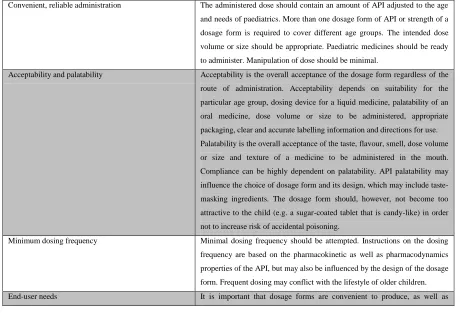
outlined in (Table 3) [30-36].
Table 3: Standard features for dosage forms of paediatrics are outlined by WHO (2010)
Convenient, reliable administration The administered dose should contain an amount of API adjusted to the age and needs of paediatrics. More than one dosage form of API or strength of a dosage form is required to cover different age groups. The intended dose volume or size should be appropriate. Paediatric medicines should be ready to administer. Manipulation of dose should be minimal.
Acceptability and palatability Acceptability is the overall acceptance of the dosage form regardless of the route of administration. Acceptability depends on suitability for the particular age group, dosing device for a liquid medicine, palatability of an oral medicine, dose volume or size to be administered, appropriate packaging, clear and accurate labelling information and directions for use. Palatability is the overall acceptance of the taste, flavour, smell, dose volume or size and texture of a medicine to be administered in the mouth. Compliance can be highly dependent on palatability. API palatability may influence the choice of dosage form and its design, which may include taste-masking ingredients. The dosage form should, however, not become too attractive to the child (e.g. a sugar-coated tablet that is candy-like) in order not to increase risk of accidental poisoning.
Hamad Alyami, et al. Int J Pharm 2018; 8(1): 91-97
ISSN 2249-1848
96
affordable. It is also important to bear in mind supply chain considerations such as ease of transportation and storage requirements. Storage in a refrigerator by the user is not always possible. Depending on age and clinical condition of the child, there are restrictions to the applicable dose volume or size. Generally, in developing the product, minimum dose volume and size should be attempted. Lack of access to clean water is an important issue to take into consideration in the development of medicines to be dissolved, diluted or dispersed prior to administration, as it may compromise the quality. It may be necessary to educate patients on how to obtain water of suitable quality, e.g. boiling or filtering instructions. Provision of the liquid vehicle as a part of the package may be an option to be considered, or the dose may be dispersed or dissolved in suitable food or beverage prior to administration. Instructions on such use should always be labelled.
Dosage form development for the paediatric population
should ensure global application including addressing
limitations such as lack of appropriate storage conditions,
cost of production and the lack of access to clean water
encountered in developing countries. A flexible dosage form
platform should also be used to ensure delivery of a wide range
of APIs.
REFERENCES
1. EMEA. Reflection paper: formulations of choice for the paediatric population. EMEA, London 2006.
2. P. Michaud, J. Suris, R. Viner., Arch. Disease. Child. 2004, 89(10), 943-949.
3. L. J. Bauman, D. Drotar., Promoting adherence to medical treatment in chronic childhood illness: Concepts, methods, and interventions. 2000, 71-93.
4. A. Patel., Pediatrics. 2015. 135(5), 883-889.
5. H. Barr., Hugh Barr, Marion Helme & Lynda D’Avray. 2014, 30-45.
6. J. J. Hirani, D. A. Rathod, K. R. Vadalia., Trop. J. Pharma. Res. 2009, 8(2), 161-172.
7. K. Sumiya., J. Pharma. Soc. Japan. 2000. 120(7), 652-656.
8. O. Benkert, A. Szegedi, M. Philipp, R. Kohnen, C. Heinrich, A. Heukels, M. van der Vegte-Senden, R. A. Baker, J. H. Simmons, and A. J. Schutte.,. J. Clinic. Psychopharma, 2006, 26(1), 75-78.
9. H. Alyami., Europ. J. Hospital. Pharma. 2016, 2016. 2-7.
10. T. Mukattash., Europ. J. Clinic. Pharma. 2011, 67(5), 449-461.
11. G. Akram, A.B. Mullen., Internat. J. Pharma. Pract. 2012, 20(3), 191-198.
12. N. K. Gale., B. M. C. Med. Res. Method. 2013, 13(1), 117.
13. D. Walsh, S. Downe,. J. Advan. Nurs. 2005, 50(2), 204-211.
14. J. Ritchie, L. Spencer., The Qualitative researcher’s companion, 2002. 573, 305-329.
15. C. J. Siccama, S. Penna., Qualitat. Researc. J. 2008, 8(2), 91-103.
16. J. Brooks., Qualitat. Researc. Psycho. 2015, 12(2), 202-222.
17. J. Ilieva, S. Baron, N. M. Healey., Internat. J. Market. Research. 2002, 44(3), 361.
18. G. Ricci., The. Brazil. J. Infect. Diseases. 2016, 20(5), 429-436.
97
20. L. A. Squires., Therap. Innovat. Regulat. Sci. 2013, 47(5), 533-541.21. D. Matsui., Paediat. Perinat. Drug. Therap. 2007, 8(2), 55-60.
22. L. V. Adams., PLoS. One. 2013, 8(3), e58303.
23. S. P. Bryson., Internat. J. Pharma. 2014, 469(2), 257-259.
24. V. Parkash., J. Advanc. Pharma. Technol. Research. 2011, 2(4), 223.
25. E. A. MacGregor, J. Brandes, A. Eikermann., Headache: The. J. Head. Face. Pain. 2003, 43(1), 19-26.
26. G. Carnaby-Mann, M. Crary, Archiv. Otolaryngo. – Head. Neck. Surg. 2005, 131(11), 970-975.
27. A. Lajoinie., Brit. J. Clinic. Pharma. 2014, 78(5), 1080-1089.
28. E. Ansah., Trop. Med. Internat. Health. 2001, 6(7), 496-504.
29. A. Bagenda., Annals. Trop. Paediatrics. 2011, 31(3), 235-245.
30. Cheng, S. Ratnapalan., Pediatric. Emerg. Care. 2007, 23(6), 384-386.
31. L. Jacobsen, K. Riley, B. Lee, K. Bradford and R. Jhaveri., Pediatric. Drugs. 2016, 18(1), 65-73.
32. K. Paranthaman., AIDS. Care. 2009, 21(8), 1025-1031.
33. Reddington., The. Pediatric. Infectious. Disease. J. 2000, 19(12), 1148-1153.
34. A. Levitan., Chem. Senses. 2008, 33(5), 415-423.
35. A. A. Hasamnis., J. Pharma. Pharmacotherap. 2011, 2(2), 119.