ISSN (e): 2250-3021, ISSN (p): 2278-8719
Vol. 09, Issue 11, November. 2019, Series -III, PP 16-22
Comparative seismic study of setback & regular RCC buildings
Anamika Bhagat, Dr.Rajeev Chandak, Professor
M tech Scholar, Department of Civil Engineering Jabalpur Engineering College,Jabalpur,India Department of Civil Engineering, Jabalpur Engineering College,,Jabalpur,India
Corresponding Author: Anamika Bhagat
Received 08November 2019; Accepted 25 November 2019
Abstract
The buildings are subjected to dynamic actions by both wind and earthquakes. The design for wind forces and for earthquake seismic effects is noticeably dissimilar. The intuitive philosophy of structural design uses force as the basis, which is consistent in wind design, wherein the structure is subjected to a pressure on its exposed surface area; this is force-type loading. However, in earthquake design, the building is subjected to random and accidental motion of the ground at its base. An earthquake (also known as a quake or temblor) is the consequence of a sudden discharge of energy in the Earth's Crust that produces seismic waves with huge amount of energy. The seismicity of an area indicates to the frequency, type and magnitude of earthquakes experienced over a period of time in a particular region.
This study presents the performance & behavior of setback & regular RCC framed structure under seismic load. Different building geometries including setbacks & regular frame are taken in this study.. All frames are created & analyzed in software Staad.Pro V8i. A comparative study is made between all these building models taking different parameters. Different seismic parameters like bending moment, nodal displacement, etc. are obtained. The seismic analysis is done according to IS 1893:2002 part (1). The Seismic zone four & medium soil strata conditions are taken for all the cases. The uniform bay width of 3 m is taken in all the models. The variation in the different seismic parameters is observed along different height & number of bays. In all the cases, it is seen that performance of regular frame is found to superior than irregular frame. A comparative study is made between different models taking each seismic parameter. At last discussion & conclusion are proposed according to results obtained.
Key Word: Setback building, Seismic response parameter, Regular RCC framed building etc.
I.
INTRODUCTION
Every building is vertical cantilevers projecting away from the earth’s surface. Therefore, when the earthquake motions occur, these vertical cantilevers experience sudden jerks, particularly when the shaking is fierce. So, special concern is required to defend them from this hazardous jerky movement. Building intended to be earthquake-resistant should have competing demands. These are mentioned one by one. First of all; it should be strong enough to not uphold any damage during weak earthquake shaking. Secondly, buildings become costly, if designed not to sustain any harm during sturdy earthquake motions. Thirdly, it is supposed to be rigid enough to not revolve (swing) too to a great extent, even during weak earthquake motions. And, lastly, it is expected that it should not fall down during the probable seismic shaking. The characteristics (intensity, time period duration, etc) of seismic ground vibrations occurring at any location depend upon the magnitude of the earthquake, its focus. It is observed that it also depends upon the distance from the epicentre, the passageway through which the seismic waves travel, and the soil stratum on which the structure lies. The earthquake ground motions can be resolved in any three mutually perpendicular directions along three axes. The major direction of earthquake ground vibration is usually horizontal which is considered generally X. The response of a structure to ground shaking depends upon the nature of foundation soil: materials, size of the soil particles, their granular arrangement and manner of construction of structures and the duration and characteristics of ground motion.
urban locality with closely spaced tall buildings. The various configurations of setback buildings are described earlier.
1.1 Objectives
The objectives of this research are as follows:
1) To carry out a comparative study of the various seismic response parameters of different types of reinforced concrete building frames with varying configuration, irregularities, etc.
2) Study of change in seismic parameters along the increasing altitude and increasing number of bays. . 3) Comparison between setback & regular frames on the basis of critical bending moment, inter-storey drift,
& nodal displacement etc.
4) Study of change in seismic performance of building structures due to setback (vertical irregularities).
1.2 METHODOLOGY
The steps undertaken in the present study to achieve the aforesaid objectives are as follows: a) Carry out wide literature review, to set up the objectives of the research work.
b) Select RCC frame models of setback building & regular with different configurations & heights, assuming equal bay width of 3 m in both horizontal directions(X&Z).
c) To perform static seismic analysis for each RCC frame building models taken in this work. d) To Analyze and compare the result of the data obtained by static seismic analysis.
e) Presentation of results in the form of tables & graphs. f) Detailed discussion on the results .
g) Finally derivation of conclusions and proposals based on the above presented work.
II.
LITERATURE REVIEW
Various studies have been conducted on the seismic behavior of reinforced concrete framed structures.Some of those are mentioned here.
M.D. Kevadkaret. al. (2013) has carried out the lateral load analysis of G+12 R.C.C.regular building. In this study R.C.C. building was modeled and analyzed in three Parts I) Model without bracing and shear wall II) Model with different shear wall system III) Model with Different bracing system The computer aided analysis was done by using E-TABS to find out the effective lateral load system during earthquake in high seismic areas. The performance of the building was evaluated in terms of Lateral Displacement, Storey Shear and Storey Drifts, Base shear and Demand Capacity (Performance point). It was found that the X type of steel bracing system significantly contributes to the structural stiffness and reduces the maximum inter story drift, lateral displacement and demand capacity (Performance Point) of R.C.C building than the shear wall system.
In this study, G+ 12 bare frame model, shear wall model and Steel bracing model is analyzed using standard software. It is shown that the concept of using steel bracing is one of the advantageous concepts which can be used to strengthen structure. Steel bracings reduce flexure and shear demands on beams and columns and transfer the lateral load through axial load mechanism. The lateral displacement of the building was reduced by 40 to 60 % by the use of shear wall Type-III and X Type steel bracing system. Steel bracings can be used as an alternative to the other strengthening techniques available as the total weight of structure changes significantly. Ti was observed that shear wall has more storey shear as compare to steel bracing but there is 10 to15% differences in lateral displacement between shear wall and steel bracing.
S.S. Patil, S.A. Ghadge (2013) carried out the seismic analysis of multistory building in STAAD Pro. with various conditions of lateral stiffness system. The three types of models were organized in this study that is bare frame type model, brace frame type model and shear wall frame type model. The dynamic method of analysis i.e. Response spectrum method is used. This investigation studied the consequence of advanced modes of vibration & actual allocation of forces in elastic range in a superior way. Test outcomes were presented in the form of various seismic parameters like base shear, story drift and story deflections and obtain efficient lateral load resisting structure.
Ravikumar M., et.al. (2012) studied the seismic vulnerability of RC buildings having irregular configurations. They studied the seismic demands of different irregular R.C buildings using various analytical techniques for the seismic zone V (hard rock) of India. The configuration includes plan irregularities such as diaphragm discontinuity, re-entrant corners and vertical irregularities such as geometrical irregularity, buildings resting on sloping ground. The performance was studied in terms of base shear, lateral displacements, time period, , storey drifts and eccentricity in linear analysis using a code – IS1893 (Part 1):2002 .Whereas the performance point and hinge status in Non linear analysis using ATC40.The pushover analysis was carried out to identify the correct lateral load pattern while considering the different irregular buildings.
calculated the fundamental period & base shear of the structure by various codes namely IS 1893 (Part 1): 2002,UBC 1997, NZS 1170.5 – 2004 and BS EN 1998 -1: 2004. Five storey building is taken in the current study with base dimensions of the building are 10.2x10.2m and the total height of building is 15m. Response spectrum analysis is carried out in all three structural systems for all zones according to different codes.
Yousuf M. et. al. (2013) done the dynamic analysis of reinforced concrete building with plan irregularities. Four models of G+5 building with one symmetric plan and remaining irregular plan were taken for the study. The examination of R.C.C. building was carried out with the FE based software ETABS 9.5. The evaluation of various seismic response such as; base shear lateral forces, storey shear and storey drift was carried out. Four cross sectional variation in columns section were considered for studying effectiveness in resisting lateral forces. The paper also deals with the effect of the variation of the building plan on the structural response building. Dynamic responses under major earthquake, associated to IS 1893–2002(part1) have been carried out.
Karavasilis et.al. (2008) performed a study on the inelastic seismic response of plane steel moment resisting frames (MRF) with vertical geometric irregularity (setback). The statistical analysis of the formed response databank showed that the number of stories, beam-to-column geometrical irregularity, strength ratio and limit state under consideration powerfully influence the amplitude of inelastic deformation demands and the height wise distribution and. All this was proposed on the basis of analysis done on different sets. The analysis which is employed is nonlinear regression with the purpose of derive simple formulae which reveal the above mentioned influences and offer, for a given strength reduction factor, three important response quantities, i.e. the maximum roof displacement, maximum rotation ductility and the maximum inter storey drift ratio along the height of the structure.
III.
SIESMIC ANALYSIS
Seismic analysis is a subset of structural analysis and is the calculation of the response of the building structure to earthquake and is a relevant part of structural design where earthquakes are prevalent. The seismic analysis of a structure involves evaluation of the earthquake forces acting at various level of the structure during an earthquake and the effect of such forces on the behavior of the overall structure. The analysis may be static or dynamic in approach as per the code provisions. Seismic Coefficient Method is used in this study. This is equivalent static analysis considering a design seismic coefficient. This is a linear static analysis. This approach defines a way to represent the effect of earthquake ground motion when series of forces are act on a building, through a seismic design response spectrum. This method assumes that the building responds in its fundamental mode. The applicability of this method is extended in many building codes by applying factors to account for higher buildings with some higher modes, and for low levels of twisting. To account for effects due to "yielding" of the structure, many codes apply modification factors that reduce the design forces. In the equivalent static method, the lateral force equivalent to the design basis earthquake is applied statically.
The slab thickness is taken as 150 mm for all the buildings. All Infill walls are considered to be the external with thickness of 200 mm. The parapet wall is assumed to be of 200 mm thickness and of 1m height for all the selected buildings. The unit weight of concrete as 25kN/m & brick as 20KN/m3 are used in the modeling. The structures are modeled by using computer software Staad. Pro V8i.The floor load is taken as 4.75kN/m2 including floor finish load. The 3kN/m2 live load is implicit in all the cases. The Seismic zone four & medium soil strata conditions are taken for all the cases. The zone factor 0.24 & Response reduction factor (RF) 3 is adopted in the study. The importance factor is 1 & rock-soil site factor is 2.The first type of structure is taken & damping ratio is 0.05.
1893 load X1 1893 load Z1
Member load wall Floor load (DL)
Fig.1: Representation of loads acting on frame 4 storey regular frame
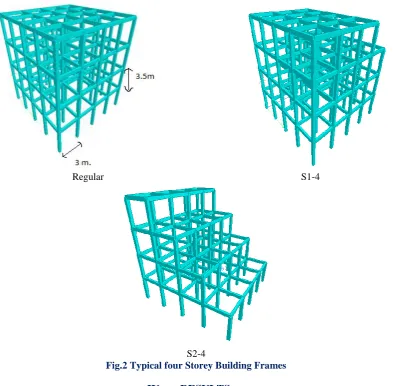
Regular S1-4
S2-4
Fig.2 Typical four Storey Building Frames
IV.
RESULTS
The aim of the study is to find out the variation of critical seismic parameters among three frame configurations The seismic parameters which are considered for this study are shear force, bending moment storey drift& nodal displacement . The critical maximum values are taken in all the cases. The Z directional shear force and bending moment are considered. The storey drift and highest nodal displacement of both the horizontal direction Z & X taken. These parameters are tabulated storey wise for different types of building geometry.
Table 1: Critical seismic parameters for 4 storey & 8 storey building
BUILDING TYPE
SHEAR FORCE Fz (kN)
BENDING MOMENT Mz (kN-m)
STOREY DRIFT (mm)
NODE
DISPLACEMENT(mm)
X Z X (Tran.) Z (Tran.)
R-4 49.08 125.67 17.6 17.6 56.13 56.35
S1-4 51.27 127.63 16.5 16.6 52.47 59.56
S2-4 53.76 131.66 14.2 18.0 48.75 62.64
R-8 82.44 227.2 13.3 13.2 82.00 83.05
S2-8 85.30 233 12.6 16.0 76.15 87.79
R-12 114.75 298.33 7.8 7.8 78.3 78.3
S1-12 120.60 305.52 7.9 7.3 67.88 79.80
S2-12 115.2 349.45 9.2 10.2 65.70 79
The shear force and bending moment rises suddenly as the vertical geometric irregularity increases. It is observed that the storey drift in Z direction increases among the building frames with the type.Now let us discuss about the other two parameters i.e. storey drift and nodal displacement. These are also taken as critical. The relative displacement between two adjacent storey is called as storey drift. The storey drift of R-4 in both the horizontal direction is almost equal. It is seen that the storey drift in Z direction increases among the building frames. The regular frame R has least and irregular frame S2 has maximum drift in Z direction among same type of frames. But in the X direction opposite thing is observed. The inter storey drift decreases among the frames. The nodal displacement of setback frames is more than setback frames in Z direction.
Fig.3 Variation of critical seismic parameters ,Four Bay frames
V.
CONCLUSIONS
Based on the work presented in this thesis following point-wise conclusions can be drawn:
1) The seismic performance of regular frame R is found to be better than corresponding irregular frames in nearly all the cases. For 4 bay frames, the critical shear force of regular frames is almost 6.54 % lower than setback frames.
2) The average critical bending moment of 4 bay irregular frames is almost 3.15 % more than the corresponding regular frame .
irregular frames. So It is concluded that the increase in building height resulted in larger bending moment in all the cases.
4) The critical shear force of four storey four bay regular frame is 49.08 KN while twelve storey four bay regular frame is 114.75 KN Which is 133.08 % more than four storey frame. The same situation is observed for irregular frames. So It is concluded that the increase in building height resulted in larger shear force. 5) The regular building has almost same critical storey drift in both the horizontal directions. There is 0 %
deviation in X & Z direction storey drift. Thus it is concluded that the critical relative displacement between floors for regular frames in both horizontal direction come out to be equal even if building height or numbers of bays are increased.
REFERENCES
[1]. BIS (2002). “IS 1893 (Part 1)-2002: Indian Standard Criteria for Earthquake Resistant Design of Structures”, Part 1 – General Provisions and Buildings (Fifth Revision), Bureau of Indian Standards, New Delhi
[2]. Karavasilis, T.L., Bazeos, N. and Beskos. (2008). “Seismic response of plane steel MRF with setbacks: Estimation of inelastic deformation demands”. Journal of Constructional Steel Research, 64, pp. 644-654 [3]. Kevadkar M.D., Kodag P.B. (2013). “Lateral Load Analysis of R.C.C. Building”. International Journal of
Modern Engineering Research, Vol.3, Issue.3, ISSN: 2249-6645, pp- 1428-1434
[4]. Munshi Javeed A., Ghosh S.K. (1998). “Analysis of Seismic Performance Of a Code Designed RCC Building”. Engineering Structures, Vol. 20, No.7, pp- 608-616.
[5]. Patil S.S., Ghadge S.A., & Konapure C.G. (2013). “Seismic Analysis of High-Rise Building by Response Spectrum Method”, International Journal Of Computational Engineering Research, Vol.- 3, Issue- 3, pp 272-279.
[6]. Ravikumar C M, Babu Narayan K S, Sujith B V & Venkat Reddy (2012).“the effect of irregular
configurations on seismic vulnerability of RC buildings”. Architecture Research 2012, Vol.-
2,Issue- 3: pp 20-26, DOI: 10.5923/j.arch.20120203.01.
[7]. Staad.Pro.V8i, (2007) “Integrated Software for Structural Analysis and Design”. Version V8i,A Bentely Solution Centre USA, www.bently.com
[8]. Yousuf M, Shimpale P.M. (2013) “Dynamic Analysis of Reinforced Concrete Building with Plan Irregularities”. International Journal of Emerging Technology and Advanced Engineering, Volume 3, Issue 9, pp 110-116.