Experimental Investigation on Concrete with
Partial Replacement of Fine Aggregate by Glass
Powder in Additional of Palm Kernel Shell Fiber
S. Sakthivel M. Vigneshwaran
Assistant Professor Student
Department of Civil (Structural) Engineering Department of Civil Engineering The Kavery Engineering College, Mecheri, Salem, Tamilnadu,
India.
The Kavery Engineering College, Mecheri, Salem, Tamilnadu, India.
C. Arulkumar K. Ajithkumar
Student Student
Department of Civil Engineering Department of Civil Engineering The Kavery Engineering College, Mecheri, Salem, Tamilnadu,
India.
The Kavery Engineering College, Mecheri, Salem, Tamilnadu, India.
A. Baskaran Student
Department of Civil Engineering
The Kavery Engineering College, Mecheri, Salem, Tamilnadu, India.
Abstract
Waste management is becoming a major issue for community worldwide. Glass being non-bio degradable is not suitable for additional to land fill, and as such recycling opportunities need to be investigated .due to the high material consumption of the construction industry. The utilization of waste glass has a partial replacement for fine aggregate in structural concrete is particularly attractive. To attain the set out objectives of the present investigation, sand has been replaced with glass powder by 10,20 and 30% and palm kernel shell fiber by 5,10 and 15% produce concrete respectively. The concrete specimen tested for compressive, split tension and flexural strength. The concrete are three concrete samples were tested at 7, 14 and 28 days. Keywords: Glass Powder, Compressive Strength, Split Tensile &Flexural Strength, Palm Kernel Shell Fiber
________________________________________________________________________________________________________
I. INTRODUCTION
The most widely used fine aggregate for making of concrete natural sand from riverbed. However, the availability of river sand for preparation of concrete is becoming method of mining from the riverbeds, towering water table.
There has been so much demand on construction material in many countries around the world. Concurrently with the rapid expansion of construction activities housing and other building at the same time the rise cost of production with very serious shortage on construction material that will play a critical role in long term fixture. The discovery of the alternative of conventional building material that is cheaper and accessible became highly critical issue.
In India 0.7% of total urban waste generated comprises of glass. The waste glass is crushed in to specified size for use as aggregate in various applications such as filtration replacement in concrete. Fine glass powder for incorporation into concrete up 30% as a pozzolanic material.
Fine aggregate were partially replaced by waste glass powder as 10, 20 and 30% and palm kernel shell fiber 5,10 and 15% respectively. Palm kernel shell fiber (PKSA) has the potential to be used construction material. PKSA is the ash produced from husk fibre and shell of palm oil burning by generation plant boiler which generates energy to be used in palm kernel oil mill in order to extract palm oil. PKSA is found to have high pozzolans material and it can not only be used as partial cement replacement but also can increase the compressive strength and durability of concrete.
II. MATERIAL PROPERTIES
Material Used
Cement
Coarse Aggregate Fine Aggregate
Replacement glass powder (partial Replacement of fineaggregate 10%, 20%&30%) Palm kernel shell fiber ( 5%, 10%&15%)
Water Cement:
The ordinary Portland cement (OPC) 53 grade cement is used in the project work. Physical Properties of Cement
The most common cement used is an ordinary Portland cement. The Ordinary Portland Cement of 53 gradesconforming. Many tests were conducted on cement; some of them are consistency tests, setting tests, soundness tests.
Table – 1
Physical Properties of Cement
Sl. No Physical Properties Of OPC 53 Grade Cement Results
1 Specific Gravity 3.16
2 Standard Consistency 40%
3 Fineness Test 7.3%
4 Soundness Test 3mm
5 Initial Setting Time 30 min
6 Final Setting Time 10Hours
Coarse Aggregates:
Aggregates are the important and large used constituents in concrete. They give bond to the concrete, reduce shrinkage and effect economy. One of the most important factors for producing workable concrete is good gradation of aggregates. Crushed granite of 20mm maximum size has been used as coarse aggregate. Analysis of combined aggregates confirms to the specifications for graded aggregates.
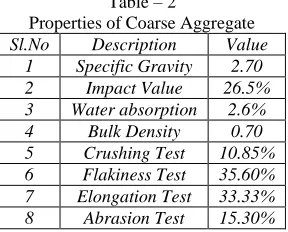
Table – 2
Properties of Coarse Aggregate Sl.No Description Value
1 Specific Gravity 2.70 2 Impact Value 26.5% 3 Water absorption 2.6% 4 Bulk Density 0.70 5 Crushing Test 10.85% 6 Flakiness Test 35.60% 7 Elongation Test 33.33% 8 Abrasion Test 15.30%
Fine Aggregate:
Sand collected from nearby river is used for this project. The various properties of sand are tabulated in Table II. Table – 3
Properties of Fine Aggregate Sl.No Description Value
1 Specific Gravity 2.62 2 Bulk Density 0.78 3 Sieve analysis Zone iii
Glass Powder:
Glass is one of the waste material waste glass can be also be producted from empty glass bottle and pots ,and come in several district color containing common liquid and other substance.
Table – 5
Physical Properties of Glass Powder Sl.No Description Value
Water:
Water is the important ingredient of concrete as it actively participates in the chemical reaction with cement. Potable water with pH value 7 is used for mixing and curing throughout the experiment.
III. EXPERIMENTAL INVESTICATION
Mix Proportioning
The grade of concrete M30 is used further proportion of 1:0.93:2.46 respectively. Characteristic compressive strength required at the end of 28 days is 30 N/mm2
Slump Cone Test
To determine consistency of concrete, Slump test was conducted with varying water content and a particular w/c is fixed according to the slump of 85mm from graph plotted. The various w/c for different proportions of cement with corn cob ash and coarse aggregate with steel slag.
Casting of Specimen
As the aggregate of size less than 20 mm and greater than 12.5 mm are used, cubes mould of 150x150x150 mm are used. Cylindrical mould of size 150 mm diameter and 300 mm height and beam mould of size 500x100x100mm are used for casting specimen.
Production of Concrete;
Cube Moulds, Cylindrical mould and beam mould of were used. They were lubricated with engine oil in order to reduce friction and to enhance removal of cubes from the moulds. They were then filled with concrete in three layers and each layer was tamped 25 times. The moulds containing the cubes were left for 24 hours under a room temperature for the cubes to set before removing the mould. The cubes were removed after 24 hours and were taken to curing tank
Curing of Cubes;
The method use for curing in this work is the total immersion of the cubes in water for specific age of 7, 14, and 28 days from the day of casting.
Compressive Strength Test
The compressive strength of concrete is one of the most important properties of concrete. Comparative strength if M30 grade of concrete for the partially replacement of fine aggregate by glass powder and palm kernel shell fiber was found. In this test 150x150x150mm concrete cubes were cast, by using 30 N/mm2concrete. The mixing was done by cubes were remolded and placed under water and cured for 28 days. Then the cubes were tested for their crushing strength at 7, 14 and 28 days.
Split Tensile Strength Test
The test is carried out in a cylindrical specimen of 150mm diameter and 300mm length. The cylindrical specimen is placed horizontally between the loading surface of a compression testing machine and the load is applied until failure of cylinder, along the vertical diameter.
Flexural Strength Test
Flexural strength is a measurement that indicates a material's resistance to deforming when it is placed under a load. The values needed to calculate flexural strength are measured by experimentation, with rectangular samples of the material placed under load in a Two-point testing setup.
Test on hardened concrete
IV. RESULT AND DISCUSSIONS
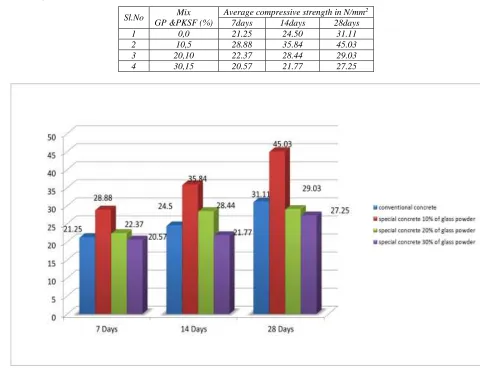
The Compressive Strength on Cubes
Sl.No Mix GP &PKSF (%)
Average compressive strength in N/mm2
7days 14days 28days
1 0,0 21.25 24.50 31.11
2 10,5 28.88 35.84 45.03
3 20,10 22.37 28.44 29.03
4 30,15 20.57 21.77 27.25
Fig. 1: Compressive Strength
The Split Tensile Strength on Cylinder
Sl. No Mix GP &PKSF (%)
Average Split Tensile strength in N/mm2
7days 14days 28days
1 0,0 2.54 2.87 3.55
2 10,5 2.35 2.87 3.32
3 20,10 1.72 2.19 2.61
Fig. 2: Split Tensile Strength
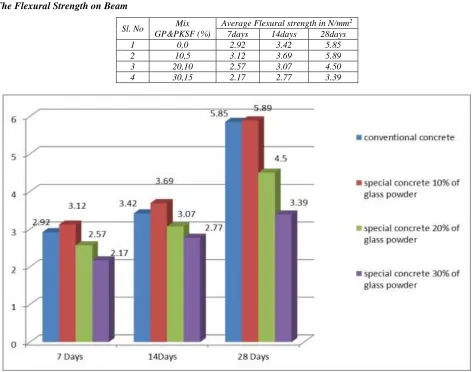
The Flexural Strength on Beam
Sl. No Mix GP&PKSF (%)
Average Flexural strength in N/mm2
7days 14days 28days
1 0,0 2.92 3.42 5.85
2 10,5 3.12 3.69 5.89
3 20,10 2.57 3.07 4.50
V. CONCLUSION
This project report summarizes the experimental behavior of glass powder concrete with addition of palm kernel shell as fibre. Slump gradually decreased with increase in glass percentage.
The various strength tests are conducted on concrete with replacement of 10%&5% replacement of glass powder and palm kernel shell fibre. It gives 10% increase in compressive strength, increased in tensile and increase in flexural strength when compared to conventional specimen.
From the tests result; we recommends that the concrete with replacement of 10%and 5% of glass powder and palm kernel shell fibre gives good result and may use in various structural element.
The replacement of glass powder and palm kernel shell leads to environmental and reduce the wastage [installation.
REFERENCES
[1] M.Adaway,Y.WangSchool of Engineering ,Deakin University,Waurn Ponds,Australia, “Recycled glass as a partial replacement for fine aggregate in structural concrete-Effects an compressive strength”
[2] Dr.G.Vijayakumar, Ms.H.Vishaliny, Dr.D.govindarajulu.Associateprofessor, professor, CivilEngg, Pandicherry Engineering college, pandicherry IndiaM.Th. student in civil engg,Pandicherry Engineering college,pandicherry india, “Studies on glass powder as partial replacement cement in concrete production”.
[3] M.Mageswari and Dr.B.Vidivelli. Research scholar structural engineering annamalai university. Annamalai nagar tamilnadu, India Professor of structural engineering annamalai university Annamalai nagar tamilnadu, India. “The use of sheet glass powder as fine aggregate replacement in concrete”.
[4] S.P.Gautam, Vikas Srivasdava and V.C.Agarwal, Civil Engineering department. SHIATS, Allahabad-211007,UP,India gautam. “Use of glass as fine aggregate in concrete”.
[5] M.S.Kuttimarks,R.Shruthi,Assistant professor (BE Student Department of Civil Engineering, Sree Sastha institute of Engineering and Tecnology, Chennai .) “Experimental studies on Replacement of fine aggregate with glass and fly ash”. Volume 2,issue 2,may 2014,PP205-208.
[6] Olowe K .O.,Adebayo V.B.1(Civil Engineering department,Afe Babalola university,Ado-Ekiti,Nigeria)2(Civil Engineering department,Afe Babalola university,Ado-Ekiti,Nigeria) “Investigation on palm kernel ash as partial cement replacement in high strength concrete”.SSRG Journal volume 2 issue 4 April 2015
[7] T.Subramani, A. Mumtaj,Professor and dean Civil Engineering department,VMKV Engg. College, vinayaka missionsuniversity, Salem, India PG Student of structural engineering.Civil Engineering department,VMKV Engg. College, vinayaka missionsuniversity, Salem, India. “Partial replacement of sand with glass fibre”. Volume4 , issue5 may 2015