A Review on Sybil Attack Detection Techniques
Jaydip Kamani Dhaval Parikh
PG Student Associate Professor
Department of Computer Engineering Department of Computer Engineering
L.D. College Of Engineering L.D. College Of Engineering
Abstract
In Vehicular Communication, the security system against the attacker is very important. Sybil attacks have been regarded as a serious security threat to ad hoc networks and sensor networks. It is an attack in which an original identity of the vehicle is corrupted or theft by an attacker to creates multiple fake identities. Detecting such type of attacker and the original vehicle is a challenging task in VANET. This survey paper briefly presents various Sybil attack detection mechanism in VANET.
Keywords: VANET, Security, Sybil Attack detection, Incorrect Safety Messages
_______________________________________________________________________________________________________
I.
I
NTRODUCTIONVehicular Ad-Hoc Network (VANET) is a special type of Mobile Ad-Hoc Network (MANET) with some unique characteristics like, high mobility, no power constraint, large scale, variable density etc. there is On Board Unit (OBU) to replace node in MANET and Road Side Unit (RSU) to provide infrastructure. VANETs are very dynamic in nature because connection between nodes is very short lived. It is designed for Vehicular to vehicular (V2V) and Vehicular to Infrastructure (V2I) communication [7]. Security in VANETs is important, because the message sent by one vehicle might have important consequences such as accident prevention. There are many possible attacks on VANETs; one of the harmful attacks is Sybil attack.
Fig. 1: VANET Architecture [8]
This paper presents literature survey for detecting Sybil attack in VANETs. The rest of the paper is divided as: Section II will briefly introduce Sybil attack, Section III will present the survey about Sybil attack in VANETs, and Section IV will present results. And last we will conclude the paper
Confidentiality: B.
This service provides the confidentiality to the communication content. It guarantees the privacy of drivers against unauthorized observers. The most popular technique pseudonyms are used to preserved privacy in vehicular networks.
Authentication: C.
Authentication is the verification of identity between vehicles and RSUs and the validation of integrity of the information exchange. Additionally, it ensures that all vehicles are the right vehicle to communicate within network.
Integrity: D.
Data integrity is the assurance that the data received by nodes, RSUs and AS is the same as what has been generated during the exchange of message. In order to protect the integrity of the message, digital signature which is integrated with password access is used.
Non-Repudiation: E.
ThisEnsures that sender and receiver cannot deny ever sending and receiving the message such as accident messages. In certain fields, non-repudiation is called audit ability where by RSUs and vehicles can prove have been receive and sent respectively. Some of the attacks are mentioned below [1].
Sybil Attack: 1)
In this attack sort, a node sends multiple messages to alternative nodes and every message contains a special Forged supply identity. The fundamental goals of the assaulter are to produce illusion to alternative nodes by wrong messages and to enforce alternative nodes on the road to go away the road for the advantages of the assaulter.
Black Hole Attack: 2)
In this problem a node refuses to participate in the network or when an established node drops out to form a black hole. In this all the traffic of the network gets redirected towards a specific node which is actually doesn’t exist which results in data lost.
ID Disclosure: 3)
It is a passive attack. During this attacker send the malicious code to the neighbors of the target node and collects the desired information. They take the ID of the target node and its current location. Due to this target vehicle’s ID are disclosed and that they lose their privacy. In this global observer will access their information by observance the route of the target vehicle
Man in the Middle Attack: 4)
The attacker sits in the middle of the two communicating vehicle and launch this attack. In this type of attacker control all the communication between the sender and the receiver but communicating vehicles assume they are directly communicating with each other. In MIMA attacker listen the communication between the vehicles and inject false or modified message between the vehicles.
Brute Force: 5)
Safety information is crucial in VANET. For secure VANET application as appropriate cryptographic algorithms and approaches. The attacker can use the brute force technique to find the cryptographic key.
Denial of Service (DOS) Attack: 6)
In DOS the most objective is to prevent the legitimate user from accessing the network services and from network resources. DOS attack will occur by jam the channel system so no authentic vehicle will access it. In VANET it's most major problem because the user cannot communicate within the network and pass data to other vehicle that could result in a lot of devastation in life important application.
Sybil Attack; 7)
Sybil attack is a kind of impersonation, where multiple identities of the attacker node are present. Fig. 2 shows the Sybil nodes assuming multiple personalities of the attacker node.
In Sybil attack, a malicious node forges different identities in the form of different nodes.
This forge gives wrong information to neighboring vehicles by communicating with other physical nodes and distributing false traffic information.
Fig. 2: Sybil Attack [6]
Sybil attacks can incur great security threats to VANETs. First, Sybil nodes may create an illusion of traffic jam. A driver may convince the neighboring vehicles that there is traffic jam ahead, so that they will choose alternate path and allow the driver a clear path to his/her destination. Second, Sybil nodes may directly or indirectly inject false data into the networks, greatly impacting on the data consistency of the system. For example, while voting to generate a traffic status report, if some of the voters are Sybil vehicles, the report may wrong. Finally, Sybil nodes may originate further DoS attacks such as channel jamming attacks and message suppression attacks.
III.
L
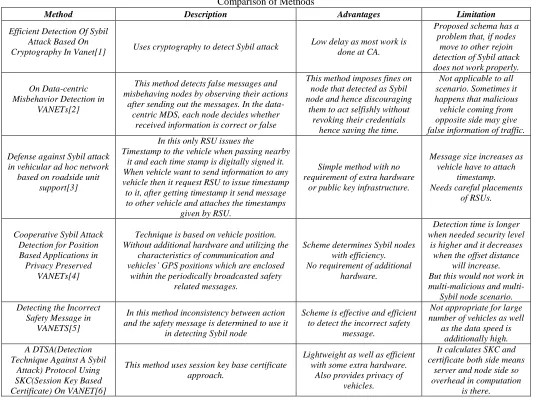
ITERATURE REVIEW SYBIL ATTACKIn 2011, Mina Rahbari et al., [1] proposed a Sybil attack detection method using cryptographic system. This method is based on a fixed key infrastructure for detection impersonation attack, in other words, Sybil attack. Using a Mat lab simulator the results of this study are reviewed. The method has low delay for detection Sybil attack, because most operations are done in Certification Authority, so this proposed scheme is an efficient method for detection Sybil attack. This proposed schema has a problem that, if nodes move to other rejoin detection of Sybil attack does not work properly.
In 2011, Sushmita Ruj et al., [2] introduced the concept of data-centric Misbehavior Detection Schemes (MDS) to detect false messages and misbehaving nodes by observing their actions after sending out the messages. In the data-centric MDS, each node decides whether received information is correct or false. The decision is based on the consistency of recent messages. Voting or majority decisions are not needed, that makes MDS resilient to identify Sybil attacks. Once misbehavior is detected, Instead of revoking all the secret ID of misbehaving nodes it imposes fines on misbehaving nodes and hence discouraging them to act selfishly. The results showed that the scheme reduced the computation and communication costs that were involved in revoking all the secret ID of misbehaving nodes.
S. Park et al. [3] suggested new timestamp series approach based on road side unit support. This approach doesn’t require special infrastructure, and it also not require public key infrastructure. it is rare that two vehicles passes multiple RSUs at exactly the same time, based on this assumption and temporary relation between vehicles and RSU, two messages with same timestamp series by same RSU will be considered as a Sybil messages by one vehicle. This approach neither needs vehicular-based public-key infrastructure (VPKI) nor Internet accessible RSUs, so it is economical solution for the VANETs. Disadvantages of this approach are: it requires to a precise deployment of RSUs in urban areas and traffic messages are gradually extended and this increases time of message authentication.
Yong Hao et al. [4] presented a new scheme. This scheme determines Sybil attacks regionally in a very cooperative means by examining the rationality of vehicles' position to their own neighbors. This technique is based on vehicle position in privacy preserved VANETs. Without additional hardware and utilizing the characteristics of communication and vehicles’ GPS positions which square measure enclosed within the periodically broadcasted safety related messages this scheme determines Sybil nodes with efficiency. Simulation result shows that detection time is longer when needed security level is higher and it decreases when the offset distance will increase. But this would not work in multi-malicious and multi-Sybil node scenario.
certificate for the detection of a Sybil Attack and the verification time for ID. This method additionally reduces detection and verification time as a result of hashing and XOR function. User’s privacy is additionally protected. Disadvantage is that it calculates SKC and certificate both side means server and node side so overhead in computation is there.
IV.
R
ESULTTable 1 gives summury of survey.
Table - 1 Comparison of Methods
Method Description Advantages Limitation
Efficient Detection Of Sybil Attack Based On
Cryptography In Vanet[1] Uses cryptography to detect Sybil attack
Low delay as most work is done at CA.
Proposed schema has a problem that, if nodes
move to other rejoin detection of Sybil attack does not work properly.
On Data-centric Misbehavior Detection in
VANETs[2]
This method detects false messages and misbehaving nodes by observing their actions
after sending out the messages. In the data-centric MDS, each node decides whether
received information is correct or false
This method imposes fines on node that detected as Sybil node and hence discouraging
them to act selfishly without revoking their credentials
hence saving the time.
Not applicable to all scenario. Sometimes it happens that malicious
vehicle coming from opposite side may give false information of traffic.
Defense against Sybil attack in vehicular ad hoc network
based on roadside unit support[3]
In this only RSU issues the
Timestamp to the vehicle when passing nearby it and each time stamp is digitally signed it. When vehicle want to send information to any vehicle then it request RSU to issue timestamp to it, after getting timestamp it send message to other vehicle and attaches the timestamps
given by RSU.
Simple method with no requirement of extra hardware
or public key infrastructure.
Message size increases as vehicle have to attach
timestamp. Needs careful placements
of RSUs.
Cooperative Sybil Attack Detection for Position Based Applications in Privacy Preserved
VANETs[4]
Technique is based on vehicle position. Without additional hardware and utilizing the
characteristics of communication and vehicles’ GPS positions which are enclosed
within the periodically broadcasted safety related messages.
Scheme determines Sybil nodes with efficiency. No requirement of additional
hardware.
Detection time is longer when needed security level
is higher and it decreases when the offset distance
will increase. But this would not work in malicious and
multi-Sybil node scenario. Detecting the Incorrect
Safety Message in VANETS[5]
In this method inconsistency between action and the safety message is determined to use it
in detecting Sybil node
Scheme is effective and efficient to detect the incorrect safety
message.
Not appropriate for large number of vehicles as well
as the data speed is additionally high. A DTSA(Detection
Technique Against A Sybil Attack) Protocol Using SKC(Session Key Based Certificate) On VANET[6]
This method uses session key base certificate approach.
Lightweight as well as efficient with some extra hardware.
Also provides privacy of vehicles.
It calculates SKC and certificate both side means
server and node side so overhead in computation
is there.
V.
C
ONCLUSIONR
EFERENCES[1] Mina Rahbari1 and Mohammad Ali Jabreil Jamali, “Efficient Detection of Sybil Attack Based On Cryptography in Vanet”, International Journal of Network Security & Its Applications (IJNSA), Vol.3, No.6, November 2011.
[2] Sushmita Ruj, Marcos Antonio Cavenaghi, Zhen Huang, Amiya Nayak, “On Data-centric Misbehavior Detection in VANETs”, International journal of Network Security& its applications, 2011
[3] Soyoung Park, Baber Aslam ,“Defense against Sybil attack in vehicular ad hoc network based on roadside unit support”, Embedded Security In Cars Conference(ESCAR), 2009
[4] Yong Hao, Jin Tang, Yu Cheng, “Cooperative Sybil Attack Detection for Position Based Applications in Privacy Preserved VANETs”, IEEE Globecom 2011 proceeding.
[5] Huibin Xu, Limin Hua, Yumei Ning and Xiaoping Xue, “Detecting the Incorrect Safety Message in VANETS”, Research Journal of Applied Sciences, Engineering and Technology 5(17): 4406-4410, ISSN: 2040-7459; e- ISSN: 2040-7467, 2013.
[6] ByungKawn Lee, “A DTSA(Detection Technique Against A Sybil Attack) Protocol Using SKC(Session Key Based Certificate) On VANET”, Electrical & Electronics Engg., Volume 3 , Issue 1; Spl. Issue of IC3T @ISSN: 2248-9584,201
[7] S. Swapna Kumar, "Vehicular Ad-hoc network" International Journal of Computer, Information, Systems and Control Engineering Vol:8 No:4, 2014 [8] Web-Site blog:
![Fig. 1: VANET Architecture [8] This paper presents literature survey for detecting Sybil attack in VANETs](https://thumb-us.123doks.com/thumbv2/123dok_us/7806169.1661586/1.612.60.557.355.557/vanet-architecture-presents-literature-survey-detecting-sybil-vanets.webp)
![Fig. 2: Sybil Attack [6] Sybil attacks can incur great security threats to VANETs. First, Sybil nodes may create an illusion of traffic jam](https://thumb-us.123doks.com/thumbv2/123dok_us/7806169.1661586/3.612.45.563.54.213/sybil-attack-attacks-security-threats-vanets-illusion-traffic.webp)